Fractals Unveiled
Exploring the Infinite Complexity of Nature and Mathematics
Have you ever wondered why snowflakes, coastlines, and tree branches seem to follow eerily similar patterns?
300 pages15 chaptersJan 12, 2025Math
About this book
Welcome to the captivating realm of fractal geometry, where infinity meets intricate detail. In "Fractals Unveiled," you'll discover how these mesmerizing mathematical structures permeate our world, from the microscopic to the cosmic scale. This book peels back the layers of complexity to reveal the elegant simplicity at the heart of fractals. You'll gain a deep understanding of how fractals bridge the gap between pure mathematics and the natural world, opening your eyes to patterns you've always seen but never fully appreciated. From the basics of fractal construction to cutting-edge applications in computer graphics, data compression, and even financial modeling, this book equips you with the knowledge to see the world through a fractal lens. Prepare to be amazed as you uncover the hidden order in chaos and learn how fractals are revolutionizing our understanding of nature, art, and technology.
Table of contents
- IntroductionWhat Are Fractals?, A Brief History of Fractal Geometry, Book OverviewRead below
- Chapter 1: Foundations of Fractal GeometrySelf-Similarity: The Core of Fractals, Iteration and Recursive Processes, Scaling and Infinite Detail, Euclidean Geometry vs. Fractal Geometry
- Chapter 2: Classic Fractal ShapesThe Cantor Set, The Koch Snowflake, The Sierpinski Triangle, The Menger Sponge
- Chapter 3: The Mandelbrot SetDiscovery and Significance, Complex Numbers and the Mandelbrot Equation, Generating the Mandelbrot Set, Exploring the Mandelbrot Set
- Chapter 4: Julia SetsIntroduction to Julia Sets, Relationship to the Mandelbrot Set, Generating Julia Sets, Filled Julia Sets and Their Properties
- Chapter 5: Fractal DimensionThe Concept of Dimension, Hausdorff Dimension, Box-Counting Dimension, Calculating Fractal Dimensions
- Chapter 6: Iterated Function SystemsBasics of Iterated Function Systems, Affine Transformations, The Chaos Game, Examples of IFS Fractals
- Chapter 7: L-Systems and Fractal PlantsIntroduction to L-Systems, Turtle Graphics, Modeling Plants with L-Systems, Advanced L-System Techniques
- Chapter 8: Random FractalsBrownian Motion and Fractional Brownian Motion, Percolation Clusters, Diffusion-Limited Aggregation, Fractal Landscapes
- Chapter 9: Fractals in NatureCoastlines and Mountains, Trees and Plants, Clouds and Galaxies, Fractals in the Human Body
- Chapter 10: Fractals and Chaos TheoryIntroduction to Chaos Theory, Strange Attractors, The Lorenz System, The Connection Between Chaos and Fractals
- Chapter 11: Fractals in Computer GraphicsFractal Rendering Techniques, Terrain Generation, Texture Synthesis, Special Effects in Movies and Games
- Chapter 12: Fractals in Data CompressionBasics of Fractal Compression, Fractal Image Compression, Fractal Audio Compression, Limitations and Future Prospects
- Chapter 13: Fractals in Antenna DesignIntroduction to Fractal Antennas, Multiband and Wideband Antennas, Miniaturization of Antennas, Examples of Fractal Antennas
- Chapter 14: Fractals in Art and MusicFractal Art and Digital Imagery, Fractal-Based Music Composition, Fractals in Architecture, The Aesthetics of Natural Fractals
- Chapter 15: The Future of Fractal GeometryEmerging Applications of Fractals, Quantum Fractals, Fractals in Network Science, Open Problems in Fractal Geometry
- ConclusionEmbracing a Fractal Worldview, Continuing Your Fractal Exploration
- Glossary
- Further Reading
Introduction
Welcome to the captivating world of fractal geometry, a realm where mathematics and nature intertwine in ways that challenge our perception of reality. As you embark on this journey through "Fractals Unveiled," you'll discover a universe of infinite complexity hidden within seemingly simple patterns. This introduction serves as your gateway to understanding the fundamental concepts of fractals, their historical context, and the transformative impact they've had on various fields of study. Prepare to have your mind expanded as we delve into the intricate beauty of these mathematical marvels that surround us in ways you may never have imagined.
Fractals represent a paradigm shift in how we perceive and describe the world around us. Unlike the smooth lines and perfect shapes of Euclidean geometry that dominated mathematical thinking for centuries, fractals embrace the rough, jagged, and infinitely detailed forms found abundantly in nature. From the branching patterns of trees and river systems to the intricate structures of snowflakes and coastlines, fractals provide a powerful framework for understanding and modeling the complexity of our universe. As you progress through this book, you'll gain the tools to recognize and appreciate these patterns, opening your eyes to a new way of seeing the world.
The study of fractals is not just an academic exercise; it has far-reaching implications and applications across numerous disciplines. In the pages that follow, you'll explore how fractal geometry has revolutionized fields as diverse as computer graphics, data compression, antenna design, and even financial modeling. You'll learn how artists and musicians harness the power of fractals to create stunning works that resonate with the inherent beauty of nature. Moreover, you'll discover how the principles of fractal geometry provide insights into chaos theory, offering a bridge between the deterministic world of classical physics and the unpredictable realm of complex systems.
What Are Fractals?
At their core, fractals are geometric shapes that exhibit an infinite level of detail and self-similarity across different scales. This means that as you zoom in on a fractal, you'll find patterns that resemble the whole, repeating endlessly. Imagine looking at a coastline from space, then flying closer to observe a bay, then walking along a rocky beach. At each level, you'd see similar jagged patterns, each echoing the larger structure. This property of self-similarity is the hallmark of fractals and sets them apart from the smooth shapes of traditional geometry.
The term "fractal" was coined by the mathematician Benoit Mandelbrot in 1975, derived from the Latin word "fractus," meaning broken or fractured. This name aptly describes the fragmented and irregular nature of these shapes. However, the concept of fractals extends far beyond mere visual curiosity. Fractals possess a property known as fractional dimension, which allows them to exist between the integer dimensions we're familiar with. For instance, a fractal coastline is more than a one-dimensional line but less than a two-dimensional plane, occupying a fractional dimension that reflects its complexity.
One of the most fascinating aspects of fractals is their ability to arise from simple mathematical rules applied repeatedly. This process, known as iteration, can generate incredibly complex structures from basic starting conditions. The Mandelbrot Set, perhaps the most famous fractal, emerges from a straightforward equation involving complex numbers. Yet, when this equation is iterated millions of times and visualized, it produces an infinitely intricate boundary that has captivated mathematicians and artists alike. This demonstrates a fundamental principle of fractals: complexity can arise from simplicity when simple rules are applied recursively.
Fractals challenge our intuition about the nature of space and dimension. In Euclidean geometry, dimensions are whole numbers: a line is one-dimensional, a plane is two-dimensional, and a cube is three-dimensional. Fractals, however, can have fractional dimensions that reflect their level of complexity and space-filling properties. The concept of fractal dimension provides a quantitative measure of the "roughness" or intricacy of a fractal shape. For example, the Koch snowflake, a classic fractal, has a dimension of approximately 1.26, indicating that it's more complex than a simple line but doesn't quite fill a two-dimensional plane.
The ubiquity of fractals in nature suggests that they are not merely mathematical curiosities but fundamental building blocks of our universe. From the branching patterns of blood vessels and neural networks to the distribution of galaxies in the cosmos, fractal structures appear to be nature's preferred method for organizing complex systems. This prevalence has led scientists to explore fractal principles in fields ranging from biology and physics to economics and urban planning. By understanding fractals, we gain insights into the underlying order of seemingly chaotic systems and the efficient ways nature solves problems of growth, distribution, and adaptation.
One of the most powerful aspects of fractals is their ability to model and describe natural phenomena that defy traditional geometric descriptions. Consider the problem of measuring a coastline, famously explored by Mandelbrot. As you use increasingly smaller units of measurement, you capture more detail, and the measured length increases. This "coastline paradox" demonstrates that natural boundaries often have fractal properties, with their measured length depending on the scale of observation. This concept has profound implications for how we understand and measure the natural world, challenging our notions of precision and scale.
Fractals also play a crucial role in understanding the behavior of complex systems. In chaos theory, strange attractors—the patterns that chaotic systems tend towards over time—often exhibit fractal properties. This connection between fractals and chaos provides a bridge between deterministic systems and the unpredictable behavior that can emerge from them. It suggests that underlying even the most turbulent and chaotic phenomena, there may be a form of order and structure, albeit one that defies simple description or prediction.
As you delve deeper into the world of fractals, you'll discover that they are not just mathematical constructs or natural curiosities, but powerful tools for problem-solving and innovation. In computer graphics, fractal algorithms generate realistic landscapes and textures. In telecommunications, fractal antennas provide efficient multi-band capabilities in compact designs. In medicine, fractal analysis helps in diagnosing certain conditions by examining the fractal patterns in biological structures. These applications demonstrate the versatility and practical importance of fractal geometry in modern technology and research.
Understanding fractals requires a shift in perspective, an openness to seeing the world through a new lens. As you progress through this book, you'll develop this "fractal vision," learning to recognize the self-similar patterns and infinite complexity that surround us. This way of seeing extends beyond mathematics, influencing how we understand natural processes, approach problem-solving, and even perceive beauty. The study of fractals is, in many ways, a study of the fundamental patterns of creation and the hidden order within apparent chaos.
In the chapters that follow, we'll explore specific types of fractals, delve into the mathematics behind their creation, and examine their wide-ranging applications. You'll learn about classic fractals like the Sierpinski triangle and the Menger sponge, dive deep into the mesmerizing intricacies of the Mandelbrot and Julia sets, and discover how fractals are generated through iterated function systems and L-systems. Along the way, you'll gain the tools to create your own fractals, analyze natural phenomena through a fractal lens, and appreciate the profound impact of fractal geometry on our understanding of the universe.
A Brief History of Fractal Geometry
The history of fractal geometry is a fascinating journey that spans centuries, intertwining mathematical discovery with philosophical questions about the nature of infinity and the structure of the universe. While the term "fractal" and its formal study are relatively recent, the roots of fractal geometry can be traced back to the 17th century. This rich history reflects the gradual recognition of patterns and structures that defied classical geometric description, ultimately leading to a revolutionary new field of mathematics with far-reaching implications.
The earliest precursors to fractal geometry can be found in the work of philosophers and mathematicians grappling with concepts of infinity and self-similarity. In the 17th century, Gottfried Wilhelm Leibniz explored ideas of recursive self-similarity, pondering the philosophical implications of structures that could be infinitely divided while maintaining their overall form. These early musings laid the groundwork for later mathematical explorations, hinting at the existence of geometric objects that transcended traditional Euclidean descriptions[1].
The 19th century saw the emergence of mathematical constructs that would later be recognized as fractals, though at the time, they were often viewed as mathematical curiosities or "monster curves." In 1872, Karl Weierstrass presented a function that was continuous everywhere but differentiable nowhere—a concept that challenged the prevailing notions of smoothness and continuity in mathematics. This function, now known as the Weierstrass function, exhibits fractal-like properties and is considered one of the earliest examples of a fractal curve in mathematics.
Another significant milestone came in 1883 with Georg Cantor's introduction of the Cantor set. This set, created by repeatedly removing the middle third of a line segment, results in a dust-like collection of points with remarkable properties. The Cantor set is self-similar, has a fractional dimension, and is uncountably infinite—all characteristics that would later be recognized as hallmarks of fractal objects. Cantor's work was groundbreaking, pushing the boundaries of set theory and laying crucial foundations for the later development of fractal geometry.
The turn of the 20th century brought further developments that would prove crucial to the eventual formalization of fractal geometry. In 1904, Helge von Koch introduced what is now known as the Koch snowflake, a curve that is continuous everywhere but differentiable nowhere. This elegant construction, formed by repeatedly adding smaller triangles to the sides of an equilateral triangle, provided a visually striking example of an infinitely detailed shape with a finite area but infinite perimeter. The Koch snowflake became one of the most recognizable fractal shapes, illustrating key concepts of self-similarity and infinite complexity within a bounded form.
The early 20th century saw continued exploration of these unusual mathematical objects. In 1915, Wacław Sierpiński described the triangle that bears his name, another classic example of a self-similar fractal shape. The Sierpiński triangle, formed by repeatedly removing the central triangle from an equilateral triangle, demonstrates how a simple iterative process can generate a complex, infinitely detailed structure. These explorations, while fascinating to mathematicians, were often viewed as isolated curiosities rather than part of a cohesive field of study.
A pivotal moment in the history of fractal geometry came in 1918 with Gaston Julia's work on iterative functions in the complex plane. Julia studied the behavior of complex polynomial functions under iteration, discovering intricate sets of points that exhibited chaotic behavior. These sets, now known as Julia sets, are fundamental to fractal geometry and play a crucial role in understanding the dynamics of complex systems. However, the full significance of Julia's work would not be realized until decades later, with the advent of computer graphics allowing for the visualization of these complex mathematical objects.
The mid-20th century brought renewed interest in these mathematical oddities, driven in part by advancements in technology that allowed for more sophisticated analysis and visualization. In the 1960s, Benoit Mandelbrot began his groundbreaking work at IBM, applying computational power to explore and visualize complex mathematical structures. Mandelbrot's research into the statistical self-similarity of various natural and mathematical phenomena led him to recognize a unifying principle behind many of the "monstrous" shapes that had puzzled mathematicians for decades.
Mandelbrot's seminal moment came in 1975 when he coined the term "fractal" to describe these self-similar, infinitely complex shapes. His 1977 book, "Fractals: Form, Chance, and Dimension," followed by the more comprehensive "The Fractal Geometry of Nature" in 1982, introduced fractal geometry to a wider audience and established it as a distinct field of mathematical study. Mandelbrot's work unified previously disparate mathematical curiosities under a single framework and demonstrated the relevance of fractal geometry to understanding natural phenomena[2].
The introduction of the Mandelbrot set in 1980 marked a watershed moment in the history of fractal geometry. This set, generated by a simple iterative process in the complex plane, produced images of astounding complexity and beauty. The visual appeal of the Mandelbrot set, combined with its deep mathematical properties, captured the imagination of both mathematicians and the general public. It became an icon of fractal geometry and chaos theory, spurring further research and popularizing the field.
The last decades of the 20th century saw an explosion of interest in fractal geometry, fueled by advances in computer technology that allowed for increasingly detailed exploration and visualization of fractal structures. Researchers began to recognize fractal patterns in a wide array of natural phenomena, from the structure of coastlines and mountains to the branching of trees and blood vessels. This recognition led to applications of fractal geometry in fields as diverse as biology, physics, economics, and computer science.
The development of iterated function systems (IFS) by John Hutchinson in the 1980s provided a powerful new tool for generating and analyzing fractals. IFS allowed for the creation of complex fractal shapes through the repeated application of a set of affine transformations, opening up new avenues for both theoretical study and practical applications of fractals. This approach proved particularly useful in computer graphics and image compression algorithms.
As we moved into the 21st century, fractal geometry continued to evolve and find new applications. The field has expanded to include the study of random fractals, multifractals, and fractal analysis techniques. These developments have led to applications in fields such as finance, where fractal analysis is used to study market behavior, and in medical imaging, where fractal dimension can be used as a diagnostic tool for certain conditions.
Today, fractal geometry stands as a testament to the power of interdisciplinary thinking and the importance of challenging established paradigms. What began as a collection of mathematical curiosities has grown into a robust field with profound implications for how we understand and model the world around us. The history of fractal geometry reminds us that sometimes the most significant breakthroughs come from exploring the edges of our knowledge, where apparent chaos gives way to hidden order and beauty.
Book Overview
"Fractals Unveiled: Exploring the Infinite Complexity of Nature and Mathematics" is designed to take you on a comprehensive journey through the fascinating world of fractal geometry. This book is structured to build your understanding progressively, starting from the fundamental concepts and moving towards more advanced topics and applications. Each chapter is crafted to provide a blend of theoretical knowledge, practical insights, and real-world examples, ensuring that you not only grasp the mathematical principles but also appreciate their relevance and impact across various fields.
The book begins with this introduction, which you're currently reading, setting the stage for your exploration of fractals. Here, we've introduced the basic concept of fractals, touched on their historical development, and provided an overview of what's to come. This foundation is crucial for understanding the context and significance of the material that follows. As you progress through the subsequent chapters, you'll find that each builds upon the knowledge gained in the previous ones, creating a coherent and comprehensive understanding of fractal geometry.
Chapter 1, "Foundations of Fractal Geometry," delves into the core principles that define fractals. You'll explore the concept of self-similarity in depth, understanding how patterns repeat at different scales within a fractal structure. The chapter also covers iteration and recursive processes, which are fundamental to fractal generation. You'll learn about scaling and infinite detail, key characteristics that set fractals apart from traditional geometric shapes. Finally, this chapter will contrast Euclidean geometry with fractal geometry, highlighting the paradigm shift that fractals represent in mathematical thinking.
In Chapter 2, "Classic Fractal Shapes," you'll be introduced to some of the most well-known and historically significant fractals. This includes the Cantor Set, an early example of a fractal that demonstrates how a simple process can create a complex structure. You'll explore the Koch Snowflake, one of the first fractals to be described mathematically, and the Sierpinski Triangle, which beautifully illustrates the principle of self-similarity. The chapter concludes with an examination of the Menger Sponge, a three-dimensional fractal that challenges our perception of space and volume.
Chapter 3 is dedicated entirely to "The Mandelbrot Set," arguably the most famous fractal of all. You'll learn about its discovery and significance, delve into the complex numbers and equations that generate it, and explore techniques for creating and visualizing the Mandelbrot Set. This chapter will also guide you through the intricate details and patterns within the set, revealing the infinite complexity that has captivated mathematicians and artists alike.
Building on the Mandelbrot Set, Chapter 4 explores "Julia Sets," closely related fractals that offer a wealth of beautiful and mathematically significant structures. You'll learn how Julia Sets relate to the Mandelbrot Set, how to generate them, and the properties of filled Julia Sets. This chapter will deepen your understanding of complex dynamics and the interplay between different types of fractals.
Chapter 5 tackles the crucial concept of "Fractal Dimension," which provides a quantitative measure of a fractal's complexity. You'll explore different approaches to defining and calculating fractal dimension, including the Hausdorff dimension and box-counting methods. This chapter will equip you with the tools to analyze and compare different fractal structures mathematically.
In Chapter 6, "Iterated Function Systems," you'll learn about a powerful method for generating and analyzing fractals. This chapter covers the basics of IFS, affine transformations, and the fascinating "Chaos Game" algorithm. You'll see how relatively simple sets of functions can create complex and beautiful fractal shapes, opening up new possibilities for fractal creation and analysis.
Chapter 7 introduces "L-Systems and Fractal Plants," exploring how simple rule-based systems can generate complex, plant-like structures. You'll learn about turtle graphics, a method for visualizing L-Systems, and see how these systems can be used to model realistic plant growth and structures. This chapter bridges the gap between abstract mathematical fractals and the natural world.
Chapter 8 delves into "Random Fractals," introducing stochastic processes that generate fractal-like structures. You'll explore Brownian motion, percolation clusters, diffusion-limited aggregation, and techniques for creating fractal landscapes. This chapter highlights how randomness and fractals intertwine to create structures that closely mimic natural phenomena.
In Chapter 9, "Fractals in Nature," you'll see how the principles you've learned apply to the world around us. From coastlines and mountains to trees, clouds, and even structures within the human body, this chapter reveals the ubiquity of fractal patterns in nature. You'll gain a new appreciation for the complexity and efficiency of natural forms and processes.
Chapter 10 explores the connection between "Fractals and Chaos Theory," introducing concepts like strange attractors and the Lorenz system. This chapter will help you understand how fractals provide insights into chaotic systems and the delicate balance between order and randomness in complex phenomena.
The final chapters of the book focus on practical applications of fractal geometry. Chapter 11 covers "Fractals in Computer Graphics," showing how fractal algorithms are used to create realistic textures, terrains, and special effects in movies and games. Chapter 12 explores "Fractals in Data Compression," revealing how fractal properties can be leveraged to efficiently store and transmit information. Chapter 13 delves into "Fractals in Antenna Design," demonstrating how fractal geometries are revolutionizing telecommunications technology.
Chapter 14, "Fractals in Art and Music," showcases the creative applications of fractal geometry. You'll explore how artists and musicians use fractal principles to create works that resonate with the inherent beauty of nature. This chapter also touches on fractals in architecture and the aesthetic appeal of natural fractal forms.
The book concludes with Chapter 15, "The Future of Fractal Geometry," which looks ahead to emerging applications and open problems in the field. This chapter will inspire you to consider how fractal concepts might continue to shape our understanding of the world and drive innovation across various disciplines.
Throughout the book, you'll find numerous illustrations, examples, and exercises to reinforce your understanding. Code snippets and algorithmic descriptions are provided where relevant, allowing you to experiment with fractal generation and analysis on your own. By the end of "Fractals Unveiled," you'll have gained not just knowledge, but a new way of seeing and understanding the world around you, appreciating the infinite complexity that can arise from simple rules and the hidden order within apparent chaos.
This is the end of the free sample. The full book has 15 chapters.
Want this book written for you?
Tell us your goals and background, and get your own version of this book, tailored by AI to you.


Benefits of AI-tailored books
- Read one book, not ten:
- all the Math knowledge you need, gathered into a single book.
- Save days of learning:
- tell us your goals, choose your topics, and the whole book is built around them.
- Learn effortlessly:
- Math book written for your specific background and expertise.
- Understand at a glance:
- includes charts, tables, timelines, checklists, decision trees, and more.
- Stay current:
- written the day you order it, not years ago.
- Trust what you read:
- every book is checked for accuracy, with real research when your subject needs it.
Create your unique book in 3 steps
- 1. Select your focus
Select the focus of your Math book and share your background
- 2. Personalize your book
Specify your goals and choose sub-topics to include
- 3. Get your tailored book
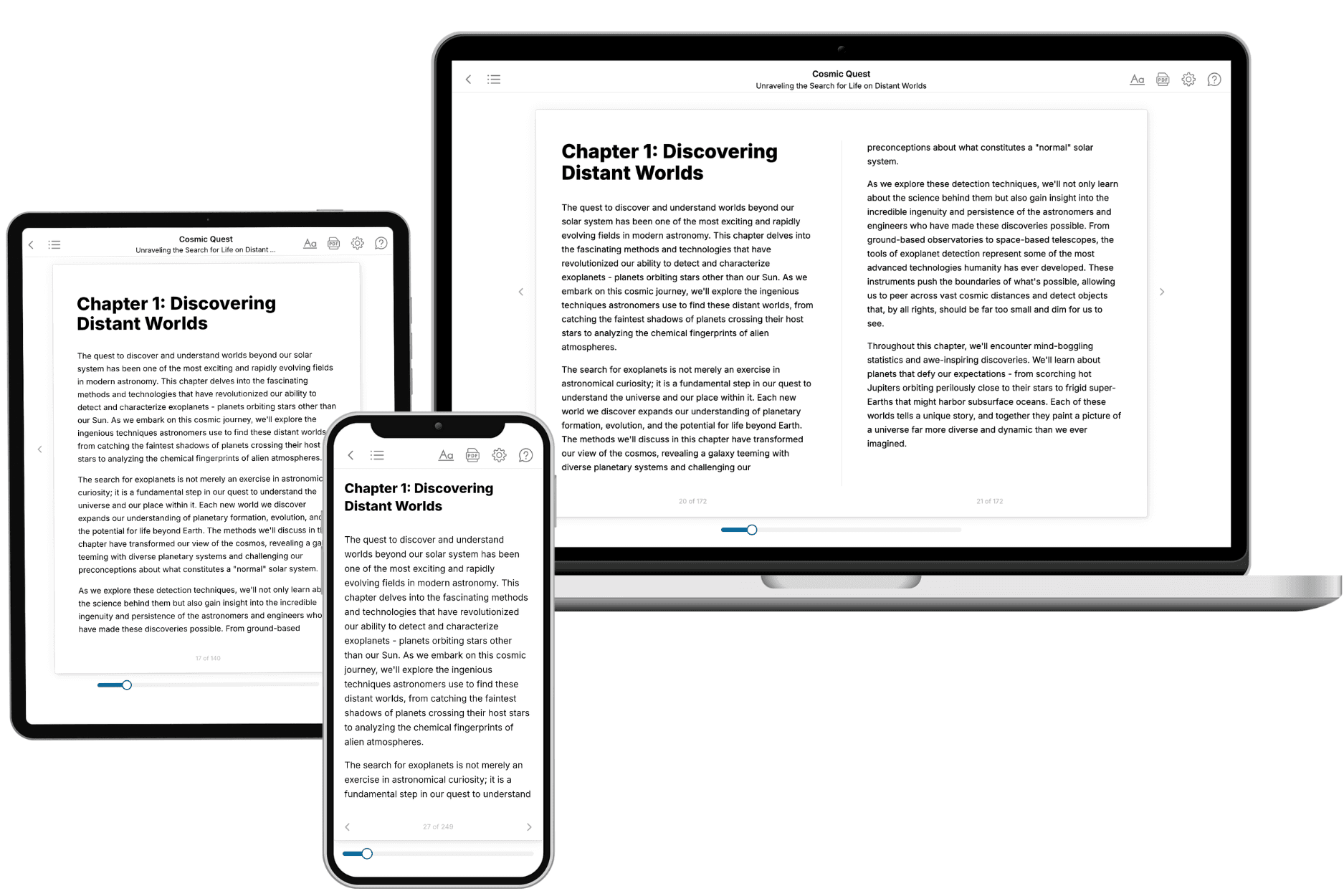
Your book is ready in 10 minutes. Read it online, download as EPUB or PDF, or send to Kindle.
Frequently asked questions
- What is TailoredRead?
TailoredRead creates complete, full-length nonfiction ebooks, written specifically for you. Tell us what you want to learn and why, and TailoredRead writes you a complete ebook on it, with charts, tables, and diagrams throughout. Read it online, on Kindle, or on any e-reader, or download it as a PDF or EPUB. Every book is written fresh the day you order it.
- How is the book tailored to me?
Before anything is written, you answer a few short questions about your goals, your background, and the topics you care about. Your book is then planned around your answers: written at your level, focused on your goals, and covering the topics you chose, instead of the one-size-fits-all book a store sells everyone.
- Will it read like generic AI content?
No. Your book isn't a chat transcript: it's planned chapter by chapter before a single word is written, told in a clear book voice, and explains ideas visually with charts, tables, and diagrams. After writing, every book goes through an editorial pass that polishes chapters so the book reads consistent from start to finish. Judge for yourself: browse thousands of sample books on our Explore Books page.
- How accurate is the content?
Our AI first checks whether your subject needs live research. Niche and fast-moving subjects are researched before writing, and the book plan and chapters are grounded in what it finds. After writing, every book goes through a quality pass that checks its facts and consistency, and researched books list their sources in a Notes section at the back.
- How long is the book?
You choose the length: Comprehensive (250-300 pages), Detailed (150-200 pages), Essential (70-100 pages), or Short (30-50 pages).
- Does the book include visuals?
Yes. Every book includes charts, tables, and diagrams: timelines, checklists, step-by-step guides, decision trees, comparison tables, matrices, and bar charts. A typical book includes dozens of these visual elements.
- Can I read it on Kindle? What formats can I download?
Yes. Every book can be read in our online reader or downloaded as a PDF or EPUB. The EPUB can be opened with Kindle, Apple Books, Kobo, and any e-reader. The Commercial and Author licenses also include an editable Word (DOCX) and Markdown download.
- How much does it cost?
About the price of a regular ebook. The exact price depends on your book's length and complexity, from $2 for the shortest books to $35 for the most comprehensive, and it's shown when you review your book, before you commit to anything. Each book is a one-time purchase, yours to keep, no subscription. Licenses that let you share, teach, or publish your book range from $35.99 to $49.99.
- Can I preview the book before purchasing?
Before you pay, you'll see what your book will cover: the title, a detailed description, the estimated length, and the complete chapter-by-chapter table of contents, so you know what you're getting before you decide. The full text itself is written after you purchase.
- How long does it take to create a book?
About 10 minutes. You can start reading the opening chapters while the rest is still being written.