Mastering ANOVA Assumptions
A Practical Guide to Robust Statistical Analysis
Are you confident that your ANOVA results are truly valid?
269 pages13 chaptersJan 17, 2025Statistical Analysis
About this book
In the world of statistical analysis, the Analysis of Variance (ANOVA) is a powerful tool, but its effectiveness hinges on meeting certain critical assumptions. "Mastering ANOVA Assumptions: A Practical Guide to Robust Statistical Analysis" is your comprehensive companion in navigating these often-misunderstood prerequisites. This book demystifies the complex world of ANOVA assumptions, breaking them down into easily digestible concepts. You'll gain a deep understanding of each assumption, learn how to test for violations, and discover practical strategies to address any issues that arise. From normality and homogeneity of variances to independence of observations, you'll explore each assumption in detail, supported by real-world examples and case studies. But this book goes beyond mere theory. You'll find hands-on techniques for data preparation, assumption testing, and interpreting results. With a focus on practical application, you'll learn how to make informed decisions about your analysis approach, ensuring your research stands up to rigorous scrutiny. Whether you're a graduate student embarking on your first major research project or an experienced researcher looking to refine your statistical skills, this book will elevate your understanding of ANOVA and empower you to conduct more robust, reliable analyses. Don't let violated assumptions undermine your research - equip yourself with the knowledge to master ANOVA assumptions and take your statistical analysis to the next level.
Table of contents
- IntroductionOverview of Analysis of Variance (ANOVA), The Importance of ANOVA Assumptions, Structure of the Book, How to Use This BookRead below
- Chapter 1: Foundations of ANOVAThe Purpose and Applications of ANOVA, Types of ANOVA: One-way, Two-way, and Beyond, Understanding the F-Distribution, Hypothesis Testing in ANOVA
- Chapter 2: Overview of ANOVA AssumptionsThe Four Main ANOVA Assumptions, Why Assumptions Matter, Interplay Between Assumptions, Robustness of ANOVA to Assumption Violations
- Chapter 3: The Normality AssumptionUnderstanding Normality in ANOVA, Tests for Normality, Visualizing Normality, Consequences of Normality Violations, Addressing Normality Issues
- Chapter 4: Homogeneity of VariancesThe Concept of Homogeneity of Variances, Testing for Homogeneity of Variances, Visualizing Variance Homogeneity, Effects of Heteroscedasticity on ANOVA, Dealing with Unequal Variances
- Chapter 5: Independence of ObservationsUnderstanding Independence in ANOVA, Assessing Independence, Consequences of Dependent Observations, Strategies for Ensuring Independence
- Chapter 6: Absence of OutliersDefining Outliers in ANOVA, Methods for Detecting Outliers, Impact of Outliers on ANOVA Results, Treating Outliers: Remove, Transform, or Keep?
- Chapter 7: Data Preparation for ANOVAData Cleaning and Preprocessing, Selecting Appropriate Variables, Data Transformations for Meeting Assumptions, Sample Size Considerations
- Chapter 8: Testing ANOVA AssumptionsStatistical Tests for Assumptions, Graphical Methods for Assumption Checking, Software Tools for Assumption Testing, Interpreting Assumption Test Results
- Chapter 9: Consequences of Assumption ViolationsImpact on Type I Error Rate, Effects on Statistical Power, Influence on Effect Size Estimation, Issues in Result Interpretation
- Chapter 10: Addressing Assumption ViolationsUsing Data Transformations, Robust ANOVA Methods, Nonparametric Alternatives to ANOVA, Bootstrapping Techniques
- Chapter 11: Real-World Applications of ANOVAANOVA in Psychology Research, Applications in Biological Studies, ANOVA in Engineering Experiments, Use in Social Sciences
- Chapter 12: Advanced ANOVA TechniquesRepeated Measures ANOVA, Analysis of Covariance (ANCOVA), Multivariate ANOVA (MANOVA), Mixed Models and Their Assumptions
- Chapter 13: Future Directions in ANOVA ResearchBayesian Approaches to ANOVA, Machine Learning and ANOVA, ANOVA in the Age of Big Data, Emerging Techniques for Assumption Handling
- ConclusionKey Takeaways, Best Practices for ANOVA, Future Outlook for ANOVA
- Glossary
- Further Reading
Introduction
Welcome to "Mastering ANOVA Assumptions: A Practical Guide to Robust Statistical Analysis." This book is designed to be your comprehensive companion in navigating the often-misunderstood world of Analysis of Variance (ANOVA) assumptions. As a graduate student or early-career researcher with intermediate knowledge of statistics, you are likely familiar with the power and versatility of ANOVA in your field. However, you may have encountered challenges or uncertainties when it comes to ensuring the validity of your ANOVA results. This introduction will set the stage for your journey towards mastering ANOVA assumptions, providing you with a solid foundation for conducting more robust and reliable statistical analyses in your research endeavors.
Throughout this book, you will gain a deep understanding of each ANOVA assumption, learn how to test for violations, and discover practical strategies to address any issues that arise. From normality and homogeneity of variances to independence of observations and the absence of outliers, you will explore each assumption in detail, supported by real-world examples and case studies. This book goes beyond mere theory, offering hands-on techniques for data preparation, assumption testing, and interpreting results. With a focus on practical application, you will learn how to make informed decisions about your analysis approach, ensuring your research stands up to rigorous scrutiny.
The importance of understanding and meeting ANOVA assumptions cannot be overstated. These assumptions form the foundation upon which the validity of your statistical inferences rests. By mastering these concepts, you will be better equipped to design robust studies, analyze data with confidence, and draw meaningful conclusions from your research. Whether you are working in psychology, biology, engineering, or any other field that employs ANOVA, the knowledge and skills you gain from this book will be invaluable in elevating the quality and reliability of your statistical analyses.
As we embark on this journey together, remember that mastering ANOVA assumptions is not just about avoiding statistical pitfalls. It's about developing a deeper, more nuanced understanding of your data and the statistical tools at your disposal. This knowledge will empower you to make more informed decisions throughout your research process, from study design to data collection, analysis, and interpretation. By the end of this book, you will have the confidence and expertise to tackle complex statistical challenges, ensuring that your research contributions are built on a solid foundation of robust statistical practice.
Overview of Analysis of Variance (ANOVA)
Analysis of Variance, commonly known as ANOVA, is a powerful statistical technique used to compare means across multiple groups or conditions. Developed by statistician Ronald Fisher in the 1920s, ANOVA has become an indispensable tool in various fields of research, including psychology, biology, medicine, engineering, and social sciences. At its core, ANOVA is designed to test whether there are statistically significant differences between the means of two or more independent groups, allowing researchers to investigate the impact of one or more factors on a dependent variable.
The fundamental principle behind ANOVA is the partitioning of total variance in a dataset into different sources. By comparing the variance between groups (explained variance) to the variance within groups (unexplained variance or error variance), ANOVA provides a way to determine whether the differences observed between groups are statistically significant or merely due to chance. This comparison is quantified through the F-statistic, which forms the basis for hypothesis testing in ANOVA.
One of the key strengths of ANOVA is its versatility. There are several types of ANOVA, each suited to different research designs and questions. The most basic form is one-way ANOVA, which examines the effect of a single independent variable on a continuous dependent variable. Two-way ANOVA extends this concept by allowing the investigation of two independent variables simultaneously, including their potential interaction effects. More complex designs, such as factorial ANOVA, repeated measures ANOVA, and mixed-design ANOVA, provide researchers with tools to address a wide range of experimental setups and research questions.
ANOVA's power lies in its ability to handle multiple group comparisons efficiently. Unlike t-tests, which become cumbersome and increase the risk of Type I errors when comparing multiple groups, ANOVA provides a single, omnibus test to determine whether there are any significant differences among the groups. This approach controls the overall error rate and offers a more streamlined analysis process. If significant differences are found, post-hoc tests can then be employed to identify specific group differences.
In the context of research methodology, ANOVA plays a crucial role in experimental design and hypothesis testing. It allows researchers to systematically investigate cause-and-effect relationships by manipulating independent variables and observing their impact on dependent variables. This capability makes ANOVA an essential tool for testing theories, evaluating interventions, and exploring complex relationships in various scientific disciplines.
However, the power and flexibility of ANOVA come with important caveats. The validity and reliability of ANOVA results depend heavily on meeting certain statistical assumptions. These assumptions, which include normality of distribution, homogeneity of variances, independence of observations, and absence of outliers, form the cornerstone of ANOVA's theoretical foundation. Violating these assumptions can lead to inaccurate results, inflated Type I error rates, or reduced statistical power, potentially compromising the integrity of research findings.
Understanding these assumptions is not just a matter of statistical rigor; it's essential for conducting meaningful and reliable research. By mastering ANOVA assumptions, you gain the ability to critically evaluate the appropriateness of ANOVA for your specific research questions, assess the validity of your results, and make informed decisions about data preparation and analysis strategies. This knowledge empowers you to navigate the complexities of real-world data, where perfect adherence to assumptions is often challenging, and to employ appropriate techniques to address violations when they occur.
As we delve deeper into the world of ANOVA assumptions in the following chapters, you will gain a comprehensive understanding of each assumption's theoretical basis, practical implications, and methods for assessment and mitigation. This knowledge will not only enhance your ability to conduct robust statistical analyses but also deepen your overall understanding of statistical inference and research methodology. By the end of this book, you will be well-equipped to leverage the full power of ANOVA in your research endeavors, ensuring that your statistical analyses are both rigorous and meaningful.
The Importance of ANOVA Assumptions
The importance of ANOVA assumptions in statistical analysis cannot be overstated. These assumptions form the bedrock upon which the validity and reliability of ANOVA results are built. Understanding and meeting these assumptions is crucial for several reasons, each of which contributes to the overall integrity and credibility of your research findings. As you embark on your journey to master ANOVA assumptions, it's essential to grasp why these statistical prerequisites are so vital to the research process.
First and foremost, ANOVA assumptions ensure the accuracy and reliability of your statistical inferences. The mathematical framework of ANOVA is constructed based on certain conditions being met in your data. When these conditions (assumptions) are satisfied, you can trust that the p-values, confidence intervals, and effect sizes produced by your analysis are accurate representations of the underlying population parameters. This accuracy is crucial for drawing valid conclusions from your research and for the cumulative progress of scientific knowledge. Violating ANOVA assumptions can lead to biased or misleading results, potentially leading to Type I errors (false positives) or Type II errors (false negatives), which can have serious implications for theory development and practical applications in your field.
Secondly, adherence to ANOVA assumptions is essential for maintaining the statistical power of your analyses. Statistical power refers to the ability of a test to detect a true effect when it exists. When ANOVA assumptions are met, the test operates at its optimal power, maximizing your chances of detecting significant effects that truly exist in the population. Conversely, when assumptions are violated, the power of the test can be compromised, potentially leading to missed opportunities to identify important relationships or effects in your data. This is particularly crucial in fields where sample sizes are often limited due to practical or ethical constraints, as every bit of statistical power becomes valuable in these contexts.
Another critical aspect of ANOVA assumptions is their role in ensuring the comparability and generalizability of research findings. When assumptions are met, the results of your ANOVA can be more confidently compared to other studies in your field that have used similar methodologies. This comparability is crucial for the meta-analytic synthesis of research findings and for building a coherent body of knowledge in your discipline. Moreover, meeting ANOVA assumptions enhances the generalizability of your results, allowing for more confident extrapolation from your sample to the broader population of interest. This generalizability is a key goal of most research endeavors and is essential for the practical application of research findings.
Understanding ANOVA assumptions also plays a crucial role in the design phase of your research. By being aware of these assumptions, you can plan your study in a way that maximizes the likelihood of meeting them. This foresight can influence decisions about sampling strategies, measurement techniques, and experimental designs. For instance, knowing about the assumption of homogeneity of variances might lead you to employ more balanced designs or to consider potential sources of heteroscedasticity in your planning phase. This proactive approach can save considerable time and resources by reducing the need for complex post-hoc adjustments or alternative analyses.
Furthermore, a thorough understanding of ANOVA assumptions equips you with the tools to critically evaluate published research in your field. As you develop expertise in this area, you'll be better positioned to assess the methodological rigor of studies that employ ANOVA, identifying potential weaknesses or limitations in their analyses. This critical evaluation skill is invaluable for contributing to peer review processes, conducting literature reviews, and synthesizing research findings in your area of specialization.
It's important to note that while meeting ANOVA assumptions is crucial, real-world data often presents challenges in perfectly satisfying all assumptions. This reality underscores the importance of not just understanding the assumptions themselves, but also mastering techniques for assessing violations and strategies for addressing them. By developing this comprehensive skill set, you'll be prepared to handle the complexities of real data, making informed decisions about when to proceed with ANOVA, when to employ alternative techniques, and how to interpret results in light of any assumption violations.
Lastly, mastering ANOVA assumptions contributes to the overall advancement of statistical literacy in your field. As you become proficient in these concepts, you'll be better equipped to communicate the nuances of your statistical analyses to colleagues, in publications, and at conferences. This enhanced communication can lead to more robust discussions about methodology, fostering a culture of rigorous statistical practice within your research community.
In conclusion, the importance of ANOVA assumptions extends far beyond mere statistical technicalities. These assumptions are fundamental to conducting reliable, powerful, and generalizable research. By investing time and effort in mastering these concepts, you are not only enhancing the quality of your own research but also contributing to the overall integrity and progress of your field. As we delve deeper into each assumption in the following chapters, keep in mind that each concept you learn is a step towards becoming a more skilled, critical, and effective researcher.
Structure of the Book
"Mastering ANOVA Assumptions: A Practical Guide to Robust Statistical Analysis" is structured to provide you with a comprehensive and logical progression through the complex world of ANOVA assumptions. The book is designed to build your knowledge systematically, starting from foundational concepts and moving towards more advanced applications and considerations. This structure ensures that you can develop a deep understanding of each aspect of ANOVA assumptions, while also seeing how these elements fit together in the broader context of statistical analysis.
The book begins with this introduction, which sets the stage for your learning journey. Following this, Chapter 1 delves into the foundations of ANOVA, providing a robust overview of its purpose, applications, and fundamental concepts. This chapter serves as a refresher for those familiar with ANOVA and lays essential groundwork for those newer to the technique. You'll explore the various types of ANOVA, understand the F-distribution, and review the principles of hypothesis testing in the context of ANOVA. This foundational knowledge is crucial for fully grasping the importance and implications of ANOVA assumptions.
Chapter 2 provides an overview of ANOVA assumptions, introducing you to the four main assumptions: normality, homogeneity of variances, independence of observations, and absence of outliers. This chapter explains why these assumptions matter, how they interplay with each other, and discusses the concept of ANOVA's robustness to certain assumption violations. This overview sets the stage for the detailed exploration of each assumption in the subsequent chapters.
Chapters 3 through 6 form the core of the book, with each chapter dedicated to one of the four main ANOVA assumptions. Chapter 3 focuses on the normality assumption, Chapter 4 on homogeneity of variances, Chapter 5 on independence of observations, and Chapter 6 on the absence of outliers. Each of these chapters follows a similar structure: they begin by explaining the concept behind the assumption, discuss methods for testing the assumption, explore the consequences of violating the assumption, and provide strategies for addressing violations. This consistent structure allows you to develop a comprehensive understanding of each assumption and how to handle it in practice.
Chapter 7 shifts focus to the practical aspects of data preparation for ANOVA. This chapter covers essential topics such as data cleaning, variable selection, and data transformations that can help meet ANOVA assumptions. It also discusses important considerations regarding sample size, which can impact the robustness of ANOVA to assumption violations.
Building on the individual assumption chapters and data preparation knowledge, Chapter 8 provides a comprehensive guide to testing ANOVA assumptions. This chapter covers both statistical tests and graphical methods for assessing assumptions, discusses software tools that can aid in this process, and guides you through the interpretation of assumption test results.
Chapter 9 delves deeper into the consequences of assumption violations, exploring how these violations can impact Type I error rates, statistical power, effect size estimation, and result interpretation. This chapter helps you understand the practical implications of assumption violations on your research conclusions.
Chapter 10 is dedicated to addressing assumption violations, providing you with a toolkit of strategies including data transformations, robust ANOVA methods, nonparametric alternatives, and bootstrapping techniques. This chapter equips you with practical solutions for scenarios where ANOVA assumptions are not fully met.
To bridge theory with practice, Chapter 11 presents real-world applications of ANOVA across various fields, including psychology, biology, engineering, and social sciences. This chapter helps you see how ANOVA and its assumptions are handled in different research contexts, providing valuable insights for applying these concepts in your own field.
Chapter 12 introduces advanced ANOVA techniques, including repeated measures ANOVA, ANCOVA, MANOVA, and mixed models. This chapter extends your understanding of ANOVA assumptions to more complex analytical scenarios, preparing you for advanced research designs.
Looking towards the future, Chapter 13 explores emerging directions in ANOVA research, including Bayesian approaches, the intersection of ANOVA with machine learning, challenges posed by big data, and new techniques for handling assumptions. This chapter provides you with a glimpse into the evolving landscape of statistical analysis and how ANOVA fits into this broader context.
The book concludes with a summary of key takeaways, best practices for applying ANOVA, and a future outlook for ANOVA in research. Additional resources include a comprehensive glossary of terms and suggestions for further reading, allowing you to continue expanding your knowledge beyond the scope of this book.
Throughout the book, you'll find practical examples, case studies, and hands-on exercises that help reinforce the concepts presented. Code snippets and output interpretations are provided where relevant, giving you concrete tools to apply in your own analyses. By the end of the book, you'll have a comprehensive understanding of ANOVA assumptions, the skills to assess and address them, and the confidence to apply these concepts in your research endeavors.
How to Use This Book
"Mastering ANOVA Assumptions: A Practical Guide to Robust Statistical Analysis" is designed to be a comprehensive resource that can be approached in multiple ways, depending on your current level of expertise and specific learning goals. To get the most out of this book, consider the following strategies for engaging with the material effectively.
If you're new to ANOVA or need a refresher on the basics, it's recommended to start from the beginning and work through the chapters sequentially. The book is structured to build your knowledge progressively, starting with foundational concepts and moving towards more advanced topics. Pay particular attention to Chapter 1, which provides essential background on ANOVA, and Chapter 2, which gives an overview of the assumptions. These early chapters will set the stage for the more detailed discussions that follow.
For those already familiar with ANOVA and looking to deepen their understanding of specific assumptions, you may choose to focus on Chapters 3 through 6, which provide in-depth coverage of each main assumption. Each of these chapters can be read independently, allowing you to target your learning to areas where you feel you need the most improvement. However, it's still beneficial to review the interplay between assumptions discussed in Chapter 2, as this context can enhance your overall understanding.
Practical application is key to mastering ANOVA assumptions. As you read through the chapters, take time to work through the examples and exercises provided. Try to replicate the analyses using your own statistical software of choice. This hands-on approach will help solidify your understanding and develop your skills in applying these concepts to real data. Chapter 8, which focuses on testing assumptions, is particularly important for developing practical skills, so consider spending extra time on the exercises in this section.
If you're primarily interested in how to handle violations of assumptions, pay special attention to Chapter 10. This chapter provides a toolkit of strategies for addressing assumption violations, which can be invaluable in real-world research scenarios where data doesn't always behave ideally. Combine this with the information in Chapter 9 on the consequences of violations to develop a nuanced understanding of when and how to apply these strategies.
For those working in specific fields, Chapter 11 on real-world applications can provide valuable context for how ANOVA is applied in different research areas. Look for examples that align with your field of study, but also consider exploring applications in other areas, as this can often provide new perspectives and ideas for your own research.
If you're engaged in or planning more complex research designs, Chapter 12 on advanced ANOVA techniques will be particularly relevant. This chapter extends the concepts of assumptions to more sophisticated analyses, helping you navigate the complexities of designs like repeated measures or multivariate analyses.
Throughout your reading, make use of the glossary provided at the end of the book to clarify any unfamiliar terms. The further reading suggestions can also be valuable for diving deeper into specific topics that particularly interest you or are most relevant to your research.
Consider using this book as a reference guide as you conduct your own analyses. The structured approach to each assumption and the practical advice for testing and addressing violations make it a valuable resource to keep on hand as you work with your data. Don't hesitate to revisit chapters or sections as needed when you encounter specific challenges in your research.
Engage with the material actively. Take notes, highlight key points, and try to summarize main concepts in your own words. This active engagement will help reinforce your learning and make it easier to apply these concepts in practice. Consider discussing the concepts with colleagues or forming a study group to work through the material together, as explaining concepts to others can significantly enhance your own understanding.
Finally, remember that mastering ANOVA assumptions is an ongoing process. Statistical methods and best practices evolve, and new challenges emerge with different types of data and research questions. Use this book as a foundation, but stay curious and continue to seek out new information and developments in the field. The chapter on future directions (Chapter 13) can provide a starting point for exploring emerging trends and techniques in statistical analysis.
By approaching this book with an active, engaged learning style and applying the concepts to your own research contexts, you'll be well on your way to mastering ANOVA assumptions and enhancing the rigor and reliability of your statistical analyses. Whether you're reading cover-to-cover or using it as a targeted reference, this book is designed to support your growth as a skilled and confident researcher.
This is the end of the free sample. The full book has 13 chapters.
Want this book written for you?
Tell us your goals and background, and get your own version of this book, tailored by AI to you.


Benefits of AI-tailored books
- Read one book, not ten:
- all the Statistical Analysis knowledge you need, gathered into a single book.
- Save days of learning:
- tell us your goals, choose your topics, and the whole book is built around them.
- Learn effortlessly:
- Statistical Analysis book written for your specific background and expertise.
- Understand at a glance:
- includes charts, tables, timelines, checklists, decision trees, and more.
- Stay current:
- written the day you order it, not years ago.
- Trust what you read:
- every book is checked for accuracy, with real research when your subject needs it.
Create your unique book in 3 steps
- 1. Select your focus
Select the focus of your Statistical Analysis book and share your background
- 2. Personalize your book
Specify your goals and choose sub-topics to include
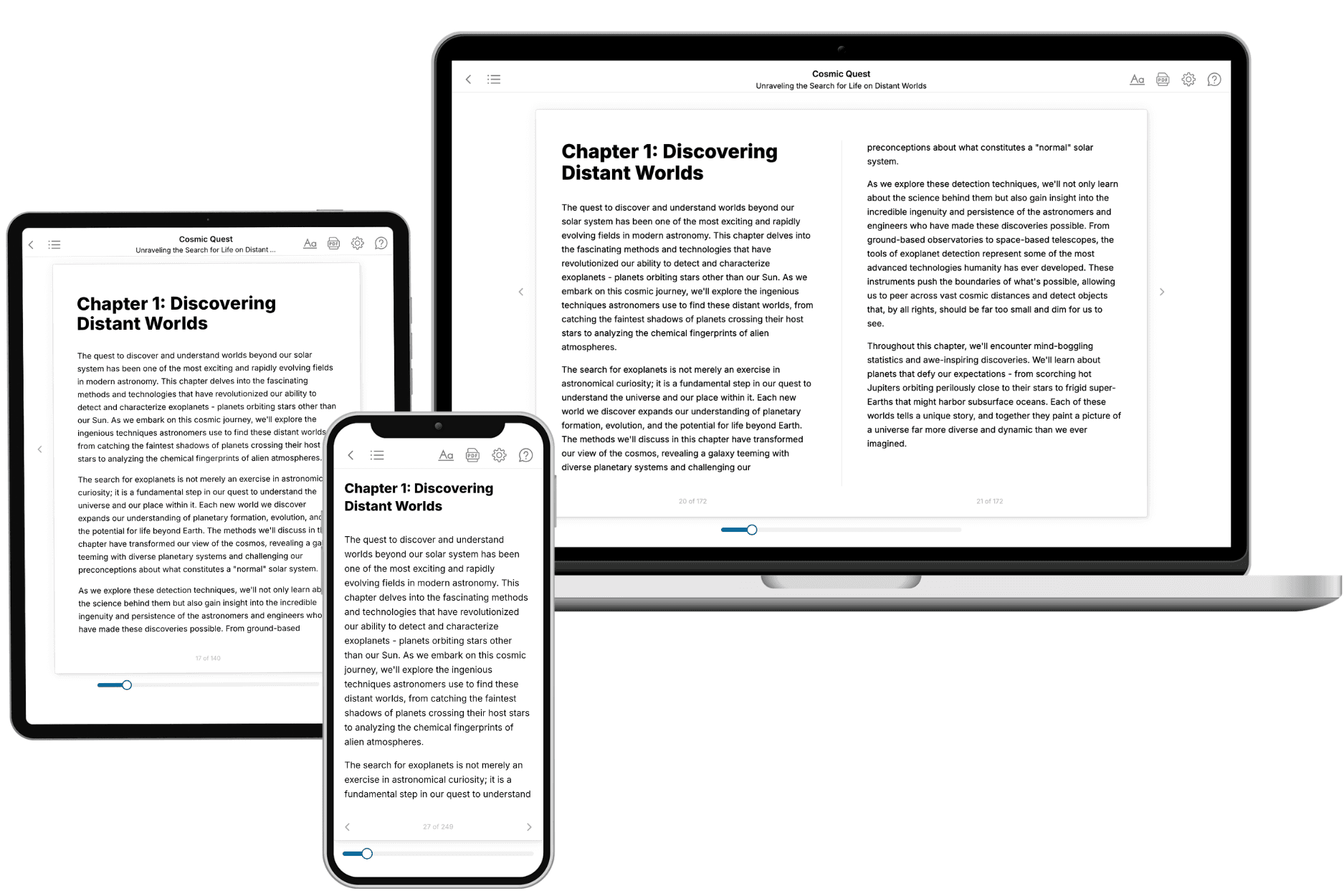
- 3. Get your tailored book
Your book is ready in 10 minutes. Read it online, download as EPUB or PDF, or send to Kindle.
Frequently asked questions
- What is TailoredRead?
TailoredRead creates complete, full-length nonfiction ebooks, written specifically for you. Tell us what you want to learn and why, and TailoredRead writes you a complete ebook on it, with charts, tables, and diagrams throughout. Read it online, on Kindle, or on any e-reader, or download it as a PDF or EPUB. Every book is written fresh the day you order it.
- How is the book tailored to me?
Before anything is written, you answer a few short questions about your goals, your background, and the topics you care about. Your book is then planned around your answers: written at your level, focused on your goals, and covering the topics you chose, instead of the one-size-fits-all book a store sells everyone.
- Will it read like generic AI content?
No. Your book isn't a chat transcript: it's planned chapter by chapter before a single word is written, told in a clear book voice, and explains ideas visually with charts, tables, and diagrams. After writing, every book goes through an editorial pass that polishes chapters so the book reads consistent from start to finish. Judge for yourself: browse thousands of sample books on our Explore Books page.
- How accurate is the content?
Our AI first checks whether your subject needs live research. Niche and fast-moving subjects are researched before writing, and the book plan and chapters are grounded in what it finds. After writing, every book goes through a quality pass that checks its facts and consistency, and researched books list their sources in a Notes section at the back.
- How long is the book?
You choose the length: Comprehensive (250-300 pages), Detailed (150-200 pages), Essential (70-100 pages), or Short (30-50 pages).
- Does the book include visuals?
Yes. Every book includes visual elements such as timelines, checklists, step-by-step guides, decision trees, comparison tables, and matrices, and many include bar charts. A typical book includes dozens of these visual elements.
- Can I read it on Kindle? What formats can I download?
Yes. Every book can be read in our online reader or downloaded as a PDF or EPUB. The EPUB can be opened with Kindle, Apple Books, Kobo, and any e-reader. The Commercial and Author licenses also include an editable Word (DOCX) and Markdown download.
- How much does it cost?
About the price of a regular ebook. The exact price depends on your book's length and complexity, from $2 for the shortest books to $35 for the most comprehensive, and it's shown when you review your book, before you commit to anything. Each book is a one-time purchase, yours to keep, no subscription. Licenses that let you share, teach, or publish your book range from $35.99 to $49.99.
- Can I preview the book before purchasing?
Before you pay, you'll see what your book will cover: the title, a detailed description, the estimated length, and the complete chapter-by-chapter table of contents, so you know what you're getting before you decide. The full text itself is written after you purchase.
- How long does it take to create a book?
About 10 minutes. You can start reading the opening chapters while the rest is still being written.