Mastering Lasso Regression
A Practical Guide to Regularization in Scikit-Learn for AI and Machine Learning
Dive into the world of Lasso Regression and discover its power in the realm of AI and Machine Learning.
346 pages17 chaptersJan 2, 2025Machine Learning
About this book
This book takes you on an enlightening exploration of one of the most valuable regularization techniques in the data scientist's toolkit. You'll start by building a solid foundation in the principles of Lasso Regression, understanding its mathematical underpinnings and its role in feature selection and model complexity reduction. As you progress, you'll gain hands-on experience implementing Lasso Regression using Scikit-Learn, one of the most popular machine learning libraries in Python. Through practical examples and real-world case studies, you'll learn how to apply Lasso Regression to solve complex problems in various domains. By the end of this journey, you'll have mastered the art of using Lasso Regression to build more accurate and interpretable models, giving you a competitive edge in your data science projects. Whether you're looking to optimize your machine learning models or gain a deeper understanding of regularization techniques, this book equips you with the knowledge and skills to leverage Lasso Regression effectively in your AI and machine learning endeavors.
Table of contents
- IntroductionThe Importance of Regularization in Machine Learning, Overview of Lasso Regression, Introduction to Scikit-Learn, Book Structure and How to Use ItRead below
- Chapter 1: Foundations of Linear RegressionThe Concept of Linear Regression, Ordinary Least Squares Method, Assumptions and Limitations of Linear Regression, The Problem of Overfitting
- Chapter 2: Introduction to RegularizationThe Concept of Regularization, L1 and L2 Penalties, Bias-Variance Tradeoff, Feature Selection through Regularization
- Chapter 3: Lasso Regression: Theoretical FoundationsMathematical Formulation of Lasso, Effects of L1 Penalty, Sparsity Promotion in Lasso, Geometric Interpretation of Lasso
- Chapter 4: Optimization Algorithms for LassoCoordinate Descent Algorithm, Least Angle Regression (LARS), Proximal Gradient Methods, Comparison of Optimization Techniques
- Chapter 5: Getting Started with Scikit-LearnInstalling and Setting Up Scikit-Learn, Data Preprocessing in Scikit-Learn, Model Selection and Evaluation, Building Pipelines in Scikit-Learn
- Chapter 6: Implementing Lasso Regression in Scikit-LearnThe Lasso Class in Scikit-Learn, Understanding Lasso Hyperparameters, Fitting and Predicting with Lasso, Analyzing Lasso Coefficients
- Chapter 7: Tuning the Regularization ParameterThe Importance of Alpha in Lasso, Grid Search for Alpha Tuning, Cross-Validation Techniques, Visualizing the Regularization Path
- Chapter 8: Feature Selection with LassoDetermining Feature Importance, Building Sparse Models, Stability Selection, Recursive Feature Elimination with Lasso
- Chapter 9: Variants and Extensions of LassoElastic Net: Combining L1 and L2 Penalties, Group Lasso for Structured Sparsity, Adaptive Lasso, Fused Lasso for Ordered Variables
- Chapter 10: Lasso for Non-Linear RelationshipsPolynomial Features with Lasso, Kernel Lasso, Generalized Additive Models with Lasso, Spline Regression with Lasso Penalty
- Chapter 11: Lasso in Time Series AnalysisLasso for Autoregressive Models, Trend Filtering with Lasso, Sparse Vector Autoregression, Forecasting with Lasso Regression
- Chapter 12: Lasso for High-Dimensional DataThe Curse of Dimensionality, Screening Methods for Ultra-High Dimensions, Parallel Lasso Algorithms, Challenges and Solutions for Big Data
- Chapter 13: Interpretability of Lasso ModelsInterpreting Lasso Coefficients, Ranking Features by Importance, Partial Dependence Plots, Model Explainability Techniques
- Chapter 14: Lasso in Ensemble MethodsBagging with Lasso, Random Lasso, Boosting with Lasso Base Learners, Stacking with Lasso Meta-Model
- Chapter 15: Practical Considerations and Best PracticesScaling and Normalization, Handling Missing Data, Dealing with Categorical Variables, Model Validation Strategies, Hyperparameter Tuning Best Practices
- Chapter 16: Case Studies and ApplicationsLasso in Genomics, Image Processing with Lasso, Text Analysis and NLP Applications, IoT and Sensor Data Analysis
- Chapter 17: Future Directions and Advanced TopicsDistributed Lasso for Big Data, Online and Streaming Lasso, Lasso in Deep Learning, Quantum Computing and Lasso
- ConclusionKey Takeaways, Future Learning Paths
- Glossary
- Further Reading
- AppendixMathematical Review, Python Basics for Scikit-Learn
Introduction
Welcome to "Mastering Lasso Regression: A Practical Guide to Regularization in Scikit-Learn for AI and Machine Learning." This book is designed to be your comprehensive guide to understanding and implementing Lasso Regression, a powerful regularization technique that has become an essential tool in the modern data scientist's arsenal. As you embark on this journey, you'll discover how Lasso Regression can revolutionize your approach to feature selection, model complexity reduction, and ultimately, the creation of more accurate and interpretable machine learning models.
In today's data-driven world, the ability to extract meaningful insights from complex datasets is more crucial than ever. As a data scientist or machine learning practitioner with intermediate knowledge of statistical methods and programming, you're already aware of the challenges posed by high-dimensional data and the constant struggle against overfitting. Lasso Regression offers a elegant solution to these problems, and this book will equip you with the knowledge and skills to harness its full potential.
Throughout this book, we'll delve deep into the theoretical foundations of Lasso Regression, explore its implementation using the popular Scikit-Learn library in Python, and examine its wide-ranging applications in AI and Machine Learning. By the time you reach the final chapter, you'll have gained a thorough understanding of how to apply Lasso Regression to solve complex problems across various domains, giving you a significant advantage in your data science projects.
Our journey will be both theoretical and practical. We'll start by building a solid foundation in the principles of Lasso Regression, understanding its mathematical underpinnings, and exploring its role in feature selection and model complexity reduction. As we progress, you'll gain hands-on experience implementing Lasso Regression using Scikit-Learn, one of the most popular machine learning libraries in Python. Through practical examples and real-world case studies, you'll learn how to apply Lasso Regression to solve complex problems in various domains.
This introduction chapter will set the stage for your learning journey. We'll begin by discussing the critical importance of regularization in machine learning, providing context for why techniques like Lasso Regression are so valuable. We'll then give you an overview of Lasso Regression itself, highlighting its key features and benefits. Following that, we'll introduce you to Scikit-Learn, the powerful Python library that we'll be using throughout this book to implement Lasso Regression. Finally, we'll outline the structure of the book and provide guidance on how to use it effectively to maximize your learning.
So, without further ado, let's dive into the fascinating world of Lasso Regression and begin our journey towards mastering this invaluable technique in the context of AI and Machine Learning.
The Importance of Regularization in Machine Learning
In the realm of machine learning, the concept of regularization stands as a cornerstone principle, playing a crucial role in the development of robust and generalizable models. At its core, regularization is a technique designed to prevent overfitting, a common challenge that occurs when a model learns the training data too well, including its noise and peculiarities, at the expense of its ability to generalize to new, unseen data. The importance of regularization in machine learning cannot be overstated, as it directly addresses one of the field's most persistent and challenging problems.
To truly appreciate the significance of regularization, it's essential to understand the fundamental trade-off in machine learning between model complexity and generalization performance. As models become more complex, they gain the ability to capture intricate patterns in the training data. However, this increased complexity comes at a cost: the risk of overfitting grows substantially. Overfitted models perform exceptionally well on the training data but fail to maintain that performance when presented with new, unseen data. This phenomenon is at the heart of why regularization is so crucial in machine learning.
Regularization techniques, such as Lasso Regression, which we'll explore in depth throughout this book, provide a systematic way to control model complexity. They do this by adding a penalty term to the model's loss function, effectively discouraging overly complex solutions. This penalty term acts as a constraint, forcing the model to find a balance between fitting the training data well and maintaining simplicity. The result is a model that is more likely to generalize effectively to new data, a key goal in any machine learning task.
One of the most significant benefits of regularization is its ability to perform feature selection automatically. In many real-world scenarios, datasets contain a large number of features, some of which may be irrelevant or redundant. Traditional methods often struggle with high-dimensional data, leading to models that are difficult to interpret and prone to overfitting. Regularization techniques like Lasso can automatically identify and prioritize the most relevant features, effectively reducing the dimensionality of the problem. This not only improves model performance but also enhances interpretability, a crucial factor in many applications where understanding the model's decision-making process is as important as its predictions.
Moreover, regularization plays a vital role in dealing with multicollinearity, a common issue in regression analysis where predictor variables are highly correlated with each other. In the presence of multicollinearity, standard regression techniques can produce unstable and unreliable estimates of coefficients. Regularization methods help mitigate this problem by shrinking the coefficients of correlated predictors, leading to more stable and reliable models.
The importance of regularization extends beyond just improving model performance. In many fields, such as healthcare, finance, and scientific research, the stakes of decision-making based on machine learning models are high. Regularized models, with their improved generalization capabilities and reduced tendency to overfit, provide a more reliable foundation for these critical decisions. They offer a safeguard against making predictions or decisions based on spurious correlations or noise in the training data, which is especially crucial in high-stakes environments.
Furthermore, regularization aligns well with the principle of Occam's razor in scientific thinking, which states that simpler explanations are generally better than more complex ones, all else being equal. By encouraging simpler models, regularization techniques like Lasso not only improve predictive performance but also lead to more interpretable and explainable models. This is increasingly important in an era where model transparency and explainability are becoming key considerations in the deployment of machine learning systems.
In the context of deep learning and neural networks, regularization takes on even greater importance. As these models can have millions of parameters, the risk of overfitting is particularly acute. Techniques like L1 and L2 regularization, dropout, and early stopping are essential tools in the deep learning practitioner's toolkit, allowing for the training of powerful, complex models that can still generalize well to unseen data.
As we delve deeper into Lasso Regression in the coming chapters, you'll see how this specific form of regularization embodies these principles, offering a powerful tool for feature selection, model simplification, and improved generalization. The skills you'll develop in understanding and applying Lasso Regression will not only make you a more effective practitioner but will also provide you with insights that can be applied to a wide range of machine learning problems and techniques.
In conclusion, regularization stands as a fundamental concept in machine learning, offering a systematic approach to building models that are not just accurate on training data, but robust, generalizable, and interpretable. As we progress through this book, keep in mind that the principles of regularization you'll learn through Lasso Regression are applicable across a wide spectrum of machine learning techniques, making them an invaluable addition to your data science toolkit.
Overview of Lasso Regression
Lasso Regression, short for Least Absolute Shrinkage and Selection Operator, is a powerful regularization technique that has gained significant popularity in the field of machine learning and statistical modeling. Introduced by Robert Tibshirani in 1996, Lasso has become an indispensable tool for data scientists and researchers dealing with high-dimensional data and complex model selection problems. At its core, Lasso Regression is a linear regression method that incorporates a regularization term, specifically designed to perform both feature selection and regularization simultaneously.
The fundamental idea behind Lasso Regression is to add a penalty term to the ordinary least squares (OLS) objective function. This penalty term is proportional to the absolute value of the magnitude of coefficients, also known as the L1 norm. Mathematically, the Lasso objective function can be expressed as:
where Y is the target variable, X is the feature matrix, β represents the coefficients, ||·||² denotes the L2 norm (sum of squared residuals), ||·||₁ is the L1 norm (sum of absolute values), and λ (lambda) is the regularization parameter that controls the strength of the penalty.minimize: ||Y - Xβ||² + λ||β||₁
One of the most distinctive and valuable properties of Lasso Regression is its ability to produce sparse models. As the regularization parameter λ increases, Lasso tends to shrink some coefficients exactly to zero, effectively performing feature selection. This sparsity-inducing property sets Lasso apart from other regularization techniques like Ridge Regression (which uses an L2 penalty) and makes it particularly useful in scenarios where you have a large number of features and want to identify the most relevant ones.
The mechanism by which Lasso achieves this sparsity is worth understanding. The L1 penalty creates a constraint region in the parameter space that has corners on the axes. When the solution touches one of these corners, some coefficients become exactly zero. This geometric interpretation provides insight into why Lasso is effective at feature selection, as it tends to favor solutions with fewer non-zero coefficients.
Lasso Regression offers several key advantages that have contributed to its widespread adoption:
- Feature Selection: By shrinking some coefficients to zero, Lasso automatically performs feature selection, identifying the most important predictors in your model. This can lead to simpler, more interpretable models and can help in understanding which features have the strongest impact on the target variable.
- Regularization: Like other regularization techniques, Lasso helps prevent overfitting by adding a penalty for large coefficients. This results in models that generalize better to unseen data.
- Handling Multicollinearity: In situations where predictors are highly correlated, Lasso tends to select one variable from a group of correlated variables, effectively addressing multicollinearity issues.
- Computational Efficiency: Especially for high-dimensional data, Lasso can be more computationally efficient than other variable selection methods, as it performs feature selection as part of the model fitting process.
- Interpretability: The sparse solutions produced by Lasso often lead to more interpretable models, as they involve fewer predictors.
Despite its many advantages, it's important to be aware of some limitations and considerations when using Lasso Regression:
- Sensitivity to Scaling: Lasso is sensitive to the scale of the input features. It's generally recommended to standardize your features before applying Lasso.
- Instability with Correlated Predictors: When dealing with highly correlated features, Lasso's selection can be somewhat unstable, potentially choosing different features in different samples of the same data.
- Bias: The shrinkage of coefficients introduces bias into the model, which can be a trade-off for reduced variance and improved generalization.
- Assumptions: Like other linear models, Lasso assumes a linear relationship between the features and the target variable. For non-linear relationships, extensions or transformations may be necessary.
As we progress through this book, we'll delve deeper into these aspects of Lasso Regression, exploring its mathematical foundations, implementation details, and practical applications. You'll learn how to effectively use Lasso in various scenarios, from simple linear regression problems to more complex machine learning tasks. We'll also explore variations and extensions of Lasso, such as Elastic Net, which combines L1 and L2 penalties, and Group Lasso, which can handle grouped variables.
Understanding Lasso Regression and its nuances will equip you with a powerful tool for building more accurate, interpretable, and efficient models. Whether you're working on predictive modeling, feature selection, or trying to gain insights from high-dimensional data, the knowledge you'll gain about Lasso Regression will be invaluable in your data science journey.
In the next sections, we'll introduce you to Scikit-Learn, the Python library we'll be using to implement Lasso Regression, and then we'll outline the structure of the book to guide your learning path. By the end of this book, you'll have a comprehensive understanding of Lasso Regression, from its theoretical foundations to its practical applications in real-world machine learning problems.
Introduction to Scikit-Learn
Scikit-Learn, often stylized as sklearn, is an open-source machine learning library for Python that has become a cornerstone in the data science and machine learning community. Developed by David Cournapeau in 2007 as part of the Google Summer of Code project, Scikit-Learn has since evolved into a comprehensive and widely-used toolkit for data mining and data analysis. Its popularity stems from its efficient, well-documented, and easy-to-use implementation of a wide range of machine learning algorithms, including Lasso Regression, which will be our focus throughout this book.
At its core, Scikit-Learn is designed with several key principles in mind:
- Consistency: Scikit-Learn provides a consistent interface across all of its algorithms, making it easy to switch between different models or techniques without having to learn a new API each time.
- Efficiency: Built on top of NumPy, SciPy, and matplotlib, Scikit-Learn leverages optimized numerical and scientific libraries to provide high-performance implementations of machine learning algorithms.
- Accessibility: With clear and comprehensive documentation, along with a wealth of examples and tutorials, Scikit-Learn is designed to be accessible to both beginners and experienced practitioners.
- Extensibility: The library is designed to be easily extensible, allowing users to build custom estimators and transformers that integrate seamlessly with existing Scikit-Learn functionality.
Scikit-Learn covers a wide range of machine learning tasks, including:
- Classification: Algorithms for assigning categories to data points, such as logistic regression, support vector machines, and decision trees.
- Regression: Techniques for predicting continuous values, including linear regression, Lasso, Ridge, and Elastic Net.
- Clustering: Unsupervised learning methods for grouping similar data points, like K-means and DBSCAN.
- Dimensionality Reduction: Techniques for reducing the number of features in a dataset, such as Principal Component Analysis (PCA) and t-SNE.
- Model Selection and Evaluation: Tools for cross-validation, parameter tuning, and performance metrics.
- Preprocessing: Utilities for data normalization, encoding categorical variables, and handling missing values.
For our exploration of Lasso Regression, Scikit-Learn provides the Lasso class, which implements Lasso Regression with coordinate descent as the default solver. This implementation is highly efficient and scales well to large datasets, making it an excellent choice for practical applications. Scikit-Learn also offers related classes like LassoCV for automatic cross-validation of the regularization parameter, and LassoLarsCV which combines Lasso with Least Angle Regression (LARS) algorithm.
One of the key advantages of using Scikit-Learn for Lasso Regression is its seamless integration with the broader Python ecosystem for data science. You can easily combine Scikit-Learn's Lasso implementation with other tools for data manipulation (like pandas), visualization (such as matplotlib or seaborn), and more advanced machine learning techniques (including ensemble methods and pipelines).
Here's a simple example of how you might use Lasso Regression in Scikit-Learn:
from sklearn.linear_model import Lasso
from sklearn.model_selection import train_test_split
from sklearn.metrics import mean_squared_error
import numpy as np

# Assume X and y are your feature matrix and target vector
X_train, X_test, y_train, y_test = train_test_split(X, y, test_size=0.2, random_state=42)

# Initialize and fit the Lasso model
lasso = Lasso(alpha=0.1)
lasso.fit(X_train, y_train)

# Make predictions and evaluate
y_pred = lasso.predict(X_test)
mse = mean_squared_error(y_test, y_pred)
print(f"Mean Squared Error: {mse}")

# Examine coefficients
print("Lasso coefficients:", lasso.coef_)
As we progress through this book, you'll become intimately familiar with these and more advanced uses of Scikit-Learn for Lasso Regression. We'll explore how to leverage Scikit-Learn's capabilities for tasks such as:
- Preprocessing data for Lasso Regression
- Implementing cross-validation to tune the regularization parameter
- Combining Lasso with other techniques in machine learning pipelines
- Visualizing the effects of Lasso Regression on feature selection
- Comparing Lasso with other regularization techniques
By the end of this book, you'll not only have a deep understanding of Lasso Regression but also be proficient in implementing it effectively using Scikit-Learn. This combination of theoretical knowledge and practical skills will enable you to apply Lasso Regression to a wide range of real-world machine learning problems, enhancing your capabilities as a data scientist or machine learning practitioner.
In the next section, we'll outline the structure of this book, providing you with a roadmap for your journey into mastering Lasso Regression with Scikit-Learn. This overview will help you navigate the content effectively and make the most of your learning experience.
Book Structure and How to Use It
"Mastering Lasso Regression: A Practical Guide to Regularization in Scikit-Learn for AI and Machine Learning" is structured to provide you with a comprehensive understanding of Lasso Regression, from its theoretical foundations to its practical applications. The book is designed to be both a learning resource and a reference guide, allowing you to progress sequentially through the chapters or jump to specific topics of interest. Here's an overview of the book's structure and some guidance on how to use it effectively:
1. Foundations (Chapters 1-2): The book begins by laying a solid foundation in linear regression and regularization. These chapters are crucial for understanding the context in which Lasso Regression operates.
- Chapter 1: Foundations of Linear Regression
- Chapter 2: Introduction to Regularization
2. Lasso Theory and Optimization (Chapters 3-4): These chapters delve into the theoretical aspects of Lasso Regression and the algorithms used to solve Lasso problems.
- Chapter 3: Lasso Regression: Theoretical Foundations
- Chapter 4: Optimization Algorithms for Lasso
3. Practical Implementation with Scikit-Learn (Chapters 5-7): This section focuses on the practical aspects of implementing Lasso Regression using Scikit-Learn.
- Chapter 5: Getting Started with Scikit-Learn
- Chapter 6: Implementing Lasso Regression in Scikit-Learn
- Chapter 7: Tuning the Regularization Parameter
4. Advanced Topics and Applications (Chapters 8-14): These chapters explore more advanced aspects of Lasso Regression and its applications in various domains.
- Chapter 8: Feature Selection with Lasso
- Chapter 9: Variants and Extensions of Lasso
- Chapter 10: Lasso for Non-Linear Relationships
- Chapter 11: Lasso in Time Series Analysis
- Chapter 12: Lasso for High-Dimensional Data
- Chapter 13: Interpretability of Lasso Models
- Chapter 14: Lasso in Ensemble Methods
5. Best Practices and Real-World Applications (Chapters 15-17): The final chapters focus on practical considerations, case studies, and future directions.
- Chapter 15: Practical Considerations and Best Practices
- Chapter 16: Case Studies and Applications
- Chapter 17: Future Directions and Advanced Topics
How to Use This Book:
- Sequential Learning: If you're new to Lasso Regression or want a comprehensive understanding, work through the chapters sequentially. Each chapter builds on the knowledge from previous ones.
- Hands-On Practice: Don't just read the code examples – run them, modify them, and experiment. The more you practice, the better you'll understand the concepts.
- Focus on Relevant Sections: If you're an experienced practitioner, you may want to focus on specific chapters that address your current needs or interests.
- Revisit and Reference: Use this book as a reference. You may find yourself returning to certain chapters as you encounter specific challenges in your work.
- Engage with Exercises: Each chapter includes exercises and discussion questions. These are crucial for reinforcing your learning and applying the concepts.
- Explore Further: Use the "Further Reading" section at the end of the book to dive deeper into topics that particularly interest you.
Remember, learning is an active process. As you progress through the book, try to apply the concepts to your own datasets or problems. Experiment with the Scikit-Learn implementations, and don't hesitate to explore beyond the examples provided. The more you engage with the material, the more proficient you'll become in using Lasso Regression effectively in your data science and machine learning projects.
By the end of this book, you'll have a comprehensive understanding of Lasso Regression, from its theoretical underpinnings to its practical applications. You'll be equipped with the knowledge and skills to implement Lasso Regression effectively using Scikit-Learn, and you'll have insights into how to apply this powerful technique to solve real-world machine learning problems. Whether you're looking to optimize your models, perform feature selection, or gain deeper insights from your data, the knowledge you'll gain from this book will be an invaluable asset in your data science toolkit.
This is the end of the free sample. The full book has 17 chapters.
Want this book written for you?
Tell us your goals and background, and get your own version of this book, tailored by AI to you.


Benefits of AI-tailored books
- Read one book, not ten:
- all the Machine Learning knowledge you need, gathered into a single book.
- Save days of learning:
- tell us your goals, choose your topics, and the whole book is built around them.
- Learn effortlessly:
- Machine Learning book written for your specific background and expertise.
- Understand at a glance:
- includes charts, tables, timelines, checklists, decision trees, and more.
- Stay current:
- written the day you order it, not years ago.
- Trust what you read:
- every book is checked for accuracy, with real research when your subject needs it.
Create your unique book in 3 steps
- 1. Select your focus
Select the focus of your Machine Learning book and share your background
- 2. Personalize your book
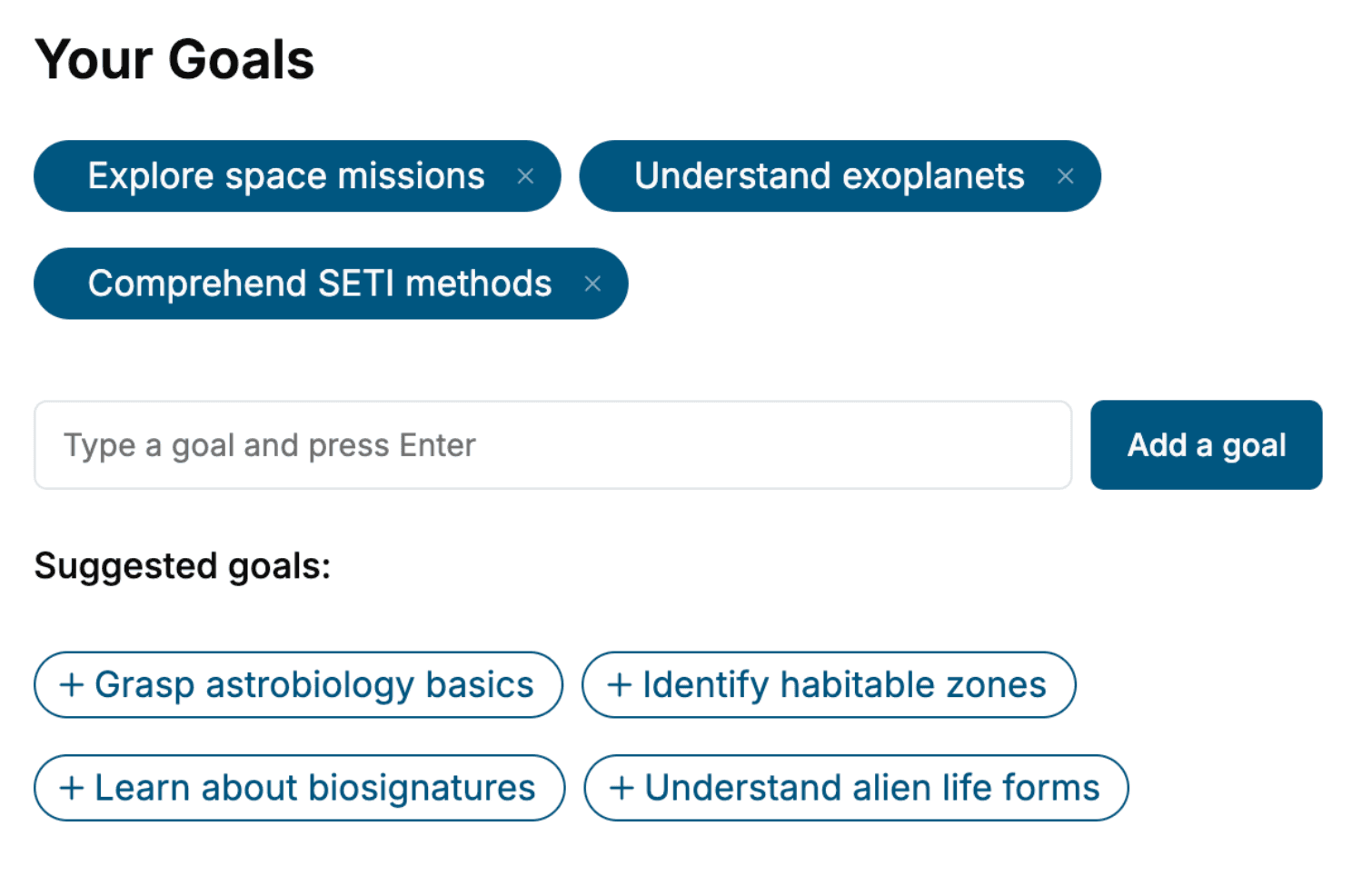
Specify your goals and choose sub-topics to include
- 3. Get your tailored book
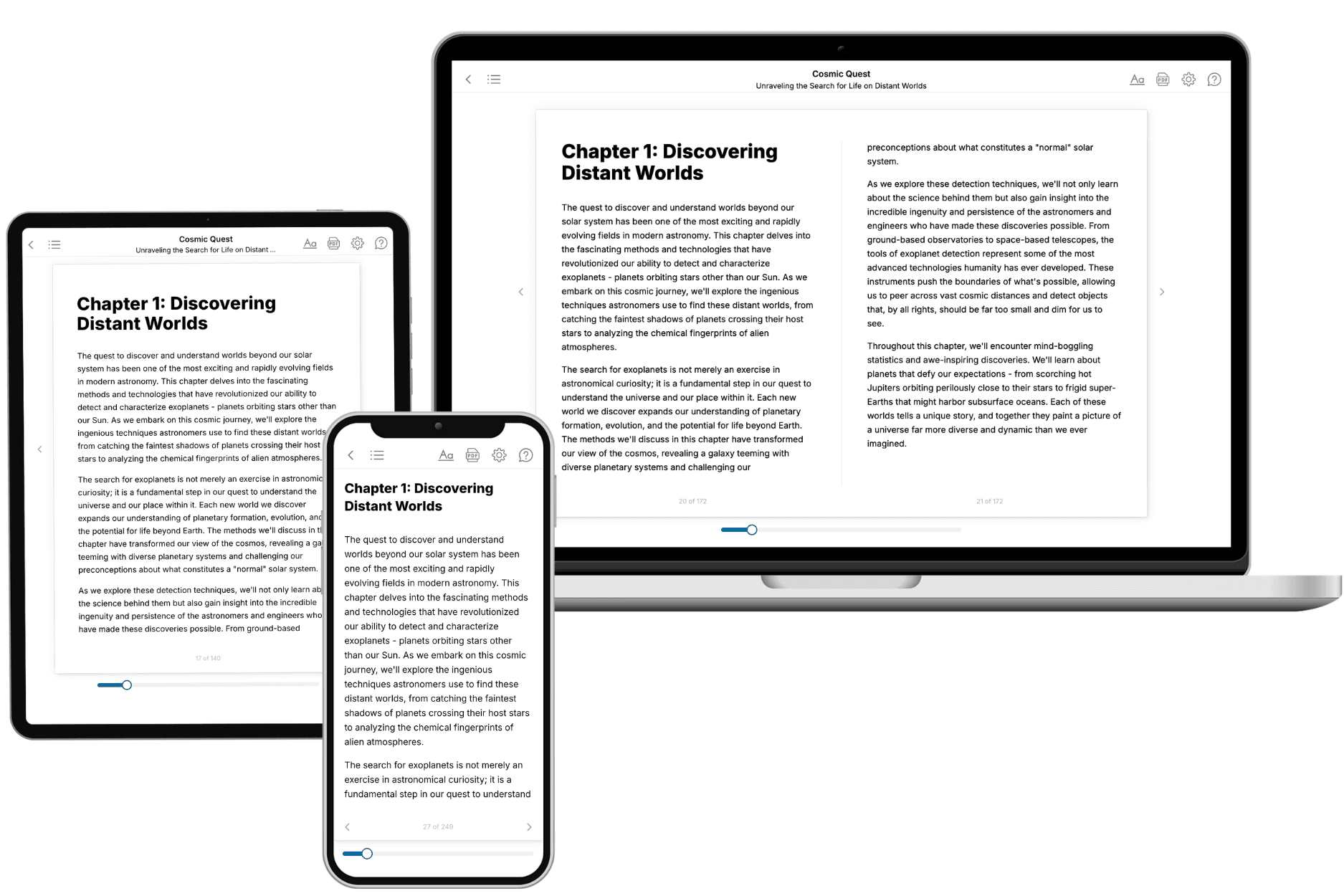
Your book is ready in 10 minutes. Read it online, download as EPUB or PDF, or send to Kindle.

Frequently asked questions
- What is TailoredRead?
TailoredRead creates complete, full-length nonfiction ebooks, written specifically for you. Tell us what you want to learn and why, and TailoredRead writes you a complete ebook on it, with charts, tables, and diagrams throughout. Read it online, on Kindle, or on any e-reader, or download it as a PDF or EPUB. Every book is written fresh the day you order it.
- How is the book tailored to me?
Before anything is written, you answer a few short questions about your goals, your background, and the topics you care about. Your book is then planned around your answers: written at your level, focused on your goals, and covering the topics you chose, instead of the one-size-fits-all book a store sells everyone.
- Will it read like generic AI content?
No. Your book isn't a chat transcript: it's planned chapter by chapter before a single word is written, told in a clear book voice, and explains ideas visually with charts, tables, and diagrams. After writing, every book goes through an editorial pass that polishes chapters so the book reads consistent from start to finish. Judge for yourself: browse thousands of sample books on our Explore Books page.
- How accurate is the content?
Our AI first checks whether your subject needs live research. Niche and fast-moving subjects are researched before writing, and the book plan and chapters are grounded in what it finds. After writing, every book goes through a quality pass that checks its facts and consistency, and researched books list their sources in a Notes section at the back.
- How long is the book?
You choose the length: Comprehensive (250-300 pages), Detailed (150-200 pages), Essential (70-100 pages), or Short (30-50 pages).
- Does the book include visuals?
Yes. Every book includes charts, tables, and diagrams: timelines, checklists, step-by-step guides, decision trees, comparison tables, matrices, and bar charts. A typical book includes dozens of these visual elements.
- Can I read it on Kindle? What formats can I download?
Yes. Every book can be read in our online reader or downloaded as a PDF or EPUB. The EPUB can be opened with Kindle, Apple Books, Kobo, and any e-reader. The Commercial and Author licenses also include an editable Word (DOCX) and Markdown download.
- How much does it cost?
About the price of a regular ebook. The exact price depends on your book's length and complexity, from $2 for the shortest books to $35 for the most comprehensive, and it's shown when you review your book, before you commit to anything. Each book is a one-time purchase, yours to keep, no subscription. Licenses that let you share, teach, or publish your book range from $35.99 to $49.99.
- Can I preview the book before purchasing?
Before you pay, you'll see what your book will cover: the title, a detailed description, the estimated length, and the complete chapter-by-chapter table of contents, so you know what you're getting before you decide. The full text itself is written after you purchase.
- How long does it take to create a book?
About 10 minutes. You can start reading the opening chapters while the rest is still being written.