Ridge Regression Mastery
Harnessing the Power of Regularization in Scikit-Learn for Advanced Machine Learning
Imagine yourself confidently tackling complex machine learning problems, armed with a powerful tool that enhances your models' performance and interpretability.
300 pages16 chaptersDec 19, 2024Data Science
About this book
You're no longer intimidated by multicollinearity or overfitting issues. Instead, you're creating robust, accurate predictions that stand up to real-world challenges. This is the reality that awaits you with "Ridge Regression Mastery." This comprehensive guide takes you on a deep dive into the world of regularization techniques, focusing on the versatile and powerful Ridge Regression method. You'll explore its theoretical foundations, practical implementations in Scikit-Learn, and its crucial role in modern AI and machine learning landscapes. From understanding the mathematics behind Ridge Regression to mastering its application in various scenarios, this book equips you with the knowledge and skills to elevate your data science practice. You'll learn how to fine-tune your models, interpret results, and make informed decisions about when and how to apply Ridge Regression for optimal outcomes. Whether you're working on predictive modeling, feature selection, or tackling high-dimensional datasets, "Ridge Regression Mastery" provides you with the insights and techniques to push the boundaries of your machine learning projects. Get ready to enhance your analytical toolkit and become a more effective, confident data scientist.
Table of contents
- IntroductionThe Importance of Regularization in Machine Learning, Ridge Regression: An Overview, Introduction to Scikit-Learn, Book Structure and How to Use ItRead below
- Chapter 1: Foundations of Linear RegressionBasic Concepts of Linear Regression, The Method of Least Squares, Assumptions of Linear Regression, The Problem of Multicollinearity
- Chapter 2: The Theory Behind Ridge RegressionUnderstanding L2 Regularization, The Ridge Regression Cost Function, Geometric Interpretation of Ridge Regression, Bias-Variance Tradeoff in Ridge Regression
- Chapter 3: Mathematical Formulation of Ridge RegressionMatrix Notation and Derivation, Closed-form Solution for Ridge Regression, Eigenvalue Analysis and Shrinkage, Probabilistic Interpretation of Ridge Regression
- Chapter 4: Implementing Ridge Regression with Scikit-LearnSetting Up Your Scikit-Learn Environment, The Ridge Class in Scikit-Learn, Understanding Ridge Regression Hyperparameters, A Simple Ridge Regression Example
- Chapter 5: Data Preparation for Ridge RegressionThe Importance of Feature Scaling, Handling Missing Data, Encoding Categorical Variables, Feature Engineering for Ridge Regression
- Chapter 6: Model Evaluation and SelectionCross-Validation Techniques, Evaluation Metrics for Ridge Regression, Interpreting Learning Curves, Grid Search for Hyperparameter Tuning
- Chapter 7: Choosing the Right Regularization ParameterThe Effect of Alpha on Model Performance, Visualizing the Regularization Path, Automated Methods for Alpha Selection, Incorporating Domain Knowledge in Parameter Selection
- Chapter 8: Ridge Regression vs. Other TechniquesRidge vs. Lasso Regression, Elastic Net: Combining Ridge and Lasso, Ridge Regression and Principal Component Regression, When to Use Ridge Regression
- Chapter 9: Advanced Ridge Regression TechniquesKernel Ridge Regression, Bayesian Ridge Regression, Multi-task Learning with Ridge Regression, Online Learning and Stochastic Gradient Descent
- Chapter 10: Ridge Regression for ClassificationLogistic Ridge Regression, Multi-class Classification with Ridge, ROC Curves and AUC for Ridge Classifiers, Calibrating Probabilistic Outputs
- Chapter 11: Ridge Regression for High-Dimensional DataThe Curse of Dimensionality, Feature Selection with Ridge Regression, Sparse Ridge Regression, Case Study: Ridge Regression in Genomics
- Chapter 12: Ridge Regression for Time Series AnalysisAutoregressive Models with Ridge Regularization, Handling Seasonal Trends, Forecasting with Ridge Regression, Time Series Cross-Validation
- Chapter 13: Ensemble Methods and Ridge RegressionBagging with Ridge Regression, Boosting Algorithms with Ridge Base Learners, Stacking Models with Ridge Meta-learner, Case Study: Ensemble Methods in Practice
- Chapter 14: Ridge Regression in Deep LearningWeight Decay as L2 Regularization, Transfer Learning with Ridge Regression Layers, Interpreting Neural Networks with Ridge Regression, Case Study: Ridge Regression in a Deep Learning Pipeline
- Chapter 15: Interpretability of Ridge Regression ModelsAnalyzing Ridge Regression Coefficients, Feature Importance in Ridge Regression, Partial Dependence Plots, SHAP Values for Ridge Regression
- Chapter 16: Scalability and Performance OptimizationParallel Computing for Ridge Regression, GPU Acceleration with CUDA, Ridge Regression for Big Data, Performance Tuning Tips and Tricks
- ConclusionFuture Directions in Ridge Regression Research, Final Thoughts and Best Practices
- AppendixMathematical Review, Scikit-Learn API Reference for Ridge Regression
Introduction
Welcome to the world of Ridge Regression, a powerful technique that stands at the intersection of statistical modeling and machine learning. As you embark on this journey through "Ridge Regression Mastery," you're about to unlock a wealth of knowledge that will transform your approach to data analysis and predictive modeling. This introduction serves as your gateway to understanding the critical role of regularization in machine learning, the fundamental concepts of Ridge Regression, and how Scikit-Learn empowers you to implement these techniques efficiently.
In the rapidly evolving landscape of data science and artificial intelligence, the ability to build robust, accurate models is more crucial than ever. As datasets grow larger and more complex, traditional linear regression techniques often fall short, grappling with issues like overfitting and multicollinearity. This is where Ridge Regression steps in, offering a elegant solution that balances model complexity with predictive power. By the end of this book, you'll not only understand the theoretical underpinnings of Ridge Regression but also be equipped with practical skills to apply it effectively in your own projects.
Throughout this introduction, we'll lay the groundwork for your deep dive into Ridge Regression. We'll explore why regularization is a game-changer in machine learning, provide an overview of Ridge Regression and its key benefits, introduce you to Scikit-Learn as your go-to tool for implementation, and outline the structure of this book to guide your learning journey. Whether you're looking to enhance your existing models, tackle new challenges in high-dimensional data analysis, or simply deepen your understanding of machine learning techniques, this book is your comprehensive guide to mastering Ridge Regression.
The Importance of Regularization in Machine Learning
In the realm of machine learning and statistical modeling, regularization stands as a cornerstone technique, pivotal in addressing some of the most persistent challenges faced by data scientists and analysts. At its core, regularization is a set of methods designed to prevent overfitting, improve model generalization, and handle the complexities of high-dimensional data. To truly appreciate the significance of regularization, it's essential to understand the problems it solves and the benefits it brings to the table.
Overfitting is perhaps the most notorious issue that regularization tackles head-on. When a model learns the training data too well, including its noise and peculiarities, it fails to generalize to new, unseen data. This phenomenon is particularly prevalent in complex models with many parameters, where the model has the capacity to essentially "memorize" the training set rather than learn underlying patterns. Regularization introduces a penalty for complexity, encouraging the model to find a balance between fitting the training data and maintaining simplicity. This balance is crucial for creating models that perform well not just on the data they were trained on, but also on new, real-world data they encounter[1].
Another significant challenge that regularization addresses is the curse of dimensionality. As the number of features in a dataset increases, the volume of the space increases so rapidly that the available data become sparse. This sparsity is problematic for many statistical methods, as they require a significant amount of data to produce reliable results. Regularization techniques help mitigate this issue by effectively reducing the complexity of the model, making it more robust in high-dimensional spaces. This is particularly relevant in modern machine learning scenarios where datasets often contain hundreds or thousands of features.
Multicollinearity, where predictor variables in a model are highly correlated, is another area where regularization proves invaluable. In the presence of multicollinearity, standard regression techniques can produce unstable estimates with high variance. Regularization methods, particularly Ridge Regression, stabilize these estimates by adding a bias term. This trade-off between bias and variance is fundamental to the success of regularized models in handling correlated features[2].
The importance of regularization extends beyond just improving model performance. It also enhances model interpretability, a crucial aspect in many domains where understanding the impact of individual features is as important as the predictions themselves. By shrinking the coefficients of less important features towards zero, regularization techniques like Ridge Regression provide a clearer picture of which variables are most influential in the model. This interpretability is invaluable in fields such as healthcare, finance, and social sciences, where insights into feature importance can guide decision-making and policy formulation.
Furthermore, regularization plays a critical role in the broader context of model selection and complexity control. It provides a systematic way to choose between different model complexities, helping to automate the process of finding the right balance between underfitting and overfitting. This is particularly useful in automated machine learning (AutoML) systems, where the goal is to develop models with minimal human intervention.
In the era of big data and deep learning, the principles of regularization have found new applications and interpretations. Techniques like dropout in neural networks, which randomly omits units during training, can be viewed as a form of regularization. Similarly, early stopping in iterative learning algorithms is another manifestation of regularization principles. These examples illustrate how the concept of regularization has evolved and permeated various aspects of modern machine learning.
As you delve deeper into Ridge Regression in the subsequent chapters, you'll see how it embodies these regularization principles. Ridge Regression, with its L2 penalty term, offers a powerful yet intuitive approach to regularization. It shrinks the coefficients of correlated predictors towards each other, allowing them to borrow strength from one another. This property makes Ridge Regression particularly effective in scenarios with many features, some of which may be correlated.
The importance of regularization in machine learning cannot be overstated. It's not just a technique but a fundamental principle that underpins the development of robust, generalizable models. As datasets grow larger and more complex, and as the demand for automated, scalable machine learning solutions increases, the role of regularization becomes even more critical. By mastering Ridge Regression and understanding its place in the broader landscape of regularization techniques, you'll be well-equipped to tackle a wide range of machine learning challenges, from predictive modeling to feature selection and beyond.
Ridge Regression: An Overview
Ridge Regression, also known as Tikhonov regularization in some contexts, is a powerful extension of ordinary least squares (OLS) regression that introduces a regularization term to the model. This technique, first introduced by Arthur E. Hoerl and Robert W. Kennard in 1970, has since become a fundamental tool in the arsenal of data scientists and statisticians. At its core, Ridge Regression addresses the shortcomings of standard linear regression when dealing with multicollinearity and overfitting, making it an invaluable method for a wide range of applications in machine learning and predictive modeling[3].
The key innovation of Ridge Regression lies in its modification of the ordinary least squares objective function. While OLS aims to minimize the sum of squared residuals, Ridge Regression adds a penalty term proportional to the sum of the squared coefficients. This additional term is controlled by a regularization parameter, often denoted as λ (lambda) or α (alpha). The inclusion of this penalty term results in a bias-variance tradeoff: as the regularization parameter increases, the flexibility of the model decreases, reducing variance but potentially increasing bias. This tradeoff is at the heart of Ridge Regression's ability to produce more stable and generalizable models, especially in situations where multicollinearity is present.
One of the most significant advantages of Ridge Regression is its ability to handle multicollinearity effectively. In situations where predictor variables are highly correlated, standard OLS can produce unstable estimates with large variances. Ridge Regression mitigates this issue by shrinking the coefficients of correlated predictors towards each other, allowing them to borrow strength from one another. This shrinkage effect is particularly useful in high-dimensional settings where the number of predictors may exceed the number of observations, a common scenario in modern data analysis.
Another key feature of Ridge Regression is that it performs L2 regularization. Unlike other regularization techniques such as Lasso (which uses L1 regularization), Ridge Regression does not typically produce sparse models. Instead, it tends to spread out the coefficient values among correlated features rather than picking one and ignoring the others. This property can be advantageous in situations where you believe that most or all of your features contribute to the outcome to some degree, and you want to retain this information in your model.
The mathematical formulation of Ridge Regression provides insights into its behavior. In matrix notation, the Ridge Regression estimator can be expressed as β̂ = (X'X + λI)^(-1)X'y, where X is the design matrix, y is the response vector, λ is the regularization parameter, and I is the identity matrix. This formulation reveals how Ridge Regression modifies the normal equations of OLS by adding a constant term (λ) to the diagonal of the X'X matrix. This addition ensures that the matrix is always invertible, solving the problem of singular or near-singular matrices that can occur with multicollinearity in OLS.
From a geometric perspective, Ridge Regression can be interpreted as constraining the coefficient vector to lie within a hypersphere of a certain radius. As the regularization parameter increases, this hypersphere shrinks, forcing the coefficients to become smaller. This geometric interpretation provides an intuitive understanding of how Ridge Regression achieves its regularization effect and why it tends to produce models with smaller coefficient values compared to OLS.
In practice, the choice of the regularization parameter is crucial and often determined through cross-validation. The optimal value of this parameter balances the model's fit to the training data with its ability to generalize to new data. Techniques such as k-fold cross-validation or leave-one-out cross-validation are commonly used to select the best regularization parameter, ensuring that the model performs well not just on the training set but also on unseen data.
Ridge Regression's versatility extends beyond simple linear regression problems. It can be adapted for classification tasks through logistic ridge regression, making it a valuable tool in a wide range of machine learning applications. Moreover, the principles underlying Ridge Regression have influenced the development of other regularization techniques and have found applications in various advanced machine learning methods, including neural networks and deep learning models.
As you progress through this book, you'll delve deeper into the nuances of Ridge Regression, exploring its theoretical foundations, practical implementations, and applications in various real-world scenarios. You'll learn how to leverage Ridge Regression to build more robust and accurate models, interpret its results, and understand its place in the broader landscape of machine learning techniques. By mastering Ridge Regression, you'll add a powerful and flexible tool to your data science toolkit, enabling you to tackle complex modeling challenges with confidence and precision.
Introduction to Scikit-Learn
Scikit-Learn, often stylized as sklearn, stands as one of the most popular and comprehensive machine learning libraries in the Python ecosystem. Developed by David Cournapeau in 2007 as part of the Google Summer of Code project, Scikit-Learn has since evolved into a robust, efficient, and user-friendly toolkit for data mining and data analysis. Its importance in the field of machine learning cannot be overstated, as it provides a consistent interface for a wide array of algorithms, making it an indispensable tool for both beginners and experienced practitioners alike[4].
At its core, Scikit-Learn is designed with several key principles in mind: consistency, performance, documentation, and ease of use. These principles are evident in every aspect of the library, from its API design to its implementation details. The consistency in Scikit-Learn's API means that once you've learned how to use one class of models (e.g., linear models), you can easily apply that knowledge to other types of models. This consistency extends to data preprocessing, model selection, and evaluation metrics, creating a seamless experience for users as they move through different stages of their machine learning workflows.
One of Scikit-Learn's greatest strengths is its comprehensive coverage of machine learning algorithms. It includes implementations of a wide range of supervised and unsupervised learning algorithms, including classification, regression, clustering, dimensionality reduction, model selection, and preprocessing. For Ridge Regression specifically, Scikit-Learn provides the Ridge class, which implements Ridge Regression with built-in cross-validation capabilities. This implementation is not only efficient but also allows for easy integration with other Scikit-Learn tools and pipelines.
Performance is another critical aspect of Scikit-Learn. The library is built on top of NumPy and SciPy, leveraging their efficient array operations and linear algebra routines. Many of Scikit-Learn's core algorithms are implemented in Cython, a language that combines the ease of Python with the speed of C. This focus on performance means that Scikit-Learn can handle large datasets and complex models efficiently, making it suitable for both research and production environments.
Documentation is a cornerstone of Scikit-Learn's success. The library boasts extensive and well-maintained documentation, including detailed API references, user guides, and examples. This comprehensive documentation makes it easier for users to understand the underlying principles of the algorithms, their parameters, and how to use them effectively. For Ridge Regression, you'll find detailed explanations of the algorithm, its parameters, and examples of how to use it in various scenarios.
Scikit-Learn's ecosystem extends beyond just machine learning algorithms. It includes tools for data preprocessing (scaling, normalization, encoding categorical variables), feature selection, model evaluation (cross-validation, scoring metrics), and model persistence (saving and loading trained models). This comprehensive toolkit allows you to handle entire machine learning workflows within a single, consistent framework.
The library's design philosophy emphasizes composability and interoperability. Scikit-Learn's estimators (objects that learn from data) and transformers (objects that process data) can be easily combined into pipelines. This allows for the creation of complex workflows that can be treated as single units for fitting and prediction. For Ridge Regression, this means you can easily combine preprocessing steps, the regression itself, and post-processing or evaluation steps into a single, cohesive pipeline.
Scikit-Learn also integrates well with other popular Python libraries in the data science ecosystem. It works seamlessly with NumPy for numerical computations, Pandas for data manipulation, and Matplotlib or Seaborn for visualization. This integration allows you to leverage the strengths of each library while maintaining a consistent workflow.
As you progress through this book and delve deeper into Ridge Regression, you'll find that Scikit-Learn provides not just the core Ridge Regression implementation, but also a suite of tools for model selection (e.g., RidgeCV for cross-validated Ridge Regression), preprocessing (e.g., StandardScaler for feature scaling), and model evaluation (e.g., cross_val_score for cross-validation). These tools will be instrumental in helping you apply Ridge Regression effectively and efficiently to real-world problems.
In the context of this book, Scikit-Learn will serve as your primary tool for implementing and experimenting with Ridge Regression. You'll learn how to leverage its Ridge and RidgeCV classes, how to preprocess your data effectively, how to select the best regularization parameter, and how to evaluate your models. The skills you develop in using Scikit-Learn for Ridge Regression will also be transferable to other machine learning tasks, making this knowledge invaluable for your broader data science journey.
As we progress through the chapters, you'll gain hands-on experience with Scikit-Learn, learning not just the how but also the why behind its design choices and implementations. This deep understanding will empower you to use Scikit-Learn effectively, not just for Ridge Regression, but for a wide range of machine learning tasks in your future projects.
Book Structure and How to Use It
"Ridge Regression Mastery" is structured to provide you with a comprehensive understanding of Ridge Regression, from its theoretical foundations to practical applications using Scikit-Learn. The book is designed to cater to your needs as a data scientist or machine learning practitioner with intermediate knowledge of statistical methods and machine learning algorithms. Whether you're looking to deepen your understanding of regularization techniques or seeking to apply Ridge Regression effectively in your projects, this book will guide you through every aspect of the topic.
The book is organized into 16 chapters, each focusing on a specific aspect of Ridge Regression. We begin with the foundations and gradually build up to more advanced topics and applications. Here's an overview of how the book is structured and how you can make the most of it:
1. Foundations of Linear Regression (Chapter 1): This chapter revisits the basics of linear regression, ensuring you have a solid foundation before diving into Ridge Regression. It covers key concepts like the method of least squares, assumptions of linear regression, and the problem of multicollinearity. Even if you're familiar with these topics, a quick review will set the stage for understanding why Ridge Regression is necessary.
2. Theory and Mathematical Formulation (Chapters 2-3): These chapters delve into the theoretical underpinnings of Ridge Regression. You'll explore L2 regularization, the Ridge Regression cost function, and its geometric interpretation. The mathematical formulation is presented in detail, including matrix notation and eigenvalue analysis. While these chapters are more theoretical, they provide crucial insights that will inform your practical application of Ridge Regression.
3. Implementation with Scikit-Learn (Chapters 4-7): Here, we transition into the practical aspects of Ridge Regression. You'll learn how to implement Ridge Regression using Scikit-Learn, prepare your data effectively, evaluate your models, and choose the right regularization parameter. These chapters form the core of the practical skills you'll develop.
4. Comparison and Advanced Techniques (Chapters 8-9): These chapters broaden your perspective by comparing Ridge Regression to other techniques like Lasso and Elastic Net. You'll also explore advanced Ridge Regression techniques, including Kernel Ridge Regression and Bayesian Ridge Regression.
5. Applications and Extensions (Chapters 10-14): This section covers various applications of Ridge Regression, including classification tasks, handling high-dimensional data, time series analysis, and its role in ensemble methods and deep learning. These chapters will help you understand how to apply Ridge Regression in diverse scenarios.
6. Interpretability and Scalability (Chapters 15-16): The final chapters focus on interpreting Ridge Regression models and scaling them for large datasets. You'll learn about feature importance, partial dependence plots, and techniques for optimizing performance.
To make the most of this book, consider the following approach:
- Read sequentially: The chapters build upon each other, so reading in order will provide the most coherent learning experience.
- Hands-on practice: Implement the concepts as you learn them. The Scikit-Learn examples provided throughout the book are meant to be run and experimented with.
- Reflect and apply: After each chapter, think about how the concepts could apply to your own projects or datasets.
- Revisit and review: Don't hesitate to revisit earlier chapters as you progress. The interconnected nature of the topics means that later chapters can shed new light on earlier concepts.
- Explore further: Use the references and suggested readings to dive deeper into topics that particularly interest you.
Remember, the goal of this book is not just to teach you about Ridge Regression, but to empower you to use it effectively in your data science practice. As you work through the chapters, focus on building an intuitive understanding of the concepts alongside the technical details. This balanced approach will enable you to apply Ridge Regression creatively and effectively to a wide range of machine learning challenges.
By the end of this book, you'll have a deep understanding of Ridge Regression, its implementation in Scikit-Learn, and its applications in various machine learning scenarios. You'll be equipped to tackle complex modeling tasks, make informed decisions about regularization techniques, and contribute meaningfully to advanced machine learning projects. Let's begin this journey into the world of Ridge Regression, where you'll discover how this powerful technique can enhance your data science toolkit and elevate your machine learning projects to new heights.
Notes
Introduction
- 1. T. Hastie and others, "The Elements of Statistical Learning," Springer Science & Business Media, 2009
- 2. G. James and others, An Introduction to Statistical Learning, Springer, 2013
- 3. A. E. Hoerl and R. W. Kennard, "Ridge regression," Technometrics, 1970
- 4. F. Pedregosa and others, "Scikit-learn: Machine learning in Python," Journal of machine learning research, 12(Oct), 2011
This is the end of the free sample. The full book has 16 chapters.
Want this book written for you?
Tell us your goals and background, and get your own version of this book, tailored by AI to you.


Benefits of AI-tailored books
- Read one book, not ten:
- all the Data Science knowledge you need, gathered into a single book.
- Save days of learning:
- tell us your goals, choose your topics, and the whole book is built around them.
- Learn effortlessly:
- Data Science book written for your specific background and expertise.
- Understand at a glance:
- includes charts, tables, timelines, checklists, decision trees, and more.
- Stay current:
- written the day you order it, not years ago.
- Trust what you read:
- every book is checked for accuracy, with real research when your subject needs it.
Create your unique book in 3 steps
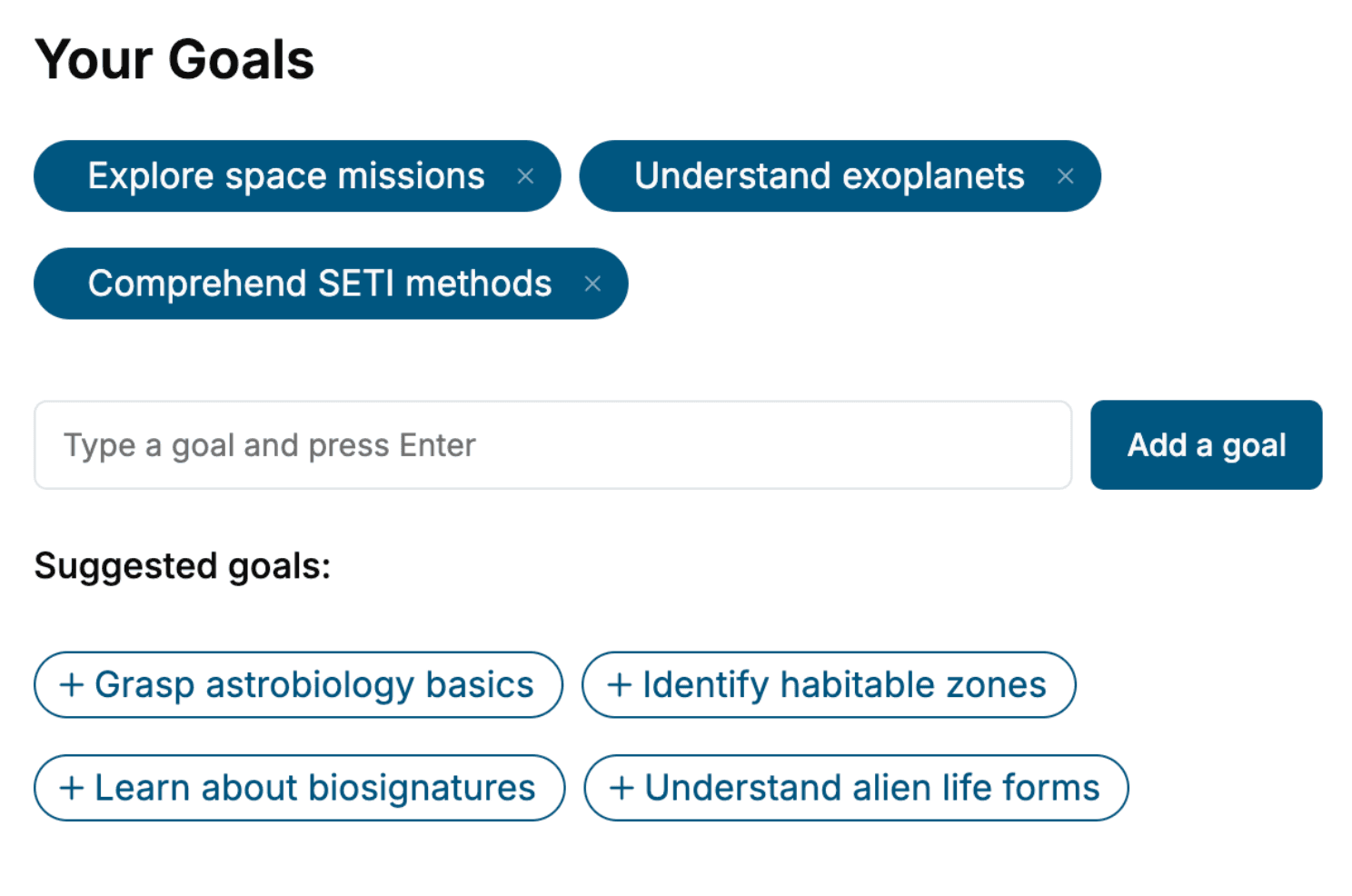
- 1. Select your focus
Select the focus of your Data Science book and share your background
- 2. Personalize your book
Specify your goals and choose sub-topics to include
- 3. Get your tailored book
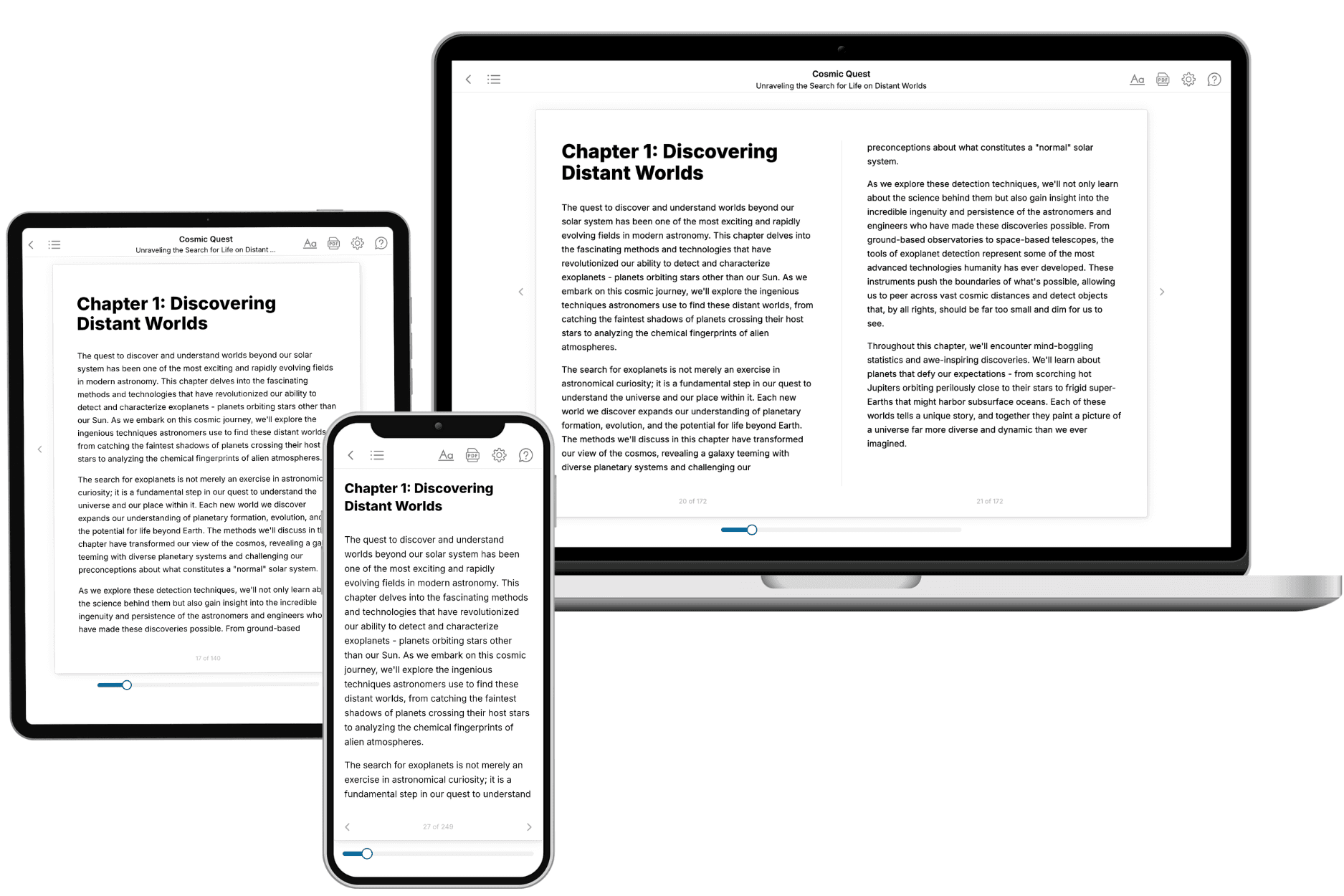
Your book is ready in 10 minutes. Read it online, download as EPUB or PDF, or send to Kindle.

Frequently asked questions
- What is TailoredRead?
TailoredRead creates complete, full-length nonfiction ebooks, written specifically for you. Tell us what you want to learn and why, and TailoredRead writes you a complete ebook on it, with charts, tables, and diagrams throughout. Read it online, on Kindle, or on any e-reader, or download it as a PDF or EPUB. Every book is written fresh the day you order it.
- How is the book tailored to me?
Before anything is written, you answer a few short questions about your goals, your background, and the topics you care about. Your book is then planned around your answers: written at your level, focused on your goals, and covering the topics you chose, instead of the one-size-fits-all book a store sells everyone.
- Will it read like generic AI content?
No. Your book isn't a chat transcript: it's planned chapter by chapter before a single word is written, told in a clear book voice, and explains ideas visually with charts, tables, and diagrams. After writing, every book goes through an editorial pass that polishes chapters so the book reads consistent from start to finish. Judge for yourself: browse thousands of sample books on our Explore Books page.
- How accurate is the content?
Our AI first checks whether your subject needs live research. Niche and fast-moving subjects are researched before writing, and the book plan and chapters are grounded in what it finds. After writing, every book goes through a quality pass that checks its facts and consistency, and researched books list their sources in a Notes section at the back.
- How long is the book?
You choose the length: Comprehensive (250-300 pages), Detailed (150-200 pages), Essential (70-100 pages), or Short (30-50 pages).
- Does the book include visuals?
Yes. Every book includes charts, tables, and diagrams: timelines, checklists, step-by-step guides, decision trees, comparison tables, matrices, and bar charts. A typical book includes dozens of these visual elements.
- Can I read it on Kindle? What formats can I download?
Yes. Every book can be read in our online reader or downloaded as a PDF or EPUB. The EPUB can be opened with Kindle, Apple Books, Kobo, and any e-reader. The Commercial and Author licenses also include an editable Word (DOCX) and Markdown download.
- How much does it cost?
About the price of a regular ebook. The exact price depends on your book's length and complexity, from $2 for the shortest books to $35 for the most comprehensive, and it's shown when you review your book, before you commit to anything. Each book is a one-time purchase, yours to keep, no subscription. Licenses that let you share, teach, or publish your book range from $35.99 to $49.99.
- Can I preview the book before purchasing?
Before you pay, you'll see what your book will cover: the title, a detailed description, the estimated length, and the complete chapter-by-chapter table of contents, so you know what you're getting before you decide. The full text itself is written after you purchase.
- How long does it take to create a book?
About 10 minutes. You can start reading the opening chapters while the rest is still being written.