The 2025 Muscle Blueprint
Cutting-Edge Strategies for Optimal Bodybuilding Gains
Picture yourself with the physique you've always dreamed of – lean, muscular, and perfectly sculpted.
269 pages13 chaptersJul 29, 2025BodybuildingCreated by Stuart
About this book
Imagine having the knowledge to achieve this ideal body efficiently and effectively, backed by the latest scientific research. "The 2025 Muscle Blueprint" is your comprehensive guide to turning this vision into reality. In this groundbreaking book, you'll discover cutting-edge approaches to bodybuilding that go beyond traditional methods. You'll learn how to tailor your workouts for maximum muscle hypertrophy, optimize your nutrition and supplement regimen, and enhance your recovery processes for faster gains. With a focus on the latest advancements in exercise science and nutrition, this book provides you with the tools to take your physique to the next level. Whether you're looking to break through a plateau, prevent injuries, or simply achieve better results in less time, "The 2025 Muscle Blueprint" has you covered. You'll gain insights into advanced periodization techniques, learn how to track your performance metrics effectively, and understand the intricate balance of hormonal optimization for muscle growth. This isn't just another bodybuilding book – it's a roadmap to your best physique, backed by science and tailored to your individual needs.
Table of contents
- IntroductionThe New Era of Bodybuilding, The Science and Art of Muscle Growth, What to Expect from This Book, The Importance of PersonalizationRead below
- Chapter 1: The Science of Muscle GrowthUnderstanding Muscle Physiology, Mechanics of Hypertrophy, Anabolic vs. Catabolic Processes, Genetic Factors in Muscle Building
- Chapter 2: Advanced Training PrinciplesProgressive Overload Techniques, Optimizing Volume and Intensity, Strategic Exercise Selection, Effective Rep Ranges for Growth, Rest Intervals and Their Impact
- Chapter 3: Designing Your Optimal WorkoutCrafting Effective Split Routines, Optimizing Training Frequency, Strategic Exercise Ordering, Tempo Manipulation for Growth
- Chapter 4: Advanced Training TechniquesDrop Sets and Supersets, Eccentric Training Methods, Blood Flow Restriction Training, Isometric Holds and Pauses, Cluster Sets for Strength and Size
- Chapter 5: Nutrition Fundamentals for Muscle GrowthCalculating Your Caloric Needs, Optimal Macronutrient Balance, Protein Requirements for Bodybuilders, Carbohydrate Strategies for Energy, The Role of Healthy Fats
- Chapter 6: Meal Timing and FrequencyPre-Workout Nutrition Strategies, The Post-Workout Anabolic Window, Nutrient Timing Throughout the Day, Meal Frequency and Muscle Growth
- Chapter 7: The Ultimate Supplement GuideProtein Supplements: Types and Usage, Creatine: Benefits and Protocols, BCAAs and EAAs: Do You Need Them?, Pre-Workout Formulas: Fact vs. Fiction, Natural Testosterone Boosters
- Chapter 8: Recovery and Growth OptimizationSleep and Its Impact on Muscle Growth, Stress Management for Better Gains, Active Recovery Techniques, Foam Rolling and Mobility Work
- Chapter 9: Hormonal Optimization for Muscle GrowthNatural Testosterone Optimization, Boosting Growth Hormone Naturally, Managing Cortisol for Better Gains, Improving Insulin Sensitivity
- Chapter 10: Periodization for Consistent GainsLinear Periodization Models, Undulating Periodization Strategies, Block Periodization for Bodybuilders, Deload Strategies for Recovery
- Chapter 11: Injury Prevention and LongevityThe Importance of Proper Form, Effective Warm-Up Protocols, Maintaining Joint Health, Recognizing and Avoiding Overtraining, Rehabilitation Techniques for Common Injuries
- Chapter 12: Tracking Progress and PerformanceMeasuring Body Composition, Tracking Strength Metrics, The Art of Progress Photos, Using Apps and Technology for Tracking
- Chapter 13: Mindset and MotivationEffective Goal Setting Strategies, Developing Mental Toughness, Visualization Techniques for Success, Building Consistency and Habits
- ConclusionKey Takeaways, Future Trends in Bodybuilding, Final Thoughts and Encouragement
- AppendixSample Workout Routines, Sample Meal Plans, Recommended Supplement Stacks
- Glossary
Introduction
Welcome to "The 2025 Muscle Blueprint: Cutting-Edge Strategies for Optimal Bodybuilding Gains." This comprehensive guide is designed to revolutionize your approach to bodybuilding, providing you with the most up-to-date, scientifically-backed strategies to maximize muscle growth and achieve your ideal physique. As a dedicated bodybuilder or fitness enthusiast with intermediate knowledge, you're about to embark on a journey that will transform your understanding of muscle building and elevate your training to new heights.
In the ever-evolving world of fitness and bodybuilding, staying ahead of the curve is crucial. This book serves as your roadmap to navigating the complex landscape of muscle growth, offering insights into cutting-edge techniques, nutrition strategies, and recovery methods that will propel you towards your goals. By delving into the intricate science behind muscle hypertrophy and combining it with practical, actionable advice, "The 2025 Muscle Blueprint" bridges the gap between theory and application, ensuring that you're equipped with the knowledge to make informed decisions about your training and lifestyle.
Throughout this book, you'll discover that muscle growth is far more than just lifting weights and eating protein. It's a multifaceted process influenced by a myriad of factors, including training methodology, nutritional precision, recovery optimization, and hormonal balance. We'll explore each of these elements in depth, providing you with a holistic understanding of what it takes to build muscle efficiently and effectively in the modern era of bodybuilding.
As we journey through the chapters ahead, you'll learn how to personalize your approach to bodybuilding, recognizing that there's no one-size-fits-all solution to muscle growth. You'll gain insights into advanced training principles, discover how to design optimal workout routines, and master the art of progressive overload. We'll delve into the latest research on nutrition and supplementation, helping you fine-tune your diet for maximum gains. Moreover, you'll learn the importance of recovery and how to optimize it, ensuring that your hard work in the gym translates into tangible results.
By the time you reach the final page, you'll have a comprehensive understanding of the most effective strategies for building muscle, preventing injuries, and achieving long-term success in bodybuilding. Whether you're looking to break through a plateau, accelerate your gains, or simply refine your approach to training and nutrition, "The 2025 Muscle Blueprint" will serve as your ultimate guide to sculpting the physique you've always dreamed of.
The New Era of Bodybuilding
The world of bodybuilding has undergone a remarkable transformation in recent years, ushering in a new era that combines traditional wisdom with cutting-edge science. Gone are the days when bodybuilding was solely about lifting heavy weights and consuming massive amounts of protein. Today's approach is far more nuanced, integrating advanced training techniques, precise nutritional strategies, and a deep understanding of human physiology to achieve optimal results.
This new era of bodybuilding is characterized by a shift towards evidence-based practices. Scientific research has become the cornerstone of modern muscle-building strategies, allowing bodybuilders to make informed decisions about their training and nutrition. Studies in exercise physiology, nutrition science, and endocrinology have provided invaluable insights into the mechanisms of muscle growth, revolutionizing our understanding of how to stimulate hypertrophy effectively[1].
One of the most significant advancements in this new era is the emphasis on personalization. It's now widely recognized that individual genetic factors, body types, and even lifestyle considerations play crucial roles in determining the most effective approach to muscle building. This shift has led to the development of sophisticated tools and methodologies for tailoring training programs, nutrition plans, and recovery strategies to meet the unique needs of each bodybuilder.
Technology has also played a pivotal role in shaping the new era of bodybuilding. From wearable devices that track performance metrics to advanced imaging techniques that measure muscle growth with unprecedented accuracy, technology has provided bodybuilders with powerful tools to monitor their progress and make data-driven decisions. Apps and online platforms have made it easier than ever to access expert knowledge, track workouts, and analyze nutritional intake, putting a wealth of information at your fingertips.
Another hallmark of this new era is the holistic approach to muscle building. Today's bodybuilders recognize that achieving optimal gains requires more than just time in the gym. Factors such as sleep quality, stress management, and overall lifestyle choices are now understood to have significant impacts on muscle growth and recovery. This comprehensive view has led to the integration of practices like meditation, yoga, and other stress-reduction techniques into many bodybuilders' routines.
The supplement industry has also evolved dramatically, moving away from overhyped "magic bullets" towards scientifically-validated products that support muscle growth and recovery. Advances in supplement formulation and delivery systems have resulted in more effective products, while increased scrutiny and regulation have helped to ensure safety and efficacy. As a result, today's bodybuilders have access to a range of supplements that can genuinely enhance their results when used in conjunction with proper training and nutrition.
In this new era, the concept of functional muscle has gained prominence. While aesthetic goals remain important, there's an increasing focus on building muscle that enhances overall athletic performance and supports long-term health. This shift has led to the incorporation of more diverse training modalities, including functional movements, plyometrics, and sport-specific exercises, into bodybuilding routines.
The rise of social media and online communities has also transformed the bodybuilding landscape. These platforms have created unprecedented opportunities for knowledge sharing, allowing bodybuilders to connect with experts and peers from around the world. However, this abundance of information also presents challenges, as it can be difficult to distinguish between credible advice and misinformation. This book aims to cut through the noise, providing you with evidence-based strategies that have been proven effective in the real world.
As we delve deeper into "The 2025 Muscle Blueprint," you'll discover how to harness the power of these advancements to accelerate your muscle-building journey. By embracing the principles of this new era of bodybuilding, you'll be equipped to achieve results that were once thought impossible, pushing the boundaries of your genetic potential and sculpting a physique that stands as a testament to your dedication and knowledge.
The Science and Art of Muscle Growth
Muscle growth, or hypertrophy, is a fascinating process that lies at the intersection of science and art. While scientific research provides us with a deep understanding of the physiological mechanisms behind muscle growth, the application of this knowledge in real-world training scenarios requires an artistic touch. This blend of science and art is what makes bodybuilding such a complex and rewarding pursuit.
At its core, muscle hypertrophy is a biological process triggered by mechanical tension, metabolic stress, and muscle damage[2]. When you engage in resistance training, you create micro-tears in your muscle fibers. In response to this damage, your body initiates a complex cascade of cellular and molecular events aimed at repairing and strengthening the muscle tissue. This adaptive response is what leads to increases in muscle size and strength over time.
The science of muscle growth involves a deep understanding of various physiological systems. The endocrine system, for instance, plays a crucial role by regulating the release of anabolic hormones like testosterone and growth hormone, which are essential for muscle protein synthesis. The nervous system is equally important, as it controls muscle activation and adaptation to training stimuli. Nutrition science comes into play when considering the role of macronutrients and micronutrients in supporting muscle growth and recovery.
Recent advancements in molecular biology have provided unprecedented insights into the signaling pathways involved in muscle hypertrophy. Researchers have identified key proteins and genes that regulate muscle growth, such as mTOR (mammalian target of rapamycin) and satellite cells. Understanding these molecular mechanisms allows for more targeted approaches to training and nutrition, optimizing the conditions for muscle growth at a cellular level.
However, while science provides the foundation, the art of muscle growth lies in the practical application of this knowledge. Every individual responds differently to training stimuli, and what works for one person may not be optimal for another. This is where the artistry of bodybuilding comes into play. It requires a keen sense of body awareness, the ability to interpret subtle signals from your muscles, and the creativity to adjust your approach based on your unique response to different training and nutrition strategies.
The art of muscle building also involves mastering the mind-muscle connection. This concept, once dismissed as bro-science, has gained scientific credibility in recent years. Studies have shown that focusing on the targeted muscle during exercise can enhance muscle activation and potentially lead to greater hypertrophy[3]. Developing this connection requires practice and a deep understanding of proper form and technique for each exercise.
Another artistic aspect of muscle growth is the ability to design effective training programs. While scientific principles guide the overall structure, creating a program that is both effective and enjoyable requires creativity. This includes selecting exercises that target muscles from various angles, incorporating variety to prevent boredom and plateaus, and balancing different training modalities to stimulate all aspects of muscle growth.
The art of periodization - strategically manipulating training variables over time - is another crucial skill in optimizing muscle growth. This involves creatively structuring your training cycles to provide the right balance of stimulus and recovery, allowing for consistent progress while minimizing the risk of overtraining or injury.
Nutrition, too, has both scientific and artistic elements. While the science dictates your caloric and macronutrient needs, the art lies in creating meal plans that not only meet these requirements but are also enjoyable and sustainable. This might involve experimenting with different food combinations, cooking methods, and meal timings to find what works best for your body and lifestyle.
The psychological aspect of bodybuilding is perhaps where the art is most evident. Building muscle requires tremendous mental fortitude, discipline, and patience. Developing the mindset to push through challenging workouts, adhere to strict nutrition plans, and persist even when progress seems slow is as much an art as it is a science. Visualization techniques, goal-setting strategies, and methods for maintaining motivation all fall into this artistic realm.
As you progress through "The 2025 Muscle Blueprint," you'll learn how to masterfully blend the science and art of muscle growth. You'll gain a deep understanding of the physiological processes underlying hypertrophy, while also developing the skills to apply this knowledge in a way that's tailored to your unique body and goals. By embracing both the scientific principles and the artistic nuances of bodybuilding, you'll be well-equipped to sculpt your physique with precision and creativity.
What to Expect from This Book
"The 2025 Muscle Blueprint" is designed to be your comprehensive guide to achieving optimal bodybuilding gains. As you journey through its pages, you'll find a wealth of information, strategies, and practical advice that will transform your approach to muscle building. This book is not just a collection of theories; it's a roadmap to real-world results, backed by the latest scientific research and proven techniques used by successful bodybuilders and fitness professionals.
In the chapters that follow, you'll dive deep into the multifaceted world of muscle growth. We'll start by exploring the fundamental science behind muscle hypertrophy, providing you with a solid foundation of knowledge that will inform all aspects of your training and nutrition. You'll learn about the physiological processes that drive muscle growth, the role of different energy systems, and how various factors like genetics and hormones influence your muscle-building potential.
The book will then guide you through advanced training principles that go beyond basic lifting techniques. You'll discover how to optimize your training volume and intensity, master the art of progressive overload, and implement advanced techniques like drop sets, eccentric training, and blood flow restriction training. These strategies will help you break through plateaus and stimulate new muscle growth, even if you've been training for years.
A significant portion of the book is dedicated to nutrition and supplementation, areas that are often misunderstood or overcomplicated. You'll learn how to calculate your precise caloric needs for muscle growth, optimize your macronutrient ratios, and time your nutrient intake for maximum anabolic effect. We'll also cut through the hype surrounding supplements, providing evidence-based recommendations on which products can truly enhance your results and how to use them effectively.
Recovery and injury prevention are crucial aspects of successful bodybuilding that are often overlooked. This book will teach you how to optimize your recovery through proper sleep hygiene, stress management techniques, and active recovery methods. You'll also learn about the importance of mobility work and proper form in preventing injuries, ensuring that you can train consistently and intensely for years to come.
One of the unique features of "The 2025 Muscle Blueprint" is its focus on hormonal optimization. You'll gain insights into how different hormones affect muscle growth and learn natural strategies to optimize your hormonal environment for maximum gains. This includes techniques for boosting testosterone, managing cortisol levels, and improving insulin sensitivity - all without resorting to harmful substances.
The book also delves into the crucial topic of periodization, teaching you how to structure your training over weeks, months, and even years to ensure consistent progress. You'll learn about different periodization models and how to apply them to your own training, allowing you to avoid plateaus and continue making gains long-term.
Throughout the book, you'll find practical examples, sample workout routines, and meal plans that illustrate how to apply the concepts in real-life situations. These resources will help you translate the knowledge you gain into actionable steps, making it easier to implement changes in your own training and nutrition regimen.
We'll also explore the psychological aspects of bodybuilding, providing strategies for goal setting, maintaining motivation, and developing the mental toughness required to push through challenging workouts and stick to your nutrition plan. These mental tools are often the difference between those who achieve their dream physique and those who fall short.
As we near the conclusion, you'll learn how to effectively track your progress using various metrics and technologies. This data-driven approach will allow you to make informed decisions about your training and nutrition, ensuring that you're always moving in the right direction.
Finally, the book will look towards the future, discussing emerging trends and technologies in the world of bodybuilding. This forward-looking perspective will help you stay ahead of the curve and continue to optimize your approach as new research and techniques emerge.
By the time you finish "The 2025 Muscle Blueprint," you'll have a comprehensive understanding of what it takes to build muscle effectively in the modern era. More importantly, you'll have the tools and knowledge to create a personalized plan that aligns with your unique goals, body type, and lifestyle. This book is not just about providing information; it's about empowering you to become your own expert, capable of making informed decisions that will drive your bodybuilding success for years to come.
The Importance of Personalization
In the world of bodybuilding and muscle growth, one size does not fit all. The importance of personalization cannot be overstated when it comes to optimizing your training, nutrition, and recovery strategies. While general principles of muscle building apply to everyone, the specific approach that will yield the best results can vary significantly from person to person. Understanding and embracing this concept of personalization is crucial for achieving your maximum potential in bodybuilding.
Genetic factors play a significant role in how individuals respond to training and nutrition interventions. Research has shown that there can be high, medium, and low responders to resistance training, with some individuals gaining muscle more easily than others[4]. This variability is influenced by factors such as muscle fiber type distribution, hormone levels, and even the expression of certain genes related to muscle growth.
Body type, or somatotype, is another crucial factor that necessitates personalization. Whether you're an ectomorph (naturally thin), mesomorph (naturally muscular), or endomorph (naturally heavier), your body type can influence how you respond to different training volumes, intensities, and nutritional strategies. For instance, an ectomorph might require a higher caloric intake and lower training volume to gain muscle, while an endomorph might benefit from more frequent, higher-volume training sessions and stricter dietary control.
Individual differences in recovery capacity also play a significant role in determining the optimal training frequency and volume. Some individuals can handle and benefit from high-frequency training, while others may require more rest between sessions to avoid overtraining. Factors such as sleep quality, stress levels, and overall lifestyle can all impact recovery capacity and, consequently, the ideal training approach.
Nutritional needs can vary widely between individuals, even among those with similar body types and goals. Factors such as metabolic rate, insulin sensitivity, and food intolerances can all influence the ideal macronutrient ratios, meal timing, and overall caloric intake for muscle growth. What works perfectly for one person might lead to suboptimal results or even negative effects for another.
The concept of personalization extends to exercise selection as well. While certain compound movements are generally beneficial for most bodybuilders, individual biomechanics, injury history, and even personal preferences can influence which exercises are most effective and sustainable for each person. Some individuals might find that their muscles respond better to certain movement patterns or angles of resistance, necessitating a tailored approach to exercise selection.
Hormonal profiles can vary significantly between individuals and can have a profound impact on muscle-building potential. Factors such as natural testosterone levels, cortisol responsiveness, and growth hormone production can all influence how an individual responds to training and nutrition interventions. Understanding your hormonal profile and how to optimize it through lifestyle and training choices is a key aspect of personalization in bodybuilding.
Psychological factors also play a crucial role in the need for personalization. Motivation levels, stress tolerance, and even personality traits can influence the type of training program and nutritional approach that an individual can adhere to long-term. A program that looks perfect on paper but doesn't align with your psychological profile is unlikely to yield optimal results.
The concept of nutrient partitioning - how your body distributes the calories you consume between muscle tissue and fat stores - can also vary between individuals. Some people naturally partition nutrients more favorably towards muscle growth, while others may need to be more strategic with their nutrition to avoid excessive fat gain while building muscle.
Given these numerous factors that can influence muscle growth, it's clear that a one-size-fits-all approach is far from ideal. Instead, the most effective bodybuilding strategy is one that takes into account your unique characteristics, preferences, and responses to different interventions. This is where the art of bodybuilding comes into play, as it requires careful observation, experimentation, and adjustment to find what works best for you.
Throughout "The 2025 Muscle Blueprint," you'll learn how to personalize various aspects of your bodybuilding approach. This includes techniques for assessing your body type and genetic predispositions, methods for tracking your response to different training and nutrition strategies, and guidelines for adjusting your approach based on your individual progress and feedback.
Remember, personalization is an ongoing process. As you progress in your bodybuilding journey, your body will change, and so too might your response to certain strategies. Continual self-assessment and willingness to adjust your approach are key to long-term success. By embracing the principle of personalization, you'll be able to create a bodybuilding plan that's perfectly tailored to your unique needs, maximizing your potential for muscle growth and overall physique development.
Notes
Introduction
- 1. B. J. Schoenfeld, "The mechanisms of muscle hypertrophy and their application to resistance training," Journal of Strength and Conditioning Research, 2010
- 2. B. J. Schoenfeld, "The mechanisms of muscle hypertrophy and their application to resistance training," Journal of Strength and Conditioning Research, 2010
- 3. B. J. Schoenfeld and B. Contreras, "Attentional focus for maximizing muscle development," Strength and Conditioning Journal, 2016
- 4. M. J. Hubal and others, "Variability in muscle size and strength gain after unilateral resistance training," Medicine and science in sports and exercise, 2005
This is the end of the free sample. The full book has 13 chapters.
Want this book written for you?
Tell us your goals and background, and get your own version of this book, tailored by AI to you.


Benefits of AI-tailored books
- Read one book, not ten:
- all the Bodybuilding knowledge you need, gathered into a single book.
- Save days of learning:
- tell us your goals, choose your topics, and the whole book is built around them.
- Learn effortlessly:
- Bodybuilding book written for your specific background and expertise.
- Understand at a glance:
- includes charts, tables, timelines, checklists, decision trees, and more.
- Stay current:
- written the day you order it, not years ago.
- Trust what you read:
- every book is checked for accuracy, with real research when your subject needs it.
Create your unique book in 3 steps
- 1. Select your focus
Select the focus of your Bodybuilding book and share your background
- 2. Personalize your book
Specify your goals and choose sub-topics to include
- 3. Get your tailored book
Your book is ready in 10 minutes. Read it online, download as EPUB or PDF, or send to Kindle.

Frequently asked questions
- What is TailoredRead?
TailoredRead creates complete, full-length nonfiction ebooks, written specifically for you. Tell us what you want to learn and why, and TailoredRead writes you a complete ebook on it, with charts, tables, and diagrams throughout. Read it online, on Kindle, or on any e-reader, or download it as a PDF or EPUB. Every book is written fresh the day you order it.
- How is the book tailored to me?
Before anything is written, you answer a few short questions about your goals, your background, and the topics you care about. Your book is then planned around your answers: written at your level, focused on your goals, and covering the topics you chose, instead of the one-size-fits-all book a store sells everyone.
- Will it read like generic AI content?
No. Your book isn't a chat transcript: it's planned chapter by chapter before a single word is written, told in a clear book voice, and explains ideas visually with charts, tables, and diagrams. After writing, every book goes through an editorial pass that polishes chapters so the book reads consistent from start to finish. Judge for yourself: browse thousands of sample books on our Explore Books page.
- How accurate is the content?
Our AI first checks whether your subject needs live research. Niche and fast-moving subjects are researched before writing, and the book plan and chapters are grounded in what it finds. After writing, every book goes through a quality pass that checks its facts and consistency, and researched books list their sources in a Notes section at the back.
- How long is the book?
You choose the length: Comprehensive (250-300 pages), Detailed (150-200 pages), Essential (70-100 pages), or Short (30-50 pages).
- Does the book include visuals?
Yes. Every book includes charts, tables, and diagrams: timelines, checklists, step-by-step guides, decision trees, comparison tables, matrices, and bar charts. A typical book includes dozens of these visual elements.
- Can I read it on Kindle? What formats can I download?
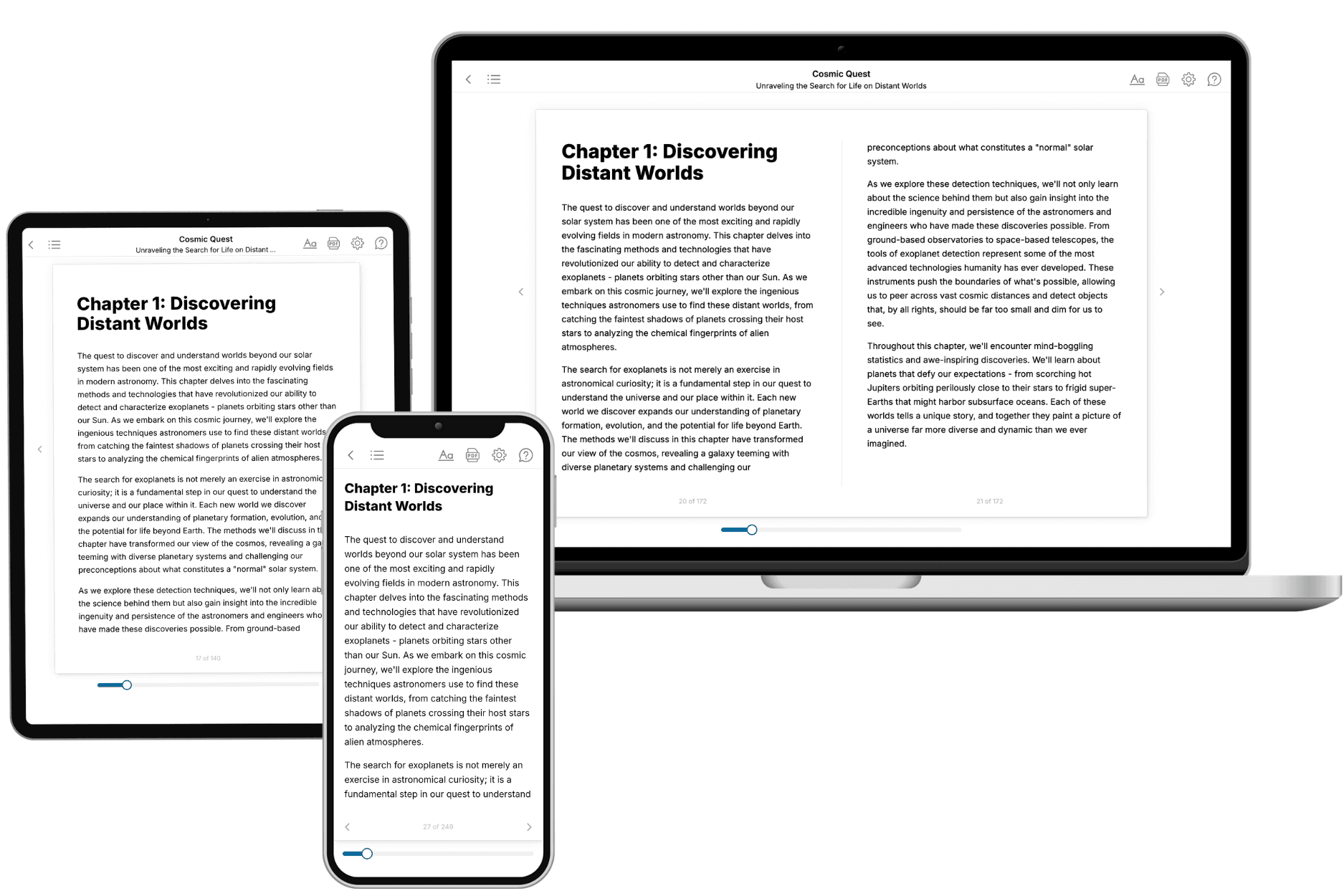
Yes. Every book can be read in our online reader or downloaded as a PDF or EPUB. The EPUB can be opened with Kindle, Apple Books, Kobo, and any e-reader. The Commercial and Author licenses also include an editable Word (DOCX) and Markdown download.
- How much does it cost?
About the price of a regular ebook. The exact price depends on your book's length and complexity, from $2 for the shortest books to $35 for the most comprehensive, and it's shown when you review your book, before you commit to anything. Each book is a one-time purchase, yours to keep, no subscription. Licenses that let you share, teach, or publish your book range from $35.99 to $49.99.
- Can I preview the book before purchasing?
Before you pay, you'll see what your book will cover: the title, a detailed description, the estimated length, and the complete chapter-by-chapter table of contents, so you know what you're getting before you decide. The full text itself is written after you purchase.
- How long does it take to create a book?
About 10 minutes. You can start reading the opening chapters while the rest is still being written.