The 2025 Sports Card Collector's Playbook
Master Authentication, Grading Strategy, and Portfolio Building to Maximize Your Collection's Value
What if the difference between a worthless counterfeit and a valuable investment comes down to three specific authentication techniques you haven't mastered yet?
191 pages8 chaptersJan 4, 2026Sports Cards CollectingCreated by Ryan
About this book
This practical guide cuts through the noise of sports card collecting to give you the exact strategies used by serious collectors and investors to spot fakes, optimize grading decisions, and build portfolios that actually appreciate. You'll learn how to authenticate cards using hologram verification and print variation analysis, understand the 2025 PSA grading shifts that are reshaping the market, and identify undervalued cards before other collectors catch on. Whether you're tracking rookie card trends, predicting breakout players, or building investment-grade sets, this book provides the frameworks and tools to make data-driven decisions. From navigating online auctions to assessing market volatility, you'll gain the confidence to manage your collection strategically and maximize returns while minimizing risk.
Table of contents
- IntroductionWhy 2025 Marks a Turning Point for Collectors, Your Collecting Roadmap: From Casual to Strategic, How to Use This Book to Achieve Your GoalsRead below
- Chapter 1: Authentication Mastery: Spotting Counterfeits Like a ProThe 2025 Counterfeit Landscape: What's Changed, Hologram Verification Techniques and Red Flags, Print Variation Analysis: Spotting Fakes Through Details, Essential Authentication Tools and How to Use Them
- Chapter 2: Grading Strategy Development: Maximizing Slab ValueUnderstanding PSA Grading Shifts in 2025, Condition Grading Consistency and Slab Quality Evaluation, Grading Submission Timing: When to Send and When to Hold, Raw Cards vs. Slabbed Cards: Strategic Decision-Making
- Chapter 3: Card Valuation Fundamentals: From Vintage to EmergingVintage Card Valuation: Rarity, Condition, and Market Demand, Rookie Card Trend Analysis and Breakout Prediction, Identifying Emerging Athlete Cards Before They Spike, Cross-Platform Price Comparison and Undervalued Card Identification
- Chapter 4: Sports Card Economics: Understanding Market DynamicsSupply and Demand Principles in Card Markets, Market Volatility Assessment and Risk Management, Resale Market Dynamics and Timing Your Sales, Social Media Impact on Card Values and Trends
- Chapter 5: Building Investment-Grade Collections: Strategic Portfolio DevelopmentPortfolio Diversification Across Players, Eras, and Sports, Investment-Grade Set Building and Niche Player Portfolios, Collection ROI Optimization: Maximizing Returns on Investment, Long-Term Value Projection and Portfolio Positioning
- Chapter 6: Collection Management and Preservation: Protecting Your AssetsStorage Best Practices and Environmental Control, Preservation Techniques for Long-Term Card Health, Collection Insurance Optimization and Documentation, Batch Lot Analysis Strategy for Bulk Acquisitions
- Chapter 7: Online Auction Tactics and Trading StrategiesOnline Auction Fundamentals and Platform Dynamics, Bidding Strategy and Speculative Buy Timing, Seller Tactics and Negotiation Techniques, Emerging Sports and Alternative Card Categories
- Chapter 8: Leveraging Collector Communities: Networks and IntelligenceBuilding and Leveraging Collector Networks, Gathering Market Intelligence from Community Sources, Finding Deal Opportunities Through Community Connections
- Conclusion: Your 2025 Collecting Action PlanKey Takeaways and Strategic Priorities, Your Next Steps to Implement These Strategies
- Glossary of Sports Card Terms and Grading Standards
- Further Reading and Resources
Introduction
The sports card market has transformed dramatically over the past few years, evolving from a nostalgic hobby into a sophisticated investment arena where six-figure transactions occur daily. What once seemed like a simple pastime of collecting favorite players has become a complex ecosystem requiring authentication expertise, market analysis skills, and strategic portfolio management. The difference between collectors who build valuable portfolios and those who accumulate worthless cardboard often comes down to knowledge—specifically, understanding authentication techniques, grading dynamics, and market timing that separate genuine investments from costly mistakes.
You've likely already experienced the thrill of acquiring cards and watching certain pieces appreciate in value. Perhaps you've also felt the frustration of missing opportunities, overpaying for cards that declined in value, or wondering whether that vintage card you're eyeing is authentic or a sophisticated counterfeit. These challenges aren't unique to you. Thousands of collectors at the intermediate level face the same crossroads: they understand the basics but lack the advanced strategies needed to compete with serious investors and dealers who consistently identify undervalued cards before the broader market catches on.
This book exists to bridge that gap. Rather than rehashing basic collecting principles you already know, it provides the specific frameworks, authentication techniques, and market analysis tools that transform casual collecting into strategic portfolio building. You'll learn how to spot counterfeits using multi-layered verification methods, understand the 2025 PSA grading changes that are reshaping submission strategies, and identify emerging players before their cards spike in value. More importantly, you'll develop the analytical mindset that allows you to make data-driven decisions rather than emotional purchases, positioning your collection for long-term appreciation while managing downside risk.
Why 2025 Marks a Turning Point for Collectors
The sports card market in 2025 operates under fundamentally different conditions than even two years ago. Several converging factors have created both unprecedented opportunities and significant risks for collectors. First, the counterfeit problem has escalated dramatically, with sophisticated operations producing fake slabs, holograms, and print variations that fool even experienced collectors using outdated authentication methods. Second, PSA—the industry's dominant grading company—implemented significant standard adjustments in late 2024 that affect how cards are evaluated, particularly regarding centering tolerances and surface assessment. These changes mean cards submitted today may receive different grades than identical cards submitted eighteen months ago, creating both confusion and strategic opportunities for collectors who understand the shifts.
Third, the market has experienced substantial volatility corrections after the 2020-2021 boom period. Cards that sold for five or ten times their historical values have returned to more sustainable price levels, creating buying opportunities for strategic collectors while punishing those who purchased at peak prices without understanding market cycles. This correction has separated speculative flippers from serious collectors, and the current market rewards those who can identify genuine value rather than chase hype. Understanding these dynamics allows you to position your collection to benefit from the next appreciation cycle rather than getting caught in another downturn.
Fourth, emerging sports and alternative card categories have gained significant traction. Women's basketball, soccer, and even non-traditional sports have developed robust collector bases with cards appreciating rapidly as these sports gain mainstream attention. The collector who diversifies strategically across these emerging categories—rather than concentrating exclusively in traditional baseball and basketball—gains exposure to growth opportunities that most collectors overlook. This diversification also provides portfolio stability when individual sports or player categories experience temporary declines.
Fifth, the integration of social media and real-time market data has accelerated price discovery and trend propagation. A player's breakout performance can trigger immediate card value spikes within hours, not days or weeks. This acceleration creates opportunities for collectors who monitor the right signals and act decisively, but it also means that by the time mainstream collecting channels discuss a trend, the opportunity has often passed. Developing systems to identify these signals early—before they reach broader awareness—becomes a critical competitive advantage in the 2025 market environment.
Sixth, the authentication and grading infrastructure has become more sophisticated but also more complex. Multiple grading companies now compete with PSA, each with different standards, market acceptance levels, and pricing structures. Understanding when to use PSA versus alternatives like BGS, SGC, or CGC requires analyzing specific card categories, submission costs, turnaround times, and market premiums for different slabs. Making optimal grading decisions can mean the difference between a card worth hundreds versus thousands of dollars, yet most collectors default to PSA without considering whether alternative grading companies might provide better value for specific submissions.
Finally, the collector community itself has matured significantly. Online forums, Discord servers, and social media groups provide unprecedented access to market intelligence, deal opportunities, and collective expertise. However, navigating these communities effectively requires understanding their dynamics, building genuine relationships, and contributing value rather than simply extracting information. Collectors who leverage community networks strategically gain access to private sales, batch lot opportunities, and market insights unavailable through public channels. This community leverage has become as important as individual expertise in building high-value collections.
These seven factors combine to create a market environment where knowledge and strategy matter more than ever. The collectors who thrive in 2025 aren't necessarily those with the largest budgets, but those who understand authentication, grading dynamics, market cycles, and community leverage well enough to make consistently better decisions than their competition. This book provides the frameworks and specific techniques to develop that competitive advantage, regardless of your current collection size or budget constraints.
Your Collecting Roadmap: From Casual to Strategic
Transitioning from casual collecting to strategic portfolio building requires shifting your mindset from emotional attachment to analytical evaluation. This doesn't mean eliminating the enjoyment of collecting—quite the opposite. Strategic collectors often derive more satisfaction from their hobby because they're building something valuable rather than accumulating cards that depreciate. The roadmap involves developing competencies in four core areas: authentication mastery, grading optimization, valuation accuracy, and portfolio management. Each area builds on the others, creating a comprehensive skill set that transforms how you approach every acquisition, submission, and sale decision.
Authentication mastery forms the foundation because everything else becomes irrelevant if you're buying counterfeits. You'll learn to verify cards using multiple authentication layers rather than relying on single indicators that sophisticated counterfeiters have learned to replicate. This includes hologram verification techniques that go beyond simple visual inspection, print variation analysis that identifies subtle differences between authentic and fake cards, and understanding the specific counterfeiting methods used for different card eras and manufacturers. Mastering authentication doesn't require expensive equipment—most techniques use tools you already own or can acquire inexpensively—but it does require systematic application and attention to details most collectors overlook.
Grading optimization represents the second competency area. Understanding when to submit cards for grading, which grading company to use, and how to evaluate condition accurately before submission directly impacts your collection's value and your return on investment. The 2025 PSA standard shifts mean that cards you might have considered borderline for certain grades now have different submission value propositions. You'll learn to assess condition consistency, understand how graders evaluate specific defects, and time your submissions to maximize value while minimizing costs. This includes knowing when to hold raw cards versus when immediate grading makes strategic sense, and how to build submission batches that optimize your cost per card while maintaining quality standards.
Valuation accuracy forms the third competency. This goes beyond simply checking recent sales on eBay or COMC. You'll develop frameworks for assessing vintage card values based on rarity, condition, and market demand dynamics. You'll learn to identify rookie card trends before they become obvious to the broader market, spot emerging athletes whose cards remain undervalued, and conduct cross-platform price comparisons that reveal genuine deals versus overpriced listings. Valuation accuracy also means understanding market cycles—recognizing when specific player categories or card types are overheated versus when they're experiencing temporary corrections that create buying opportunities.
Portfolio management represents the integration of the previous three competencies into a coherent collection strategy. This includes diversification principles that reduce concentration risk, set building strategies that create value beyond individual card appreciation, and ROI optimization techniques that ensure your collecting activities generate positive returns over time. Portfolio management also involves understanding your own collecting goals and risk tolerance. Are you building a collection to hold for decades, or do you plan to turn over inventory regularly? Do you prefer the stability of established vintage cards or the growth potential of emerging players? Your answers to these questions should drive your acquisition strategy and portfolio composition.
The roadmap also includes developing systems and processes that make strategic collecting sustainable. This means creating authentication checklists you apply to every potential purchase, maintaining condition assessment standards that ensure grading consistency, tracking your collection's value and performance over time, and building relationships within collector communities that provide ongoing market intelligence. These systems prevent the emotional decision-making and inconsistent practices that undermine many collectors' results. They also make collecting more efficient—you'll spend less time second-guessing decisions and more time executing a clear strategy.
Throughout this journey, you'll encounter trade-offs and decisions that don't have single correct answers. Should you focus on depth within a specific player or team, or breadth across multiple categories? Should you prioritize condition quality or accept lower grades to acquire more cards within your budget? Should you submit cards immediately when you acquire them or wait to batch submissions for cost efficiency? This book provides frameworks for making these decisions based on your specific goals and circumstances, rather than prescribing one-size-fits-all solutions that ignore individual differences in collecting objectives and constraints.
The transition from casual to strategic collecting typically occurs in stages rather than overnight. You might start by applying authentication techniques to high-value purchases while continuing to buy lower-value cards more casually. You might focus initially on grading optimization for your existing collection before expanding into new acquisition strategies. This gradual approach allows you to develop competencies systematically while maintaining the enjoyment that drew you to collecting in the first place. The key is consistent application of strategic principles across an expanding portion of your collecting activities, gradually building the expertise and systems that characterize successful long-term collectors.
How to Use This Book to Achieve Your Goals
This book is structured to provide both comprehensive coverage and targeted reference material depending on your immediate needs. You can read it sequentially from beginning to end to build a complete strategic collecting framework, or you can jump directly to chapters addressing your most pressing challenges. Each chapter stands alone while also connecting to broader themes, allowing flexible navigation based on your priorities. However, if you're new to strategic collecting, reading sequentially provides the most coherent learning experience because later chapters build on concepts and terminology introduced earlier.
The chapter structure follows a logical progression from foundational skills to advanced strategies:
- Chapter 1: Authentication Mastery teaches you to spot counterfeits using hologram verification, print variation analysis, and multi-layered authentication techniques that protect you from costly mistakes
- Chapter 2: Grading Strategy Development explains the 2025 PSA standard shifts, condition assessment techniques, submission timing strategies, and when to grade versus hold raw cards
- Chapter 3: Card Valuation Fundamentals covers vintage card assessment, rookie card trend analysis, emerging athlete identification, and cross-platform price comparison methods
- Chapter 4: Sports Card Economics explores supply-demand dynamics, market volatility assessment, resale timing strategies, and social media's impact on card values
- Chapter 5: Building Investment-Grade Collections addresses portfolio diversification, set building strategies, ROI optimization, and long-term value projection techniques
- Chapter 6: Collection Management and Preservation details storage best practices, preservation techniques, insurance optimization, and batch lot analysis for bulk acquisitions
- Chapter 7: Online Auction Tactics provides bidding strategies, seller tactics, negotiation techniques, and guidance on emerging sports and alternative card categories
- Chapter 8: Leveraging Collector Communities explains how to build networks, gather market intelligence, and find deal opportunities through community connections
Each chapter includes specific, actionable techniques rather than generic advice. You'll find step-by-step processes for authentication checks, frameworks for evaluating grading decisions, checklists for condition assessment, and templates for tracking collection performance. These practical tools allow immediate implementation rather than requiring you to translate abstract concepts into concrete actions. When you finish a chapter, you should be able to apply what you learned to your next card purchase, grading submission, or portfolio decision within days, not months.
The book also includes numerous examples drawn from real market situations. These examples illustrate how strategic collectors apply the frameworks and techniques in practice, including both successful decisions and instructive mistakes. Learning from these examples helps you develop pattern recognition—the ability to quickly assess situations and apply appropriate strategies without extensive analysis each time. This pattern recognition becomes increasingly valuable as you gain experience, allowing faster and more confident decision-making in time-sensitive situations like online auctions or private sale opportunities.
To maximize your learning, consider implementing a practice-based approach as you read. When you encounter an authentication technique, apply it to cards you already own or are considering purchasing. When you learn about grading optimization, evaluate several cards in your collection using the condition assessment frameworks provided. When you study valuation methods, practice analyzing cards across different price points and categories. This active learning approach builds competency faster than passive reading alone, and it helps you identify areas where you need additional practice or clarification.
The book assumes you already understand basic collecting terminology and have some experience buying, selling, and evaluating cards. It doesn't spend time explaining what a rookie card is, how grading scales work at a basic level, or why condition matters. Instead, it builds on that foundation to provide advanced strategies and techniques that intermediate collectors need to reach the next level. If you encounter unfamiliar terms, the glossary at the end provides quick reference definitions. If you need deeper background on specific topics, the resources section points you toward additional learning materials.
Your goals should guide how you prioritize different chapters and techniques. If your primary concern is avoiding counterfeits on high-value vintage purchases, focus intensively on Chapter 1's authentication techniques before moving to other topics. If you're trying to optimize your grading submissions to improve ROI, Chapter 2 becomes your priority. If you're looking to identify undervalued cards before they spike, Chapters 3 and 4 provide the valuation and market analysis frameworks you need. The book's modular structure supports this goal-directed approach while ensuring you don't miss critical foundational concepts that support advanced techniques.
Finally, treat this book as a reference you'll return to repeatedly rather than a one-time read. As you gain experience and your collection evolves, different chapters will become relevant at different times. You might initially focus on authentication and grading, then return months later to dive deeper into portfolio diversification strategies as your collection grows. You might revisit the market economics chapter when you notice unusual volatility in specific card categories. This ongoing reference use ensures you continue extracting value from the book as your expertise develops and your collecting challenges evolve.
The sports card market will continue changing after this book's publication. New counterfeiting techniques will emerge, grading standards will evolve further, and market dynamics will shift in response to player performance, economic conditions, and collector sentiment. However, the frameworks and analytical approaches you'll learn remain applicable regardless of these changes. Understanding how to authenticate cards, evaluate condition, assess value, and manage portfolios strategically provides enduring advantages that transcend specific market conditions. These competencies allow you to adapt to changes rather than being disrupted by them, positioning you for long-term success regardless of how the market evolves in 2026, 2027, and beyond.
This is the end of the free sample. The full book has 8 chapters.
Want this book written for you?
Tell us your goals and background, and get your own version of this book, tailored by AI to you.


Benefits of AI-tailored books
- Read one book, not ten:
- all the Sports Cards Collecting knowledge you need, gathered into a single book.
- Save days of learning:
- tell us your goals, choose your topics, and the whole book is built around them.
- Learn effortlessly:
- Sports Cards Collecting book written for your specific background and expertise.
- Understand at a glance:
- includes charts, tables, timelines, checklists, decision trees, and more.
- Stay current:
- written the day you order it, not years ago.
- Trust what you read:
- every book is checked for accuracy, with real research when your subject needs it.
Create your unique book in 3 steps
- 1. Select your focus
Select the focus of your Sports Cards Collecting book and share your background
- 2. Personalize your book
Specify your goals and choose sub-topics to include
- 3. Get your tailored book
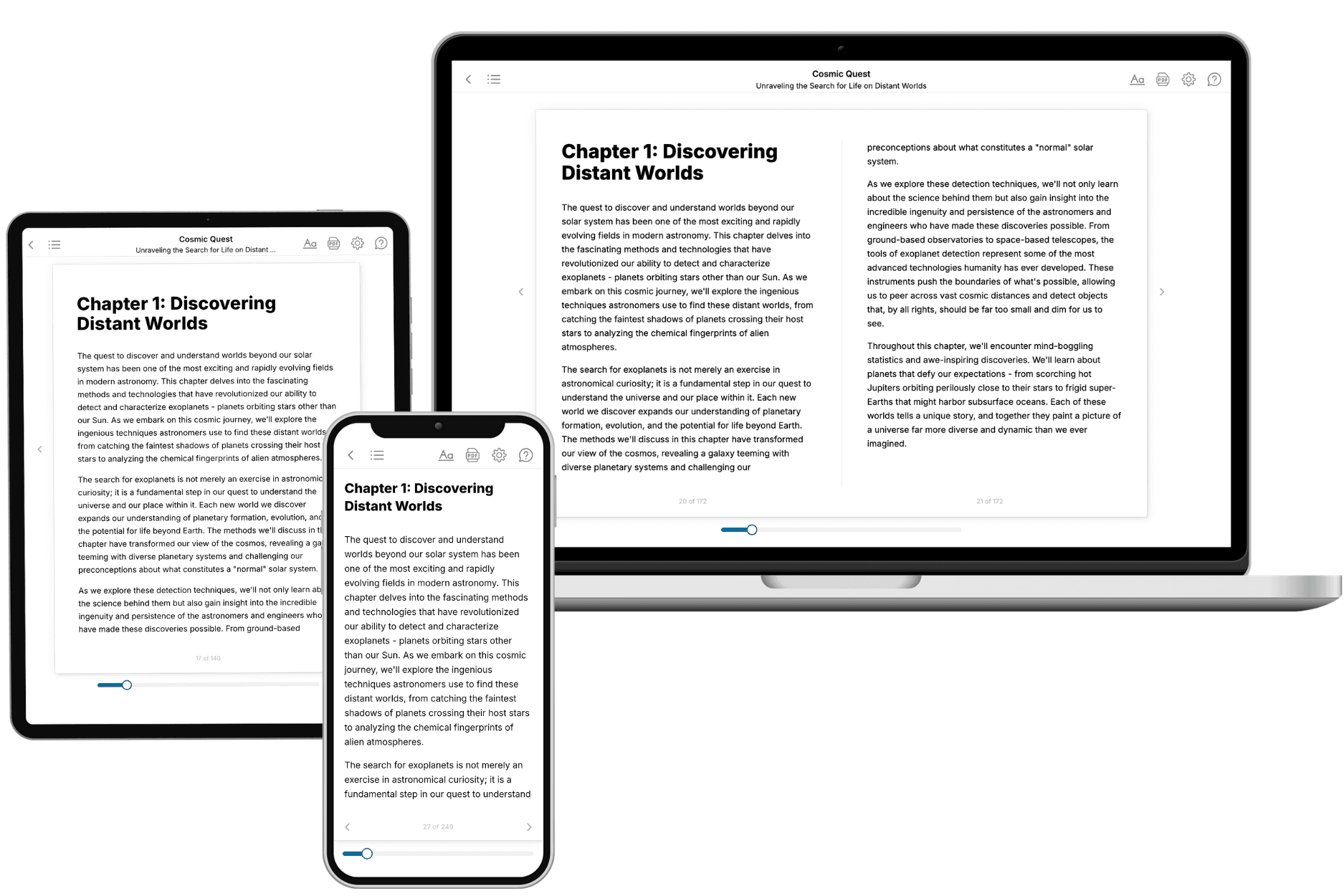
Your book is ready in 10 minutes. Read it online, download as EPUB or PDF, or send to Kindle.

Frequently asked questions
- What is TailoredRead?
TailoredRead creates complete, full-length nonfiction ebooks, written specifically for you. Tell us what you want to learn and why, and TailoredRead writes you a complete ebook on it, with charts, tables, and diagrams throughout. Read it online, on Kindle, or on any e-reader, or download it as a PDF or EPUB. Every book is written fresh the day you order it.
- How is the book tailored to me?
Before anything is written, you answer a few short questions about your goals, your background, and the topics you care about. Your book is then planned around your answers: written at your level, focused on your goals, and covering the topics you chose, instead of the one-size-fits-all book a store sells everyone.
- Will it read like generic AI content?
No. Your book isn't a chat transcript: it's planned chapter by chapter before a single word is written, told in a clear book voice, and explains ideas visually with charts, tables, and diagrams. After writing, every book goes through an editorial pass that polishes chapters so the book reads consistent from start to finish. Judge for yourself: browse thousands of sample books on our Explore Books page.
- How accurate is the content?
Our AI first checks whether your subject needs live research. Niche and fast-moving subjects are researched before writing, and the book plan and chapters are grounded in what it finds. After writing, every book goes through a quality pass that checks its facts and consistency, and researched books list their sources in a Notes section at the back.
- How long is the book?
You choose the length: Comprehensive (250-300 pages), Detailed (150-200 pages), Essential (70-100 pages), or Short (30-50 pages).
- Does the book include visuals?
Yes. Every book includes charts, tables, and diagrams: timelines, checklists, step-by-step guides, decision trees, comparison tables, matrices, and bar charts. A typical book includes dozens of these visual elements.
- Can I read it on Kindle? What formats can I download?
Yes. Every book can be read in our online reader or downloaded as a PDF or EPUB. The EPUB can be opened with Kindle, Apple Books, Kobo, and any e-reader. The Commercial and Author licenses also include an editable Word (DOCX) and Markdown download.
- How much does it cost?
About the price of a regular ebook. The exact price depends on your book's length and complexity, from $2 for the shortest books to $35 for the most comprehensive, and it's shown when you review your book, before you commit to anything. Each book is a one-time purchase, yours to keep, no subscription. Licenses that let you share, teach, or publish your book range from $35.99 to $49.99.
- Can I preview the book before purchasing?
Before you pay, you'll see what your book will cover: the title, a detailed description, the estimated length, and the complete chapter-by-chapter table of contents, so you know what you're getting before you decide. The full text itself is written after you purchase.
- How long does it take to create a book?
About 10 minutes. You can start reading the opening chapters while the rest is still being written.