Adaptive AI Mastery
A Practical Guide to Incremental Learning and Dynamic AI Systems
Many AI engineers struggle with static models that quickly become outdated in rapidly changing environments.
346 pages18 chaptersMar 21, 2025AI and Machine LearningCreated by Khaleel
About this book
You've likely faced the frustration of deploying a model only to see its performance degrade over time. Adaptive AI Mastery: A Practical Guide to Incremental Learning and Dynamic AI Systems is your comprehensive roadmap to overcoming these challenges. This book demystifies the complexities of adaptive AI, providing you with actionable strategies to implement incremental learning techniques and create AI systems that evolve with your data. From mastering online learning algorithms to optimizing model deployment, you'll gain the skills to build AI solutions that stay relevant in dynamic environments. Packed with real-world examples and hands-on exercises, this guide will elevate your AI engineering capabilities, enabling you to create more efficient, accurate, and scalable solutions that adapt to the ever-changing landscape of data.
Table of contents
- IntroductionThe Importance of Adaptive AI, Book Overview and Learning Objectives, The AI Engineer's Journey to Mastery, Understanding Dynamic DatasetsRead below
- Chapter 1: Foundations of Adaptive AIStatic vs. Adaptive AI Models, Principles of Incremental Learning, Online Learning Algorithms, Understanding Concept Drift
- Chapter 2: Data Stream ProcessingCharacteristics of Data Streams, Stream Processing Techniques, Windowing Strategies, Sampling and Synopsis Structures
- Chapter 3: Concept Drift Detection and AdaptationTypes of Concept Drift, Drift Detection Methods, Adaptation Strategies, Evaluating Drift Detection Performance
- Chapter 4: Adaptive Feature EngineeringAdaptive Feature Selection Techniques, Dynamic Feature Extraction, Incremental Principal Component Analysis, Tracking Feature Importance Over Time
- Chapter 5: Ensemble Learning for Adaptive AIAdaptive Ensemble Architectures, Online Bagging and Boosting, Dynamic Model Weighting, Ensemble Pruning Strategies
- Chapter 6: Incremental Decision TreesHoeffding Trees, Very Fast Decision Trees (VFDT), Adaptive Random Forests, Incremental Tree Ensembles
- Chapter 7: Adaptive Neural NetworksOnline Backpropagation, Incremental Learning in Neural Networks, Adaptive Network Architectures, Continual Learning Techniques
- Chapter 8: Incremental Deep LearningOnline Convolutional Neural Networks, Incremental Recurrent Neural Networks, Adaptive Transformer Models, Deep Transfer Learning
- Chapter 9: Incremental Bayesian MethodsOnline Naive Bayes, Incremental Bayesian Networks, Particle Filters for Sequential Inference, Bayesian Optimization for Adaptive Systems
- Chapter 10: Incremental Support Vector MachinesOnline Support Vector Machines, Incremental SVM Training, Adaptive Kernel Methods, SVMs for Concept Drift Adaptation
- Chapter 11: Incremental Clustering TechniquesClustering in Data Streams, Online K-Means Clustering, Incremental DBSCAN, Adaptive Hierarchical Clustering
- Chapter 12: Transfer Learning in Adaptive AIFundamentals of Transfer Learning, Domain Adaptation Techniques, Few-Shot Learning for Quick Adaptation, Continual Transfer Learning
- Chapter 13: Active Learning StrategiesQuery Strategies for Active Learning, Active Learning in Data Streams, Uncertainty Sampling Techniques, Active Learning with Ensembles
- Chapter 14: Adaptive Reinforcement LearningOnline Reinforcement Learning, Adaptive Policy Learning, Multi-Agent Reinforcement Learning, Reinforcement Learning in Non-Stationary Environments
- Chapter 15: Adaptive Hyperparameter OptimizationOnline Hyperparameter Tuning, Adaptive Learning Rate Techniques, Dynamic Regularization Strategies, Meta-Learning for Hyperparameter Adaptation
- Chapter 16: Adaptive Model EvaluationPerformance Metrics for Streaming Data, Prequential Evaluation, Adaptive Cross-Validation Techniques, Assessing Model Performance Under Concept Drift
- Chapter 17: Adaptive Model DeploymentStrategies for Online Model Deployment, Model Versioning and Rollback, Real-time Model Monitoring, Automated Model Updates
- Chapter 18: Scalability in Adaptive AI SystemsDistributed Incremental Learning, Parallel Processing for Adaptive AI, Adaptive Model Compression Techniques, Resource Optimization for Large-Scale Adaptive Systems
- ConclusionFuture Trends in Adaptive AI, Ongoing Challenges and Research Directions, Best Practices for Implementing Adaptive AI Systems
- Glossary
- Further Reading
Introduction
In the rapidly evolving landscape of artificial intelligence, the ability to create systems that can adapt and learn continuously is becoming increasingly crucial. As an AI engineer with a coding bootcamp background, you're likely familiar with the challenges of deploying models that quickly become outdated in dynamic environments. The field of adaptive AI and incremental learning offers solutions to these challenges, enabling the development of AI systems that evolve with data, maintain relevance, and improve performance over time. This introduction will set the stage for your journey into mastering adaptive AI techniques, providing you with a solid foundation to build upon as you progress through the book.
Throughout this chapter, we'll explore the fundamental concepts that underpin adaptive AI, including the importance of continuous learning, the nature of dynamic datasets, and the key principles that drive incremental learning algorithms. We'll also outline the structure of the book and the learning objectives you can expect to achieve. By the end of this introduction, you'll have a clear understanding of why adaptive AI is essential in today's fast-paced technological landscape and how this book will equip you with the knowledge and skills to implement these cutting-edge techniques in your own projects.
The Importance of Adaptive AI
In today's data-driven world, the volume, velocity, and variety of information are increasing at an unprecedented rate. Traditional static AI models, while powerful in their own right, often struggle to keep pace with this ever-changing landscape. This is where adaptive AI comes into play, offering a paradigm shift in how we approach machine learning and artificial intelligence. Adaptive AI refers to systems that can modify their behavior and improve their performance over time based on new data and experiences, without the need for constant manual retraining or reconfiguration.
The importance of adaptive AI cannot be overstated in our rapidly evolving digital ecosystem. In many real-world applications, the relationships between variables and the underlying patterns in data are not static but change over time. This phenomenon, known as concept drift, poses a significant challenge to traditional AI models. For instance, in financial fraud detection, cybercriminals constantly develop new techniques to evade detection, rendering static models increasingly ineffective. Adaptive AI systems, on the other hand, can detect these changes and update their knowledge base accordingly, maintaining high levels of accuracy and relevance[1].
Moreover, adaptive AI is crucial in scenarios where data labeling is expensive, time-consuming, or impractical. In many real-world applications, it's not feasible to have human experts constantly label new data for model retraining. Adaptive AI techniques, such as active learning and semi-supervised learning, can significantly reduce the need for labeled data while still allowing models to learn and improve from new experiences. This capability is particularly valuable in domains like autonomous vehicles, where the system must continuously adapt to new driving conditions and scenarios without constant human intervention.
Another key advantage of adaptive AI is its ability to handle the cold start problem more effectively. In many applications, such as recommendation systems or personalized content delivery, it's challenging to provide accurate predictions for new users or items with limited historical data. Adaptive AI techniques, particularly those leveraging transfer learning and meta-learning, can quickly adapt to new scenarios by leveraging knowledge gained from previous experiences. This results in faster time-to-value and improved user experiences, even in the face of limited initial data[2].
Furthermore, adaptive AI plays a crucial role in enhancing the robustness and reliability of AI systems. In dynamic environments, the performance of static models can degrade over time, leading to unreliable predictions and potentially costly errors. Adaptive AI systems, with their ability to detect and respond to changes in data distributions, can maintain high levels of performance even in the face of evolving conditions. This is particularly important in critical applications such as healthcare diagnostics, where the consequences of model degradation can be severe.
The importance of adaptive AI extends beyond individual applications to the broader field of artificial general intelligence (AGI). The ability to continuously learn, adapt, and transfer knowledge across domains is considered a key characteristic of truly intelligent systems. By mastering adaptive AI techniques, you're not only enhancing your ability to build more effective and resilient AI solutions but also contributing to the advancement of AI towards more general and flexible forms of machine intelligence.
As an AI engineer, understanding and implementing adaptive AI techniques will significantly enhance your ability to create robust, efficient, and scalable AI solutions. It will enable you to tackle complex real-world problems where data distributions change over time, labeling is expensive, or rapid adaptation to new scenarios is required. Throughout this book, you'll gain hands-on experience with a wide range of adaptive AI techniques, from online learning algorithms and concept drift detection to advanced topics like incremental deep learning and adaptive reinforcement learning.
By embracing adaptive AI, you're positioning yourself at the forefront of AI innovation, ready to tackle the challenges of building intelligent systems that can thrive in our dynamic and ever-changing world. The skills and knowledge you'll gain will not only make you a more effective AI engineer but also open up new possibilities for creating AI systems that are more flexible, efficient, and capable of continuous improvement.
Book Overview and Learning Objectives
This book, "Adaptive AI Mastery: A Practical Guide to Incremental Learning and Dynamic AI Systems," is designed to be your comprehensive roadmap to mastering the field of adaptive AI. It is structured to provide a logical progression from foundational concepts to advanced techniques, ensuring that you build a solid understanding of adaptive AI principles while also gaining practical skills to implement these ideas in real-world scenarios. The book is divided into 18 chapters, each focusing on a crucial aspect of adaptive AI and incremental learning.
We begin with the foundations of adaptive AI in Chapter 1, where you'll learn the fundamental differences between static and adaptive AI models, and gain a deep understanding of the principles that drive incremental learning. This foundation is crucial for understanding the more advanced concepts that follow. Chapter 2 delves into data stream processing, a critical skill for handling the continuous flow of data in adaptive AI systems. You'll learn various techniques for processing streaming data efficiently, including windowing strategies and synopsis structures.
Chapters 3 through 5 focus on core adaptive AI techniques. You'll explore concept drift detection and adaptation strategies, learning how to identify when your models need to be updated and how to perform those updates effectively. Adaptive feature engineering techniques will teach you how to dynamically select and extract relevant features as your data evolves. The section on ensemble learning will show you how to leverage multiple models to create more robust and adaptable AI systems.
In Chapters 6 through 11, we dive deep into specific machine learning algorithms and how they can be adapted for incremental learning. You'll learn about incremental decision trees, adaptive neural networks, incremental deep learning techniques, Bayesian methods, support vector machines, and clustering algorithms. Each chapter will provide you with a thorough understanding of how these algorithms can be modified to learn continuously from streaming data.
Chapters 12 through 15 cover advanced topics in adaptive AI. You'll explore transfer learning techniques that allow models to adapt quickly to new domains, active learning strategies for optimizing data labeling efforts, adaptive reinforcement learning for dynamic environments, and techniques for adaptive hyperparameter optimization. These chapters will equip you with cutting-edge tools to tackle complex adaptive AI challenges.
The final chapters focus on practical aspects of implementing adaptive AI systems. Chapter 16 covers adaptive model evaluation, teaching you how to assess the performance of your models in dynamic environments. Chapter 17 delves into adaptive model deployment, showing you how to effectively roll out and maintain adaptive AI systems in production. Finally, Chapter 18 addresses the critical issue of scalability, providing strategies for building large-scale adaptive AI systems that can handle massive amounts of streaming data.
By the end of this book, you will have achieved several key learning objectives:
- Understand the fundamental principles of adaptive AI and incremental learning
- Master techniques for processing and analyzing streaming data
- Implement various adaptive machine learning algorithms, from decision trees to deep learning models
- Develop strategies for detecting and adapting to concept drift in real-time
- Apply ensemble learning methods to create more robust adaptive AI systems
- Utilize transfer learning and active learning to optimize model adaptation in new domains
- Implement adaptive reinforcement learning for dynamic decision-making scenarios
- Evaluate and deploy adaptive AI models in production environments
- Scale adaptive AI systems to handle large-scale, real-world applications
Each chapter is designed to build upon the previous ones, providing a structured learning path. However, depending on your specific needs and prior experience, you may also find value in focusing on particular sections. The book includes numerous code examples, case studies, and practical exercises to reinforce your learning and help you apply these concepts to real-world problems.
As you progress through the book, you'll not only gain theoretical knowledge but also develop practical skills that you can immediately apply in your work as an AI engineer. You'll learn how to implement adaptive AI techniques using popular machine learning libraries and frameworks, and you'll gain insights into best practices for designing, deploying, and maintaining adaptive AI systems in production environments.
By the conclusion of this book, you'll be well-equipped to tackle the challenges of building AI systems that can learn and adapt in dynamic, real-world environments. You'll have the skills to create more efficient, accurate, and scalable AI solutions that maintain their relevance and performance over time. This knowledge will not only enhance your capabilities as an AI engineer but also position you at the forefront of this exciting and rapidly evolving field.
The AI Engineer's Journey to Mastery
As an AI engineer with a coding bootcamp background, you're embarking on an exciting journey to master adaptive AI techniques. This journey will take you from your current intermediate level of expertise to becoming a proficient practitioner capable of implementing and optimizing adaptive AI models for real-time, scalable, and efficient solutions. The path to mastery in adaptive AI is both challenging and rewarding, requiring a combination of theoretical understanding, practical skills, and hands-on experience.
Your journey begins with solidifying your foundation in machine learning and AI principles. While you likely have a good grasp of these concepts from your bootcamp experience, adaptive AI builds upon this knowledge, introducing new paradigms and techniques. You'll need to shift your mindset from thinking about AI models as static entities to viewing them as dynamic, evolving systems. This transition is crucial and forms the basis for understanding the more advanced concepts you'll encounter later in your journey.
As you progress, you'll delve deeper into the world of streaming data and online learning algorithms. This phase of your journey is critical, as it introduces you to the fundamental techniques that enable AI systems to learn continuously from data streams. You'll learn how to process and analyze data in real-time, a skill that's essential for building adaptive AI systems. This part of your journey may challenge your existing notions of data processing and model training, but it will also open up new possibilities for creating more responsive and adaptable AI solutions.
The next stage of your journey involves mastering various adaptive machine learning algorithms. You'll explore how traditional algorithms like decision trees, neural networks, and support vector machines can be modified to learn incrementally. This phase is particularly exciting as you'll see familiar algorithms in a new light, understanding how they can be transformed to handle dynamic, evolving datasets. You'll also dive into more advanced topics like adaptive deep learning and incremental Bayesian methods, expanding your toolkit with powerful techniques for building sophisticated adaptive AI systems.
As you advance in your journey, you'll encounter more complex challenges related to concept drift, transfer learning, and active learning. These topics represent some of the cutting-edge areas in adaptive AI research and will push you to think creatively about how AI systems can adapt to changing environments and transfer knowledge across different domains. Mastering these concepts will significantly enhance your ability to build AI systems that are not only adaptive but also efficient in their learning processes.
Throughout your journey, you'll be developing practical skills alongside theoretical knowledge. You'll work with real-world datasets, implement adaptive AI algorithms, and tackle challenging projects that simulate the complexities of real-world adaptive AI applications. This hands-on experience is crucial for truly mastering adaptive AI techniques and being able to apply them effectively in your work.
An important aspect of your journey will be learning how to evaluate and deploy adaptive AI models in production environments. You'll gain insights into the unique challenges of maintaining and updating adaptive models in real-time systems, and you'll learn strategies for ensuring the reliability and performance of these systems over time. This practical knowledge is essential for bridging the gap between theoretical understanding and real-world application.
As you near the end of your journey, you'll focus on scalability and advanced optimization techniques. You'll learn how to design and implement large-scale adaptive AI systems capable of handling massive amounts of streaming data. This final phase will challenge you to think at a systems level, considering not just individual algorithms but how entire adaptive AI architectures can be optimized for performance and efficiency.
Throughout this journey, it's important to remember that mastery is an ongoing process. The field of adaptive AI is rapidly evolving, with new techniques and applications emerging regularly. As such, your journey doesn't end with this book but continues as you apply these skills in your work and stay abreast of new developments in the field. Engaging with the AI community, participating in research discussions, and continuously experimenting with new techniques will be crucial for maintaining and expanding your expertise.
Your background in coding bootcamps provides you with a strong foundation in practical programming skills, which will be invaluable as you implement and experiment with adaptive AI techniques. However, this journey will also challenge you to deepen your theoretical understanding, pushing you to explore the mathematical and statistical principles underlying adaptive AI algorithms. Embracing this challenge will not only enhance your ability to implement these techniques but also empower you to innovate and contribute to the field.
As you progress through this book and beyond, remember that the journey to mastery in adaptive AI is not just about accumulating knowledge, but about developing a mindset of continuous learning and adaptation. This mindset mirrors the very systems you'll be building – always ready to learn, adapt, and improve. By embracing this approach, you'll not only master adaptive AI techniques but also position yourself as a forward-thinking AI engineer capable of tackling the most challenging and dynamic problems in the field.
Understanding Dynamic Datasets
As an AI engineer venturing into the realm of adaptive AI, one of the most crucial concepts you need to grasp is the nature and importance of dynamic datasets. Unlike static datasets that remain constant over time, dynamic datasets are characterized by their continuous evolution, reflecting the ever-changing nature of real-world data. Understanding dynamic datasets is fundamental to developing adaptive AI systems that can maintain their relevance and performance in the face of changing data distributions and patterns.
Dynamic datasets are ubiquitous in real-world applications. They can be found in various domains, including financial markets, where stock prices and economic indicators fluctuate constantly; social media, where trends and user behaviors evolve rapidly; IoT systems, which generate continuous streams of sensor data; and many more. These datasets present unique challenges and opportunities for AI systems, requiring approaches that can handle their dynamic nature effectively.
One of the key characteristics of dynamic datasets is their non-stationarity. In statistical terms, a stationary process is one whose statistical properties, such as mean and variance, do not change over time. However, real-world data often violates this assumption. For example, in a recommendation system for an e-commerce platform, user preferences and product popularity can change dramatically over time, especially in response to events like holidays or new product launches. Traditional machine learning models trained on static snapshots of data struggle to capture these temporal dynamics, leading to degraded performance over time[3].
Another important aspect of dynamic datasets is the concept of data velocity. In many applications, new data is generated at a rapid pace, creating a continuous stream of information. This high velocity of data presents challenges in terms of storage, processing, and model updating. Traditional batch processing approaches, where models are retrained periodically on accumulated data, may not be sufficient to keep up with the speed of data generation. Instead, online learning algorithms that can update models incrementally with each new data point become crucial.
Dynamic datasets also often exhibit concept drift, a phenomenon where the statistical properties of the target variable change over time. Concept drift can manifest in various forms:
- Sudden drift: Abrupt changes in data distribution, often due to unexpected events or system changes.
- Gradual drift: Slow, progressive changes in data patterns over time.
- Recurring drift: Patterns that disappear and reappear periodically, such as seasonal trends.
- Incremental drift: A sequence of small changes that accumulate over time to create significant shifts in data distribution.
The volume of data in dynamic datasets can also pose significant challenges. In many real-world applications, the amount of data generated over time can be massive, leading to issues of scalability and computational efficiency. Adaptive AI systems need to be designed to handle this high volume of data, often requiring distributed processing techniques and efficient data structures for storing and accessing historical information.
Another characteristic of dynamic datasets is the potential for missing or noisy data. In real-time data streams, sensors may fail, network connections may drop, or data may arrive out of order. Adaptive AI systems need to be robust to these imperfections in the data, able to handle missing values and filter out noise without compromising their learning capabilities.
Understanding dynamic datasets also involves recognizing the importance of feature evolution. In many real-world scenarios, the relevance and importance of features can change over time. New features may become available, while others may become obsolete. Adaptive feature selection and extraction techniques are crucial for maintaining model performance in these evolving feature spaces.
Moreover, dynamic datasets often exhibit complex temporal dependencies. Unlike static datasets where each data point is assumed to be independent and identically distributed, dynamic datasets may have intricate temporal structures. For instance, in time series forecasting tasks, recent observations may be more relevant than older ones, and there may be long-term trends or seasonal patterns that need to be captured. Understanding and modeling these temporal dependencies is crucial for developing effective adaptive AI systems.
As an AI engineer, working with dynamic datasets requires a shift in mindset from traditional machine learning approaches. Instead of thinking about model training as a one-time process, you need to consider learning as a continuous, ongoing activity. This involves not only updating model parameters but also potentially evolving the model structure itself to adapt to changing data characteristics.
Throughout this book, you'll delve deeper into various techniques for handling dynamic datasets, from online learning algorithms and adaptive feature selection to concept drift detection and adaptation strategies. You'll learn how to design AI systems that can ingest streaming data, update their knowledge incrementally, and maintain high performance in the face of evolving data distributions.
By mastering the intricacies of dynamic datasets, you'll be well-equipped to tackle some of the most challenging and exciting problems in modern AI. Whether you're developing recommendation systems that adapt to changing user preferences, financial models that stay relevant in volatile markets, or IoT applications that can handle diverse and evolving sensor data, understanding dynamic datasets is key to creating AI systems that can thrive in our rapidly changing world.
Notes
Introduction
- 1. J. Gama and others, "A survey on concept drift adaptation," ACM Computing Surveys, 2014
- 2. S. J. Pan and Q. Yang, "A survey on transfer learning," IEEE Transactions on Knowledge and Data Engineering, 2009
- 3. Žliobaitė and others, "An overview of concept drift applications," Big data analysis: New algorithms for a new society (). Springer, Cham, 2016
This is the end of the free sample. The full book has 18 chapters.
Want this book written for you?
Tell us your goals and background, and get your own version of this book, tailored by AI to you.


Benefits of AI-tailored books
- Read one book, not ten:
- all the AI and Machine Learning knowledge you need, gathered into a single book.
- Save days of learning:
- tell us your goals, choose your topics, and the whole book is built around them.
- Learn effortlessly:
- AI and Machine Learning book written for your specific background and expertise.
- Understand at a glance:
- includes charts, tables, timelines, checklists, decision trees, and more.
- Stay current:
- written the day you order it, not years ago.
- Trust what you read:
- every book is checked for accuracy, with real research when your subject needs it.
Create your unique book in 3 steps
- 1. Select your focus
Select the focus of your AI and Machine Learning book and share your background
- 2. Personalize your book
Specify your goals and choose sub-topics to include
- 3. Get your tailored book
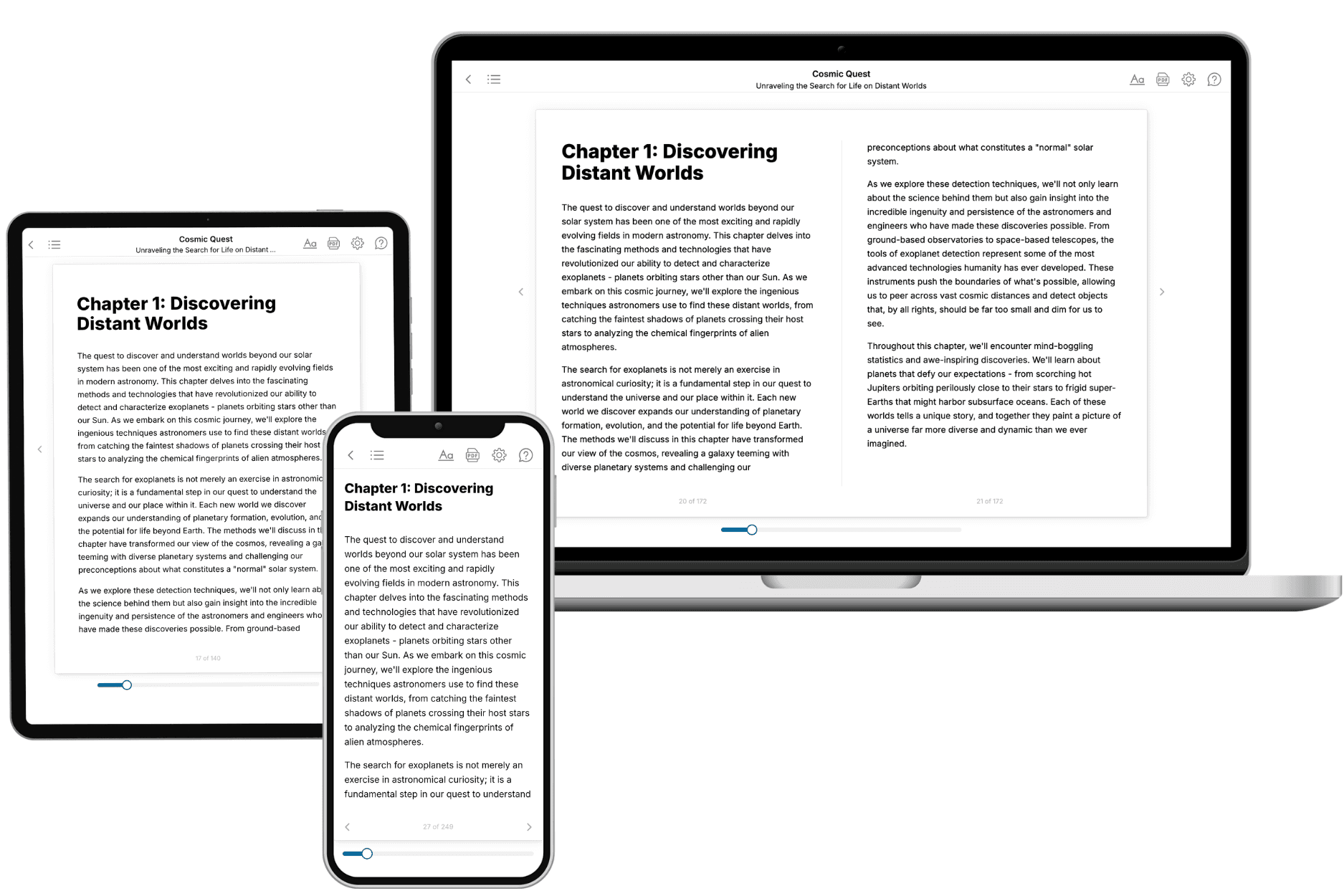
Your book is ready in 10 minutes. Read it online, download as EPUB or PDF, or send to Kindle.

Frequently asked questions
- What is TailoredRead?
TailoredRead creates complete, full-length nonfiction ebooks, written specifically for you. Tell us what you want to learn and why, and TailoredRead writes you a complete ebook on it, with charts, tables, and diagrams throughout. Read it online, on Kindle, or on any e-reader, or download it as a PDF or EPUB. Every book is written fresh the day you order it.
- How is the book tailored to me?
Before anything is written, you answer a few short questions about your goals, your background, and the topics you care about. Your book is then planned around your answers: written at your level, focused on your goals, and covering the topics you chose, instead of the one-size-fits-all book a store sells everyone.
- Will it read like generic AI content?
No. Your book isn't a chat transcript: it's planned chapter by chapter before a single word is written, told in a clear book voice, and explains ideas visually with charts, tables, and diagrams. After writing, every book goes through an editorial pass that polishes chapters so the book reads consistent from start to finish. Judge for yourself: browse thousands of sample books on our Explore Books page.
- How accurate is the content?
Our AI first checks whether your subject needs live research. Niche and fast-moving subjects are researched before writing, and the book plan and chapters are grounded in what it finds. After writing, every book goes through a quality pass that checks its facts and consistency, and researched books list their sources in a Notes section at the back.
- How long is the book?
You choose the length: Comprehensive (250-300 pages), Detailed (150-200 pages), Essential (70-100 pages), or Short (30-50 pages).
- Does the book include visuals?
Yes. Every book includes visual elements such as timelines, checklists, step-by-step guides, decision trees, comparison tables, and matrices, and many include bar charts. A typical book includes dozens of these visual elements.
- Can I read it on Kindle? What formats can I download?
Yes. Every book can be read in our online reader or downloaded as a PDF or EPUB. The EPUB can be opened with Kindle, Apple Books, Kobo, and any e-reader. The Commercial and Author licenses also include an editable Word (DOCX) and Markdown download.
- How much does it cost?
About the price of a regular ebook. The exact price depends on your book's length and complexity, from $2 for the shortest books to $35 for the most comprehensive, and it's shown when you review your book, before you commit to anything. Each book is a one-time purchase, yours to keep, no subscription. Licenses that let you share, teach, or publish your book range from $35.99 to $49.99.
- Can I preview the book before purchasing?
Before you pay, you'll see what your book will cover: the title, a detailed description, the estimated length, and the complete chapter-by-chapter table of contents, so you know what you're getting before you decide. The full text itself is written after you purchase.
- How long does it take to create a book?
About 10 minutes. You can start reading the opening chapters while the rest is still being written.