Advanced Bump Stop Tuning for Oval Track Racing
Master Linear Springs, Load Cells, and Suspension Setup for Competitive Edge
Most mechanics treat bump stops as an afterthought—a safety feature that only matters when the suspension bottoms out.
191 pages9 chaptersJul 10, 2026Motorsport
About this book
This approach leaves significant performance on the table. Advanced bump stop tuning is the difference between a competitive setup and a championship-winning one, yet it remains one of the least understood aspects of oval track suspension. This guide reveals how to harness linear bump springs and load cell technology to diagnose suspension behavior with precision. You'll learn to interpret load cell data in real-time, understand force curves and compression rates, and make informed adjustments that translate directly to faster lap times. Whether you're working with soft spring combinations in pro late models or managing aggressive setups in super late models, you'll discover how proper bump stop calibration prevents bottoming, optimizes weight transfer, and extends tire life. Packed with practical tuning strategies, diagnostic techniques, and track-tested solutions, this book transforms bump stop setup from trial-and-error into a systematic, data-driven process. Master the technical foundation that separates good mechanics from great ones.
Table of contents
- IntroductionWhy Bump Stops Matter More Than You Think, The Evolution from Rubber to Linear Springs, Moving from Guesswork to Data-Driven Tuning, How to Use This Book for Maximum BenefitRead below
- Chapter 1: Suspension Fundamentals and Bump Stop RoleSuspension Geometry and Load Paths, The Critical Function of Bump Stops in Suspension, Dispelling Common Misconceptions About Bump Stops
- Chapter 2: Linear Bump Springs: Theory and ApplicationUnderstanding Linear Spring Mechanics and Force Curves, Selecting the Right Spring Rate for Your Application, Comparing Linear Springs to Traditional Rubber Stops, Installation and Mounting Best Practices
- Chapter 3: Load Cell Technology and Data InterpretationLoad Cell Fundamentals and How They Work, Setting Up Data Collection Systems, Reading and Interpreting Load Cell Signals, Identifying Performance Patterns in Real-Time Data
- Chapter 4: Diagnostic Techniques Using Load CellsEstablishing Baseline Measurements and Thresholds, Detecting Chassis Bottoming and Suspension Compression, Analyzing Weight Transfer Through Load Cell Data, Troubleshooting Common Suspension Issues with Data
- Chapter 5: Soft Spring Setups for Pavement RacingAdvantages and Challenges of Soft Spring Combinations, Integrating Bump Stops with Soft Spring Packages, Maximizing Grip Without Sacrificing Stability, Managing Temperature Effects on Soft Spring Performance
- Chapter 6: Pro and Super Late Model Tuning StrategiesPro Late Model Suspension and Bump Stop Configuration, Super Late Model Aggressive Setup Techniques, Class-Specific Rules and Tuning Constraints, Benchmarking Against Competitive Setups
- Chapter 7: Practical Tuning Adjustments and OptimizationA Systematic Process for Making Tuning Changes, Fine-Tuning Spring Rates and Bump Stop Engagement, Managing Ride Height and Bump Stop Clearance, Adapting Setups for Different Track Surfaces and Conditions
- Chapter 8: Advanced Diagnostics and Performance MaximizationMulti-Point Load Cell Analysis for Comprehensive Understanding, Correlating Load Cell Data with Tire Wear Patterns, Using Data to Drive Lap Time Improvements, Avoiding Common Tuning Mistakes and Pitfalls
- Chapter 9: Maintenance, Troubleshooting, and Long-Term PerformanceMaintenance Schedules for Bump Stops and Springs, Identifying Wear Patterns and Replacement Timing, Seasonal and Environmental Adjustments, Durability Testing and Reliability Assurance
- ConclusionKey Takeaways for Competitive Advantage, Embracing Continuous Improvement and Data-Driven Decisions
- Appendix: Quick Reference Guides and SpecificationsSpring Rate Selection Charts, Load Cell Specifications and Compatibility, Pre-Race Tuning Checklist
Introduction
There is a component sitting on nearly every oval track race car that most mechanics barely think about until something goes wrong. It absorbs punishment every single lap, directly influences how the chassis behaves through the corners, and can be the difference between a car that wins races and one that just finishes them. That component is the bump stop. Despite its outsized influence on handling balance, tire wear, and lap times, bump stop tuning remains one of the most misunderstood and underutilized areas of oval track suspension setup. This book exists to change that.
If you have spent time in a race shop, you already know the basics of suspension setup. You understand spring rates, shock valving, and ride height. You have probably adjusted a bump stop or two based on feel, driver feedback, or a hunch that something was rubbing when it should not be. That approach works well enough to get a car around the track, but it leaves real performance on the table. The mechanics who consistently build fast, consistent race cars are the ones who treat bump stops as precision tuning tools rather than safety limiters. That distinction matters enormously at the competitive level.
What separates this book from a general suspension guide is its focus on two specific technologies that have transformed how top-level teams approach bump stop tuning: linear bump springs and load cell measurement systems. Linear springs replaced traditional rubber bump stops in many competitive applications because they offer predictable, measurable force curves. Load cells replaced guesswork because they reveal exactly what the suspension is doing during actual racing conditions. Together, these tools turn bump stop tuning into a systematic, data-driven process. That is the approach this book teaches from the ground up.
The chapters ahead move from foundational theory to hands-on diagnostic technique to class-specific tuning strategy. Whether you are working on a pro late model with a soft spring package or managing an aggressive super late model setup, the principles here apply directly to your situation. The goal is not to overwhelm you with theory but to give you a clear, practical framework that you can take to the shop and use immediately. Every concept is grounded in real-world application, and every recommendation is built around what actually works on oval tracks.
Why Bump Stops Matter More Than You Think
Most mechanics encounter bump stops in one of two situations: when a driver complains the car is bottoming out, or during a pre-race inspection when someone notices the clearance looks wrong. In both cases, the bump stop is treated as a problem to be managed rather than a tool to be optimized. This reactive mindset is understandable, but it fundamentally misrepresents what bump stops actually do during a race. They are active participants in the suspension system, engaging and disengaging dozens of times per lap on many oval track configurations.
Consider what happens when a car enters a banked corner at speed. The outside suspension compresses under lateral load, the chassis rolls, and the ride height drops. If the bump stop engages at the right moment and with the right force, it adds a secondary spring rate that controls chassis roll without sacrificing compliance. If it engages too early or too aggressively, it creates a sudden stiffness spike that upsets the car's balance and reduces tire contact patch. If it never engages at all, the chassis may bottom out or roll excessively through the corner. The bump stop is not a passive bystander in this sequence. It is an active variable.
The performance implications extend well beyond handling feel. Bump stop engagement directly affects weight transfer rates, which in turn affect how quickly the car transitions from entry to mid-corner to exit. A bump stop that engages too abruptly can cause the front tires to lose grip during corner entry, making the car push. One that is too soft may allow excessive body roll that shifts weight off the inside rear tire, reducing traction on exit. These are not minor nuances. They are the kinds of handling characteristics that drivers describe in vague terms like "loose" or "tight," and that mechanics often chase with shock adjustments when the real answer lies in the bump stop setup.
Tire wear is another area where bump stop tuning has a measurable impact. When the suspension compresses into the bump stop unevenly or too aggressively, it changes the camber and toe angles at the contact patch. Over the course of a race, those geometry changes translate into uneven tire wear patterns that cost grip and reduce tire life. Teams running long-distance events or series with limited tire allocations feel this effect acutely. Proper bump stop calibration keeps the suspension geometry within its intended operating range, which protects the tires and maintains consistent grip across the entire race distance.[1]
There is also a chassis protection argument that goes beyond performance. Repeated hard bottoming events stress the chassis structure, particularly around the frame rails and crossmembers that are closest to the ground. Over a season, that stress accumulates. Properly set bump stops act as a controlled buffer that absorbs energy progressively rather than allowing the chassis to slam into the ground. This is not just about longevity. It is about maintaining the structural integrity that keeps the car's geometry consistent from race to race.
The bottom line is straightforward: bump stops influence handling balance, weight transfer, tire wear, chassis geometry, and structural durability. Treating them as an afterthought means accepting a performance deficit in all of those areas simultaneously. The mechanics who understand this and act on it have a genuine competitive advantage over those who do not.
Real-world example: A regional super late model team was struggling with a persistent mid-corner push that no amount of shock adjustment seemed to fix. After installing load cells, the data revealed that the right front bump stop was engaging nearly 40% earlier than intended due to a ride height measurement error. The early engagement was creating a sudden stiffness spike that transferred load off the left front tire precisely when the driver needed front grip. Correcting the bump stop gap eliminated the push without any other changes to the setup.
This kind of discovery is only possible when you treat bump stops as tunable components and use the right tools to measure their behavior. That is exactly what this book teaches you to do.
The Evolution from Rubber to Linear Springs
For decades, rubber bump stops were the standard solution across virtually every form of motorsport. They were cheap, durable, and simple to install. A rubber stop would compress under load, absorb energy, and prevent the suspension from reaching its mechanical limit. For street cars and lower-level racing applications, that was more than adequate. But as oval track racing became more technically sophisticated, the limitations of rubber stops became increasingly apparent to teams chasing tenths of a second.
The core problem with rubber bump stops is their progressive and nonlinear force curve. As a rubber stop compresses, its resistance increases at an accelerating rate. The first 20% of compression might require 50 pounds of force. The next 20% might require 150 pounds. The final 20% might require 500 pounds or more. This exponential stiffening is difficult to predict, difficult to measure, and nearly impossible to tune with precision. When you change a rubber stop, you are essentially swapping one unknown force curve for another. The only way to know what you have is to run the car and feel the result.
Linear bump springs changed this equation fundamentally. A linear spring follows Hooke's Law: force equals spring rate multiplied by displacement. If you install a 500 lb/in linear bump spring and it compresses 0.5 inches, it exerts 250 pounds of force. If it compresses 1.0 inch, it exerts 500 pounds. The relationship is consistent, predictable, and measurable. This predictability is not just a theoretical advantage. It means you can calculate the expected force at any point in the suspension travel, compare that calculation to your load cell data, and make precise adjustments based on real numbers rather than feel.[2]
The adoption of linear bump springs in oval track racing accelerated significantly through the 2000s and 2010s as data acquisition systems became more accessible. Teams that were already collecting suspension travel data found that linear springs gave them a direct connection between the numbers on their data logger and the forces acting on the chassis. That connection made it possible to tune bump stops from the data rather than from driver feedback alone. The result was faster development cycles and more consistent setups from track to track.
Linear springs also offer practical advantages in terms of installation and adjustment. Most linear bump spring systems use a stack of individual spring elements that can be added or removed to change the effective spring rate. This modularity means you can make incremental adjustments without replacing the entire assembly. You can also mix spring rates within a stack to create a two-stage response: a softer initial engagement followed by a stiffer secondary rate as compression increases. This kind of tuning flexibility simply does not exist with traditional rubber stops.
It is worth noting that rubber bump stops have not disappeared entirely. They still appear in many stock classes and lower-budget applications where cost and simplicity are priorities. Some teams also use rubber stops as a secondary limiter behind a linear spring stack, providing a hard stop at the end of travel. Understanding both technologies and knowing when each is appropriate is part of being a well-rounded suspension mechanic. But for any application where precision tuning matters, linear springs are the clear choice.
The transition from rubber to linear springs is not just a material change. It represents a shift in how mechanics think about bump stops. Instead of asking "is the bump stop too hard or too soft," you start asking "what force does this corner need at this point in the suspension travel, and how do I achieve it?" That question-driven approach is the foundation of everything that follows in this book.
Comparison at a glance:
- Rubber bump stops: Nonlinear force curve, difficult to predict, limited adjustability, low cost, adequate for non-critical applications
- Linear bump springs: Predictable force curve, fully calculable, modular and adjustable, higher cost, essential for precision tuning
Moving from Guesswork to Data-Driven Tuning
Ask any experienced mechanic how they used to tune bump stops, and the answer usually involves some combination of driver feedback, visual inspection, and trial and error. The driver says the car feels stiff through the center of the corner. You look at the bump stop gap, decide it might be engaging too early, add a spacer, and run the car again. Maybe it gets better. Maybe it gets worse. Maybe the driver cannot tell the difference. This process can take an entire practice session to produce a single useful data point, and even then, you are not entirely sure what changed or why.
Load cell technology breaks this cycle by providing direct, quantitative measurement of the forces acting on the bump stop during actual track conditions. A load cell is a precision sensor that converts mechanical force into an electrical signal. When installed in the suspension system at the bump stop location, it records the exact force being applied at every moment of the lap. That data is logged by the car's data acquisition system and can be reviewed after the session with the same software used to analyze shock potentiometer travel, steering angle, and lateral acceleration.
The practical impact of this capability is significant. Instead of guessing whether the bump stop is engaging in Turn 2, you can look at the load cell trace and see exactly when engagement occurs, how much force is being applied, and how long the engagement lasts. You can compare that data to the driver's steering input trace and the lateral acceleration channel to understand exactly what the car is doing at that moment. If the bump stop is engaging 0.3 seconds before the driver reaches peak lateral load, you know the gap is too small. If it never engages at all, you know the gap is too large or the spring rate is too high.
Data-driven tuning also makes it possible to identify problems that would be nearly impossible to detect through feel alone. Consider a situation where the bump stop on the right rear corner is engaging inconsistently, sometimes hard and sometimes barely at all, due to a worn mounting surface that allows slight lateral movement under load. The driver might describe the car as "unpredictable" or "inconsistent," which could point to a dozen different causes. The load cell data would show the inconsistency directly, pointing immediately to the right rear corner as the source of the problem.
One of the most valuable aspects of load cell data is its ability to reveal the rate of force change, not just the peak force. A bump stop that engages gradually over 0.2 seconds produces a very different handling response than one that reaches the same peak force in 0.05 seconds. The gradual engagement gives the driver time to feel the transition and adjust their inputs. The abrupt engagement can catch the driver off guard and upset the car's balance. Load cell data shows you both the magnitude and the rate of engagement, giving you the information needed to tune for the right response rather than just the right peak force.
Getting started with load cell data does not require a massive investment in new equipment. Many teams already have data acquisition systems capable of logging load cell signals. The sensors themselves are available from several motorsport suppliers at prices that are accessible for most competitive programs. Chapter 3 covers the specific hardware requirements, installation procedures, and software setup in detail. For now, the key point is that the technology is within reach, and the return on investment in terms of tuning efficiency and competitive performance is substantial.
The shift to data-driven tuning also changes the dynamic between the mechanic and the driver. When you can show a driver a load cell trace and explain exactly what the suspension is doing at a specific point on the track, the conversation becomes more productive. Instead of debating whether the car "feels" stiff or loose, you are discussing specific numbers and specific moments. Drivers who understand what the data means become better at providing targeted feedback, which accelerates the tuning process further. This collaborative, data-centered approach is how top-level teams operate, and it is accessible to any program willing to invest in the right tools and knowledge.
What good load cell data tells you:
- Exactly when bump stop engagement begins relative to corner entry
- Peak force applied during maximum compression
- Rate of force increase (gradual vs. abrupt engagement)
- Duration of engagement through the corner
- Consistency of engagement from lap to lap
- Asymmetry between left and right side engagement
How to Use This Book for Maximum Benefit
This book is written for mechanics who already have a working knowledge of oval track suspension systems. It assumes you understand basic spring and shock terminology, that you have set up a race car before, and that you are comfortable working with data acquisition software at a basic level. If you are brand new to suspension setup, some of the later chapters may move faster than is comfortable. In that case, the recommended approach is to read through the entire book once for context, then return to the earlier chapters to build the foundational knowledge before applying the advanced techniques.
The book is organized to follow a logical progression from theory to application. The first two chapters establish the foundational knowledge you need: how suspension geometry and load paths work, what bump stops actually do within that system, and how linear springs function mechanically. If you are already confident in these areas, you can move through them quickly. But do not skip them entirely. The specific framing used in those chapters sets up the diagnostic language and conceptual models that appear throughout the rest of the book.
Chapters 3 and 4 are the technical core of the book. They cover load cell technology in detail, from hardware selection and installation through data interpretation and diagnostic technique. These chapters are dense with specific information, and they reward careful reading. The concepts introduced here are referenced repeatedly in the later chapters, so a solid understanding of load cell data interpretation is essential before moving into the tuning strategy sections.
Chapters 5 through 7 shift from diagnostics to application. They cover specific tuning strategies for different racing classes and track conditions, with detailed guidance on how to integrate bump stop setup with the rest of the suspension package. These chapters are where the theory becomes directly actionable. Each chapter includes specific examples, recommended starting points, and adjustment frameworks that you can apply to your own car. The goal is to give you a structured process rather than a list of rules, because every car and every track is different.
Chapter 8 covers advanced diagnostics and performance maximization, including multi-point load cell analysis and the correlation between load cell data and tire wear patterns. This chapter is aimed at mechanics who are already comfortable with basic load cell interpretation and want to push their diagnostic capability further. Chapter 9 addresses maintenance, wear patterns, and long-term reliability, which are often overlooked in performance-focused discussions but are critical for consistent results across a full season.
To get the most out of this book, consider the following approach as you work through it:
- Read actively. Keep a notebook nearby and write down questions, observations, and ideas as they occur to you. The concepts here connect to each other in ways that become clearer as you progress, and your notes will help you track those connections.
- Apply as you go. If you have access to a car and a data system, try to implement each concept as you learn it rather than waiting until you have finished the book. Hands-on application accelerates understanding significantly.
- Use the appendix. The quick reference guides, spring rate charts, and pre-race checklists in the appendix are designed to be used at the track. Print them out or save them to a tablet so they are available when you need them.
- Revisit key chapters. Chapters 3 and 4 in particular are worth reading more than once. The first read gives you the overview. The second read, after you have seen some actual load cell data, will reveal details that were not fully meaningful the first time through.
One important note about the examples and specifications used throughout this book. The numbers provided, spring rates, gap measurements, force thresholds, and similar values, are intended as starting points and reference ranges rather than universal prescriptions. Every car is different, every track is different, and every driver has different preferences and driving styles. The frameworks and processes described here are designed to help you find the right numbers for your specific situation, not to hand you a setup sheet that works everywhere. The goal is to develop your diagnostic capability so that you can solve problems independently, not to create dependence on a fixed set of rules.
Finally, approach this material with the understanding that bump stop tuning is an iterative process. Even the most experienced mechanics do not get it perfect on the first try. What separates good mechanics from great ones is not that they make fewer mistakes. It is that they have better tools and better frameworks for understanding what went wrong and correcting it quickly. That is exactly what this book is designed to give you. The knowledge here, combined with the data tools described in the following chapters, will make you faster at diagnosing problems, more confident in your adjustments, and more consistent in your results across a full racing season.
Recommended reading path by experience level:
- Intermediate mechanics building foundational knowledge: Read all chapters in order, spend extra time on Chapters 1, 2, and 3 before moving forward
- Experienced mechanics focused on diagnostics: Skim Chapters 1 and 2, focus deeply on Chapters 3, 4, and 8
- Class-specific tuning focus (pro or super late model): Read Chapters 3 and 4 first, then go directly to Chapter 6, then return to fill in gaps
- Maintenance and reliability focus: Read Chapters 1, 2, and 9 as a priority, then add Chapters 7 and 8 for context
Oval track racing rewards preparation, precision, and the willingness to keep learning. Bump stop tuning is one of the areas where that preparation pays off most directly, because so few competitors invest the time to understand it properly. By the time you finish this book, you will have a clear advantage in that area. The work starts now.
This is the end of the free sample. The full book has 9 chapters.
Want this book written for you?
Tell us your goals and background, and get your own version of this book, tailored by AI to you.


Benefits of AI-tailored books
- Read one book, not ten:
- all the Motorsport knowledge you need, gathered into a single book.
- Save days of learning:
- tell us your goals, choose your topics, and the whole book is built around them.
- Learn effortlessly:
- Motorsport book written for your specific background and expertise.
- Understand at a glance:
- includes charts, tables, timelines, checklists, decision trees, and more.
- Stay current:
- written the day you order it, not years ago.
- Trust what you read:
- every book is checked for accuracy, with real research when your subject needs it.
Create your unique book in 3 steps
- 1. Select your focus
Select the focus of your Motorsport book and share your background
- 2. Personalize your book
Specify your goals and choose sub-topics to include
- 3. Get your tailored book
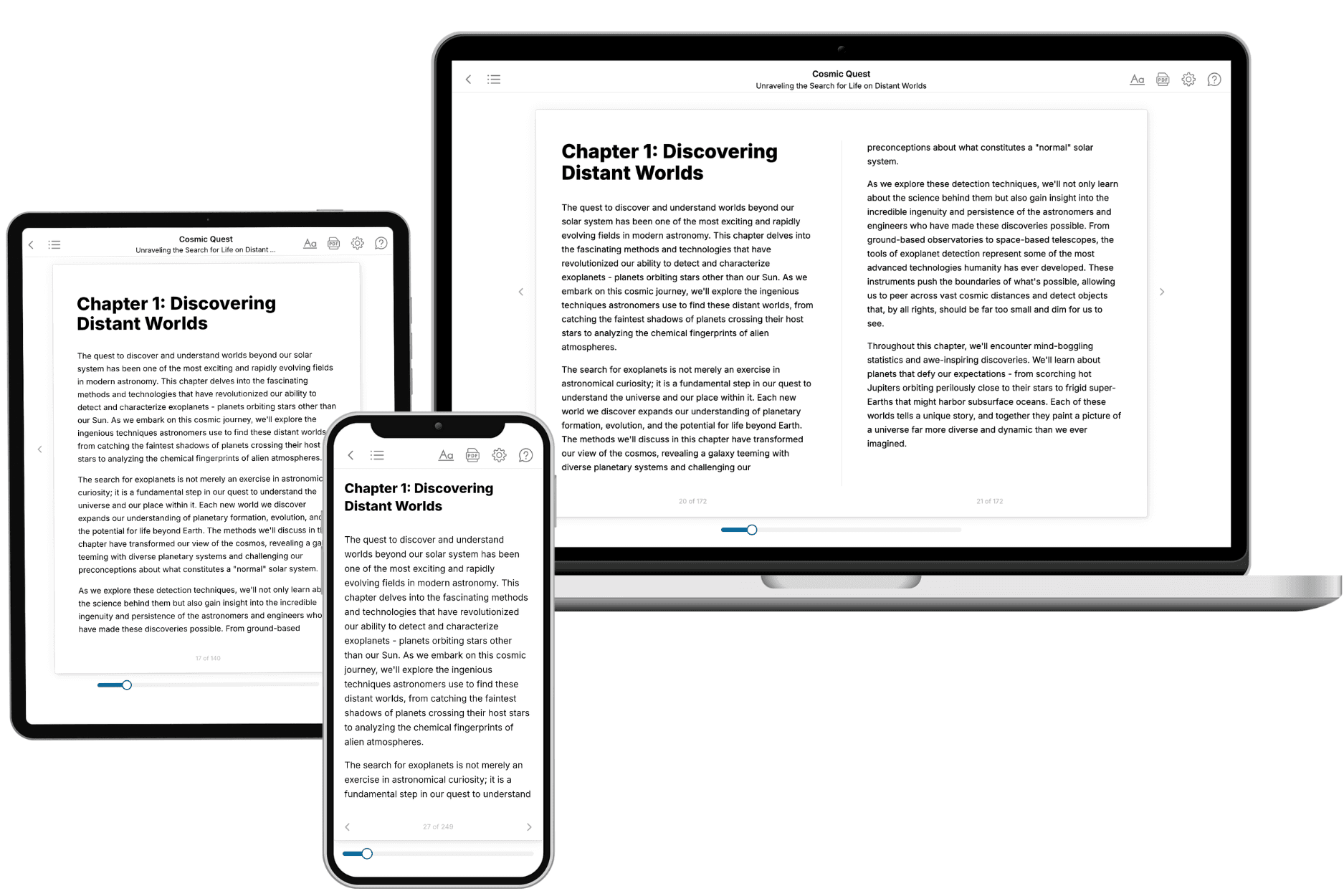
Your book is ready in 10 minutes. Read it online, download as EPUB or PDF, or send to Kindle.

Frequently asked questions
- What is TailoredRead?
TailoredRead creates complete, full-length nonfiction ebooks, written specifically for you. Tell us what you want to learn and why, and TailoredRead writes you a complete ebook on it, with charts, tables, and diagrams throughout. Read it online, on Kindle, or on any e-reader, or download it as a PDF or EPUB. Every book is written fresh the day you order it.
- How is the book tailored to me?
Before anything is written, you answer a few short questions about your goals, your background, and the topics you care about. Your book is then planned around your answers: written at your level, focused on your goals, and covering the topics you chose, instead of the one-size-fits-all book a store sells everyone.
- Will it read like generic AI content?
No. Your book isn't a chat transcript: it's planned chapter by chapter before a single word is written, told in a clear book voice, and explains ideas visually with charts, tables, and diagrams. After writing, every book goes through an editorial pass that polishes chapters so the book reads consistent from start to finish. Judge for yourself: browse thousands of sample books on our Explore Books page.
- How accurate is the content?
Our AI first checks whether your subject needs live research. Niche and fast-moving subjects are researched before writing, and the book plan and chapters are grounded in what it finds. After writing, every book goes through a quality pass that checks its facts and consistency, and researched books list their sources in a Notes section at the back.
- How long is the book?
You choose the length: Comprehensive (250-300 pages), Detailed (150-200 pages), Essential (70-100 pages), or Short (30-50 pages).
- Does the book include visuals?
Yes. Every book includes charts, tables, and diagrams: timelines, checklists, step-by-step guides, decision trees, comparison tables, matrices, and bar charts. A typical book includes dozens of these visual elements.
- Can I read it on Kindle? What formats can I download?
Yes. Every book can be read in our online reader or downloaded as a PDF or EPUB. The EPUB can be opened with Kindle, Apple Books, Kobo, and any e-reader. The Commercial and Author licenses also include an editable Word (DOCX) and Markdown download.
- How much does it cost?
About the price of a regular ebook. The exact price depends on your book's length and complexity, from $2 for the shortest books to $35 for the most comprehensive, and it's shown when you review your book, before you commit to anything. Each book is a one-time purchase, yours to keep, no subscription. Licenses that let you share, teach, or publish your book range from $35.99 to $49.99.
- Can I preview the book before purchasing?
Before you pay, you'll see what your book will cover: the title, a detailed description, the estimated length, and the complete chapter-by-chapter table of contents, so you know what you're getting before you decide. The full text itself is written after you purchase.
- How long does it take to create a book?
About 10 minutes. You can start reading the opening chapters while the rest is still being written.