The Agora of Ideas
A Journey Through Ancient Greek Philosophy
Embark on an intellectual odyssey through the birthplace of Western philosophy with "The Agora of Ideas: A Journey Through Ancient Greek Philosophy." This captivating exploration takes you back to the bustling streets of Athens and the sun-drenched shores of Ionia, where the foundations of modern thought were first laid.
269 pages13 chaptersDec 6, 2024Philosophy
About this book
As you delve into the pages of this book, you'll encounter the brilliant minds that shaped our understanding of the world. From the cosmic speculations of the Pre-Socratics to the ethical inquiries of Socrates, the systematic thought of Plato, and the scientific approach of Aristotle, you'll witness the evolution of ideas that continue to influence our lives today. "The Agora of Ideas" doesn't just recount historical facts; it brings ancient concepts to life, showing their relevance in our contemporary world. You'll explore the timeless questions that Greek philosophers grappled with: What is the nature of reality? How can we live a good life? What is the role of reason in understanding the world? Through clear explanations and engaging narratives, you'll gain a deeper appreciation for the intellectual heritage that has shaped Western civilization for over two millennia.
Table of contents
- IntroductionThe Importance of Greek Philosophy, Historical Context of Ancient Greece, Overview of the Book's JourneyRead below
- Chapter 1: The Dawn of Philosophy: Pre-Socratic ThinkersThe Milesian School: Thales, Anaximander, and Anaximenes, Heraclitus and the Doctrine of Flux, Parmenides and the Nature of Being, Pythagoras and the Power of Numbers
- Chapter 2: The Atomists: Building Blocks of RealityLeucippus and the Concept of Atoms, Democritus and the Atomic Theory, The Impact of Atomism on Later Thought
- Chapter 3: The Sophists: Masters of RhetoricProtagoras and Relativism, Gorgias and the Power of Persuasion, The Sophist Approach to Education, The Legacy of Sophist Thought
- Chapter 4: Socrates: The Gadfly of AthensThe Socratic Method of Inquiry, Socratic Ethics and the Pursuit of Virtue, The Trial and Death of Socrates, Socrates' Influence on Western Philosophy
- Chapter 5: Plato: The Architect of IdealismThe Theory of Forms, The Allegory of the Cave, Plato's Dialogues and Literary Style, Plato's Views on Education and the Soul, Plato's Political Philosophy
- Chapter 6: Aristotle: The Master of LogicAristotelian Logic and Categories, Metaphysics and the Nature of Being, Ethics and the Doctrine of the Mean, Aristotle's Political Theory, Aristotle's Contributions to Science
- Chapter 7: Hellenistic Philosophy: Schools of ThoughtThe Cynics and the Simple Life, Stoicism and the Art of Living, Epicureanism and the Pursuit of Pleasure, Skepticism and the Limits of Knowledge
- Chapter 8: Neoplatonism: The Last Flowering of Ancient ThoughtPlotinus and the One, Porphyry and the Neoplatonic School, Proclus and Systematic Neoplatonism, The Influence of Neoplatonism on Later Thought
- Chapter 9: Logic and Epistemology in Ancient Greek PhilosophyEarly Developments in Logic, The Aristotelian Syllogism, Stoic Logic and Propositional Calculus, Skeptical Challenges to Knowledge, Platonic Theories of Knowledge
- Chapter 10: Ethics and Politics in Ancient Greek ThoughtThe Concept of Virtue in Greek Ethics, Eudaimonia: The Greek Conception of Happiness, Justice in Plato's Republic, Aristotle's Theory of Constitutions, Stoic Cosmopolitanism and World Citizenship
- Chapter 11: Aesthetics and Art in Greek PhilosophyPlato's Critique of Art and Poetry, Aristotle's Poetics and the Theory of Tragedy, The Concept of Beauty and Proportion, Art as Mimesis: Imitation and Representation
- Chapter 12: Nature and the Cosmos in Greek PhilosophyPre-Socratic Cosmological Theories, Plato's Timaeus and the Demiurge, Aristotle's Physics and Natural Philosophy, Stoic Materialism and the Logos, Epicurean Atomism and the Swerve
- Chapter 13: The Enduring Legacy of Greek PhilosophyGreek Philosophy in Medieval Thought, The Renaissance Revival of Greek Ideas, Greek Influences in Modern Philosophy, The Contemporary Relevance of Ancient Greek Philosophy
- Conclusion
- Glossary of Key Terms
- Suggestions for Further Reading
Introduction
Welcome to "The Agora of Ideas: A Journey Through Ancient Greek Philosophy." As you embark on this intellectual odyssey, you are about to step into a world that has shaped the very foundations of Western thought. This introduction will serve as your guide, illuminating the path ahead and providing context for the profound ideas you will encounter. Ancient Greek philosophy is not merely a subject of historical interest; it is a living, breathing tradition that continues to influence how we think about the world, ourselves, and our place in the cosmos.
The journey you are about to undertake is one that has been traveled by countless thinkers, scholars, and curious minds over the millennia. From the bustling streets of ancient Athens to the quiet contemplation of modern academia, the questions raised by Greek philosophers have echoed through time, challenging and inspiring each new generation. As you delve into the pages that follow, you will find that these ancient thinkers were grappling with issues that remain startlingly relevant today: the nature of reality, the pursuit of knowledge, the foundations of ethics, and the quest for a fulfilling life.
Throughout this book, you will encounter a diverse cast of characters, each contributing their unique perspective to the grand tapestry of Greek thought. From the early naturalists who sought to explain the world through rational inquiry, to the towering figures of Socrates, Plato, and Aristotle, whose ideas have become cornerstones of Western philosophy, to the later schools that developed and challenged these ideas, you will witness the evolution of philosophical thought in all its complexity and brilliance.
As we begin our exploration, it's important to approach these ideas with both an open mind and a critical eye. The Greek philosophers were not infallible sages, but rather passionate seekers of truth who often disagreed with one another and whose ideas have been debated, refined, and sometimes refuted over time. The value of studying their work lies not just in the answers they provided, but in the questions they asked and the methods of inquiry they developed.
In this introduction, we will lay the groundwork for your journey by examining three crucial aspects: the importance of Greek philosophy, the historical context in which it emerged, and an overview of the intellectual landscape we will be traversing together. By the end of this chapter, you will be well-equipped to navigate the rich and complex world of Ancient Greek philosophy, ready to engage with ideas that have the power to transform your understanding of the world and your place within it.
The Importance of Greek Philosophy
The significance of Ancient Greek philosophy in the development of Western thought cannot be overstated. It represents a pivotal moment in human intellectual history, marking the transition from mythological explanations of the world to rational inquiry and systematic thought. This shift laid the groundwork for the scientific method, logical reasoning, and critical thinking that are hallmarks of modern intellectual discourse. The Greek philosophers' commitment to using reason to understand the world around them set a precedent that continues to influence how we approach knowledge and truth today.
One of the most profound contributions of Greek philosophy is its emphasis on asking fundamental questions about existence, knowledge, and ethics. These thinkers were not content with surface-level explanations or unexamined beliefs. Instead, they probed deeply into the nature of reality, challenging assumptions and seeking to understand the underlying principles that govern the universe. This quest for understanding led to the development of metaphysics, epistemology, and ethics as distinct branches of philosophical inquiry, each with its own set of questions and methodologies.
The impact of Greek philosophy extends far beyond the realm of abstract thought. It has played a crucial role in shaping political theory, legal systems, and concepts of citizenship and democracy. The Athenian experiment with democracy, while limited by modern standards, provided a model that has inspired political thinkers for centuries. Plato's "Republic" and Aristotle's "Politics" continue to be studied as foundational texts in political philosophy, offering insights into the nature of justice, the ideal state, and the relationship between the individual and society.
In the realm of ethics, Greek philosophers laid the groundwork for much of Western moral thought. The Socratic emphasis on self-examination and the pursuit of virtue, Aristotle's concept of eudaimonia (human flourishing), and the Stoic ideal of living in accordance with reason have all had a lasting impact on how we think about morality and the good life. These ethical frameworks continue to inform contemporary debates on issues ranging from personal conduct to social justice.
Greek philosophy has also been instrumental in the development of logic and critical thinking. Aristotle's systematic approach to logic, including his formulation of the syllogism, provided a foundation for formal reasoning that remained largely unchallenged until the 19th century. The emphasis on clear argumentation and the careful examination of premises and conclusions has become a cornerstone of academic discourse across disciplines.
The influence of Greek philosophy on Western science cannot be overlooked. While many of the specific theories proposed by Greek thinkers have been superseded by modern scientific discoveries, their approach to understanding the natural world through observation and rational analysis laid the groundwork for the scientific revolution. Concepts such as atoms, first proposed by Democritus, or the idea of natural laws governing the universe, have proven remarkably prescient in light of modern scientific understanding.
In the realm of psychology and understanding human nature, Greek philosophers made significant contributions that continue to resonate. Plato's tripartite model of the soul and Aristotle's exploration of human psychology in works like "De Anima" (On the Soul) foreshadowed many later developments in the field of psychology. The emphasis on self-knowledge and the examination of one's own thoughts and motivations remains a central tenet of many psychological and therapeutic approaches.
The legacy of Greek philosophy is also evident in the fields of literature and the arts. The concept of mimesis (imitation) in art, explored by Plato and Aristotle, has been influential in aesthetic theory. The use of dialogue as a philosophical method, exemplified in Plato's works, has inspired countless writers and thinkers to explore ideas through conversation and debate. The Greek philosophical tradition has provided a rich source of themes and ideas for artists, writers, and filmmakers throughout history.
Perhaps most importantly, Greek philosophy has bequeathed to us a method of inquiry and a set of intellectual tools that remain valuable in navigating the complexities of the modern world. The Socratic method of questioning, the emphasis on logical reasoning, and the willingness to challenge established beliefs are all approaches that can help us think more clearly about the issues we face today. In an era of information overload and competing ideologies, the critical thinking skills honed by Greek philosophy are more relevant than ever.
As you delve deeper into the world of Ancient Greek philosophy, you will find that its importance lies not just in the specific ideas proposed by individual thinkers, but in the broader intellectual tradition it established. This tradition values rational inquiry, open debate, and the pursuit of wisdom as ends in themselves. It encourages us to question our assumptions, to seek evidence for our beliefs, and to engage in dialogue with those who hold different views. In doing so, it provides a model for intellectual growth and personal development that remains as valuable today as it was in ancient Athens.
The study of Greek philosophy is not merely an academic exercise or a journey into the past. It is an engagement with ideas that continue to shape our world and our understanding of ourselves. As you explore the chapters that follow, you will find that the questions raised by Greek philosophers are often the same questions we grapple with in our own lives: What is the nature of reality? How can we live ethically? What constitutes a good life? By wrestling with these questions alongside the great thinkers of antiquity, you have the opportunity to deepen your own understanding and to develop a more nuanced perspective on the world around you.
In conclusion, the importance of Greek philosophy lies in its enduring relevance, its foundational role in Western thought, and its capacity to inspire critical thinking and personal growth. As we move forward in our exploration, keep in mind that you are not just learning about a historical period or a set of abstract ideas. You are engaging with a living tradition that has the power to transform your understanding of yourself and the world. The journey ahead promises to be both intellectually stimulating and personally enriching, offering insights that can inform your own philosophical reflections and contribute to your growth as a thoughtful, engaged individual in the modern world.
Historical Context of Ancient Greece
To fully appreciate the depth and significance of Ancient Greek philosophy, it is crucial to understand the historical context in which it emerged and flourished. The development of Greek philosophical thought was not an isolated phenomenon but was deeply intertwined with the political, social, and cultural dynamics of the ancient Greek world. This rich tapestry of historical circumstances provided the fertile ground from which some of the most influential ideas in Western thought would spring.
The period we typically associate with Ancient Greek philosophy spans roughly from the 6th century BCE to the 3rd century CE, encompassing what is known as the Classical and Hellenistic periods of Greek history. However, the roots of Greek philosophical inquiry can be traced back even further, to the Archaic period (800-480 BCE), when Greek city-states were beginning to develop their distinctive political and cultural identities. This era saw the emergence of the polis (city-state) as the primary unit of Greek political organization, a development that would have profound implications for the way Greeks thought about society, politics, and the individual's place within them.
The 6th and 5th centuries BCE marked a period of significant cultural and intellectual ferment in the Greek world. This was the age of the Pre-Socratic philosophers, who began to question traditional mythological explanations of the world and seek rational explanations for natural phenomena. This shift from mythos to logos (from myth to reason) was a crucial step in the development of philosophical thought. It coincided with broader cultural changes, including the spread of literacy, the development of more sophisticated forms of government, and increased contact with other civilizations through trade and colonization.
The Persian Wars (499-449 BCE) played a significant role in shaping Greek identity and self-perception. The Greek victory over the much larger Persian Empire not only preserved Greek independence but also fostered a sense of cultural superiority and confidence. This period saw the rise of Athens as a dominant power in the Greek world, ushering in what is often called the "Golden Age" of Athenian culture. Under the leadership of Pericles, Athens became a center of artistic, literary, and philosophical activity. The development of Athenian democracy, while limited by modern standards, provided a political context that encouraged public debate and the free exchange of ideas.
It was in this intellectually vibrant atmosphere that Socrates emerged as a central figure in Athenian philosophical discourse. His method of questioning and his emphasis on ethics and self-knowledge marked a turning point in Greek philosophy, shifting the focus from cosmological speculation to human affairs. The trial and execution of Socrates in 399 BCE, ostensibly for impiety and corrupting the youth, highlighted the tensions between philosophical inquiry and traditional religious and political authority.
The 4th century BCE saw the establishment of the first formal philosophical schools, including Plato's Academy and Aristotle's Lyceum. These institutions played a crucial role in systematizing philosophical thought and training new generations of thinkers. The conquests of Alexander the Great in the latter part of the 4th century BCE ushered in the Hellenistic period, characterized by the spread of Greek culture throughout the eastern Mediterranean and beyond. This expansion of the Greek world led to new cultural encounters and intellectual exchanges, influencing the development of philosophical thought.
The Hellenistic period (323-31 BCE) saw the emergence of new philosophical schools, including Stoicism, Epicureanism, and Skepticism, each offering different approaches to the question of how to live a good life in an uncertain world. These schools developed against the backdrop of political instability following the fragmentation of Alexander's empire, reflecting a shift in philosophical focus from the ideal polis to individual ethics and personal happiness.
The Roman conquest of Greece in the 2nd century BCE marked another significant turning point. While initially viewed as a defeat, it ultimately led to the spread of Greek culture and philosophy throughout the Roman world. Many Roman elites embraced Greek philosophy, with figures like Cicero playing a crucial role in transmitting Greek ideas to a Latin-speaking audience. The Roman period also saw the development of Neoplatonism, a synthesis of Platonic philosophy with mystical and religious elements that would have a profound influence on later Christian thought.
Throughout this long period of development, Greek philosophy was not an isolated academic pursuit but was deeply embedded in the social and political life of the Greek world. Philosophers often played active roles in public affairs, serving as advisors to rulers, participating in political debates, and sometimes founding or leading political movements. The relationship between philosophy and politics was often fraught, as evidenced by the experiences of figures like Socrates, Plato, and Aristotle, each of whom faced political challenges or persecution at various points in their lives.
The economic and social structure of the Greek world also played a significant role in shaping philosophical discourse. The institution of slavery, while morally problematic from a modern perspective, provided the leisure time that allowed a class of free citizens to engage in philosophical speculation. At the same time, the exclusion of women and non-citizens from formal political and educational institutions limited the diversity of voices in philosophical debates, a limitation that has been increasingly recognized and critiqued in modern scholarship.
Religion and mythology, while challenged by philosophical inquiry, remained important elements of Greek culture throughout this period. Philosophers often engaged critically with traditional religious beliefs, sometimes offering reinterpretations of myths or developing more abstract conceptions of divinity. This engagement with religious thought would have significant implications for the later development of theology in both pagan and monotheistic traditions.
The historical context of Ancient Greek philosophy also includes significant developments in science, mathematics, and medicine. The work of figures like Hippocrates in medicine, Euclid in geometry, and Archimedes in physics and engineering both influenced and was influenced by philosophical thought. The Greek emphasis on rational inquiry and systematic observation laid the groundwork for later scientific developments, even as many specific Greek theories were eventually superseded.
In conclusion, the historical context of Ancient Greek philosophy is a complex tapestry of political, social, cultural, and intellectual developments. The emergence of the polis, the Persian Wars, the rise and fall of Athenian power, the conquests of Alexander, and the Roman conquest all played crucial roles in shaping the environment in which Greek philosophy developed. Understanding this context is essential for appreciating the depth and significance of Greek philosophical thought, as well as its enduring relevance to our own time. As we explore the ideas of individual thinkers and schools in the chapters that follow, we will continually return to this historical backdrop, seeing how philosophical ideas both reflected and shaped the world in which they emerged.
Overview of the Book's Journey
As we embark on this exploration of Ancient Greek philosophy, it's important to have a clear roadmap of the intellectual terrain we will be traversing. This book is designed to take you on a comprehensive journey through the major periods, thinkers, and ideas that shaped Greek philosophical thought. Our exploration will be both chronological and thematic, allowing you to see how ideas developed over time while also delving deeply into specific concepts and debates that have had a lasting impact on Western thought.
We begin our journey with the Pre-Socratic philosophers, those early thinkers who first began to question traditional mythological explanations and seek rational understanding of the natural world. Chapter 1, "The Dawn of Philosophy: Pre-Socratic Thinkers," will introduce you to figures such as Thales, Anaximander, and Anaximenes of the Milesian school, who sought to identify the fundamental substance underlying all reality. You'll also encounter Heraclitus, with his doctrine of perpetual flux, and Parmenides, who argued for the unchanging nature of true reality. This chapter will highlight how these early thinkers laid the groundwork for later philosophical inquiry by introducing key concepts and methods of rational investigation.
Chapter 2, "The Atomists: Building Blocks of Reality," focuses on an important strand of Pre-Socratic thought that has had a profound influence on the development of scientific thinking. Here, you'll explore the ideas of Leucippus and Democritus, who proposed that the universe is composed of indivisible particles (atoms) moving in empty space. This early materialist philosophy challenged many conventional ideas about the nature of reality and foreshadowed much later scientific developments.
The intellectual landscape of Ancient Greece was not solely dominated by those we now consider philosophers. Chapter 3, "The Sophists: Masters of Rhetoric," examines the role of these professional teachers and their impact on Greek thought. You'll learn about figures like Protagoras and Gorgias, whose relativist and skeptical ideas challenged traditional notions of truth and morality. This chapter will also explore the Sophists' emphasis on rhetoric and its implications for education and political life in ancient Athens.
No exploration of Greek philosophy would be complete without a thorough examination of Socrates, often considered the pivotal figure in the development of Western philosophy. Chapter 4, "Socrates: The Gadfly of Athens," delves into the life, methods, and ideas of this enigmatic thinker. You'll learn about the Socratic method of inquiry, his emphasis on ethics and self-knowledge, and the profound impact he had on his contemporaries and subsequent generations of philosophers. The chapter will also address the controversy surrounding Socrates' trial and execution, exploring the tensions between philosophical inquiry and political authority in ancient Athens.
Chapters 5 and 6 are dedicated to the two giants of Greek philosophy: Plato and Aristotle. In "Plato: The Architect of Idealism," you'll explore Plato's theory of Forms, his allegory of the cave, and his views on education, the soul, and the ideal state. This chapter will help you understand how Plato's ideas have shaped Western thought on metaphysics, epistemology, and political philosophy. "Aristotle: The Master of Logic" will introduce you to the systematic thought of Plato's most famous student. You'll examine Aristotle's contributions to logic, metaphysics, ethics, politics, and natural science, seeing how his empirical approach and comprehensive system of knowledge laid the groundwork for many later scientific and philosophical developments.
The Hellenistic period saw the emergence of new philosophical schools that offered different approaches to the question of how to live a good life. Chapter 7, "Hellenistic Philosophy: Schools of Thought," explores the ideas of the Cynics, Stoics, Epicureans, and Skeptics. You'll see how these schools responded to the changing political and social landscape of the post-Alexandrian world, offering philosophies that emphasized personal ethics and the pursuit of happiness in an uncertain world.
Chapter 8, "Neoplatonism: The Last Flowering of Ancient Thought," examines the final major development in Greek philosophy. You'll explore how thinkers like Plotinus synthesized elements of Platonic thought with mystical and religious ideas, creating a philosophical system that would have a profound influence on later Christian and Islamic thought.
The next four chapters take a more thematic approach, examining key areas of philosophical inquiry in depth. Chapter 9, "Logic and Epistemology in Ancient Greek Philosophy," traces the development of Greek ideas about knowledge and reasoning, from the early logical innovations of the Pre-Socratics through the sophisticated systems of Aristotle and the Stoics. Chapter 10, "Ethics and Politics in Ancient Greek Thought," explores how Greek philosophers grappled with questions of morality, justice, and the ideal political order. Chapter 11, "Aesthetics and Art in Greek Philosophy," examines Greek ideas about beauty, art, and creativity, including Plato's critique of poetry and Aristotle's theory of tragedy. Chapter 12, "Nature and the Cosmos in Greek Philosophy," returns to the Greek fascination with the natural world, exploring how different thinkers and schools conceptualized the universe and humanity's place within it.
The book concludes with Chapter 13, "The Enduring Legacy of Greek Philosophy," which traces the influence of Greek ideas through medieval, Renaissance, and modern thought, demonstrating the continuing relevance of Ancient Greek philosophy to contemporary debates and issues.
Throughout this journey, you'll encounter not just abstract ideas but the vibrant personalities and historical contexts that shaped Greek philosophical thought. You'll see how philosophers engaged with and challenged each other's ideas, how their theories reflected and influenced the societies in which they lived, and how their questions and methods continue to inform our own intellectual inquiries today.
This book is designed to be both accessible to newcomers to philosophy and rewarding for those with prior knowledge of the subject. Each chapter includes clear explanations of key concepts, engaging discussions of primary texts, and reflections on the relevance of Greek ideas to contemporary issues. Sidebars and text boxes provide additional context, definitions of important terms, and explorations of particularly influential or controversial ideas.
As you progress through the book, you'll develop not just knowledge of Ancient Greek philosophy but also skills in critical thinking, textual analysis, and philosophical argumentation. You'll be encouraged to engage actively with the ideas presented, questioning assumptions, evaluating arguments, and considering how ancient wisdom might apply to modern challenges.
By the end of this journey, you will have gained a comprehensive understanding of the major figures, ideas, and debates that shaped Ancient Greek philosophy. More importantly, you will have developed a deeper appreciation for the enduring power of philosophical inquiry and its potential to enrich our understanding of ourselves and the world around us. Whether you're a student, a general reader, or a seasoned philosopher, this book offers an opportunity to engage with some of the most profound and influential ideas in the history of human thought.
This is the end of the free sample. The full book has 13 chapters.
Want this book written for you?
Tell us your goals and background, and get your own version of this book, tailored by AI to you.


Benefits of AI-tailored books
- Read one book, not ten:
- all the Philosophy knowledge you need, gathered into a single book.
- Save days of learning:
- tell us your goals, choose your topics, and the whole book is built around them.
- Learn effortlessly:
- Philosophy book written for your specific background and expertise.
- Understand at a glance:
- includes charts, tables, timelines, checklists, decision trees, and more.
- Stay current:
- written the day you order it, not years ago.
- Trust what you read:
- every book is checked for accuracy, with real research when your subject needs it.
Create your unique book in 3 steps
- 1. Select your focus
Select the focus of your Philosophy book and share your background
- 2. Personalize your book
Specify your goals and choose sub-topics to include
- 3. Get your tailored book
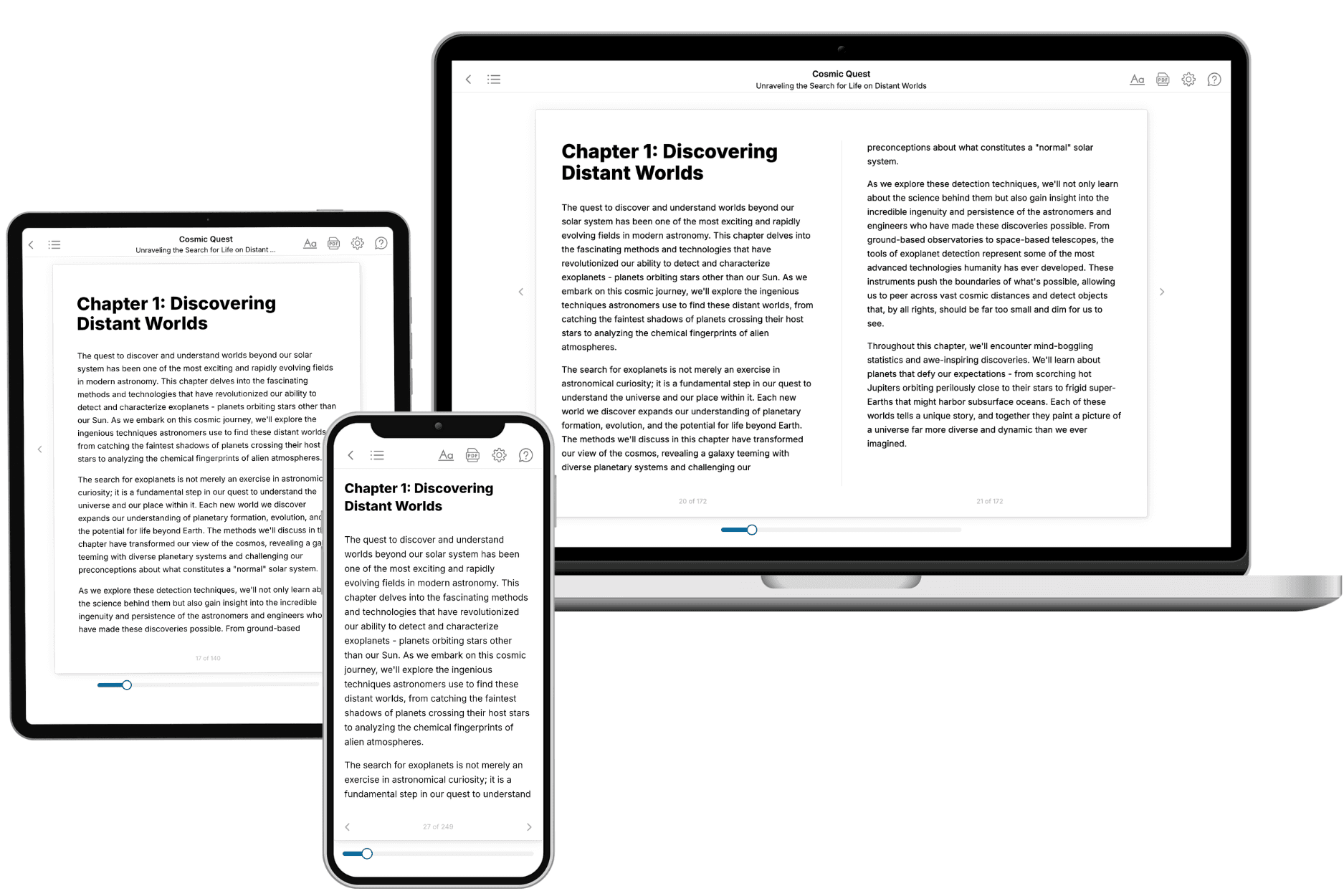
Your book is ready in 10 minutes. Read it online, download as EPUB or PDF, or send to Kindle.

Frequently asked questions
- What is TailoredRead?
TailoredRead creates complete, full-length nonfiction ebooks, written specifically for you. Tell us what you want to learn and why, and TailoredRead writes you a complete ebook on it, with charts, tables, and diagrams throughout. Read it online, on Kindle, or on any e-reader, or download it as a PDF or EPUB. Every book is written fresh the day you order it.
- How is the book tailored to me?
Before anything is written, you answer a few short questions about your goals, your background, and the topics you care about. Your book is then planned around your answers: written at your level, focused on your goals, and covering the topics you chose, instead of the one-size-fits-all book a store sells everyone.
- Will it read like generic AI content?
No. Your book isn't a chat transcript: it's planned chapter by chapter before a single word is written, told in a clear book voice, and explains ideas visually with charts, tables, and diagrams. After writing, every book goes through an editorial pass that polishes chapters so the book reads consistent from start to finish. Judge for yourself: browse thousands of sample books on our Explore Books page.
- How accurate is the content?
Our AI first checks whether your subject needs live research. Niche and fast-moving subjects are researched before writing, and the book plan and chapters are grounded in what it finds. After writing, every book goes through a quality pass that checks its facts and consistency, and researched books list their sources in a Notes section at the back.
- How long is the book?
You choose the length: Comprehensive (250-300 pages), Detailed (150-200 pages), Essential (70-100 pages), or Short (30-50 pages).
- Does the book include visuals?
Yes. Every book includes charts, tables, and diagrams: timelines, checklists, step-by-step guides, decision trees, comparison tables, matrices, and bar charts. A typical book includes dozens of these visual elements.
- Can I read it on Kindle? What formats can I download?
Yes. Every book can be read in our online reader or downloaded as a PDF or EPUB. The EPUB can be opened with Kindle, Apple Books, Kobo, and any e-reader. The Commercial and Author licenses also include an editable Word (DOCX) and Markdown download.
- How much does it cost?
About the price of a regular ebook. The exact price depends on your book's length and complexity, from $2 for the shortest books to $35 for the most comprehensive, and it's shown when you review your book, before you commit to anything. Each book is a one-time purchase, yours to keep, no subscription. Licenses that let you share, teach, or publish your book range from $35.99 to $49.99.
- Can I preview the book before purchasing?
Before you pay, you'll see what your book will cover: the title, a detailed description, the estimated length, and the complete chapter-by-chapter table of contents, so you know what you're getting before you decide. The full text itself is written after you purchase.
- How long does it take to create a book?
About 10 minutes. You can start reading the opening chapters while the rest is still being written.