AI in Gaming
How Artificial Intelligence is Reshaping Console and Handheld Gaming
Discover how artificial intelligence is fundamentally changing the way games are played, designed, and experienced on modern consoles and handheld devices.
207 pages9 chaptersApr 22, 2026Artificial Intelligence
About this book
This book walks you through the practical applications of AI in gaming—from intelligent NPCs that learn your strategies to graphics optimization that happens in real-time, and personalized difficulty systems that adapt to your skill level. You'll explore how machine learning creates endless procedural worlds, how voice AI transforms player interaction, and why AI-driven development tools are making better games faster. Whether you're curious about the technology behind your favorite games or want to understand where gaming is headed, this guide breaks down complex AI concepts into clear, actionable insights. Learn what's happening under the hood of next-generation gaming and how AI is creating more immersive, responsive, and personalized experiences than ever before.
Table of contents
- IntroductionWhy AI Matters in Gaming Today, What You'll Learn in This Book, AI Basics for GamersRead below
- Chapter 1: Intelligent NPCs and Adaptive OpponentsFrom Scripted Behavior to Learning Opponents, How AI Decision-Making Works in Games, NPCs That Learn Your Strategies, Real-World Examples in Modern Games
- Chapter 2: AI-Powered Graphics and Performance OptimizationAI Upscaling: Better Graphics Without the Performance Cost, Real-Time Performance Tuning, AI and Advanced Lighting Techniques, Maintaining Smooth Gameplay with AI
- Chapter 3: Procedural Content Generation and Infinite WorldsWhat Is Procedural Content Generation?, AI-Generated Levels and Environments, Creating Infinite Replayability, Games Using Procedural Generation Today
- Chapter 4: Personalization and Adaptive DifficultyAI-Driven Difficulty Adjustment, Understanding Player Preferences and Skill, Personalized Game Recommendations, Keeping Players Engaged Through AI
- Chapter 5: Physics Simulation and Environmental IntelligenceAI-Enhanced Physics Engines, Worlds That Respond to Your Actions, Dynamic Destruction and Environmental Interaction, How Physics AI Increases Immersion
- Chapter 6: Voice Recognition and Natural Language ProcessingVoice Commands in Gaming, Natural Language Dialogue Systems, Voice AI for Accessibility, The Future of Voice in Gaming
- Chapter 7: AI in Game Development and DesignAI Tools for Game Developers, Automated Testing and Bug Detection, AI-Assisted Game Balancing, AI-Generated Art and Audio Assets
- Chapter 8: Cloud Gaming and Cross-Platform AIHow AI Powers Cloud Gaming, Predicting and Reducing Latency, AI for Seamless Cross-Platform Play, The Next Generation of Cloud Gaming
- Chapter 9: Challenges, Ethics, and the Road AheadCurrent Limitations of AI in Gaming, Ethical Considerations and Player Privacy, Emerging Trends and What's Next
- ConclusionKey Takeaways, Staying Informed About AI in Gaming
- Glossary of AI and Gaming Terms
- Further Reading and Resources
Introduction
Think about the last time a game genuinely surprised you. Maybe an enemy flanked you in a way you didn't expect, or a game world felt so alive that you forgot you were staring at a screen. Chances are, artificial intelligence had something to do with that moment. AI has quietly become one of the most powerful forces shaping modern gaming, working behind the scenes to make experiences feel richer, smarter, and more personal than anything that was possible even a decade ago.
Gaming has always pushed technology to its limits. From the earliest arcade machines to today's photorealistic open worlds, developers have constantly chased the goal of creating more believable, engaging experiences. For most of gaming's history, that meant better hardware: faster processors, sharper displays, and more memory. But hardware alone can only take a game so far. The real leap forward has come from teaching games to think, to adapt, and to respond in ways that feel genuinely intelligent. That's where AI steps in, and its impact is growing faster than most players realize.
This book is designed to pull back the curtain on that technology. You don't need a computer science degree to understand what's happening inside your favorite games. What you do need is a clear, honest guide that explains the concepts, shows you real examples, and connects the technology to the experiences you already know and love. That's exactly what this book aims to deliver. Whether you're gaming on a PlayStation 5, an Xbox Series X, a Nintendo Switch, or a handheld device, AI is shaping your experience in ways that are worth understanding.
The chapters ahead cover everything from intelligent enemies and procedural worlds to graphics optimization, voice interaction, and the future of cloud gaming. Each topic is grounded in real games, real technology, and real implications for how you play. Along the way, you'll also find honest discussions about the challenges and ethical questions that come with bringing AI deeper into entertainment. By the end, you'll have a clear picture of where gaming stands today and where it's headed tomorrow.
Why AI Matters in Gaming Today
Artificial intelligence isn't a new concept in gaming. The ghosts in Pac-Man (1980) each had distinct movement patterns that could be learned and exploited, which was a primitive but real form of AI behavior. What has changed dramatically is the scale, sophistication, and scope of what AI can now do. Modern gaming AI doesn't just follow a script. It observes, learns, and responds in ways that can genuinely catch players off guard.
The numbers behind this shift are striking. The global AI in gaming market was valued at approximately $1.5 billion in 2022 and is projected to exceed $11 billion by 2032, growing at a compound annual rate of around 25%.[1] That growth isn't driven by hype alone. It reflects real investment from major studios and platform makers who have seen firsthand what AI can do for player engagement, game quality, and development efficiency.
One of the clearest signs of AI's importance is how console manufacturers have built it directly into their hardware. NVIDIA's DLSS (Deep Learning Super Sampling) technology uses neural networks to upscale lower-resolution images in real time, delivering sharper visuals without the performance cost of rendering at native resolution. Sony's PlayStation 5 includes a custom machine learning engine as part of its system architecture. These aren't optional add-ons. They are core features that define what modern gaming hardware can do.
AI also matters because players' expectations have risen sharply. Audiences today expect game worlds that feel alive, enemies that feel smart, and experiences that feel tailored to them personally. Meeting those expectations without AI would require enormous teams and budgets that most studios simply don't have. AI makes it possible to deliver richer experiences more efficiently, which benefits both developers and players.
There's also a competitive dimension worth noting. Studios that adopt AI tools for development, testing, and design are able to ship better games faster. Those that don't risk falling behind. This dynamic is accelerating adoption across the industry, from indie developers using AI-assisted asset creation tools to AAA studios deploying machine learning for playtesting and balance tuning. AI isn't just changing what games feel like to play. It's changing how they get made in the first place.
Perhaps most importantly, AI matters because it changes the relationship between player and game. Traditional games were static experiences. You played them, and they stayed the same. AI-powered games can evolve, adapt, and respond to you specifically. That shift from static to dynamic is one of the most significant changes in gaming's history, and it's still unfolding.
A concrete example: In Left 4 Dead 2, Valve's "AI Director" system monitors player stress levels in real time by tracking health, ammo, and recent deaths. It then adjusts enemy spawns, pacing, and item placement to keep the experience challenging but not overwhelming. Players rarely notice the system working, but they feel its effects constantly. That invisible responsiveness is exactly what modern AI brings to gaming.
Understanding why AI matters isn't just an academic exercise. It helps you appreciate what's happening when a game feels surprisingly fair, unexpectedly challenging, or unusually immersive. It also helps you recognize when AI is being used well versus when it's being used in ways that might not serve your interests as a player. Both of those skills become more valuable as AI becomes more deeply embedded in every aspect of gaming.
What You'll Learn in This Book
This book covers the full landscape of AI in console and handheld gaming, organized around the areas where AI is having the biggest impact right now. Each chapter focuses on a specific domain, explains the core technology in plain language, and connects it to games and experiences you're likely already familiar with. The goal is always practical understanding, not technical depth for its own sake.
Here's a quick map of what each chapter covers:
- Chapter 1: Intelligent NPCs and Adaptive Opponents. How game characters have evolved from simple scripts to learning systems, and what that means for how games challenge you.
- Chapter 2: AI-Powered Graphics and Performance Optimization. How technologies like DLSS and AMD's FSR use machine learning to deliver better visuals at lower hardware cost.
- Chapter 3: Procedural Content Generation and Infinite Worlds. How AI creates levels, environments, and entire game worlds that are different every time you play.
- Chapter 4: Personalization and Adaptive Difficulty. How games learn your skill level and preferences, then adjust themselves to keep you in the zone.
- Chapter 5: Physics Simulation and Environmental Intelligence. How AI makes game worlds feel physically real and responsive to your actions.
- Chapter 6: Voice Recognition and Natural Language Processing. How voice commands and conversational AI are changing the way you interact with games and devices.
- Chapter 7: AI in Game Development and Design. How developers use AI tools to build, test, and balance games more effectively.
- Chapter 8: Cloud Gaming and Cross-Platform AI. How AI powers streaming services, reduces latency, and enables seamless play across devices.
- Chapter 9: Challenges, Ethics, and the Road Ahead. An honest look at what AI can't do yet, and the ethical questions the industry needs to answer.
Each chapter is designed to stand on its own, so you can read straight through or jump to the topics that interest you most. If you're primarily curious about graphics technology, Chapter 2 is your starting point. If you want to understand how games adapt to your skill level, head to Chapter 4. The book is structured to reward both linear readers and those who prefer to explore.
Throughout the book, you'll find real-world examples drawn from games across multiple platforms, including PlayStation, Xbox, Nintendo Switch, and PC titles that have influenced console gaming. Examples are chosen because they illustrate a concept clearly, not because they represent any particular platform preference. The goal is always to ground abstract technology in experiences that feel familiar and concrete.
You'll also find practical takeaways in each chapter. Understanding AI in gaming isn't just intellectually interesting. It can change how you approach games, how you evaluate new hardware and software, and how you think about the industry's direction. By the end of this book, you'll have a framework for understanding AI developments as they happen, not just a snapshot of where things stand today.
One thing this book deliberately avoids is unnecessary technical jargon. Where technical terms are essential, they're explained clearly the first time they appear and collected in a glossary at the back. The aim is always clarity. If a concept can be explained with a simple analogy or a concrete game example, that's the approach taken here.
Finally, this book takes a balanced view of AI in gaming. The technology is genuinely exciting, and its potential is enormous. But it also comes with real limitations, open questions, and ethical considerations that deserve honest attention. You'll find both the enthusiasm and the skepticism here, because understanding AI in gaming means understanding the full picture.
AI Basics for Gamers
Before diving into specific applications, it helps to have a clear mental model of what AI actually is and how it works in a gaming context. The term "artificial intelligence" gets used loosely, sometimes to describe any computer behavior that seems smart, and sometimes to describe very specific machine learning systems. In this book, both meanings appear, so it's worth distinguishing them from the start.
At its broadest, AI in gaming refers to any system that makes decisions or generates content automatically, without a human programmer specifying every possible outcome in advance. This includes everything from a simple enemy patrol route to a neural network that upscales graphics in real time. The common thread is automation and decision-making, not necessarily the kind of general intelligence the term "AI" sometimes implies in science fiction.
Within that broad category, there are a few key types of AI that appear repeatedly throughout this book:
- Rule-based AI: Systems that follow explicit if-then logic. An enemy that attacks when it sees you and retreats when its health drops below 20% is rule-based. It's predictable but fast and reliable.
- Behavior trees: A more structured form of rule-based AI that organizes decisions into a branching hierarchy. Most modern NPC behavior is built on behavior trees or similar frameworks.
- Machine learning (ML): Systems that improve their performance by processing large amounts of data, rather than following hand-coded rules. ML is behind graphics upscaling, player behavior prediction, and many personalization systems.
- Neural networks: A specific type of machine learning loosely inspired by the structure of the human brain. Neural networks are particularly good at pattern recognition, which makes them useful for image processing, voice recognition, and game analytics.
- Procedural generation: Algorithms that create content (levels, terrain, items) based on rules and randomness, often combined with ML to produce more coherent and varied results.
A useful analogy for understanding the difference between rule-based AI and machine learning is the difference between a recipe and a chef. A recipe gives explicit instructions for every step. A trained chef understands principles and can improvise based on what's available. Rule-based AI follows the recipe. Machine learning systems are more like the chef: they've processed enough examples to develop judgment that goes beyond explicit instructions.
It's also important to understand what AI in gaming is not. It is not sentient. It does not have goals, feelings, or awareness. When a game enemy seems to "know" where you're hiding, it's because the AI has access to information (like your position coordinates) and rules for acting on that information, not because it's genuinely thinking. This distinction matters because it helps set realistic expectations for what AI can and can't do, and it helps you recognize when a game is using AI cleverly versus when it's just cheating.
The "cheating AI" problem: Some games give AI opponents access to information that a human player wouldn't have, such as your exact location at all times, to simulate difficulty. This isn't true intelligence. It's a shortcut. Genuinely well-designed AI creates challenge through smart decision-making, not information advantages. As you read this book, you'll develop a sharper eye for the difference.
One more concept worth introducing early is the idea of training data. Machine learning systems learn by processing examples. A neural network that upscales game graphics has been trained on millions of image pairs, low-resolution and high-resolution versions of the same content, so it can learn to predict what a sharper version of any given image should look like. A player behavior model has been trained on data from thousands or millions of play sessions. The quality and quantity of training data has a huge influence on how well these systems perform.
Understanding training data also helps explain why AI systems sometimes fail in unexpected ways. If a model was trained mostly on data from one type of player or one type of game scenario, it may perform poorly when it encounters something outside that range. This is called distribution shift, and it's one of the core challenges in applying machine learning to real-world systems, including games. You'll see this concept come up again in later chapters, particularly when discussing adaptive difficulty and player personalization.
Finally, it's worth noting that AI in gaming is not a single technology but a collection of technologies, each suited to different problems. Graphics upscaling uses convolutional neural networks. NPC behavior often uses behavior trees combined with utility AI. Procedural generation uses noise functions, constraint solvers, and increasingly, generative models. Knowing that these are distinct tools, not one monolithic system, will help you understand why AI excels in some areas of gaming and still struggles in others.
With these basics in place, you're ready to explore each domain in depth. The chapters ahead build on these foundations, adding detail and nuance as the topics become more specific. By the time you reach the final chapter, the concepts introduced here will feel familiar and well-grounded in real examples. That's the foundation this introduction is designed to provide: not exhaustive technical knowledge, but a clear enough mental model to make everything that follows click into place.
Notes
Introduction
- 1. Allied Market Research, AI in Gaming Market Size, Share, Competitive Landscape and Trend Analysis Report. alliedmarketresearch.com, 2023
This is the end of the free sample. The full book has 9 chapters.
Want this book written for you?
Tell us your goals and background, and get your own version of this book, tailored by AI to you.


Benefits of AI-tailored books
- Read one book, not ten:
- all the Artificial Intelligence knowledge you need, gathered into a single book.
- Save days of learning:
- tell us your goals, choose your topics, and the whole book is built around them.
- Learn effortlessly:
- Artificial Intelligence book written for your specific background and expertise.
- Understand at a glance:
- includes charts, tables, timelines, checklists, decision trees, and more.
- Stay current:
- written the day you order it, not years ago.
- Trust what you read:
- every book is checked for accuracy, with real research when your subject needs it.
Create your unique book in 3 steps
- 1. Select your focus
Select the focus of your Artificial Intelligence book and share your background
- 2. Personalize your book
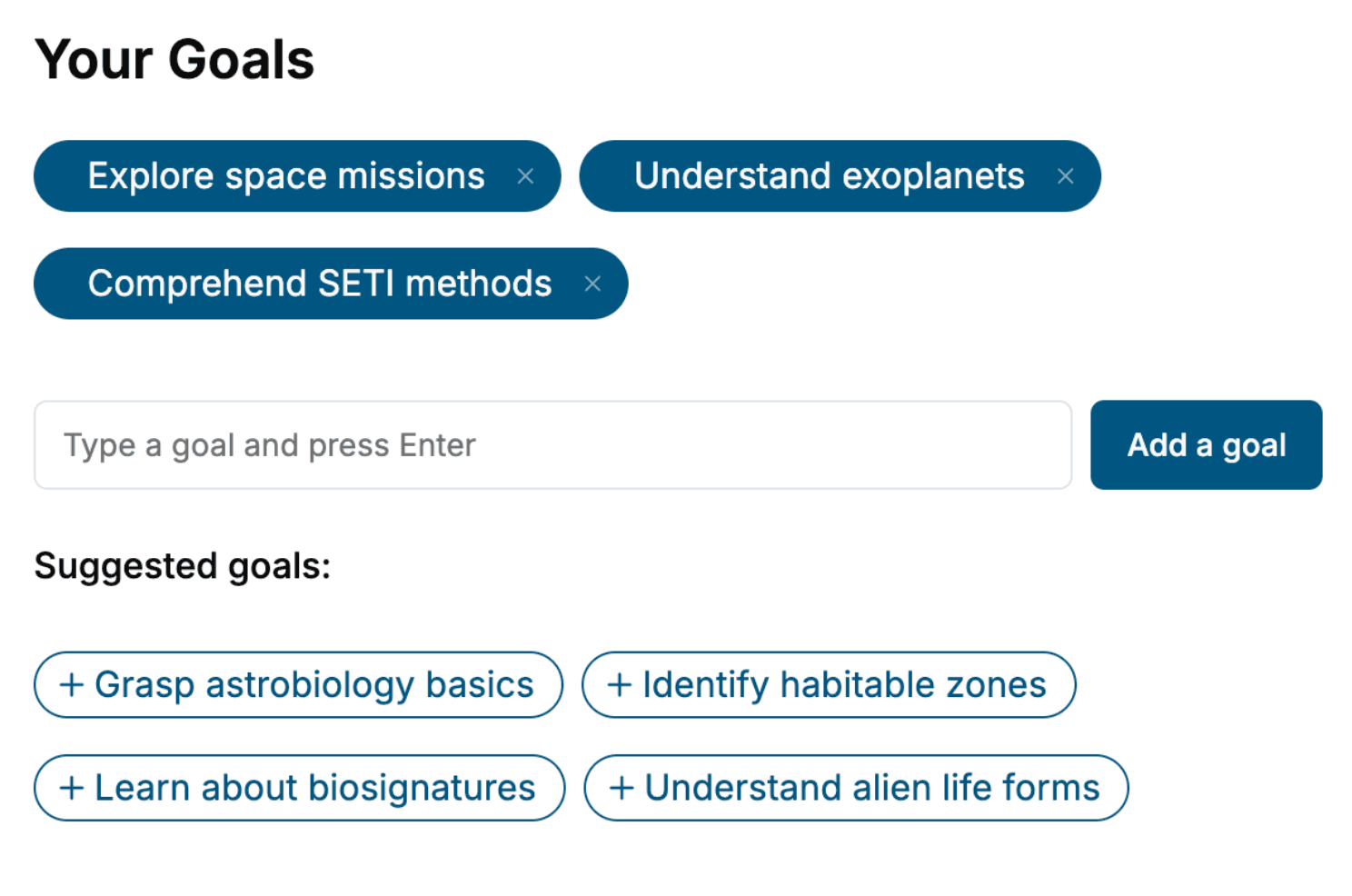
Specify your goals and choose sub-topics to include
- 3. Get your tailored book
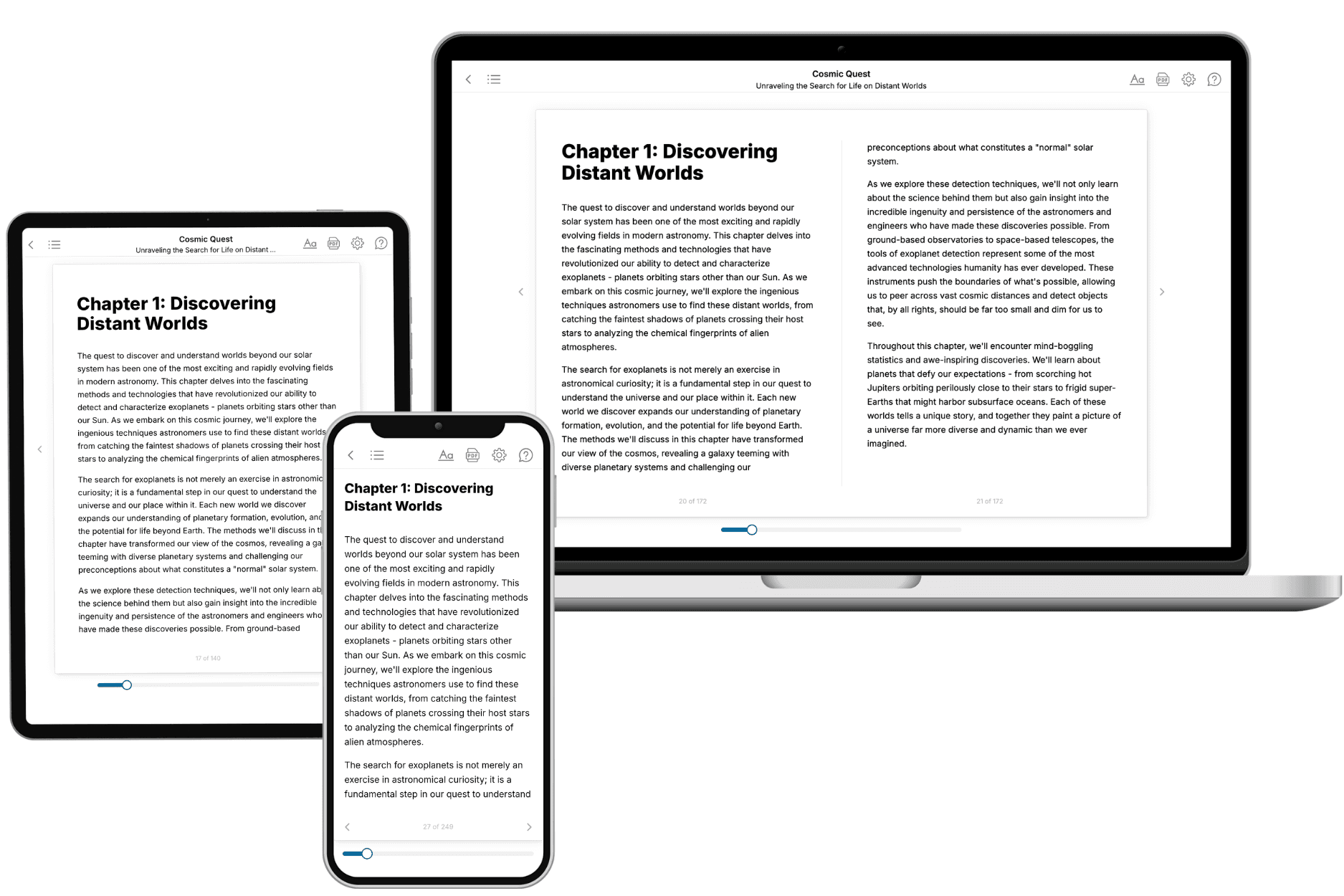
Your book is ready in 10 minutes. Read it online, download as EPUB or PDF, or send to Kindle.

Frequently asked questions
- What is TailoredRead?
TailoredRead creates complete, full-length nonfiction ebooks, written specifically for you. Tell us what you want to learn and why, and TailoredRead writes you a complete ebook on it, with charts, tables, and diagrams throughout. Read it online, on Kindle, or on any e-reader, or download it as a PDF or EPUB. Every book is written fresh the day you order it.
- How is the book tailored to me?
Before anything is written, you answer a few short questions about your goals, your background, and the topics you care about. Your book is then planned around your answers: written at your level, focused on your goals, and covering the topics you chose, instead of the one-size-fits-all book a store sells everyone.
- Will it read like generic AI content?
No. Your book isn't a chat transcript: it's planned chapter by chapter before a single word is written, told in a clear book voice, and explains ideas visually with charts, tables, and diagrams. After writing, every book goes through an editorial pass that polishes chapters so the book reads consistent from start to finish. Judge for yourself: browse thousands of sample books on our Explore Books page.
- How accurate is the content?
Our AI first checks whether your subject needs live research. Niche and fast-moving subjects are researched before writing, and the book plan and chapters are grounded in what it finds. After writing, every book goes through a quality pass that checks its facts and consistency, and researched books list their sources in a Notes section at the back.
- How long is the book?
You choose the length: Comprehensive (250-300 pages), Detailed (150-200 pages), Essential (70-100 pages), or Short (30-50 pages).
- Does the book include visuals?
Yes. Every book includes visual elements such as timelines, checklists, step-by-step guides, decision trees, comparison tables, and matrices, and many include bar charts. A typical book includes dozens of these visual elements.
- Can I read it on Kindle? What formats can I download?
Yes. Every book can be read in our online reader or downloaded as a PDF or EPUB. The EPUB can be opened with Kindle, Apple Books, Kobo, and any e-reader. The Commercial and Author licenses also include an editable Word (DOCX) and Markdown download.
- How much does it cost?
About the price of a regular ebook. The exact price depends on your book's length and complexity, from $2 for the shortest books to $35 for the most comprehensive, and it's shown when you review your book, before you commit to anything. Each book is a one-time purchase, yours to keep, no subscription. Licenses that let you share, teach, or publish your book range from $35.99 to $49.99.
- Can I preview the book before purchasing?
Before you pay, you'll see what your book will cover: the title, a detailed description, the estimated length, and the complete chapter-by-chapter table of contents, so you know what you're getting before you decide. The full text itself is written after you purchase.
- How long does it take to create a book?
About 10 minutes. You can start reading the opening chapters while the rest is still being written.