Air Signs Decoded
Master the Gemini, Libra, and Aquarius Energies in Your Birth Chart
Discover how air sign energy shapes your thinking, communication style, and approach to relationships.
207 pages9 chaptersJul 10, 2026Astrology
About this book
Whether you have a Gemini, Libra, or Aquarius placement in your birth chart, this guide reveals the intellectual and social gifts these signs bring—along with the blind spots worth understanding. You'll learn why air signs are natural communicators and idea-generators, how each sign expresses itself uniquely, and how your specific air sign placements influence your personality across different life areas. Through practical insights and real-world examples, you'll recognize air sign patterns in yourself and others, harness your natural strengths in connection and innovation, and navigate the challenges of overthinking and emotional detachment. Whether you're exploring your Sun, Moon, Rising, or other planetary placements, this book provides the clarity you need to work with your air sign energy authentically and effectively.
Table of contents
- IntroductionWhy Air Signs Matter in Your Birth Chart, How to Use This Book, The Air Element: Intellect, Communication, and ConnectionRead below
- Chapter 1: The Air Element FoundationWhat Makes Air Signs Different, The Four Elements in Astrology, Air Sign Philosophy and Worldview
- Chapter 2: Gemini: The CommunicatorGemini Core Traits and Characteristics, Gemini Strengths: Adaptability and Curiosity, Gemini Challenges: Scattered Energy and Inconsistency, Gemini in Relationships and Social Dynamics
- Chapter 3: Libra: The HarmonizerLibra Core Traits and Characteristics, Libra Strengths: Diplomacy and Aesthetic Sense, Libra Challenges: Indecision and People-Pleasing, Libra in Relationships and Partnership
- Chapter 4: Aquarius: The InnovatorAquarius Core Traits and Characteristics, Aquarius Strengths: Vision and Humanitarian Ideals, Aquarius Challenges: Detachment and Rebellion, Aquarius in Relationships and Community
- Chapter 5: Air Signs in Your Birth ChartSun, Moon, and Rising Signs Explained, Air Sun Sign: Your Core Identity, Air Moon Sign: Your Emotional Nature, Air Rising Sign: How Others Perceive You
- Chapter 6: Air Signs in Love and RelationshipsAir Venus: How You Love and Attract, Air Mars: Your Passion and Drive, Air Sign Compatibility with Other Elements, Communication Patterns in Air Sign Relationships
- Chapter 7: The Shadow Side of Air SignsOverthinking and Analysis Paralysis, Emotional Detachment and Avoidance, Superficiality and Lack of Depth, Working with Shadow Traits Consciously
- Chapter 8: Air Signs in Career and PurposeNatural Career Paths for Air Signs, Air Sign Work Style and Productivity, Finding Meaning Through Ideas and Innovation
- Chapter 9: Integrating Air Sign EnergyGrounding Air Energy in Daily Life, Balancing Intellect and Emotion, Practical Exercises for Air Signs
- ConclusionEmbracing Your Air Nature, Next Steps in Your Astrological Journey
- Glossary
- Further Reading and Resources
Introduction
There is a particular kind of person who walks into a room and immediately starts asking questions. They want to know what everyone thinks, what the latest news is, and what ideas are circulating. They connect dots between conversations, spot patterns others miss, and leave the room with three new contacts and a half-formed theory about something they just heard. Chances are, that person has significant air sign energy in their birth chart. Air signs, Gemini, Libra, and Aquarius, are the zodiac's thinkers, communicators, and connectors. Understanding them changes how you read a chart entirely.
Astrology is a rich symbolic language, and the four elements, fire, earth, air, and water, form its grammatical backbone. Each element describes a fundamental mode of experiencing the world. Fire acts. Earth builds. Water feels. Air thinks. When you have planets placed in air signs, those planets express themselves through the lens of intellect, language, and social exchange. This is not a minor detail. It shapes how you process emotions, how you make decisions, how you love, and how you find meaning. Recognizing air sign energy in your chart is one of the most clarifying things you can do as an intermediate astrology student.
This book is designed to take you deeper than the surface-level descriptions you may have already encountered. You probably know that Gemini is curious, Libra is balanced, and Aquarius is unconventional. But knowing a keyword list is very different from understanding why these signs behave the way they do, what drives them at a core level, and how their energy shifts depending on which planet carries it and which house it occupies. That deeper understanding is what this book is built to give you. By the time you finish, you will be able to look at any air sign placement in a chart and know exactly what it means in context.
Throughout these chapters, you will find practical frameworks, real-world examples, and honest discussions of both the gifts and the blind spots that air sign energy brings. Air signs are genuinely brilliant at certain things, and genuinely challenged by others. Both sides of that picture matter. Growth in astrology, and in life, comes from seeing the full picture clearly rather than only celebrating the strengths or only criticizing the weaknesses. This book holds both with equal respect.
Why Air Signs Matter in Your Birth Chart
Your birth chart is a snapshot of the sky at the exact moment you were born. Every planet was positioned in a specific sign and house, and those placements describe different dimensions of your personality, your drives, your relationships, and your life path. When several of those planets fall in air signs, or even just one key planet like your Sun, Moon, or Rising sign, air energy becomes a defining thread running through your entire chart story.
Air signs matter because they govern some of the most fundamental human activities: thinking, speaking, listening, connecting, and making sense of the world through ideas. In a birth chart, air placements describe how your mind works, how you communicate, how you form relationships, and how you engage with society at large. These are not peripheral concerns. They touch nearly every area of life, from your career to your closest partnerships to your inner dialogue.
Consider someone with a Gemini Sun, Libra Moon, and Aquarius Rising. Every major personal point in their chart is in an air sign. Their core identity (Sun) is built around curiosity and communication. Their emotional needs (Moon) are oriented toward harmony and intellectual connection. The face they show the world (Rising) carries the Aquarian quality of originality and social vision. Understanding air signs is not optional for reading this person's chart accurately. It is the entire foundation.
Even if you have just one air sign placement, it still carries significant weight. A person with a Capricorn Sun and Taurus Moon might seem thoroughly earthy, but if their Venus is in Aquarius, their approach to love and attraction will carry a distinctly air-sign flavor: independent, intellectually driven, and drawn to unconventional connections. Missing that placement means missing a crucial piece of who they are in relationships.
Air signs also matter at a collective level. Astrologers have noted that major cultural shifts often correlate with significant planetary movements through air signs.[1] The so-called Great Conjunction of Jupiter and Saturn moved into Aquarius in December 2020, marking what many astrologers described as a shift from earth-sign themes (materialism, structure, tradition) toward air-sign themes (information, networks, collective ideas). Whether or not you follow mundane astrology, this illustrates how deeply the air element is tied to the way ideas and communication shape human civilization.
Understanding air signs in your chart is ultimately about self-knowledge. It helps you recognize why you think the way you think, why certain kinds of conversations energize you, why you sometimes struggle to stay grounded or emotionally present, and why ideas feel as real and important to you as physical experiences. That self-knowledge is the starting point for everything else this book covers.
Air sign placements in your chart are not just personality quirks. They are the architecture of how your mind engages with the world, and understanding them gives you a map for working with your natural strengths rather than against them.
One practical reason to study air signs carefully is that they are often misread, even by people with intermediate chart knowledge. Gemini gets labeled as two-faced or flaky. Libra gets dismissed as indecisive. Aquarius gets called cold or aloof. These are surface-level readings that miss the deeper logic driving each sign. When you understand the air element at its root, those behaviors start to make complete sense, and you can engage with them far more skillfully.
How to Use This Book
This book is structured to build your understanding layer by layer. It starts with the air element itself, then moves through each of the three air signs in depth, then explores how air sign energy expresses itself across different planetary placements and life areas. Finally, it addresses integration: how to work consciously with air sign energy rather than simply being carried along by it. You can read it straight through, or you can jump to the sections most relevant to your chart right now.
Before you begin, it helps to have your birth chart in front of you. If you do not already have one, you can generate a free chart at several reputable websites using your birth date, birth time, and birth location.[2] Birth time matters significantly for accuracy, especially for your Rising sign and house placements. If you do not know your exact birth time, you can still work with your Sun, Moon, and other planetary placements, though your Rising sign and houses will be uncertain.
As you read, keep a notebook nearby. Astrology is most useful when it connects to your actual lived experience. When a description resonates, write down a specific example from your life that illustrates it. When something does not seem to fit, note that too. Your chart is a starting point for self-inquiry, not a fixed verdict. The goal is always to use astrological insight as a tool for reflection, not as a box to squeeze yourself into.
Here is a suggested approach for getting the most from this book:
- Identify all your air sign placements before you start reading. Note which planets are in Gemini, Libra, or Aquarius, and which houses they occupy.
- Read the foundational chapters (Introduction and Chapter 1) fully, even if you feel confident about the basics. The framing here sets up everything that follows.
- Read the chapter for each of your air signs in depth. If you have a Libra Moon and an Aquarius Venus, read both Chapter 3 and Chapter 4 carefully.
- Use Chapter 5 to understand how your specific planetary placements (Sun, Moon, Rising, etc.) modify the air sign energy you carry.
- Return to Chapters 7 and 9 regularly. The shadow work and integration practices are not one-time reads. They are ongoing tools.
Each chapter includes concrete examples drawn from recognizable personality patterns and life situations. These examples are composites designed to illustrate astrological principles clearly. They are not meant to be taken as predictions or as descriptions of specific real individuals. Astrology describes tendencies and energies, not fixed outcomes. How those energies manifest in any given person's life depends on countless factors, including upbringing, culture, choices, and the full complexity of the birth chart.
You will also notice that this book does not treat air signs as superior or inferior to other elements. Every element has its gifts and its challenges. Air signs are not smarter than fire signs, nor are they more evolved than earth or water signs. They simply operate through a different primary mode. The goal here is understanding, not ranking. If you have strong earth or water placements alongside your air signs, those chapters will help you see how different energies interact within a single chart.
Finally, approach this material with curiosity rather than judgment. Astrology works best as a mirror, not a verdict. When you read about the shadow side of air signs, including the overthinking, the emotional avoidance, the tendency toward superficiality, try to meet those descriptions with the same openness you would bring to a conversation with a trusted friend who knows you well. The point is never to criticize but always to illuminate.
This book assumes you already understand the basics of birth chart structure: what the twelve signs are, what planets represent, and what houses describe. If any of those concepts feel shaky, the Glossary at the back of the book provides clear definitions to keep you oriented. Use it freely as you read.
The Air Element: Intellect, Communication, and Connection
In classical astrology, the four elements, fire, earth, air, and water, were understood as the fundamental building blocks of all matter and experience.[3] Each element described not just a physical substance but a quality of consciousness, a way of being in the world. Air, in this framework, was associated with the mind, with breath, with the invisible currents that carry information from one place to another. It was the element of thought, language, and relationship.
That ancient understanding maps remarkably well onto what we observe in people with strong air sign placements. Air sign energy is fundamentally relational and conceptual. It is oriented toward exchange: the exchange of ideas, of words, of perspectives. Where a fire sign might ask "What can I do?" and an earth sign might ask "What can I build?", an air sign instinctively asks "What does this mean, and who else is thinking about it?" The primary currency of air energy is information and connection.
The three air signs each express this element through a different modality. In astrology, signs are grouped not only by element but also by modality, which describes how a sign engages with change and structure:
- Gemini is a mutable air sign. It is flexible, adaptable, and constantly in motion. Gemini energy gathers information from multiple sources and moves fluidly between ideas and perspectives.
- Libra is a cardinal air sign. It initiates and leads, but through diplomacy and relationship rather than force. Libra energy seeks to create balance and harmony by bringing people and ideas into alignment.
- Aquarius is a fixed air sign. It is determined, persistent, and committed to its vision. Aquarius energy holds a particular set of ideas or ideals with great conviction and works steadily toward them.
Understanding these modalities helps explain why three signs that share the same element can feel so different from one another. Gemini and Aquarius are both air signs, but Gemini shifts and adapts constantly while Aquarius holds its position with remarkable stubbornness. Libra and Gemini are both socially oriented, but Libra is focused on creating harmony in one-on-one relationships while Gemini is more interested in the sheer variety of social exchange. The element gives them a shared foundation; the modality shapes how they build on it.
At its best, air element energy produces some of the most valuable human capacities. Consider what the world would look like without the qualities air signs embody:
- Without curiosity and information-gathering (Gemini), knowledge would stagnate and innovation would slow.
- Without diplomacy and the pursuit of fairness (Libra), conflict resolution and justice systems would lose their philosophical grounding.
- Without visionary thinking and collective idealism (Aquarius), social progress and humanitarian movements would lack their driving force.
At the same time, air energy without grounding can become unmoored. Ideas without action remain theoretical. Communication without emotional depth can feel hollow. Connection without commitment can leave people feeling unseen. These are the challenges that air signs face, and they are worth taking seriously. The shadow side of air energy is not a flaw to be ashamed of but a natural consequence of any element taken to its extreme. Every element has one. Fire burns out. Earth becomes rigid. Water floods. Air dissipates.
One of the most important things to understand about air sign energy is that it is inherently social. Unlike fire, which can burn alone, or earth, which can build in solitude, air requires exchange. Air signs think better in conversation. They process emotions by talking them through. They find meaning through the connections they make between ideas and between people. This is not a weakness or a dependency. It is simply how air energy works. Recognizing this helps explain why air sign placements often correlate with strong communication skills, wide social networks, and a genuine love of intellectual exchange.
The air element is also deeply connected to the concept of objectivity. Air signs tend to step back from situations and analyze them from a distance. This gives them a valuable perspective that other elements sometimes lack. A water sign might be so immersed in feeling that it cannot see the larger pattern. An air sign can zoom out, identify the structure, and articulate what is happening with clarity. This capacity for detached analysis is one of air's greatest gifts, and also, when overused, one of its most significant limitations in emotional and relational contexts.
As you move through this book, keep returning to this foundational understanding: air signs are driven by the need to understand, to communicate, and to connect. Every trait, every strength, every challenge described in the chapters ahead flows from that core orientation. When you see an air sign placement in a chart, ask yourself: how is this planet expressing itself through the lens of intellect and exchange? That question will guide you to accurate, nuanced interpretations every time.
Air is the element of the mind in motion. It does not sit still, it does not work alone, and it does not find meaning in silence. It finds meaning in the space between people, in the moment when one idea meets another and something new is born.
This introduction has laid the groundwork. You now have a clear sense of why air signs matter, how to use this book effectively, and what the air element fundamentally represents. From here, the journey goes deeper. Chapter 1 builds the full elemental framework so you can see exactly where air fits within the broader astrological system. Then the real exploration begins: three signs, each with their own genius, their own struggles, and their own irreplaceable contribution to the human story.
Notes
Introduction
- 1. Richard Tarnas, Cosmos and Psyche, Viking Press, 2006
- 2. Astro.com offers free birth chart calculations with detailed planet and house placements
- 3. Nicholas Campion, The Dawn of Astrology: A Cultural History of Western Astrology, Continuum, 2008
This is the end of the free sample. The full book has 9 chapters.
Want this book written for you?
Tell us your goals and background, and get your own version of this book, tailored by AI to you.


Benefits of AI-tailored books
- Read one book, not ten:
- all the Astrology knowledge you need, gathered into a single book.
- Save days of learning:
- tell us your goals, choose your topics, and the whole book is built around them.
- Learn effortlessly:
- Astrology book written for your specific background and expertise.
- Understand at a glance:
- includes charts, tables, timelines, checklists, decision trees, and more.
- Stay current:
- written the day you order it, not years ago.
- Trust what you read:
- every book is checked for accuracy, with real research when your subject needs it.
Create your unique book in 3 steps
- 1. Select your focus
Select the focus of your Astrology book and share your background
- 2. Personalize your book
Specify your goals and choose sub-topics to include
- 3. Get your tailored book
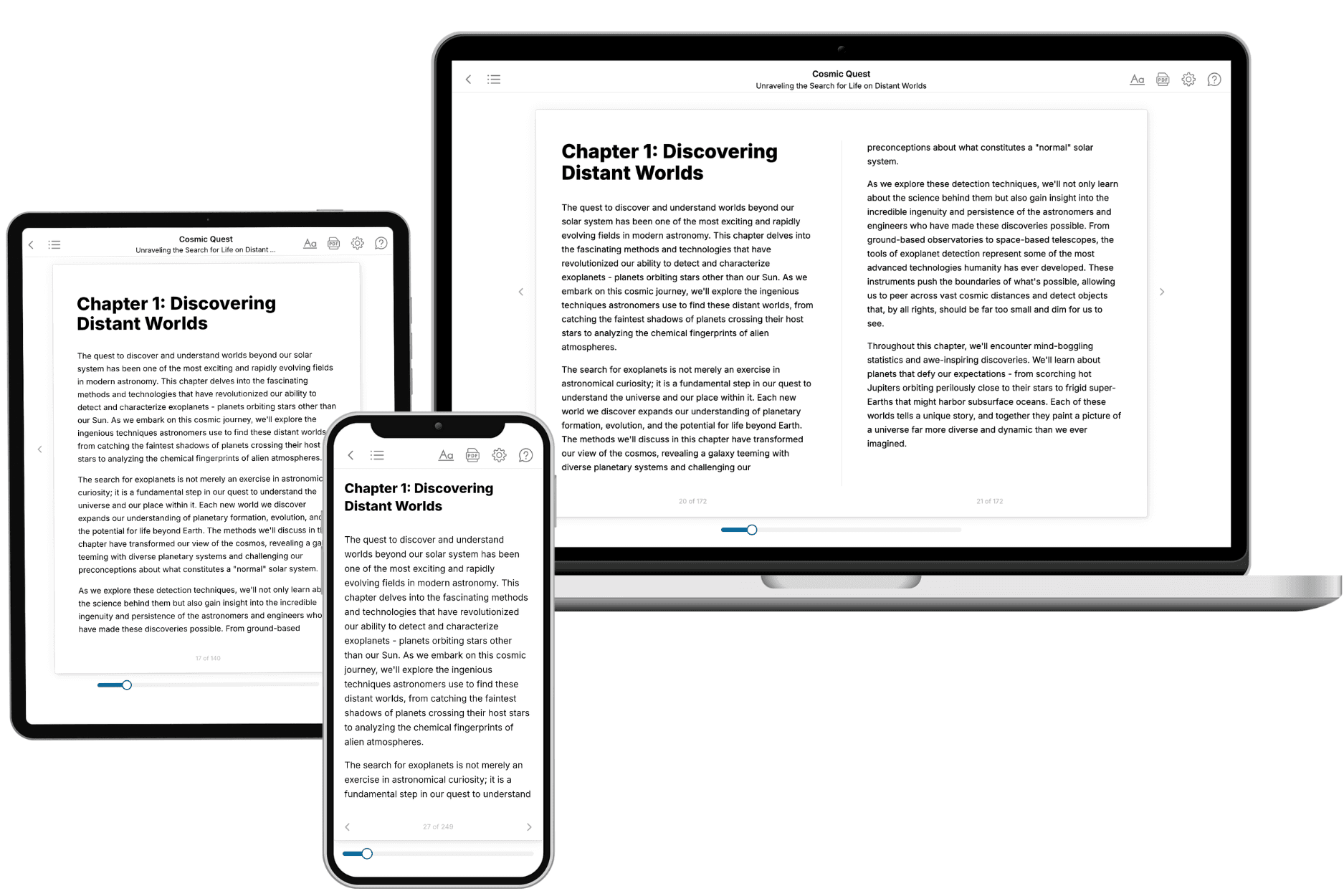
Your book is ready in 10 minutes. Read it online, download as EPUB or PDF, or send to Kindle.
Frequently asked questions
- What is TailoredRead?
TailoredRead creates complete, full-length nonfiction ebooks, written specifically for you. Tell us what you want to learn and why, and TailoredRead writes you a complete ebook on it, with charts, tables, and diagrams throughout. Read it online, on Kindle, or on any e-reader, or download it as a PDF or EPUB. Every book is written fresh the day you order it.
- How is the book tailored to me?
Before anything is written, you answer a few short questions about your goals, your background, and the topics you care about. Your book is then planned around your answers: written at your level, focused on your goals, and covering the topics you chose, instead of the one-size-fits-all book a store sells everyone.
- Will it read like generic AI content?
No. Your book isn't a chat transcript: it's planned chapter by chapter before a single word is written, told in a clear book voice, and explains ideas visually with charts, tables, and diagrams. After writing, every book goes through an editorial pass that polishes chapters so the book reads consistent from start to finish. Judge for yourself: browse thousands of sample books on our Explore Books page.
- How accurate is the content?
Our AI first checks whether your subject needs live research. Niche and fast-moving subjects are researched before writing, and the book plan and chapters are grounded in what it finds. After writing, every book goes through a quality pass that checks its facts and consistency, and researched books list their sources in a Notes section at the back.
- How long is the book?
You choose the length: Comprehensive (250-300 pages), Detailed (150-200 pages), Essential (70-100 pages), or Short (30-50 pages).
- Does the book include visuals?
Yes. Every book includes charts, tables, and diagrams: timelines, checklists, step-by-step guides, decision trees, comparison tables, matrices, and bar charts. A typical book includes dozens of these visual elements.
- Can I read it on Kindle? What formats can I download?
Yes. Every book can be read in our online reader or downloaded as a PDF or EPUB. The EPUB can be opened with Kindle, Apple Books, Kobo, and any e-reader. The Commercial and Author licenses also include an editable Word (DOCX) and Markdown download.
- How much does it cost?
About the price of a regular ebook. The exact price depends on your book's length and complexity, from $2 for the shortest books to $35 for the most comprehensive, and it's shown when you review your book, before you commit to anything. Each book is a one-time purchase, yours to keep, no subscription. Licenses that let you share, teach, or publish your book range from $35.99 to $49.99.
- Can I preview the book before purchasing?
Before you pay, you'll see what your book will cover: the title, a detailed description, the estimated length, and the complete chapter-by-chapter table of contents, so you know what you're getting before you decide. The full text itself is written after you purchase.
- How long does it take to create a book?
About 10 minutes. You can start reading the opening chapters while the rest is still being written.