Algebraic Geometry Unveiled
A Step-by-Step Journey Through Mathematical Landscapes
Your mathematical odyssey begins as you step into the fascinating world of Algebraic Geometry.
315 pages15 chaptersMar 11, 2025MathematicsCreated by Jose Fernando
About this book
This book guides you through the intricate tapestry of curves, polynomials, and abstract algebra, gradually revealing the beauty and power of this mathematical discipline. You'll start by building a solid foundation, exploring the essential prerequisites and basic concepts that form the bedrock of Algebraic Geometry. As you progress, you'll delve into more complex territories, discovering affine varieties, algebraic groups, and the interplay between topology and geometry. Your journey will take you through the realms of commutative algebra, cohomology, and the captivating world of Riemann surfaces and elliptic curves. By the end of this intellectual adventure, you'll have gained a comprehensive understanding of Algebraic Geometry's core principles and its connections to other mathematical domains. This book equips you with the knowledge and tools to confidently explore more advanced topics in this rich and rewarding field.
Table of contents
- IntroductionWhat is Algebraic Geometry?, A Brief Historical Overview, How This Book is Structured, Your Learning Path in Algebraic GeometryRead below
- Chapter 1: Mathematical PrerequisitesLinear Algebra Essentials, Introduction to Abstract Algebra, Basic Topology Concepts, Complex Analysis Fundamentals
- Chapter 2: Polynomials and Algebraic EquationsPolynomial Rings, Ideals and Quotient Rings, Field Extensions, Introduction to Galois Theory
- Chapter 3: Affine VarietiesAffine Space and Coordinate Rings, The Zariski Topology, Hilbert's Basis Theorem, The Nullstellensatz
- Chapter 4: Projective VarietiesProjective Space and Homogeneous Polynomials, Projective Varieties and Their Properties, The Projective Nullstellensatz, Grassmannians and Flag Varieties
- Chapter 5: Sheaves and SchemesIntroduction to Sheaf Theory, Locally Ringed Spaces, The Definition of a Scheme, Examples of Schemes
- Chapter 6: Dimension TheoryKrull Dimension, Transcendence Degree, Dimension of Varieties, Dimension of Schemes
- Chapter 7: Smooth VarietiesTangent Spaces and Smoothness, Regular Functions and Differentials, Kähler Differentials, Smooth Morphisms
- Chapter 8: Divisors and Line BundlesWeil Divisors, Cartier Divisors, Linear Systems, The Picard Group
- Chapter 9: Cohomology in Algebraic GeometrySheaf Cohomology, Čech Cohomology, Derived Functors, Serre Duality
- Chapter 10: Algebraic CurvesPlane Algebraic Curves, Bézout's Theorem, The Riemann-Roch Theorem, Jacobians of Curves
- Chapter 11: Algebraic SurfacesClassification of Surfaces, Ruled Surfaces, K3 Surfaces, Enriques Surfaces
- Chapter 12: Intersection TheoryThe Chow Ring, Intersection Products, Chern Classes, The Riemann-Hurwitz Formula
- Chapter 13: Algebraic GroupsGroup Schemes, Linear Algebraic Groups, Lie Algebras of Algebraic Groups, Representation Theory of Algebraic Groups
- Chapter 14: Moduli SpacesThe Moduli Problem, Moduli of Curves, Moduli of Vector Bundles, Geometric Invariant Theory
- Chapter 15: Introduction to Arithmetic GeometryDiophantine Equations, Elliptic Curves, Height Functions, The Mordell-Weil Theorem
- ConclusionSummary of Algebraic Geometry, Future Directions in Algebraic Geometry
- AppendixNotation Guide, Common Proof Techniques in Algebraic Geometry
- Glossary
- Further Reading
Introduction
Welcome to the captivating world of Algebraic Geometry, a field that seamlessly blends the precision of algebra with the intuition of geometry. As you embark on this mathematical journey, you'll discover a realm where equations come to life as geometric shapes, and abstract concepts manifest in tangible forms. This introduction serves as your gateway to understanding the fundamental principles, historical context, and structure of Algebraic Geometry, setting the stage for the in-depth exploration that awaits you in the subsequent chapters.
Algebraic Geometry stands as a testament to the power of mathematical synthesis, bringing together diverse areas of mathematics to create a unified framework for studying geometric objects defined by polynomial equations. Its applications extend far beyond pure mathematics, influencing fields such as physics, cryptography, and even biology. As you progress through this book, you'll gain not only a deep appreciation for the elegance of Algebraic Geometry but also the tools to apply its principles to a wide array of real-world problems.
Whether you're a seasoned mathematician looking to expand your horizons or a curious scholar from a related field, this introduction will provide you with the necessary context and motivation to dive into the rich tapestry of Algebraic Geometry. By the end of this chapter, you'll have a clear understanding of what Algebraic Geometry entails, its historical development, the structure of this book, and a roadmap for your learning journey ahead.
What is Algebraic Geometry?
Algebraic Geometry is a branch of mathematics that studies geometric objects defined by polynomial equations. At its core, it seeks to understand the intricate relationship between algebraic equations and geometric shapes. This field combines the abstract nature of algebra with the visual intuition of geometry, creating a powerful framework for analyzing mathematical structures.
The fundamental objects of study in Algebraic Geometry are algebraic varieties, which are geometric manifestations of solutions to systems of polynomial equations. These varieties can range from simple curves and surfaces to complex higher-dimensional objects. For example, the equation x² + y² = 1 defines a circle in the plane, while more complex systems of equations can describe intricate shapes in higher dimensions.
One of the key strengths of Algebraic Geometry lies in its ability to translate geometric problems into algebraic ones and vice versa. This duality allows mathematicians to leverage tools from both domains to solve problems that might be intractable using only one approach. For instance, the study of singularities—points where a variety is not smooth—can be approached both geometrically and algebraically, often leading to deeper insights.
Algebraic Geometry also provides a unifying language for various areas of mathematics. It serves as a bridge between abstract algebra, number theory, complex analysis, and topology. This interconnectedness is exemplified by the concept of schemes, introduced by Alexander Grothendieck in the 1960s, which generalized the notion of algebraic varieties and revolutionized the field[1].
The applications of Algebraic Geometry extend far beyond pure mathematics. In theoretical physics, it plays a crucial role in string theory and quantum field theory. In computer science, it contributes to cryptography and coding theory. Even in biology, algebraic geometric methods have been applied to problems in phylogenetics and systems biology.
As you delve deeper into this field, you'll encounter a rich tapestry of concepts such as affine and projective varieties, sheaves, cohomology theories, and intersection theory. These tools will enable you to analyze the global properties of geometric objects, understand their symmetries, and explore their relationships with other mathematical structures.
One of the most fascinating aspects of Algebraic Geometry is its ability to reveal deep connections between seemingly disparate areas of mathematics. For example, the study of elliptic curves, which are particular types of algebraic curves, has led to significant advances in number theory, including the proof of Fermat's Last Theorem[2].
As you progress through this book, you'll develop an intuition for thinking geometrically about algebraic problems and algebraically about geometric ones. This dual perspective will not only enhance your problem-solving skills but also provide you with a deeper appreciation for the underlying unity of mathematics.
Algebraic Geometry is a field that rewards persistence and creativity. Its concepts can be challenging at first, but as you build your understanding, you'll find that it offers a unique blend of rigorous logic and creative insight. The ability to visualize abstract algebraic relationships and to express geometric intuitions in precise algebraic terms is a skill that will serve you well in many areas of mathematics and beyond.
In the following sections, we'll explore the historical development of Algebraic Geometry, outline the structure of this book, and provide a roadmap for your learning journey. This context will help you appreciate the evolution of the field and prepare you for the exciting exploration that lies ahead.
A Brief Historical Overview
The roots of Algebraic Geometry can be traced back to ancient civilizations, where the interplay between geometry and algebra first began to emerge. The ancient Babylonians and Egyptians, for instance, solved practical problems involving areas and volumes, unknowingly laying the groundwork for what would eventually become Algebraic Geometry. However, it wasn't until the 17th century that the field started to take a more recognizable form.
The Renaissance period marked a significant turning point in the development of Algebraic Geometry. René Descartes, in his seminal work "La Géométrie" (1637), introduced the concept of coordinates, effectively bridging the gap between algebra and geometry[3]. This innovation, now known as Cartesian geometry, allowed geometric problems to be expressed and solved using algebraic equations. Descartes' work laid the foundation for the systematic study of curves and surfaces defined by polynomial equations.
In the 18th and 19th centuries, Algebraic Geometry saw rapid advancements. Mathematicians like Leonhard Euler, Joseph-Louis Lagrange, and Augustin-Louis Cauchy made significant contributions to the field. The study of algebraic curves, in particular, gained momentum during this period. Bernhard Riemann's groundbreaking work on complex analysis and the geometry of surfaces in the mid-19th century had a profound impact on the development of Algebraic Geometry[4].
The late 19th and early 20th centuries witnessed a shift towards a more rigorous and abstract approach to Algebraic Geometry. Mathematicians like David Hilbert, Emmy Noether, and B.L. van der Waerden played crucial roles in formalizing the foundations of the field. Hilbert's work on invariant theory and his famous basis theorem provided essential tools for studying algebraic varieties. Noether's contributions to abstract algebra, particularly her work on rings and ideals, had a profound influence on the algebraic aspects of the field.
The 20th century saw a revolution in Algebraic Geometry, largely driven by the work of Oscar Zariski and André Weil. Zariski introduced modern algebraic techniques to study geometric properties, while Weil's work on algebraic varieties over finite fields laid the groundwork for arithmetic geometry. This period also saw the development of sheaf theory and cohomology, which provided powerful tools for studying global properties of algebraic varieties.
Perhaps the most significant transformation in Algebraic Geometry came with the work of Alexander Grothendieck in the 1960s. Grothendieck's introduction of schemes generalized the concept of algebraic varieties and provided a unified framework for studying various aspects of Algebraic Geometry. His approach, often referred to as "the rising sea," aimed to develop the most general possible foundations for the field[5].
Grothendieck's work, along with contributions from other mathematicians like Jean-Pierre Serre and Pierre Deligne, led to the development of modern Algebraic Geometry. This new approach incorporated ideas from category theory, homological algebra, and other abstract mathematical disciplines, greatly expanding the scope and power of Algebraic Geometry.
In recent decades, Algebraic Geometry has continued to evolve and find new applications. The proof of the Weil conjectures by Pierre Deligne in the 1970s was a major milestone, demonstrating the power of the modern approach. The field has also seen significant interactions with theoretical physics, particularly in string theory and quantum field theory. The development of tropical geometry, which applies algebraic geometric techniques to combinatorial problems, is another exciting recent development.
Today, Algebraic Geometry remains a vibrant and active field of research, with connections to numerous areas of mathematics and science. Its tools and concepts are applied in diverse fields such as cryptography, coding theory, robotics, and even biology. The historical development of Algebraic Geometry reflects the broader evolution of mathematical thought, from concrete problem-solving to abstract theory-building, and back to applications in various domains.
As you embark on your journey through this book, keep in mind that you are following in the footsteps of some of the greatest mathematicians in history. The concepts you'll encounter have been refined and developed over centuries, each building on the insights of previous generations. This historical perspective can provide valuable context and motivation as you tackle the challenges and rewards of learning Algebraic Geometry.
How This Book is Structured
This book is designed to guide you through the intricate landscape of Algebraic Geometry in a systematic and accessible manner. The structure is carefully crafted to build your understanding progressively, starting from the foundational concepts and moving towards more advanced topics. Each chapter is designed to be both self-contained and interconnected, allowing you to grasp individual concepts while appreciating their place in the broader context of Algebraic Geometry.
The book begins with a comprehensive introduction to the prerequisites necessary for a deep understanding of Algebraic Geometry. Chapter 1, "Mathematical Prerequisites," covers essential topics from linear algebra, abstract algebra, basic topology, and complex analysis. This chapter serves as a refresher for those familiar with these topics and provides a solid foundation for those encountering them for the first time in the context of Algebraic Geometry.
Following the prerequisites, the book delves into the core concepts of Algebraic Geometry. Chapter 2, "Polynomials and Algebraic Equations," introduces you to the fundamental objects of study in the field. You'll explore polynomial rings, ideals, field extensions, and get an introduction to Galois theory. This chapter sets the stage for the algebraic aspects of the subject that will be crucial throughout the book.
Chapters 3 and 4 focus on affine and projective varieties, respectively. These chapters introduce you to the geometric objects at the heart of Algebraic Geometry. You'll learn about the Zariski topology, Hilbert's Basis Theorem, and the fundamental Nullstellensatz, which connects algebraic and geometric perspectives. The transition from affine to projective geometry will broaden your understanding of the subject and introduce important concepts like homogeneous polynomials and projective space.
As you progress, the book introduces more advanced concepts. Chapter 5, "Sheaves and Schemes," marks a significant step towards modern Algebraic Geometry. Here, you'll encounter the abstract machinery that allows for a unified treatment of various geometric and algebraic objects. This chapter may be challenging, but it's crucial for understanding contemporary research in the field.
Subsequent chapters delve into specific aspects of Algebraic Geometry. You'll explore dimension theory, smooth varieties, divisors and line bundles, and cohomology. These chapters provide you with the tools to analyze the global properties of algebraic varieties and understand their structure in depth.
The book then focuses on specific classes of algebraic varieties. Chapters 10 and 11 cover algebraic curves and surfaces, respectively. These chapters allow you to apply the general theory to concrete examples, deepening your understanding and intuition. You'll encounter important results like Bézout's Theorem, the Riemann-Roch Theorem, and the classification of surfaces.
The later chapters of the book introduce you to more specialized topics in Algebraic Geometry. You'll study intersection theory, which provides tools for understanding how varieties intersect. The chapter on algebraic groups connects Algebraic Geometry with group theory, leading to applications in representation theory. The discussion of moduli spaces introduces you to the modern approach of studying families of geometric objects.
The book concludes with an introduction to arithmetic geometry, bridging the gap between Algebraic Geometry and number theory. This final chapter showcases the power of Algebraic Geometry in tackling number-theoretic problems, particularly through the study of elliptic curves.
Throughout the book, you'll find numerous examples, exercises, and illustrations to reinforce your understanding. Each chapter concludes with a summary of key points and a set of challenging problems to test and extend your knowledge. The book also includes appendices covering notation, common proof techniques in Algebraic Geometry, and a comprehensive glossary of terms.
This structure is designed to accommodate different learning styles and goals. If you're new to the subject, you can work through the chapters sequentially, building your knowledge step by step. If you're more experienced, you may choose to focus on specific topics or use the book as a reference. Regardless of your approach, the interconnected nature of the chapters will help you develop a cohesive understanding of Algebraic Geometry.
Your Learning Path in Algebraic Geometry
Embarking on a journey through Algebraic Geometry is an exciting and challenging endeavor. As you progress through this book, you'll encounter a rich tapestry of mathematical concepts, each building upon the last to create a comprehensive understanding of this fascinating field. Your learning path will be unique, shaped by your background, interests, and goals. However, there are some general guidelines and strategies that can help you make the most of your study of Algebraic Geometry.
First and foremost, it's crucial to build a solid foundation in the prerequisites. Chapter 1 covers the essential background material, but don't hesitate to spend extra time reviewing these topics if needed. A strong grasp of linear algebra, abstract algebra, basic topology, and complex analysis will serve you well throughout your study of Algebraic Geometry. If you find yourself struggling with any of these areas, consider supplementing your study with additional resources or practice problems.
As you move into the core concepts of Algebraic Geometry, starting with polynomials and algebraic equations in Chapter 2, focus on developing both your algebraic and geometric intuitions. Algebraic Geometry is unique in its blend of these two perspectives, and being able to switch between them fluidly will be a valuable skill. Practice visualizing algebraic equations geometrically and describing geometric shapes algebraically.
When you reach the chapters on affine and projective varieties (Chapters 3 and 4), take the time to work through plenty of examples. These fundamental objects form the backbone of Algebraic Geometry, and a deep understanding of their properties will serve you well in later chapters. Don't be discouraged if some concepts, like the Zariski topology, feel abstract at first. With practice and persistence, these ideas will become more intuitive.
The introduction of sheaves and schemes in Chapter 5 marks a significant leap in abstraction. This material can be challenging, even for experienced mathematicians. Approach it with patience and don't be afraid to revisit earlier sections as needed. Remember that these abstract concepts are powerful tools that unify and generalize many ideas in Algebraic Geometry.
As you progress through the more advanced topics in later chapters, try to connect new concepts with what you've already learned. For example, when studying cohomology, think about how it relates to the properties of varieties you've encountered earlier. Look for opportunities to apply new techniques to problems you've seen before, as this can deepen your understanding and reveal new insights.
Throughout your study, make use of the exercises provided at the end of each chapter. These problems are designed to reinforce key concepts and challenge you to apply your knowledge in new ways. Don't be discouraged if you can't solve every problem immediately – some are intended to stretch your understanding and introduce ideas that will be explored in more depth later.
As you encounter specific classes of algebraic varieties, such as curves and surfaces, take the time to explore concrete examples in detail. Sketch curves, visualize surfaces, and try to develop an intuitive feel for their properties. These tangible examples can provide valuable insight and motivation for the more abstract theory.
When you reach the later chapters on specialized topics like intersection theory, algebraic groups, and moduli spaces, consider how these areas connect with and extend the core concepts you've learned. These chapters showcase the breadth and depth of Algebraic Geometry and may inspire you to delve deeper into specific areas that interest you.
Throughout your learning journey, don't hesitate to seek out additional resources. While this book aims to be comprehensive, Algebraic Geometry is a vast field with many excellent texts and online resources available. Supplement your reading with lectures, seminars, or discussions with peers if possible. Engaging with the material in different formats can reinforce your understanding and provide new perspectives.
Finally, remember that learning Algebraic Geometry is a gradual process. Don't be discouraged if you don't grasp every concept immediately. Some ideas may take time to fully sink in, and you may find yourself revisiting earlier chapters as your understanding deepens. This is a natural part of the learning process in mathematics, especially in a field as rich and interconnected as Algebraic Geometry.
Your journey through Algebraic Geometry promises to be intellectually rewarding. As you progress, you'll develop not only a deep understanding of this beautiful mathematical field but also enhance your overall mathematical maturity and problem-solving skills. Embrace the challenges, celebrate your progress, and enjoy the process of discovery as you unveil the elegant world of Algebraic Geometry.
Notes
Introduction
- 1. D. Mumford, The Red Book of Varieties and Schemes, Springer-Verlag, 1988
- 2. A. Wiles, "Modular elliptic curves and Fermat's Last Theorem," Annals of Mathematics, 1995
- 3. R. Descartes, La Géométrie, Leiden: Jan Maire, 1637
- 4. B. Riemann, "Theorie der Abel'schen Functionen," Journal für die reine und angewandte Mathematik, 1857
- 5. A. Grothendieck, Éléments de géométrie algébrique, Publications Mathématiques de l'IHÉS, 1960
This is the end of the free sample. The full book has 15 chapters.
Want this book written for you?
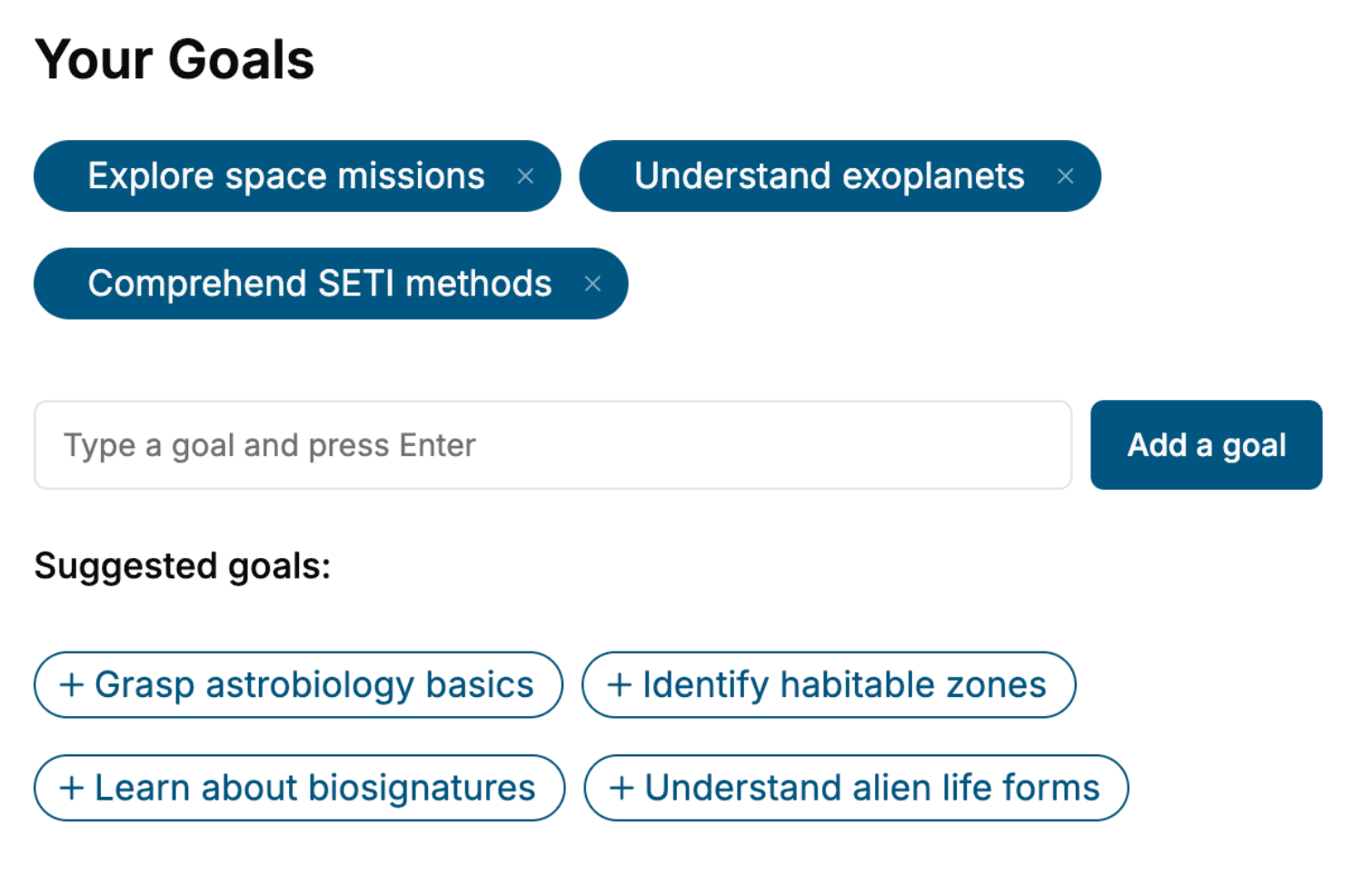
Tell us your goals and background, and get your own version of this book, tailored by AI to you.


Benefits of AI-tailored books
- Read one book, not ten:
- all the Mathematics knowledge you need, gathered into a single book.
- Save days of learning:
- tell us your goals, choose your topics, and the whole book is built around them.
- Learn effortlessly:
- Mathematics book written for your specific background and expertise.
- Understand at a glance:
- includes charts, tables, timelines, checklists, decision trees, and more.
- Stay current:
- written the day you order it, not years ago.
- Trust what you read:
- every book is checked for accuracy, with real research when your subject needs it.
Create your unique book in 3 steps
- 1. Select your focus
Select the focus of your Mathematics book and share your background
- 2. Personalize your book
Specify your goals and choose sub-topics to include
- 3. Get your tailored book
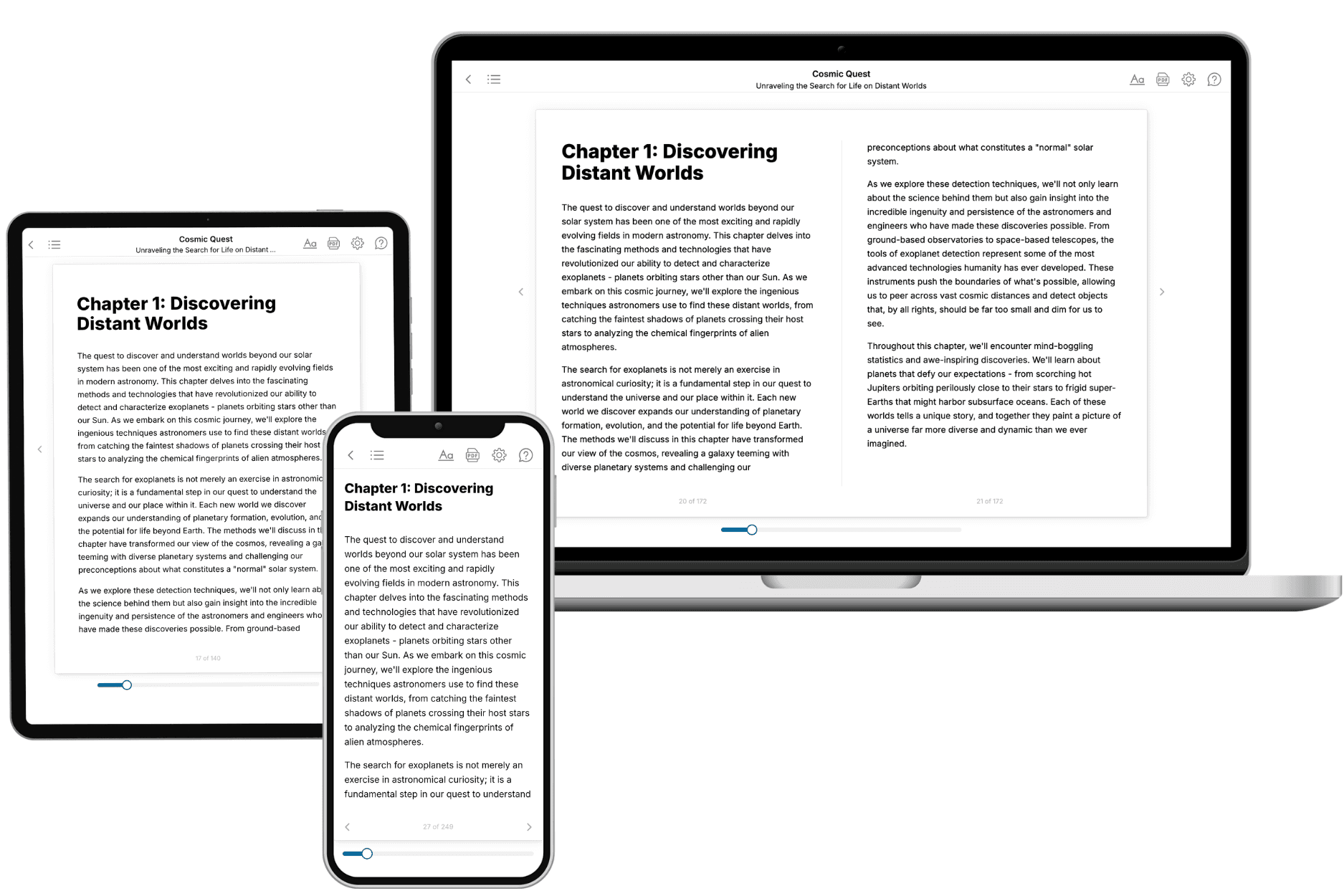
Your book is ready in 10 minutes. Read it online, download as EPUB or PDF, or send to Kindle.

Frequently asked questions
- What is TailoredRead?
TailoredRead creates complete, full-length nonfiction ebooks, written specifically for you. Tell us what you want to learn and why, and TailoredRead writes you a complete ebook on it, with charts, tables, and diagrams throughout. Read it online, on Kindle, or on any e-reader, or download it as a PDF or EPUB. Every book is written fresh the day you order it.
- How is the book tailored to me?
Before anything is written, you answer a few short questions about your goals, your background, and the topics you care about. Your book is then planned around your answers: written at your level, focused on your goals, and covering the topics you chose, instead of the one-size-fits-all book a store sells everyone.
- Will it read like generic AI content?
No. Your book isn't a chat transcript: it's planned chapter by chapter before a single word is written, told in a clear book voice, and explains ideas visually with charts, tables, and diagrams. After writing, every book goes through an editorial pass that polishes chapters so the book reads consistent from start to finish. Judge for yourself: browse thousands of sample books on our Explore Books page.
- How accurate is the content?
Our AI first checks whether your subject needs live research. Niche and fast-moving subjects are researched before writing, and the book plan and chapters are grounded in what it finds. After writing, every book goes through a quality pass that checks its facts and consistency, and researched books list their sources in a Notes section at the back.
- How long is the book?
You choose the length: Comprehensive (250-300 pages), Detailed (150-200 pages), Essential (70-100 pages), or Short (30-50 pages).
- Does the book include visuals?
Yes. Every book includes visual elements such as timelines, checklists, step-by-step guides, decision trees, comparison tables, and matrices, and many include bar charts. A typical book includes dozens of these visual elements.
- Can I read it on Kindle? What formats can I download?
Yes. Every book can be read in our online reader or downloaded as a PDF or EPUB. The EPUB can be opened with Kindle, Apple Books, Kobo, and any e-reader. The Commercial and Author licenses also include an editable Word (DOCX) and Markdown download.
- How much does it cost?
About the price of a regular ebook. The exact price depends on your book's length and complexity, from $2 for the shortest books to $35 for the most comprehensive, and it's shown when you review your book, before you commit to anything. Each book is a one-time purchase, yours to keep, no subscription. Licenses that let you share, teach, or publish your book range from $35.99 to $49.99.
- Can I preview the book before purchasing?
Before you pay, you'll see what your book will cover: the title, a detailed description, the estimated length, and the complete chapter-by-chapter table of contents, so you know what you're getting before you decide. The full text itself is written after you purchase.
- How long does it take to create a book?
About 10 minutes. You can start reading the opening chapters while the rest is still being written.