The Alphabet Cipher Handbook
Master the Art and Science of Letter-Based Codes and Secret Messages
Discover the hidden world of alphabet ciphers and how they've protected secrets throughout history.
191 pages8 chaptersApr 3, 2026Cryptography
About this book
This comprehensive guide takes you from basic substitution techniques to advanced polyalphabetic systems, revealing the mathematical principles and linguistic patterns that make ciphers work—and how to break them. You'll explore legendary ciphers like the Caesar cipher and Vigenère square, understand frequency analysis and pattern recognition, and learn why certain ciphers succeeded while others fell to cryptanalysis. Whether you're interested in cryptography's historical evolution, want to understand modern encryption principles, or simply fascinated by the puzzle of hidden messages, this book provides practical knowledge and real-world examples. Each chapter builds your skills systematically, from creating your own ciphers to analyzing existing ones. By the end, you'll understand not just how alphabet ciphers work, but why they matter in our increasingly digital world.
Table of contents
- IntroductionWhy Ciphers Matter in Modern Communication, What You'll Learn in This Book, How to Use This GuideRead below
- Chapter 1: Foundations of Alphabet CiphersWhat Is a Cipher and How Does It Work?, Understanding Language Structure and Patterns, The Three Main Categories of Alphabet Ciphers
- Chapter 2: Substitution Ciphers: The FoundationThe Caesar Cipher: History and Mechanics, Simple Substitution Ciphers and Key Systems, Why Monoalphabetic Ciphers Are Vulnerable
- Chapter 3: Breaking Ciphers: Frequency Analysis and Pattern RecognitionLetter Frequency Distribution in English, Identifying Patterns and Common Words, Brute Force and Computational Approaches
- Chapter 4: Polyalphabetic Ciphers: Adding ComplexityThe Vigenère Cipher and Its Variations, Key Management and Repetition Patterns, Cryptanalysis of Polyalphabetic Systems
- Chapter 5: Transposition Ciphers: Rearranging the MessageColumnar Transposition and Rail Fence Methods, Double Transposition and Complex Rearrangement, Analyzing and Breaking Transposition Ciphers
- Chapter 6: Historical Ciphers and Their LegacyThe Playfair Cipher: Digraph Encryption, Enigma and Rotor-Based Systems, How Ciphers Evolved Through History
- Chapter 7: Modern Applications and Digital CiphersAlphabet Ciphers in Digital Communication, Combining Alphabet Ciphers with Modern Encryption, Practical Security Considerations Today
- Chapter 8: Creating Your Own CiphersPrinciples of Secure Cipher Design, Testing Your Cipher's Strength, Hands-On Cipher Creation Projects
- ConclusionKey Takeaways and Next Steps, The Future of Alphabet-Based Cryptography
- Glossary of Cipher Terms
- Further Reading and Resources
Introduction
Every secret message ever written started with a simple idea: hide the meaning from everyone except the intended reader. From ancient generals scratching coded orders onto wooden tablets to modern intelligence agencies protecting classified communications, the desire to keep information private is as old as language itself. Alphabet ciphers sit at the heart of this story. They are the tools that turned ordinary letters into puzzles, transformed plain words into mysteries, and gave ordinary people the power to communicate in ways that outsiders simply could not understand.
What makes alphabet ciphers so enduring is their elegance. At their core, they work with the same twenty-six letters you use every day. There are no exotic symbols to memorize, no specialized equipment required, and no advanced mathematics needed to get started. Yet within that simple framework lies extraordinary depth. The same alphabet that spells out a grocery list can, with the right system applied, produce a message that stumped the world's best codebreakers for decades. That tension between simplicity and complexity is what makes this field so fascinating to explore.
This book is built for learners who already have some familiarity with how language and basic cryptography work, and who want to go deeper. You will not find a surface-level overview here. Instead, each chapter builds on the last, taking you from the foundational mechanics of substitution and transposition through the mathematical elegance of polyalphabetic systems, all the way to the principles that connect historical ciphers to modern digital encryption. Along the way, you will encounter real historical examples, practical exercises, and the analytical frameworks that professional cryptanalysts use to break codes. By the time you finish, you will think about letters, patterns, and hidden meaning in ways you never did before.
The journey through alphabet ciphers is also a journey through history. These systems protected military strategies during wartime, secured diplomatic correspondence between empires, and even shaped the outcomes of major conflicts. Understanding how they worked, why some succeeded, and why others failed is not just an academic exercise. It reveals timeless principles about security, communication, and the ongoing contest between those who want to hide information and those who want to uncover it. That contest is still very much alive today, and the lessons from centuries of cipher history remain surprisingly relevant in a world of digital communication and data security.
Why Ciphers Matter in Modern Communication
It might be tempting to think of alphabet ciphers as historical curiosities, interesting relics from a time before computers. That would be a mistake. The principles behind letter-based encryption are not just alive in modern cryptography; they are foundational to it. Every time you send an encrypted message, log into a secure website, or use a password manager, you are benefiting from ideas that trace directly back to the cipher systems explored in this book. The mathematics got more complex, and the keys got much longer, but the core logic of substitution and transformation remains.
Consider how much of modern life depends on secure communication. Online banking, private messaging apps, medical records, and government databases all rely on encryption to stay protected. The encryption algorithms used in these systems, such as AES (Advanced Encryption Standard), are built on principles of substitution and permutation that echo the structure of classical alphabet ciphers. Studying how a Caesar cipher works is not just a history lesson. It is a way of understanding the conceptual DNA of the systems that protect your personal data right now.[1]
Beyond professional security applications, ciphers matter because they teach critical thinking. Cryptanalysis, the art of breaking codes, requires you to look at a problem from multiple angles simultaneously. You have to think like the person who created the cipher while also thinking like someone trying to defeat it. This dual perspective builds analytical skills that transfer directly to fields like data science, linguistics, software engineering, and even investigative journalism. The habit of looking for hidden patterns in seemingly random information is one of the most valuable cognitive tools a person can develop.
There is also a cultural dimension worth acknowledging. Ciphers appear throughout literature, art, and popular culture in ways that reflect society's enduring fascination with hidden knowledge. From Edgar Allan Poe's story "The Gold-Bug," which features a substitution cipher as a central plot device, to the Zodiac Killer's encrypted letters that challenged investigators for decades, coded messages capture the public imagination in a way that few other intellectual puzzles do.[2] Understanding how these ciphers actually work transforms you from a passive observer of these stories into someone who can engage with them analytically.
Ciphers also matter in education. Cryptography is one of the most effective ways to make abstract mathematical concepts feel concrete and meaningful. When students see that modular arithmetic is the engine behind the Caesar cipher, or that matrix algebra underlies certain transposition systems, mathematics stops being an abstract exercise and becomes a tool with real-world power. This book draws on that educational value throughout, connecting the mechanics of each cipher to the broader mathematical and linguistic ideas that make it work.
Finally, understanding ciphers matters for digital literacy. In an era of widespread misinformation, data breaches, and privacy concerns, knowing how encryption works at a conceptual level helps you make better decisions about your own digital security. You do not need to be a professional cryptographer to benefit from this knowledge. Understanding why a short, repeated key weakens a cipher helps you understand why password reuse is dangerous. Understanding frequency analysis helps you appreciate why truly random keys are so important. These are practical insights with immediate real-world value.
A note on perspective: Throughout history, the same cipher knowledge that protected legitimate communications was also used to conceal harmful activities. This book approaches cipher systems as educational and analytical tools. The goal is understanding, not enabling harm. The cryptanalytic techniques covered here are the same ones used by security researchers, historians, and educators worldwide.
What You'll Learn in This Book
This book covers the full landscape of alphabet cipher systems, organized to build your knowledge progressively. Each chapter introduces new concepts while reinforcing and extending what came before. By the end, you will have a comprehensive understanding of how letter-based ciphers work, how they fail, and how the principles behind them connect to modern cryptographic practice. Here is a clear picture of what each major section covers and what skills you will develop along the way.
The opening chapters establish the foundations. You will start by understanding exactly what a cipher is and how it differs from a code, a distinction that matters more than most people realize. From there, you will explore how the structure of language itself, specifically the uneven distribution of letters and the predictable patterns of words, creates both the challenge and the opportunity for cipher design. This linguistic foundation is essential because it explains why some ciphers are easy to break and others are not.
The middle chapters dive into the three major families of alphabet ciphers. Substitution ciphers replace letters with other letters or symbols. Transposition ciphers rearrange the order of letters without changing them. Polyalphabetic ciphers use multiple substitution alphabets to add layers of complexity. Each family gets dedicated coverage, including its history, its mechanics, its strengths, and its vulnerabilities. You will learn not just how to use these systems but how to think about them analytically.
A significant portion of the book is dedicated to cryptanalysis, the science of breaking ciphers. This includes:
- Frequency analysis and how letter distribution patterns reveal substitution keys
- Pattern recognition techniques for identifying common words and structural clues
- The Kasiski examination method for finding repeated sequences in polyalphabetic ciphers
- Index of coincidence calculations for determining cipher type
- Brute force approaches and when computational methods are appropriate
The historical chapters bring the subject to life through real examples. You will explore the Caesar cipher used by Julius Caesar himself, the Vigenère cipher that was considered unbreakable for nearly three centuries, the Playfair cipher that protected British military communications in both World Wars, and the principles behind the Enigma machine that shaped the outcome of World War II.[3] Each historical example is analyzed not just as a curiosity but as a case study in cipher design and cryptanalysis.
The final chapters connect everything to the present. You will see how alphabet cipher principles appear in modern digital encryption, understand how hybrid systems combine classical and contemporary techniques, and work through practical exercises in designing and testing your own cipher systems. The book closes with a look at where alphabet-based cryptography is heading and what role these foundational concepts will continue to play as encryption technology evolves.
By the time you finish this book, you will be able to:
- Identify and classify any alphabet cipher system by type and structure
- Apply frequency analysis and pattern recognition to break monoalphabetic ciphers
- Use the Kasiski examination and index of coincidence to attack polyalphabetic systems
- Explain the historical significance of major cipher systems and their cryptanalytic defeats
- Design a basic cipher system and evaluate its resistance to common attacks
- Connect classical cipher principles to modern encryption concepts
How to Use This Guide
This book is designed to be read sequentially, with each chapter building on the concepts introduced before it. If you skip ahead to the chapter on polyalphabetic ciphers without reading the substitution cipher chapter first, you will likely find yourself missing context that makes the more advanced material harder to follow. That said, if you already have solid knowledge of a particular topic, the chapters are written to be self-contained enough that you can skim familiar sections and focus your attention where it is most useful.
Throughout the book, you will encounter several recurring features designed to reinforce learning and make the material practical. Worked examples walk through cipher operations step by step, showing both the encryption and decryption process with real text. Analysis exercises present you with cipher challenges and guide you through the process of breaking them. Design challenges ask you to apply what you have learned to create or modify cipher systems. Engaging actively with these features, rather than just reading past them, will significantly deepen your understanding.
The mathematical content in this book is kept as accessible as possible. Where formulas appear, they are explained in plain language alongside the symbolic notation. You do not need advanced mathematics to follow the material, but you should be comfortable with basic arithmetic, the concept of modular arithmetic (working with remainders), and simple probability. If any of these feel unfamiliar, a brief review of those topics before starting Chapter 1 will make the rest of the book much smoother.
Pay particular attention to the frequency tables and letter distribution charts that appear in the cryptanalysis chapters. These are not decorative. They are working tools that you will use repeatedly when analyzing ciphers. Consider bookmarking those pages or keeping a printed copy nearby as you work through the exercises. Similarly, the glossary at the back of the book defines every technical term used throughout the text. When a term feels unfamiliar, checking the glossary before moving on will prevent confusion from accumulating.
For learners who want to go beyond the book, each chapter points toward additional resources, including historical texts, academic papers, and online tools that let you experiment with cipher systems interactively. The further reading section at the back of the book provides a curated list of the most valuable resources for each major topic. Cryptography is a field with a rich literature, and this book is designed to be a gateway into that broader world, not a ceiling on how far you can go.
A word about the exercises: they are not optional extras. They are where the real learning happens. Reading about frequency analysis is useful. Actually sitting down with a ciphertext and working through the letter counts, making guesses, testing them, and revising your approach is where the concepts become genuinely internalized. The exercises are calibrated to be challenging but achievable, and they are sequenced so that each one builds on skills developed in previous exercises. Treat them as the core of the learning experience, not as supplementary material.
Finally, approach this subject with patience and curiosity. Cryptanalysis in particular can feel frustrating at first. A cipher that looks completely opaque can suddenly reveal itself once you find the right angle of attack. That moment of breakthrough, when the pattern clicks into place and the hidden message becomes readable, is one of the most satisfying experiences in analytical problem-solving. It is worth the effort to get there. Every expert cryptanalyst started exactly where you are now, staring at a string of seemingly random letters and wondering where to begin. This book will give you the tools to find the answer.
A practical starting point: Before reading Chapter 1, try this quick exercise. Take any paragraph of English text and count how many times each letter appears. Then rank the letters from most to least frequent. Compare your results to the standard English frequency order: E, T, A, O, I, N, S, H, R, L, D, C, U, M, F, P, G, W, Y, B, V, K, X, J, Q, Z. Notice how closely your sample matches the expected pattern. This simple observation is the foundation of frequency analysis, and it is the single most powerful tool for breaking substitution ciphers. Keep those results. You will return to them in Chapter 3.
The world of alphabet ciphers rewards careful attention and systematic thinking. It also rewards a sense of play. The best cryptanalysts throughout history combined rigorous analytical discipline with genuine creative curiosity. They were willing to try unconventional approaches, to look at a problem sideways, and to follow a hunch even when the logic was not yet fully formed. As you work through this material, bring both of those qualities with you. The analytical frameworks will give you structure. The curiosity will take you further than any framework alone ever could.
Notes
Introduction
- 1. Paar, Christof, and Jan Pelzl. Understanding Cryptography: A Textbook for Students and Practitioners. Springer, 2010
- 2. Singh, Simon. The Code Book: The Science of Secrecy from Ancient Egypt to Quantum Cryptography. Anchor Books, 1999
- 3. Kahn, David. The Codebreakers: The Comprehensive History of Secret Communication from Ancient Times to the Internet. Scribner, 1996
This is the end of the free sample. The full book has 8 chapters.
Want this book written for you?
Tell us your goals and background, and get your own version of this book, tailored by AI to you.


Benefits of AI-tailored books
- Read one book, not ten:
- all the Cryptography knowledge you need, gathered into a single book.
- Save days of learning:
- tell us your goals, choose your topics, and the whole book is built around them.
- Learn effortlessly:
- Cryptography book written for your specific background and expertise.
- Understand at a glance:
- includes charts, tables, timelines, checklists, decision trees, and more.
- Stay current:
- written the day you order it, not years ago.
- Trust what you read:
- every book is checked for accuracy, with real research when your subject needs it.
Create your unique book in 3 steps
- 1. Select your focus
Select the focus of your Cryptography book and share your background
- 2. Personalize your book
Specify your goals and choose sub-topics to include
- 3. Get your tailored book
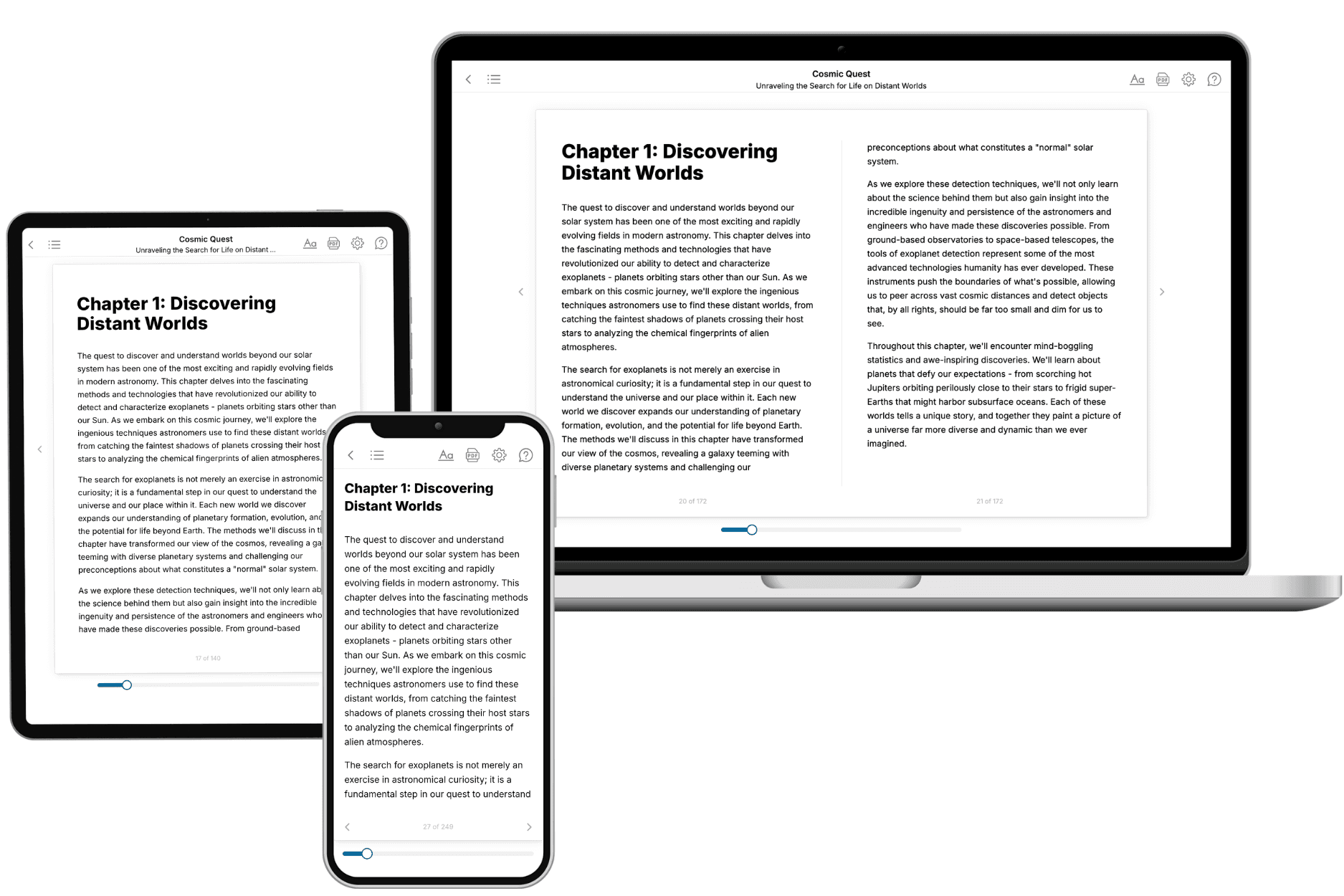
Your book is ready in 10 minutes. Read it online, download as EPUB or PDF, or send to Kindle.

Frequently asked questions
- What is TailoredRead?
TailoredRead creates complete, full-length nonfiction ebooks, written specifically for you. Tell us what you want to learn and why, and TailoredRead writes you a complete ebook on it, with charts, tables, and diagrams throughout. Read it online, on Kindle, or on any e-reader, or download it as a PDF or EPUB. Every book is written fresh the day you order it.
- How is the book tailored to me?
Before anything is written, you answer a few short questions about your goals, your background, and the topics you care about. Your book is then planned around your answers: written at your level, focused on your goals, and covering the topics you chose, instead of the one-size-fits-all book a store sells everyone.
- Will it read like generic AI content?
No. Your book isn't a chat transcript: it's planned chapter by chapter before a single word is written, told in a clear book voice, and explains ideas visually with charts, tables, and diagrams. After writing, every book goes through an editorial pass that polishes chapters so the book reads consistent from start to finish. Judge for yourself: browse thousands of sample books on our Explore Books page.
- How accurate is the content?
Our AI first checks whether your subject needs live research. Niche and fast-moving subjects are researched before writing, and the book plan and chapters are grounded in what it finds. After writing, every book goes through a quality pass that checks its facts and consistency, and researched books list their sources in a Notes section at the back.
- How long is the book?
You choose the length: Comprehensive (250-300 pages), Detailed (150-200 pages), Essential (70-100 pages), or Short (30-50 pages).
- Does the book include visuals?
Yes. Every book includes visual elements such as timelines, checklists, step-by-step guides, decision trees, comparison tables, and matrices, and many include bar charts. A typical book includes dozens of these visual elements.
- Can I read it on Kindle? What formats can I download?
Yes. Every book can be read in our online reader or downloaded as a PDF or EPUB. The EPUB can be opened with Kindle, Apple Books, Kobo, and any e-reader. The Commercial and Author licenses also include an editable Word (DOCX) and Markdown download.
- How much does it cost?
About the price of a regular ebook. The exact price depends on your book's length and complexity, from $2 for the shortest books to $35 for the most comprehensive, and it's shown when you review your book, before you commit to anything. Each book is a one-time purchase, yours to keep, no subscription. Licenses that let you share, teach, or publish your book range from $35.99 to $49.99.
- Can I preview the book before purchasing?
Before you pay, you'll see what your book will cover: the title, a detailed description, the estimated length, and the complete chapter-by-chapter table of contents, so you know what you're getting before you decide. The full text itself is written after you purchase.
- How long does it take to create a book?
About 10 minutes. You can start reading the opening chapters while the rest is still being written.