Architecting Intelligent Agents
A Unified Approach to Context-Aware MCP and A2A Systems
You will elevate your AI system design skills to new heights with this comprehensive guide to building context-aware, agentic intelligence.
315 pages16 chaptersJun 4, 2025AI and Machine LearningCreated by Allan
About this book
Dive deep into the world of Multi-Context Processing (MCP) and Agent-to-Agent (A2A) architectures, learning how to create AI systems that are not just smart, but truly intelligent and adaptable. This book offers a strategic framework for decision-making in AI architecture, complete with detailed diagrams, message sequence charts, and working examples. You'll master the art of designing and implementing MCP and A2A systems, optimizing their performance, and ensuring their scalability. From troubleshooting common pitfalls to applying advanced architectural patterns, you'll gain the knowledge to pioneer breakthroughs in AI responsiveness and efficiency. Whether you're looking to upgrade your testing frameworks, streamline AI workflows, or push the boundaries of what's possible in artificial intelligence, this book provides the tools, techniques, and insights you need. With a focus on practical implementation and real-world applications, you'll be well-equipped to lead the charge in the next generation of intelligent systems.
Table of contents
- IntroductionThe Evolution of Artificial Intelligence, The Importance of Context in AI, Book Overview and Learning Objectives, How to Use This BookRead below
- Chapter 1: The Context Crisis in Modern AI SystemsLimitations of Current AI Approaches, The Challenge of Context Understanding, The Need for Adaptable AI Systems, Impact on AI Decision-Making Capabilities
- Chapter 2: Solution Architecture OverviewIntroduction to Multi-Context Processing (MCP), Introduction to Agent-to-Agent (A2A) Architecture, A Unified Approach to Context-Aware AI, Benefits of the Proposed Architecture
- Chapter 3: MCP Fundamentals and Core ArchitectureCore Principles of Multi-Context Processing, Context Representation and Modeling, Context Switching and Management, Key Components of MCP Architecture
- Chapter 4: MCP Implementation PatternsContext Acquisition and Preprocessing, Context Fusion and Integration, Context-based Reasoning and Inference, Implementing Adaptive Behavior
- Chapter 5: MCP Integration and EcosystemIntegrating Multiple Data Sources, Working with Legacy AI Systems, API Design for MCP Systems, Building an MCP Ecosystem
- Chapter 6: A2A Architecture and Design PrinciplesFoundations of Agent-to-Agent Architecture, Agent Communication Protocols, Defining Agent Roles and Responsibilities, Coordination Mechanisms in A2A Systems
- Chapter 7: Building Production A2A SystemsAgent Development Life Cycle, Deploying and Managing Agents, Monitoring and Logging in A2A Systems, Security Considerations for A2A
- Chapter 8: A2A Optimization and PerformanceKey Performance Metrics for A2A Systems, Optimization Techniques and Best Practices, Addressing Scalability Challenges, Load Balancing and Resource Allocation
- Chapter 9: Integration Strategy and Design PatternsIntegrating MCP and A2A Architectures, Data Flow and Processing Patterns, Event-Driven Integration Approaches, Microservices and Containerization Strategies
- Chapter 10: Advanced Integration PatternsFederated Learning in Distributed Systems, Edge Computing and IoT Integration, Blockchain Integration for Trust and Transparency, Quantum Computing Considerations
- Chapter 11: Scaling and Performance EngineeringDistributed Processing Architectures, Caching Strategies for Improved Performance, Asynchronous Processing Techniques, Performance Tuning and Optimization
- Chapter 12: Safeguards, Ethics, and User AssuranceEthical Considerations in Agentic AI, Privacy Protection and Data Governance, Transparency and Explainability in AI Systems, Building User Trust and Assurance
- Chapter 13: Enterprise Implementation BlueprintsAssessment and Planning for Enterprise Adoption, Migration Strategies from Legacy Systems, Change Management and Organizational Alignment, Measuring ROI and Business Impact
- Chapter 14: Developer Experience and ToolingSetting Up Development Environments, Testing Frameworks for Context-Aware AI, Debugging and Profiling Tools, CI/CD Pipelines for AI Systems
- Chapter 15: Advanced Architectural PatternsSelf-Organizing and Adaptive Systems, Cognitive Architectures for AI, Meta-Learning and Transfer Learning, Designing for Emergent Behaviors
- Chapter 16: Career and Ecosystem DevelopmentSkill Development for Context-Aware AI, Career Paths in Agentic AI, Engaging with the AI Community, Future Trends and Research Directions
- Conclusion: The Agentic FutureRecap of Key Concepts, Future Possibilities and Challenges, Call to Action for AI Architects
- Glossary
- Further Reading
Introduction
As we stand on the cusp of a new era in artificial intelligence, the need for more sophisticated, context-aware, and adaptable AI systems has never been more pressing. The field of AI has made remarkable strides in recent years, transforming industries and reshaping the way we interact with technology. However, as AI applications become more ubiquitous and are tasked with increasingly complex decision-making processes, the limitations of current approaches have become increasingly apparent. This book, "Architecting Intelligent Agents: A Unified Approach to Context-Aware MCP and A2A Systems," aims to address these challenges by providing a comprehensive guide to designing and implementing advanced AI systems that can truly understand and operate within complex, multi-faceted contexts.
The journey ahead will take you through the intricacies of Multi-Context Processing (MCP) and Agent-to-Agent (A2A) architectures, two powerful paradigms that form the foundation for building truly intelligent and adaptable systems. By integrating these approaches, you will learn how to create AI systems that not only process vast amounts of data but also understand the nuanced contexts in which that data exists and make decisions accordingly. This unified approach represents a significant leap forward in AI capabilities, offering solutions to many of the challenges that have long plagued the field.
Throughout this book, you will find a wealth of practical knowledge, from foundational concepts to advanced implementation strategies. Whether you're looking to enhance your existing AI systems, develop new cutting-edge applications, or simply deepen your understanding of the latest advancements in AI architecture, this book will serve as an invaluable resource. With a focus on real-world applications and hands-on examples, you'll gain the skills and insights needed to lead the charge in developing the next generation of intelligent systems.
As we embark on this exploration of context-aware, agentic intelligence, it's important to recognize the transformative potential of these technologies. The systems you'll learn to design and implement have the power to revolutionize industries, from healthcare and finance to transportation and environmental management. By creating AI that can adapt to changing circumstances, communicate effectively with other agents, and make decisions based on a holistic understanding of complex situations, you'll be at the forefront of solving some of the most pressing challenges facing our world today.
This introduction will set the stage for your journey into the world of advanced AI architectures. We'll begin by examining the evolution of artificial intelligence, tracing its path from early rule-based systems to the sophisticated machine learning models of today. This historical context will help you appreciate the significance of the advancements we'll be exploring and understand why a new approach is necessary to overcome current limitations.
Next, we'll delve into the critical importance of context in AI systems. You'll learn why context awareness is the key to creating truly intelligent and responsive AI, and how it can dramatically improve decision-making capabilities across a wide range of applications. This discussion will lay the groundwork for our exploration of MCP and A2A architectures, highlighting the unique advantages they offer in addressing the context challenge.
The Evolution of Artificial Intelligence
The journey of artificial intelligence from its conceptual origins to its current state as a transformative technology is a testament to human ingenuity and perseverance. This evolution has been marked by significant milestones, paradigm shifts, and occasional setbacks, each contributing to the rich tapestry of AI as we know it today. Understanding this historical context is crucial for appreciating the significance of the advanced architectures we'll be exploring in this book and for recognizing the potential for future innovations.
The roots of AI can be traced back to the mid-20th century when pioneers like Alan Turing, John McCarthy, and Marvin Minsky laid the theoretical foundations for machine intelligence. Turing's seminal paper "Computing Machinery and Intelligence" (1950) introduced the concept of the Turing Test, which proposed a method for determining if a machine could exhibit intelligent behavior indistinguishable from a human[1]. This early conceptualization of AI set the stage for decades of research and development aimed at creating machines that could think and reason like humans.
The 1950s and 1960s saw the emergence of symbolic AI, also known as "Good Old-Fashioned AI" (GOFAI). This approach focused on creating systems that could manipulate symbols and follow logical rules to solve problems. Early successes in this era included programs like the Logic Theorist, developed by Allen Newell and Herbert A. Simon in 1955, which could prove mathematical theorems[2]. These early achievements fueled optimism about the potential of AI, leading to bold predictions about the imminent arrival of human-level machine intelligence.
However, the limitations of symbolic AI became apparent in the 1970s and 1980s, a period often referred to as the "AI winter." The inability of rule-based systems to handle the complexity and ambiguity of real-world problems led to a decline in funding and interest in AI research. This setback highlighted the need for more flexible and adaptive approaches to machine intelligence, setting the stage for the next wave of AI innovation.
The 1980s and 1990s saw a resurgence of interest in AI, driven by advancements in machine learning techniques. This period marked a shift from rule-based systems to data-driven approaches. Neural networks, which had been conceptualized decades earlier, gained renewed attention with the development of backpropagation algorithms. These algorithms allowed for the efficient training of multi-layer neural networks, opening up new possibilities for pattern recognition and decision-making tasks.
The turn of the millennium brought about the era of big data and exponential growth in computing power, catalyzing rapid advancements in AI capabilities. Deep learning, a subset of machine learning based on artificial neural networks with multiple layers, emerged as a powerful technique for tackling complex problems in areas such as computer vision, natural language processing, and speech recognition. Landmark achievements like IBM's Deep Blue defeating world chess champion Garry Kasparov in 1997 and Google DeepMind's AlphaGo beating world champion Go player Lee Sedol in 2016 captured the public imagination and demonstrated the potential of AI to match and even surpass human performance in specific domains[3].
Today, AI has become an integral part of our daily lives, powering everything from recommendation systems and virtual assistants to autonomous vehicles and advanced medical diagnostics. The field has expanded to encompass a wide range of techniques and approaches, including reinforcement learning, generative models, and transfer learning. These advancements have enabled AI systems to tackle increasingly complex and open-ended tasks, pushing the boundaries of what was previously thought possible.
However, as AI systems have become more sophisticated and are being deployed in critical decision-making contexts, new challenges have emerged. Issues of bias, interpretability, and robustness have come to the forefront, highlighting the need for more transparent and accountable AI systems. Additionally, the limitations of current AI in handling context-dependent tasks and adapting to novel situations have become increasingly apparent.
This brings us to the current frontier of AI research and development, where the focus is shifting towards creating more flexible, context-aware, and adaptable systems. The Multi-Context Processing (MCP) and Agent-to-Agent (A2A) architectures that we'll explore in this book represent the cutting edge of this new paradigm. These approaches aim to address the limitations of current AI systems by enabling machines to understand and operate within complex, multi-faceted contexts, and to collaborate effectively with other intelligent agents.
As we stand at this exciting juncture in the evolution of AI, it's clear that the field is poised for another transformative leap. The integration of context awareness and agentic intelligence has the potential to unlock new capabilities and applications that were previously out of reach. By understanding this historical context and the trajectory of AI development, you'll be better equipped to appreciate the significance of the advanced architectures we'll be exploring and to envision the future possibilities they enable.
The Importance of Context in AI
As we delve deeper into the realm of advanced AI architectures, it becomes increasingly clear that context is not just a peripheral consideration, but a fundamental cornerstone of truly intelligent systems. The importance of context in AI cannot be overstated; it is the key that unlocks the door to more nuanced, adaptable, and human-like artificial intelligence. In this section, we will explore why context is so crucial, how it impacts AI decision-making, and why traditional approaches have struggled to incorporate contextual understanding effectively.
At its core, context refers to the circumstances that form the setting for an event, statement, or idea. In human cognition, our ability to understand and interpret context is so innate that we often take it for granted. We effortlessly adjust our behavior, language, and decision-making based on a myriad of contextual cues – social norms, physical environment, historical knowledge, and more. This contextual intelligence allows us to navigate complex social situations, understand nuanced communication, and make appropriate decisions in varying circumstances.
For AI systems, however, incorporating this level of contextual understanding has been a significant challenge. Traditional AI approaches have often relied on narrow, task-specific models that excel within well-defined parameters but struggle when faced with ambiguity or novel situations. This limitation becomes particularly apparent in real-world applications where context can dramatically alter the interpretation of data or the appropriateness of a particular action.
Consider, for example, a natural language processing system designed to analyze sentiment in customer reviews. Without contextual understanding, such a system might misinterpret sarcasm or cultural references, leading to inaccurate assessments. Similarly, an autonomous vehicle navigating city streets must not only recognize objects and follow traffic rules but also understand the context of its environment – distinguishing between a child's ball rolling into the street (which might presage a child following) and a piece of litter blowing in the wind.
The importance of context in AI extends far beyond these examples, permeating virtually every domain where AI is applied. In healthcare, contextual understanding can mean the difference between an accurate diagnosis and a potentially harmful misinterpretation of symptoms. In financial systems, context-aware AI can better detect fraudulent activities by considering not just individual transactions but the broader pattern of behavior and circumstances surrounding them.
Moreover, as AI systems are increasingly deployed in complex, dynamic environments, the ability to adapt to changing contexts becomes crucial. An AI agent that can recognize shifts in context and adjust its behavior accordingly is far more robust and versatile than one constrained to a single context or set of assumptions. This adaptability is key to creating AI systems that can operate effectively in the real world, where conditions are rarely static and unexpected situations are the norm rather than the exception.
The integration of contextual understanding also plays a vital role in making AI systems more transparent and explainable. When an AI can articulate the context in which it's operating and how that context influences its decisions, it becomes easier for humans to trust and collaborate with these systems. This explainability is particularly crucial in high-stakes domains like healthcare, finance, and law enforcement, where the reasoning behind AI-driven decisions must be clear and justifiable.
Furthermore, context-aware AI has the potential to bridge the gap between narrow AI (systems designed for specific tasks) and the long-sought goal of artificial general intelligence (AGI). By enabling AI systems to understand and operate within diverse contexts, we move closer to creating machines that can exhibit human-like flexibility and general problem-solving abilities across a wide range of domains.
Despite its critical importance, incorporating context into AI systems presents significant technical challenges. These challenges include:
- Representation: How do we effectively represent complex, multi-dimensional contexts in a way that AI systems can process and utilize?
- Acquisition: How can AI systems gather relevant contextual information from their environment, especially in situations where not all contextual factors are immediately apparent?
- Integration: How do we integrate contextual understanding with existing AI models and decision-making processes?
- Scalability: How can we ensure that context-aware systems remain efficient and performant as the complexity and volume of contextual information increases?
- Generalization: How do we create AI systems that can generalize contextual understanding across different domains and situations?
Addressing these challenges is at the heart of the Multi-Context Processing (MCP) and Agent-to-Agent (A2A) architectures that we'll explore in depth throughout this book. These advanced approaches offer promising solutions for creating AI systems that can truly understand and leverage context in their operations.
As we move forward, it's important to recognize that the pursuit of context-aware AI is not just a technical challenge, but also a step towards creating more ethical and responsible AI systems. By enabling AI to understand the nuanced contexts in which it operates, we can build safeguards against unintended consequences and ensure that AI decisions align more closely with human values and societal norms.
In conclusion, the importance of context in AI cannot be overstated. It is the key to unlocking more intelligent, adaptable, and trustworthy AI systems. As you progress through this book, keep in mind that every concept, technique, and architecture we discuss is ultimately in service of this goal: to create AI that can understand and operate within the rich, complex contexts that define our world. By mastering these approaches, you'll be at the forefront of a new era in AI development, one that promises to bring us closer to the dream of truly intelligent machines that can work alongside humans in harmony and mutual understanding.
Book Overview and Learning Objectives
"Architecting Intelligent Agents: A Unified Approach to Context-Aware MCP and A2A Systems" is designed to be your comprehensive guide to the cutting edge of AI system design and implementation. This book aims to equip you with the knowledge, skills, and insights needed to create advanced AI systems that can understand and operate within complex, multi-faceted contexts. As you progress through the chapters, you'll gain a deep understanding of Multi-Context Processing (MCP) and Agent-to-Agent (A2A) architectures, and learn how to integrate these powerful paradigms to build truly intelligent and adaptable systems.
The book is structured to provide a logical progression from foundational concepts to advanced implementation strategies. Each chapter builds upon the knowledge gained in previous sections, allowing you to gradually develop a comprehensive understanding of context-aware, agentic AI systems. Throughout the book, you'll find a balance of theoretical explanations, practical examples, and hands-on guidance, ensuring that you not only grasp the concepts but also learn how to apply them in real-world scenarios.
Key learning objectives for this book include:
- Understanding the limitations of current AI approaches and the need for context-aware systems
- Mastering the principles and core architecture of Multi-Context Processing (MCP)
- Exploring the foundations and design principles of Agent-to-Agent (A2A) architecture
- Learning how to integrate MCP and A2A approaches to create unified, context-aware AI systems
- Developing skills in implementing, optimizing, and scaling advanced AI architectures
- Gaining insights into ethical considerations and user assurance in agentic AI systems
- Exploring advanced architectural patterns and future trends in AI development
The book is divided into several major sections, each focusing on a crucial aspect of context-aware, agentic AI:
- Foundations and Context: The first few chapters provide a comprehensive overview of the current state of AI, the importance of context, and the fundamental concepts of MCP and A2A architectures.
- Multi-Context Processing: This section delves deep into MCP, covering its core principles, implementation patterns, and integration strategies.
- Agent-to-Agent Architecture: Here, you'll explore the intricacies of A2A systems, including design principles, implementation techniques, and optimization strategies.
- Integration and Advanced Patterns: These chapters focus on bringing MCP and A2A together, exploring advanced integration patterns and cutting-edge architectural approaches.
- Practical Considerations: The final sections of the book cover crucial aspects of deploying context-aware AI in real-world scenarios, including scaling, performance engineering, ethical considerations, and enterprise implementation strategies.
By the end of this book, you will have gained:
- A deep understanding of the theoretical foundations of context-aware, agentic AI
- Practical skills in designing and implementing MCP and A2A architectures
- The ability to integrate these approaches to create unified, advanced AI systems
- Insights into optimizing and scaling context-aware AI for enterprise applications
- An appreciation for the ethical implications and future possibilities of these technologies
Whether you're an experienced AI practitioner looking to expand your skillset, a software architect seeking to incorporate advanced AI capabilities into your systems, or a researcher exploring the frontiers of artificial intelligence, this book will provide you with the knowledge and tools to push the boundaries of what's possible in AI system design.
As you progress through the book, you'll find that each chapter includes not only theoretical explanations but also practical examples, code snippets, and case studies. These elements are designed to help you bridge the gap between concept and implementation, ensuring that you can apply what you've learned to real-world scenarios.
Moreover, the book emphasizes the importance of critical thinking and problem-solving in AI architecture. You'll be encouraged to consider the broader implications of the technologies you're working with, to anticipate potential challenges, and to develop innovative solutions. This approach will not only enhance your technical skills but also prepare you to be a thought leader in the field of AI development.
Remember, the field of AI is rapidly evolving, and the concepts presented in this book represent the cutting edge of current research and practice. As such, you're encouraged to approach the material with an open and curious mind, ready to explore new ideas and challenge existing assumptions. By the end of this journey, you'll be well-equipped to contribute to the next wave of innovations in artificial intelligence, creating systems that are more intelligent, more adaptable, and more attuned to the complexities of the real world.
How to Use This Book
To get the most out of "Architecting Intelligent Agents: A Unified Approach to Context-Aware MCP and A2A Systems," it's important to approach the material strategically and engage with it actively. This section will provide you with guidance on how to effectively use this book to maximize your learning and practical application of the concepts covered.
First and foremost, while the book is designed to be read sequentially, with each chapter building upon the knowledge gained in previous sections, you should feel free to adapt your reading approach to your specific needs and background. If you're already familiar with certain concepts, you may choose to skim those sections and focus more deeply on areas that are new to you. However, even if you're an experienced practitioner, it's recommended to at least briefly review all sections, as the book presents a unified approach that integrates various concepts in novel ways.
As you read through each chapter, consider the following strategies to enhance your learning experience:
- Active Reading: Don't just passively consume the information. Engage with the material by taking notes, highlighting key concepts, and jotting down questions or ideas that come to mind as you read.
- Practical Application: Throughout the book, you'll find practical examples and code snippets. Take the time to work through these examples, experimenting with the code and adapting it to your own projects or ideas.
- Reflection and Connection: After each chapter, take a moment to reflect on what you've learned. Consider how the concepts relate to your current work or projects, and think about potential applications in your field.
- Incremental Learning: The book covers complex topics that may take time to fully grasp. Don't be discouraged if you don't understand everything immediately. Focus on building a solid understanding of the fundamentals before moving on to more advanced concepts.
- Hands-On Projects: As you progress through the book, consider starting a hands-on project that allows you to apply the concepts you're learning. This could be a small-scale implementation of an MCP or A2A system, or even a more ambitious project that grows as you gain more knowledge.
The book includes various features designed to support your learning:
- Key Concepts: At the beginning of each chapter, you'll find a list of key concepts that will be covered. Use these as a roadmap for your reading and as a quick reference for review.
- Code Examples: Throughout the book, you'll encounter code snippets and examples. These are provided to illustrate practical implementations of the concepts discussed. It's highly recommended that you experiment with these examples, modifying and expanding them to deepen your understanding.
- Case Studies: Real-world case studies are included to demonstrate how the concepts and techniques can be applied in practical scenarios. Analyze these carefully and consider how you might apply similar approaches in your own work.
- Diagrams and Illustrations: Complex concepts are often accompanied by visual aids. Take the time to study these diagrams, as they can provide valuable insights into system architectures and processes.
- Further Reading: At the end of each chapter, you'll find suggestions for further reading. These resources can help you delve deeper into specific topics that interest you.
As you work through the book, it's important to pace yourself and allow time for the concepts to sink in. The material covered is complex and multifaceted, and rushing through it may lead to a superficial understanding. Instead, aim for depth of comprehension, even if it means progressing more slowly.
Don't hesitate to revisit earlier chapters or sections as you progress. The interconnected nature of the concepts means that later chapters may shed new light on earlier material, making a second pass through certain sections highly valuable.
Additionally, consider forming a study group or finding a learning partner. Discussing the concepts with others can help solidify your understanding and expose you to different perspectives and interpretations. If you're working through this book as part of a team or organization, consider scheduling regular meetings to discuss your progress and share insights.
Remember that the field of AI is rapidly evolving, and while this book provides a comprehensive foundation in context-aware, agentic AI systems, it's important to stay updated with the latest developments. Use the knowledge gained from this book as a springboard for further exploration and continuous learning in the field.
Finally, don't underestimate the power of practical application. While the theoretical understanding provided by this book is crucial, the real learning often happens when you apply these concepts to real-world problems. Look for opportunities to implement what you've learned in your work or personal projects. Start small if necessary, but aim to gradually tackle more complex challenges as your confidence and skills grow.
By approaching this book with dedication, curiosity, and a focus on practical application, you'll be well on your way to mastering the art of architecting intelligent agents. The knowledge and skills you gain will position you at the forefront of AI development, ready to create the next generation of context-aware, adaptive, and truly intelligent systems.
Notes
Introduction
- 1. A. M. Turing, "Computing Machinery and Intelligence," Mind, 1950
- 2. A. Newell and H. A. Simon, "The logic theory machine--A complex information processing system," IRE Transactions on Information Theory, 1956
- 3. D. Silver and others, "Mastering the game of Go with deep neural networks and tree search," Nature, 2016
This is the end of the free sample. The full book has 16 chapters.
Want this book written for you?
Tell us your goals and background, and get your own version of this book, tailored by AI to you.


Benefits of AI-tailored books
- Read one book, not ten:
- all the AI and Machine Learning knowledge you need, gathered into a single book.
- Save days of learning:
- tell us your goals, choose your topics, and the whole book is built around them.
- Learn effortlessly:
- AI and Machine Learning book written for your specific background and expertise.
- Understand at a glance:
- includes charts, tables, timelines, checklists, decision trees, and more.
- Stay current:
- written the day you order it, not years ago.
- Trust what you read:
- every book is checked for accuracy, with real research when your subject needs it.
Create your unique book in 3 steps
- 1. Select your focus
Select the focus of your AI and Machine Learning book and share your background
- 2. Personalize your book
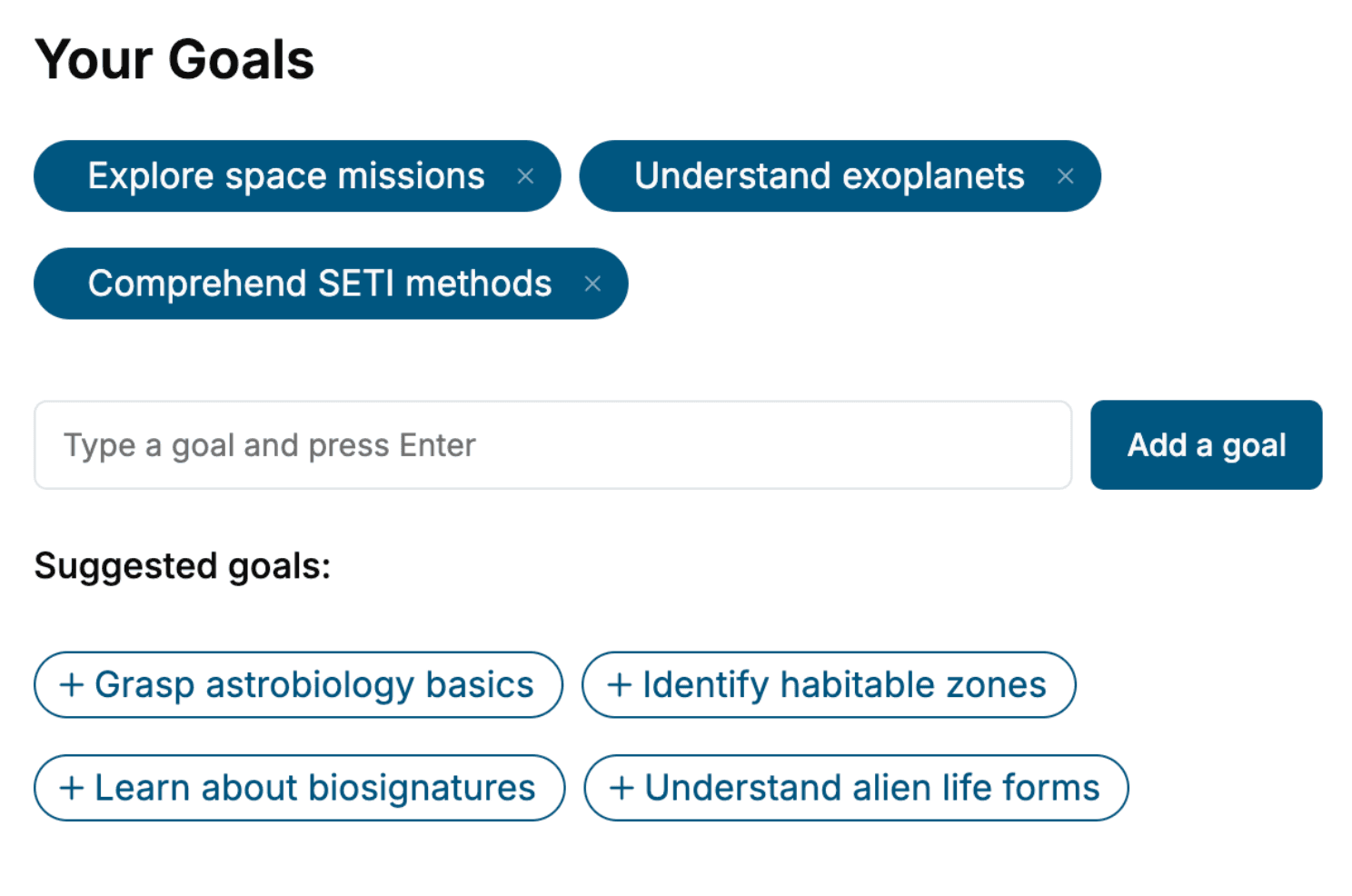
Specify your goals and choose sub-topics to include
- 3. Get your tailored book
Your book is ready in 10 minutes. Read it online, download as EPUB or PDF, or send to Kindle.

Frequently asked questions
- What is TailoredRead?
TailoredRead creates complete, full-length nonfiction ebooks, written specifically for you. Tell us what you want to learn and why, and TailoredRead writes you a complete ebook on it, with charts, tables, and diagrams throughout. Read it online, on Kindle, or on any e-reader, or download it as a PDF or EPUB. Every book is written fresh the day you order it.
- How is the book tailored to me?
Before anything is written, you answer a few short questions about your goals, your background, and the topics you care about. Your book is then planned around your answers: written at your level, focused on your goals, and covering the topics you chose, instead of the one-size-fits-all book a store sells everyone.
- Will it read like generic AI content?
No. Your book isn't a chat transcript: it's planned chapter by chapter before a single word is written, told in a clear book voice, and explains ideas visually with charts, tables, and diagrams. After writing, every book goes through an editorial pass that polishes chapters so the book reads consistent from start to finish. Judge for yourself: browse thousands of sample books on our Explore Books page.
- How accurate is the content?
Our AI first checks whether your subject needs live research. Niche and fast-moving subjects are researched before writing, and the book plan and chapters are grounded in what it finds. After writing, every book goes through a quality pass that checks its facts and consistency, and researched books list their sources in a Notes section at the back.
- How long is the book?
You choose the length: Comprehensive (250-300 pages), Detailed (150-200 pages), Essential (70-100 pages), or Short (30-50 pages).
- Does the book include visuals?
Yes. Every book includes charts, tables, and diagrams: timelines, checklists, step-by-step guides, decision trees, comparison tables, matrices, and bar charts. A typical book includes dozens of these visual elements.
- Can I read it on Kindle? What formats can I download?
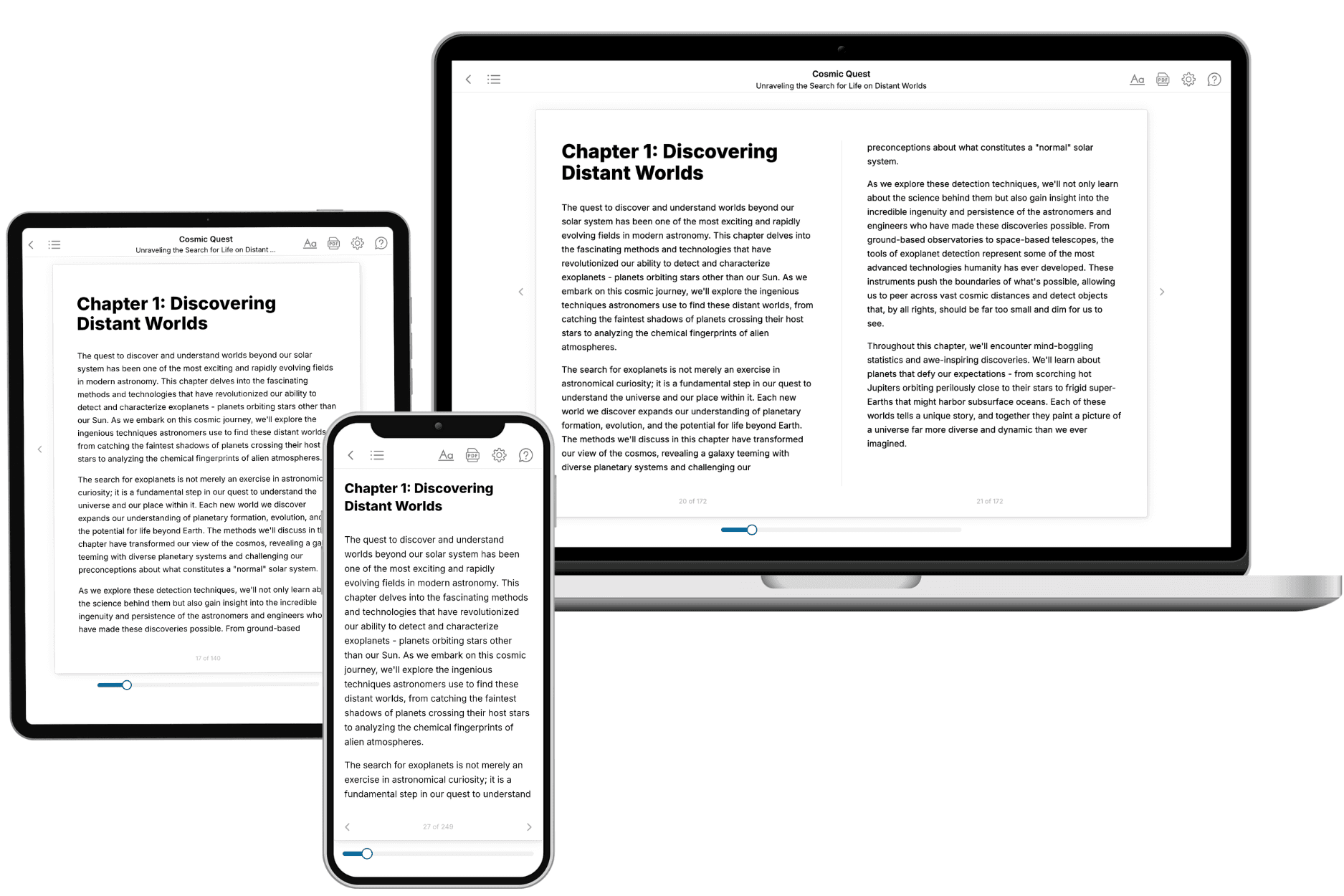
Yes. Every book can be read in our online reader or downloaded as a PDF or EPUB. The EPUB can be opened with Kindle, Apple Books, Kobo, and any e-reader. The Commercial and Author licenses also include an editable Word (DOCX) and Markdown download.
- How much does it cost?
About the price of a regular ebook. The exact price depends on your book's length and complexity, from $2 for the shortest books to $35 for the most comprehensive, and it's shown when you review your book, before you commit to anything. Each book is a one-time purchase, yours to keep, no subscription. Licenses that let you share, teach, or publish your book range from $35.99 to $49.99.
- Can I preview the book before purchasing?
Before you pay, you'll see what your book will cover: the title, a detailed description, the estimated length, and the complete chapter-by-chapter table of contents, so you know what you're getting before you decide. The full text itself is written after you purchase.
- How long does it take to create a book?
About 10 minutes. You can start reading the opening chapters while the rest is still being written.