The Architecture of Power
How Political Systems Shape History and Society
Most people view political history as a collection of disconnected events—wars, revolutions, and famous leaders—without seeing the underlying patterns.
207 pages10 chaptersJan 5, 2026Political Science
About this book
In reality, political systems follow predictable trajectories shaped by fundamental forces. This book reveals the hidden architecture that explains how societies organize power, why systems rise and fall, and what drives political transformation. You'll discover how geography constrains political possibilities, why institutions matter more than individual leaders, and how economic systems intertwine with governance structures. By examining pivotal moments—from the fall of empires to the emergence of democracies—you'll gain insight into the forces reshaping politics today. Whether you're trying to understand current events, anticipate political trends, or simply grasp why the world works as it does, this book provides the conceptual tools to see beyond headlines and recognize the deeper currents moving history forward.
Table of contents
- IntroductionWhy Political History Matters Today, Patterns, Not Chaos: Finding Order in Political Change, How to Use This BookRead below
- Chapter 1: Foundations of PowerWhat Is Political Power?, Geography as Political Destiny, Legitimacy: Why People Accept Authority
- Chapter 2: Ancient Political SystemsTribal and Kinship-Based Societies, The Rise of City-States and Early Republics, Empires and Centralized Rule, Political Innovations That Shaped Civilizations
- Chapter 3: Medieval and Feudal SystemsHow Feudalism Organized Power and Land, The Church and State: Competing Powers, The Emergence of Nation-States from Feudal Chaos
- Chapter 4: Absolute Monarchy and CentralizationDivine Right and the Justification of Absolute Power, Building Centralized States and Bureaucracies, The Limits and Contradictions of Absolute Rule
- Chapter 5: Enlightenment Ideas and Revolutionary ChangeIntellectual Foundations: New Ideas About Power, The American Revolution: First Modern Democratic Experiment, The French Revolution: Radical Transformation, Revolutionary Ideas Spread Across the Globe
- Chapter 6: Nineteenth-Century Political TransformationsNationalism and the Modern Nation-State, Liberalism, Democracy, and Expanding Rights, How Industrialization Reshaped Political Systems
- Chapter 7: Twentieth-Century Ideologies and ConflictsThe Rise of Socialism and Communism, Fascism and Authoritarian Responses, World Wars and Their Political Consequences, The Cold War: Ideological Division of the World
- Chapter 8: Why Institutions MatterHow Rules and Structures Shape Political Behavior, Checks and Balances: Distributing Power, How Institutions Evolve and Resist Change
- Chapter 9: Modern Political Systems TodayVarieties of Democracy: Presidential, Parliamentary, and Hybrid, Authoritarian Systems and Their Persistence, Hybrid Regimes and the Blurring of Categories
- Chapter 10: Contemporary Political ChallengesPolarization and Political Fragmentation, Globalization and the Challenge to National Sovereignty, Technology, Information, and Political Change
- ConclusionLessons from History for Understanding the Future, Applying These Frameworks to Current Events
- Further Reading and Resources
Introduction
Every day, headlines announce political upheavals that seem unprecedented and chaotic. Democracies appear fragile, authoritarian regimes resurge, and long-standing alliances fracture. Yet beneath this apparent disorder lies a deeper architecture—patterns of power that have shaped human societies for millennia. Understanding these patterns transforms how you see the world. What appears as random political turbulence becomes recognizable as part of longer historical trajectories. The conflicts dominating today's news echo struggles that have recurred throughout history, each time wearing different costumes but following similar scripts. This book reveals that architecture, providing you with conceptual tools to decode political events and anticipate where current trends might lead.
Political systems are not accidents of history. They emerge from identifiable forces—geography, economics, technology, culture, and human choices—that interact in predictable ways. When you grasp these underlying dynamics, contemporary politics becomes comprehensible rather than bewildering. The rise of populist movements, the tension between globalization and nationalism, the fragility of democratic norms—all these phenomena have historical precedents that illuminate their nature and trajectory. By examining how political systems developed, transformed, and sometimes collapsed across different eras and cultures, you gain perspective that transcends the immediate moment. This historical depth allows you to distinguish between genuinely novel developments and recurring patterns wearing modern disguises.
This introduction establishes why political history matters for understanding the present, how to recognize patterns rather than seeing only chaos, and how to navigate this book effectively. You don't need specialized knowledge to benefit from these insights. The frameworks presented here are accessible yet sophisticated enough to explain complex political phenomena. Whether you're trying to make sense of current events, anticipate future developments, or simply understand why societies organize power as they do, this book provides the foundation. The goal is not to make you a historian but to equip you with analytical tools that reveal the hidden structures shaping political life. These tools remain relevant regardless of which specific events dominate tomorrow's headlines, because they address the fundamental dynamics that drive political change across all contexts and eras.
Why Political History Matters Today
The present moment always feels unique, but political challenges rarely are. When democratic institutions face pressure from populist movements, when economic inequality fuels political instability, when technological change disrupts established power structures—these dynamics have historical precedents that offer crucial insights. Studying political history is not an academic exercise in memorizing dates and names. It's a practical method for understanding the forces shaping your world right now. Historical patterns reveal which political arrangements prove durable and which contain inherent contradictions that eventually cause collapse. They show how institutions evolve, how legitimacy erodes, and how societies navigate transitions between different systems of governance. Without this historical perspective, you're left interpreting each event in isolation, unable to distinguish signal from noise or recognize when seemingly stable systems approach tipping points.
Consider the current debates about democratic backsliding in established democracies. These concerns become clearer when you understand how democracies emerged historically—not as inevitable outcomes but through specific institutional innovations that balanced competing interests and distributed power. The Weimar Republic's collapse into Nazi Germany demonstrates how democratic institutions can fail when economic crisis combines with political polarization and institutional weakness. The Roman Republic's transformation into empire shows how republics can gradually surrender self-governance when citizens prioritize security and stability over political participation[1]. These historical examples don't predict the future, but they illuminate vulnerabilities in democratic systems and identify warning signs worth monitoring. They reveal that democracy requires more than elections—it depends on norms, institutions, and civic culture that can erode even when formal structures remain intact.
Political history also explains why certain conflicts persist across generations. The tension between centralized authority and local autonomy, between individual rights and collective security, between economic efficiency and social equity—these are not new debates invented by contemporary politicians. They represent fundamental trade-offs inherent in political organization. Understanding their historical manifestations helps you recognize when politicians present false choices or claim unprecedented crises. For instance, debates about immigration and national identity echo nineteenth-century conflicts over who belongs to the nation-state and what defines citizenship. Trade disputes reflect longstanding tensions between economic interdependence and political sovereignty. Recognizing these continuities doesn't diminish contemporary challenges, but it does provide perspective on which solutions have worked, which have failed, and why.
The practical value of historical knowledge becomes evident when you examine how political systems respond to crisis. The COVID-19 pandemic revealed stark differences in governmental capacity and legitimacy across countries. Some states mobilized resources effectively while maintaining public trust; others struggled with both implementation and compliance. These variations weren't random—they reflected institutional legacies, political cultures, and state-society relationships developed over decades or centuries. Countries with strong bureaucratic traditions and high social trust generally managed better than those lacking these foundations. Understanding why requires examining how different political systems developed their institutional capacities and cultivated legitimacy. This historical perspective helps explain not just what happened during the pandemic, but why different societies responded so differently to similar challenges.
Historical knowledge also protects against manipulation. Politicians frequently invoke history selectively to justify their agendas, claiming their policies align with national traditions or warning that opponents threaten cherished values. A solid grasp of political history allows you to evaluate these claims critically. When leaders invoke traditional values
or claim to restore a golden age, historical knowledge reveals whether such eras actually existed or whether they're mythologized versions of more complex realities. When politicians warn that certain policies lead inevitably to tyranny, historical understanding helps assess whether such slippery-slope arguments reflect genuine patterns or rhetorical exaggeration. This critical perspective is essential for informed citizenship in an era of information abundance and deliberate misinformation.
Furthermore, political history reveals that change is possible even when current arrangements seem permanent. Systems that appeared unshakeable—absolute monarchies, colonial empires, communist regimes—eventually transformed or collapsed. This historical perspective provides both caution and hope. Caution, because it shows that even successful systems contain vulnerabilities and can fail when they stop adapting to changing conditions. Hope, because it demonstrates that oppressive or dysfunctional systems need not last forever. The fall of the Berlin Wall, the end of apartheid in South Africa, the spread of democratic governance across much of the world—these transformations seemed impossible until they happened. Understanding how previous political transformations occurred helps identify conditions that enable change and strategies that prove effective. This knowledge is particularly valuable for those working to reform or transform existing systems.
Finally, political history matters because it reveals the contingency of current arrangements. The specific institutions, borders, and power structures that exist today resulted from particular historical circumstances and human decisions. They were not inevitable, and they are not permanent. This recognition opens space for imagining alternatives. When you understand that nation-states emerged only in recent centuries, that democracy took millennia to develop, and that current international institutions were created within living memory, you realize that political organization remains an ongoing project rather than a finished product. This perspective is essential for addressing contemporary challenges—climate change, technological disruption, global inequality—that may require institutional innovations as significant as those that created modern political systems. History shows that humans have repeatedly reimagined and reconstructed political order. That capacity remains available today.
Patterns, Not Chaos: Finding Order in Political Change
Political events often appear chaotic and unpredictable, but they follow identifiable patterns shaped by recurring dynamics. Recognizing these patterns transforms how you interpret political developments. Instead of seeing each crisis or transition as unique, you begin noticing similarities across different contexts and eras. This pattern recognition doesn't mean history repeats exactly—specific circumstances always differ. But certain dynamics recur because they reflect fundamental aspects of political organization and human behavior. Understanding these patterns allows you to move beyond surface-level descriptions of events to grasp the underlying forces driving change. It's the difference between watching waves crash randomly on a beach and understanding the tides, currents, and weather systems that determine when and how those waves arrive.
One fundamental pattern involves the relationship between economic systems and political structures. Throughout history, major economic transformations have triggered political reorganization. The agricultural revolution enabled the emergence of settled communities and hierarchical societies. The commercial revolution of the late medieval period weakened feudalism and strengthened monarchies that could tax trade. The Industrial Revolution created new social classes and eventually forced political systems to expand participation and representation. Today, the information revolution is disrupting established political arrangements in ways that echo previous technological transformations. This pattern doesn't determine specific outcomes, but it reveals that economic and political systems must maintain some degree of alignment. When they diverge too far—when political institutions fail to adapt to economic realities—pressure builds until something gives. Recognizing this pattern helps you anticipate where tensions might emerge and what kinds of political changes economic shifts might eventually require.
Another recurring pattern involves the lifecycle of political institutions. Institutions typically emerge to solve specific problems or manage particular conflicts. Initially, they may function effectively, but over time they often become rigid, captured by special interests, or misaligned with changing circumstances. This institutional sclerosis creates pressure for reform or revolution. Consider how the Roman Senate, originally an effective governing body for a city-state, became dysfunctional when Rome expanded into a vast empire. Or how absolute monarchies, which successfully centralized power and built state capacity, eventually became obstacles to further economic and social development. Contemporary examples include international institutions designed for the post-World War II era struggling to address twenty-first-century challenges. This pattern suggests that institutional maintenance and periodic renewal are essential for political stability. Systems that cannot reform gradually often face revolutionary upheaval instead.
The dynamics of political legitimacy follow recognizable patterns as well. Legitimacy—the belief that authority is rightful and should be obeyed—can derive from different sources: tradition, legal-rational procedures, charismatic leadership, or performance in delivering security and prosperity. Political systems typically rely on multiple sources of legitimacy, but the balance shifts over time. When traditional legitimacy erodes, as happened during the Enlightenment, systems must find alternative foundations or face collapse. When performance legitimacy fails, as during economic crises, systems fall back on procedural legitimacy or nationalist appeals. Understanding these patterns helps explain why some governments weather crises while others collapse. It also reveals vulnerabilities in current systems. Democracies that rely heavily on performance legitimacy—delivering economic growth and rising living standards—become fragile when economic conditions deteriorate. Authoritarian regimes that depend on nationalist legitimacy must continually identify external threats or internal enemies to maintain support.
Patterns also emerge in how political change occurs. Gradual evolution and revolutionary rupture represent two distinct pathways, each with characteristic dynamics. Evolutionary change typically happens when existing elites recognize the need for reform and possess sufficient flexibility to accommodate new groups and interests. Britain's gradual democratization over several centuries exemplifies this pattern—the franchise expanded incrementally, incorporating new social classes without revolutionary upheaval. Revolutionary change occurs when existing systems prove too rigid to reform and when alternative visions mobilize sufficient support to challenge the status quo. The French Revolution, Russian Revolution, and Iranian Revolution followed this pattern. Understanding these different pathways helps you assess whether current political tensions are likely to resolve through reform or escalate into more fundamental confrontation. It also reveals that the pathway matters—revolutionary change often produces different outcomes than evolutionary reform, even when both aim at similar goals.
Geographic patterns shape political development in ways that persist across centuries. States with defensible borders and navigable rivers developed differently from those on open plains or mountainous terrain. Maritime powers faced different political challenges than continental empires. These geographic factors don't determine political outcomes, but they create constraints and opportunities that influence institutional development. For example, the fragmented geography of ancient Greece encouraged the development of independent city-states rather than unified empires. Britain's island position enabled it to avoid large standing armies and the centralized state structures they required, facilitating earlier parliamentary development. Understanding these geographic patterns helps explain why certain political forms emerged where they did and why transplanting institutions from one context to another often produces unexpected results. It also suggests that geography continues to influence contemporary politics, even in an era of globalization and digital communication.
Finally, patterns appear in the relationship between ideas and political change. New political concepts—popular sovereignty, individual rights, nationalism, socialism—don't simply reflect material conditions. They actively shape how people understand their interests and possibilities. These ideas spread through networks of intellectuals, activists, and eventually mass movements, creating new political possibilities. The Enlightenment ideas about natural rights and government by consent didn't automatically produce democracy, but they provided conceptual tools that reformers and revolutionaries used to challenge existing systems. Similarly, nationalist ideas transformed how people understood political community, making the nation-state seem natural and inevitable rather than one option among many. Today, ideas about human rights, environmental sustainability, and digital privacy are reshaping political debates and potentially prefiguring future institutional changes. Recognizing this pattern reveals that political change requires not just material conditions but also conceptual frameworks that make alternatives imaginable and desirable. Ideas matter, but they matter in patterned ways that historical analysis can illuminate.
How to Use This Book
This book is structured to build your understanding progressively, moving from foundational concepts through historical developments to contemporary applications. You can read it sequentially for a comprehensive overview, or you can focus on specific chapters addressing particular interests or questions. Each chapter stands relatively independently while contributing to the larger framework. The early chapters establish conceptual foundations—what political power is, how geography shapes possibilities, why legitimacy matters. Middle chapters trace historical development chronologically, examining how different political systems emerged, functioned, and transformed. Later chapters address contemporary systems and challenges, applying historical insights to current political dynamics. This structure allows you to see both the long arc of political development and the specific mechanisms driving change in different contexts.
Throughout the book, you'll encounter several analytical frameworks that recur across chapters. These frameworks provide tools for analyzing political systems and events. The first framework examines how power is organized and distributed—whether concentrated or dispersed, centralized or decentralized, formal or informal. The second framework focuses on legitimacy—what justifies authority and how that justification changes over time. The third framework analyzes institutions—the rules, norms, and structures that shape political behavior and outcomes. The fourth framework considers the relationship between political systems and their broader context—economic structures, technological capabilities, cultural values, and geographic constraints. As you progress through the book, you'll see these frameworks applied to different historical periods and political systems. This repetition is intentional—it helps you internalize these analytical tools so you can apply them independently to situations not covered in the book.
Each chapter includes concrete examples and case studies that illustrate abstract concepts. These examples serve multiple purposes:
- Illustration: They show how general patterns manifest in specific contexts, making abstract ideas concrete and memorable
- Comparison: They enable you to see similarities and differences across cases, revealing which factors matter most
- Application: They demonstrate how to apply analytical frameworks to real situations, modeling the kind of analysis you can conduct yourself
- Nuance: They reveal complexity and variation, preventing oversimplification of historical patterns
The book emphasizes connections between historical developments and contemporary politics. These connections appear in several forms. Sometimes historical examples directly illuminate current situations—understanding how the Weimar Republic collapsed helps assess democratic vulnerabilities today. Sometimes historical patterns suggest what to watch for—knowing how previous technological revolutions disrupted political systems helps anticipate how digital technology might reshape contemporary politics. Sometimes history reveals alternatives—examining different democratic models shows that current arrangements aren't the only possibilities. As you read, actively consider how historical insights apply to current events and political debates. This active engagement transforms historical knowledge from inert information into practical analytical capability. Keep a mental list of contemporary situations that historical examples illuminate, and periodically reflect on what patterns you're noticing.
You'll also find that the book challenges some common assumptions about political development. It questions narratives of inevitable progress, showing that democracy and rights expanded through conflict and contingency rather than automatic evolution. It complicates simple stories about good and bad political systems, revealing that most systems involve trade-offs rather than pure advantages or disadvantages. It demonstrates that political change rarely results from single causes, instead emerging from complex interactions among multiple factors. These challenges to conventional wisdom are not meant to be cynical or relativistic. Rather, they aim to develop more sophisticated understanding that recognizes complexity without becoming paralyzed by it. Political systems involve genuine choices and real consequences, but those choices are more nuanced than simplified narratives suggest.
To get maximum value from this book, engage actively rather than passively absorbing information. After each chapter, pause to consider:
- What patterns or dynamics did this chapter reveal?
- How do these patterns connect to contemporary political situations I'm aware of?
- What questions does this chapter raise that I want to explore further?
- How does this chapter's content relate to previous chapters?
- What assumptions of mine did this chapter challenge or confirm?
The book concludes with chapters explicitly focused on contemporary politics and future challenges. These chapters apply the historical frameworks developed earlier to current situations, demonstrating how historical perspective illuminates present dynamics. They also address challenges that may require new institutional innovations—climate change, technological disruption, global governance. These concluding chapters are not predictions but explorations of possibilities informed by historical patterns. They show how understanding the past helps navigate an uncertain future, not by providing blueprints but by revealing dynamics, identifying vulnerabilities, and suggesting what kinds of institutional arrangements might address emerging challenges. By the time you reach these chapters, you'll have the conceptual tools to evaluate these applications critically and to conduct similar analyses of situations not covered in the book.
Finally, remember that this book provides frameworks and perspectives rather than definitive answers. Political systems are complex, and reasonable people can disagree about interpretations and implications. The goal is to enhance your analytical capabilities, not to prescribe specific political positions. You may find yourself disagreeing with particular interpretations or emphasizing different factors than the book does. That's not only acceptable but desirable—it means you're engaging critically with the material and developing your own analytical perspective. Use this book as a foundation for ongoing learning rather than a final word. The further reading section provides resources for deeper exploration of topics that particularly interest you. Political understanding is a lifelong project, and this book aims to equip you for that journey rather than complete it.
Notes
Introduction
- 1. Ronald Syme, The Roman Revolution, Oxford University Press, 1939
This is the end of the free sample. The full book has 10 chapters.
Want this book written for you?
Tell us your goals and background, and get your own version of this book, tailored by AI to you.


Benefits of AI-tailored books
- Read one book, not ten:
- all the Political Science knowledge you need, gathered into a single book.
- Save days of learning:
- tell us your goals, choose your topics, and the whole book is built around them.
- Learn effortlessly:
- Political Science book written for your specific background and expertise.
- Understand at a glance:
- includes charts, tables, timelines, checklists, decision trees, and more.
- Stay current:
- written the day you order it, not years ago.
- Trust what you read:
- every book is checked for accuracy, with real research when your subject needs it.
Create your unique book in 3 steps
- 1. Select your focus
Select the focus of your Political Science book and share your background
- 2. Personalize your book
Specify your goals and choose sub-topics to include
- 3. Get your tailored book
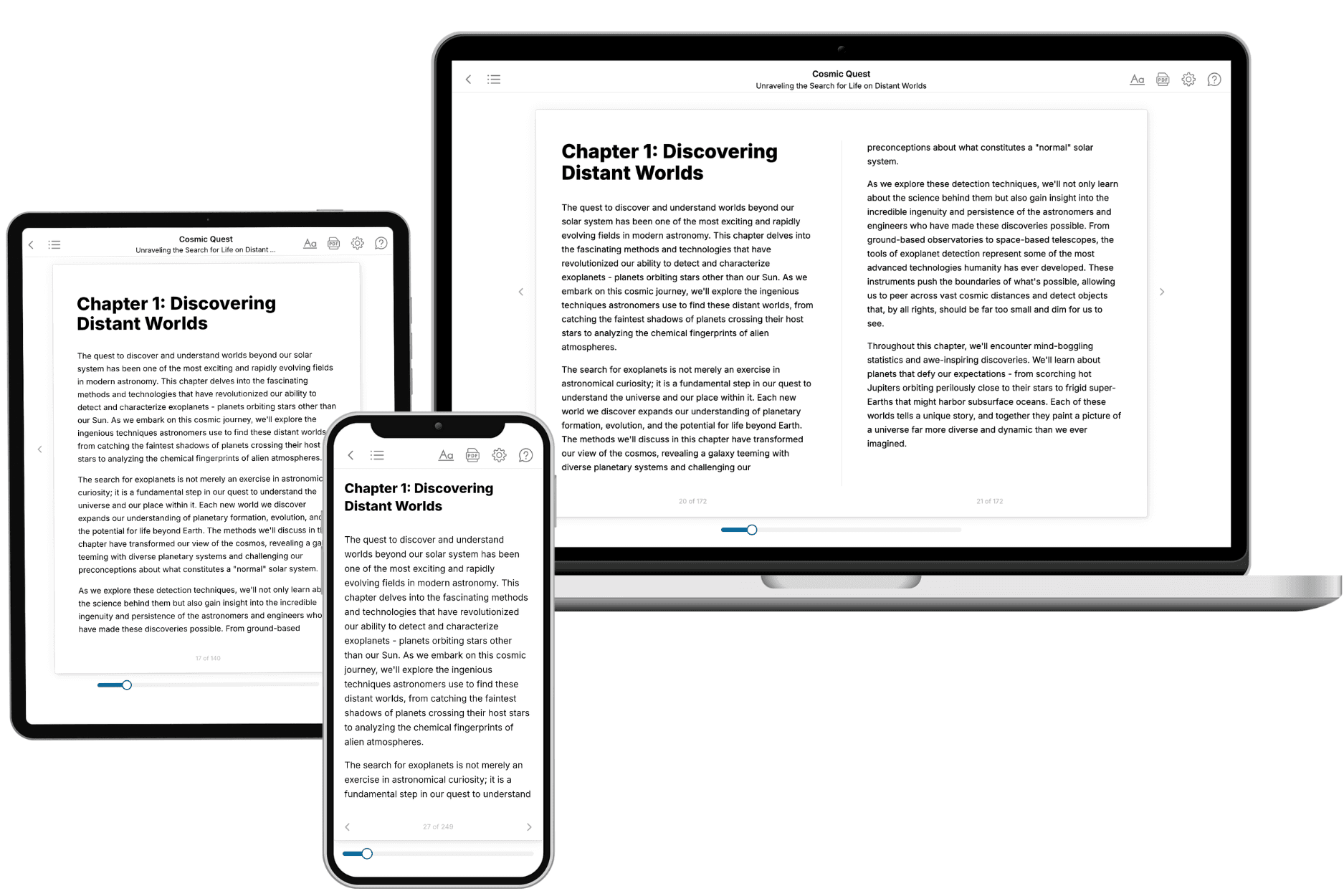
Your book is ready in 10 minutes. Read it online, download as EPUB or PDF, or send to Kindle.

Frequently asked questions
- What is TailoredRead?
TailoredRead creates complete, full-length nonfiction ebooks, written specifically for you. Tell us what you want to learn and why, and TailoredRead writes you a complete ebook on it, with charts, tables, and diagrams throughout. Read it online, on Kindle, or on any e-reader, or download it as a PDF or EPUB. Every book is written fresh the day you order it.
- How is the book tailored to me?
Before anything is written, you answer a few short questions about your goals, your background, and the topics you care about. Your book is then planned around your answers: written at your level, focused on your goals, and covering the topics you chose, instead of the one-size-fits-all book a store sells everyone.
- Will it read like generic AI content?
No. Your book isn't a chat transcript: it's planned chapter by chapter before a single word is written, told in a clear book voice, and explains ideas visually with charts, tables, and diagrams. After writing, every book goes through an editorial pass that polishes chapters so the book reads consistent from start to finish. Judge for yourself: browse thousands of sample books on our Explore Books page.
- How accurate is the content?
Our AI first checks whether your subject needs live research. Niche and fast-moving subjects are researched before writing, and the book plan and chapters are grounded in what it finds. After writing, every book goes through a quality pass that checks its facts and consistency, and researched books list their sources in a Notes section at the back.
- How long is the book?
You choose the length: Comprehensive (250-300 pages), Detailed (150-200 pages), Essential (70-100 pages), or Short (30-50 pages).
- Does the book include visuals?
Yes. Every book includes charts, tables, and diagrams: timelines, checklists, step-by-step guides, decision trees, comparison tables, matrices, and bar charts. A typical book includes dozens of these visual elements.
- Can I read it on Kindle? What formats can I download?
Yes. Every book can be read in our online reader or downloaded as a PDF or EPUB. The EPUB can be opened with Kindle, Apple Books, Kobo, and any e-reader. The Commercial and Author licenses also include an editable Word (DOCX) and Markdown download.
- How much does it cost?
About the price of a regular ebook. The exact price depends on your book's length and complexity, from $2 for the shortest books to $35 for the most comprehensive, and it's shown when you review your book, before you commit to anything. Each book is a one-time purchase, yours to keep, no subscription. Licenses that let you share, teach, or publish your book range from $35.99 to $49.99.
- Can I preview the book before purchasing?
Before you pay, you'll see what your book will cover: the title, a detailed description, the estimated length, and the complete chapter-by-chapter table of contents, so you know what you're getting before you decide. The full text itself is written after you purchase.
- How long does it take to create a book?
About 10 minutes. You can start reading the opening chapters while the rest is still being written.