The Art of Bunraku
Mastering the Ancient Japanese Craft of Three-Person Puppetry
Many people assume that puppet theater is simple entertainment for children, but Bunraku puppetry represents one of the most sophisticated and demanding theatrical arts ever developed.
331 pages17 chaptersOct 12, 2025Theater
About this book
This ancient Japanese craft requires three skilled puppeteers to bring a single puppet to life, creating performances of breathtaking emotional depth and technical precision. You'll discover the centuries-old techniques that transform carved wood and fabric into living, breathing characters capable of moving audiences to tears. From understanding the intricate construction methods passed down through generations to mastering the subtle art of three-person manipulation, this comprehensive guide reveals the secrets behind Japan's most revered puppet theater tradition. Whether you're drawn to the meditative craft of puppet construction or the dynamic art of performance, you'll learn to appreciate the profound cultural significance of Bunraku while developing practical skills that honor this UNESCO-recognized art form. Through detailed explanations of traditional techniques, cultural context, and step-by-step guidance, you'll gain the knowledge needed to participate in preserving and practicing this extraordinary theatrical tradition. This book bridges the gap between cultural appreciation and hands-on craftsmanship, offering both the historical understanding and practical instruction necessary to engage meaningfully with Bunraku puppetry in the modern world.
Table of contents
- IntroductionThe Mystique of Bunraku, Three-Person Harmony, A Living Cultural Treasure, Your Path ForwardRead below
- Chapter 1: Origins and Historical DevelopmentBirth in the Edo Period, The Great Osaka Theaters, Legendary Master Craftsmen, Modern Preservation Efforts
- Chapter 2: Cultural Significance and PhilosophyJapanese Aesthetic Principles, Spiritual Dimensions, Social Commentary Through Performance, UNESCO World Heritage Recognition
- Chapter 3: Anatomy of a Bunraku PuppetHead Construction and Types, Body Proportions and Structure, Jointing and Movement Systems, Costume Integration
- Chapter 4: Traditional Materials and ToolsWood Selection and Preparation, Essential Carving Tools, Traditional Fabric Choices, Paints and Finishing Materials
- Chapter 5: Carving the Puppet HeadDesign and Planning, Rough Shaping Techniques, Carving Facial Features, Surface Finishing
- Chapter 6: Body Construction TechniquesCreating the Torso Framework, Arm Mechanisms and Joints, Leg Construction for Female Puppets, Internal Control Systems
- Chapter 7: Painting and DecorationBase Preparation and Priming, Traditional Facial Painting, Character Type Variations, Protective Finishes
- Chapter 8: Costume Creation and StylingHistorical Period Accuracy, Traditional Fabric Techniques, Layering Systems, Accessories and Props
- Chapter 9: The Three-Person Manipulation SystemThe Omozukai (Main Puppeteer), The Hidarizukai (Left Hand Operator), The Ashizukai (Foot Operator), Coordination Principles
- Chapter 10: Basic Manipulation TechniquesProper Holding Positions, Walking and Basic Movements, Head and Neck Control, Simulating Breathing
- Chapter 11: Advanced Movement PatternsEmotional Gesture Vocabulary, Dance Sequences, Combat and Action Scenes, Transformation Scenes
- Chapter 12: Kata - Stylized Movement FormsClassical Kata Forms, Character-Specific Movements, Emotional Expression Kata, Practice and Memorization Methods
- Chapter 13: Integration with Music and NarrationFollowing Shamisen Rhythms, Coordinating with the Tayu Narrator, Understanding Musical Cues, Precision in Timing
- Chapter 14: Stage Techniques and PositioningUnderstanding Stage Geography, Visibility and Sightlines, Entrances and Exits, Achieving Puppeteer Invisibility
- Chapter 15: Character Development and InterpretationTraditional Character Archetypes, Expressing Personality Through Movement, Portraying Different Ages, Indicating Social Status
- Chapter 16: Puppet Maintenance and CareDaily Care Routines, Proper Storage Methods, Basic Repair Techniques, Restoration Principles
- Chapter 17: Modern Applications and AdaptationsAdapting Contemporary Stories, Educational Applications, Fusion with Other Art Forms, International Influence and Exchange
- Conclusion
- Glossary
- Further Reading
Introduction
When most people think of puppet theater, they imagine simple marionettes dancing on strings or hand puppets entertaining children at birthday parties. This common perception barely scratches the surface of what puppetry can achieve as an art form. In the traditional theaters of Japan, an entirely different kind of puppet performance unfolds—one so sophisticated and emotionally powerful that it has moved audiences to tears for over four centuries. This is Bunraku, the ancient Japanese art of three-person puppetry, where carved wooden figures become vessels for the deepest human emotions and most compelling stories ever told on stage.
Bunraku represents the pinnacle of puppet theater artistry, demanding a level of skill, coordination, and cultural understanding that few theatrical traditions can match. Unlike other forms of puppetry where a single performer controls a puppet, Bunraku requires three highly trained puppeteers working in perfect harmony to bring one puppet to life. The main puppeteer, or omozukai, controls the head and right arm while coordinating the puppet's overall movement and emotional expression. The hidarizukai operates the left arm with subtle precision, while the ashizukai manages the legs and feet, creating the illusion of natural human locomotion. This intricate collaboration produces performances of breathtaking realism and emotional depth that have earned Bunraku recognition as a UNESCO Intangible Cultural Heritage of Humanity.
The journey into Bunraku puppetry is not merely about learning technical skills—it is an immersion into Japanese culture, philosophy, and aesthetic principles that have shaped this art form for generations. Every aspect of Bunraku, from the careful selection of wood for carving puppet heads to the precise timing of movements synchronized with shamisen music and narrative chanting, reflects centuries of refinement and cultural wisdom. The puppets themselves are masterworks of craftsmanship, with heads carved according to traditional character types, bodies constructed with sophisticated jointing systems, and costumes that represent the finest examples of period textile arts. Understanding and creating these elements requires not only technical proficiency but also deep appreciation for the cultural context that gives Bunraku its meaning and power.
Your exploration of this remarkable art form will challenge preconceptions about what puppets can achieve and what puppet theater can express. Through detailed examination of construction techniques, manipulation methods, and performance principles, you will discover how master craftsmen and puppeteers transform wood, fabric, and human skill into theatrical experiences that rival any live performance art. Whether your interest lies in the meditative craft of puppet construction, the dynamic art of three-person manipulation, or the cultural significance of this living tradition, this comprehensive guide will provide the knowledge and understanding necessary to engage meaningfully with Bunraku puppetry in the modern world.
The Mystique of Bunraku
The first encounter with authentic Bunraku performance often leaves audiences stunned by the sheer impossibility of what they witness. A wooden puppet, roughly two-thirds human size, moves across the stage with such natural grace and emotional authenticity that viewers forget they are watching an inanimate object. The puppet's eyes seem to follow other characters, its breathing appears natural and rhythmic, and its gestures convey subtle emotions with a precision that many human actors struggle to achieve. This transformation from carved wood to living character represents one of the most remarkable achievements in theatrical arts, accomplished through techniques that have been refined and passed down through generations of master craftsmen and performers.
The mystique of Bunraku lies not only in its visual impact but also in the profound philosophical principles that underpin every aspect of the art form. Japanese aesthetic concepts such as ma (the meaningful use of pause and space), jo-ha-kyu (the rhythm of introduction, development, and climax), and mono no aware (the bittersweet awareness of impermanence) are woven into every performance. These principles guide everything from the timing of a puppet's gesture to the overall structure of a dramatic scene. When a Bunraku puppet pauses before delivering an emotional moment, that pause carries the weight of centuries of artistic tradition and cultural understanding about the power of restraint and timing in creating emotional impact.
The construction of Bunraku puppets themselves embodies this mystique through their extraordinary attention to detail and symbolic significance. Each puppet head belongs to one of approximately twelve basic character types, known as kashira, with specific features that immediately communicate the character's role, personality, and social status to knowledgeable audiences. The head of a young noble woman differs dramatically from that of a middle-aged merchant or an elderly warrior, not just in obvious features like age lines or facial hair, but in subtle proportions and expressions that reflect deep cultural understanding of character archetypes. The bodies, while hidden beneath elaborate costumes, contain sophisticated jointing systems that allow for remarkably human-like movement while maintaining the structural integrity necessary for the demanding manipulation techniques.
Perhaps most mysterious to newcomers is how three separate individuals can coordinate their movements so seamlessly that the puppet appears to be controlled by a single consciousness. This coordination goes far beyond simple mechanical synchronization—it requires the puppeteers to think and feel as one entity, sharing not only the physical manipulation of the puppet but also the emotional interpretation of the character. The main puppeteer must communicate intentions and emotional shifts to the other two through subtle physical cues, while all three must remain constantly aware of the musical accompaniment and narrative chanting that provides the rhythm and emotional context for their performance. This level of coordination typically requires years of training and practice together as a team.
The mystique extends to the relationship between the visible puppeteers and the puppet itself, creating a unique theatrical convention where audiences simultaneously see the manipulators and accept the puppet as an independent character. Unlike Western puppet traditions that often hide the puppeteer, Bunraku puppeteers perform in full view of the audience, dressed in black robes that symbolically render them invisible while allowing their skill to be appreciated. This visible invisibility creates a fascinating psychological dynamic where audiences consciously choose to focus on the puppet while unconsciously appreciating the artistry of the manipulation. The result is a form of theatrical magic that acknowledges its own artifice while creating genuine emotional connection.
Understanding this mystique requires recognizing that Bunraku operates on multiple levels of meaning and appreciation simultaneously. On the surface level, audiences enjoy compelling stories of love, betrayal, honor, and sacrifice performed by remarkably lifelike puppets. On a deeper level, connoisseurs appreciate the technical mastery required for seamless three-person manipulation, the cultural authenticity of period costumes and settings, and the preservation of traditional narrative and musical forms. On the deepest level, Bunraku serves as a meditation on the nature of life itself, using the metaphor of puppets controlled by unseen forces to explore themes of fate, free will, and the human condition. This multi-layered richness ensures that Bunraku remains endlessly fascinating, revealing new depths of meaning and artistry with each encounter.
The mystique of Bunraku also encompasses its role as a living link to Japan's cultural past, maintaining traditions and techniques that might otherwise be lost to modernization. Every performance represents not just entertainment but cultural preservation, keeping alive the skills of master carvers, textile artists, musicians, and performers whose knowledge represents centuries of accumulated wisdom. When you witness a Bunraku performance or engage with the craft of puppet construction, you participate in this living tradition, connecting with generations of artists who have dedicated their lives to perfecting and preserving this extraordinary art form.
For those drawn to explore Bunraku more deeply, the mystique serves as both inspiration and challenge. The apparent simplicity of wooden puppets moved by visible operators masks layers of complexity that can take decades to fully appreciate and master. Yet this complexity is not intimidating but inviting, offering endless opportunities for discovery, learning, and personal artistic growth. Whether approaching Bunraku as a cultural enthusiast, craft practitioner, or performing artist, you will find that its mystique deepens rather than diminishes with understanding, revealing new dimensions of beauty and meaning that enrich both artistic practice and personal appreciation of this remarkable theatrical tradition.
Three-Person Harmony
The three-person manipulation system that defines Bunraku represents one of the most sophisticated examples of collaborative artistry in world theater. This system, known as sannin-zukai, evolved over centuries from simpler one-person puppet operations into the complex coordinated effort that characterizes modern Bunraku. The division of labor among three puppeteers allows for a level of detail and realism in puppet movement that would be impossible for a single operator to achieve. Each puppeteer specializes in specific aspects of the puppet's movement and expression, developing expertise that contributes to the overall illusion of life and consciousness in the wooden figure.
The omozukai, or main puppeteer, holds the most senior position and bears primary responsibility for the puppet's overall performance and emotional expression. This puppeteer controls the puppet's head through an internal mechanism and operates the right arm using a system of strings and rods. The omozukai must coordinate not only these physical elements but also serve as the leader for the other two puppeteers, communicating timing, emotional shifts, and movement intentions through subtle physical cues. Years of training are required to master the complex hand positions and finger movements necessary to create natural head movements, facial expressions, and right-arm gestures while simultaneously leading the collaborative effort. The omozukai typically trains for fifteen to twenty years before being considered ready for major roles.
The hidarizukai specializes in operating the puppet's left arm and hand, a role that requires extraordinary sensitivity and precision. While this might seem like a secondary function, the left hand in Japanese culture carries significant symbolic and practical importance in gesture and expression. The hidarizukai must master the subtle art of making the left hand complement and enhance the right hand's movements while maintaining independence when the dramatic situation requires it. This puppeteer must also be prepared to handle props, manipulate costume elements, and create gestures that support the overall emotional expression of the character. The coordination between the omozukai and hidarizukai must be so seamless that the puppet's arm movements appear to originate from a single consciousness.
The ashizukai, responsible for the puppet's legs and feet, faces unique challenges in creating the illusion of natural human locomotion. This role requires not only technical skill in manipulating the leg mechanisms but also deep understanding of how different characters move based on their age, social status, emotional state, and physical condition. A young woman's delicate steps differ dramatically from an elderly man's labored gait or a warrior's confident stride. The ashizukai must also coordinate with the other puppeteers to ensure that the puppet's lower body movements support and enhance the overall performance rather than distracting from it. This position serves as the traditional entry point for new puppeteers, though mastery still requires many years of dedicated practice.
The harmony among these three puppeteers extends beyond mere mechanical coordination to encompass shared emotional and artistic interpretation of the character being portrayed. Before each performance, the team must discuss and agree upon their interpretation of the character's personality, emotional journey, and key dramatic moments. During performance, they must remain constantly attuned to each other's subtle cues and adjustments, ready to adapt their own movements to maintain the unified illusion. This requires not only technical skill but also deep empathy and communication abilities that allow three individuals to think and feel as one artistic entity.
The training process for achieving this three-person harmony follows traditional Japanese apprenticeship methods, emphasizing gradual skill development, respect for hierarchy, and deep immersion in the art form's cultural context. Beginning students typically spend years observing performances and practicing basic movements before being allowed to participate in actual productions. The relationship between senior and junior puppeteers involves not only technical instruction but also transmission of cultural knowledge, artistic philosophy, and professional ethics. This mentorship system ensures that each new generation of puppeteers understands not only the mechanical aspects of puppet manipulation but also the deeper cultural and artistic principles that give Bunraku its meaning and power.
Modern practitioners of Bunraku, whether in Japan or internationally, must adapt these traditional training methods to contemporary circumstances while preserving the essential elements that make three-person harmony possible. This might involve modified apprenticeship structures, intensive workshop formats, or collaborative learning approaches that maintain the emphasis on gradual skill development and deep cultural understanding. The key is recognizing that technical proficiency alone is insufficient—true three-person harmony requires the development of shared artistic vision, mutual trust, and the ability to subordinate individual ego to collective artistic expression.
The achievement of genuine three-person harmony in Bunraku manipulation represents a profound lesson in collaboration that extends far beyond puppet theater. The principles of clear communication, shared responsibility, mutual support, and unified artistic vision that make Bunraku possible offer valuable insights for any collaborative endeavor. When three puppeteers successfully merge their individual skills into a seamless collective performance, they demonstrate the transformative power of true teamwork and the extraordinary results that become possible when individual talents are coordinated toward a common artistic goal.
A Living Cultural Treasure
Bunraku's designation as a UNESCO Intangible Cultural Heritage of Humanity in 2003 formally recognized what Japanese culture has understood for centuries: this art form represents far more than entertainment or craft—it embodies living cultural knowledge that connects contemporary practitioners and audiences with centuries of artistic, philosophical, and social wisdom[1]. Unlike museum artifacts or historical documents that preserve culture in static form, Bunraku maintains its vitality through continuous practice, adaptation, and transmission from master to student. Each performance, each newly carved puppet head, and each training session contributes to the ongoing life of this cultural treasure, ensuring that ancient wisdom remains accessible and relevant to modern practitioners and audiences.
The cultural significance of Bunraku extends deeply into Japanese social and philosophical traditions, reflecting core values and worldviews that have shaped Japanese society for generations. The art form embodies the Japanese concept of shokunin—the craftsman's dedication to perfecting one's art through lifelong practice and continuous refinement. Bunraku practitioners, whether puppet carvers, puppeteers, or musicians, exemplify this philosophy through their commitment to gradual skill development, attention to minute details, and respect for traditional methods. The years-long apprenticeships, the careful preservation of specific techniques, and the emphasis on collective rather than individual achievement all reflect cultural values that prioritize long-term mastery over quick results and community harmony over personal recognition.
As a repository of historical knowledge, Bunraku preserves detailed information about Japanese life, customs, and social structures from the Edo period (1603-1868) through its stories, costumes, and performance conventions. The puppet theater's repertoire includes works that chronicle historical events, social conflicts, and cultural changes that shaped Japanese society during crucial periods of development. Characters represent authentic social types from merchants and samurai to courtesans and farmers, with their costumes, speech patterns, and behavioral codes accurately reflecting the social hierarchies and cultural norms of their respective periods. This historical authenticity makes Bunraku performances valuable cultural documents that preserve knowledge about Japanese society that might otherwise be lost or forgotten.
The preservation of traditional crafts and techniques within Bunraku represents another dimension of its cultural treasure status. The art form maintains specialized skills in wood carving, textile arts, musical instrument construction, and performance techniques that have been refined over centuries. Master puppet carvers still use traditional tools and methods to create heads according to classical character types, while costume makers employ historical textile techniques and authentic materials to create garments that accurately represent period dress. These craft traditions, maintained within the context of Bunraku, preserve technical knowledge and artistic skills that contribute to Japan's broader cultural heritage and provide models for contemporary craft practitioners.
The philosophical and spiritual dimensions of Bunraku connect the art form to deeper currents of Japanese thought and religious tradition. The puppet theater's exploration of themes such as duty versus desire, the impermanence of worldly attachments, and the complex relationship between fate and free will reflects Buddhist and Confucian influences that have profoundly shaped Japanese culture. The metaphor of puppets controlled by unseen forces serves as a meditation on the human condition, inviting audiences to contemplate their own relationship to the forces that shape their lives. This philosophical depth ensures that Bunraku remains relevant and meaningful to contemporary audiences while preserving traditional wisdom about fundamental human experiences.
The international recognition of Bunraku as a cultural treasure has created opportunities for cross-cultural exchange and learning that extend the art form's influence beyond Japan's borders. International workshops, cultural exchange programs, and collaborative projects have introduced Bunraku techniques and principles to puppet theater practitioners worldwide, while also providing Japanese masters with fresh perspectives on their traditional art. This international engagement demonstrates how living cultural treasures can maintain their authenticity while adapting to global contexts and contributing to worldwide artistic development. The challenge lies in preserving essential cultural elements while allowing for creative adaptation and innovation.
For contemporary practitioners and enthusiasts, engaging with Bunraku as a living cultural treasure involves both privilege and responsibility. The privilege lies in accessing centuries of accumulated artistic wisdom and participating in the continuation of an extraordinary cultural tradition. The responsibility involves approaching the art form with appropriate respect, dedication, and cultural sensitivity while contributing to its preservation and development for future generations. This means not only learning technical skills but also understanding the cultural context that gives those skills meaning and significance. It requires recognizing that mastery involves not just individual achievement but also contribution to the collective preservation and transmission of cultural knowledge.
The future vitality of Bunraku as a living cultural treasure depends on finding ways to honor traditional methods and values while adapting to contemporary circumstances and needs. This might involve developing new training methods that preserve essential elements while accommodating modern learning styles, creating contemporary works that maintain traditional artistic principles while addressing current themes, or using modern technology to document and preserve traditional knowledge while supporting rather than replacing human skill and artistry. The key is ensuring that adaptation serves the goal of preservation and transmission rather than compromising the essential cultural elements that make Bunraku a unique and valuable artistic tradition.
Your Path Forward
Embarking on the journey into Bunraku puppetry requires understanding that this is not merely a hobby or casual interest but a commitment to engaging with one of the world's most sophisticated theatrical traditions. Your path forward will involve multiple interconnected areas of learning and practice, each building upon the others to create a comprehensive understanding of this remarkable art form. Whether your primary interest lies in puppet construction, performance techniques, or cultural appreciation, success in any aspect of Bunraku requires foundational knowledge in all areas. The interconnected nature of craft, performance, and cultural understanding means that even specialists must maintain broad competency across the entire spectrum of Bunraku arts.
The practical foundation of your Bunraku journey begins with understanding traditional construction methods and materials. This involves learning to select and prepare appropriate woods for carving, mastering the use of traditional carving tools, and developing the patience and precision necessary for creating authentic puppet heads and bodies. The construction phase teaches fundamental lessons about Japanese craftsmanship principles, including attention to detail, respect for materials, and the gradual development of skill through repetitive practice. Even if your ultimate goal is performance rather than construction, hands-on experience with puppet making provides essential insights into how the puppets function mechanically and how their design supports the manipulation techniques that bring them to life.
Your development as a Bunraku practitioner will necessarily involve extensive study of Japanese cultural and historical contexts that give the art form its meaning and authenticity. This cultural education encompasses multiple areas:
- Historical knowledge of the Edo period and the social conditions that shaped Bunraku's development
- Understanding of Japanese aesthetic principles such as ma, jo-ha-kyu, and mono no aware
- Familiarity with traditional Japanese music, particularly shamisen techniques and rhythmic patterns
- Knowledge of classical Japanese literature and the stories that form Bunraku's traditional repertoire
- Appreciation of Japanese textile arts, costume design, and period dress conventions
The performance aspect of your journey involves progressive skill development in manipulation techniques, beginning with basic movements and gradually advancing to complex emotional expressions and character portrayals. Your training should follow traditional progression patterns, starting with fundamental exercises in puppet handling, breathing simulation, and basic locomotion before advancing to character-specific movements and collaborative three-person techniques. This progression typically requires several years of dedicated practice, with each level of skill opening new possibilities for artistic expression while revealing additional layers of complexity and refinement. The performance training also develops essential qualities such as patience, concentration, and the ability to subordinate individual ego to collective artistic expression.
Practical steps for beginning your Bunraku journey include identifying learning resources and opportunities that match your current skill level and geographic location. This might involve:
- Seeking out workshops or classes offered by qualified instructors with authentic Bunraku training
- Connecting with puppet theater communities that include practitioners interested in traditional Japanese techniques
- Studying video recordings of authentic Bunraku performances to develop visual familiarity with proper techniques
- Beginning with simplified puppet construction projects that teach basic principles without requiring master-level carving skills
- Developing foundational skills in related areas such as woodworking, textile arts, or traditional Japanese music
Your journey will benefit significantly from connecting with others who share your interest in Bunraku and traditional puppet theater. This community aspect provides not only practical support and learning opportunities but also the social context that makes the collaborative nature of Bunraku possible. Building relationships with fellow practitioners creates opportunities for group practice sessions, shared learning experiences, and eventually the formation of manipulation teams capable of authentic three-person puppet operation. The community also provides motivation and encouragement during the inevitable challenges and plateaus that accompany any serious artistic pursuit.
Setting realistic expectations for your Bunraku journey helps maintain motivation while avoiding frustration with the gradual pace of skill development that characterizes traditional Japanese arts. Authentic mastery requires years of dedicated practice, and even basic competency takes considerable time to develop. However, the journey itself provides rewards at every stage, from the meditative satisfaction of carving your first puppet head to the excitement of achieving your first successful collaborative manipulation. The key is appreciating incremental progress while maintaining commitment to long-term goals and understanding that each stage of development brings its own insights and satisfactions.
Your path forward in Bunraku ultimately represents more than learning a craft or performance technique—it offers an opportunity for personal growth through engagement with a profound artistic tradition that has enriched human culture for centuries. The discipline, patience, cultural sensitivity, and collaborative skills developed through Bunraku practice extend far beyond puppet theater to enrich other areas of life and creative expression. By committing to this journey with appropriate respect, dedication, and openness to learning, you join a lineage of artists and craftspeople who have preserved and transmitted this extraordinary cultural treasure while contributing to its continued vitality and relevance in the modern world.
Notes
Introduction
- 1. UNESCO Intangible Cultural Heritage Lists, Ningyo Johruri Bunraku Puppet Theatre, 2003
This is the end of the free sample. The full book has 17 chapters.
Want this book written for you?
Tell us your goals and background, and get your own version of this book, tailored by AI to you.


Benefits of AI-tailored books
- Read one book, not ten:
- all the Theater knowledge you need, gathered into a single book.
- Save days of learning:
- tell us your goals, choose your topics, and the whole book is built around them.
- Learn effortlessly:
- Theater book written for your specific background and expertise.
- Understand at a glance:
- includes charts, tables, timelines, checklists, decision trees, and more.
- Stay current:
- written the day you order it, not years ago.
- Trust what you read:
- every book is checked for accuracy, with real research when your subject needs it.
Create your unique book in 3 steps
- 1. Select your focus
Select the focus of your Theater book and share your background
- 2. Personalize your book
Specify your goals and choose sub-topics to include
- 3. Get your tailored book
Your book is ready in 10 minutes. Read it online, download as EPUB or PDF, or send to Kindle.


Frequently asked questions
- What is TailoredRead?
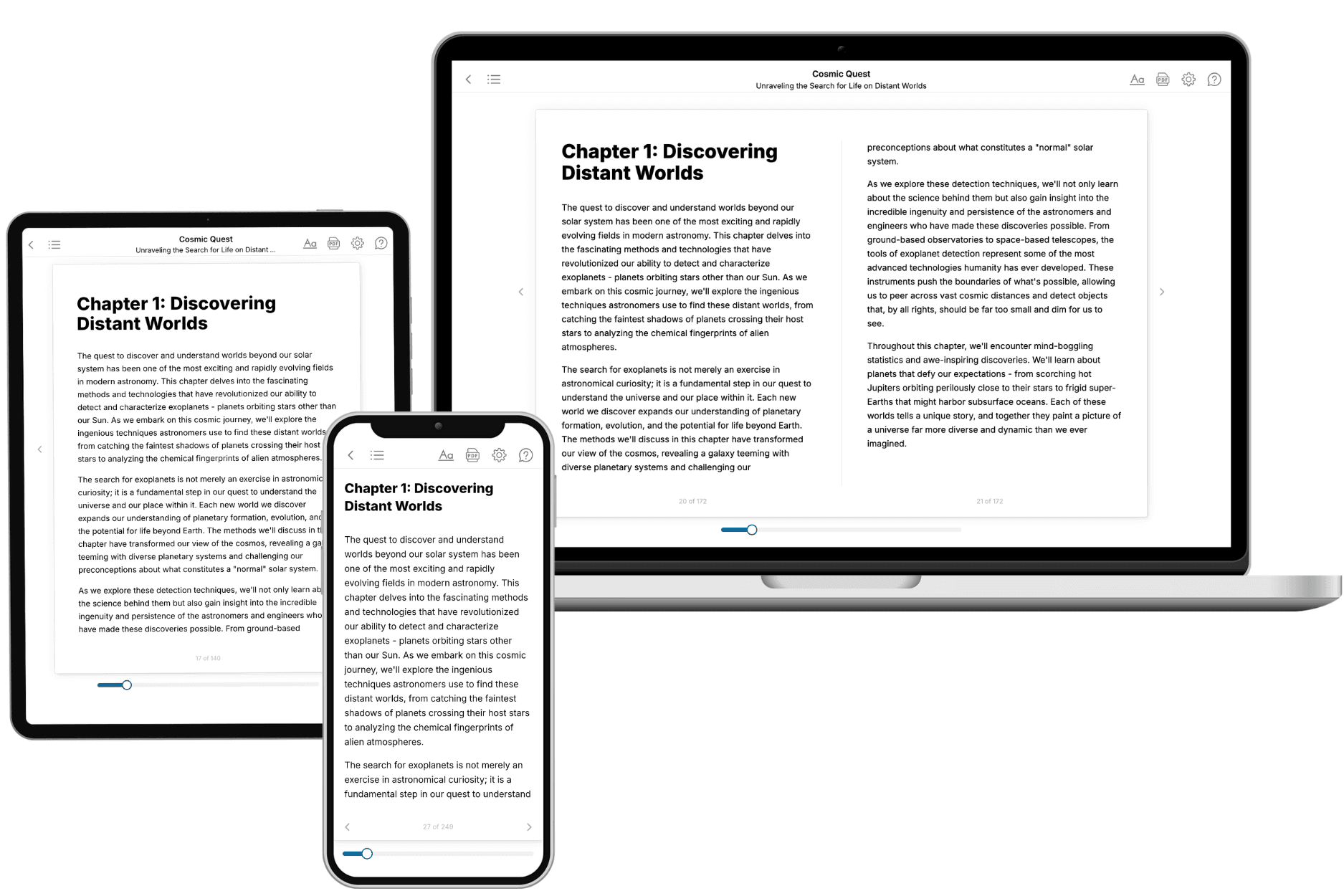
TailoredRead creates complete, full-length nonfiction ebooks, written specifically for you. Tell us what you want to learn and why, and TailoredRead writes you a complete ebook on it, with charts, tables, and diagrams throughout. Read it online, on Kindle, or on any e-reader, or download it as a PDF or EPUB. Every book is written fresh the day you order it.
- How is the book tailored to me?
Before anything is written, you answer a few short questions about your goals, your background, and the topics you care about. Your book is then planned around your answers: written at your level, focused on your goals, and covering the topics you chose, instead of the one-size-fits-all book a store sells everyone.
- Will it read like generic AI content?
No. Your book isn't a chat transcript: it's planned chapter by chapter before a single word is written, told in a clear book voice, and explains ideas visually with charts, tables, and diagrams. After writing, every book goes through an editorial pass that polishes chapters so the book reads consistent from start to finish. Judge for yourself: browse thousands of sample books on our Explore Books page.
- How accurate is the content?
Our AI first checks whether your subject needs live research. Niche and fast-moving subjects are researched before writing, and the book plan and chapters are grounded in what it finds. After writing, every book goes through a quality pass that checks its facts and consistency, and researched books list their sources in a Notes section at the back.
- How long is the book?
You choose the length: Comprehensive (250-300 pages), Detailed (150-200 pages), Essential (70-100 pages), or Short (30-50 pages).
- Does the book include visuals?
Yes. Every book includes charts, tables, and diagrams: timelines, checklists, step-by-step guides, decision trees, comparison tables, matrices, and bar charts. A typical book includes dozens of these visual elements.
- Can I read it on Kindle? What formats can I download?
Yes. Every book can be read in our online reader or downloaded as a PDF or EPUB. The EPUB can be opened with Kindle, Apple Books, Kobo, and any e-reader. The Commercial and Author licenses also include an editable Word (DOCX) and Markdown download.
- How much does it cost?
About the price of a regular ebook. The exact price depends on your book's length and complexity, from $2 for the shortest books to $35 for the most comprehensive, and it's shown when you review your book, before you commit to anything. Each book is a one-time purchase, yours to keep, no subscription. Licenses that let you share, teach, or publish your book range from $35.99 to $49.99.
- Can I preview the book before purchasing?
Before you pay, you'll see what your book will cover: the title, a detailed description, the estimated length, and the complete chapter-by-chapter table of contents, so you know what you're getting before you decide. The full text itself is written after you purchase.
- How long does it take to create a book?
About 10 minutes. You can start reading the opening chapters while the rest is still being written.