The Art of Homemade Puff Pastry
Master the Technique, Create Bakery-Quality Pastries at Home
Making puff pastry at home seems intimidating—the lamination process appears complex, the timing feels precise, and you worry about ending up with greasy, dense pastry instead of those beautiful, flaky layers.
238 pages11 chaptersMar 27, 2026Baking and Desserts
About this book
But the truth is, homemade puff pastry is entirely achievable once you understand the science and master a few key techniques. This book breaks down the intimidating process into clear, manageable steps, explaining exactly why each stage matters and how to troubleshoot when things go wrong. You'll learn the critical role of temperature, discover the secrets to perfect lamination, and understand how to rest your dough properly. With detailed instructions, helpful tips, and solutions to common problems, you'll gain the confidence to create bakery-quality puff pastry that impresses family and friends. Whether you're making elegant vol-au-vents, delicate mille-feuille, or savory cheese straws, this guide equips you with everything needed to succeed.
Table of contents
- IntroductionWhy Puff Pastry Matters, What You'll Learn in This Book, How to Use This GuideRead below
- Chapter 1: Understanding Puff PastryWhat Is Puff Pastry and How Does It Work?, The Science of Lamination, Homemade vs. Store-Bought: The Real Differences
- Chapter 2: Essential Ingredients and EquipmentChoosing the Right Ingredients, Butter Selection and Preparation, Tools and Equipment You'll Need, Setting Up Your Workspace
- Chapter 3: The Detrempe: Your FoundationMaking the Detrempe Dough, Getting the Hydration Balance Right, Resting and Preparing for Lamination
- Chapter 4: Mastering the Lamination ProcessPreparing Your Butter Block, Enclosing the Butter in Dough, The First Folds: Building Your Layers, Subsequent Folds and Rest Periods
- Chapter 5: Temperature Control and TimingWhy Temperature Is Everything, Managing Dough Temperature Throughout, Rest Schedules and Timing
- Chapter 6: Shaping and Preparing for BakingRolling to Final Thickness, Cutting Shapes and Designs, Egg Wash and Surface Treatments, The Final Rest Before Baking
- Chapter 7: Baking Perfect Puff PastryPreparing Your Oven, Baking Temperatures and Times, Recognizing When Your Pastry Is Done
- Chapter 8: Troubleshooting Common ProblemsGreasy or Oily Pastry, Uneven Rise or Poor Puffing, Shrinkage and Shape Loss, Other Common Issues and Solutions
- Chapter 9: Classic Puff Pastry RecipesVol-au-Vents and Bouchées, Mille-Feuille and Napoleons, Danish Pastries and Variations
- Chapter 10: Variations and Advanced TechniquesUsing Alternative Fats and Flours, Creating Flavored Puff Pastry, Quick Puff Pastry Methods
- Chapter 11: Storage and Make-Ahead StrategiesStoring Puff Pastry Dough, Freezing and Thawing Properly, Make-Ahead Planning for Entertaining
- ConclusionYour Puff Pastry Journey Begins
- Glossary of Terms
- Further Reading and Resources
Introduction
There is a moment in every bakery visit when your eyes land on a tray of freshly baked puff pastry. The layers are visible from across the counter, stacked in thin, golden sheets that seem almost too perfect to be real. You pick one up, take a bite, and feel that satisfying shatter followed by a soft, buttery interior. It is one of the most impressive things baking can produce. And for most home bakers, it feels completely out of reach.
That feeling of intimidation is understandable. Puff pastry has a reputation for being difficult, temperamental, and time-consuming. Recipes warn you about butter leaking out, layers merging together, or pastry that refuses to rise. Baking forums are full of cautionary tales from people who spent an afternoon on lamination only to pull a flat, greasy sheet from the oven. It is enough to make anyone reach for the frozen store-bought version instead. But here is the truth: most of those failures come from a handful of specific, avoidable mistakes, not from the process being inherently difficult.
This book exists to close the gap between what puff pastry seems like and what it actually is. Once you understand why each step matters, the whole process becomes logical rather than mysterious. Temperature control, resting periods, butter consistency, folding technique: these are not arbitrary rules. They are the direct result of how fat, flour, water, and heat interact with each other. When you understand the science, you stop guessing and start making decisions with confidence. That shift in understanding is what separates a baker who struggles with puff pastry from one who makes it reliably and well.
Whether your goal is to make elegant mille-feuille for a dinner party, savory cheese straws for a gathering, or simply to understand one of the foundational techniques in classical pastry, this guide will take you there step by step. You do not need professional equipment or a commercial kitchen. You need a rolling pin, a refrigerator, good butter, and the willingness to follow a process carefully. Everything else is explained in the pages ahead.
Why Puff Pastry Matters
Puff pastry is one of the oldest and most respected techniques in European baking. Its origins trace back to seventeenth-century France, where pastry chefs developed the lamination method to create doughs with extraordinary lift and texture.[1] The technique spread quickly through professional kitchens because it produced results that no other method could replicate: hundreds of paper-thin layers of dough and butter that puff dramatically in the oven, creating a structure that is simultaneously crisp, flaky, and rich.
What makes puff pastry so significant is its versatility. Very few preparations in baking can move so naturally between sweet and savory applications. A single batch of well-made puff pastry can become the base for a fruit tart, the shell for a creamy vol-au-vent, the casing for a beef Wellington, or the foundation for a caramelized palmier. This range is almost unmatched in the pastry world. Learning to make it well is not just learning one recipe. It is gaining access to an entire category of cooking.
Beyond versatility, homemade puff pastry simply tastes better than anything you can buy in a store. Commercial versions are often made with margarine or vegetable shortening rather than real butter, which produces a noticeably inferior flavor and a waxy texture that lingers on the palate. Even premium store-bought versions made with butter cannot match the freshness and quality of a batch made at home, because the lamination process begins to degrade once the dough is frozen and thawed. When you make it yourself, you control every variable.
There is also a practical advantage that surprises many home bakers: homemade puff pastry actually keeps better than store-bought. A properly made batch can be refrigerated for up to three days or frozen for up to three months without significant quality loss. This means you can invest a few hours on a weekend and have high-quality pastry ready to use throughout the week or month. The effort is front-loaded, but the payoff extends well beyond a single baking session.
Mastering puff pastry also builds a deeper understanding of baking as a whole. The principles involved, including gluten development, fat layering, steam generation, and temperature management, appear in many other preparations. Croissants, Danish pastry, rough puff, and even some pie doughs share DNA with classic puff pastry. Once you understand how lamination works, these related techniques become much easier to grasp. You are not just learning one skill. You are building a foundation that makes you a more capable baker across the board.
Finally, there is the simple satisfaction of making something impressive from scratch. Puff pastry carries a certain prestige in home baking circles because so few people attempt it. When you set a tray of homemade vol-au-vents on a table or slice into a mille-feuille you made yourself, the reaction from people around you is immediate and genuine. That reaction is earned, and it reflects real skill. This book is designed to help you earn it.
What You'll Learn in This Book
This book is organized to take you from zero to confident in a logical sequence. Each chapter builds on the one before it, so by the time you reach the recipes, you will already understand why every instruction is written the way it is. There is no guesswork involved. Every technique is explained with a reason, and every reason connects back to the science of how puff pastry works.
The first section of the book covers the fundamentals. You will learn exactly what puff pastry is, how the lamination process creates those distinctive layers, and why homemade versions outperform store-bought in both flavor and texture. This foundational knowledge is not just background reading. It is the framework that makes everything else make sense. Bakers who skip this kind of understanding tend to follow recipes mechanically and struggle when something goes wrong. Bakers who understand the principles can adapt, troubleshoot, and improve.
From there, the book moves into ingredients and equipment. You will learn:
- Which flour to choose and why protein content matters for puff pastry specifically
- How to select and prepare butter for lamination, including what to look for in terms of fat content and moisture
- Which tools are genuinely necessary versus which ones are optional upgrades
- How to set up your workspace to keep everything at the right temperature
The core technique chapters walk you through every stage of making puff pastry from scratch. You will learn how to make the détrempe, which is the base dough, and how to get the hydration level right so it is neither too stiff nor too sticky. You will then learn how to prepare your butter block, enclose it in the dough, and execute the folding sequence that creates the layers. Each fold is explained in detail, with guidance on what the dough should look and feel like at every stage.
Temperature control gets its own dedicated chapter because it is genuinely the most critical variable in the entire process. Many puff pastry failures come down to butter that is too warm, a kitchen that is too hot, or dough that was not rested long enough between folds. This chapter explains exactly what temperatures to aim for, how to recognize when your dough needs to go back in the refrigerator, and how to manage the process in a warm kitchen. These are practical, actionable strategies, not vague advice.
The book also covers shaping, baking, and finishing in detail. You will learn how to roll your finished dough to the correct thickness for different applications, how to cut shapes cleanly without compressing the layers, and how to apply egg wash for a professional finish. The baking chapter explains oven temperatures, rack positions, and how to recognize when your pastry is properly done rather than just golden on the outside.
A full troubleshooting chapter addresses the most common problems home bakers encounter, including greasy pastry, uneven rise, shrinkage, and layers that merge instead of separating. Each problem is explained with its root cause and a clear solution. If something goes wrong during your first attempt, this chapter will tell you exactly what happened and how to fix it next time.
The final section of the book moves into recipes and advanced techniques. Classic preparations like vol-au-vents, mille-feuille, and Danish pastries are covered with full instructions. There are also chapters on variations, including alternative fats and flours for different dietary needs, flavored puff pastry, and quick puff pastry methods for when you need results faster. Storage and make-ahead strategies round out the book, giving you the tools to fit homemade puff pastry into a realistic schedule.
How to Use This Guide
Before you start, it is worth taking a moment to think about how to get the most out of this book. The temptation with any technique-focused guide is to skip straight to the recipes. That approach works fine for many types of cooking, but puff pastry is different. The technique chapters are not optional background reading. They contain information that directly affects your results, and skipping them is one of the most common reasons first attempts fail.
The recommended approach is to read Chapters 1 through 5 before you attempt your first batch. This will take less time than you think, and the payoff is significant. By the time you start mixing your first détrempe, you will already understand what you are trying to achieve at each stage, what the dough should look and feel like, and what warning signs to watch for. That knowledge transforms the process from a stressful exercise in following instructions to a genuinely engaging baking project.
When you are ready to make your first batch, here is a practical approach to follow:
- Read the full recipe or technique chapter once before you start. Do not begin mixing while reading. Get the whole picture first.
- Check your ingredients and equipment. Make sure your butter is the right type, your flour is measured, and your workspace is cool enough before you begin.
- Plan your time realistically. A full batch of classic puff pastry takes several hours when you include rest periods. Most of that time is inactive waiting, but you need to be available to continue the process at the right intervals.
- Keep the troubleshooting chapter bookmarked. If something looks wrong during the process, check that chapter before deciding to start over. Many apparent failures are recoverable.
The rest periods built into the lamination process are not wasted time. They are when the gluten in your dough relaxes and the butter firms back up to the right consistency. Use these periods productively. Clean your workspace, prepare any fillings you plan to use, or simply step away and rest. Trying to rush the process by shortening rest times is one of the most reliable ways to end up with disappointing results. The schedule is part of the technique.
It is also worth setting realistic expectations for your first attempt. Puff pastry made by a beginner will almost certainly be better than store-bought, but it may not be perfect. The layers might not be completely even, the rise might be slightly irregular, or the color might be a little uneven. These are normal outcomes for a first batch, and they do not mean you did anything seriously wrong. Each time you make puff pastry, you will get better at reading the dough, managing the temperature, and executing the folds. The learning curve is real but short.
Pay attention to the visual and tactile cues described throughout the book. Baking is a sensory skill, and written instructions can only take you so far. When a chapter describes how the dough should feel when the gluten is properly relaxed, or what the butter block should look like when it is at the right temperature, those descriptions are worth pausing over. Try to build a mental picture before you start, and then compare what you see and feel in real life to what the book describes. That comparison is how you develop genuine skill rather than just following steps.
The recipes in Chapters 9 and 10 are written assuming you have already worked through the technique chapters. They reference terms and methods explained earlier in the book without repeating all the detail. If you encounter a term you do not recognize, the glossary at the back of the book provides clear definitions for every technical term used throughout. It is a useful reference to keep accessible, especially during your first few sessions.
Finally, do not be discouraged by the reputation puff pastry has for being difficult. That reputation is largely based on attempts made without proper understanding of the technique. With the knowledge in this book and a little patience, you have everything you need to make puff pastry that genuinely impresses. The process is methodical, the science is logical, and the results are worth every minute of effort. Let's get started.
A note on measurements: This book uses both weight measurements in grams and volume measurements in cups and tablespoons. Weight measurements are more accurate for baking and are strongly recommended wherever possible. A kitchen scale is one of the most valuable tools you can own as a baker, and it will make every recipe in this book easier to execute with consistent results.
Notes
Introduction
- 1. Alan Davidson, The Oxford Companion to Food, 3rd Edition, Oxford University Press, 2014
This is the end of the free sample. The full book has 11 chapters.
Want this book written for you?
Tell us your goals and background, and get your own version of this book, tailored by AI to you.


Benefits of AI-tailored books
- Read one book, not ten:
- all the Baking and Desserts knowledge you need, gathered into a single book.
- Save days of learning:
- tell us your goals, choose your topics, and the whole book is built around them.
- Learn effortlessly:
- Baking and Desserts book written for your specific background and expertise.
- Understand at a glance:
- includes charts, tables, timelines, checklists, decision trees, and more.
- Stay current:
- written the day you order it, not years ago.
- Trust what you read:
- every book is checked for accuracy, with real research when your subject needs it.
Create your unique book in 3 steps
- 1. Select your focus
Select the focus of your Baking and Desserts book and share your background
- 2. Personalize your book
Specify your goals and choose sub-topics to include
- 3. Get your tailored book
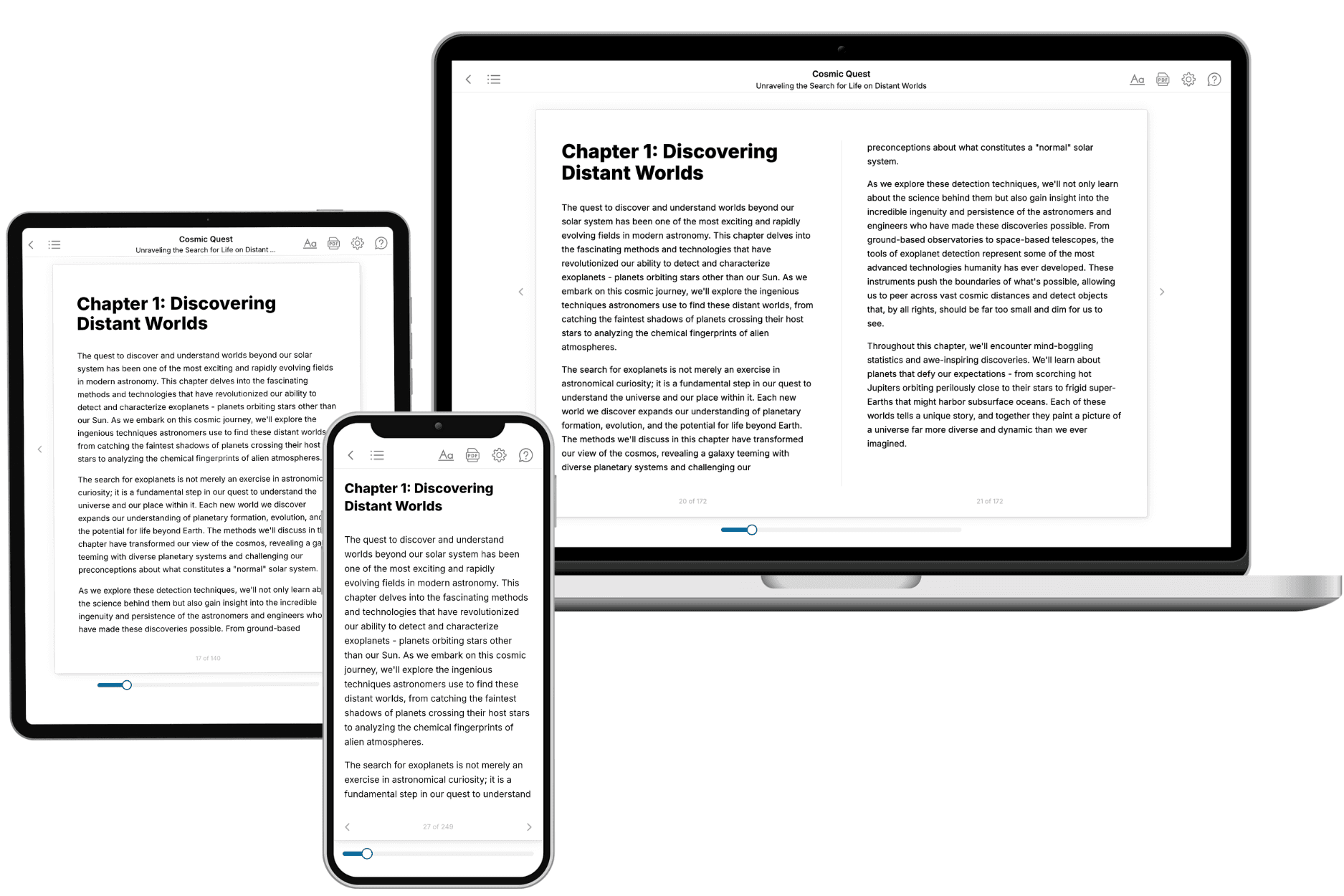
Your book is ready in 10 minutes. Read it online, download as EPUB or PDF, or send to Kindle.
Frequently asked questions
- What is TailoredRead?
TailoredRead creates complete, full-length nonfiction ebooks, written specifically for you. Tell us what you want to learn and why, and TailoredRead writes you a complete ebook on it, with charts, tables, and diagrams throughout. Read it online, on Kindle, or on any e-reader, or download it as a PDF or EPUB. Every book is written fresh the day you order it.
- How is the book tailored to me?
Before anything is written, you answer a few short questions about your goals, your background, and the topics you care about. Your book is then planned around your answers: written at your level, focused on your goals, and covering the topics you chose, instead of the one-size-fits-all book a store sells everyone.
- Will it read like generic AI content?
No. Your book isn't a chat transcript: it's planned chapter by chapter before a single word is written, told in a clear book voice, and explains ideas visually with charts, tables, and diagrams. After writing, every book goes through an editorial pass that polishes chapters so the book reads consistent from start to finish. Judge for yourself: browse thousands of sample books on our Explore Books page.
- How accurate is the content?
Our AI first checks whether your subject needs live research. Niche and fast-moving subjects are researched before writing, and the book plan and chapters are grounded in what it finds. After writing, every book goes through a quality pass that checks its facts and consistency, and researched books list their sources in a Notes section at the back.
- How long is the book?
You choose the length: Comprehensive (250-300 pages), Detailed (150-200 pages), Essential (70-100 pages), or Short (30-50 pages).
- Does the book include visuals?
Yes. Every book includes charts, tables, and diagrams: timelines, checklists, step-by-step guides, decision trees, comparison tables, matrices, and bar charts. A typical book includes dozens of these visual elements.
- Can I read it on Kindle? What formats can I download?
Yes. Every book can be read in our online reader or downloaded as a PDF or EPUB. The EPUB can be opened with Kindle, Apple Books, Kobo, and any e-reader. The Commercial and Author licenses also include an editable Word (DOCX) and Markdown download.
- How much does it cost?
About the price of a regular ebook. The exact price depends on your book's length and complexity, from $2 for the shortest books to $35 for the most comprehensive, and it's shown when you review your book, before you commit to anything. Each book is a one-time purchase, yours to keep, no subscription. Licenses that let you share, teach, or publish your book range from $35.99 to $49.99.
- Can I preview the book before purchasing?
Before you pay, you'll see what your book will cover: the title, a detailed description, the estimated length, and the complete chapter-by-chapter table of contents, so you know what you're getting before you decide. The full text itself is written after you purchase.
- How long does it take to create a book?
About 10 minutes. You can start reading the opening chapters while the rest is still being written.