The Art of Mathematical Proof
Building Logical Arguments and Rigorous Reasoning in Intermediate Algebra
Many students believe that mathematical proofs are mysterious rituals reserved for advanced mathematicians, or that success in algebra means simply getting the right answer.
222 pages12 chaptersOct 20, 2025Mathematical Proofs
About this book
This misconception leaves you unprepared for higher mathematics and unable to truly understand why mathematical statements are true. This book bridges that gap by teaching you how to construct rigorous mathematical arguments using the algebraic concepts you already know. You'll discover how to think like a mathematician, moving beyond computational skills to develop the logical reasoning that underlies all mathematical truth. Through carefully structured explanations and progressive examples, you'll learn to recognize proof patterns, choose appropriate strategies, and communicate your mathematical ideas with clarity and precision. Whether you're preparing for advanced coursework, strengthening your analytical abilities, or simply curious about the foundations of mathematical truth, this book provides the tools and confidence you need to master the art of proof-writing in algebra and beyond.
Table of contents
- IntroductionWhat Is a Mathematical Proof?, Why Proofs Matter in Algebra, How to Use This BookRead below
- Chapter 1: Foundations of Mathematical ReasoningThe Language of Logic, Mathematical Statements and Truth Values, Logical Connectives and Compound Statements, Universal and Existential Quantifiers
- Chapter 2: Algebraic Axioms and PropertiesThe Field Axioms of Real Numbers, Order Properties and Inequalities, Absolute Value Properties
- Chapter 3: Direct Proof TechniquesThe Structure of a Direct Proof, Proving Conditional Statements, Proving Algebraic Identities, Divisibility and Integer Properties
- Chapter 4: Proof by Cases and ExhaustionWhen to Use Case Analysis, Even and Odd Integer Proofs, Absolute Value and Piecewise Functions
- Chapter 5: Contrapositive and Proof by ContradictionThe Contrapositive Method, Structure of Proof by Contradiction, Proving Irrationality, Choosing Between Direct, Contrapositive, and Contradiction
- Chapter 6: Proving Equivalence and Biconditional StatementsUnderstanding Biconditional Statements, Proving Both Directions, Chain of Equivalences Method
- Chapter 7: Mathematical InductionThe Principle of Mathematical Induction, Establishing the Base Case, The Inductive Step, Proving Summation Formulas
- Chapter 8: Proving InequalitiesProperties of Inequalities, The Arithmetic-Geometric Mean Inequality, The Triangle Inequality
- Chapter 9: Sets and Functions in AlgebraSet Notation and Operations, Proving Set Equality and Subset Relations, Proving Function Properties, Injective and Surjective Functions
- Chapter 10: Counterexamples and Disproving StatementsThe Role of Counterexamples, Strategies for Finding Counterexamples, Common Algebraic Misconceptions
- Chapter 11: The Art of Clear Proof WritingPrecise Mathematical Language, Organizing Your Proof, Common Logical Errors to Avoid, Revising and Refining Your Proofs
- Chapter 12: Advanced Proof TechniquesStrong Induction, The Well-Ordering Principle, Existence and Uniqueness Proofs
- ConclusionYour Journey to Proof Mastery, Next Steps in Mathematical Reasoning
Introduction
Mathematics is often perceived as a subject of formulas, calculations, and correct answers. You solve equations, simplify expressions, and compute values. These skills are essential, but they represent only one dimension of mathematical understanding. Beneath every formula lies a deeper truth: a logical structure that explains why the formula works, when it applies, and how it connects to other mathematical ideas. This deeper layer is the realm of mathematical proof, where you move beyond computation to explore the foundations of mathematical truth itself.
Many students reach intermediate algebra with strong computational abilities but limited experience in constructing logical arguments. You might excel at solving quadratic equations yet struggle to explain why the quadratic formula always works. You can factor polynomials efficiently but may not understand why factoring is valid or what it reveals about polynomial structure. This gap between procedural skill and conceptual understanding becomes increasingly problematic as you advance in mathematics. Higher-level courses assume you can not only perform calculations but also construct rigorous arguments, recognize patterns in mathematical structures, and communicate your reasoning clearly and precisely.
This book addresses that gap directly. It builds on your existing algebraic knowledge to develop proof-writing skills systematically and accessibly. You will learn to think like a mathematician, recognizing that proving a statement requires more than showing it works in a few examples. You will discover multiple proof strategies, each suited to different types of problems, and develop the judgment to choose the most effective approach. Most importantly, you will gain confidence in your ability to construct, understand, and evaluate mathematical arguments. These skills extend far beyond mathematics itself, strengthening your analytical thinking and problem-solving abilities in any field that requires logical reasoning and precise communication.
The journey from computational mathematics to proof-based reasoning represents a significant shift in perspective. Instead of asking What is the answer?
you will learn to ask Why is this true?
and How can I convince someone else that it must be true?
This transition can feel challenging at first, but it opens doors to deeper mathematical understanding and appreciation. You will see familiar algebraic concepts in new light, understanding not just how to use them but why they work and how they fit into the broader mathematical landscape. This book provides the guidance, structure, and practice you need to make this transition successfully.
What Is a Mathematical Proof?
A mathematical proof is a logical argument that establishes the truth of a mathematical statement beyond any doubt. Unlike arguments in everyday life, which may rely on persuasion, authority, or probability, mathematical proofs demand absolute certainty. A proof demonstrates that a statement must be true based on accepted axioms, previously proven theorems, and valid logical reasoning. No exceptions exist, no counterexamples can arise, and the conclusion follows necessarily from the premises. This standard of certainty distinguishes mathematics from other disciplines and gives mathematical knowledge its unique reliability and permanence.
Consider the statement The sum of two even integers is always even.
You might verify this with examples: 2 + 4 = 6, 8 + 12 = 20, 100 + 200 = 300. Each example supports the claim, but no number of examples constitutes a proof. Even testing a million cases leaves open the possibility that the million-and-first case might fail. A proof, by contrast, covers all possible cases simultaneously through logical reasoning. An even integer can be written as 2k for some integer k. Another even integer can be written as 2m for some integer m. Their sum is 2k + 2m = 2(k + m). Since k + m is an integer, 2(k + m) is even by definition. This argument covers every possible pair of even integers, establishing the truth of the statement universally and permanently.
Mathematical proofs serve multiple purposes beyond establishing truth. They explain why statements are true, revealing the underlying structure and relationships that make them work. A proof of the quadratic formula, for instance, not only confirms that the formula is correct but also shows how it emerges from the process of completing the square. Proofs also clarify the scope and limitations of mathematical statements. When you prove that the product of two negative numbers is positive, you simultaneously understand why this property holds and recognize that it depends on specific axioms about real numbers. This understanding helps you recognize when similar reasoning applies to other mathematical structures and when it does not.
The structure of a proof typically follows a clear pattern, though the specific details vary with the proof technique employed. You begin with assumptions or hypotheses—statements you accept as true for the purpose of the argument. These might be axioms, previously proven theorems, or conditions specified in the statement you are proving. You then apply logical reasoning and valid mathematical operations to transform these assumptions step by step. Each step must follow necessarily from previous steps, with no logical gaps or unjustified leaps. Finally, you reach a conclusion that follows inevitably from your reasoning. This conclusion is the statement you set out to prove, now established as a mathematical truth.
Different types of mathematical statements require different proof approaches. Some statements assert that a property holds for all objects in a category: For all real numbers x and y, x + y = y + x.
Others claim that at least one object with certain properties exists: There exists an irrational number between any two distinct rational numbers.
Still others establish conditional relationships: If n is divisible by 6, then n is divisible by 3.
Each type of statement suggests particular proof strategies, and learning to recognize these patterns is a key skill in proof-writing. As you progress through this book, you will develop an intuition for matching statements to appropriate proof techniques.
Mathematical proofs also function as a form of communication. When you write a proof, you are not merely convincing yourself of a statement's truth; you are explaining your reasoning to others in a way that allows them to verify your logic independently. This communicative aspect requires clarity, precision, and attention to your audience's knowledge level. A proof written for experts in a field can assume substantial background knowledge and use specialized notation freely. A proof written for students learning a concept must explain each step more carefully and justify reasoning that experts would consider obvious. Throughout this book, you will learn to write proofs that communicate effectively, balancing rigor with readability.
The concept of proof has evolved throughout mathematical history, and different areas of mathematics sometimes employ different standards of rigor. Ancient Greek mathematicians developed geometric proofs of remarkable sophistication, though their treatment of infinity and infinitesimals would not satisfy modern standards. The development of calculus in the seventeenth and eighteenth centuries initially relied on intuitive arguments that later mathematicians formalized more rigorously. Today, some proofs are so complex that they require computer verification, raising philosophical questions about the nature of mathematical certainty. Despite these variations, the core principle remains constant: a proof must establish truth through logical reasoning that others can verify and accept.
Understanding what constitutes a valid proof also means recognizing what does not. Verification by examples, no matter how numerous, is not proof. Appeals to intuition or visual plausibility are not proof, though they may guide you toward a proof strategy. Circular reasoning, where you assume what you are trying to prove, is not valid. Neither is proof by intimidation, where complex notation or obscure references substitute for clear logic. As you develop your proof-writing skills, you will learn to distinguish rigorous arguments from superficially convincing but logically flawed reasoning. This critical ability protects you from accepting false claims and strengthens your overall mathematical thinking.
Why Proofs Matter in Algebra
Algebra forms the foundation for virtually all higher mathematics, from calculus and differential equations to abstract algebra and number theory. The properties you use routinely in algebraic manipulation—commutativity, associativity, distributivity, and others—are not arbitrary rules but logical consequences of fundamental axioms. Understanding why these properties hold, not just how to apply them, transforms algebra from a collection of techniques into a coherent logical system. This deeper understanding makes you more flexible and creative in problem-solving because you recognize the underlying principles that connect seemingly different problems and techniques.
Consider the distributive property: a(b + c) = ab + ac. You have applied this property countless times to expand expressions and factor polynomials. But why is it true? A proof reveals that this property follows from the definition of multiplication as repeated addition and the associative and commutative properties of addition. Understanding this foundation helps you recognize when the distributive property applies and when it might not. For instance, matrix multiplication distributes over matrix addition, but it is not commutative. Recognizing these patterns requires understanding the logical structure underlying algebraic properties, not just memorizing formulas.
Proofs in algebra also develop your ability to work with abstract concepts and general cases. When you solve a specific equation like x² - 5x + 6 = 0, you find particular values: x = 2 or x = 3. When you prove that every quadratic equation ax² + bx + c = 0 (with a ≠ 0) has solutions given by the quadratic formula, you establish a universal truth that applies to infinitely many specific cases simultaneously. This shift from particular to general, from concrete to abstract, is essential for mathematical maturity. It allows you to see patterns, make connections, and apply knowledge flexibly across different contexts.
The process of constructing proofs strengthens critical thinking skills that extend far beyond mathematics. When you prove a mathematical statement, you must:
- Analyze the statement carefully to understand exactly what needs to be proven
- Identify relevant assumptions, definitions, and previously established results
- Develop a logical strategy for connecting assumptions to conclusions
- Execute that strategy with precision, ensuring each step follows validly from previous steps
- Communicate your reasoning clearly so others can verify your logic
- Review your argument critically to identify and correct any gaps or errors
Proofs also protect you from common misconceptions and errors. Many plausible-sounding mathematical claims are actually false, and only rigorous proof can distinguish truth from falsehood. For example, you might observe that n² + n + 41 produces prime numbers for n = 0, 1, 2, 3, and many other values. Testing dozens or even hundreds of cases might convince you that this formula always produces primes. However, when n = 41, the expression equals 41² + 41 + 41 = 41(41 + 1 + 1) = 41 × 43, which is composite. This example illustrates why proof is necessary: patterns that hold for many cases can still fail eventually, and only logical proof establishes truth with certainty.
In practical terms, proof skills make you more effective at learning new mathematics. When you encounter a new theorem or formula, you can read its proof to understand not just what it says but why it is true and when it applies. This deeper engagement helps you remember results more reliably and apply them more appropriately. You also become better at identifying when you need to look up a result versus when you can derive it yourself from principles you already know. This independence and flexibility are marks of mathematical maturity that serve you well in advanced coursework and professional applications of mathematics.
The ability to construct and evaluate proofs also prepares you for the reality that mathematics is not a finished product but an ongoing human endeavor. New mathematical results are discovered constantly, and understanding these advances requires reading and evaluating proofs. Even in applied fields, you may encounter situations where no formula or algorithm exists for your specific problem, and you must reason from first principles to develop a solution. The proof-writing skills you develop in algebra provide the foundation for this kind of creative mathematical thinking, enabling you to contribute to mathematical knowledge rather than merely consuming it.
Finally, there is an aesthetic dimension to mathematical proof that many people find deeply satisfying. A well-constructed proof has an elegance and beauty comparable to great art or music. The way a complex statement reduces to simple principles, the unexpected connections that emerge between seemingly unrelated concepts, the moment when a clever insight unlocks a difficult problem—these experiences provide intellectual pleasure that goes beyond practical utility. As you develop your proof-writing abilities, you may discover this aesthetic appreciation, finding that mathematics offers not just useful tools but also profound beauty and insight into the logical structure of reality itself.
How to Use This Book
This book is designed to build your proof-writing skills progressively, starting with fundamental concepts and advancing to sophisticated techniques. Each chapter introduces new ideas while reinforcing and extending previous material. The structure reflects a pedagogical philosophy: you learn proof-writing not by memorizing templates but by understanding logical principles, seeing them applied in varied contexts, and practicing them yourself. The chapters are ordered to support this developmental process, with earlier chapters providing foundations that later chapters build upon. While you can reference specific chapters as needed, working through the book sequentially will give you the most comprehensive and coherent learning experience.
The book begins with foundations of mathematical reasoning, introducing the logical language and structures that underlie all proofs. You will learn about mathematical statements, truth values, logical connectives, and quantifiers. This material may seem abstract at first, but it provides essential vocabulary and concepts for understanding and constructing proofs. Even if you are eager to start proving algebraic theorems, investing time in these foundations will pay dividends throughout your proof-writing journey. The logical principles you learn here apply not just to algebra but to all mathematical reasoning, making them among the most valuable and transferable skills you will develop.
After establishing logical foundations, the book explores algebraic axioms and properties—the starting points for algebraic proofs. You will examine the field axioms of real numbers, order properties, and absolute value properties. Understanding these axioms deeply transforms them from rules you follow into logical principles you can apply creatively. This chapter also illustrates an important aspect of mathematical thinking: recognizing that even familiar properties rest on foundational assumptions. By making these assumptions explicit, you gain clarity about what you can take for granted in proofs and what requires justification.
The core chapters of the book introduce major proof techniques systematically. You will learn direct proof, proof by cases, contrapositive, proof by contradiction, and mathematical induction. Each technique is presented with clear explanations of its logical structure, guidance on when to use it, and numerous examples showing it in action. These chapters form the heart of the book, providing the tools you need to prove a wide variety of mathematical statements. As you work through them, pay attention not just to the mechanics of each technique but also to the strategic thinking involved in choosing which technique to apply to a given problem.
Throughout the book, examples play a central role in your learning. Each major concept is illustrated with concrete examples that show the technique in action. These examples are carefully chosen to demonstrate both straightforward applications and more subtle or challenging situations. When you encounter an example, read it actively rather than passively. Before looking at the solution, try to work through the problem yourself. Even if you cannot complete the proof, attempting it helps you engage more deeply with the material and appreciate the reasoning in the presented solution. After reading an example, consider how you might explain it to someone else or how you might modify the problem slightly and adapt the proof technique.
The book also includes guidance on proof-writing as a craft. Mathematical proofs must be not only logically correct but also clearly communicated. You will learn about precise mathematical language, effective proof organization, common logical errors to avoid, and strategies for revising and refining your work. These aspects of proof-writing are often neglected in mathematics education, yet they are crucial for communicating your ideas effectively. A proof that is logically sound but poorly written may fail to convince your reader or may contain errors that you and others cannot detect because the reasoning is obscured by unclear presentation.
As you work through the book, adopt an active learning approach. Mathematics is not a spectator sport; you learn by doing. After reading about a proof technique, practice it yourself with similar problems. When you encounter a theorem, try to prove it yourself before reading the provided proof. When you read a proof, verify each step carefully, making sure you understand why it is valid and necessary. If a step seems unclear, work through it with specific examples or try to explain it in your own words. This active engagement transforms reading from passive absorption into active learning, dramatically improving your retention and understanding.
You will inevitably encounter difficulties and make mistakes as you develop your proof-writing skills. This is not only normal but essential to the learning process. When you attempt a proof and get stuck, you are identifying gaps in your understanding that you can then address. When you make an error in reasoning, you are learning to recognize a type of mistake that you will avoid in the future. Approach these challenges with patience and curiosity rather than frustration. Each difficulty overcome strengthens your skills and deepens your understanding. The book provides guidance on common pitfalls and strategies for overcoming obstacles, but ultimately, your persistence and willingness to struggle productively with challenging material will determine your success.
The book assumes you have foundational knowledge of intermediate algebra, including:
- Operations with real numbers, including integers, rational numbers, and irrational numbers
- Solving linear and quadratic equations
- Working with polynomials, including factoring and expansion
- Understanding of functions and their properties
- Basic set notation and terminology
- Familiarity with absolute value and inequalities
Finally, remember that developing proof-writing skills is a gradual process that requires time and practice. You will not master all techniques immediately, and your early proofs may feel awkward or uncertain. This is completely normal. Mathematical maturity develops over months and years, not days or weeks. Be patient with yourself, celebrate your progress, and maintain a growth mindset. Each proof you attempt, whether successful or not, contributes to your developing expertise. By the time you complete this book, you will have built a strong foundation in mathematical reasoning that will serve you throughout your mathematical journey and beyond. The skills you develop here—logical thinking, clear communication, strategic problem-solving, and rigorous analysis—are among the most valuable and enduring benefits of mathematical education.
This is the end of the free sample. The full book has 12 chapters.
Want this book written for you?
Tell us your goals and background, and get your own version of this book, tailored by AI to you.


Benefits of AI-tailored books
- Read one book, not ten:
- all the Mathematical Proofs knowledge you need, gathered into a single book.
- Save days of learning:
- tell us your goals, choose your topics, and the whole book is built around them.
- Learn effortlessly:
- Mathematical Proofs book written for your specific background and expertise.
- Understand at a glance:
- includes charts, tables, timelines, checklists, decision trees, and more.
- Stay current:
- written the day you order it, not years ago.
- Trust what you read:
- every book is checked for accuracy, with real research when your subject needs it.
Create your unique book in 3 steps
- 1. Select your focus
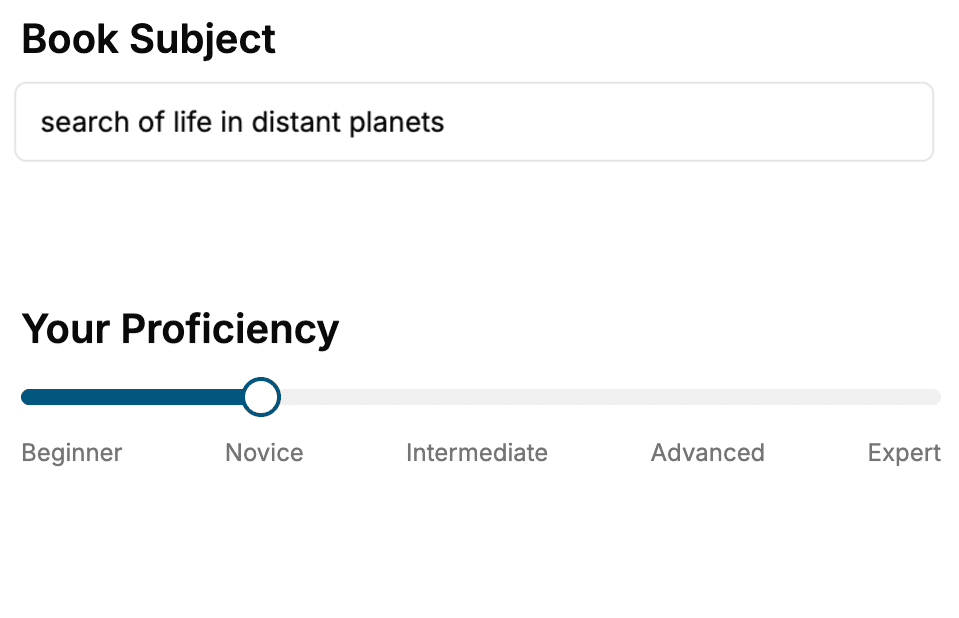
Select the focus of your Mathematical Proofs book and share your background
- 2. Personalize your book
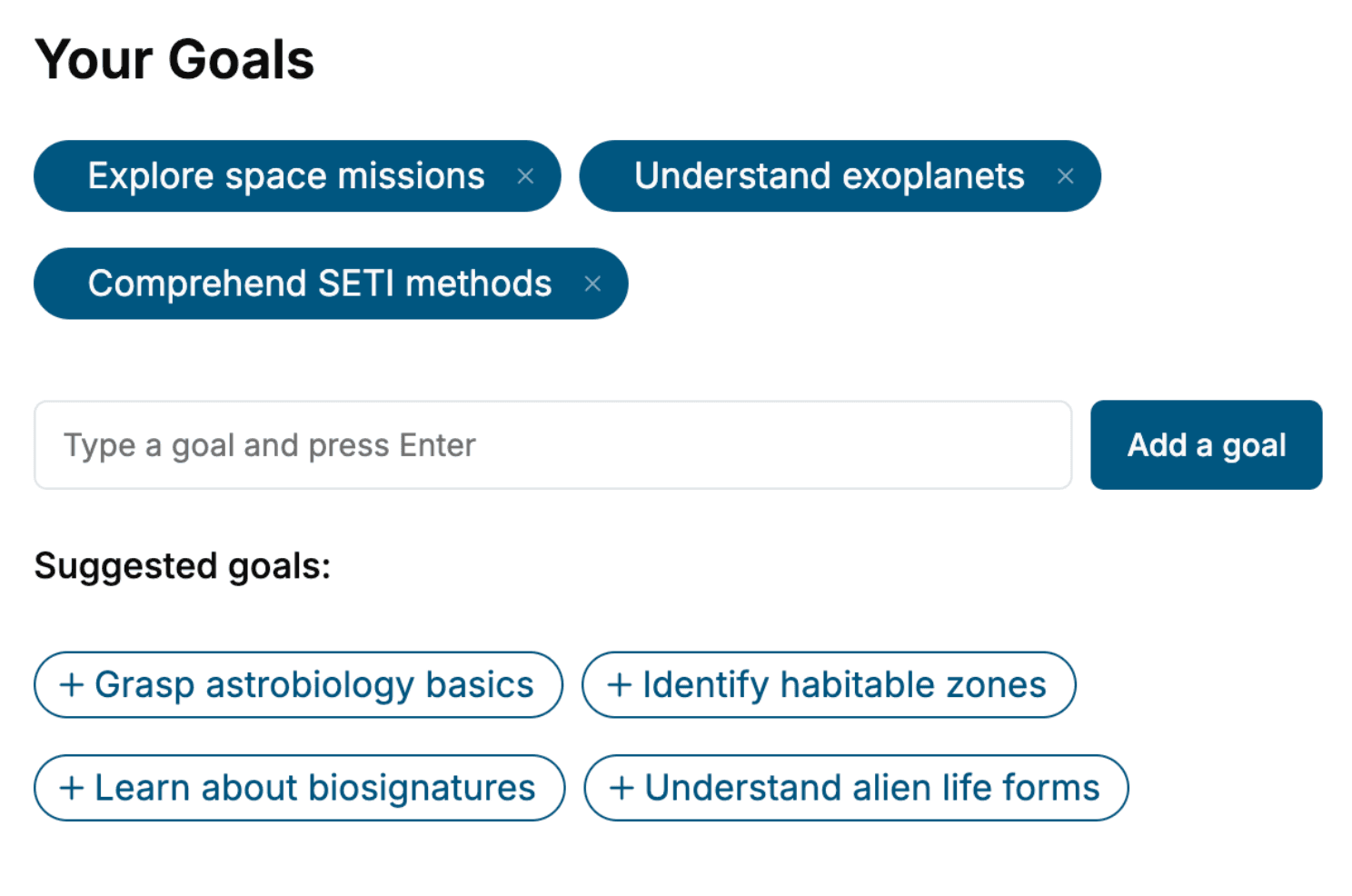
Specify your goals and choose sub-topics to include
- 3. Get your tailored book
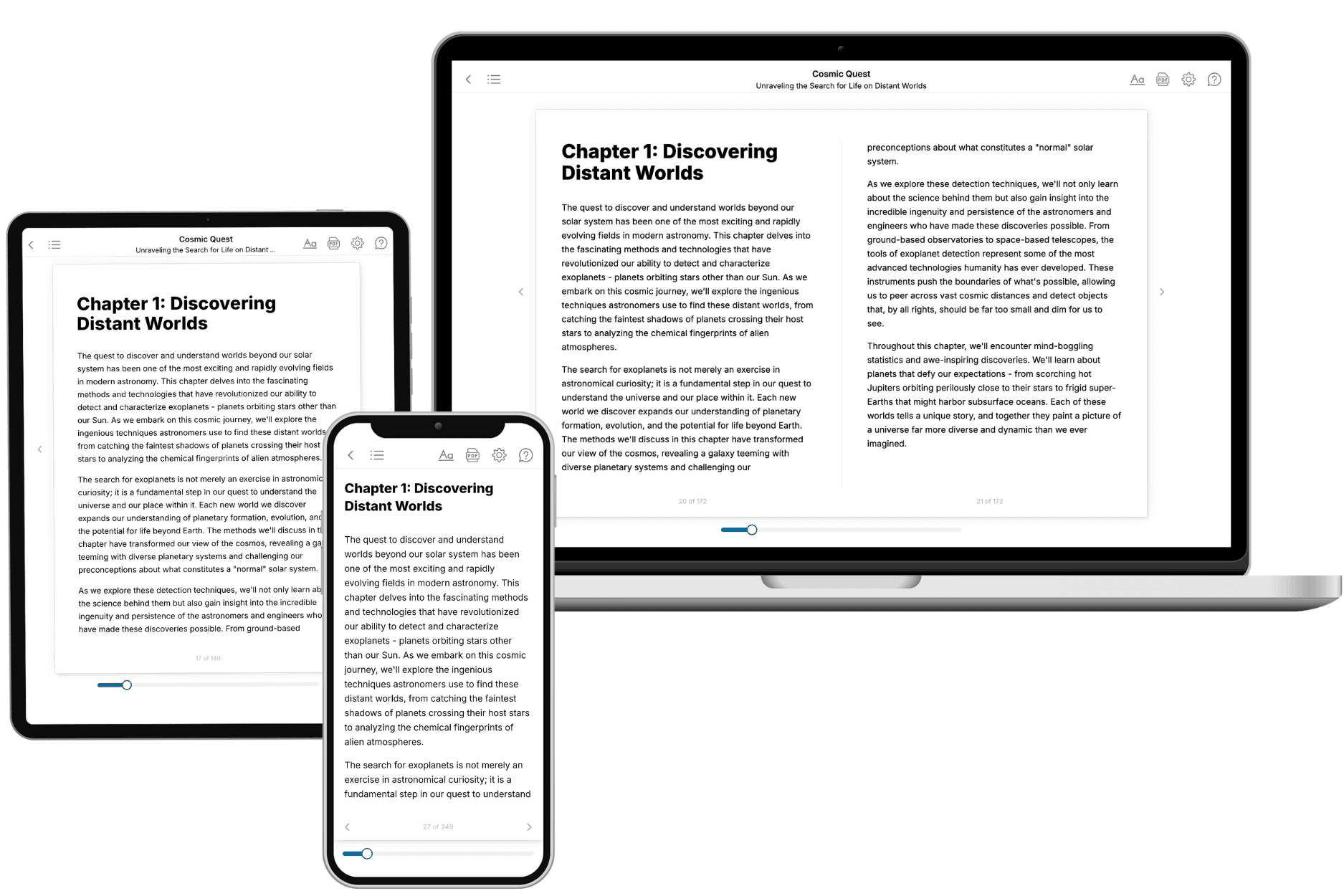
Your book is ready in 10 minutes. Read it online, download as EPUB or PDF, or send to Kindle.
Frequently asked questions
- What is TailoredRead?
TailoredRead creates complete, full-length nonfiction ebooks, written specifically for you. Tell us what you want to learn and why, and TailoredRead writes you a complete ebook on it, with charts, tables, and diagrams throughout. Read it online, on Kindle, or on any e-reader, or download it as a PDF or EPUB. Every book is written fresh the day you order it.
- How is the book tailored to me?
Before anything is written, you answer a few short questions about your goals, your background, and the topics you care about. Your book is then planned around your answers: written at your level, focused on your goals, and covering the topics you chose, instead of the one-size-fits-all book a store sells everyone.
- Will it read like generic AI content?
No. Your book isn't a chat transcript: it's planned chapter by chapter before a single word is written, told in a clear book voice, and explains ideas visually with charts, tables, and diagrams. After writing, every book goes through an editorial pass that polishes chapters so the book reads consistent from start to finish. Judge for yourself: browse thousands of sample books on our Explore Books page.
- How accurate is the content?
Our AI first checks whether your subject needs live research. Niche and fast-moving subjects are researched before writing, and the book plan and chapters are grounded in what it finds. After writing, every book goes through a quality pass that checks its facts and consistency, and researched books list their sources in a Notes section at the back.
- How long is the book?
You choose the length: Comprehensive (250-300 pages), Detailed (150-200 pages), Essential (70-100 pages), or Short (30-50 pages).
- Does the book include visuals?
Yes. Every book includes charts, tables, and diagrams: timelines, checklists, step-by-step guides, decision trees, comparison tables, matrices, and bar charts. A typical book includes dozens of these visual elements.
- Can I read it on Kindle? What formats can I download?
Yes. Every book can be read in our online reader or downloaded as a PDF or EPUB. The EPUB can be opened with Kindle, Apple Books, Kobo, and any e-reader. The Commercial and Author licenses also include an editable Word (DOCX) and Markdown download.
- How much does it cost?
About the price of a regular ebook. The exact price depends on your book's length and complexity, from $2 for the shortest books to $35 for the most comprehensive, and it's shown when you review your book, before you commit to anything. Each book is a one-time purchase, yours to keep, no subscription. Licenses that let you share, teach, or publish your book range from $35.99 to $49.99.
- Can I preview the book before purchasing?
Before you pay, you'll see what your book will cover: the title, a detailed description, the estimated length, and the complete chapter-by-chapter table of contents, so you know what you're getting before you decide. The full text itself is written after you purchase.
- How long does it take to create a book?
About 10 minutes. You can start reading the opening chapters while the rest is still being written.