The Art of Persuasion
Master the Essential Techniques to Write Essays That Convince and Inspire
What separates an essay that merely presents ideas from one that genuinely persuades readers to think differently?
207 pages10 chaptersJan 24, 2026Writing
About this book
The answer lies in mastering specific, proven techniques that transform your writing from informative to influential. This comprehensive guide reveals the essential strategies used by the most effective persuasive writers—from structuring arguments that build momentum to selecting evidence that resonates with your audience. You'll discover how to establish credibility, balance logic with emotion, address opposing views strategically, and use language that sticks in readers' minds. Whether you're writing academic essays, professional proposals, or opinion pieces, these techniques will help you craft arguments that don't just inform—they convince. Through practical examples and actionable frameworks, you'll learn to anticipate reader objections, strengthen weak points, and deliver messages that inspire action and change perspectives.
Table of contents
- IntroductionWhy Persuasion Matters in Writing, What You'll Learn in This Book, How to Use This GuideRead below
- Chapter 1: Understanding PersuasionPersuasion vs. Manipulation: The Ethical Foundation, The Persuasion Triangle: Ethos, Pathos, and Logos, Knowing Your Audience: The First Step to Success
- Chapter 2: Crafting Your Thesis StatementThe Anatomy of a Strong Thesis, Positioning Your Claim for Maximum Impact, Testing Your Thesis: Is It Persuasive?
- Chapter 3: Building Credibility and TrustEstablishing Ethos: Your Credibility as a Writer, Selecting and Presenting Reliable Evidence, Acknowledging Sources and Building Authority
- Chapter 4: Logical Reasoning and ArgumentationAvoiding Common Logical Fallacies, Effective Argument Structures: Deductive and Inductive, Supporting Claims with Sound Reasoning
- Chapter 5: Mastering Emotional AppealUnderstanding Pathos: Emotional Connection Without Manipulation, Using Stories and Examples to Move Readers, Balancing Emotion with Logic
- Chapter 6: Organizing Arguments for Maximum ImpactStrategic Ordering: Where to Place Your Strongest Points, Building Momentum Throughout Your Essay, Creating Smooth Transitions and Logical Flow
- Chapter 7: Addressing CounterargumentsAnticipating Reader Objections and Concerns, Refutation Strategies: Responding to Opposition, Using Concessions to Strengthen Your Position
- Chapter 8: Language and Rhetorical DevicesThe Power of Word Choice and Tone, Rhetorical Devices: Metaphor, Parallelism, and Repetition, Sentence Variety and Rhythm for Persuasive Effect
- Chapter 9: Revision and RefinementSelf-Editing Checklist for Persuasive Essays, Testing Your Arguments: Critical Questions to Ask, Getting and Using Feedback Effectively
- Chapter 10: Practical Applications and ExamplesPersuasive Techniques in Academic Essays, Persuasion in Professional and Business Writing, Crafting Compelling Opinion Pieces and Op-Eds
- ConclusionYour Journey to Persuasive Mastery, Next Steps: Applying What You've Learned
- Further Reading and Resources
Introduction
Every day, you encounter persuasive writing. It appears in newspaper editorials arguing for policy changes, in marketing emails convincing you to try new products, in academic journals presenting research conclusions, and in social media posts advocating for causes. Some of these messages slide past your awareness without impact, while others stop you in your tracks, challenge your assumptions, and sometimes even change your mind. The difference between forgettable writing and truly persuasive communication isn't accidental—it's the result of specific, learnable techniques that transform ordinary arguments into compelling narratives. This book exists to teach you those techniques, giving you the tools to craft essays that don't just present information but actively convince readers to see things your way.
Persuasive writing represents one of humanity's most valuable skills. Throughout history, written arguments have sparked revolutions, shifted public opinion, advanced scientific understanding, and shaped the course of nations. From Thomas Paine's Common Sense galvanizing American colonists toward independence to Rachel Carson's Silent Spring launching the modern environmental movement, persuasive essays have demonstrated remarkable power to influence thought and inspire action. Yet despite this rich tradition, many writers struggle to move beyond simply stating their opinions. They present facts without context, make claims without adequate support, ignore opposing viewpoints, and wonder why their arguments fail to resonate. The gap between stating a position and genuinely persuading an audience is wider than most people realize, but it's a gap you can bridge with the right approach.
This introduction serves as your roadmap for the journey ahead. You'll discover why persuasion matters not just in formal essays but in virtually every form of written communication you'll encounter throughout your life. You'll get a clear preview of the specific techniques and frameworks this book will teach you, from crafting thesis statements that anchor your arguments to selecting evidence that resonates with your particular audience. Most importantly, you'll learn how to approach this guide strategically, extracting maximum value whether you're a student facing an assignment deadline, a professional preparing a proposal, or simply someone who wants their written words to carry more weight. The techniques you're about to learn have been tested across centuries of rhetorical tradition and refined through modern research on persuasion and communication. They work—but only if you understand them deeply and apply them deliberately.
Why Persuasion Matters in Writing
Persuasive writing skills extend far beyond the classroom essay. In your professional life, you'll need to convince colleagues to support your proposals, persuade clients to choose your services, and influence stakeholders to allocate resources to your projects. In your civic life, you might write letters to elected officials, contribute op-eds to local publications, or craft social media posts advocating for causes you believe in. In your personal life, you'll compose emails resolving conflicts, write recommendation letters supporting friends or mentees, and perhaps even draft speeches for special occasions. Each of these situations requires the same fundamental skill: the ability to present your position in ways that move others from skepticism or indifference toward agreement and action. Without persuasive writing skills, your ideas remain trapped in your own mind, unable to influence the world around you.
The stakes of persuasive writing have never been higher. We live in an era of information overload, where your arguments compete with thousands of other messages for attention and credibility. Research suggests that the average person encounters between 4,000 and 10,000 marketing messages daily, and this doesn't even account for news articles, social media posts, and other forms of communication vying for mental space[1]. In this crowded landscape, weak arguments get ignored, mediocre arguments get skimmed and forgotten, and only truly persuasive writing breaks through to change minds. Your ability to craft compelling arguments directly impacts your capacity to achieve your goals, whether those goals involve earning better grades, advancing your career, influencing public discourse, or simply getting your point across in everyday situations. Persuasion isn't a luxury skill for professional writers—it's a fundamental competency for anyone who wants their voice to matter.
Persuasive writing also serves a deeper purpose: it's the foundation of democratic discourse and rational decision-making. When communities face complex challenges—from local zoning decisions to global climate policy—progress depends on citizens who can articulate positions clearly, support claims with evidence, acknowledge legitimate concerns, and build consensus through reasoned argument rather than manipulation or coercion. The alternative to persuasive writing isn't silence; it's shouting matches, tribal thinking, and decisions driven by whoever speaks loudest or most frequently rather than who argues most effectively. By mastering persuasive techniques, you contribute to a culture of thoughtful discourse where ideas compete on their merits rather than on emotional manipulation or rhetorical tricks. This matters not just for your personal success but for the health of the communities and institutions you're part of.
Consider the difference between two writers addressing the same topic: reducing plastic waste in their community. The first writer produces an essay that simply states Plastic is bad for the environment, and we should use less of it.
This writer lists some facts about ocean pollution, expresses frustration with current practices, and concludes by urging readers to care more. The second writer takes a persuasive approach. She opens with a specific, vivid example of plastic's local impact that readers can visualize. She acknowledges why plastic became ubiquitous—its convenience and low cost—before presenting evidence of its hidden costs. She anticipates objections about individual action being meaningless and counters with data about collective impact. She proposes specific, achievable steps rather than vague exhortations to do better.
Both writers care about the issue, but only the second understands how to translate that care into writing that actually changes behavior. That's the power of persuasive technique.
The economic value of persuasive writing skills is substantial and measurable. Professionals who communicate persuasively earn higher salaries, advance more quickly, and enjoy greater career satisfaction than those who struggle to articulate their ideas effectively. A study by the National Association of Colleges and Employers consistently ranks written communication among the top skills employers seek in candidates[2]. Within organizations, employees who can write persuasive proposals, reports, and recommendations become indispensable, while those who can't often find their good ideas overlooked or attributed to others who can articulate them better. This isn't about manipulation or office politics—it's about the simple reality that ideas only matter if you can communicate them in ways that convince others of their value. Your technical expertise, creative insights, and hard work deserve to be recognized, and persuasive writing is the vehicle that makes recognition possible.
Persuasive writing also builds critical thinking skills that benefit you even when you're not trying to convince anyone of anything. The process of constructing a persuasive argument forces you to examine your own beliefs more rigorously. You must ask yourself: What evidence supports this position? What are the strongest objections to my view? Am I reasoning logically or falling into cognitive traps? Have I considered alternative explanations? This self-interrogation makes you a sharper thinker across all domains. Many people discover that learning to write persuasively actually changes what they believe, as the discipline of building sound arguments reveals weaknesses in positions they previously held without examination. The techniques in this book will make you more persuasive to others, but they'll also make you more resistant to poor arguments and manipulation, better able to evaluate claims critically, and more intellectually honest in your own thinking.
Finally, persuasive writing matters because it's deeply satisfying. There's genuine pleasure in crafting an argument that flows logically from premise to conclusion, in finding the perfect evidence to support a claim, in anticipating and addressing objections before readers even think of them. When you write persuasively, you're not just dumping information onto a page—you're building something, constructing an intellectual architecture designed to guide readers from their current position to a new understanding. This creative challenge engages your mind in ways that purely informative writing doesn't. And when your persuasive essay actually works—when a reader tells you they changed their mind, when your proposal gets approved, when your op-ed sparks meaningful conversation—the satisfaction is profound. You've used nothing but words and ideas to alter reality, to make something happen that wouldn't have happened otherwise. That's a remarkable power, and it's available to anyone willing to learn the techniques.
The question isn't whether you'll engage in persuasive writing throughout your life—you will, whether you recognize it as such or not. The question is whether you'll do it well or poorly, strategically or haphazardly, with confidence or with frustration. Every email requesting something from someone, every essay arguing a position, every presentation proposing a course of action represents an opportunity to persuade. You can approach these opportunities with a grab-bag of half-remembered techniques and hope for the best, or you can master a systematic approach that consistently produces results. This book offers the latter path. The techniques you're about to learn aren't theoretical abstractions—they're practical tools used by the most effective communicators across every field. They work in academic essays and business proposals, in opinion pieces and grant applications, in cover letters and policy briefs. They work because they're grounded in how human beings actually process arguments and make decisions. And they'll work for you, starting with your very next piece of persuasive writing.
What You'll Learn in This Book
This book is organized around ten core chapters, each focusing on a specific dimension of persuasive writing. You'll begin by understanding persuasion itself—what distinguishes ethical persuasion from manipulation, how the classical appeals of ethos, pathos, and logos work together, and why audience analysis must precede argument construction. This foundation is critical because persuasive techniques are tools, and like any tools, they can be used responsibly or irresponsibly. You'll learn to approach persuasion as a form of respectful engagement with readers' intelligence rather than an attempt to trick or coerce them. This ethical grounding will inform everything that follows, ensuring that your persuasive writing builds trust rather than eroding it.
From this foundation, you'll move to crafting thesis statements—the backbone of any persuasive essay. Many writers struggle with thesis statements, producing vague declarations that fail to stake out clear positions or guide the essay's development. You'll learn the anatomy of strong thesis statements, including how to make them specific, arguable, and significant. You'll discover techniques for positioning your claim to maximize impact, and you'll practice testing your thesis against critical questions that reveal weaknesses before you invest time developing a full essay. The chapter includes multiple examples of weak thesis statements transformed into strong ones, giving you concrete models to emulate. By the end of this section, you'll be able to craft thesis statements that give your essays direction and purpose from the very first paragraph.
Building credibility receives dedicated attention because readers won't be persuaded by arguments from sources they don't trust. You'll learn specific strategies for establishing ethos—your credibility as a writer—even when you're not a recognized expert on your topic. This includes techniques for selecting and presenting reliable evidence, acknowledging sources properly, and demonstrating that you've done your homework. You'll discover how to avoid common credibility mistakes that undermine even strong arguments, such as relying on outdated sources, cherry-picking evidence, or making claims that exceed what your evidence actually supports. The chapter provides frameworks for evaluating source quality and integrating evidence smoothly into your prose, ensuring that your arguments rest on solid foundations that readers can trust.
Logical reasoning forms the intellectual core of persuasive writing, and you'll spend significant time mastering argument structures and avoiding fallacies. The book covers both deductive reasoning (moving from general principles to specific conclusions) and inductive reasoning (building from specific observations to broader claims), explaining when each approach is most effective. You'll learn to recognize and avoid common logical fallacies that weaken arguments, including:
- Ad hominem attacks that target the person rather than their argument
- False dichotomies that present only two options when more exist
- Slippery slope reasoning that assumes one step inevitably leads to extreme outcomes
- Hasty generalizations that draw broad conclusions from insufficient evidence
- Appeal to authority that treats expert opinion as infallible
- Post hoc reasoning that confuses correlation with causation
Emotional appeal receives careful treatment that balances its power with its risks. You'll learn how to use pathos—emotional connection—without crossing into manipulation or sentimentality. The chapter on emotional appeal teaches storytelling techniques that make abstract arguments concrete and memorable, showing you how to select anecdotes and examples that resonate with your specific audience. You'll discover the principle of emotional-logical balance: how to lead with emotion to capture attention and create connection, then follow with logic to justify the emotional response and provide rational grounds for agreement. This balance is crucial because purely emotional arguments feel manipulative and fade quickly, while purely logical arguments often fail to motivate action despite being intellectually sound.
Strategic organization of arguments can dramatically increase your persuasive impact, and you'll learn multiple frameworks for structuring your essays effectively. The book covers the classical approach of placing your strongest argument first to establish credibility, the climactic approach of building toward your strongest point, and the nestorianism approach of sandwiching weaker arguments between strong ones. You'll learn when each structure works best based on your audience, purpose, and content. The chapter also addresses transitions and flow, teaching you to create seamless connections between paragraphs that guide readers through your argument without confusion or jarring shifts. You'll see examples of well-structured essays annotated to reveal the organizational choices that make them effective, giving you models to adapt for your own writing.
Addressing counterarguments transforms from a dreaded obligation into a strategic opportunity through dedicated instruction on refutation techniques. You'll learn to anticipate the objections your readers are likely to raise and address them proactively rather than hoping readers won't think of them. The book teaches multiple refutation strategies, including:
- Direct refutation that shows why an objection is factually wrong or logically flawed
- Concession and rebuttal that acknowledges valid concerns while showing they don't undermine your main argument
- Reframing that accepts an opponent's facts but interprets them differently
- Outweighing that concedes a point but demonstrates that your argument's benefits exceed its costs
Language and rhetorical devices receive focused attention because how you say something often matters as much as what you say. You'll learn about word choice and connotation, discovering how subtle shifts in vocabulary can make arguments more or less persuasive. The book covers classical rhetorical devices including metaphor, simile, analogy, parallelism, repetition, and rhetorical questions, explaining not just what these devices are but when and how to deploy them for maximum effect. You'll see examples of these devices in famous persuasive texts, from Martin Luther King Jr.'s speeches to contemporary op-eds, and you'll practice incorporating them into your own writing. The chapter also addresses sentence variety and rhythm, teaching you to vary sentence length and structure to maintain reader engagement and emphasize key points.
Revision and refinement receive dedicated coverage because first drafts, no matter how carefully planned, rarely achieve maximum persuasive impact. You'll learn a systematic self-editing process that tests your arguments against critical questions: Does each paragraph advance your thesis? Is your evidence sufficient and relevant? Have you addressed the strongest counterarguments? Are your transitions clear? Does your conclusion do more than simply repeat your introduction? The book provides checklists and frameworks for evaluating your own work objectively, helping you identify weaknesses before readers encounter them. You'll also learn strategies for soliciting and using feedback effectively, including how to distinguish between helpful criticism that strengthens your argument and unhelpful reactions that reflect personal preference rather than persuasive effectiveness.
The final chapter grounds all these techniques in practical applications across different contexts. You'll see how persuasive principles adapt to academic essays, where scholarly conventions and evidence standards shape your approach. You'll explore persuasion in professional and business writing, where brevity and bottom-line focus require different strategies than academic contexts. And you'll examine opinion pieces and op-eds, where you must persuade general audiences who may lack specialized knowledge and have limited attention spans. Each context receives specific guidance, including examples of successful persuasive writing in that genre annotated to reveal the techniques at work. By the end of this chapter, you'll understand how to adapt your persuasive approach to different audiences, purposes, and constraints, making you a versatile writer capable of convincing readers across multiple contexts.
Throughout the book, you'll encounter concrete examples rather than abstract theory. Every technique is illustrated with before-and-after examples showing weak arguments transformed into strong ones. You'll see excerpts from successful persuasive essays across multiple genres, annotated to reveal the specific choices that make them effective. You'll find templates and frameworks you can adapt to your own writing situations, from thesis statement formulas to counterargument structures. And you'll get troubleshooting guidance for common problems: what to do when you can't find strong evidence, how to handle topics where you're genuinely uncertain, how to persuade audiences who are hostile to your position. This practical focus ensures that you're not just learning about persuasive writing in the abstract—you're developing skills you can apply immediately to your next essay, proposal, or argument.
How to Use This Guide
This book is designed to work for readers with different needs and timelines. If you're facing an immediate deadline—an essay due next week or a proposal needed by month's end—you can use the book strategically by focusing on the chapters most relevant to your current challenge. Need to strengthen your thesis? Jump to Chapter 2. Struggling with counterarguments? Chapter 7 provides targeted guidance. The book's modular structure allows this kind of selective reading, though you'll gain deeper understanding by eventually working through all chapters in sequence. Each chapter stands alone sufficiently that you won't be lost if you skip around, but the chapters also build on each other, with later sections assuming familiarity with concepts introduced earlier. The ideal approach is to read the book completely once, then return to specific chapters as reference when facing particular writing challenges.
For readers with more time, the book rewards careful, sequential reading with practice between chapters. After reading about thesis statements, spend time crafting and revising thesis statements for topics you care about. After learning about logical fallacies, analyze opinion pieces in newspapers or online publications, identifying fallacies and considering how the arguments could be strengthened. After studying emotional appeal, experiment with incorporating brief narratives or examples into your writing and observe how they affect reader response. This practice-based approach transforms passive reading into active skill development. You might consider keeping a persuasive writing journal where you experiment with techniques, collect examples of effective persuasive writing you encounter, and reflect on what makes certain arguments more convincing than others. The techniques in this book become truly useful only when you practice them repeatedly until they become intuitive rather than mechanical.
The book includes numerous examples, and you should engage with these actively rather than skimming past them. When you encounter a before-and-after example showing a weak argument transformed into a strong one, pause to identify specifically what changed and why the revision is more persuasive. When you see an annotated excerpt from a successful essay, read it first without the annotations, forming your own judgment about what makes it effective, then compare your analysis to the annotations provided. When the book presents a template or framework, don't just read it—apply it to a topic you're currently working on or interested in. This active engagement with examples accelerates learning far more effectively than passive reading. Consider the examples as practice problems rather than mere illustrations, opportunities to test your developing understanding of persuasive principles.
You'll get maximum value from this book by applying its lessons to real writing projects rather than hypothetical exercises. If you're a student, use the techniques on your actual assignments. If you're a professional, apply them to proposals, reports, or communications you're developing for work. If you're writing for personal reasons—a letter to an elected official, a blog post about an issue you care about—use those projects as laboratories for practicing persuasive techniques. Real stakes focus your attention and reveal which techniques you've truly mastered versus which you've only understood superficially. You'll also build a portfolio of persuasive writing that demonstrates your developing skills, useful for future reference and potentially for professional purposes. The gap between understanding a technique intellectually and being able to deploy it effectively in your own writing is substantial, and only real-world application bridges that gap.
Consider forming or joining a writing group to practice persuasive techniques collaboratively. Share drafts with other writers who are also working to improve their persuasive skills, and provide each other with feedback using the frameworks this book teaches. A writing group creates accountability, ensuring you actually practice rather than just reading about techniques. It also exposes you to different writing styles and approaches, expanding your repertoire beyond what you'd develop in isolation. When giving feedback to others, you'll deepen your own understanding of persuasive principles—explaining why an argument works or doesn't work forces you to articulate principles more clearly than simply applying them to your own writing. If you can't find an in-person group, online writing communities offer similar benefits, though you'll need to be selective about which communities provide genuinely constructive feedback versus superficial praise or unhelpful criticism.
Pay special attention to the sections on ethics and audience analysis, even if they seem less immediately practical than chapters on specific techniques. Persuasive writing without ethical grounding becomes manipulation, and manipulation ultimately undermines your credibility and effectiveness. The most persuasive writers are those who genuinely respect their audiences, who seek to convince through honest engagement with evidence and logic rather than through tricks or emotional exploitation. Similarly, audience analysis isn't a preliminary step you can skip—it's the foundation that determines which techniques will work in your specific situation. An approach that persuades academic readers might alienate business audiences; language that resonates with experts might confuse general readers. The time you invest in understanding your audience and grounding your persuasion in ethical principles will pay dividends throughout your writing life, preventing costly mistakes and building a reputation for trustworthy communication.
Use the book's structure to diagnose weaknesses in your current persuasive writing. If you receive feedback that your arguments lack credibility, focus on Chapter 3. If readers tell you your essays are dry or fail to engage them emotionally, Chapter 5 addresses that challenge. If your arguments seem scattered or hard to follow, Chapter 6 on organization will help. The chapter titles and subsection headings are designed to help you quickly locate guidance for specific problems. You might also use the book's frameworks as diagnostic tools, working backward from a piece of writing that didn't achieve its persuasive goals to identify which principles you violated or neglected. This diagnostic approach is particularly valuable for experienced writers who have developed habits—some effective, some counterproductive—and need to identify which habits to reinforce and which to change.
Finally, recognize that mastering persuasive writing is a long-term project, not a quick fix. The techniques in this book are powerful, but they require practice to internalize. Your first attempts to apply new techniques may feel awkward or mechanical. You might find yourself overthinking your word choices or spending excessive time on thesis statements that used to take minutes. This is normal and temporary. With practice, persuasive techniques become intuitive, integrated into your natural writing process rather than conscious additions. You'll eventually reach a point where you automatically consider your audience before drafting, where you instinctively anticipate counterarguments, where you naturally select evidence that builds credibility. But reaching that point requires patience and persistence. Treat this book as the beginning of your persuasive writing education, not the end. The techniques here will serve you throughout your life, growing more valuable as you apply them across an expanding range of contexts and challenges.
The journey from competent writer to persuasive writer is challenging but deeply rewarding. You're about to learn techniques that will make your arguments more compelling, your proposals more likely to be approved, your essays more impactful, and your voice more influential. These aren't empty promises—they're the predictable results of applying proven principles systematically. The writers who change minds, inspire action, and shape conversations aren't necessarily more intelligent or more knowledgeable than others. They're simply more skilled at translating their ideas into arguments that resonate with audiences. That skill is now within your reach. Turn the page, and let's begin building it together.
This is the end of the free sample. The full book has 10 chapters.
Want this book written for you?
Tell us your goals and background, and get your own version of this book, tailored by AI to you.


Benefits of AI-tailored books
- Read one book, not ten:
- all the Writing knowledge you need, gathered into a single book.
- Save days of learning:
- tell us your goals, choose your topics, and the whole book is built around them.
- Learn effortlessly:
- Writing book written for your specific background and expertise.
- Understand at a glance:
- includes charts, tables, timelines, checklists, decision trees, and more.
- Stay current:
- written the day you order it, not years ago.
- Trust what you read:
- every book is checked for accuracy, with real research when your subject needs it.
Create your unique book in 3 steps
- 1. Select your focus
Select the focus of your Writing book and share your background
- 2. Personalize your book
Specify your goals and choose sub-topics to include
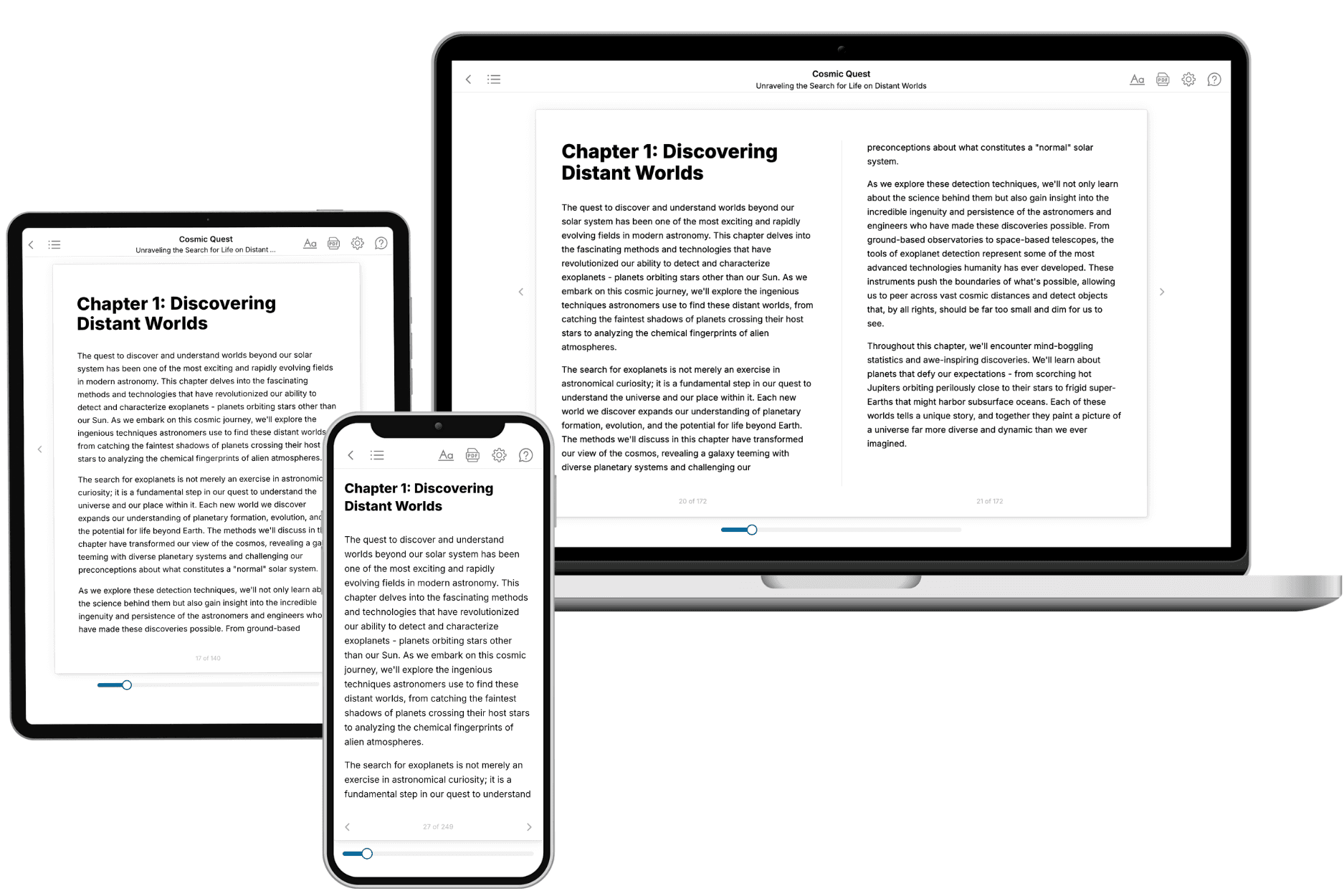
- 3. Get your tailored book
Your book is ready in 10 minutes. Read it online, download as EPUB or PDF, or send to Kindle.
Frequently asked questions
- What is TailoredRead?
TailoredRead creates complete, full-length nonfiction ebooks, written specifically for you. Tell us what you want to learn and why, and TailoredRead writes you a complete ebook on it, with charts, tables, and diagrams throughout. Read it online, on Kindle, or on any e-reader, or download it as a PDF or EPUB. Every book is written fresh the day you order it.
- How is the book tailored to me?
Before anything is written, you answer a few short questions about your goals, your background, and the topics you care about. Your book is then planned around your answers: written at your level, focused on your goals, and covering the topics you chose, instead of the one-size-fits-all book a store sells everyone.
- Will it read like generic AI content?
No. Your book isn't a chat transcript: it's planned chapter by chapter before a single word is written, told in a clear book voice, and explains ideas visually with charts, tables, and diagrams. After writing, every book goes through an editorial pass that polishes chapters so the book reads consistent from start to finish. Judge for yourself: browse thousands of sample books on our Explore Books page.
- How accurate is the content?
Our AI first checks whether your subject needs live research. Niche and fast-moving subjects are researched before writing, and the book plan and chapters are grounded in what it finds. After writing, every book goes through a quality pass that checks its facts and consistency, and researched books list their sources in a Notes section at the back.
- How long is the book?
You choose the length: Comprehensive (250-300 pages), Detailed (150-200 pages), Essential (70-100 pages), or Short (30-50 pages).
- Does the book include visuals?
Yes. Every book includes charts, tables, and diagrams: timelines, checklists, step-by-step guides, decision trees, comparison tables, matrices, and bar charts. A typical book includes dozens of these visual elements.
- Can I read it on Kindle? What formats can I download?
Yes. Every book can be read in our online reader or downloaded as a PDF or EPUB. The EPUB can be opened with Kindle, Apple Books, Kobo, and any e-reader. The Commercial and Author licenses also include an editable Word (DOCX) and Markdown download.
- How much does it cost?
About the price of a regular ebook. The exact price depends on your book's length and complexity, from $2 for the shortest books to $35 for the most comprehensive, and it's shown when you review your book, before you commit to anything. Each book is a one-time purchase, yours to keep, no subscription. Licenses that let you share, teach, or publish your book range from $35.99 to $49.99.
- Can I preview the book before purchasing?
Before you pay, you'll see what your book will cover: the title, a detailed description, the estimated length, and the complete chapter-by-chapter table of contents, so you know what you're getting before you decide. The full text itself is written after you purchase.
- How long does it take to create a book?
About 10 minutes. You can start reading the opening chapters while the rest is still being written.