The Art and Science of Mathematical Proof
Master Proof Techniques, Logic, and Mathematical Reasoning from First Principles
You'll develop the ability to construct rigorous mathematical proofs and think like a mathematician by mastering systematic proof techniques grounded in logic and set theory.
238 pages11 chaptersNov 22, 2025Mathematical ProofsCreated by Vikram
About this book
This book bridges the gap between computational mathematics and proof-based reasoning, providing you with a complete framework for understanding how mathematical arguments work and how to build them yourself. Through clear explanations of direct proof, contradiction, induction, and contrapositive methods, combined with practical applications in set theory, functions, and sequences, you'll gain the confidence to tackle advanced mathematics. Each technique is presented with concrete examples, worked problems, and strategic guidance on when and how to apply different approaches. You'll learn not just the mechanics of proof writing, but the underlying logical principles that make proofs work. By the end, you'll have internalized the patterns of mathematical reasoning and developed the articulation skills needed to communicate complex ideas with precision and clarity—essential preparation for higher mathematics courses and advanced problem-solving.
Table of contents
- IntroductionWhy Proofs Matter: The Foundation of Mathematical Thinking, The Transition from Computation to Proof-Based Mathematics, How to Use This Book: A Roadmap for Mastery, Developing the Proof-Writing MindsetRead below
- Chapter 1: Foundations of Logic and Mathematical LanguagePropositions and Truth Values, Logical Operators: AND, OR, NOT, and Implication, Quantifiers and Variables: Universal and Existential Statements, Logical Equivalence and De Morgan's Laws
- Chapter 2: Set Theory: The Language of MathematicsSets, Elements, and Notation, Set Operations: Union, Intersection, Complement, and Difference, Subsets, Power Sets, and Cardinality, Proving Set Relationships and Identities
- Chapter 3: Relations and Functions: Expressing Mathematical ConnectionsRelations: Definition and Properties, Functions: Domain, Codomain, and Range, Injective, Surjective, and Bijective Functions, Function Composition and Inverse Functions
- Chapter 4: Direct Proof: The Foundation of Mathematical ArgumentThe Structure of a Direct Proof, Direct Proof with Numbers and Algebra, Direct Proof with Sets and Functions, Common Pitfalls and How to Avoid Them
- Chapter 5: Proof by Contradiction: Proving What Cannot BeThe Principle of Proof by Contradiction, Strategic Thinking: When to Use Contradiction, Classic Examples: Irrationality and Impossibility Proofs, The Contrapositive: A Related Technique
- Chapter 6: Mathematical Induction: Proving Infinite StatementsThe Principle of Mathematical Induction, Base Cases and Inductive Steps, Induction with Sums, Products, and Inequalities, Strong Induction and Well-Ordering
- Chapter 7: Sequences and Series: Proving Properties of Infinite CollectionsSequences: Definition and Notation, Convergence and Limits of Sequences, Proving Properties of Series and Sums, Applications: Recursive Definitions and Recurrence Relations
- Chapter 8: Advanced Proof Techniques and StrategiesProof by Cases: Dividing the Problem, Existence and Uniqueness Proofs, Proving Equivalences: If and Only If Statements, Disproving Claims with Counterexamples
- Chapter 9: Mathematical Writing and CommunicationClarity and Precision in Mathematical Language, Organizing Proofs: Flow, Structure, and Readability, Notation, Conventions, and Mathematical Style, Revising and Refining Your Proofs
- Chapter 10: Problem-Solving Strategies and Proof SelectionUnderstanding the Problem: Analysis and Exploration, Selecting the Right Proof Technique, Working Backwards: From Conclusion to Hypothesis, Systematic Practice and Pattern Recognition
- Chapter 11: Integrated Applications: Combining TechniquesProofs Using Multiple Techniques, Foundations for Real Analysis: Limits and Continuity, Introduction to Algebraic Structures and Proofs
- Conclusion: Your Path ForwardReflecting on Your Progress and Mastery, Next Steps: Advanced Mathematics and Continued Growth
- Glossary of Key Terms
- Further Reading and Resources
Introduction
Mathematics is often perceived as a subject of computation and calculation, where success means finding the right answer through memorized formulas and procedures. This view serves you well through algebra, trigonometry, and even calculus. But as you advance in mathematics, something fundamental shifts. The questions change from What is the answer?
to Why is this true?
and How can we be certain?
This transition marks your entry into the world of mathematical proof, where the goal is not merely to compute but to understand, justify, and communicate mathematical truth with absolute rigor. Proof is the language through which mathematicians express certainty, and mastering this language opens doors to abstract algebra, real analysis, topology, and every advanced mathematical field.
The challenge many students face at this juncture is not a lack of mathematical ability but rather an absence of systematic training in proof techniques and logical reasoning. You may have solved countless calculus problems, yet find yourself staring blankly at a statement like Prove that the sum of two even integers is even
without knowing where to begin. This difficulty is not a reflection of your mathematical potential—it simply indicates that proof writing requires a different skill set than computational mathematics. Proof construction demands that you think structurally about mathematical statements, recognize patterns in logical arguments, and communicate your reasoning with precision and clarity. These are learnable skills that improve dramatically with deliberate practice and proper guidance.
This book provides you with a comprehensive framework for mastering mathematical proof. You will learn the foundational proof techniques—direct proof, proof by contradiction, mathematical induction, and contrapositive—that form the backbone of mathematical reasoning across all fields. You will develop fluency in the language of mathematics through systematic study of logic, set theory, functions, and relations. Most importantly, you will practice applying these techniques to increasingly sophisticated problems, building the pattern recognition and strategic thinking that distinguish confident proof writers from those who struggle. By the end of this journey, you will possess not just knowledge about proofs, but the internalized ability to construct rigorous mathematical arguments and communicate complex ideas with the precision that advanced mathematics demands.
Why Proofs Matter: The Foundation of Mathematical Thinking
Mathematical proof serves as the ultimate arbiter of truth in mathematics. Unlike empirical sciences where theories are supported by evidence and remain subject to revision, mathematical statements proven through rigorous logical argument achieve absolute certainty. When Euclid proved that there are infinitely many prime numbers over two thousand years ago, he established a truth that remains unassailable today and will remain so forever. This permanence and certainty distinguish mathematics from all other fields of human inquiry. Proof is not merely a formality or academic exercise—it is the mechanism through which mathematical knowledge is created, verified, and transmitted across generations. Without proof, mathematics would be reduced to conjecture and speculation, losing the foundational role it plays in science, technology, and human understanding.
The practical importance of proof extends far beyond pure mathematics. Every algorithm that powers modern technology, every cryptographic system that secures digital communication, and every engineering calculation that ensures structural safety rests on proven mathematical theorems. When you use a GPS system, you rely on mathematical proofs about signal processing and geometric calculations. When you make an online purchase, cryptographic protocols based on number theory proofs protect your financial information. The reliability of these systems depends entirely on the certainty provided by mathematical proof. A computational check of a million cases might suggest a pattern, but only a proof guarantees that the pattern holds universally. This distinction between empirical observation and logical certainty is what makes mathematics uniquely powerful and trustworthy.
Beyond its role in establishing truth, proof develops a particular mode of thinking that transfers to problem-solving in any domain. Constructing a proof requires you to:
- Analyze complex statements and identify their logical structure
- Break down problems into manageable components
- Recognize patterns and connections between different concepts
- Construct logical arguments where each step follows necessarily from previous ones
- Anticipate objections and ensure your reasoning is airtight
- Communicate complex ideas with precision and clarity
Proof also reveals the deep interconnectedness of mathematical ideas. When you prove that a function is continuous, you draw on definitions from set theory, logic, and the real number system. When you use mathematical induction, you invoke fundamental properties of the natural numbers. Each proof situates a particular result within the broader landscape of mathematical knowledge, showing how different areas of mathematics support and illuminate one another. This web of logical connections transforms mathematics from a collection of isolated facts into a unified intellectual structure. Understanding these connections gives you insight into why mathematical concepts are defined the way they are and how different areas of mathematics relate to one another. This holistic understanding is what separates those who merely memorize mathematical facts from those who truly comprehend mathematical ideas.
For students transitioning to advanced mathematics, proof literacy is not optional—it is the price of admission. Upper-level courses in abstract algebra, real analysis, topology, and number theory assume fluency in proof techniques. These courses present theorems and expect you to understand their proofs, construct your own proofs for homework problems, and prove results on examinations. Without solid grounding in proof methods, these courses become exercises in frustration rather than intellectual exploration. Conversely, students who have mastered proof techniques find these courses challenging but accessible, even enjoyable. The difference lies not in innate mathematical ability but in systematic preparation. This book provides that preparation, equipping you with the tools and practice needed to succeed in proof-based mathematics.
Perhaps most importantly, learning to construct proofs changes your relationship with mathematics itself. Computational mathematics often feels like following recipes—apply this formula, execute that algorithm, arrive at an answer. Proof-based mathematics invites you to understand why the recipes work, to question assumptions, and to create new mathematical knowledge. This shift from passive consumption to active creation is intellectually liberating. You move from asking How do I solve this?
to asking Why is this true?
and even What else might be true?
This transformation represents mathematical maturity, the point at which you begin to think like a mathematician rather than merely applying mathematical techniques. The journey requires effort and persistence, but the intellectual rewards—the satisfaction of understanding, the elegance of logical argument, the power of rigorous reasoning—make it worthwhile.
The beauty of mathematical proof lies in its accessibility. Unlike experimental science, which requires laboratories and equipment, or empirical research, which requires data collection, mathematical proof requires only clear thinking and careful reasoning. The barriers to entry are low—you need no special resources, only time, effort, and systematic guidance. This book provides that guidance, presenting proof techniques in a structured progression that builds your skills incrementally. You will start with fundamental concepts in logic and set theory, progress through core proof techniques, and culminate in sophisticated applications that integrate multiple methods. Each step prepares you for the next, ensuring that you develop both the technical skills and the strategic thinking needed for mathematical proof. The path is challenging but navigable, and the destination—genuine mathematical literacy—is within your reach.
The Transition from Computation to Proof-Based Mathematics
The shift from computational mathematics to proof-based reasoning represents one of the most significant intellectual transitions in mathematical education. In computational courses, problems typically have clear solution procedures: differentiate this function, integrate that expression, solve this equation. Success means executing algorithms correctly and arriving at numerical or algebraic answers. The focus is on technique and calculation, and you can often verify your answer by substitution or comparison with the back of the textbook. This approach develops important skills—algebraic manipulation, pattern recognition, procedural fluency—but it does not prepare you for the fundamentally different demands of proof-based mathematics. The transition catches many capable students off guard, not because they lack mathematical ability, but because the nature of mathematical work has changed in ways they were not prepared for.
In proof-based mathematics, problems rarely come with clear solution procedures. Instead, you face statements like Prove that if n is odd, then n² is odd
or Show that the intersection of two open sets is open.
These problems do not ask you to compute anything—they ask you to construct a logical argument that establishes truth with certainty. There is no formula to apply, no algorithm to execute. Instead, you must:
- Understand precisely what the statement claims
- Identify what you are given (hypotheses) and what you must establish (conclusion)
- Determine which proof technique is appropriate for this type of statement
- Construct a logical chain of reasoning from hypotheses to conclusion
- Express your argument clearly using proper mathematical language
- Verify that your reasoning is sound and complete
The language of mathematics also becomes more formal and precise in proof-based courses. In calculus, you might write as x approaches infinity, f(x) approaches zero
and convey the essential idea. In real analysis, this informal statement must be replaced with the precise epsilon-delta definition: For every ε > 0, there exists M such that if x > M, then |f(x)| < ε.
This precision is not pedantry—it is necessary for rigorous reasoning. Informal language often conceals ambiguities and unstated assumptions that can lead to errors. Formal mathematical language eliminates these ambiguities, ensuring that statements have unambiguous meaning. Learning to read and write this formal language is like learning a foreign language—it requires practice and feels awkward at first, but becomes natural with time and use.
Another significant difference lies in how you verify correctness. In computational mathematics, you can check your answer: Does the derivative satisfy the product rule? Does the solution satisfy the differential equation? In proof-based mathematics, verification is more subtle. You cannot simply check whether your conclusion is true—you must verify that your logical argument is valid and complete. This requires you to examine each step of your reasoning and ask: Does this step follow logically from previous statements? Have I used only the given hypotheses and previously proven results? Are there any gaps in my reasoning? This self-critical evaluation is essential for developing sound proof-writing skills. Many students initially struggle with this aspect because they are accustomed to external verification (answer keys, computational checks) rather than internal logical validation.
The psychological adjustment required for this transition should not be underestimated. Computational problems typically yield to persistent effort—if you keep working, you will eventually arrive at an answer. Proof problems can be more frustrating because you might stare at a statement for an extended period without seeing how to proceed. This experience of being stuck is normal and does not indicate inadequacy. Professional mathematicians regularly encounter problems that resist immediate solution. The difference is that experienced mathematicians have developed strategies for working through this stuck state: trying different proof techniques, examining special cases, working backwards from the conclusion, looking for similar problems they have solved before. These strategies are learnable, and this book will teach them to you systematically. Understanding that being stuck is part of the process, not a sign of failure, helps you persist through the inevitable difficulties.
Despite these challenges, the transition to proof-based mathematics is manageable with proper preparation and realistic expectations. The key is recognizing that proof writing is a skill that develops through practice, not an innate talent that some possess and others lack. Research in mathematics education consistently shows that students who engage in deliberate practice with proof construction—working through examples, analyzing model proofs, receiving feedback, and revising their work—develop strong proof-writing abilities regardless of their initial confidence level[1]. The students who struggle are typically those who expect proof writing to come naturally without systematic practice, or who become discouraged by initial difficulties and give up. If you approach proof writing as a learnable skill and commit to deliberate practice, you will develop competence and eventually confidence.
This book is specifically designed to facilitate your transition from computational to proof-based mathematics. It begins with the foundational concepts—logic, set theory, functions—that provide the language for mathematical reasoning. It then systematically introduces core proof techniques, explaining not just how each technique works but when and why to use it. Each technique is illustrated with multiple examples of increasing complexity, allowing you to see the patterns and develop intuition. Practice problems throughout the book give you opportunities to apply techniques in varied contexts, building the pattern recognition that enables you to select appropriate methods for new problems. By the end, you will have internalized the logical structures and strategic thinking that characterize mathematical proof, positioning you for success in advanced mathematics courses and beyond.
How to Use This Book: A Roadmap for Mastery
This book is structured to build your proof-writing abilities systematically, with each chapter preparing you for the next. The progression is deliberate: foundational concepts come first, establishing the language and logical framework for mathematical reasoning. Core proof techniques follow, each introduced with clear explanations, worked examples, and strategic guidance. Later chapters integrate these techniques in sophisticated applications, showing how different methods combine to solve complex problems. This structure reflects how mathematical understanding develops—through incremental mastery of concepts and techniques, followed by integration and application. To get maximum benefit from this book, you should work through chapters in sequence rather than jumping to topics that seem immediately relevant. The foundational material may seem basic, but it establishes essential concepts and notation that later chapters assume.
Active engagement is crucial for developing proof-writing skills. Reading about proof techniques is necessary but insufficient—you must practice constructing proofs yourself. This book includes numerous worked examples that demonstrate proof techniques in action. When you encounter a worked example, resist the temptation to simply read through it passively. Instead:
- Read the problem statement and attempt to solve it yourself before looking at the solution
- If you cannot solve it immediately, think about what proof technique might be appropriate
- After reading the solution, cover it and try to reproduce the proof from memory
- Identify the key insights that made the proof work
- Consider whether alternative approaches might also work
Practice problems are your primary vehicle for skill development. Each section includes problems ranging from straightforward applications of techniques to more challenging problems that require strategic thinking. You should attempt every problem, even those that seem difficult. Struggling with a problem—even if you do not solve it—builds understanding in ways that reading solutions cannot. When you get stuck, try these strategies before looking at hints or solutions: reread the relevant section, examine similar worked examples, try a simpler version of the problem, or work backwards from what you are trying to prove. If you ultimately need to consult a solution, study it carefully to understand the approach, then set it aside and attempt to reconstruct the proof independently. This process of struggle, study, and reconstruction is how proof-writing skills develop.
Mathematical writing is as important as mathematical reasoning. A correct proof poorly communicated is of limited value—mathematics is a social enterprise where ideas must be shared and understood by others. As you work through this book, pay attention not just to the logical content of proofs but to how they are written. Notice how definitions are invoked, how variables are introduced, how logical connections are expressed, and how proofs are organized for clarity. Chapter 9 addresses mathematical writing explicitly, but you should attend to writing quality throughout your practice. When you write proofs, imagine explaining your reasoning to a fellow student who understands the definitions but has not thought about this particular problem. This audience awareness helps you identify gaps in your reasoning and improve clarity.
The book's structure supports different learning goals and timelines. If you are preparing for a transition-to-proof course or self-studying before advanced mathematics courses, work through the entire book systematically over several months. If you are currently enrolled in a proof-based course and need targeted help, you might focus on specific chapters relevant to your current coursework while ensuring you understand the foundational material in Chapters 1-3. If you are reviewing proof techniques before graduate school or comprehensive examinations, you might move quickly through familiar material while working practice problems to refresh your skills. The book's modular structure allows this flexibility while maintaining the logical progression of concepts.
Collaboration can enhance your learning, but it must be approached thoughtfully. Discussing problems with peers helps you see different approaches and identify gaps in your understanding. However, collaboration should supplement rather than replace individual work. A good practice is to attempt problems independently first, then discuss approaches with others, and finally write up your solutions individually. This ensures you develop your own proof-writing abilities rather than simply copying others' reasoning. When you do collaborate, focus on discussing strategies and approaches rather than sharing complete solutions. Questions like What proof technique did you use?
or How did you get started?
promote learning, while simply copying someone else's proof does not.
Expect the learning process to be nonlinear. You will have moments of insight where concepts suddenly click, followed by periods where new material seems opaque. This is normal and does not indicate that you are falling behind. Mathematical understanding often develops through a process of gradual familiarization followed by sudden comprehension. When you feel stuck, persistence is key. Return to foundational concepts, work through additional examples, and give yourself time to absorb ideas. The brain continues processing mathematical concepts even when you are not actively studying—many students report that problems that seemed impossible one day become clear after a night's sleep. Trust the process and maintain consistent effort, even when progress feels slow.
Finally, maintain a growth mindset throughout your learning journey. Research in educational psychology demonstrates that students who view mathematical ability as developable through effort outperform those who view it as fixed talent[2]. When you struggle with a proof, interpret this as an opportunity to learn rather than evidence of inadequacy. When you make errors, view them as information about what you need to practice rather than indicators of inability. This mindset is not merely motivational—it is accurate. Proof-writing ability develops through practice, and every mathematician, no matter how accomplished, was once a beginner who struggled with basic proofs. Your current skill level reflects your current experience, not your ultimate potential. With systematic practice and persistence, you will develop the proof-writing abilities you need for advanced mathematics.
Developing the Proof-Writing Mindset
Successful proof writing requires more than technical knowledge of proof techniques—it requires a particular mindset and approach to mathematical problems. This mindset combines precision with creativity, skepticism with open-mindedness, and persistence with strategic flexibility. Developing this mindset is as important as learning specific proof methods, and it distinguishes students who thrive in proof-based mathematics from those who struggle despite adequate technical knowledge. The proof-writing mindset is not a personality trait but a set of habits and attitudes that you can deliberately cultivate through practice and reflection.
Precision is fundamental to mathematical proof. Every word in a mathematical statement carries meaning, and small changes in wording can dramatically alter what a statement claims. Consider the difference between For every x, there exists y such that x < y
and There exists y such that for every x, x < y.
The first statement is true (for any number, you can find a larger number), while the second is false (there is no number larger than all numbers). The only difference is the order of quantifiers, yet the truth values are opposite. This example illustrates why precision matters—imprecise reading or writing leads to misunderstanding and error. Developing precision requires you to slow down and read mathematical statements carefully, paying attention to every quantifier, every condition, and every logical connector. It means writing with equal care, choosing words deliberately and ensuring that what you write expresses exactly what you mean.
Skepticism is equally important. When you encounter a mathematical claim, your first instinct should be to question it: Why is this true? What if we changed the hypotheses? Are there edge cases where this might fail? This healthy skepticism is not cynicism—it is intellectual rigor. It prevents you from accepting claims without justification and helps you identify gaps in reasoning. When you construct your own proofs, apply this same skepticism to your work. After writing a proof, read it critically: Does each step actually follow from previous ones? Have you used all the hypotheses? Are there implicit assumptions you have not justified? This self-critical evaluation is how you catch errors before they become ingrained. Many students initially resist this skeptical approach because it feels negative, but it is actually a sign of mathematical maturity and leads to stronger, more reliable reasoning.
Creativity plays a surprising role in proof construction. While proofs must follow strict logical rules, finding the right approach often requires creative insight. You might need to introduce a clever substitution, construct an auxiliary object, or recognize a non-obvious connection between concepts. This creativity develops through experience—as you work through many proofs, you build a mental library of techniques and insights that you can draw upon for new problems. You can accelerate this process by studying proofs actively, asking yourself: What was the key insight here? Why did this approach work? Could I have discovered this myself? This reflective practice helps you extract general principles from specific examples, building the creative problem-solving abilities that proof construction requires.
Strategic flexibility is the ability to try different approaches when your initial strategy fails. Novice proof writers often fixate on a single approach and become frustrated when it does not work. Experienced mathematicians routinely try multiple strategies: if direct proof seems difficult, try contradiction; if a general proof is elusive, examine special cases to build intuition; if you cannot prove the statement forward, try working backwards from the conclusion. This flexibility requires you to view being stuck not as failure but as information—this approach did not work, so let me try another. The chapters on proof techniques will give you a toolkit of methods to try, and Chapter 10 will teach you systematic strategies for selecting among them. Developing this flexibility transforms proof writing from a frustrating exercise into an engaging puzzle-solving process.
Patience and persistence are perhaps the most important components of the proof-writing mindset. Significant proofs rarely yield to quick attempts—they require sustained thought, multiple attempts, and willingness to revise your approach. This can be frustrating for students accustomed to computational problems that resolve quickly. You must accept that spending thirty minutes or even several hours on a single proof is normal and productive, not a sign that you are doing something wrong. The time spent thinking deeply about a problem, even if you do not immediately solve it, builds understanding and develops problem-solving abilities. Many breakthroughs come after extended periods of struggle, when your mind has had time to process the problem from multiple angles. Learning to tolerate and even embrace this productive struggle is essential for success in proof-based mathematics.
Pattern recognition is a skill that develops gradually through extensive practice. As you work through many proofs, you begin to recognize common structures and strategies. You notice that certain types of statements typically call for specific proof techniques: universal statements about integers often yield to mathematical induction, existence claims might require explicit construction, and statements about set relationships often use element-chasing arguments. These patterns are not rigid rules—there are always exceptions and alternative approaches—but they provide starting points when you encounter new problems. You cannot learn these patterns by memorization; they must be internalized through repeated exposure and practice. This is why working through many examples is essential—each proof you study or construct adds to your pattern library and improves your ability to recognize what approach might work for new problems.
Finally, the proof-writing mindset includes intellectual humility—recognition that mathematics is difficult and that struggle is part of learning, not evidence of inadequacy. Every mathematician, including the most accomplished, regularly encounters problems they cannot immediately solve. The difference between experts and novices is not that experts never struggle, but that they have developed strategies for working through difficulties and the persistence to apply those strategies. When you find proof writing challenging, you are experiencing what every mathematician experiences. The appropriate response is not discouragement but determination—to seek help when needed, to practice deliberately, and to trust that your abilities will develop with time and effort. This combination of humility about current limitations and confidence in your capacity to grow creates the mindset that enables long-term success in mathematics.
This is the end of the free sample. The full book has 11 chapters.
Want this book written for you?
Tell us your goals and background, and get your own version of this book, tailored by AI to you.


Benefits of AI-tailored books
- Read one book, not ten:
- all the Mathematical Proofs knowledge you need, gathered into a single book.
- Save days of learning:
- tell us your goals, choose your topics, and the whole book is built around them.
- Learn effortlessly:
- Mathematical Proofs book written for your specific background and expertise.
- Understand at a glance:
- includes charts, tables, timelines, checklists, decision trees, and more.
- Stay current:
- written the day you order it, not years ago.
- Trust what you read:
- every book is checked for accuracy, with real research when your subject needs it.
Create your unique book in 3 steps
- 1. Select your focus
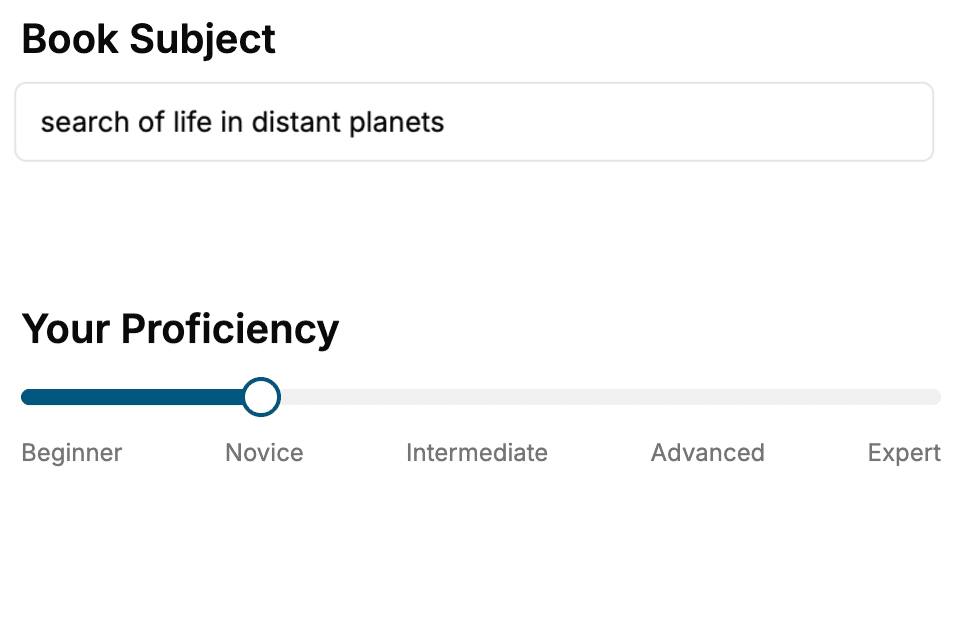
Select the focus of your Mathematical Proofs book and share your background
- 2. Personalize your book
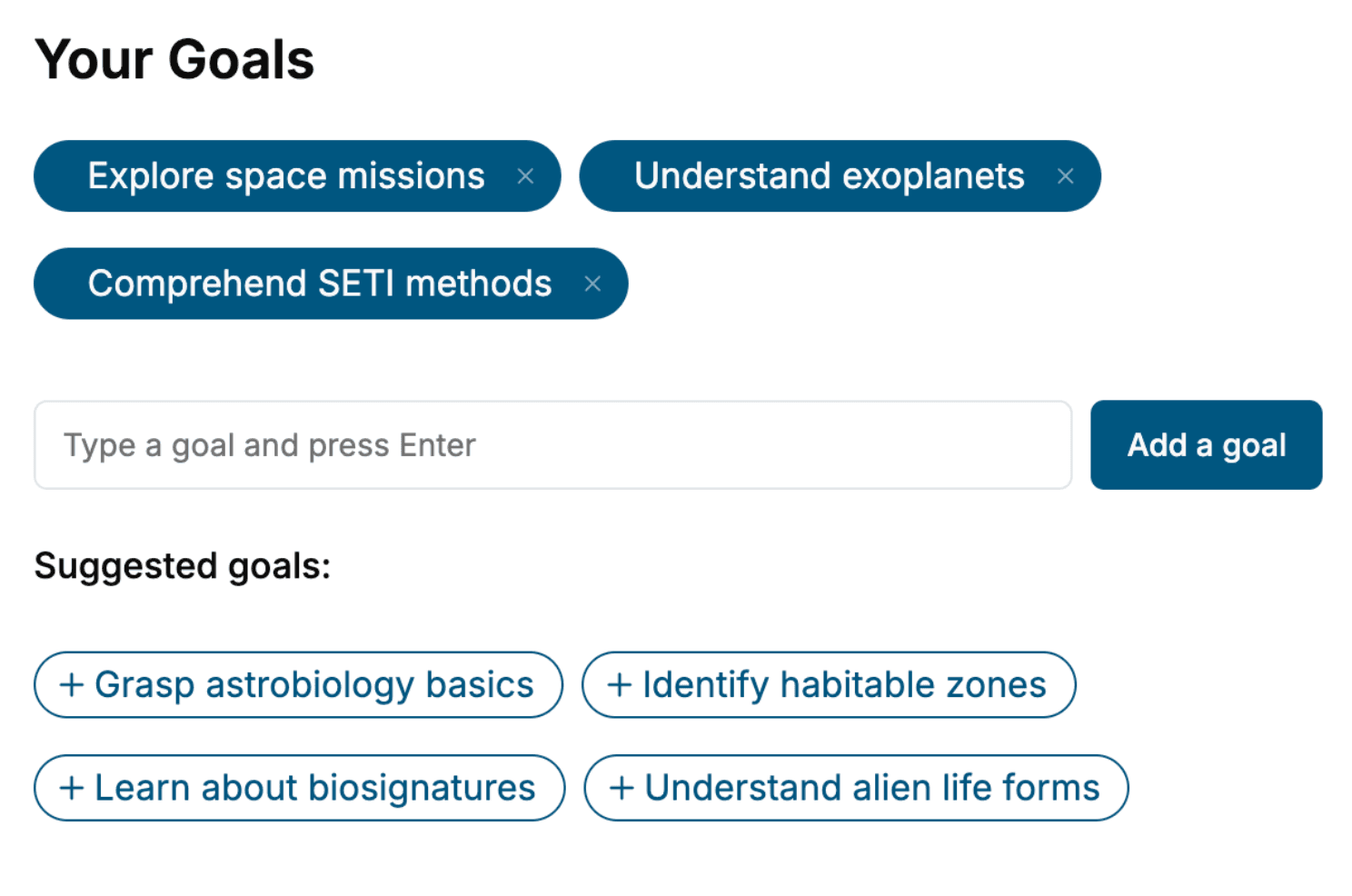
Specify your goals and choose sub-topics to include
- 3. Get your tailored book
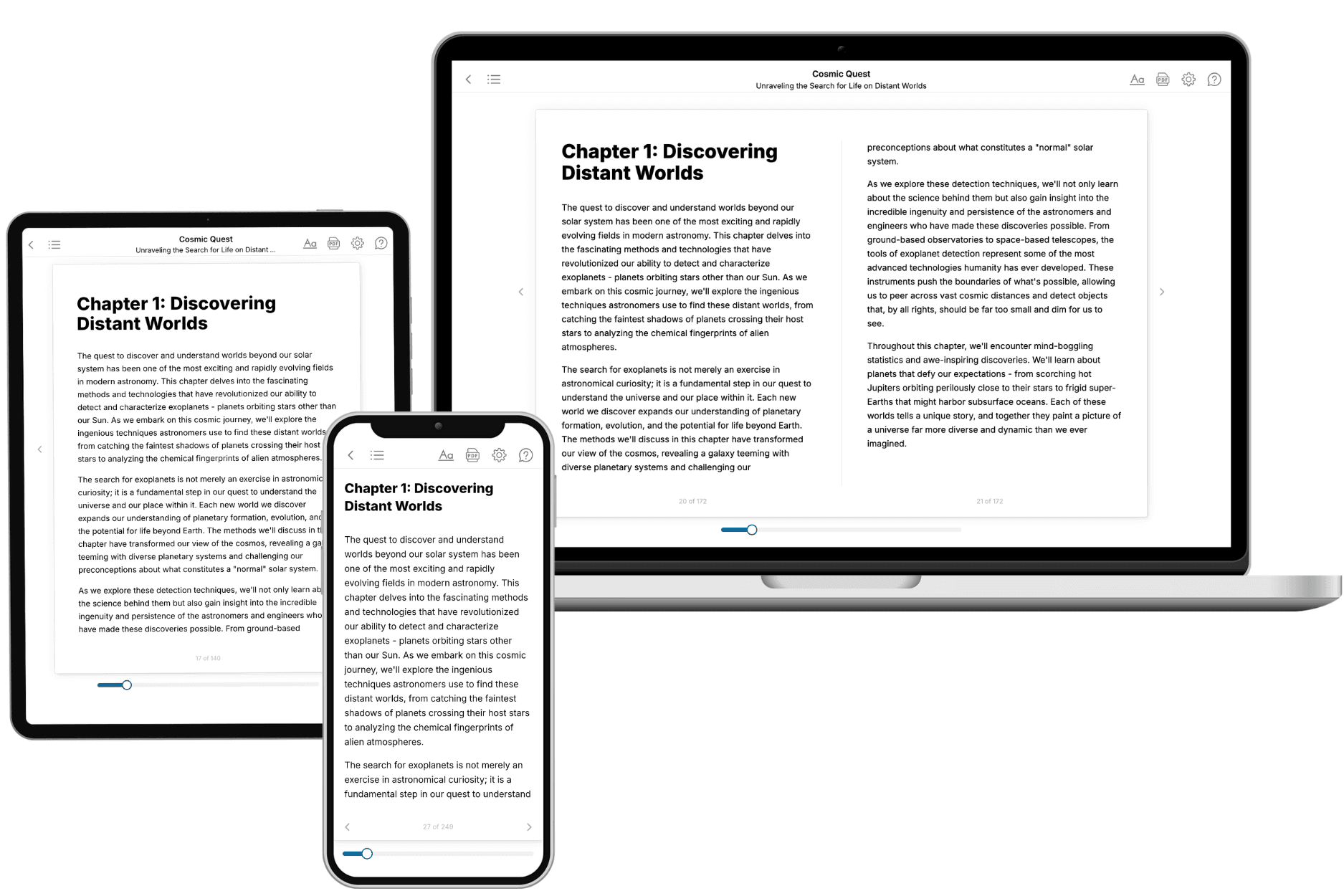
Your book is ready in 10 minutes. Read it online, download as EPUB or PDF, or send to Kindle.
Frequently asked questions
- What is TailoredRead?
TailoredRead creates complete, full-length nonfiction ebooks, written specifically for you. Tell us what you want to learn and why, and TailoredRead writes you a complete ebook on it, with charts, tables, and diagrams throughout. Read it online, on Kindle, or on any e-reader, or download it as a PDF or EPUB. Every book is written fresh the day you order it.
- How is the book tailored to me?
Before anything is written, you answer a few short questions about your goals, your background, and the topics you care about. Your book is then planned around your answers: written at your level, focused on your goals, and covering the topics you chose, instead of the one-size-fits-all book a store sells everyone.
- Will it read like generic AI content?
No. Your book isn't a chat transcript: it's planned chapter by chapter before a single word is written, told in a clear book voice, and explains ideas visually with charts, tables, and diagrams. After writing, every book goes through an editorial pass that polishes chapters so the book reads consistent from start to finish. Judge for yourself: browse thousands of sample books on our Explore Books page.
- How accurate is the content?
Our AI first checks whether your subject needs live research. Niche and fast-moving subjects are researched before writing, and the book plan and chapters are grounded in what it finds. After writing, every book goes through a quality pass that checks its facts and consistency, and researched books list their sources in a Notes section at the back.
- How long is the book?
You choose the length: Comprehensive (250-300 pages), Detailed (150-200 pages), Essential (70-100 pages), or Short (30-50 pages).
- Does the book include visuals?
Yes. Every book includes charts, tables, and diagrams: timelines, checklists, step-by-step guides, decision trees, comparison tables, matrices, and bar charts. A typical book includes dozens of these visual elements.
- Can I read it on Kindle? What formats can I download?
Yes. Every book can be read in our online reader or downloaded as a PDF or EPUB. The EPUB can be opened with Kindle, Apple Books, Kobo, and any e-reader. The Commercial and Author licenses also include an editable Word (DOCX) and Markdown download.
- How much does it cost?
About the price of a regular ebook. The exact price depends on your book's length and complexity, from $2 for the shortest books to $35 for the most comprehensive, and it's shown when you review your book, before you commit to anything. Each book is a one-time purchase, yours to keep, no subscription. Licenses that let you share, teach, or publish your book range from $35.99 to $49.99.
- Can I preview the book before purchasing?
Before you pay, you'll see what your book will cover: the title, a detailed description, the estimated length, and the complete chapter-by-chapter table of contents, so you know what you're getting before you decide. The full text itself is written after you purchase.
- How long does it take to create a book?
About 10 minutes. You can start reading the opening chapters while the rest is still being written.