The Art and Science of Statistical Sampling
Master the Methods That Drive Data-Driven Decisions
This book takes you on a journey through the fundamental principles and practical applications of statistical sampling—a cornerstone of modern research and decision-making.
207 pages9 chaptersAug 14, 2026Sampling
About this book
You'll discover why sampling matters far beyond academic statistics, exploring how organizations use these methods to understand markets, improve quality, conduct surveys, and validate hypotheses with limited resources. The book moves systematically from foundational concepts through advanced techniques, examining both the mathematical rigor and the philosophical questions that underpin sampling methodology. You'll learn how to design sampling strategies that balance accuracy with practicality, understand the sources of bias that can undermine your results, and master techniques for improving efficiency. Whether you're designing a market research study, conducting quality control, or analyzing survey data, this book equips you with the knowledge to make informed methodological choices and interpret results with confidence. Real-world examples and practical guidance ensure that theoretical concepts translate directly to your work.
Table of contents
- IntroductionWhy Sampling Matters in the Modern World, Sampling in Business, Science, and Society, How This Book Is Organized, What You'll Master by the EndRead below
- Chapter 1: Foundations of SamplingUnderstanding Populations and Samples, Sampling Error and Variability, The Economics and Ethics of Sampling
- Chapter 2: Probability Sampling MethodsSimple Random Sampling: The Foundation, Systematic Sampling: Efficiency Through Order, Stratified Sampling: Precision Through Division, Cluster Sampling: Practical Sampling at Scale
- Chapter 3: Non-Probability Sampling MethodsConvenience Sampling: When and Why, Purposive Sampling: Targeting Specific Populations, Quota Sampling: Structured Non-Probability Approaches, Snowball Sampling: Building Networks
- Chapter 4: Determining Sample SizeStatistical Power and Effect Size, Confidence Levels and Margins of Error, Balancing Theory with Real-World Constraints, Calculating Sample Size for Different Scenarios
- Chapter 5: Sources of Bias and How to Control ThemSelection Bias: When Your Sample Isn't Representative, Nonresponse Bias: The Problem of Missing Data, Measurement Bias: Errors in Data Collection, Strategies for Identifying and Reducing Bias
- Chapter 6: Advanced Sampling TechniquesMultistage Sampling: Complex Real-World Designs, Adaptive Sampling: Learning as You Go, Importance Sampling: Focusing on What Matters
- Chapter 7: Weighting and Adjustment MethodsPost-Stratification: Correcting After Collection, Propensity Score Methods: Balancing Observational Data, Calibration Weighting: Aligning with Known Totals
- Chapter 8: Philosophical Foundations of SamplingThe Frequentist Approach: Long-Run Behavior, The Bayesian Approach: Incorporating Prior Knowledge, Design-Based Versus Model-Based Inference, How Philosophy Shapes Practical Decisions
- Chapter 9: Sampling in Practice: Real-World ApplicationsSurvey Sampling: Polls, Questionnaires, and Feedback, Quality Control and Acceptance Sampling, Market Research and Consumer Studies
- ConclusionKey Takeaways and Core Principles, The Future of Sampling Methodology
- Glossary
- Further Reading and Resources
Introduction
A quality control engineer at a semiconductor plant cannot test every chip that rolls off the line. A public health researcher tracking disease prevalence across a country of 300 million people cannot interview every citizen. A retailer trying to understand why customers abandon their online shopping carts cannot follow every visitor through every session. In each case, the answer is the same: draw a carefully chosen subset, measure it well, and use what you find to say something reliable about the whole. That is sampling, and it sits at the center of how modern organizations learn about the world.
What makes sampling genuinely interesting is that it is not simply a workaround for limited budgets. Done correctly, a well-designed sample can actually outperform a poorly executed census. The 1936 Literary Digest poll famously surveyed over two million Americans and still predicted the wrong winner of the presidential election, while George Gallup's far smaller but more carefully drawn sample got it right.[1] Size alone does not guarantee accuracy. Method does. Understanding that distinction is the first step toward becoming a more effective practitioner.
This book is built for professionals who already have a working relationship with statistics and want to go deeper into the methodology of sampling itself. You may be designing surveys, running quality audits, conducting market research, or evaluating program outcomes. Whatever the context, the decisions you make about how to draw your sample, how large it should be, and how to handle the inevitable imperfections in your data will shape the credibility of everything that follows. The chapters ahead give you the conceptual grounding and practical tools to make those decisions with confidence.
The material moves from foundational ideas through increasingly sophisticated techniques, always keeping one foot in real-world application. Theory without practice produces elegant formulas that gather dust. Practice without theory produces confident conclusions that cannot be trusted. The goal here is both: a clear understanding of why each method works, paired with concrete guidance on how to apply it.
Why Sampling Matters in the Modern World
Data has never been more abundant, and yet the fundamental challenge of sampling has not gone away. If anything, it has become more complex. Organizations now collect data from websites, sensors, transactions, and social platforms at a scale that would have been unimaginable two decades ago. But volume is not the same as representativeness. A dataset of ten million social media posts tells you a great deal about people who use that platform and almost nothing about people who do not. The question of who or what is in your data remains as important as ever.
Sampling matters because decisions made from bad samples carry real consequences. Consider a pharmaceutical company that tests a new drug on a sample drawn predominantly from one demographic group. If the drug behaves differently across age groups or genetic backgrounds, the sample will miss that variation entirely. The resulting conclusions may be statistically precise but practically misleading. The same logic applies to business decisions, policy evaluations, and scientific studies. A flawed sample does not just produce uncertain results; it can produce confidently wrong ones.
At the same time, sampling is what makes large-scale inquiry possible at all. The U.S. Census Bureau's American Community Survey reaches roughly 3.5 million households each year to produce detailed estimates for the entire country.[2] National health surveys track disease trends across populations of hundreds of millions using samples of a few thousand carefully selected participants. Industrial manufacturers use acceptance sampling to verify product quality without destroying every unit they produce. In each case, sampling converts an impossible task into a tractable one.
The discipline of sampling also forces a kind of intellectual honesty that raw data collection does not. When you design a sample, you must define your Population precisely. You must acknowledge what your Sampling Frame includes and excludes. You must quantify your Sampling Error and report it alongside your findings. These requirements push researchers and analysts toward clearer thinking about what they are actually measuring and what claims their data can legitimately support.
There is also an ethical dimension that often goes unacknowledged. Sampling decisions determine whose voices get counted and whose get missed. A survey that systematically underrepresents low-income households, rural communities, or non-English speakers will produce estimates that reflect the majority while ignoring the margins. When those estimates drive policy, the people who were undersampled bear the consequences. Good sampling practice is, in this sense, a matter of fairness as much as statistics.
Finally, sampling sits at the intersection of two kinds of knowledge: the mathematical and the contextual. The formulas for calculating Margin of Error or Statistical Power are precise and learnable. But knowing which formula to apply, how to define your population, and how to interpret your results in light of real-world constraints requires judgment that only comes from understanding the full picture. That combination of rigor and judgment is what this book is designed to develop.
Sampling in Business, Science, and Society
Sampling is not confined to academic research departments. It runs through nearly every domain where decisions depend on data, and recognizing it in context helps clarify why the methodological choices matter so much in practice. The same core principles apply whether you are estimating customer satisfaction, monitoring water quality, or projecting election outcomes, but the specific design decisions look very different depending on the setting.
In business, sampling underpins market research, quality control, and customer analytics. A consumer goods company launching a new product line might use Quota Sampling to recruit focus group participants who match the demographic profile of their target market. A manufacturer might apply Acceptance Sampling to decide whether an incoming shipment of components meets quality standards without testing every single part. An e-commerce platform might run A/B tests on a random subset of users to evaluate whether a new checkout design improves conversion rates. Each of these is a sampling problem, and each requires a different approach.
In science and public health, sampling is the mechanism through which researchers make claims about populations from limited observations. Epidemiologists use carefully stratified samples to estimate disease prevalence across different age groups and regions. Clinical trials use randomization, which is a form of probability sampling, to assign participants to treatment and control conditions in a way that supports causal inference. Environmental scientists use spatial sampling designs to monitor pollution levels across large geographic areas. The credibility of the science depends directly on the quality of the sampling design.
In government and policy, large-scale surveys shape decisions that affect millions of people. Labor force statistics, poverty estimates, educational attainment data, and housing surveys all rely on sophisticated Survey Sampling designs that balance cost, coverage, and precision. The methodological choices embedded in these surveys, including how the Sampling Frame is constructed, how nonresponse is handled, and how estimates are weighted, determine what the data can and cannot tell policymakers.
In technology and data science, sampling appears in perhaps less obvious but equally consequential forms. Machine learning models are trained on samples of data, and the representativeness of those samples shapes what the model learns and where it fails. A facial recognition system trained predominantly on images of one demographic group will perform poorly on others, a direct consequence of a sampling problem in the training data.[3] Monte Carlo simulations, which are used in finance, engineering, and physics, rely on Importance Sampling to make computations tractable. Even the way a search engine indexes the web involves sampling decisions about which pages to crawl and how often.
What unites all of these applications is a common set of questions. Who or what is in the population? How do you draw a sample that represents it fairly? How large does that sample need to be? What can go wrong, and how do you detect and correct it? The answers vary by context, but the framework for thinking through them is consistent. That framework is what the chapters ahead will build, piece by piece.
A sample is only as good as the thinking that went into drawing it. The most sophisticated analysis cannot rescue a fundamentally flawed sampling design. Getting the design right is where the real work begins.
One practical implication of sampling's ubiquity is that you are almost certainly already making sampling decisions, whether or not you are framing them that way. When you decide which customers to survey, which transactions to audit, or which time periods to analyze, you are sampling. The question is whether you are doing it deliberately and with an understanding of the consequences, or by default and with unexamined assumptions. This book is an invitation to move firmly into the first category.
How This Book Is Organized
The book follows a deliberate progression from foundational concepts to advanced techniques to applied practice. Each chapter builds on what came before, so the sequence matters. That said, if you already have a solid grounding in a particular area, the chapters are written to be self-contained enough that you can move to the sections most relevant to your current work without losing the thread.
The opening chapter on Foundations of Sampling establishes the vocabulary and conceptual framework that everything else depends on. It covers the distinction between a Population and a Sample, the nature of Sampling Error and why variability is inherent rather than a sign of failure, and the economic and ethical trade-offs that make sampling not just convenient but necessary. If some of this feels familiar, treat it as a chance to sharpen your definitions before the complexity increases.
The next two chapters cover the two broad families of sampling methods. The chapter on Probability Sampling Methods walks through the four canonical designs:
- Simple Random Sampling, which gives every unit an equal chance of selection
- Systematic Sampling, which selects units at regular intervals from an ordered list
- Stratified Sampling, which divides the population into subgroups before sampling
- Cluster Sampling, which samples groups rather than individuals
For each design, the chapter explains the mechanics, the conditions under which it works best, and the guarantees of representativeness it provides. The following chapter on Non-Probability Sampling Methods covers Convenience Sampling, Purposive Sampling, Quota Sampling, and Snowball Sampling, with honest attention to both their legitimate uses and their known limitations.
The chapter on Determining Sample Size addresses one of the most common practical questions in sampling work: how many observations do you actually need? It connects Statistical Power, Effect Size, Confidence Level, and Margin of Error to concrete size calculations, and it takes seriously the real-world constraints that often force compromises between the ideal and the achievable.
The chapter on Sources of Bias and How to Control Them covers the three principal bias families that can undermine a sampling study even when the design looks sound on paper. Selection Bias, Nonresponse Bias, and Measurement Bias each operate through different mechanisms and require different detection and mitigation strategies. This chapter gives you a practical audit framework for identifying where your own studies might be vulnerable.
The chapter on Advanced Sampling Techniques extends probability sampling into more complex territory, covering Multistage Sampling for large-scale real-world designs, Adaptive Sampling for situations where the population structure is unknown in advance, and Importance Sampling for focusing estimation effort where it matters most. The chapter on Weighting and Adjustment Methods then covers what to do after data collection when your sample does not perfectly reflect the population, including Post-Stratification, Propensity Score methods, and Calibration Weighting.
The chapter on Philosophical Foundations of Sampling steps back from the mechanics to examine the deeper questions about what sampling is actually doing and what kinds of claims it can support. The debate between Frequentist Inference and Bayesian Inference, and between Design-Based Inference and Model-Based Inference, is not merely academic. It shapes how you interpret your results and how you communicate uncertainty to others. The final chapter on Sampling in Practice brings everything together through three applied domains: survey research, industrial quality control, and market research, showing how the design choices play out end-to-end in realistic scenarios.
What You'll Master by the End
By the time you reach the conclusion, you will have built a comprehensive and practical understanding of statistical sampling that goes well beyond knowing which formula to apply. The goal is a kind of methodological fluency: the ability to look at a research or analysis problem, identify the sampling challenges it presents, design an appropriate approach, and evaluate the results with a clear-eyed understanding of their limitations.
On the conceptual side, you will understand why sampling works at all, what guarantees probability designs provide, and what those guarantees cost in terms of design complexity and operational effort. You will be able to explain the difference between a Parameter and a Statistic, between Sampling Error and bias, and between Confidence Level and Credible Interval. These distinctions matter because they determine what you can and cannot claim from your data.
On the practical side, you will be equipped to make the following decisions with confidence:
- Choosing between probability and non-probability designs based on your research goals and constraints
- Selecting the right probability design (simple random, systematic, stratified, or cluster) for a given population structure
- Calculating the sample size needed to achieve a target level of precision and power
- Identifying the specific bias risks in your study design and applying targeted mitigation strategies
- Applying post-collection adjustments like Post-Stratification and Calibration Weighting when your sample deviates from the population
- Interpreting results within the appropriate inferential framework, whether frequentist or Bayesian
You will also develop a sharper instinct for spotting sampling problems in other people's work. When a news article cites a poll, you will know to ask about the Sampling Frame, the response rate, and the Margin of Error. When a business report presents customer satisfaction data, you will recognize whether the sample was drawn in a way that supports the conclusions being drawn from it. This kind of critical reading is one of the most transferable skills the book offers.
The philosophical chapter will give you a richer vocabulary for thinking about what statistical inference actually means. Many practitioners operate entirely within one inferential tradition without realizing that the other exists or that the choice between them has practical consequences. Understanding both the frequentist and Bayesian perspectives, and knowing when each is more appropriate, makes you a more versatile and more honest analyst.
Perhaps most importantly, you will come away with a realistic sense of what sampling can and cannot do. No sampling design eliminates uncertainty. Every sample is a partial view of a larger reality, and the art of sampling lies in making that partial view as informative and as honest as possible. The methods in this book are not magic; they are disciplined ways of managing uncertainty so that the conclusions you draw are as defensible as the data allows. That discipline, applied consistently, is what separates reliable analysis from confident guesswork.
The field of sampling methodology continues to evolve. New data sources, new computational tools, and new research contexts keep generating new challenges and new solutions. The foundations covered here are stable enough to serve as a reliable base for engaging with those developments as they emerge. A practitioner who understands why Stratified Sampling reduces variance, or why Nonresponse Bias is more dangerous than Sampling Error, is well positioned to evaluate new methods critically rather than adopting them uncritically. That capacity for informed judgment is the deepest goal of everything that follows.
Notes
Introduction
- 1. George Gallup and Saul Rae, The Pulse of Democracy, Simon and Schuster, 1940
- 2. U.S. Census Bureau, "American Community Survey Information Guide," U.S. Census Bureau, 2020
- 3. Joy Buolamwini and Timnit Gebru, "Gender Shades: Intersectional Accuracy Disparities in Commercial Gender Classification," Proceedings of Machine Learning Research, 2018
This is the end of the free sample. The full book has 9 chapters.
Want this book written for you?
Tell us your goals and background, and get your own version of this book, tailored by AI to you.


Benefits of AI-tailored books
- Read one book, not ten:
- all the Sampling knowledge you need, gathered into a single book.
- Save days of learning:
- tell us your goals, choose your topics, and the whole book is built around them.
- Learn effortlessly:
- Sampling book written for your specific background and expertise.
- Understand at a glance:
- includes charts, tables, timelines, checklists, decision trees, and more.
- Stay current:
- written the day you order it, not years ago.
- Trust what you read:
- every book is checked for accuracy, with real research when your subject needs it.
Create your unique book in 3 steps
- 1. Select your focus
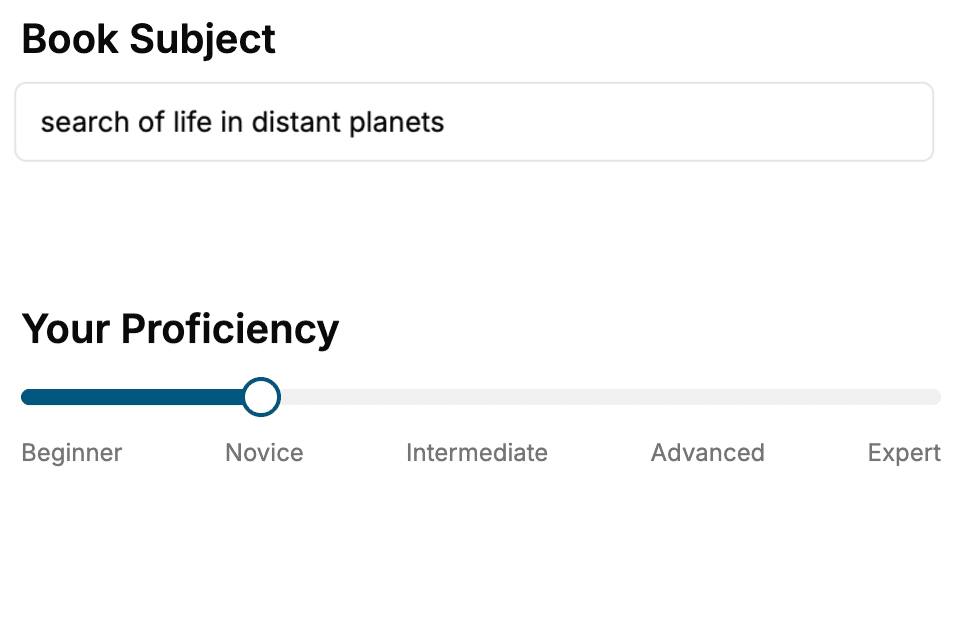
Select the focus of your Sampling book and share your background
- 2. Personalize your book
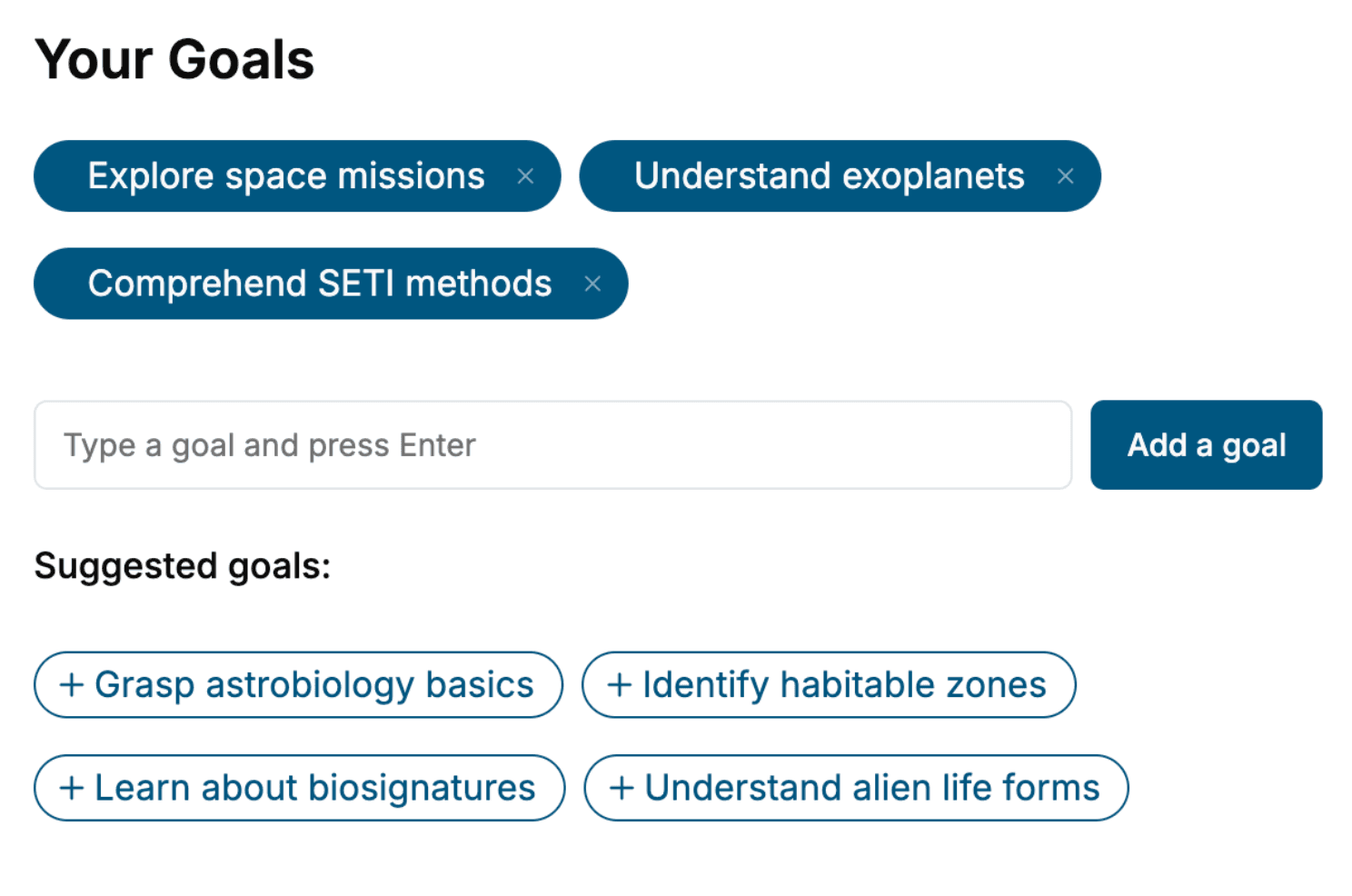
Specify your goals and choose sub-topics to include
- 3. Get your tailored book
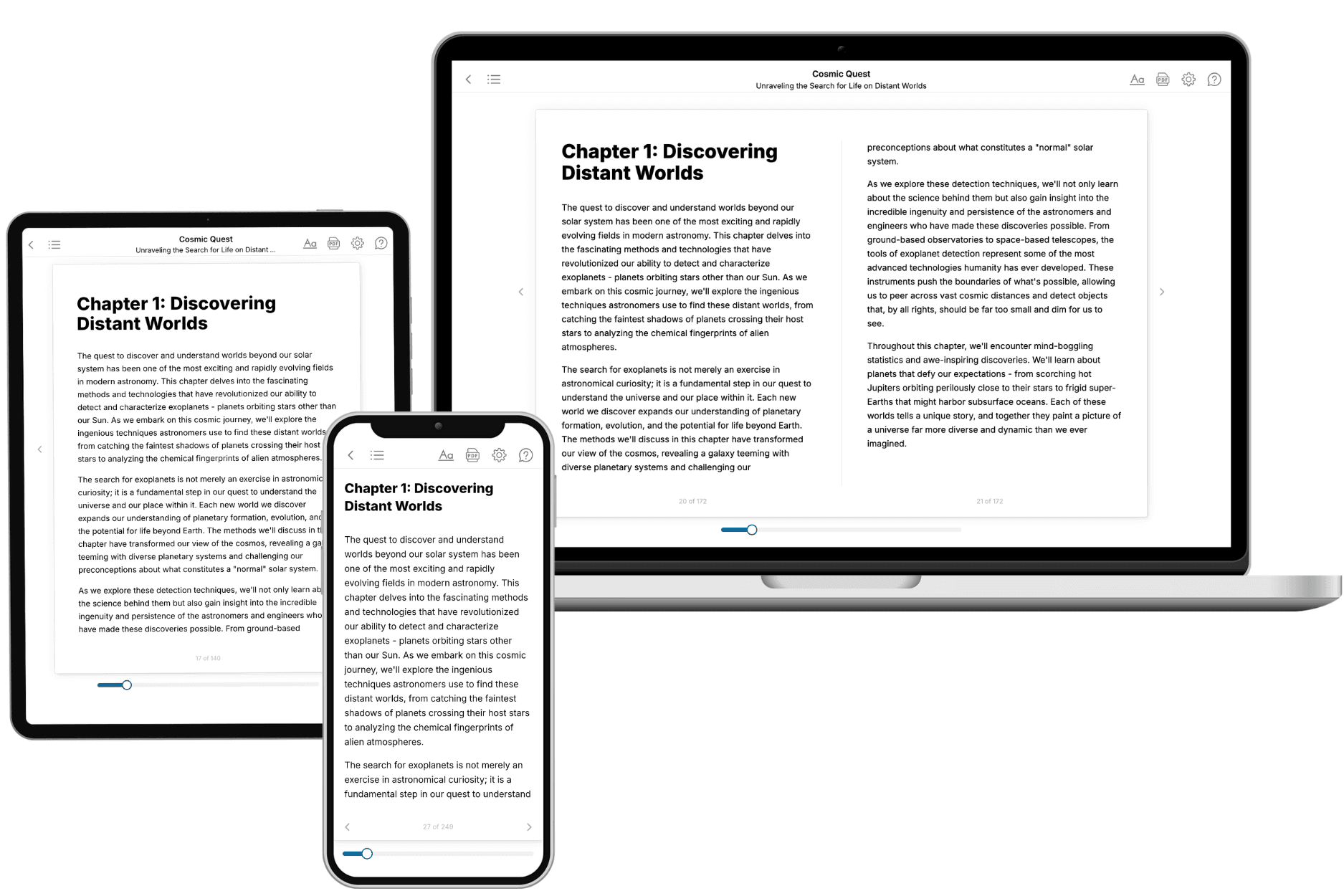
Your book is ready in 10 minutes. Read it online, download as EPUB or PDF, or send to Kindle.
Frequently asked questions
- What is TailoredRead?
TailoredRead creates complete, full-length nonfiction ebooks, written specifically for you. Tell us what you want to learn and why, and TailoredRead writes you a complete ebook on it, with charts, tables, and diagrams throughout. Read it online, on Kindle, or on any e-reader, or download it as a PDF or EPUB. Every book is written fresh the day you order it.
- How is the book tailored to me?
Before anything is written, you answer a few short questions about your goals, your background, and the topics you care about. Your book is then planned around your answers: written at your level, focused on your goals, and covering the topics you chose, instead of the one-size-fits-all book a store sells everyone.
- Will it read like generic AI content?
No. Your book isn't a chat transcript: it's planned chapter by chapter before a single word is written, told in a clear book voice, and explains ideas visually with charts, tables, and diagrams. After writing, every book goes through an editorial pass that polishes chapters so the book reads consistent from start to finish. Judge for yourself: browse thousands of sample books on our Explore Books page.
- How accurate is the content?
Our AI first checks whether your subject needs live research. Niche and fast-moving subjects are researched before writing, and the book plan and chapters are grounded in what it finds. After writing, every book goes through a quality pass that checks its facts and consistency, and researched books list their sources in a Notes section at the back.
- How long is the book?
You choose the length: Comprehensive (250-300 pages), Detailed (150-200 pages), Essential (70-100 pages), or Short (30-50 pages).
- Does the book include visuals?
Yes. Every book includes charts, tables, and diagrams: timelines, checklists, step-by-step guides, decision trees, comparison tables, matrices, and bar charts. A typical book includes dozens of these visual elements.
- Can I read it on Kindle? What formats can I download?
Yes. Every book can be read in our online reader or downloaded as a PDF or EPUB. The EPUB can be opened with Kindle, Apple Books, Kobo, and any e-reader. The Commercial and Author licenses also include an editable Word (DOCX) and Markdown download.
- How much does it cost?
About the price of a regular ebook. The exact price depends on your book's length and complexity, from $2 for the shortest books to $35 for the most comprehensive, and it's shown when you review your book, before you commit to anything. Each book is a one-time purchase, yours to keep, no subscription. Licenses that let you share, teach, or publish your book range from $35.99 to $49.99.
- Can I preview the book before purchasing?
Before you pay, you'll see what your book will cover: the title, a detailed description, the estimated length, and the complete chapter-by-chapter table of contents, so you know what you're getting before you decide. The full text itself is written after you purchase.
- How long does it take to create a book?
About 10 minutes. You can start reading the opening chapters while the rest is still being written.