The Articles of Confederation
America's First Constitution and the Path to a Stronger Union
What if the American Revolution had succeeded militarily but failed politically?
222 pages10 chaptersNov 8, 2025United States History
About this book
The Articles of Confederation nearly made this a reality. This book explores the nation's first governing document—a bold experiment in decentralized power that ultimately proved unworkable. You'll discover how the Founding Fathers' justified fear of tyranny led them to create a government so weak it couldn't pay its debts, regulate trade, or enforce its own laws. Through vivid historical narratives and clear analysis, this book traces the economic collapse, interstate conflicts, and social unrest that forced a reckoning. Learn how the Articles' spectacular failure became the catalyst for the Constitutional Convention and shaped the federal system we know today. Whether you're studying American history, exploring the roots of federalism, or simply curious about how a nation nearly fell apart before it truly began, this book provides essential context for understanding the pivotal moment when America chose a stronger union.
Table of contents
- IntroductionWhy This Moment Matters, What You'll Learn in This Book, How to Use This BookRead below
- Chapter 1: The Birth of a Nation Without a GovernmentIndependence Declared, But What Now?, The Colonists' Fear of Centralized Power, The First Attempt at National Unity
- Chapter 2: Understanding the Articles of ConfederationThe Structure and Key Provisions, State Sovereignty Above All, What Congress Could and Couldn't Do, The Impossible Amendment Process
- Chapter 3: The Economic Crisis UnfoldsThe Crushing National Debt, Currency Chaos and Inflation, The Inability to Collect Taxes, Sliding Toward Financial Collapse
- Chapter 4: Interstate Conflict and Trade WarsThe Failure to Regulate Interstate Commerce, States Imposing Tariffs on Each Other, Economic Competition Turns Destructive, Inability to Compete in Foreign Trade
- Chapter 5: Foreign Relations and Treaty FailuresThe Problem of Enforcing Treaties, British Violations and American Weakness, Loss of Diplomatic Credibility, European Powers' Contempt for American Authority
- Chapter 6: Social Unrest and Shays' RebellionThe Farmers' Debt Crisis, Shays' Rebellion: A Wake-Up Call, A Helpless Government Watches, Fear Spreads Among the Elite
- Chapter 7: The Call for Constitutional ReformA Growing Consensus for Change, The Annapolis Convention of 1786, The Path to Philadelphia
- Chapter 8: The Constitutional Convention and a New FrameworkThe Delegates Gather in Philadelphia, A Radical Departure from the Articles, Creating a Federal System, Separation of Powers and Checks and Balances
- Chapter 9: Key Differences: Articles Versus ConstitutionExecutive Power: From Absent to Central, Legislative Authority: From Weak to Strong, Judicial System: From Nonexistent to Independent, Federal Powers: From Limited to Expansive
- Chapter 10: The Legacy of the Articles in American FederalismOngoing Tensions Between State and Federal Power, How the Articles Shaped Constitutional Debates, The Articles' Influence on Modern Federalism
- ConclusionLessons from a Failed Experiment, Enduring Questions About Power and Union
- Glossary
- Further Reading
Introduction
The United States Constitution stands as one of history's most successful governing documents, having guided the nation for over two centuries. Yet before this remarkable framework came into being, the newly independent American states operated under a very different system—one that nearly destroyed the nation before it could truly begin. The Articles of Confederation, America's first constitution, represented a bold experiment in decentralized governance that ultimately failed so spectacularly it forced the Founding Fathers back to the drawing board. Understanding this failure is essential to appreciating the Constitution that replaced it and the federal system that governs America today.
Between 1781 and 1789, the United States existed in a precarious state. The thirteen former colonies had won their independence from Britain through military victory, but they struggled desperately to create a functioning government. The Articles of Confederation gave them a framework, but it was a framework built on fear—fear of the kind of centralized tyranny they had just fought a revolution to escape. This fear led the Founders to create a national government so weak it could barely function. It couldn't collect taxes, couldn't regulate trade between states, couldn't enforce its own laws, and couldn't even amend itself without unanimous consent from all thirteen states. The result was economic chaos, diplomatic humiliation, and social unrest that threatened to tear the fragile union apart.
This book tells the story of that critical period and explores why the Articles failed so completely. More importantly, it examines how that failure became the catalyst for creating something better. The weaknesses of the Articles weren't abstract theoretical problems—they were concrete crises that affected real people's lives. Farmers lost their land because states couldn't manage currency or debt. Merchants couldn't conduct business across state lines because each state imposed its own tariffs and regulations. Veterans of the Revolutionary War went unpaid because Congress had no power to raise revenue. Foreign nations refused to take American diplomats seriously because they knew the national government couldn't enforce any agreements it made. These weren't minor inconveniences; they were existential threats to the survival of the American experiment in self-governance.
Why This Moment Matters
The period of the Articles of Confederation represents one of the most consequential failures in American history—and paradoxically, one of its greatest successes. The failure was obvious: a governing system that couldn't govern, a union that couldn't unite, a nation that couldn't function as a nation. But the success lay in what came next. The Founders recognized their mistake, acknowledged the system wasn't working, and had the courage to start over. This willingness to learn from failure and adapt accordingly set a precedent that would define American governance for generations to come. The Constitutional Convention of 1787 didn't just fix a few problems with the Articles; it fundamentally reimagined what American government could be.
Understanding the Articles matters because it provides essential context for every debate about federal power, state rights, and the proper balance between them. When modern politicians argue about whether the federal government has overstepped its authority, they're continuing a conversation that began during the Articles period. When states challenge federal mandates or assert their sovereignty, they're invoking principles that were central to the Articles' design. When courts interpret the Constitution's Commerce Clause or Supremacy Clause, they're addressing problems that first became apparent under the Articles. The document may have been replaced in 1789, but its legacy continues to shape American political discourse today.
The Articles period also demonstrates a fundamental truth about governance: that both too much centralized power and too little can be dangerous. The colonists had experienced tyranny under British rule, where a distant government imposed its will without regard for local needs or consent. Their response was to create a system where the central government had almost no power at all. But they quickly discovered that this created different problems—problems that were just as threatening to liberty and prosperity as the tyranny they had escaped. The Constitution that emerged from this experience represented a middle path, an attempt to create a government strong enough to function effectively but constrained enough to protect individual and state rights.
This historical moment also reveals how crises can drive political innovation. The Founders didn't convene the Constitutional Convention because they had abstract philosophical disagreements about governance theory. They convened it because the nation was falling apart. Shays' Rebellion in Massachusetts showed that the government couldn't maintain order. The inability to pay war debts showed it couldn't manage finances. Trade wars between states showed it couldn't regulate commerce. Foreign nations' refusal to respect American treaties showed it couldn't conduct diplomacy. These concrete failures created the political will necessary to attempt something radical: replacing the entire system of government while the nation was still operating under it.
The transition from the Articles to the Constitution also illustrates the importance of institutional design. The Founders learned that good intentions and revolutionary ideals weren't enough—the structure of government itself mattered enormously. They discovered that:
- A legislature without an executive to enforce its decisions was powerless
- A government without the power to raise revenue couldn't function
- A system requiring unanimous consent for amendments couldn't adapt
- A confederation of sovereign states couldn't act as a unified nation
- A government without courts to interpret and apply laws couldn't ensure justice
Finally, this period matters because it demonstrates that the American system of government wasn't inevitable or predetermined. The Constitution wasn't the only possible outcome of the Articles' failure. Some leaders advocated for a return to monarchy. Others wanted to maintain the confederation system with minor modifications. Still others proposed dividing the nation into separate regional confederacies. The federal republic that emerged was the result of specific choices made by specific people in response to specific problems. Understanding those choices and the context in which they were made helps us appreciate both the wisdom and the compromises embedded in the Constitution.
The story of the Articles is ultimately a story about learning and adaptation. The Founders made mistakes, recognized them, and corrected course. They created a system that didn't work, acknowledged its failures, and built something better. This willingness to experiment, fail, learn, and try again became part of the American political tradition. The Constitution itself includes an amendment process precisely because the Founders learned from the Articles that a governing document must be able to evolve. The very existence of the Bill of Rights—added just two years after the Constitution was ratified—demonstrates this commitment to ongoing improvement and adaptation.
What You'll Learn in This Book
This book provides a comprehensive exploration of the Articles of Confederation period, examining both the document itself and the historical context that shaped it. You'll begin by understanding the circumstances that led to the Articles' creation—the colonists' recent experience with British tyranny, their commitment to local self-governance, and their deep suspicion of centralized power. This context is crucial because the Articles' weaknesses weren't accidental oversights; they were deliberate design choices made by people who feared strong central government more than they feared the consequences of weak central government. Understanding why the Founders made these choices helps explain both the Articles' structure and its ultimate failure.
The book then examines the Articles' specific provisions in detail, explaining what powers Congress had, what powers it lacked, and how the system was supposed to work in theory. You'll learn about the document's key features:
- The explicit declaration that each state retained its sovereignty and independence
- The single-chamber Congress where each state had one vote regardless of size
- The requirement for nine of thirteen states to approve major legislation
- The unanimous consent requirement for any amendments to the Articles
- The absence of any executive branch to enforce congressional decisions
- The lack of a national court system to resolve disputes
- Congress's inability to levy taxes or regulate interstate commerce
A substantial portion of the book focuses on the specific crises that emerged under the Articles. You'll explore the economic chaos in detail—how the inability to collect taxes left the national government bankrupt, how competing state currencies created confusion and instability, how war debts went unpaid while creditors lost faith in American credit. These weren't abstract problems; they affected ordinary people's daily lives. Farmers couldn't get fair prices for their goods because currency values fluctuated wildly. Merchants couldn't conduct interstate business because each state imposed different regulations and tariffs. Veterans who had fought for independence found themselves impoverished because the government couldn't pay them what it owed.
The book examines the destructive trade wars that erupted between states, with each trying to protect its own economic interests at the expense of its neighbors. You'll see how New York imposed tariffs on goods from New Jersey and Connecticut, how states competed to attract foreign trade by offering better terms than their neighbors, and how this competition prevented the nation from negotiating effectively with European powers. These interstate conflicts demonstrated that thirteen separate sovereignties couldn't function as a unified nation in economic matters, no matter how much they might share common revolutionary ideals.
Foreign relations failures receive detailed attention, showing how European powers viewed the United States with contempt because they knew the national government couldn't enforce any agreements it made. Britain refused to evacuate military posts on American territory as required by the peace treaty, knowing Congress couldn't compel compliance. Spain closed the Mississippi River to American navigation, understanding that the weak confederation couldn't respond effectively. American diplomats found themselves unable to negotiate meaningful treaties because foreign governments questioned whether the states would honor any commitments Congress made. This diplomatic impotence threatened both American security and economic interests.
The book provides an in-depth examination of Shays' Rebellion, the armed uprising in Massachusetts that became the final catalyst for constitutional reform. You'll understand the economic conditions that drove farmers to rebellion, the state government's harsh response, and the national government's complete inability to help restore order. This crisis crystallized the dangers of weak central authority and convinced many skeptics that fundamental reform was necessary. The rebellion's impact on elite opinion and its role in creating momentum for the Constitutional Convention receives careful analysis.
You'll follow the path from crisis to reform, examining the Annapolis Convention of 1786 and how it led to the Constitutional Convention in Philadelphia the following year. The book explores the debates at the Convention, the key compromises that shaped the Constitution, and the fundamental ways the new framework differed from the Articles. You'll see how specific failures under the Articles led to specific provisions in the Constitution—how the inability to collect taxes led to Congress's taxing power, how interstate trade wars led to the Commerce Clause, how diplomatic failures led to the treaty power, and how the lack of enforcement mechanisms led to the creation of the executive branch.
The final sections examine the Articles' lasting legacy in American political thought and practice. You'll explore how debates about federalism, state sovereignty, and the proper balance of power between national and state governments continue to echo arguments from the Articles period. The book shows how understanding this first constitutional experiment provides crucial context for interpreting the Constitution that replaced it and for understanding ongoing debates about federal power. You'll gain insights into how the Founders' experience with the Articles' failures shaped their approach to constitutional design and how those lessons continue to influence American governance today.
How to Use This Book
This book is designed to be read sequentially, as each chapter builds on the previous ones to create a comprehensive narrative of the Articles period. The chronological structure helps you understand how problems emerged, intensified, and ultimately forced constitutional reform. However, the book is also organized so that individual chapters can stand alone if you're interested in specific aspects of the Articles' history. If you're particularly interested in economic issues, you can focus on the chapters dealing with financial crisis and interstate commerce. If foreign relations are your primary interest, you can concentrate on the chapters examining diplomatic failures and treaty enforcement problems.
Throughout the book, you'll find specific examples and case studies that illustrate abstract concepts with concrete details. When discussing currency chaos, for instance, the book doesn't just explain that different states issued different currencies—it shows you specific examples of how this affected merchants trying to conduct business across state lines. When examining interstate trade conflicts, it provides detailed accounts of specific disputes between particular states. These examples help make the historical period come alive and demonstrate how constitutional structures affect real people's lives. Pay attention to these examples, as they often reveal insights that general descriptions might miss.
The book uses several features to enhance your understanding and make information easy to find:
- Key terms are highlighted when first introduced, helping you build a vocabulary for discussing constitutional history
- Blockquotes present important primary source material, letting the historical figures speak in their own words
- Lists and structured breakdowns organize complex information into digestible components
- Footnotes provide sources for specific claims and point you toward additional resources for deeper exploration
- Cross-references connect related concepts across different chapters, helping you see the bigger picture
As you read, consider keeping notes on the connections between the Articles' failures and the Constitution's provisions. The book frequently points out these connections, but you'll gain deeper understanding by actively thinking about how specific problems led to specific solutions. For example, when reading about Congress's inability to collect taxes under the Articles, think about how this relates to the Constitution's grant of taxing power to Congress. When learning about interstate trade wars, consider how the Commerce Clause addresses these problems. This active engagement with the material will help you understand not just what happened, but why it matters.
The book assumes you have basic familiarity with the American Revolution and the general outline of early American history, but it doesn't require specialized knowledge. Technical terms and historical concepts are explained when introduced, and the glossary at the end provides quick reference for key terms. If you encounter unfamiliar concepts, the glossary and the "Further Reading" section can help you explore topics in greater depth. The book aims to be accessible to anyone interested in American history while still providing enough detail and analysis to be valuable for serious students of the period.
Pay particular attention to the comparative analysis in later chapters, where the book explicitly contrasts the Articles with the Constitution. These comparisons help clarify both documents by showing them in relation to each other. Understanding what the Constitution changed—and what it kept—from the Articles provides insights into the Founders' priorities and concerns. The side-by-side examination of how each document handled specific issues like executive power, legislative authority, and federal-state relations reveals the thinking behind constitutional design choices.
Consider the book's themes as you read: the tension between liberty and order, the challenge of balancing state and national power, the importance of institutional design, and the role of crisis in driving political change. These themes recur throughout the narrative and connect the historical specifics to broader questions about governance that remain relevant today. The Articles period offers lessons not just about American history, but about the challenges any federal system faces in balancing unity with diversity, national power with local autonomy, and effective governance with protection of rights.
Finally, use this book as a foundation for understanding current debates about federalism and constitutional interpretation. The arguments about federal power versus state sovereignty that you'll encounter in these pages continue in different forms today. When you hear debates about federal mandates, state rights, or the proper scope of congressional authority, you're hearing echoes of arguments that first emerged during the Articles period. Understanding this historical foundation will help you engage more thoughtfully with contemporary constitutional questions and appreciate the ongoing relevance of America's first constitutional experiment—even though that experiment ultimately failed.
This is the end of the free sample. The full book has 10 chapters.
Want this book written for you?
Tell us your goals and background, and get your own version of this book, tailored by AI to you.


Benefits of AI-tailored books
- Read one book, not ten:
- all the United States History knowledge you need, gathered into a single book.
- Save days of learning:
- tell us your goals, choose your topics, and the whole book is built around them.
- Learn effortlessly:
- United States History book written for your specific background and expertise.
- Understand at a glance:
- includes charts, tables, timelines, checklists, decision trees, and more.
- Stay current:
- written the day you order it, not years ago.
- Trust what you read:
- every book is checked for accuracy, with real research when your subject needs it.
Create your unique book in 3 steps
- 1. Select your focus
Select the focus of your United States History book and share your background
- 2. Personalize your book
Specify your goals and choose sub-topics to include
- 3. Get your tailored book
Your book is ready in 10 minutes. Read it online, download as EPUB or PDF, or send to Kindle.

Frequently asked questions
- What is TailoredRead?
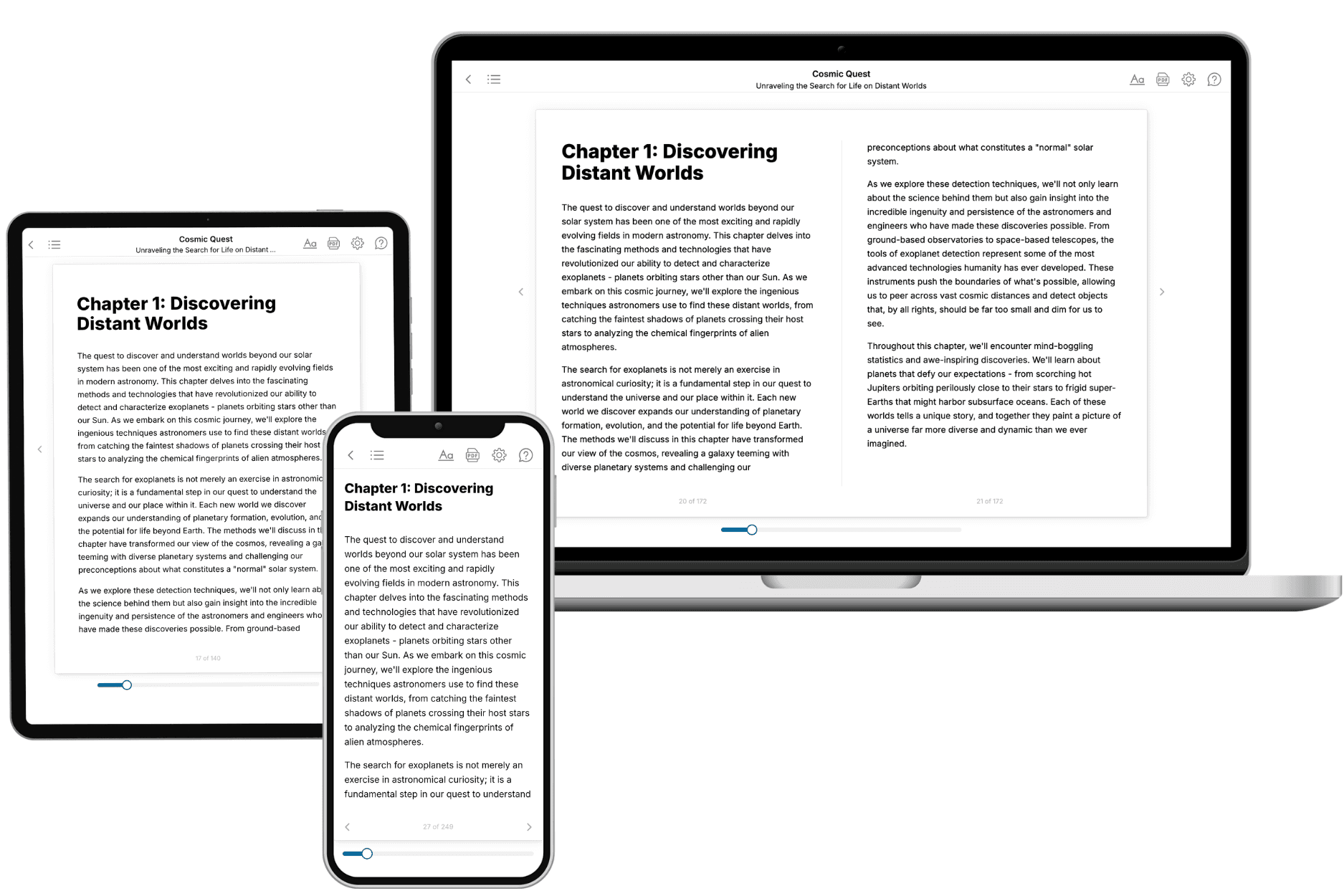
TailoredRead creates complete, full-length nonfiction ebooks, written specifically for you. Tell us what you want to learn and why, and TailoredRead writes you a complete ebook on it, with charts, tables, and diagrams throughout. Read it online, on Kindle, or on any e-reader, or download it as a PDF or EPUB. Every book is written fresh the day you order it.
- How is the book tailored to me?
Before anything is written, you answer a few short questions about your goals, your background, and the topics you care about. Your book is then planned around your answers: written at your level, focused on your goals, and covering the topics you chose, instead of the one-size-fits-all book a store sells everyone.
- Will it read like generic AI content?
No. Your book isn't a chat transcript: it's planned chapter by chapter before a single word is written, told in a clear book voice, and explains ideas visually with charts, tables, and diagrams. After writing, every book goes through an editorial pass that polishes chapters so the book reads consistent from start to finish. Judge for yourself: browse thousands of sample books on our Explore Books page.
- How accurate is the content?
Our AI first checks whether your subject needs live research. Niche and fast-moving subjects are researched before writing, and the book plan and chapters are grounded in what it finds. After writing, every book goes through a quality pass that checks its facts and consistency, and researched books list their sources in a Notes section at the back.
- How long is the book?
You choose the length: Comprehensive (250-300 pages), Detailed (150-200 pages), Essential (70-100 pages), or Short (30-50 pages).
- Does the book include visuals?
Yes. Every book includes visual elements such as timelines, checklists, step-by-step guides, decision trees, comparison tables, and matrices, and many include bar charts. A typical book includes dozens of these visual elements.
- Can I read it on Kindle? What formats can I download?
Yes. Every book can be read in our online reader or downloaded as a PDF or EPUB. The EPUB can be opened with Kindle, Apple Books, Kobo, and any e-reader. The Commercial and Author licenses also include an editable Word (DOCX) and Markdown download.
- How much does it cost?
About the price of a regular ebook. The exact price depends on your book's length and complexity, from $2 for the shortest books to $35 for the most comprehensive, and it's shown when you review your book, before you commit to anything. Each book is a one-time purchase, yours to keep, no subscription. Licenses that let you share, teach, or publish your book range from $35.99 to $49.99.
- Can I preview the book before purchasing?
Before you pay, you'll see what your book will cover: the title, a detailed description, the estimated length, and the complete chapter-by-chapter table of contents, so you know what you're getting before you decide. The full text itself is written after you purchase.
- How long does it take to create a book?
About 10 minutes. You can start reading the opening chapters while the rest is still being written.