Attention Unveiled
Mastering the Core of Modern AI and Machine Learning
In the rapidly evolving world of artificial intelligence, understanding complex concepts can feel like navigating a labyrinth blindfolded.
269 pages13 chaptersJan 7, 2025AI and Machine Learning
About this book
Attention mechanisms, a crucial component of modern AI systems, often leave even experienced professionals puzzled. But what if you could unravel this complexity and harness its power? "Attention Unveiled" is your compass in the intricate landscape of AI and machine learning. This book demystifies attention mechanisms, breaking down their role in perplexity and AI models. You'll journey from the fundamentals to advanced applications, gaining insights that will transform your approach to AI development and research. By the time you finish this book, you'll have a robust understanding of attention mechanisms and their practical implications. You'll be equipped to implement these concepts in your projects, optimize AI models, and push the boundaries of what's possible in machine learning. Whether you're looking to enhance your professional skills or drive innovation in your field, "Attention Unveiled" is your key to unlocking the full potential of modern AI techniques.
Table of contents
- IntroductionThe Importance of Attention in AI, Book Overview and Learning Objectives, The Current AI Landscape, How Attention Mechanisms Are Revolutionizing AIRead below
- Chapter 1: Foundations of Attention in AIUnderstanding Human Attention, The Analogy Between Human and AI Attention, Historical Development of Attention in AI, Why Attention Matters in Modern AI
- Chapter 2: Neural Networks and AttentionBasic Neural Network Architectures, Limitations of Traditional Neural Networks, Introducing Attention to Neural Networks, Benefits of Attention in Neural Networks
- Chapter 3: Types of Attention MechanismsSoft Attention, Hard Attention, Self-Attention, Multi-Head Attention, Global vs. Local Attention
- Chapter 4: Mathematical Foundations of AttentionVector Representations in AI, Calculating Attention Weights, The Softmax Function in Attention, Key Formulas in Attention Mechanisms
- Chapter 5: Transformers and AttentionThe Transformer Architecture, Self-Attention in Transformers, Positional Encoding, Applications of Transformer Models
- Chapter 6: Understanding Perplexity in AIDefining Perplexity, Why Perplexity Matters in Language Models, Calculating Perplexity, Interpreting Perplexity Scores
- Chapter 7: Attention Mechanisms and PerplexityThe Relationship Between Attention and Perplexity, How Attention Mechanisms Reduce Perplexity, Measuring the Impact of Attention on Perplexity, Case Studies: Attention and Perplexity in Real Models
- Chapter 8: Attention in Natural Language ProcessingMachine Translation, Text Summarization, Question Answering Systems, Sentiment Analysis
- Chapter 9: Attention in Computer VisionImage Captioning, Object Detection and Recognition, Visual Question Answering, Image Generation with Attention
- Chapter 10: Multimodal AttentionAttention Between Text and Images, Audio-Visual Attention Mechanisms, Cross-Modal Learning with Attention, Applications of Multimodal Attention
- Chapter 11: Optimizing Attention MechanismsImproving Computational Efficiency, Attention Pruning Techniques, Sparse Attention Models, Hardware Acceleration for Attention
- Chapter 12: Challenges and Limitations of AttentionScalability Issues in Attention Models, Interpretability of Attention Weights, Biases in Attention Mechanisms, Strategies for Overcoming Limitations
- Chapter 13: Future Directions in Attention ResearchBridging Attention in AI and Neuroscience, Quantum Computing and Attention, Attention Mechanisms in Robotics, Ethical Considerations in Advanced Attention Systems
- Conclusion
- Glossary
- Further Reading
Introduction
In the ever-evolving landscape of artificial intelligence and machine learning, attention mechanisms have emerged as a transformative force, reshaping the way we approach complex problems in natural language processing, computer vision, and beyond. As you embark on this journey through "Attention Unveiled: Mastering the Core of Modern AI and Machine Learning," you are about to delve into the heart of what makes modern AI systems so powerful and versatile. This introduction will set the stage for your exploration, providing a comprehensive overview of the importance of attention in AI, the structure and objectives of this book, the current AI landscape, and how attention mechanisms are revolutionizing the field.
The concept of attention in AI draws inspiration from human cognitive processes, mimicking our ability to focus on relevant information while filtering out the noise. Just as you might concentrate on a specific conversation in a crowded room, AI systems equipped with attention mechanisms can prioritize certain parts of their input data, leading to more accurate and contextually appropriate outputs. This fundamental shift in approach has led to breakthroughs in various domains, from machine translation and text summarization to image captioning and even multimodal tasks that combine different types of data.
As you progress through this book, you will gain a deep understanding of how attention mechanisms work, their mathematical foundations, and their practical applications. You will explore the intricate relationship between attention and perplexity in language models, and discover how these mechanisms are implemented in state-of-the-art architectures like Transformers. By the end of this journey, you will be equipped with the knowledge and insights needed to leverage attention mechanisms in your own projects, pushing the boundaries of what's possible in AI and machine learning.
Whether you're a seasoned professional looking to stay at the forefront of AI advancements or a researcher aiming to contribute to the field's rapid progress, this book will serve as your comprehensive guide to mastering attention mechanisms. The concepts and techniques you'll learn here will not only enhance your understanding of current AI systems but also prepare you for the future developments that will undoubtedly build upon these foundational ideas.
As we begin this exploration, it's important to approach the subject with both excitement and critical thinking. While attention mechanisms have undoubtedly revolutionized AI, they also come with their own set of challenges and limitations. Throughout this book, we'll examine these aspects objectively, providing you with a balanced view that acknowledges both the potential and the pitfalls of these powerful techniques.
The Importance of Attention in AI
Attention mechanisms have become a cornerstone of modern artificial intelligence, fundamentally changing the way AI systems process and interpret information. Their importance cannot be overstated, as they have led to significant improvements in performance across a wide range of tasks and applications. At its core, the concept of attention in AI is inspired by human cognitive processes, particularly our ability to focus on relevant information while ignoring irrelevant details. This biomimetic approach has proven to be incredibly effective in enhancing the capabilities of machine learning models.
One of the primary reasons attention mechanisms are so crucial is their ability to handle long-range dependencies in sequential data. Traditional neural network architectures, such as recurrent neural networks (RNNs), often struggle with capturing relationships between distant elements in a sequence. This limitation is particularly problematic in tasks like machine translation or text summarization, where understanding the context over long passages is essential. Attention mechanisms address this issue by allowing the model to dynamically focus on different parts of the input sequence when generating each element of the output. This dynamic focus enables the model to maintain relevant context over long distances, leading to more coherent and contextually appropriate outputs[1].
Another key aspect of attention's importance lies in its ability to provide interpretability to AI models. In many traditional neural network architectures, understanding how the model arrives at its decisions can be challenging, often referred to as the "black box" problem. Attention mechanisms, however, offer a window into the decision-making process of the model. By examining the attention weights, researchers and practitioners can gain insights into which parts of the input the model considers most relevant for a given output. This interpretability is not only valuable for debugging and improving models but also for building trust in AI systems, especially in critical applications such as healthcare or finance where understanding the reasoning behind a model's decisions is crucial[2].
The versatility of attention mechanisms further underscores their importance in AI. While they initially gained prominence in natural language processing tasks, their applicability has expanded to numerous other domains. In computer vision, attention mechanisms have been used to improve object detection, image captioning, and even image generation. They have also shown promise in multimodal tasks that combine different types of data, such as visual question answering. This wide-ranging applicability demonstrates the fundamental nature of attention as a general-purpose tool for enhancing AI systems across diverse problem domains.
Attention mechanisms have also played a crucial role in the development of more efficient and scalable AI models. By allowing models to focus on the most relevant parts of the input, attention can lead to more computationally efficient processing, especially when dealing with large amounts of data. This efficiency is particularly evident in transformer architectures, which rely heavily on self-attention mechanisms and have become the foundation for many state-of-the-art language models. The ability to process information more efficiently not only improves performance but also enables the development of larger, more powerful models that can tackle increasingly complex tasks[3].
The importance of attention in AI extends beyond its technical capabilities to its impact on the field as a whole. The introduction and refinement of attention mechanisms have spurred new research directions and inspired novel approaches to longstanding problems in AI. They have encouraged researchers to rethink fundamental assumptions about how neural networks should be structured and how information should be processed. This paradigm shift has led to a cascade of innovations, with each new development building upon the foundational concept of attention to push the boundaries of what's possible in AI.
Moreover, attention mechanisms have contributed significantly to the democratization of AI. By enabling more efficient and effective models, they have made it possible for a wider range of researchers and practitioners to work on complex AI problems. Pre-trained models that leverage attention, such as BERT and GPT, have become widely available, allowing even those with limited resources to build upon state-of-the-art AI capabilities. This accessibility has accelerated the pace of innovation and application of AI across various industries and domains.
As we delve deeper into the specifics of attention mechanisms throughout this book, it's important to keep in mind their broader significance. Attention is not just a technical innovation; it represents a fundamental shift in how we approach artificial intelligence. It embodies the idea that AI systems can benefit from focusing on what's important, much like humans do. This concept has far-reaching implications for the future of AI, potentially bringing us closer to creating more human-like artificial intelligence that can understand and interact with the world in more nuanced and contextually appropriate ways.
In conclusion, the importance of attention in AI cannot be overstated. It has revolutionized the field by enabling more powerful, interpretable, and efficient models. Attention mechanisms have expanded the range of problems that AI can effectively tackle and have inspired new directions in AI research and development. As you progress through this book, you'll gain a deeper appreciation for how attention mechanisms work and why they are so crucial to modern AI systems. This understanding will not only enhance your ability to work with current AI technologies but also prepare you to contribute to the ongoing evolution of artificial intelligence.
Book Overview and Learning Objectives
"Attention Unveiled: Mastering the Core of Modern AI and Machine Learning" is designed to provide you with a comprehensive understanding of attention mechanisms in the context of artificial intelligence and machine learning. This book is structured to take you on a journey from the fundamental concepts of attention to its advanced applications and future directions. Each chapter builds upon the previous ones, gradually increasing in complexity and depth, ensuring that you develop a solid foundation before tackling more advanced topics.
The primary objective of this book is to equip you with the knowledge and skills necessary to understand, implement, and optimize attention mechanisms in various AI applications. By the end of this book, you should be able to:
- Understand the theoretical foundations of attention mechanisms and their relationship to human cognitive processes
- Grasp the mathematical principles underlying different types of attention mechanisms
- Recognize the role of attention in improving the performance and efficiency of neural networks
- Comprehend the concept of perplexity in language models and its relationship to attention mechanisms
- Analyze and implement various types of attention mechanisms, including soft attention, hard attention, self-attention, and multi-head attention
- Understand the architecture of transformer models and how they leverage attention mechanisms
- Apply attention mechanisms to solve problems in natural language processing, computer vision, and multimodal tasks
- Optimize attention-based models for improved performance and computational efficiency
- Critically evaluate the challenges and limitations of current attention mechanisms
- Explore potential future directions in attention research and their implications for AI development
The book is divided into several key sections, each focusing on a crucial aspect of attention mechanisms:
- Foundations of Attention in AI: This section introduces the concept of attention, drawing parallels between human cognitive processes and AI systems. It provides a historical context for the development of attention mechanisms in AI and explains why attention has become so important in modern machine learning.
- Neural Networks and Attention: Here, you'll learn about the basics of neural network architectures and how attention mechanisms are integrated into them. This section highlights the limitations of traditional neural networks and demonstrates how attention addresses these shortcomings.
- Types of Attention Mechanisms: This comprehensive section covers various forms of attention, including soft attention, hard attention, self-attention, and multi-head attention. You'll learn the unique characteristics and applications of each type.
- Mathematical Foundations: To provide a deeper understanding, this section delves into the mathematical principles underlying attention mechanisms. You'll explore vector representations, attention weight calculations, and key formulas essential for implementing attention in AI models.
- Transformers and Attention: This section focuses on the revolutionary transformer architecture, which heavily relies on self-attention mechanisms. You'll learn about positional encoding and the wide-ranging applications of transformer models.
- Perplexity and Attention: Here, you'll explore the concept of perplexity in language models and how attention mechanisms help reduce perplexity, leading to more coherent and contextually appropriate outputs.
- Applications of Attention: Several chapters are dedicated to the practical applications of attention mechanisms in various domains, including natural language processing, computer vision, and multimodal tasks.
- Optimization and Challenges: This section covers techniques for optimizing attention-based models and addresses the current limitations and challenges faced when working with attention mechanisms.
- Future Directions: The book concludes by exploring potential future developments in attention research, including connections to neuroscience, quantum computing, and ethical considerations in advanced AI systems.
Throughout the book, you'll find practical examples, case studies, and code snippets to illustrate key concepts. These hands-on elements are designed to bridge the gap between theory and practice, enabling you to apply what you've learned to real-world scenarios. Each chapter also includes thought-provoking questions and exercises to reinforce your understanding and encourage critical thinking about the material.
To make the most of this book, it's recommended that you have a basic understanding of machine learning concepts and some familiarity with neural networks. However, effort has been made to explain complex concepts in an accessible manner, making the content approachable for readers with varying levels of expertise. As you progress through the chapters, you'll find that the material becomes increasingly sophisticated, challenging you to expand your knowledge and skills.
By the end of this book, you should feel confident in your ability to work with attention mechanisms in various AI applications. You'll have gained not only technical knowledge but also a deeper appreciation for the role of attention in advancing the field of artificial intelligence. This understanding will position you to contribute meaningfully to the ongoing development of AI technologies and to apply these powerful techniques in your own projects and research.
Remember, the field of AI is rapidly evolving, and attention mechanisms continue to be an area of active research. While this book provides a comprehensive overview of the current state of the art, it also aims to inspire you to think critically about the future of attention in AI. As you read, consider how the concepts you're learning might be extended or applied in novel ways. Your insights and innovations could be the next step in the ongoing revolution of artificial intelligence.
The Current AI Landscape
The artificial intelligence landscape is experiencing a period of unprecedented growth and transformation, with attention mechanisms playing a pivotal role in shaping its evolution. To fully appreciate the impact of attention in AI, it's crucial to understand the current state of the field and the key trends driving its development. This overview will provide you with a comprehensive picture of where AI stands today and how attention mechanisms fit into this rapidly changing ecosystem.
One of the most significant trends in the current AI landscape is the dominance of deep learning models, particularly those based on transformer architectures. These models, which heavily rely on attention mechanisms, have set new benchmarks in a wide range of tasks, from natural language processing to computer vision. The success of models like GPT (Generative Pre-trained Transformer) and BERT (Bidirectional Encoder Representations from Transformers) has led to a paradigm shift in how we approach AI problems. These models demonstrate remarkable capabilities in understanding context, generating human-like text, and performing complex reasoning tasks[4].
The scale of AI models has also seen a dramatic increase, with companies and research institutions pushing the boundaries of what's possible with larger and more complex architectures. Models with hundreds of billions of parameters are now a reality, enabling more sophisticated reasoning and generation capabilities. This trend towards larger models is closely tied to advancements in attention mechanisms, which allow for more efficient processing of vast amounts of data and better capture of long-range dependencies in sequences.
Another key aspect of the current AI landscape is the growing emphasis on multimodal learning. AI systems are increasingly being designed to process and understand multiple types of data simultaneously, such as text, images, and audio. Attention mechanisms play a crucial role in this domain, enabling models to effectively combine information from different modalities. This has led to breakthroughs in tasks like visual question answering, image captioning, and even creative applications like text-to-image generation[5].
The field of AI ethics and responsible AI development has also gained significant traction in recent years. As AI systems become more powerful and influential, there's an increasing focus on ensuring that they are developed and deployed in ways that are fair, transparent, and beneficial to society. Attention mechanisms, with their ability to provide some level of interpretability to model decisions, play an important role in this context. However, they also raise new ethical questions, particularly when it comes to the potential biases that might be encoded in the attention patterns learned by these models.
In the realm of natural language processing, we're seeing a shift towards more nuanced understanding of language and context. Models equipped with attention mechanisms are demonstrating impressive capabilities in tasks that require deep comprehension, such as question answering, summarization, and even creative writing. The ability of these models to generate coherent and contextually appropriate text over long sequences is pushing the boundaries of what's possible in human-AI interaction.
Computer vision is another area where attention mechanisms are making significant impacts. From improving object detection and recognition to enabling more sophisticated image generation and editing tasks, attention is helping AI systems to process visual information in more human-like ways. This is leading to advancements in fields such as autonomous vehicles, medical imaging, and augmented reality.
The current AI landscape is also characterized by a strong trend towards transfer learning and few-shot learning. Pre-trained models, often based on transformer architectures with attention mechanisms, are being used as starting points for a wide range of tasks. This approach allows for more efficient use of data and computational resources, making advanced AI capabilities accessible to a broader range of applications and users.
Edge AI and federated learning are emerging as important areas of focus, driven by the need for privacy-preserving AI and the desire to bring AI capabilities closer to the end-user. Attention mechanisms are being adapted to work efficiently on edge devices with limited computational resources, opening up new possibilities for on-device AI applications.
The intersection of AI and other cutting-edge technologies is also shaping the current landscape. Quantum computing, for instance, is being explored for its potential to dramatically accelerate certain AI computations, including those involved in attention mechanisms. Similarly, neuromorphic computing, which aims to mimic the structure and function of biological neural networks, is influencing how we think about attention in AI systems.
As the AI landscape continues to evolve, we're seeing an increasing focus on developing more efficient and sustainable AI models. This includes research into sparse attention mechanisms and other techniques to reduce the computational and energy costs associated with large-scale AI systems. These efforts are crucial for making advanced AI technologies more accessible and environmentally sustainable.
In conclusion, the current AI landscape is characterized by rapid advancements, with attention mechanisms at the forefront of many breakthrough technologies. From transforming natural language processing and computer vision to enabling more sophisticated multimodal and transfer learning approaches, attention is playing a pivotal role in shaping the future of AI. As you delve deeper into the specifics of attention mechanisms throughout this book, keep in mind this broader context and the transformative impact these techniques are having on the field of artificial intelligence as a whole.
How Attention Mechanisms Are Revolutionizing AI
Attention mechanisms have sparked a revolution in artificial intelligence, fundamentally changing the way AI systems process information and tackle complex problems. This transformation is not just a minor improvement but a paradigm shift that has led to breakthroughs across various domains of AI. To fully appreciate the revolutionary impact of attention mechanisms, it's essential to understand how they have addressed longstanding challenges in AI and opened up new possibilities for more sophisticated and capable systems.
One of the most significant ways attention mechanisms are revolutionizing AI is by enabling models to handle long-range dependencies in sequential data more effectively. Traditional recurrent neural networks (RNNs) and even long short-term memory (LSTM) networks often struggle to maintain context over long sequences, leading to issues like vanishing gradients. Attention mechanisms solve this problem by allowing the model to directly access and weigh the relevance of all parts of the input sequence when generating each element of the output. This capability has led to dramatic improvements in tasks such as machine translation, where maintaining context across long sentences is crucial for accurate translations[6].
The introduction of self-attention, particularly in the context of transformer architectures, has been a game-changer for natural language processing (NLP). Models like BERT and GPT, which rely heavily on self-attention mechanisms, have set new state-of-the-art benchmarks across a wide range of NLP tasks. These models demonstrate an unprecedented ability to understand context, generate coherent text, and perform complex reasoning tasks. The success of these attention-based models has led to a shift away from recurrent architectures in many NLP applications, marking a significant change in how we approach language processing tasks[7].
Attention mechanisms are also revolutionizing the field of computer vision. While convolutional neural networks (CNNs) have been the dominant architecture in this domain for years, attention-based models are increasingly being used to enhance or even replace traditional CNN architectures. In tasks such as image classification, object detection, and image captioning, attention allows models to focus on the most relevant parts of an image, leading to improved accuracy and more interpretable results. The ability to combine attention mechanisms with CNNs has led to hybrid architectures that leverage the strengths of both approaches, pushing the boundaries of what's possible in computer vision tasks.
The revolution brought about by attention mechanisms extends to multimodal learning, where AI systems need to process and understand multiple types of data simultaneously. Attention provides a powerful framework for aligning and integrating information from different modalities, such as text and images. This has led to significant advancements in tasks like visual question answering, where models need to understand both textual questions and visual content to provide accurate answers. The success of attention in multimodal tasks is paving the way for more sophisticated AI systems that can interact with the world in more human-like ways, understanding and generating content across multiple sensory domains.
Another revolutionary aspect of attention mechanisms is their contribution to model interpretability. The attention weights learned by these models provide insights into which parts of the input the model considers most relevant for a given output. This level of interpretability is crucial for building trust in AI systems, especially in critical applications where understanding the reasoning behind a model's decisions is essential. The ability to visualize attention patterns has not only aided in debugging and improving models but has also opened up new avenues for research into how AI systems process and understand information.
Attention mechanisms have also played a key role in advancing the field of transfer learning. Pre-trained models that leverage attention, such as BERT and GPT, can be fine-tuned for a wide range of downstream tasks with relatively little task-specific data. This approach has democratized access to state-of-the-art AI capabilities, allowing researchers and practitioners with limited resources to build upon powerful pre-trained models. The success of this approach has led to a proliferation of attention-based pre-trained models for various domains and languages, significantly accelerating the pace of AI development and application.
The efficiency gains provided by attention mechanisms are another revolutionary aspect. While attention-based models can be computationally intensive, they often lead to more efficient processing of information compared to traditional architectures. This is particularly evident in the ability of transformer models to parallelize computations, allowing for more efficient training on modern hardware. Additionally, research into sparse attention mechanisms and other optimization techniques is further improving the efficiency of these models, making it possible to apply attention-based approaches to an even wider range of problems and applications.
Attention mechanisms are also driving innovations in reinforcement learning. By allowing agents to focus on the most relevant parts of their environment or state space, attention can lead to more efficient learning and better performance in complex tasks. This has implications for fields such as robotics and game playing, where attention-enhanced agents can make more informed decisions based on the most relevant information.
The impact of attention mechanisms extends beyond specific applications to influence how we think about AI architectures more broadly. The success of attention-based models has sparked a reevaluation of fundamental assumptions about how neural networks should be structured and how information should be processed. This shift in thinking is leading to new research directions and inspiring novel approaches to longstanding problems in AI.
As attention mechanisms continue to evolve, they are opening up new possibilities for more advanced AI systems. Research into dynamic and adaptive attention mechanisms, which can adjust their focus based on the task at hand, promises to create even more flexible and powerful AI models. Similarly, explorations into the connections between attention in AI and attention in biological systems may lead to new insights and more brain-like artificial intelligence.
In conclusion, attention mechanisms are revolutionizing AI by enabling more powerful, interpretable, and efficient models across a wide range of applications. From transforming how we process sequential data to enabling more sophisticated multimodal and transfer learning approaches, attention is at the forefront of many of the most exciting developments in AI. As you delve deeper into the specifics of attention mechanisms throughout this book, keep in mind the broader revolutionary impact these techniques are having on the field of artificial intelligence as a whole. The concepts and techniques you'll learn are not just incremental improvements, but part of a fundamental shift in how we approach the development of intelligent systems.
Notes
Introduction
- 1. D. Bahdanau and others, Neural Machine Translation by Jointly Learning to Align and Translate. arXiv preprint arXiv:1409.0473, 2014
- 2. K. Xu and others, "Show, Attend and Tell," International Conference on Machine Learning (), 2015
- 3. A. Vaswani and others, "Attention is All You Need," Advances in Neural Information Processing Systems (), 2017
- 4. T. B. Brown and others, Language Models are Few-Shot Learners. arXiv preprint arXiv:2005.14165, 2020
- 5. A. Ramesh and others, Zero-Shot Text-to-Image Generation. arXiv preprint arXiv:2102.12092, 2021
- 6. D. Bahdanau and others, Neural Machine Translation by Jointly Learning to Align and Translate. arXiv preprint arXiv:1409.0473, 2014
- 7. J. Devlin and others, BERT: Pre-training of Deep Bidirectional Transformers for Language Understanding. arXiv preprint arXiv:1810.04805, 2018
This is the end of the free sample. The full book has 13 chapters.
Want this book written for you?
Tell us your goals and background, and get your own version of this book, tailored by AI to you.


Benefits of AI-tailored books
- Read one book, not ten:
- all the AI and Machine Learning knowledge you need, gathered into a single book.
- Save days of learning:
- tell us your goals, choose your topics, and the whole book is built around them.
- Learn effortlessly:
- AI and Machine Learning book written for your specific background and expertise.
- Understand at a glance:
- includes charts, tables, timelines, checklists, decision trees, and more.
- Stay current:
- written the day you order it, not years ago.
- Trust what you read:
- every book is checked for accuracy, with real research when your subject needs it.
Create your unique book in 3 steps
- 1. Select your focus
Select the focus of your AI and Machine Learning book and share your background
- 2. Personalize your book
Specify your goals and choose sub-topics to include
- 3. Get your tailored book
Your book is ready in 10 minutes. Read it online, download as EPUB or PDF, or send to Kindle.


Frequently asked questions
- What is TailoredRead?
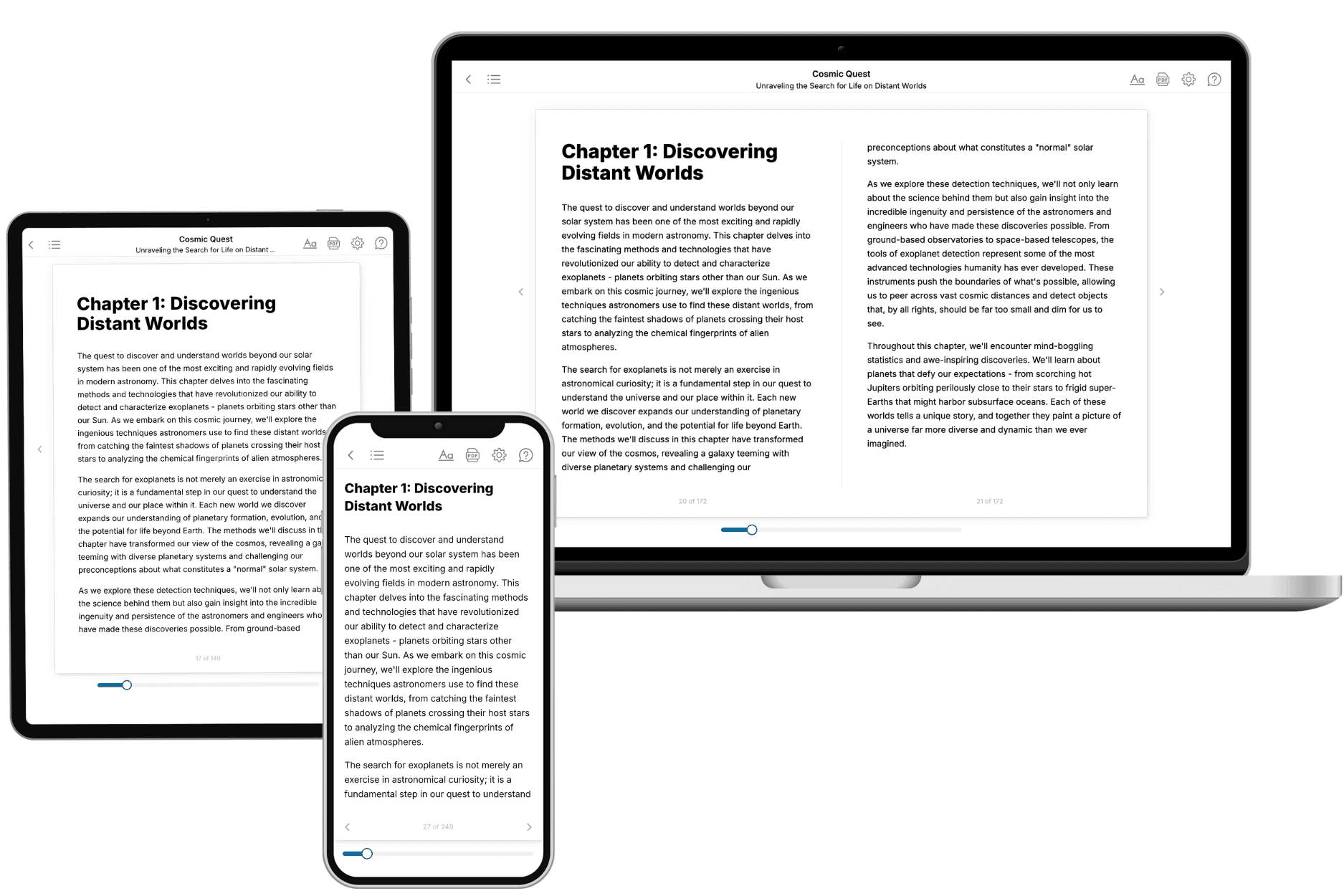
TailoredRead creates complete, full-length nonfiction ebooks, written specifically for you. Tell us what you want to learn and why, and TailoredRead writes you a complete ebook on it, with charts, tables, and diagrams throughout. Read it online, on Kindle, or on any e-reader, or download it as a PDF or EPUB. Every book is written fresh the day you order it.
- How is the book tailored to me?
Before anything is written, you answer a few short questions about your goals, your background, and the topics you care about. Your book is then planned around your answers: written at your level, focused on your goals, and covering the topics you chose, instead of the one-size-fits-all book a store sells everyone.
- Will it read like generic AI content?
No. Your book isn't a chat transcript: it's planned chapter by chapter before a single word is written, told in a clear book voice, and explains ideas visually with charts, tables, and diagrams. After writing, every book goes through an editorial pass that polishes chapters so the book reads consistent from start to finish. Judge for yourself: browse thousands of sample books on our Explore Books page.
- How accurate is the content?
Our AI first checks whether your subject needs live research. Niche and fast-moving subjects are researched before writing, and the book plan and chapters are grounded in what it finds. After writing, every book goes through a quality pass that checks its facts and consistency, and researched books list their sources in a Notes section at the back.
- How long is the book?
You choose the length: Comprehensive (250-300 pages), Detailed (150-200 pages), Essential (70-100 pages), or Short (30-50 pages).
- Does the book include visuals?
Yes. Every book includes charts, tables, and diagrams: timelines, checklists, step-by-step guides, decision trees, comparison tables, matrices, and bar charts. A typical book includes dozens of these visual elements.
- Can I read it on Kindle? What formats can I download?
Yes. Every book can be read in our online reader or downloaded as a PDF or EPUB. The EPUB can be opened with Kindle, Apple Books, Kobo, and any e-reader. The Commercial and Author licenses also include an editable Word (DOCX) and Markdown download.
- How much does it cost?
About the price of a regular ebook. The exact price depends on your book's length and complexity, from $2 for the shortest books to $35 for the most comprehensive, and it's shown when you review your book, before you commit to anything. Each book is a one-time purchase, yours to keep, no subscription. Licenses that let you share, teach, or publish your book range from $35.99 to $49.99.
- Can I preview the book before purchasing?
Before you pay, you'll see what your book will cover: the title, a detailed description, the estimated length, and the complete chapter-by-chapter table of contents, so you know what you're getting before you decide. The full text itself is written after you purchase.
- How long does it take to create a book?
About 10 minutes. You can start reading the opening chapters while the rest is still being written.