The Axolotl Owner's Guide to Regeneration
Understanding, Supporting, and Celebrating Your Pet's Remarkable Healing Powers
Watching your axolotl regrow a lost limb is one of nature's most mesmerizing experiences—but only if you understand what your pet needs to heal successfully.
238 pages10 chaptersJun 23, 2026Pets
About this book
Many axolotl owners witness incomplete regeneration, infection, or scarring because they don't realize how fragile the healing process truly is. This guide reveals the science behind your axolotl's remarkable abilities and shows you exactly how to support optimal recovery. You'll discover what happens at the cellular level during regeneration, how to recognize when your pet is injured, and the specific environmental conditions that make the difference between perfect regrowth and permanent damage. Learn why water quality matters more than you think, how stress sabotages healing, and what nutrition your axolotl needs to rebuild tissue. Whether your pet is currently recovering or you want to be prepared for the future, this book equips you with the knowledge to give your axolotl the best chance at complete, healthy regeneration.
Table of contents
- IntroductionWhy Regeneration Matters for Your Axolotl, What You'll Learn in This Guide, How to Use This BookRead below
- Chapter 1: The Axolotl's Extraordinary AbilityWhat Makes Axolotls Unique Among Animals, A Brief History of Axolotl Regeneration Research, What Can Your Axolotl Actually Regenerate?
- Chapter 2: The Science Behind RegenerationCellular Basics: How Cells Work Together, The Blastema: Where Regeneration Begins, Dedifferentiation: Cells Returning to Their Origins, Growth and Patterning: Building the New Limb
- Chapter 3: Recognizing Injury and IllnessCommon Injuries in Captive Axolotls, Signs Your Axolotl Is Injured or Ill, When to Seek Veterinary Care
- Chapter 4: Water Quality and RegenerationAmmonia, Nitrite, and Nitrate: The Nitrogen Cycle, pH and Water Hardness: Finding the Right Balance, Testing and Maintaining Optimal Water Parameters, Water Changes During Recovery: Frequency and Best Practices
- Chapter 5: Temperature and Environmental ConditionsThe Ideal Temperature Range for Regeneration, How Temperature Fluctuations Affect Healing, Tank Setup for Optimal Recovery
- Chapter 6: Stress and Its Impact on HealingUnderstanding Axolotl Stress Responses, Common Stressors in the Home Aquarium, Creating a Calm Environment for Healing
- Chapter 7: Nutrition for RegenerationNutritional Requirements for Healing, Feeding During Recovery: Timing and Portions, Supplements and Additives That Support Regeneration
- Chapter 8: The Regeneration TimelineThe Immediate Aftermath: First 24-48 Hours, Early Healing Phase: Weeks 1-2, Active Growth Phase: Weeks 3-8, Maturation Phase: Months 2-6
- Chapter 9: Complications and When Regeneration FailsInfection Prevention and Recognition, Incomplete Regeneration and Scarring, Understanding the Limits of Regeneration
- Chapter 10: Special Situations and Advanced TopicsRegeneration in Juvenile vs. Adult Axolotls, Managing Multiple Injuries Simultaneously, Genetic Variations and Regenerative Capacity
- ConclusionYour Role as a Caregiver, Final Thoughts on Supporting Your Axolotl
- Frequently Asked QuestionsQuick Answers to Common Questions
- Glossary of TermsKey Terminology and Definitions
- Further Reading and ResourcesRecommended Resources for Axolotl Care
Introduction
There is a moment that almost every axolotl owner experiences at least once. You notice something is wrong. A limb looks shorter than it should. A gill tuft is missing. A tail has a ragged edge where it was once smooth. Your first instinct is probably alarm, followed quickly by a flood of questions. Is this serious? Will it heal? What do you do now? If you have kept axolotls for any length of time, you already know the short answer: these animals can heal in ways that seem almost impossible. But knowing that regeneration is possible and knowing how to support it are two very different things.
Axolotls (Ambystoma mexicanum) are not just unusual pets. They are among the most scientifically remarkable vertebrates on the planet. Unlike most animals, including humans, axolotls can regrow entire limbs, repair damaged heart tissue, regenerate portions of their spinal cord, and even recover from injuries to their brain. This is not a simplified or partial repair. In many cases, the regrown structure is functionally complete, with bones, muscles, nerves, and blood vessels all rebuilt from scratch. Scientists have studied this ability for over a century, and it continues to generate active research in regenerative medicine today.[1]
But here is the part that many owners do not fully appreciate until something goes wrong: regeneration is not automatic or guaranteed. It is a biological process that depends heavily on the conditions you provide. Water quality, temperature, nutrition, stress levels, and tank setup all play direct roles in whether your axolotl heals cleanly, heals partially, or develops complications. The difference between a perfect limb regrowth and a scarred, deformed stump often comes down to decisions made in the days and weeks following an injury. This guide exists to make sure you have the knowledge to make the right ones.
Whether your axolotl is currently recovering from an injury, you are preparing for the possibility of future injuries, or you simply want to understand your pet more deeply, this book is written for you. It assumes you already have some experience keeping axolotls and are ready to go beyond the basics. The goal is not to overwhelm you with scientific jargon, but to give you a clear, practical understanding of what is happening inside your axolotl's body and what you can do to help. Every chapter connects the science directly to real care decisions you will face as an owner.
Why Regeneration Matters for Your Axolotl
Regeneration is not just a fascinating party trick. For axolotls, it is a core survival mechanism that shapes how their entire biology works. In the wild, axolotls live in the lake complex of Xochimilco near Mexico City, an environment where encounters with predators, territorial disputes, and physical hazards are a regular part of life.[2] The ability to lose a limb and regrow it without permanent disability is a genuine evolutionary advantage. In captivity, the threats are different, but the biology remains the same.
For you as an owner, understanding regeneration matters because it changes how you respond to injuries. Many pet owners who are unfamiliar with axolotl biology panic when they see a missing limb and assume the worst. Others go to the opposite extreme and assume everything will sort itself out without any intervention. Both responses can lead to poor outcomes. The reality sits in the middle: axolotls have a powerful healing system, but that system needs the right conditions to function properly. Your role is to create and maintain those conditions.
Regeneration also matters because it is a window into your axolotl's overall health. How quickly and completely your axolotl heals tells you a great deal about the quality of its environment and care. An axolotl that heals slowly, incompletely, or with repeated infections is almost always signaling that something in its environment is not right. Learning to read the regeneration process as a health indicator is one of the most valuable skills you can develop as an owner.
There is also a broader significance worth acknowledging. Axolotl regeneration is one of the most actively studied topics in biomedical research. Scientists are working to understand how these animals achieve what mammals cannot, with the hope of eventually applying those insights to human medicine. Conditions like spinal cord injury, heart disease, and limb loss could one day be treated using principles first discovered in axolotls.[3] As an axolotl owner, you are in a unique position to observe this biology firsthand, in your own home, every day.
Understanding regeneration also helps you set realistic expectations. Not every injury results in perfect regrowth. Age, genetics, the severity of the injury, and the quality of care all influence the outcome. Some axolotls regrow limbs that look nearly identical to the originals. Others develop limbs with extra digits, unusual branching, or slightly different proportions. Knowing what is normal, what is a complication, and what represents a genuine failure of healing allows you to respond appropriately rather than either overreacting or missing a problem that needs attention.
Finally, regeneration matters because it is one of the things that makes axolotls genuinely extraordinary pets. Watching a limb bud appear, grow, and develop over weeks is an experience that very few pet owners ever get to have. It connects you to something much larger than the daily routine of feeding and water changes. When you understand what you are watching, that experience becomes even more meaningful. This guide is designed to give you that understanding.
What You'll Learn in This Guide
This book is organized to take you from the foundational science of regeneration through to the practical, day-to-day decisions you will make as a caregiver. Each chapter builds on the previous one, so reading from start to finish gives you the most complete picture. That said, the book is also designed to work as a reference you can return to when specific situations arise. Here is a brief overview of what each section covers.
The first two chapters establish the scientific foundation. Chapter 1 explores what makes axolotls unique among animals and gives you a sense of the history of regeneration research. You will learn exactly what structures an axolotl can and cannot regenerate, which helps you understand both the power and the limits of this ability. Chapter 2 goes deeper into the cellular biology, explaining concepts like blastema formation and dedifferentiation in plain language. You do not need a biology degree to follow along. The goal is to give you enough understanding to make sense of what you are observing when your axolotl heals.
Chapters 3 through 6 focus on recognition and environment. Chapter 3 covers how to identify injuries and illness, including the signs that are easy to miss. Chapter 4 explains the relationship between water quality and regeneration in detail, covering the nitrogen cycle, pH, hardness, and how to test and maintain optimal parameters. Chapter 5 addresses temperature and tank setup, two factors that have a surprisingly large impact on healing speed and quality. Chapter 6 examines stress, which is one of the most underestimated obstacles to successful regeneration.
Chapter 7 covers nutrition, explaining what your axolotl needs to eat during recovery and why certain foods and supplements can make a measurable difference. Chapter 8 walks you through the full regeneration timeline, from the first 24 hours after an injury through the months-long maturation phase. Knowing what to expect at each stage helps you recognize whether healing is progressing normally or whether something has gone wrong.
The final chapters address complications and special situations. Chapter 9 covers infection prevention, incomplete regeneration, and the limits of what axolotls can heal. Chapter 10 explores more advanced topics, including differences between juvenile and adult regeneration, how to manage multiple simultaneous injuries, and how genetic variations affect regenerative capacity. The book closes with a conclusion, a frequently asked questions section, a glossary of key terms, and a list of further reading and resources.
Throughout the book, you will find specific, actionable guidance rather than vague general advice. The aim is always to answer the question: what do you actually do? Concepts are illustrated with concrete examples and scenarios drawn from real axolotl care situations. Where relevant, the science is cited so you can explore further if you want to go deeper. By the time you finish, you should feel genuinely equipped to support your axolotl through any healing process it faces.
Here is a quick summary of the core skills and knowledge areas this guide develops:
- Understanding the cellular biology of regeneration at a practical level
- Recognizing injuries and illness early, before they become serious
- Maintaining water quality and temperature conditions that support healing
- Reducing stress in your axolotl's environment
- Feeding and supplementing appropriately during recovery
- Reading the regeneration timeline and knowing what is normal
- Identifying complications and knowing when to seek veterinary help
- Setting realistic expectations for different types of injuries
How to Use This Book
The most effective way to use this guide depends on where you are right now. If your axolotl is currently injured or recovering, you may want to jump directly to the chapters most relevant to your situation. Chapter 3 will help you assess the injury. Chapter 4 and Chapter 5 will help you optimize the environment immediately. Chapter 8 will tell you what to expect over the coming days and weeks. You can always come back to the earlier chapters on biology and science once the immediate situation is under control.
If your axolotl is healthy right now and you are reading this to be prepared, the best approach is to read from the beginning. The scientific chapters are not just background information. They genuinely change how you observe and interpret your axolotl's behavior and condition. Owners who understand blastema formation, for example, are much better at recognizing the early signs of regeneration and distinguishing healthy healing from early infection. That knowledge is most useful when you have time to absorb it calmly, before an emergency arises.
Pay particular attention to the sections on water quality and stress. These two areas are where most regeneration problems originate, and they are also the areas where owner action makes the biggest difference. Many axolotl owners who experience poor healing outcomes later realize that their water parameters were not as stable as they thought, or that their tank had stressors they had not identified. Reading those chapters carefully and honestly assessing your own setup is one of the most valuable things you can do for your axolotl's long-term health.
The glossary at the back of the book is worth bookmarking. Regeneration biology involves some specific terminology, and having clear definitions on hand makes the scientific chapters much easier to follow. Key terms are bolded when they first appear in the text, and each one has a corresponding entry in the glossary. If you encounter a term that feels unfamiliar, the glossary is the fastest way to get back on track without losing the thread of what you are reading.
The FAQ section is designed for quick reference. It covers the questions that come up most often among axolotl owners dealing with injuries and recovery. If you have a specific, practical question and want a fast answer, the FAQ is a good first stop. The further reading section points you toward scientific papers, reputable care resources, and communities where you can connect with other experienced axolotl owners. No single book can cover everything, and staying connected to current research and experienced keepers is always worthwhile.
A note on veterinary care: this guide is designed to help you provide excellent supportive care and make informed decisions, but it is not a substitute for professional veterinary advice. Axolotl-experienced exotic vets are not always easy to find, but they exist, and there are situations where professional assessment is genuinely necessary. Chapter 3 covers the specific signs that indicate a vet visit is needed. When in doubt, always err on the side of seeking professional guidance.
One of the most important things to bring to this book is patience. Regeneration is a slow process by human standards. A regrown limb can take anywhere from a few weeks to several months to reach full development, depending on the axolotl's age, the extent of the injury, and the quality of care provided. There will be periods where progress seems to stall, where the new growth looks strange or asymmetrical, or where you are not sure whether what you are seeing is normal. This guide will help you navigate those moments with confidence rather than anxiety.
Finally, approach this subject with genuine curiosity. Axolotl regeneration is one of the most extraordinary biological phenomena you will ever have the chance to observe up close. The more you understand about what is happening, the more remarkable it becomes. This guide is written with the belief that knowledge makes you a better caregiver and that being a better caregiver makes the experience of keeping axolotls richer and more rewarding for both you and your pet. That is the spirit in which every chapter ahead has been written.
Notes
Introduction
- 1. E. M. Tanaka, "The molecular and cellular choreography of appendage regeneration," Cell, 2016
- 2. L. Zambrano and others, "Extremely reduced genetic diversity in the endangered Mexican axolotl (Ambystoma mexicanum)," Animal Conservation, 2010
- 3. J. W. Godwin and others, "Macrophages are required for adult salamander limb regeneration," Proceedings of the National Academy of Sciences, 2013
This is the end of the free sample. The full book has 10 chapters.
Want this book written for you?
Tell us your goals and background, and get your own version of this book, tailored by AI to you.


Benefits of AI-tailored books
- Read one book, not ten:
- all the Pets knowledge you need, gathered into a single book.
- Save days of learning:
- tell us your goals, choose your topics, and the whole book is built around them.
- Learn effortlessly:
- Pets book written for your specific background and expertise.
- Understand at a glance:
- includes charts, tables, timelines, checklists, decision trees, and more.
- Stay current:
- written the day you order it, not years ago.
- Trust what you read:
- every book is checked for accuracy, with real research when your subject needs it.
Create your unique book in 3 steps
- 1. Select your focus
Select the focus of your Pets book and share your background
- 2. Personalize your book
Specify your goals and choose sub-topics to include
- 3. Get your tailored book
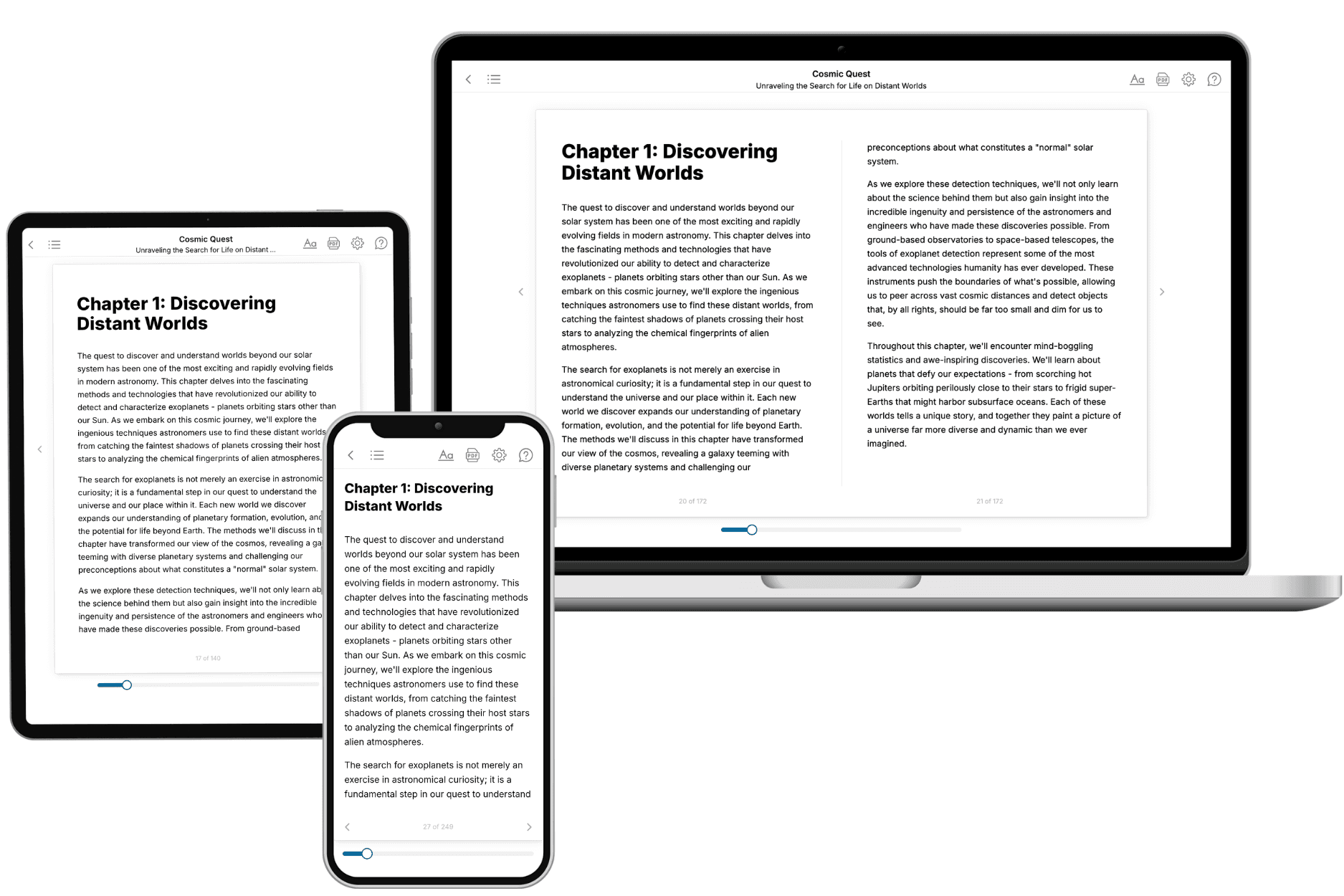
Your book is ready in 10 minutes. Read it online, download as EPUB or PDF, or send to Kindle.
Frequently asked questions
- What is TailoredRead?
TailoredRead creates complete, full-length nonfiction ebooks, written specifically for you. Tell us what you want to learn and why, and TailoredRead writes you a complete ebook on it, with charts, tables, and diagrams throughout. Read it online, on Kindle, or on any e-reader, or download it as a PDF or EPUB. Every book is written fresh the day you order it.
- How is the book tailored to me?
Before anything is written, you answer a few short questions about your goals, your background, and the topics you care about. Your book is then planned around your answers: written at your level, focused on your goals, and covering the topics you chose, instead of the one-size-fits-all book a store sells everyone.
- Will it read like generic AI content?
No. Your book isn't a chat transcript: it's planned chapter by chapter before a single word is written, told in a clear book voice, and explains ideas visually with charts, tables, and diagrams. After writing, every book goes through an editorial pass that polishes chapters so the book reads consistent from start to finish. Judge for yourself: browse thousands of sample books on our Explore Books page.
- How accurate is the content?
Our AI first checks whether your subject needs live research. Niche and fast-moving subjects are researched before writing, and the book plan and chapters are grounded in what it finds. After writing, every book goes through a quality pass that checks its facts and consistency, and researched books list their sources in a Notes section at the back.
- How long is the book?
You choose the length: Comprehensive (250-300 pages), Detailed (150-200 pages), Essential (70-100 pages), or Short (30-50 pages).
- Does the book include visuals?
Yes. Every book includes charts, tables, and diagrams: timelines, checklists, step-by-step guides, decision trees, comparison tables, matrices, and bar charts. A typical book includes dozens of these visual elements.
- Can I read it on Kindle? What formats can I download?
Yes. Every book can be read in our online reader or downloaded as a PDF or EPUB. The EPUB can be opened with Kindle, Apple Books, Kobo, and any e-reader. The Commercial and Author licenses also include an editable Word (DOCX) and Markdown download.
- How much does it cost?
About the price of a regular ebook. The exact price depends on your book's length and complexity, from $2 for the shortest books to $35 for the most comprehensive, and it's shown when you review your book, before you commit to anything. Each book is a one-time purchase, yours to keep, no subscription. Licenses that let you share, teach, or publish your book range from $35.99 to $49.99.
- Can I preview the book before purchasing?
Before you pay, you'll see what your book will cover: the title, a detailed description, the estimated length, and the complete chapter-by-chapter table of contents, so you know what you're getting before you decide. The full text itself is written after you purchase.
- How long does it take to create a book?
About 10 minutes. You can start reading the opening chapters while the rest is still being written.