The Battle of Algiers
Urban Warfare, Colonial Conflict, and the Fight for Independence
The Battle of Algiers stands as one of history's most consequential urban conflicts, yet many struggle to understand its significance beyond the famous film.
222 pages10 chaptersJan 4, 2026Algerian War
About this book
This book cuts through the complexity to reveal how a year-long struggle in Algeria's capital reshaped colonial warfare, international relations, and the future of North Africa. You'll discover how the FLN's shift to urban guerrilla tactics forced the French military to confront an enemy that couldn't be defeated through conventional means. The book examines the brutal counterinsurgency measures, the civilian toll, and the strategic miscalculations that transformed a tactical French victory into a strategic defeat. By exploring the political, military, and human dimensions of this conflict, you'll gain insight into how nationalist movements challenge imperial power and why military superiority alone cannot guarantee political victory. This is essential reading for understanding modern insurgency, colonial collapse, and the enduring consequences of the Algerian War.
Table of contents
- IntroductionWhy This Battle Matters Today, What You'll Learn in This Book, How to Use This BookRead below
- Chapter 1: Algeria Before the BattleColonial Algeria: A Century of French Rule, The Roots of Nationalist Resistance, The FLN's Emergence and Early Strategy
- Chapter 2: The Algerian War BeginsNovember 1954: The Uprising Starts, The French Military Response, From Rural Insurgency to Urban Strategy
- Chapter 3: The FLN's Urban StrategyWhy Algiers: The Strategic Choice, Urban Guerrilla Tactics and Organization, The FLN's Organizational Structure in the City
- Chapter 4: The Battle Erupts: 1956-1957The Opening Phase: Bombings and Assassinations, French Military Escalation and Reinforcements, The Civilian Population Caught in the Middle
- Chapter 5: Counterinsurgency and Controversial MethodsTorture and Interrogation: The Massu Doctrine, Collective Punishment and Collective Responsibility, The Moral and Political Consequences
- Chapter 6: The Military Campaign IntensifiesFrench Tactical Operations and Sweeps, FLN Adaptation and Resilience, Key Military Operations and Turning Points
- Chapter 7: The Role of Media and International OpinionMedia Coverage and the Power of Narrative, International Response and Diplomatic Pressure, The Propaganda War: Competing Narratives
- Chapter 8: The Battle's Conclusion and AftermathThe FLN's Tactical Defeat in Algiers, The French Military Victory and Its Limits, Strategic Implications of the Battle's End
- Chapter 9: From Battle to IndependenceThe War Continues Beyond Algiers, The Battle's Impact on French Politics, The Path to Algerian Independence
- Chapter 10: Legacy and Lessons for Modern WarfareHow the Battle Shaped Urban Warfare Doctrine, Counterinsurgency Lessons for Modern Conflicts, Contemporary Relevance and Modern Applications
- ConclusionThe Enduring Significance of the Battle of Algiers, Final Reflections on Colonial Conflict and Resistance
- Glossary
- Further Reading and Resources
Introduction
The Battle of Algiers remains one of the most studied yet misunderstood conflicts of the twentieth century. Between 1956 and 1957, the streets of Algeria's capital became a battlefield where French paratroopers hunted urban guerrillas through the winding alleys of the Casbah. What appeared to be a straightforward military operation evolved into something far more complex—a conflict that would expose the limitations of conventional military power against determined nationalist resistance. The battle lasted less than a year, yet its consequences reverberated for decades, influencing military doctrine, international relations, and the trajectory of decolonization across Africa and Asia.
This conflict defies simple categorization. The French military achieved what seemed like a decisive tactical victory, dismantling the FLN's urban network and restoring order to Algiers. Yet within five years, Algeria gained independence, and France's colonial empire crumbled. This paradox—winning the battle while losing the war—has fascinated military strategists, historians, and political scientists ever since. The methods employed during the battle, particularly the systematic use of torture and collective punishment, sparked debates about military ethics that continue today. Understanding how this happened requires examining not just military operations, but the political calculations, human costs, and strategic miscalculations that transformed a colonial police action into a defining moment of anti-colonial resistance.
The Battle of Algiers also represents a turning point in how wars are fought and perceived. It demonstrated that modern conflicts are won or lost not just on battlefields, but in the court of public opinion. The FLN understood this intuitively, using spectacular attacks to generate international attention and sympathy for their cause. The French military, focused on tactical success, failed to grasp that their counterinsurgency methods—however effective in the short term—were undermining their strategic objectives. This disconnect between tactical success and strategic failure offers crucial lessons for understanding contemporary conflicts, from Iraq and Afghanistan to urban counterterrorism operations worldwide. The battle's legacy extends far beyond Algeria, shaping how militaries approach urban warfare and how insurgent movements challenge superior conventional forces.
Why This Battle Matters Today
The Battle of Algiers continues to resonate because it crystallized fundamental questions about power, legitimacy, and resistance that remain unresolved. When military forces enter urban environments to combat insurgents embedded within civilian populations, they face the same dilemmas French paratroopers confronted in 1957. How do you distinguish combatants from civilians? What methods are acceptable when conventional warfare proves ineffective? When does military necessity cross the line into counterproductive brutality? These questions have haunted every counterinsurgency operation since, from Vietnam to Fallujah. The battle provides a historical laboratory for examining these issues, offering concrete examples of what works, what fails, and why tactical victories can become strategic disasters.
Modern military academies worldwide study the Battle of Algiers as a case study in urban counterinsurgency. The tactics developed by French commanders—population control measures, intelligence networks, targeted operations—became foundational to counterinsurgency doctrine. Yet the battle also serves as a cautionary tale about the limits of military force. The French won every major engagement, captured or killed most FLN leaders in Algiers, and restored order to the city. Despite this success, they lost Algeria. This outcome challenges conventional military thinking and forces us to reconsider what victory means in asymmetric conflicts. Understanding why the French succeeded tactically but failed strategically offers insights applicable to contemporary conflicts where superior military power confronts determined resistance movements.
The battle's relevance extends beyond military strategy to questions of political legitimacy and moral authority. The systematic use of torture by French forces became public knowledge, sparking fierce debates in France and internationally. Military officers justified these methods as necessary to save lives and defeat terrorism. Critics argued that such tactics betrayed the democratic values France claimed to defend. This tension between security imperatives and ethical principles remains central to contemporary debates about counterterrorism. The Battle of Algiers demonstrates how military methods can undermine political objectives, turning neutral populations against occupying forces and eroding international support. These lessons apply directly to modern counterinsurgency operations, where winning hearts and minds proves as important as defeating armed opponents.
The battle also illuminates the dynamics of decolonization and nationalist movements. The FLN's strategy in Algiers represented a calculated gamble—shifting from rural guerrilla warfare to urban terrorism to force international attention and French overreaction. This approach has been replicated by numerous insurgent and terrorist organizations since. Understanding how the FLN organized clandestine networks, maintained operational security, and leveraged spectacular violence for political effect provides insight into how modern insurgent groups operate. The battle demonstrates that militarily weaker forces can achieve strategic objectives by changing the nature of the conflict, forcing stronger opponents to fight on unfavorable terms, and exploiting the political dimensions of violence.
Contemporary conflicts in urban environments—from Syria to Yemen to the Philippines—echo the Battle of Algiers in striking ways. Military forces conducting operations in densely populated cities face the same challenges of distinguishing combatants from civilians, gathering intelligence without alienating populations, and achieving military objectives without creating political backlash. The battle offers historical perspective on these challenges, showing how different approaches produce different outcomes. It reveals patterns that transcend specific contexts: how insurgents exploit urban terrain, how counterinsurgency operations affect civilian populations, and how military actions influence political trajectories. These patterns help us understand not just historical events, but contemporary conflicts unfolding today.
The battle's influence on popular culture and political discourse also merits attention. Gillo Pontecorvo's 1966 film The Battle of Algiers became required viewing for military officers, revolutionaries, and activists worldwide. The film's depiction of urban guerrilla warfare and counterinsurgency operations shaped how subsequent generations understood these conflicts. This cultural legacy means the Battle of Algiers functions as both historical event and symbolic reference point. When people discuss urban warfare, counterinsurgency ethics, or anti-colonial resistance, they often invoke Algiers as shorthand for complex dynamics. Understanding the actual historical battle—as opposed to its cinematic representation—becomes essential for engaging these discussions meaningfully.
Finally, the battle matters because it demonstrates how conflicts that seem distant and resolved continue shaping our present. The methods developed in Algiers influenced French military doctrine, which in turn influenced American counterinsurgency approaches in Vietnam and beyond. The torture techniques employed by French forces reappeared in later conflicts, sometimes taught by the same officers who used them in Algeria. The FLN's organizational structures and tactical innovations inspired liberation movements across Africa, Asia, and Latin America. The battle's consequences rippled outward, affecting military training, international law, human rights discourse, and political movements worldwide. Tracing these connections reveals how historical events continue influencing contemporary realities in ways we often fail to recognize.
What You'll Learn in This Book
This book provides a comprehensive examination of the Battle of Algiers within its broader historical context. You'll begin by understanding colonial Algeria and the conditions that produced nationalist resistance. The opening chapters establish how 132 years of French colonial rule created the grievances and inequalities that fueled the independence movement. You'll learn about the FLN's formation, its initial strategy of rural insurgency, and the factors that led to its fateful decision to shift operations to Algiers. This foundation proves essential for understanding why the battle occurred and what both sides hoped to achieve. Without grasping the colonial context and the war's early phases, the battle itself appears as isolated violence rather than a calculated strategic move within a larger conflict.
The book then examines the FLN's urban strategy in detail, explaining how the organization adapted guerrilla warfare tactics to an urban environment. You'll discover how the FLN structured its clandestine networks, recruited operatives, maintained security, and coordinated attacks across the city. The chapters on FLN operations provide specific examples of bombing campaigns, assassination programs, and propaganda efforts. You'll learn about key figures like Yacef Saadi, who commanded FLN operations in Algiers, and understand the organizational challenges of conducting insurgency in a city under increasing surveillance. This analysis reveals the sophistication of FLN planning and the difficulties of maintaining clandestine operations under pressure from French security forces.
The French military response receives equally detailed treatment. You'll learn how French commanders, particularly General Jacques Massu and his paratroopers, developed counterinsurgency tactics specifically for urban environments. The book examines the controversial methods employed—systematic torture, collective punishment, population control measures—and explains the military logic behind these approaches. You'll understand how French forces gathered intelligence, conducted raids, and gradually dismantled the FLN's urban network. These chapters don't shy away from difficult questions about military ethics and effectiveness. They present the French perspective while analyzing the long-term consequences of their tactical choices, showing how methods that achieved short-term success undermined broader strategic objectives.
The human dimension of the conflict receives substantial attention throughout the book. You'll encounter the experiences of civilians caught between FLN violence and French repression, the moral dilemmas faced by soldiers ordered to use torture, and the personal costs paid by individuals on all sides. The book includes specific examples of bombing victims, torture survivors, and families torn apart by the conflict. These human stories prevent the battle from becoming an abstract strategic exercise, reminding us that military operations have profound consequences for real people. Understanding these human costs proves essential for evaluating the battle's significance and learning appropriate lessons from this history.
The book dedicates significant coverage to the battle's political and international dimensions. You'll learn how media coverage shaped public perception, how international opinion influenced both French and FLN strategies, and how the battle affected French domestic politics. These chapters explain why tactical military success failed to translate into strategic victory. You'll discover how the battle accelerated France's political crisis, strengthened international support for Algerian independence, and demonstrated the limitations of military solutions to political problems. This analysis reveals patterns applicable to contemporary conflicts, where political and informational dimensions often prove more decisive than military operations.
The book's later chapters trace the battle's aftermath and long-term consequences. You'll learn how the war continued after the FLN's defeat in Algiers, how the battle influenced French politics and military doctrine, and how Algeria ultimately achieved independence despite losing the Battle of Algiers. These chapters connect tactical events to strategic outcomes, explaining the mechanisms through which military victories can become political defeats. You'll understand how the battle's legacy shaped subsequent conflicts, influenced military thinking worldwide, and continues affecting how we understand urban warfare and counterinsurgency operations today.
Throughout the book, you'll encounter specific frameworks and analytical tools for understanding asymmetric conflicts. These include:
- The relationship between tactical success and strategic victory in counterinsurgency operations
- How insurgent organizations structure clandestine networks in hostile environments
- The role of violence in generating political attention and international sympathy
- How military methods affect political legitimacy and popular support
- The dynamics of urban warfare when insurgents embed within civilian populations
- How media coverage and international opinion influence conflict outcomes
The book also addresses common misconceptions about the battle. Many people's understanding comes primarily from Pontecorvo's film, which, while powerful and generally accurate, simplifies complex realities for dramatic effect. You'll learn where the film aligns with historical evidence and where it diverges, gaining a more nuanced understanding than popular culture provides. The book also challenges simplistic narratives that portray the conflict as purely good versus evil, showing instead how both sides made calculated choices with profound moral implications. This balanced approach doesn't equate the two sides morally, but it does acknowledge the complexity of the conflict and the difficult decisions individuals faced.
How to Use This Book
This book is structured to build your understanding progressively, moving from historical context through the battle itself to its consequences and legacy. The chapters follow a chronological sequence, which helps you grasp how events unfolded and how earlier developments shaped later outcomes. If you're new to the Algerian War, reading chapters in order provides the most coherent narrative. Each chapter builds on previous material, introducing concepts and context that subsequent chapters assume you understand. The early chapters on colonial Algeria and the war's beginning establish essential background for understanding why the battle occurred and what both sides hoped to achieve.
However, the book is also designed for selective reading based on your specific interests. If you're primarily interested in military tactics and operations, you can focus on chapters covering FLN urban strategy, French counterinsurgency methods, and specific military campaigns. These chapters contain detailed tactical analysis and can be read somewhat independently. If your interest centers on political and ethical dimensions, the chapters on torture, international opinion, and the battle's aftermath provide concentrated coverage of these issues. The book's structure allows you to pursue specific topics while still benefiting from the broader narrative context.
Each chapter includes specific elements designed to enhance your understanding:
- Concrete examples: Rather than abstract descriptions, chapters provide specific incidents, operations, and individuals to illustrate broader patterns
- Analytical frameworks: Key concepts are explained and then applied to specific situations, showing how theoretical ideas manifest in practice
- Multiple perspectives: The book presents French military, FLN, and civilian viewpoints, helping you understand how different actors perceived events
- Contemporary connections: Chapters link historical events to modern conflicts, showing why these events remain relevant
- Critical questions: The text raises questions about strategy, ethics, and effectiveness, encouraging you to think critically about the material
The book assumes you have basic familiarity with twentieth-century history but doesn't require specialized knowledge of French colonial history or military affairs. Technical terms and French words are explained when first introduced, and the glossary provides quick reference for key concepts and organizations. If you encounter unfamiliar terms or want clarification on specific points, the glossary offers concise definitions. The book avoids unnecessary jargon, but some technical military and political terminology proves unavoidable when discussing counterinsurgency operations and organizational structures. These terms are always explained in context before being used regularly.
For readers interested in deeper exploration, the "Further Reading and Resources" section provides guidance on primary sources, scholarly works, memoirs, and documentary materials. These resources are organized by topic, allowing you to pursue specific interests beyond what this book covers. The recommendations include works representing different perspectives—French military memoirs, FLN accounts, scholarly analyses, and journalistic investigations. This diversity of sources enables you to develop a more comprehensive understanding and evaluate competing interpretations of controversial events. The book's footnotes also direct you to specific sources for claims and statistics, allowing you to verify information and explore topics in greater depth.
As you read, consider keeping notes on patterns and themes that recur across chapters. The relationship between tactical success and strategic failure appears repeatedly, as does the tension between military necessity and political consequences. Tracking these patterns helps you extract broader lessons applicable beyond this specific conflict. You might also note parallels to contemporary conflicts you're familiar with, considering how the dynamics observed in Algiers manifest in different contexts. This comparative approach deepens understanding and reveals why the Battle of Algiers continues generating interest and debate decades after the events occurred.
The book addresses difficult and sometimes disturbing material, particularly regarding torture, civilian casualties, and political violence. These topics receive frank treatment because understanding the battle requires confronting its brutal realities. The book doesn't sensationalize violence but doesn't sanitize it either. If you find certain sections challenging, remember that this discomfort reflects the genuine moral complexity of the conflict. The goal isn't to shock but to honestly represent what occurred and why it matters. Understanding historical violence, including its causes and consequences, proves essential for preventing similar tragedies and making informed judgments about contemporary conflicts.
Finally, approach this book as an invitation to think critically about power, resistance, and the limits of military force. The Battle of Algiers doesn't offer simple lessons or clear heroes and villains. Instead, it presents a complex situation where individuals and organizations made consequential choices under difficult circumstances. Your task as a reader isn't to pick sides but to understand the dynamics at play, evaluate the decisions made, and consider what this history teaches about conflicts past and present. The battle's enduring significance lies not in providing easy answers but in raising essential questions about how wars are fought, what victory means, and how military actions relate to political objectives. These questions remain as relevant today as they were in 1957, making the Battle of Algiers essential reading for anyone seeking to understand modern conflict.
This is the end of the free sample. The full book has 10 chapters.
Want this book written for you?
Tell us your goals and background, and get your own version of this book, tailored by AI to you.


Benefits of AI-tailored books
- Read one book, not ten:
- all the Algerian War knowledge you need, gathered into a single book.
- Save days of learning:
- tell us your goals, choose your topics, and the whole book is built around them.
- Learn effortlessly:
- Algerian War book written for your specific background and expertise.
- Understand at a glance:
- includes charts, tables, timelines, checklists, decision trees, and more.
- Stay current:
- written the day you order it, not years ago.
- Trust what you read:
- every book is checked for accuracy, with real research when your subject needs it.
Create your unique book in 3 steps
- 1. Select your focus
Select the focus of your Algerian War book and share your background
- 2. Personalize your book
Specify your goals and choose sub-topics to include
- 3. Get your tailored book
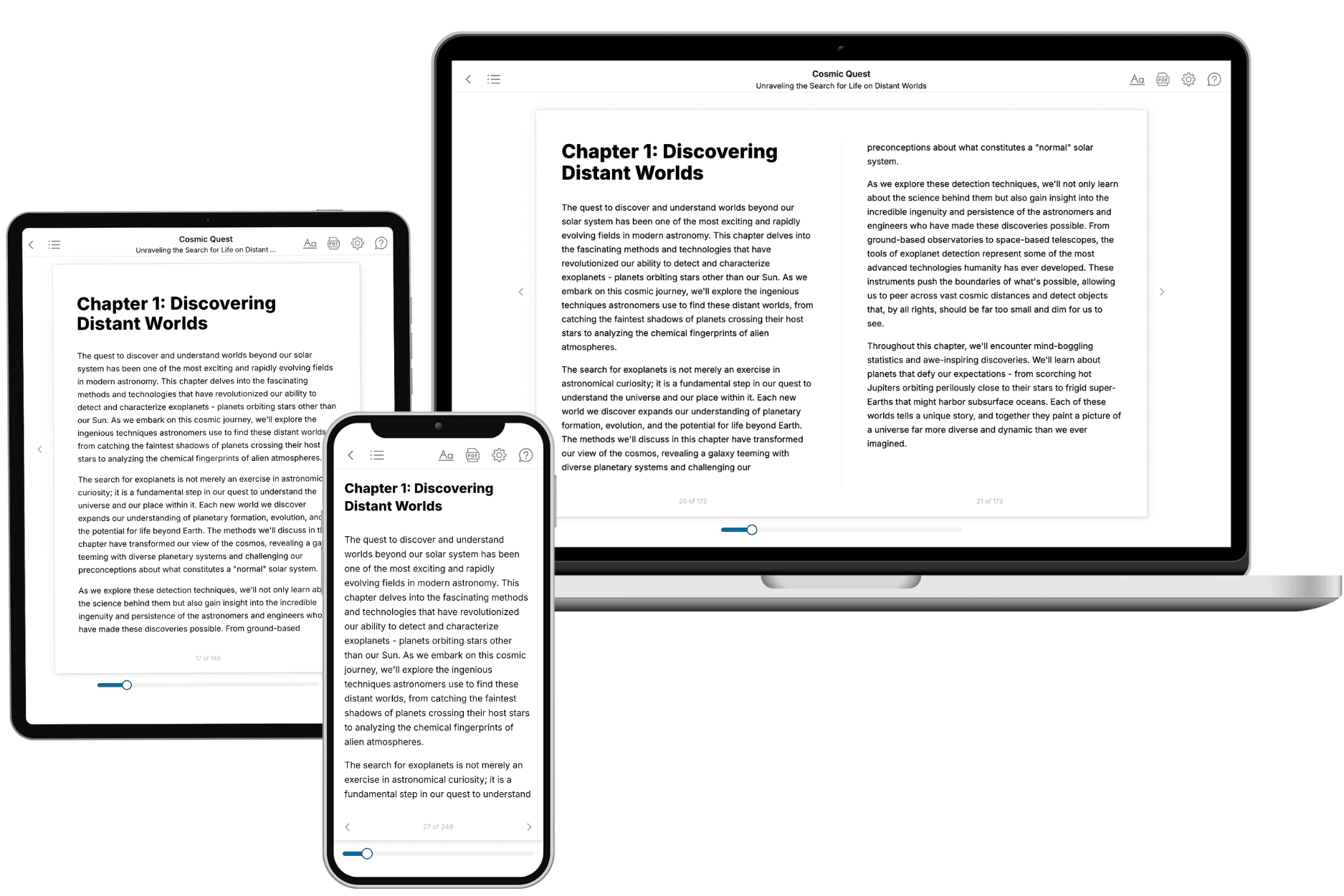
Your book is ready in 10 minutes. Read it online, download as EPUB or PDF, or send to Kindle.

Frequently asked questions
- What is TailoredRead?
TailoredRead creates complete, full-length nonfiction ebooks, written specifically for you. Tell us what you want to learn and why, and TailoredRead writes you a complete ebook on it, with charts, tables, and diagrams throughout. Read it online, on Kindle, or on any e-reader, or download it as a PDF or EPUB. Every book is written fresh the day you order it.
- How is the book tailored to me?
Before anything is written, you answer a few short questions about your goals, your background, and the topics you care about. Your book is then planned around your answers: written at your level, focused on your goals, and covering the topics you chose, instead of the one-size-fits-all book a store sells everyone.
- Will it read like generic AI content?
No. Your book isn't a chat transcript: it's planned chapter by chapter before a single word is written, told in a clear book voice, and explains ideas visually with charts, tables, and diagrams. After writing, every book goes through an editorial pass that polishes chapters so the book reads consistent from start to finish. Judge for yourself: browse thousands of sample books on our Explore Books page.
- How accurate is the content?
Our AI first checks whether your subject needs live research. Niche and fast-moving subjects are researched before writing, and the book plan and chapters are grounded in what it finds. After writing, every book goes through a quality pass that checks its facts and consistency, and researched books list their sources in a Notes section at the back.
- How long is the book?
You choose the length: Comprehensive (250-300 pages), Detailed (150-200 pages), Essential (70-100 pages), or Short (30-50 pages).
- Does the book include visuals?
Yes. Every book includes visual elements such as timelines, checklists, step-by-step guides, decision trees, comparison tables, and matrices, and many include bar charts. A typical book includes dozens of these visual elements.
- Can I read it on Kindle? What formats can I download?
Yes. Every book can be read in our online reader or downloaded as a PDF or EPUB. The EPUB can be opened with Kindle, Apple Books, Kobo, and any e-reader. The Commercial and Author licenses also include an editable Word (DOCX) and Markdown download.
- How much does it cost?
About the price of a regular ebook. The exact price depends on your book's length and complexity, from $2 for the shortest books to $35 for the most comprehensive, and it's shown when you review your book, before you commit to anything. Each book is a one-time purchase, yours to keep, no subscription. Licenses that let you share, teach, or publish your book range from $35.99 to $49.99.
- Can I preview the book before purchasing?
Before you pay, you'll see what your book will cover: the title, a detailed description, the estimated length, and the complete chapter-by-chapter table of contents, so you know what you're getting before you decide. The full text itself is written after you purchase.
- How long does it take to create a book?
About 10 minutes. You can start reading the opening chapters while the rest is still being written.