Battles of the American Revolution
The Turning Points That Forged a Nation
Imagine understanding the American Revolution not as abstract dates and names, but as a vivid sequence of decisive moments where courage, strategy, and circumstance collided to birth a nation.
176 pages9 chaptersApr 15, 2026United States History
About this book
This book takes you through the major battles that determined American independence, from the opening shots at Lexington to the final siege at Yorktown. You'll discover how Washington's army survived impossible odds, why Saratoga changed everything, and how ordinary soldiers faced extraordinary challenges on muddy fields and frozen terrain. Each battle reveals the human dimension of war—the decisions that mattered, the leaders who inspired, and the turning points that could have gone either way. Whether you're exploring American history for the first time or deepening your understanding, these accounts bring the Revolution to life with clarity and insight, showing how military strategy, geography, and determination forged the United States.
Table of contents
- IntroductionWhy These Battles Matter, The Context of Conflict, How to Read This BookRead below
- Chapter 1: The Opening Shots: Lexington and ConcordTensions Before Conflict, April 19, 1775: The Day Everything Changed, Aftermath and Significance
- Chapter 2: Bunker Hill: The First Major BattleColonial Fortifications and Strategy, The British Assault, Lessons Learned and Colonial Confidence
- Chapter 3: The New York Campaign: Washington's TrialsThe British Invasion of New York, Long Island: A Devastating Defeat, Strategic Retreat and Survival
- Chapter 4: Trenton and Princeton: Turning the TideA Desperate Situation, The Trenton Victory, Princeton and Renewed Hope
- Chapter 5: Saratoga: The Turning PointBurgoyne's Invasion from the North, Freeman's Farm and Bemis Heights, French Alliance and Global War
- Chapter 6: Valley Forge: Endurance and TransformationThe Winter Encampment, Survival and Military Training, Emergence as a Professional Army
- Chapter 7: The Southern Campaign: A Different WarThe Siege of Charleston, Camden: American Disaster, Recovery and Guerrilla Warfare
- Chapter 8: Naval Battles and Control of the SeasBritish Naval Dominance, American Privateers and Commerce Raiding, The French Navy's Impact on the War
- Chapter 9: Yorktown: The Final VictoryCornwallis Trapped in Virginia, The Siege and Combined Operations, Surrender and Independence Secured
- ConclusionThe Legacy of These Battles, Lessons from Revolutionary History
Introduction
The American Revolution is one of the most studied and celebrated events in world history, yet it is also one of the most misunderstood. Most people know the broad outline: colonists grew angry at British rule, declared independence in 1776, fought a war, and won. But that summary leaves out almost everything that actually mattered. The Revolution was not inevitable. It was not clean. And it was certainly not guaranteed to succeed. It was decided, battle by battle, on frozen riverbanks, forested hillsides, and muddy coastal plains, by men who were often cold, hungry, and outnumbered.
What makes the military history of the Revolution so compelling is how close the whole enterprise came to collapsing at almost every stage. The Continental Army was outgunned, undersupplied, and frequently outmaneuvered by one of the most professional military forces in the world. George Washington lost more battles than he won. Entire campaigns ended in near-catastrophe. Yet the cause survived, adapted, and ultimately prevailed. Understanding how that happened requires looking closely at the battles themselves, not just as events on a timeline, but as moments of decision where leadership, geography, and sheer determination shaped the outcome.
This book takes you through the major engagements of the Revolutionary War in roughly chronological order, from the first shots fired at Lexington in April 1775 to the final siege at Yorktown in October 1781. Each chapter focuses on a specific battle or campaign, examining the strategic context, the key decisions made by commanders on both sides, and the broader consequences that followed. Along the way, you will encounter not just famous generals but also the ordinary soldiers, local militiamen, and civilian populations whose experiences defined what the war actually felt like on the ground.
History is most useful when it is specific. Vague generalizations about "colonial determination" or "British arrogance" explain very little. What explains things is the precise moment when Daniel Morgan positioned his riflemen at Cowpens, or when Admiral de Grasse blocked the Chesapeake Bay and sealed Cornwallis's fate. This book aims to be that specific, grounding every major argument in the concrete details of what happened, where, and why it mattered. The goal is not just to inform but to help you see the Revolution as the participants experienced it: uncertain, dangerous, and full of moments where history could have turned out very differently.
Why These Battles Matter
It is tempting to treat military battles as the least interesting part of history, as if they were just the violent punctuation marks between more important political and social developments. But that view gets things backwards, especially for the American Revolution. The battles were not separate from the political story. They were the political story. Every engagement shaped what was possible diplomatically, economically, and constitutionally. Without Saratoga, there is almost certainly no French alliance. Without the French alliance, there is almost certainly no Yorktown. Without Yorktown, the United States as we know it may never have existed.
Consider what was actually at stake in these engagements. The men fighting for the Continental Army were not just soldiers in an abstract conflict. They were fighting for a political experiment that had no real precedent in the modern world. A republic of this scale, built on Enlightenment principles of individual rights and representative government, had never been attempted before. If the British had crushed the rebellion in 1776, as they nearly did during the New York Campaign, that experiment would have ended before it truly began. The battles were the mechanism through which an idea either survived or died.
The battles also matter because they reveal the human dimensions of the Revolution that political histories often miss. Reading the Declaration of Independence tells you what the founders believed. Studying the Battle of Bunker Hill tells you what ordinary colonists were willing to endure for those beliefs. There is a significant difference between those two things. The willingness of poorly equipped militiamen to stand their ground against professional British infantry, absorbing devastating casualties before retreating in good order, communicated something to the world that no document could fully capture.
These battles also shaped the military and strategic culture of the United States in ways that lasted for generations. Washington's emphasis on preserving his army rather than seeking decisive engagement, even at the cost of territory and public confidence, became a foundational principle of American strategic thinking. The use of irregular warfare, local knowledge, and civilian support networks in the Southern Campaign anticipated tactics that would appear again in later American conflicts. Understanding these battles is, in a real sense, understanding where American military tradition comes from.
There is also a practical reason to study these engagements carefully: they are genuinely instructive about how wars are won and lost. The Revolution offers a remarkably clear set of case studies in the relationship between strategy and outcome. You can trace, with unusual precision, how specific decisions led to specific results. Why did the British strategy of capturing major cities fail to end the war? Why did Burgoyne's invasion from Canada collapse so completely? Why did the same Continental Army that was routed at Brandywine perform so effectively at Yorktown just four years later? The answers are not mysterious. They are embedded in the details of the battles themselves.
Finally, these battles matter because they are still contested. Historians continue to debate the significance of individual engagements, the quality of specific commanders, and the relative importance of military versus political factors in determining the war's outcome. Engaging with that debate, even at an introductory level, sharpens your ability to think critically about historical causation. It forces you to ask not just what happened, but why, and whether things could have been different. That kind of thinking is valuable far beyond the study of eighteenth-century warfare.
A note on perspective: This book covers battles from both the American and British points of view. Understanding why British commanders made the decisions they did is just as important as understanding the American side. Wars are not won against cardboard opponents, and the British military was formidable, experienced, and often tactically superior. The Revolution's outcome was not a foregone conclusion, and treating it as one does a disservice to everyone who fought in it.
The Context of Conflict
Before diving into the battles themselves, it helps to understand the broader context in which they took place. The American Revolution did not begin as a military conflict. It began as a constitutional and political dispute between the British Parliament and the American colonies over the question of taxation and representation. That dispute had been building for more than a decade before the first shots were fired at Lexington in April 1775. Understanding that background helps explain why the war unfolded the way it did, and why both sides made the strategic choices they made.
Britain in 1775 was the dominant military and naval power in the world. It had just emerged from the Seven Years' War (1756 to 1763), a global conflict that had confirmed British supremacy across North America, India, and the Caribbean. The British Army was experienced, well-equipped, and professionally trained. The Royal Navy was unmatched in size and capability. From a purely military standpoint, the idea that a collection of colonial militias could successfully resist this force seemed, to most observers at the time, frankly absurd. The British government certainly thought so, expecting the rebellion to collapse within months once serious military force was applied.[1]
The colonists, for their part, had significant disadvantages but also some important structural advantages that would prove decisive over time. They were fighting on familiar terrain, with the support of a largely sympathetic local population. They did not need to win the war outright. They only needed to avoid losing it long enough for British political will to erode. This asymmetry, between a conventional power trying to suppress a rebellion and an irregular force trying to survive, shaped the entire strategic logic of the conflict. Washington understood this asymmetry better than almost anyone, and it explains many of his most controversial decisions.
The war also took place within a broader international context that is easy to overlook. Britain's European rivals, particularly France and Spain, were watching the conflict closely and looking for opportunities to weaken British power. France had been humiliated in the Seven Years' War and was eager for revenge. The possibility of French intervention hung over the entire early phase of the war, and it was the American victory at Saratoga in October 1777 that finally convinced the French government to enter the conflict openly. That decision transformed a colonial rebellion into a global war, fundamentally changing the strategic calculus for both sides.
It is also worth noting the diversity of the conflict's participants. The Revolution was not simply a war between "Americans" and "British." Roughly one-fifth of the colonial population remained loyal to the Crown, and Loyalist militias played a significant role in the Southern Campaign.[2] Native American nations were drawn into the conflict on both sides, with most ultimately supporting the British, who had offered more consistent protection of their territorial interests. Enslaved people navigated the conflict in complex ways, with thousands seeking freedom by responding to British offers of emancipation in exchange for military service. The Revolution was, in short, a civil war as much as a war of independence, and that internal dimension shaped the battles in ways that a simple "colonists versus redcoats" narrative cannot capture.
The military forces themselves deserve some context. The Continental Army, established by the Second Continental Congress in June 1775, was a professional force in aspiration but often a ragged one in reality. Enlistments were short, supplies were chronically inadequate, and pay was irregular or nonexistent. Washington spent much of the war fighting not just the British but also the logistical and political challenges of keeping his army in the field at all. The militia forces that supplemented the Continentals were unpredictable: sometimes effective in their home territory, sometimes unreliable under sustained pressure. Understanding these limitations is essential to understanding why Washington made the choices he did.
Geography was perhaps the single most important contextual factor shaping the war's military history. North America in the 1770s was a vast, largely forested continent with limited roads, difficult river crossings, and enormous distances between population centers. These conditions consistently frustrated British attempts to deliver the decisive blow that would end the rebellion. Capturing New York, Philadelphia, or Charleston did not mean controlling the countryside. Supply lines stretched thin. Armies moved slowly. Local knowledge mattered enormously. The terrain that made North America difficult to govern also made it difficult to conquer, and that geographic reality runs through every battle in this book.
- Key geographic factors: Dense forests limiting visibility and maneuver; river systems controlling movement and supply; long coastlines enabling British naval power but also American privateering; vast interior spaces that could absorb British advances without collapsing
- Key military factors: British superiority in conventional open-field battle; American advantages in irregular warfare and local knowledge; the critical role of artillery, which Washington recognized early and exploited at Boston and Yorktown
- Key political factors: The need for the Continental Congress to maintain public support; British dependence on Loyalist cooperation that often failed to materialize; the constant possibility of foreign intervention changing the balance of power
How to Read This Book
This book is organized chronologically, following the major battles and campaigns of the Revolution from 1775 to 1781. Each chapter is designed to stand on its own, so if you are already familiar with certain engagements and want to focus on others, you can do that without losing the thread. That said, reading the chapters in order will give you the fullest picture of how the war evolved, how lessons learned in one campaign influenced decisions in the next, and how the cumulative weight of individual battles shaped the final outcome.
Each chapter follows a consistent structure. It opens with the strategic context leading up to the battle or campaign, explaining what both sides were trying to achieve and why. It then moves through the engagement itself, focusing on the key decisions, turning points, and moments of contingency where things could have gone differently. Finally, each chapter examines the aftermath and significance of the battle, connecting it to the broader arc of the war. This structure is designed to help you not just follow the narrative but also develop a framework for analyzing military history more generally.
Throughout the book, you will encounter several recurring themes that tie the individual battles together into a coherent story. Watch for these as you read:
- The importance of strategic patience: Washington's willingness to retreat, preserve his army, and wait for better opportunities was consistently more important than any single victory.
- The role of terrain and geography: Almost every battle in this book was significantly shaped by the physical landscape, from the heights above Boston Harbor to the swamps of South Carolina.
- The limits of conventional military thinking: British commanders repeatedly applied European tactical doctrines to a conflict where those doctrines were poorly suited, with costly results.
- The human dimension of war: Individual soldiers, local civilians, and specific commanders made decisions that changed outcomes in ways that no grand strategy could fully predict or control.
- The international dimension: The Revolution was never purely an American affair. French, Spanish, and Dutch involvement, along with the global reach of British naval power, shaped every phase of the conflict.
A word about sources and historical interpretation. The battles covered in this book have been studied extensively by professional historians, and there is a rich body of scholarship to draw on. Where historians disagree about specific details or interpretations, this book tries to acknowledge that disagreement rather than paper over it. History is not a settled collection of facts. It is an ongoing conversation about evidence and meaning, and the American Revolution is one of the most actively debated topics in that conversation. Footnotes throughout the text point you toward key sources if you want to explore specific topics in greater depth.
You do not need to be a military historian or a specialist in eighteenth-century warfare to get full value from this book. The technical military terminology is kept to a minimum, and when specialized terms are used, they are explained in context. What you do need is curiosity and a willingness to think carefully about cause and effect. The battles of the American Revolution reward that kind of attention. They are not just stories of heroism and sacrifice, though they are certainly that. They are also case studies in decision-making under pressure, in the relationship between strategy and outcome, and in how small choices can have enormous consequences.
Maps are an essential tool for understanding military history, and you are encouraged to consult them as you read. Each chapter references specific locations, and having a sense of the geography will significantly deepen your understanding of why battles unfolded as they did. A good historical atlas of the American Revolution, or even a reliable online resource, will serve you well as a companion to this text. Visualizing the terrain, the distances involved, and the positions of opposing forces transforms abstract descriptions into something you can actually picture and analyze.
One final note on perspective and balance. This book tries to treat all participants in the Revolution with fairness and historical honesty. That means acknowledging British military competence and the genuine complexity of Loyalist motivations, not just celebrating American heroism. It also means being honest about the contradictions embedded in a revolution fought in the name of liberty by a society that practiced slavery. These contradictions do not diminish the significance of what was achieved. They are part of the full historical picture, and understanding them makes the story richer and more honest than a simple tale of good versus evil would allow.
How to get the most from each chapter: Before reading each battle chapter, take a moment to look at a map of the relevant region. As you read, pay attention to the decisions made by commanders on both sides and ask yourself what you would have done differently. After finishing each chapter, consider how the battle changed the strategic situation for both sides. This active reading approach will help you build a genuine understanding of the war's military logic, not just a collection of facts and dates.
The American Revolution was decided in the field, by soldiers and commanders who faced impossible choices under extreme pressure. Their decisions, good and bad, made the United States possible. The chapters that follow are an attempt to understand those decisions as clearly and honestly as possible, to see the Revolution not as a story we already know the ending to, but as a sequence of genuinely uncertain moments where the future was still being written. That is where the real history lives, and that is where this book begins.
This is the end of the free sample. The full book has 9 chapters.
Want this book written for you?
Tell us your goals and background, and get your own version of this book, tailored by AI to you.


Benefits of AI-tailored books
- Read one book, not ten:
- all the United States History knowledge you need, gathered into a single book.
- Save days of learning:
- tell us your goals, choose your topics, and the whole book is built around them.
- Learn effortlessly:
- United States History book written for your specific background and expertise.
- Understand at a glance:
- includes charts, tables, timelines, checklists, decision trees, and more.
- Stay current:
- written the day you order it, not years ago.
- Trust what you read:
- every book is checked for accuracy, with real research when your subject needs it.
Create your unique book in 3 steps
- 1. Select your focus
Select the focus of your United States History book and share your background
- 2. Personalize your book
Specify your goals and choose sub-topics to include
- 3. Get your tailored book
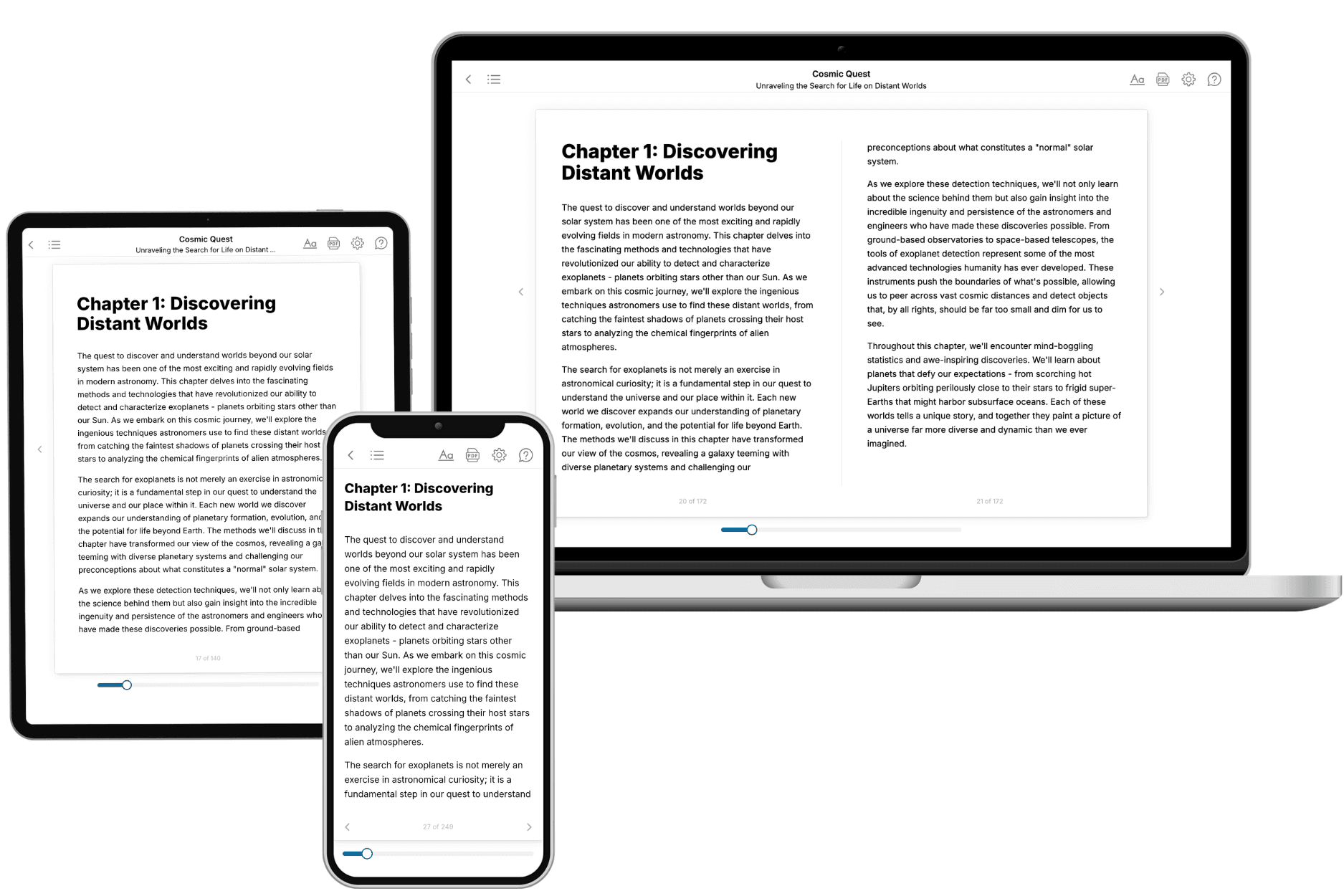
Your book is ready in 10 minutes. Read it online, download as EPUB or PDF, or send to Kindle.

Frequently asked questions
- What is TailoredRead?
TailoredRead creates complete, full-length nonfiction ebooks, written specifically for you. Tell us what you want to learn and why, and TailoredRead writes you a complete ebook on it, with charts, tables, and diagrams throughout. Read it online, on Kindle, or on any e-reader, or download it as a PDF or EPUB. Every book is written fresh the day you order it.
- How is the book tailored to me?
Before anything is written, you answer a few short questions about your goals, your background, and the topics you care about. Your book is then planned around your answers: written at your level, focused on your goals, and covering the topics you chose, instead of the one-size-fits-all book a store sells everyone.
- Will it read like generic AI content?
No. Your book isn't a chat transcript: it's planned chapter by chapter before a single word is written, told in a clear book voice, and explains ideas visually with charts, tables, and diagrams. After writing, every book goes through an editorial pass that polishes chapters so the book reads consistent from start to finish. Judge for yourself: browse thousands of sample books on our Explore Books page.
- How accurate is the content?
Our AI first checks whether your subject needs live research. Niche and fast-moving subjects are researched before writing, and the book plan and chapters are grounded in what it finds. After writing, every book goes through a quality pass that checks its facts and consistency, and researched books list their sources in a Notes section at the back.
- How long is the book?
You choose the length: Comprehensive (250-300 pages), Detailed (150-200 pages), Essential (70-100 pages), or Short (30-50 pages).
- Does the book include visuals?
Yes. Every book includes charts, tables, and diagrams: timelines, checklists, step-by-step guides, decision trees, comparison tables, matrices, and bar charts. A typical book includes dozens of these visual elements.
- Can I read it on Kindle? What formats can I download?
Yes. Every book can be read in our online reader or downloaded as a PDF or EPUB. The EPUB can be opened with Kindle, Apple Books, Kobo, and any e-reader. The Commercial and Author licenses also include an editable Word (DOCX) and Markdown download.
- How much does it cost?
About the price of a regular ebook. The exact price depends on your book's length and complexity, from $2 for the shortest books to $35 for the most comprehensive, and it's shown when you review your book, before you commit to anything. Each book is a one-time purchase, yours to keep, no subscription. Licenses that let you share, teach, or publish your book range from $35.99 to $49.99.
- Can I preview the book before purchasing?
Before you pay, you'll see what your book will cover: the title, a detailed description, the estimated length, and the complete chapter-by-chapter table of contents, so you know what you're getting before you decide. The full text itself is written after you purchase.
- How long does it take to create a book?
About 10 minutes. You can start reading the opening chapters while the rest is still being written.