Battles That Built a Nation
The Pivotal Conflicts That Shaped American Independence
Discover how a ragtag colonial militia defeated the British Empire's professional army through strategic brilliance, determination, and pivotal victories.
191 pages9 chaptersMay 29, 2026American Revolution
About this book
This comprehensive guide takes you through the Revolutionary War's most consequential battles—from the opening shots at Lexington and Concord to the decisive triumph at Yorktown. You'll explore the tactical decisions, leadership choices, and human stories behind each engagement, understanding how geography, supply chains, and military innovation shaped outcomes. Learn why certain battles became turning points that shifted momentum toward independence, and how each victory or defeat influenced the war's trajectory. Whether you're a history buff seeking deeper knowledge or someone curious about how America won its freedom, this book reveals the strategic brilliance and sacrifice that forged a nation.
Table of contents
- IntroductionWhy Revolutionary War Battles Matter Today, How to Read This Book, The War in Context: From Tension to IndependenceRead below
- Chapter 1: The Opening Shots: Lexington and ConcordRising Tensions and British Occupation, April 19, 1775: The Day Everything Changed, Why These Battles Sparked a Revolution
- Chapter 2: Bunker Hill: Proving American CourageThe Siege of Boston and Colonial Defiance, The Battle: Tactics and Terrain, A Costly Victory That Boosted American Morale
- Chapter 3: New York and the Turning Point of 1776Washington's Strategic Challenges in New York, The Battle of Long Island and Retreat, Trenton: Restoring Hope with a Daring Strike
- Chapter 4: Saratoga: The Battle That Changed EverythingBurgoyne's Ambitious Campaign from Canada, Freeman's Farm and the First Engagement, How Saratoga Secured French Support
- Chapter 5: Valley Forge and the Winter of SurvivalEnduring Hardship and Maintaining Resolve, Military Training and Organizational Reform, Emergence as a Professional Fighting Force
- Chapter 6: Charleston and the Southern CampaignBritain's Southern Strategy and Initial Success, The Siege of Charleston: A Major American Loss, Regrouping and Resistance in the South
- Chapter 7: Camden and the Road to RecoveryGeneral Gates and the Disaster at Camden, Nathanael Greene's Strategic Brilliance, Guerrilla Warfare and Unconventional Strategy
- Chapter 8: Cowpens: A Masterclass in TacticsMorgan's Innovative Battle Formation, The Battle: Precision and Coordination, Shifting Momentum in the Southern Theater
- Chapter 9: Yorktown: The Final VictoryCornwallis Cornered: The Setup for Surrender, The Siege: French and American Coordination, How Yorktown Secured American Independence
- ConclusionLessons from Revolutionary Battles, The Lasting Legacy of These Battles
- Further Reading and ResourcesRecommended Books on Revolutionary War Battles, Historic Battlefields to Visit, Primary Sources and Documentaries
Introduction
The American Revolutionary War lasted eight years, stretched across thirteen colonies, and involved tens of thousands of soldiers on both sides. Yet for all its complexity, the war was ultimately decided battle by battle, decision by decision, and moment by moment. Each engagement carried consequences that rippled far beyond the field where it was fought. A single afternoon of combat could shift the mood of an entire population, attract foreign allies, or convince a wavering commander to change his entire strategy. Understanding those battles is not just an exercise in military history. It is the clearest path to understanding how the United States came to exist at all.
What makes the Revolutionary War so compelling is the sheer improbability of the American victory. The Continental Army faced the British Empire, the most powerful military force of the eighteenth century, with a professional army, a dominant navy, and virtually unlimited resources. The colonists, by contrast, were poorly equipped, inconsistently trained, and chronically short of supplies. Their officer corps was largely self-taught. Their soldiers frequently served short enlistments and went home at critical moments. And yet they won. The story of how they won is told most vividly through the battles themselves, where tactical creativity, geographic advantage, and sheer determination repeatedly overcame superior firepower and numbers.
This book is built around the idea that battles are not isolated events. They are chapters in a larger story, each one shaped by what came before and shaping what comes after. The opening skirmishes at Lexington and Concord set a tone of defiance that made retreat politically impossible. The near-disaster in New York taught Washington lessons he would apply at Trenton. The triumph at Saratoga brought France into the war, which made Yorktown possible. Every engagement in this book connects to the others in ways that reveal the war's true logic. By the time you reach the final chapter, you will see the whole arc clearly, and you will understand why the outcome was never as inevitable as it might seem in hindsight.
A note on what this book covers and what it does not. The Revolutionary War involved dozens of significant engagements across a vast geographic area. This book focuses on the battles that had the greatest strategic and political consequences, the ones that genuinely changed the direction of the war. Some important engagements receive less attention not because they were unimportant, but because the battles selected here best illustrate the key themes: tactical innovation, leadership under pressure, the role of terrain and logistics, and the relationship between military outcomes and political will. Together, they tell the complete story of how independence was won.
Why Revolutionary War Battles Matter Today
It might be tempting to think of Revolutionary War battles as distant history, interesting but not especially relevant to the present. That view underestimates what these engagements actually represent. The decisions made on those fields, by commanders, soldiers, and political leaders, established patterns of military thinking, civic identity, and national character that still shape American life. The Revolutionary War was not just a military conflict. It was the founding act of a democratic republic, and the battles were the mechanism through which that republic was created or destroyed.
Consider what the Battle of Saratoga accomplished beyond the immediate military result. When General John Burgoyne surrendered his entire army in October 1777, the news traveled to Paris within weeks. French King Louis XVI, who had been cautiously supporting the Americans with secret aid, now saw a genuine opportunity to humiliate Britain. France entered the war as a formal ally in 1778, bringing naval power, professional troops, and financial resources that the Continental Army desperately needed.[1] Without Saratoga, there is no French alliance. Without the French alliance, there is almost certainly no Yorktown. The chain of consequences from a single battle reshaped the entire geopolitical landscape of the Atlantic world.
These battles also matter because they reveal something important about how underdogs win. The Continental Army's eventual success was not accidental. It resulted from a series of adaptations, learning from defeats, exploiting terrain, using unconventional tactics, and maintaining political support even through devastating losses. Those lessons have been studied by military strategists, political scientists, and organizational leaders ever since. The principles that Nathanael Greene applied in the Southern Campaign, trading space for time and exhausting a stronger opponent, appear in military doctrine and business strategy alike. The Revolutionary War was, among other things, a masterclass in asymmetric conflict.
There is also a human dimension that makes these battles matter in a deeply personal way. The men who fought at Bunker Hill, Valley Forge, and Cowpens were not professional soldiers in the modern sense. Many were farmers, tradesmen, and apprentices who had never fired a weapon in anger before the war began. Their courage, endurance, and sacrifice built something that had never existed before: a nation founded on the principle that government derives its authority from the consent of the governed. Understanding what they went through, and what they achieved, is a form of civic literacy that connects the present to its origins.
The battles also illuminate the war's darker complexities. The Revolutionary War was not a clean story of unified colonists rising against a tyrannical empire. It was a civil conflict in many respects, with Loyalists fighting alongside British forces and communities divided against themselves. Native American nations were drawn into the conflict on both sides. Enslaved people faced impossible choices, with some fighting for the British in exchange for promises of freedom and others serving in the Continental Army. These dimensions of the war are visible in the battles themselves, and this book does not shy away from them. A complete understanding of the conflict requires acknowledging its full human complexity.
Finally, these battles matter because they demonstrate the relationship between military events and political outcomes in a way that is unusually clear and direct. The Continental Congress needed military victories to maintain public support for independence. Washington needed political support to keep his army funded and supplied. Each battle was fought not just on the ground but in the court of public opinion, in the halls of European capitals, and in the minds of colonists who were still deciding which side to support. That interplay between military action and political consequence is one of the most important lessons the Revolutionary War has to offer, and it runs through every chapter of this book.
How to Read This Book
This book is designed to be read from beginning to end, following the chronological arc of the war from the first shots at Lexington in April 1775 to the surrender at Yorktown in October 1781. That sequence matters because each battle builds on the ones before it. The lessons Washington learned in New York directly influenced his decisions at Trenton. The momentum gained at Saratoga shaped the strategic environment in which the Southern Campaign unfolded. Reading in order gives you the full picture of how the war evolved and why each engagement mattered when it did.
That said, if you already have a strong foundation in Revolutionary War history and want to focus on specific engagements, each chapter is written to stand on its own. Key context is provided within each chapter so that you can understand the battle's significance without necessarily having read everything that came before. Cross-references to earlier chapters are included where the connections are especially important, so you can follow those threads if you want to deepen your understanding of a particular theme or decision.
Each chapter follows a consistent structure designed to give you both the tactical details and the broader significance of each battle. You will find:
- Strategic context: What was happening in the war at the time, and why this battle was being fought at all
- Terrain and logistics: How geography, supply lines, and physical conditions shaped the engagement
- Tactical decisions: The specific choices commanders made before and during the battle, and why they made them
- Human stories: The experiences of soldiers and leaders that bring the battle to life
- Consequences: How the outcome affected the war's trajectory, public morale, and political dynamics
Maps and troop positions are described in enough detail that you can visualize the battlefield without needing a separate atlas, though consulting historical maps alongside the text will enrich your understanding considerably. Several excellent online resources for Revolutionary War maps are listed in the Further Reading section at the back of the book. If you find yourself wanting to see the ground where these battles were fought, the Historical Sites section provides guidance on visiting the major battlefields, many of which are remarkably well preserved.
One approach that many readers find valuable is to pause at the end of each chapter and consider the counterfactual: what might have happened if the battle had gone differently? What if Washington had been captured during the retreat from Long Island? What if Burgoyne had not surrendered at Saratoga? These questions are not idle speculation. They help clarify why specific decisions and outcomes mattered, and they reveal how contingent the American victory actually was. The war could have ended very differently at multiple points, and recognizing that makes the eventual outcome all the more remarkable.
The footnotes throughout the book point to primary sources, scholarly histories, and specific studies that support the claims being made. These are not just formalities. They are invitations to go deeper. The Revolutionary War has been studied by some of the finest historians in American scholarship, and their work is accessible, engaging, and often surprising. If a particular battle or commander captures your interest, the footnotes and the Further Reading section will point you toward the best sources for continued exploration.
Finally, a word about perspective. This book focuses primarily on the American and British sides of the conflict, because those are the perspectives most directly relevant to understanding how independence was won and lost. But the war involved many other actors, including French and German forces, Native American nations, Loyalist militias, and enslaved people whose choices and experiences shaped the conflict in ways that are still being fully understood by historians. Where those perspectives are directly relevant to a battle's outcome or significance, they are included. The goal throughout is accuracy, context, and a genuine respect for the complexity of what actually happened.
The War in Context: From Tension to Independence
To understand the battles in this book, you need a clear picture of the world in which they were fought. The Revolutionary War did not begin suddenly or without warning. It was the product of more than a decade of escalating tension between the British government and its American colonies, a tension rooted in fundamental disagreements about taxation, representation, and the limits of imperial authority. By the time the first shots were fired in April 1775, both sides had been preparing for conflict, consciously or not, for years.
The core dispute was straightforward in principle, though enormously complicated in practice. Britain had accumulated massive debt fighting the Seven Years' War (known in America as the French and Indian War), which ended in 1763. Parliament decided that the American colonies, which had benefited from British military protection during that war, should help pay for it. A series of tax acts followed, including the Stamp Act of 1765 and the Townshend Acts of 1767, each of which provoked fierce colonial resistance.[2] The colonists' objection was not simply that they were being taxed. It was that they were being taxed by a Parliament in which they had no elected representatives. The phrase "no taxation without representation" captured a principle that colonists took seriously as a matter of constitutional right.
The situation deteriorated through a series of confrontations that hardened attitudes on both sides. The Boston Massacre of 1770, in which British soldiers fired into a crowd and killed five colonists, became a powerful piece of anti-British propaganda. The Boston Tea Party of 1773, in which colonists dumped an entire shipment of British tea into the harbor to protest the Tea Act, prompted Parliament to pass the Coercive Acts of 1774, which the colonists called the Intolerable Acts. These measures closed Boston's port, restricted colonial self-governance, and required colonists to house British soldiers. Rather than suppressing resistance, they unified it. The First Continental Congress met in September 1774, bringing together delegates from twelve colonies to coordinate a response.
By early 1775, both sides were moving toward open conflict. British General Thomas Gage, commanding the occupation forces in Boston, knew that colonial militias were stockpiling weapons and ammunition in the countryside. His decision to send troops to seize those supplies at Concord on April 19, 1775, triggered the battles that opened the war. What followed was not a planned military campaign but a spontaneous uprising that quickly took on a life of its own. Within weeks, colonial forces had surrounded Boston and the British army found itself besieged in a city it nominally controlled.
The formal declaration of independence came more than a year after the fighting began. The Second Continental Congress, meeting in Philadelphia, spent much of 1775 and early 1776 debating whether to seek reconciliation with Britain or commit fully to independence. The publication of Thomas Paine's Common Sense in January 1776 shifted public opinion dramatically, arguing in plain language that monarchy was inherently corrupt and that independence was not just desirable but necessary.[3] On July 4, 1776, Congress adopted the Declaration of Independence, transforming a military rebellion into a revolutionary war with a clear political objective.
The military situation at the time of the Declaration was not encouraging. Washington's army had been driven out of New York by a massive British force under General William Howe, and the Continental Army was retreating across New Jersey in disarray. Enlistments were expiring, morale was collapsing, and many observers on both sides believed the rebellion would be crushed within months. The battles that followed, at Trenton, Princeton, Saratoga, and eventually Yorktown, would prove those observers wrong. But the path from that desperate December of 1776 to final victory in 1781 was neither straight nor certain.
Understanding the war's broader context also means recognizing the role of geography. The thirteen colonies stretched along more than a thousand miles of Atlantic coastline, with vast interior territories beyond. Britain's strategy depended on controlling key ports and waterways, cutting the colonies apart, and suppressing resistance region by region. The Americans' strategy, developed largely by Washington through painful experience, was to keep the Continental Army intact, avoid decisive defeat, and wait for British political will to erode. That strategy required understanding terrain, supply lines, and the limits of what a smaller, less-equipped force could realistically accomplish. The battles in this book are, in large part, the story of how both strategies played out in practice.
The war also unfolded against a backdrop of global conflict. Britain was not fighting only in America. France, Spain, and the Netherlands all entered the conflict at various points, stretching British military and naval resources across multiple theaters. The Caribbean colonies, which were economically more valuable to Britain than the American mainland, required significant naval protection. India and the Mediterranean also demanded British attention. This global dimension of the war is easy to overlook when focusing on individual battles, but it shaped the strategic calculations of British commanders and politicians throughout the conflict. The American victory was partly a product of British overextension, and that overextension was visible in the decisions made at every level of the war.
The Revolutionary War was not won in a single glorious moment. It was won through eight years of persistence, adaptation, and sacrifice, battle by battle, winter by winter, until the British government concluded that the cost of continuing was greater than the value of what they were fighting to keep.
That is the story this book tells. It begins with a shot fired on a village green in Massachusetts and ends with a formal surrender ceremony on a Virginia peninsula. In between, you will find some of the most consequential military engagements in American history, fought by ordinary people in extraordinary circumstances. The battles built a nation, and understanding them is the best way to understand what that nation was built on, and what it cost to build it.
This is the end of the free sample. The full book has 9 chapters.
Want this book written for you?
Tell us your goals and background, and get your own version of this book, tailored by AI to you.


Benefits of AI-tailored books
- Read one book, not ten:
- all the American Revolution knowledge you need, gathered into a single book.
- Save days of learning:
- tell us your goals, choose your topics, and the whole book is built around them.
- Learn effortlessly:
- American Revolution book written for your specific background and expertise.
- Understand at a glance:
- includes charts, tables, timelines, checklists, decision trees, and more.
- Stay current:
- written the day you order it, not years ago.
- Trust what you read:
- every book is checked for accuracy, with real research when your subject needs it.
Create your unique book in 3 steps
- 1. Select your focus
Select the focus of your American Revolution book and share your background
- 2. Personalize your book
Specify your goals and choose sub-topics to include
- 3. Get your tailored book
Your book is ready in 10 minutes. Read it online, download as EPUB or PDF, or send to Kindle.


Frequently asked questions
- What is TailoredRead?
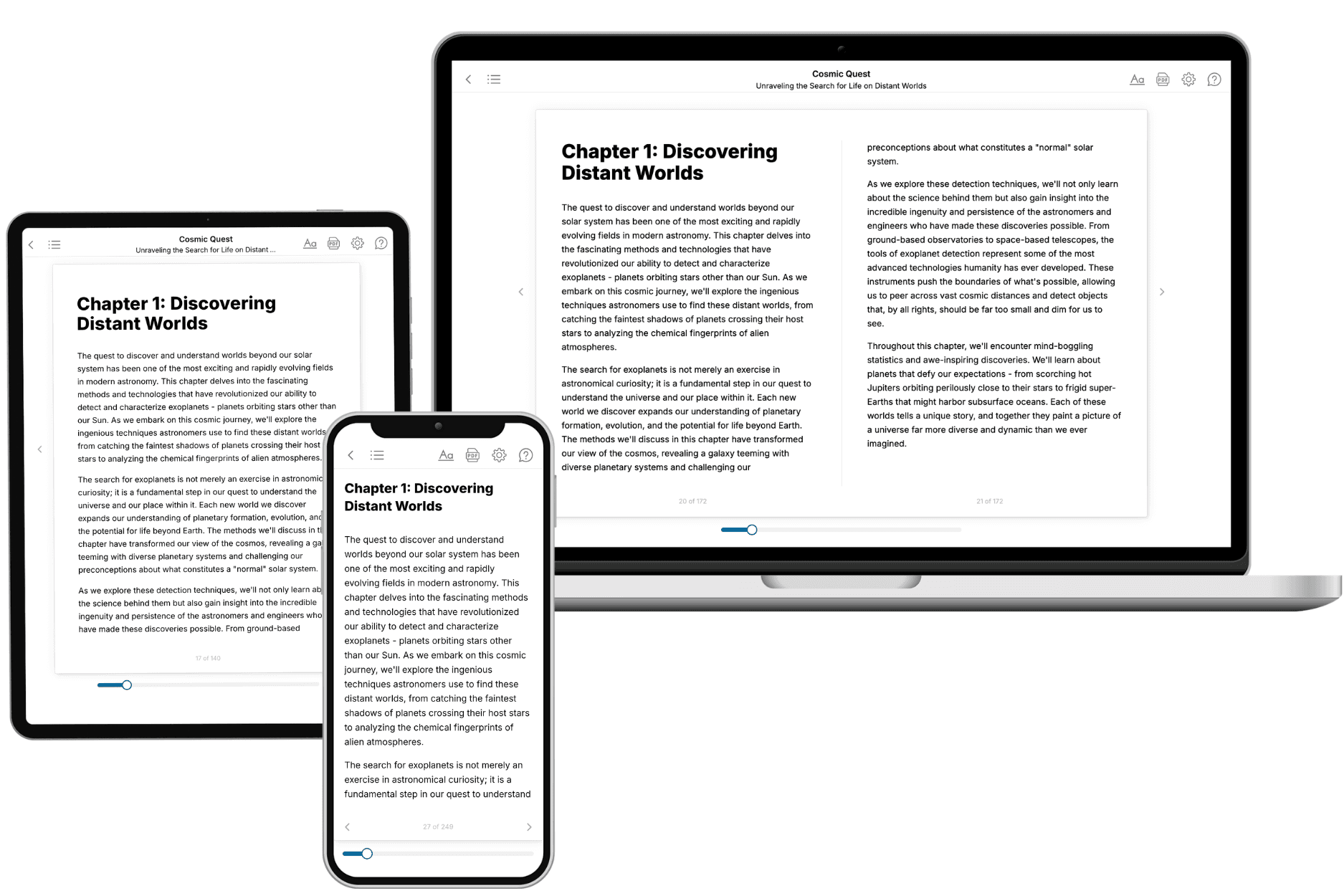
TailoredRead creates complete, full-length nonfiction ebooks, written specifically for you. Tell us what you want to learn and why, and TailoredRead writes you a complete ebook on it, with charts, tables, and diagrams throughout. Read it online, on Kindle, or on any e-reader, or download it as a PDF or EPUB. Every book is written fresh the day you order it.
- How is the book tailored to me?
Before anything is written, you answer a few short questions about your goals, your background, and the topics you care about. Your book is then planned around your answers: written at your level, focused on your goals, and covering the topics you chose, instead of the one-size-fits-all book a store sells everyone.
- Will it read like generic AI content?
No. Your book isn't a chat transcript: it's planned chapter by chapter before a single word is written, told in a clear book voice, and explains ideas visually with charts, tables, and diagrams. After writing, every book goes through an editorial pass that polishes chapters so the book reads consistent from start to finish. Judge for yourself: browse thousands of sample books on our Explore Books page.
- How accurate is the content?
Our AI first checks whether your subject needs live research. Niche and fast-moving subjects are researched before writing, and the book plan and chapters are grounded in what it finds. After writing, every book goes through a quality pass that checks its facts and consistency, and researched books list their sources in a Notes section at the back.
- How long is the book?
You choose the length: Comprehensive (250-300 pages), Detailed (150-200 pages), Essential (70-100 pages), or Short (30-50 pages).
- Does the book include visuals?
Yes. Every book includes charts, tables, and diagrams: timelines, checklists, step-by-step guides, decision trees, comparison tables, matrices, and bar charts. A typical book includes dozens of these visual elements.
- Can I read it on Kindle? What formats can I download?
Yes. Every book can be read in our online reader or downloaded as a PDF or EPUB. The EPUB can be opened with Kindle, Apple Books, Kobo, and any e-reader. The Commercial and Author licenses also include an editable Word (DOCX) and Markdown download.
- How much does it cost?
About the price of a regular ebook. The exact price depends on your book's length and complexity, from $2 for the shortest books to $35 for the most comprehensive, and it's shown when you review your book, before you commit to anything. Each book is a one-time purchase, yours to keep, no subscription. Licenses that let you share, teach, or publish your book range from $35.99 to $49.99.
- Can I preview the book before purchasing?
Before you pay, you'll see what your book will cover: the title, a detailed description, the estimated length, and the complete chapter-by-chapter table of contents, so you know what you're getting before you decide. The full text itself is written after you purchase.
- How long does it take to create a book?
About 10 minutes. You can start reading the opening chapters while the rest is still being written.