Bayesian Thinking
How to Make Better Decisions with Probability and Data
Many people believe that statistics is about finding the single "correct" answer hidden in data.
207 pages9 chaptersDec 16, 2025Bayesian Statistics
About this book
In reality, Bayesian inference reveals something more powerful: how to systematically update what you believe as new evidence emerges. This book demystifies Bayesian thinking and shows you how it drives modern AI, machine learning, and better decision-making. You'll learn why your prior assumptions matter, how to interpret data through a Bayesian lens, and how to quantify uncertainty rather than pretend it doesn't exist. Whether you're evaluating business strategies, building predictive models, or simply trying to make smarter choices, Bayesian methods provide a principled framework grounded in probability theory. This guide bridges the gap between mathematical foundations and practical application, using clear explanations and real-world examples to help you think probabilistically about the world.
Table of contents
- IntroductionWhy Bayesian Thinking Matters Today, How This Book Is Organized, What You'll Be Able to DoRead below
- Chapter 1: The Foundations of Bayesian ThinkingProbability as Belief, Not Just Frequency, Understanding Bayes' Theorem, Building Intuition Before the Math
- Chapter 2: Priors: Your Starting PointWhat Priors Represent and Why They Matter, How to Choose Appropriate Priors, Testing Sensitivity to Prior Assumptions
- Chapter 3: Likelihoods: Connecting Data to HypothesesWhat the Likelihood Function Tells You, Building Likelihood Models from Data, Real-World Likelihood Examples
- Chapter 4: Posteriors: Your Updated KnowledgeInterpreting Posterior Distributions, Making Inferences from Posteriors, Credible Intervals and Uncertainty Quantification
- Chapter 5: Bayesian Decision TheoryFrom Inference to Action, Defining Loss Functions and Utility, Finding Optimal Decisions Under Uncertainty
- Chapter 6: Bayesian Methods in Machine LearningHow Bayesian Thinking Powers Modern ML, Bayesian Regression and Uncertainty in Predictions, Bayesian Classification and Probabilistic Models
- Chapter 7: Computational Methods for Bayesian InferenceWhy Computation Matters in Bayesian Analysis, Markov Chain Monte Carlo: Sampling from Posteriors, Variational Inference: Fast Approximations
- Chapter 8: Practical Applications and Case StudiesMedical Diagnosis and Test Interpretation, Business Analytics and A/B Testing, Building Predictive Models with Uncertainty
- Chapter 9: Common Pitfalls and How to Avoid ThemAvoiding Overconfidence in Your Posteriors, Recognizing and Handling Model Misspecification, Diagnosing Computational Problems
- ConclusionKey Takeaways for Your Journey, Next Steps in Your Bayesian Learning
- Glossary
- Further Reading and Resources
Introduction
Every day, you make decisions based on incomplete information. You check the weather forecast and decide whether to carry an umbrella. You evaluate a job candidate based on their resume and interview performance. You assess whether a new marketing campaign will succeed based on early results. In each case, you're doing something remarkably sophisticated: combining what you already know with new evidence to form updated beliefs. This process, whether you realize it or not, follows the principles of Bayesian thinking.
Traditional statistics often treats uncertainty as something to eliminate or ignore. You run a test, get a p-value, and declare something "statistically significant" or not. But this approach discards valuable information and can lead to poor decisions. Bayesian inference takes a fundamentally different approach. It treats probability as a measure of belief rather than just long-run frequency. It explicitly incorporates your prior knowledge. Most importantly, it quantifies uncertainty at every step, giving you a complete picture of what you know and what you don't know.
This book will change how you think about data, decisions, and uncertainty. You'll learn why the Bayesian framework has become essential in modern artificial intelligence and machine learning. You'll discover how to update your beliefs systematically as new evidence arrives. You'll understand why being explicit about your assumptions makes your reasoning stronger, not weaker. Whether you're analyzing business metrics, building predictive models, or simply trying to make better personal decisions, Bayesian methods provide a principled foundation grounded in probability theory.
The beauty of Bayesian thinking lies in its coherence and flexibility. Unlike approaches that force you to choose between competing schools of thought, Bayesian inference provides a unified framework for reasoning under uncertainty. It works equally well whether you have massive datasets or just a handful of observations. It naturally handles complex hierarchical structures and missing data. It allows you to incorporate expert knowledge alongside empirical evidence. Most importantly, it produces results you can actually interpret: probabilities that directly answer the questions you care about.
You don't need to be a mathematician to benefit from Bayesian thinking. While the underlying theory is rigorous, the core concepts are intuitive once you see them clearly. This book bridges the gap between mathematical foundations and practical application. You'll learn to think probabilistically about real-world problems before diving into computational details. You'll see concrete examples that illustrate abstract concepts. You'll gain both the conceptual understanding and the practical tools needed to apply Bayesian methods in your own work.
Why Bayesian Thinking Matters Today
The rise of artificial intelligence and machine learning has made Bayesian thinking more relevant than ever. Modern AI systems don't just make predictions—they quantify their uncertainty about those predictions. When a self-driving car decides whether to proceed through an intersection, it doesn't just estimate the probability that another vehicle is approaching. It maintains a full probability distribution over possible scenarios and updates that distribution millisecond by millisecond as new sensor data arrives. This is Bayesian inference in action, happening thousands of times per second.
Consider how recommendation systems work on platforms like Netflix or Amazon. These systems don't simply assume they know your preferences with certainty. Instead, they maintain probabilistic beliefs about what you might like, updating those beliefs every time you watch a show, rate a product, or even hover over a thumbnail. The system starts with prior beliefs based on demographic information and general patterns. It then updates these beliefs using the likelihood of your observed behavior given different preference models. The result is a posterior distribution over your preferences that becomes more refined with each interaction. This Bayesian approach allows the system to balance exploration and exploitation, recommending both safe bets and calculated risks.
Beyond AI applications, Bayesian methods have transformed fields ranging from medicine to finance. In medical diagnosis, doctors have always thought in Bayesian terms, even if they didn't use that language. When a patient presents with symptoms, the doctor considers the base rate of various diseases in the population (the prior), evaluates how likely those symptoms would be for each disease (the likelihood), and arrives at a differential diagnosis (the posterior). Modern clinical decision support systems make this process explicit and rigorous, helping doctors avoid common cognitive biases like ignoring base rates or overweighting recent experiences.
Financial markets provide another compelling example. Portfolio managers must make decisions under profound uncertainty about future returns, correlations, and risks. Traditional approaches often pretend this uncertainty doesn't exist, producing point estimates that give false confidence. Bayesian methods, by contrast, embrace uncertainty as fundamental. They allow you to incorporate diverse information sources—historical data, economic theory, expert judgment—and produce probability distributions over future outcomes. This enables more robust risk management and better-calibrated decisions. During the 2008 financial crisis, institutions that properly quantified their uncertainty fared better than those that relied on overconfident models.
The COVID-19 pandemic demonstrated the power of Bayesian thinking on a global scale. Epidemiological models needed to make predictions with limited data that was constantly changing. Bayesian approaches allowed researchers to incorporate prior knowledge from previous pandemics, update their models as new data arrived, and explicitly quantify uncertainty in their forecasts. When early data suggested a certain transmission rate, Bayesian models didn't treat that estimate as fixed truth. Instead, they maintained probability distributions that reflected genuine uncertainty, allowing for more honest communication about what was known and unknown.
In business analytics, the shift toward Bayesian methods reflects a growing recognition that traditional hypothesis testing often answers the wrong questions. When you run an A/B test on your website, you don't really care whether the difference between variants is "statistically significant" at some arbitrary threshold. You want to know: What's the probability that variant B is better than variant A? By how much? What's the expected value of switching? Bayesian analysis answers these questions directly, providing actionable insights rather than binary decisions based on p-values.
Perhaps most importantly, Bayesian thinking provides a framework for learning from experience in a principled way. Every time you gather new data, you update your beliefs according to Bayes' theorem. Your posterior from one analysis becomes the prior for the next. This creates a coherent learning process where knowledge accumulates systematically. You never throw away information or start from scratch. This is exactly how scientific knowledge progresses and how intelligent systems improve over time. Understanding this process helps you become a more effective learner and decision-maker in any domain.
The computational revolution has made Bayesian methods practical for problems that were intractable just decades ago. Modern algorithms like Markov Chain Monte Carlo (MCMC) and variational inference can handle models with thousands or millions of parameters. Software libraries like Stan, PyMC, and TensorFlow Probability have made these methods accessible to practitioners without requiring deep expertise in numerical methods. Cloud computing provides the computational power needed for complex analyses. This democratization of Bayesian tools means you can now apply sophisticated probabilistic reasoning to real-world problems without needing a PhD in statistics.
How This Book Is Organized
This book follows a carefully structured path from foundational concepts to practical applications. Each chapter builds on previous material while remaining as self-contained as possible. The organization reflects how Bayesian thinking actually works: starting with basic probability concepts, moving through the components of Bayesian inference, and culminating in real-world applications and computational methods. You can read straight through for a comprehensive education, or jump to specific chapters that address your immediate needs.
Chapter 1: The Foundations of Bayesian Thinking establishes the conceptual groundwork. You'll learn why probability should be interpreted as a measure of belief rather than just long-run frequency. This chapter introduces Bayes' theorem not as an abstract formula but as a natural way to update beliefs with evidence. You'll develop intuition for how the theorem works before diving into mathematical details. The emphasis is on understanding the logic of Bayesian inference and why it provides a coherent framework for reasoning under uncertainty. By the end of this chapter, you'll see why Bayesian methods are fundamentally different from traditional statistical approaches.
Chapter 2: Priors explores your starting point in any Bayesian analysis. Many people initially resist the idea of incorporating prior beliefs, viewing it as subjective or arbitrary. This chapter shows why priors are actually a strength of the Bayesian approach, making your assumptions explicit rather than hiding them. You'll learn how to choose appropriate priors for different situations, ranging from informative priors based on domain expertise to weakly informative priors that let the data speak. The chapter also covers sensitivity analysis: testing how your conclusions change with different prior assumptions. This transparency about assumptions leads to more honest and robust inference.
Chapter 3: Likelihoods examines how you connect your data to your hypotheses. The likelihood function answers the question: How probable is this observed data under different possible explanations? This chapter shows you how to construct likelihood models for various types of data and problems. You'll see concrete examples ranging from simple coin flips to complex regression models. Understanding likelihoods is crucial because they represent the information your data provides, independent of your prior beliefs. The chapter emphasizes building appropriate models that capture the essential features of your problem without unnecessary complexity.
Chapter 4: Posteriors brings priors and likelihoods together to produce your updated knowledge. The posterior distribution represents everything you know after seeing the data, combining prior information with empirical evidence. This chapter teaches you how to interpret posterior distributions, extract meaningful summaries, and quantify uncertainty through credible intervals. You'll learn the crucial difference between Bayesian credible intervals and frequentist confidence intervals—a distinction that affects how you communicate uncertainty. The chapter also covers posterior predictive distributions, which allow you to make predictions about future observations while properly accounting for uncertainty.
Chapter 5: Bayesian Decision Theory extends inference to action. Knowing the posterior distribution is valuable, but ultimately you need to make decisions. This chapter introduces the framework of decision theory, where you specify loss functions or utility functions that quantify the consequences of different actions. You'll learn how to find optimal decisions that minimize expected loss or maximize expected utility. The chapter covers both simple decision problems and more complex scenarios involving sequential decisions. This material is essential for anyone who needs to translate probabilistic knowledge into concrete actions, whether in business, medicine, or engineering.
Chapter 6: Bayesian Methods in Machine Learning shows how Bayesian principles power modern AI systems. You'll see how Bayesian regression provides not just predictions but uncertainty estimates around those predictions. The chapter covers Bayesian classification, showing how probabilistic models naturally handle class imbalance and provide calibrated probability estimates. You'll learn about Bayesian neural networks and Gaussian processes, which extend deep learning with principled uncertainty quantification. This chapter is crucial for anyone working in data science or machine learning who wants to build more robust and interpretable models.
Chapter 7: Computational Methods addresses the practical challenge of actually computing posterior distributions. For most real-world problems, you can't calculate the posterior analytically—you need computational methods. This chapter introduces Markov Chain Monte Carlo (MCMC) algorithms, which generate samples from the posterior distribution. You'll learn about different MCMC variants, including Metropolis-Hastings and Hamiltonian Monte Carlo. The chapter also covers variational inference, a faster alternative that approximates the posterior with a simpler distribution. You'll gain practical knowledge about when to use each method, how to diagnose convergence problems, and how to interpret the results.
Chapter 8: Practical Applications and Case Studies demonstrates Bayesian methods in action across diverse domains. You'll see detailed examples of medical diagnosis, where Bayesian reasoning helps interpret test results correctly. The chapter covers business applications like A/B testing and customer lifetime value prediction. You'll learn how to build predictive models that quantify uncertainty, making them more useful for decision-making. Each case study walks through the complete analysis process: formulating the problem, choosing priors and likelihoods, computing the posterior, and making decisions based on the results. These examples provide templates you can adapt to your own problems.
Chapter 9: Common Pitfalls helps you avoid mistakes that can undermine Bayesian analyses. You'll learn how to recognize and avoid overconfidence in your posteriors, which can occur when your model is too simple or your priors too strong. The chapter covers model misspecification: what happens when your assumptions don't match reality, and how to detect and address this problem. You'll also learn computational diagnostics for identifying when MCMC algorithms haven't converged or when variational approximations are poor. This chapter is essential for developing the critical thinking skills needed to apply Bayesian methods responsibly.
What You'll Be Able to Do
By the end of this book, you'll possess a comprehensive toolkit for probabilistic reasoning and decision-making. You'll be able to look at a problem involving uncertainty and immediately recognize how to frame it in Bayesian terms. You'll identify what prior information is available, what data you can collect, and how to combine these elements to reach well-calibrated conclusions. This skill transcends specific applications—it's a way of thinking that applies whenever you need to reason under uncertainty, which is essentially always.
Specifically, you'll be able to formulate Bayesian models for real-world problems. This means taking a messy, ambiguous situation and translating it into a precise probabilistic framework. You'll choose appropriate probability distributions for your priors based on available information and domain knowledge. You'll construct likelihood functions that capture how your data relates to the quantities you care about. You'll understand the trade-offs between model complexity and interpretability, knowing when to add sophistication and when to keep things simple. This modeling skill is perhaps the most valuable outcome of studying Bayesian methods, as it forces you to think clearly about your assumptions and what your data can actually tell you.
You'll gain the ability to interpret and communicate uncertainty effectively. Instead of making overconfident point predictions, you'll provide probability distributions that honestly reflect what you know and don't know. You'll be able to explain what a 95% credible interval means and why it's more intuitive than a confidence interval. You'll understand how to visualize posterior distributions in ways that convey information clearly to both technical and non-technical audiences. This skill is increasingly valuable in a world where decision-makers are learning to distrust false precision and demand honest assessments of uncertainty.
The book will equip you to implement Bayesian analyses computationally. You'll understand the principles behind MCMC and variational inference well enough to use modern software tools effectively. You'll be able to write probabilistic programs in languages like Stan or PyMC, specifying your model and letting the software handle the computational details. You'll know how to diagnose convergence problems, tune algorithm parameters, and validate your results. While this book focuses on concepts rather than code, you'll develop the understanding needed to translate concepts into working implementations. The computational skills you gain will allow you to tackle problems that would be intractable with analytical methods alone.
You'll develop expertise in Bayesian decision-making, moving beyond inference to action. You'll be able to specify loss functions that capture the real-world consequences of different decisions. You'll compute expected losses under your posterior distribution and identify optimal actions. You'll understand how to incorporate the value of information into your decisions, determining when it's worth gathering more data before acting. This decision-theoretic perspective is crucial for anyone who needs to make consequential choices under uncertainty, whether you're allocating resources, designing experiments, or setting policies.
In the context of machine learning, you'll be able to build and evaluate probabilistic models that quantify predictive uncertainty. You'll understand how Bayesian neural networks differ from standard neural networks and when the additional complexity is justified. You'll be able to implement Bayesian regression models that provide uncertainty estimates for predictions, making them more useful for risk-sensitive applications. You'll know how to use posterior predictive checks to validate your models and identify areas where they fail to capture important patterns in the data. These skills are increasingly essential as machine learning systems are deployed in high-stakes domains where understanding uncertainty is critical.
You'll acquire the ability to critically evaluate Bayesian analyses, whether your own or others'. You'll be able to assess whether priors are reasonable or whether they're driving the conclusions inappropriately. You'll recognize when likelihood models are misspecified and understand the implications. You'll know how to check computational diagnostics and identify when results are unreliable. You'll be able to perform sensitivity analyses to test how robust conclusions are to modeling assumptions. This critical perspective is essential for responsible application of Bayesian methods and for avoiding the pitfalls that can lead to poor decisions.
Perhaps most importantly, you'll develop probabilistic intuition—a gut-level understanding of how probability works and how beliefs should update with evidence. You'll internalize concepts like base rates, likelihood ratios, and the balance between prior information and data. You'll recognize common fallacies like the prosecutor's fallacy or the base rate neglect that plague human reasoning. You'll be able to make quick, approximate Bayesian calculations in your head for everyday decisions. This intuition will serve you well beyond formal analyses, improving your judgment in all areas of life where you need to reason under uncertainty.
The skills you develop from this book will be immediately applicable across diverse domains. If you work in data science or machine learning, you'll be able to build more robust models with proper uncertainty quantification. If you're in business analytics, you'll make better decisions about experiments, investments, and strategies. If you're in research, you'll be able to design better studies and draw more appropriate conclusions from your data. If you're simply interested in thinking more clearly about an uncertain world, you'll have a principled framework for updating your beliefs as new evidence emerges. Bayesian thinking is not just a technical skill—it's a fundamental approach to reasoning that will enhance your decision-making in countless ways.
This is the end of the free sample. The full book has 9 chapters.
Want this book written for you?
Tell us your goals and background, and get your own version of this book, tailored by AI to you.


Benefits of AI-tailored books
- Read one book, not ten:
- all the Bayesian Statistics knowledge you need, gathered into a single book.
- Save days of learning:
- tell us your goals, choose your topics, and the whole book is built around them.
- Learn effortlessly:
- Bayesian Statistics book written for your specific background and expertise.
- Understand at a glance:
- includes charts, tables, timelines, checklists, decision trees, and more.
- Stay current:
- written the day you order it, not years ago.
- Trust what you read:
- every book is checked for accuracy, with real research when your subject needs it.
Create your unique book in 3 steps
- 1. Select your focus
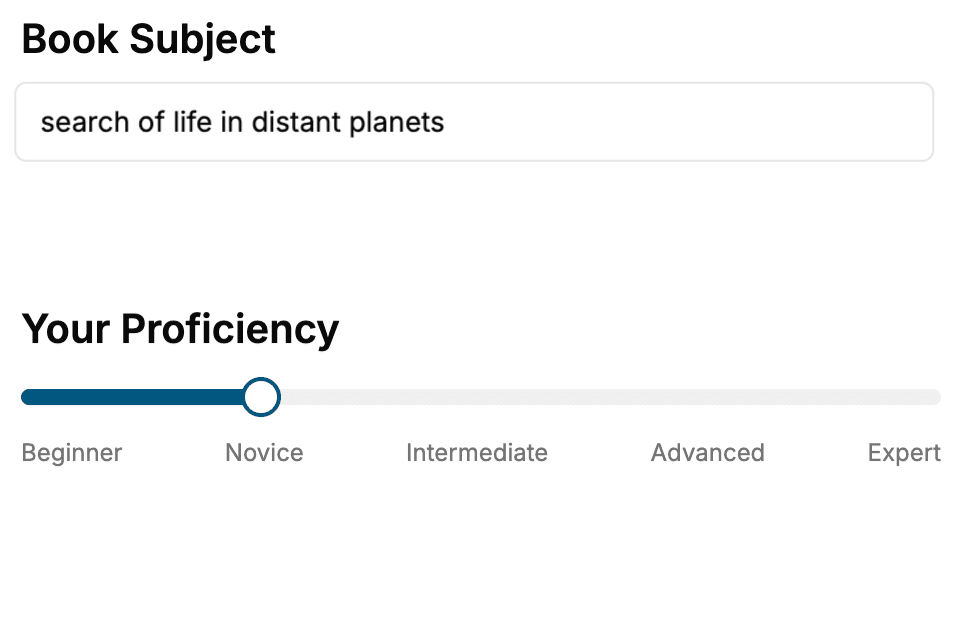
Select the focus of your Bayesian Statistics book and share your background
- 2. Personalize your book
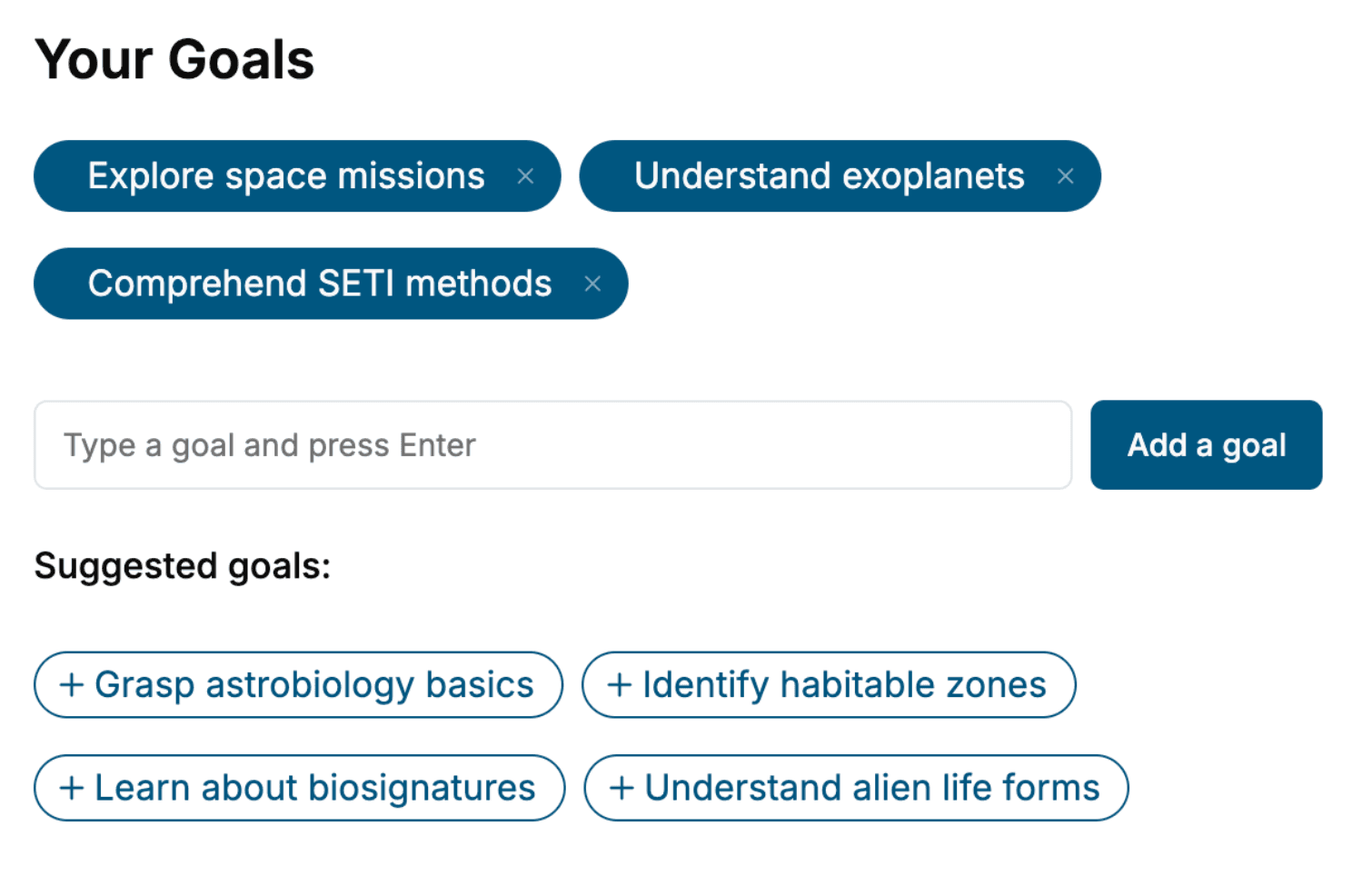
Specify your goals and choose sub-topics to include
- 3. Get your tailored book
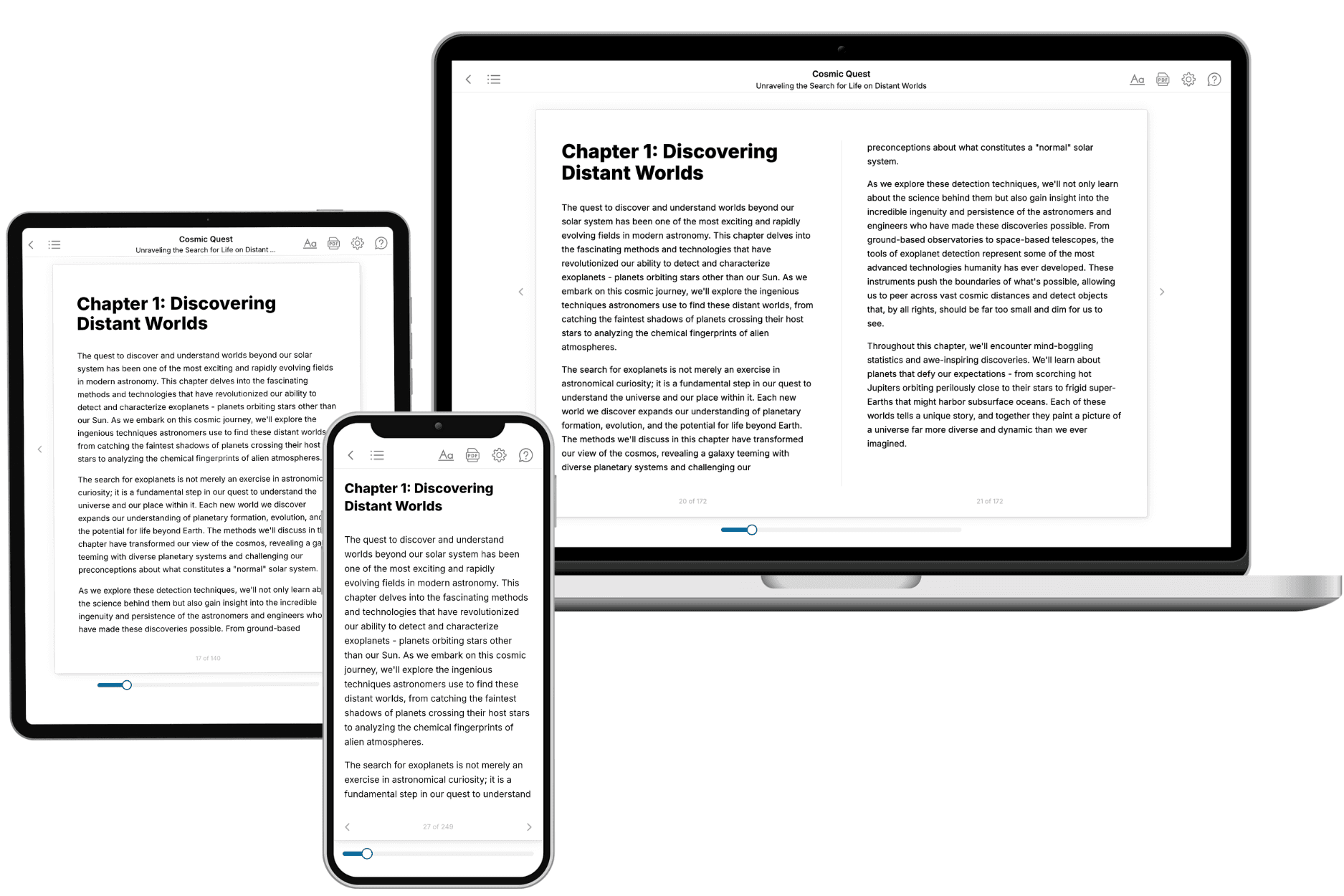
Your book is ready in 10 minutes. Read it online, download as EPUB or PDF, or send to Kindle.
Frequently asked questions
- What is TailoredRead?
TailoredRead creates complete, full-length nonfiction ebooks, written specifically for you. Tell us what you want to learn and why, and TailoredRead writes you a complete ebook on it, with charts, tables, and diagrams throughout. Read it online, on Kindle, or on any e-reader, or download it as a PDF or EPUB. Every book is written fresh the day you order it.
- How is the book tailored to me?
Before anything is written, you answer a few short questions about your goals, your background, and the topics you care about. Your book is then planned around your answers: written at your level, focused on your goals, and covering the topics you chose, instead of the one-size-fits-all book a store sells everyone.
- Will it read like generic AI content?
No. Your book isn't a chat transcript: it's planned chapter by chapter before a single word is written, told in a clear book voice, and explains ideas visually with charts, tables, and diagrams. After writing, every book goes through an editorial pass that polishes chapters so the book reads consistent from start to finish. Judge for yourself: browse thousands of sample books on our Explore Books page.
- How accurate is the content?
Our AI first checks whether your subject needs live research. Niche and fast-moving subjects are researched before writing, and the book plan and chapters are grounded in what it finds. After writing, every book goes through a quality pass that checks its facts and consistency, and researched books list their sources in a Notes section at the back.
- How long is the book?
You choose the length: Comprehensive (250-300 pages), Detailed (150-200 pages), Essential (70-100 pages), or Short (30-50 pages).
- Does the book include visuals?
Yes. Every book includes charts, tables, and diagrams: timelines, checklists, step-by-step guides, decision trees, comparison tables, matrices, and bar charts. A typical book includes dozens of these visual elements.
- Can I read it on Kindle? What formats can I download?
Yes. Every book can be read in our online reader or downloaded as a PDF or EPUB. The EPUB can be opened with Kindle, Apple Books, Kobo, and any e-reader. The Commercial and Author licenses also include an editable Word (DOCX) and Markdown download.
- How much does it cost?
About the price of a regular ebook. The exact price depends on your book's length and complexity, from $2 for the shortest books to $35 for the most comprehensive, and it's shown when you review your book, before you commit to anything. Each book is a one-time purchase, yours to keep, no subscription. Licenses that let you share, teach, or publish your book range from $35.99 to $49.99.
- Can I preview the book before purchasing?
Before you pay, you'll see what your book will cover: the title, a detailed description, the estimated length, and the complete chapter-by-chapter table of contents, so you know what you're getting before you decide. The full text itself is written after you purchase.
- How long does it take to create a book?
About 10 minutes. You can start reading the opening chapters while the rest is still being written.