Bernoulli's Principle Unveiled
Mastering Fluid Dynamics and Its Real-World Applications
Dive into the fascinating world of fluid dynamics with "Bernoulli's Principle Unveiled." This comprehensive guide takes you on an exhilarating journey through the fundamental concepts of classical mechanics, focusing on the groundbreaking work of Daniel Bernoulli.
253 pages13 chaptersDec 4, 2024Physics
About this book
From the basics of fluid behavior to advanced applications in aerodynamics, this book demystifies complex physics principles, making them accessible and engaging. You'll explore how Bernoulli's discoveries continue to shape our understanding of the world around us, from the flight of airplanes to the design of water systems. Packed with clear explanations, real-world examples, and thought-provoking experiments, this book will transform your perspective on fluid dynamics. Whether you're a student, a professional, or simply curious about the hidden forces that govern our world, "Bernoulli's Principle Unveiled" will equip you with the knowledge to see the extraordinary in the ordinary. Prepare to be inspired as you uncover the elegant simplicity behind one of physics' most powerful principles.
Table of contents
- IntroductionThe Importance of Fluid Dynamics, Bernoulli's Legacy in Physics, Overview of the BookRead below
- Chapter 1: Foundations of Fluid MechanicsProperties of Fluids, Principles of Fluid Statics, Introduction to Fluid Dynamics, Conservation Laws in Fluids
- Chapter 2: Understanding Bernoulli's PrincipleStatement of Bernoulli's Principle, Relationship Between Pressure and Velocity, Energy Conservation in Fluid Flow, The Bernoulli Equation
- Chapter 3: Mathematical Formulation of Bernoulli's PrincipleDerivation of Bernoulli's Equation, Assumptions and Limitations, Variations of the Equation, Problem-Solving Techniques
- Chapter 4: Applications in AerodynamicsAirfoil Design and Lift Generation, Wing Theory and Aircraft Flight, Bernoulli's Principle in Flight, High-Speed Flight Considerations
- Chapter 5: Hydraulics and Fluid TransportPipe Flow and Pressure Changes, The Venturi Effect, Siphons and Pumps, Water Distribution Systems
- Chapter 6: Bernoulli's Principle in Everyday LifeApplications in Sports, Weather Patterns and Wind, Household Examples, Transportation and Bernoulli
- Chapter 7: Experimental DemonstrationsSimple Experiments to Illustrate Bernoulli's Principle, Laboratory Setups and Equipment, Data Collection and Analysis, Virtual Simulations and Modeling
- Chapter 8: Historical Context and DevelopmentThe Bernoulli Family and Their Contributions, Bernoulli's Principle in Classical Mechanics, The Scientific Revolution and Fluid Dynamics, Modern Developments and Refinements
- Chapter 9: Advanced Concepts and ExtensionsCompressible Flow, Boundary Layer Theory, Turbulence and Bernoulli's Principle, Introduction to Computational Fluid Dynamics
- Chapter 10: Engineering ApplicationsAerospace Engineering, Marine Engineering, HVAC Systems, Industrial Processes and Bernoulli
- Chapter 11: Limitations and Common MisconceptionsThe Ideal Fluid Assumption, Steady Flow and Reality, Popular Misunderstandings of Bernoulli's Principle, When Not to Apply Bernoulli's Principle
- Chapter 12: Future Directions and Emerging TechnologiesMicrofluidics and Nanofluidics, Applications in Renewable Energy, Biomedical Engineering and Fluid Dynamics, Fluid Dynamics in Space Exploration
- Chapter 13: ConclusionThe Enduring Importance of Bernoulli's Principle, Future Research and Applications, Final Thoughts and Reflections
- Glossary
- Further Reading
Introduction
Welcome to the captivating world of fluid dynamics and the remarkable principle that has shaped our understanding of how fluids behave. As you embark on this journey through "Bernoulli's Principle Unveiled," you are about to discover a fundamental concept that underpins countless phenomena in the world around us. This introduction serves as your gateway to understanding the importance of fluid dynamics, the lasting legacy of Daniel Bernoulli, and the exciting exploration that awaits you in the pages to come.
Fluid dynamics, a branch of physics that deals with the motion of liquids and gases, is a field of study that touches nearly every aspect of our lives. From the air we breathe to the water we drink, from the way airplanes fly to the design of cardiovascular systems, the principles of fluid dynamics are at work. At the heart of this fascinating discipline lies Bernoulli's Principle, a cornerstone of classical mechanics that has far-reaching implications and applications.
As you delve deeper into this book, you will uncover the elegant simplicity behind one of physics' most powerful principles. You will learn how a seemingly straightforward relationship between pressure, velocity, and elevation in a fluid can explain complex phenomena and drive technological innovations. Whether you're a student of science, an engineering professional, or simply curious about the hidden forces that shape our world, this book will equip you with the knowledge to see the extraordinary in the ordinary.
Prepare to be inspired as you unravel the mysteries of fluid behavior, explore real-world applications, and gain insights into the historical context that gave birth to this revolutionary concept. By the time you reach the final pages, you will have gained not just knowledge, but a new perspective on the fluid world that surrounds us. Let's begin our exploration of Bernoulli's Principle, a journey that promises to be as enlightening as it is exciting.
The Importance of Fluid Dynamics
Fluid dynamics, the study of how liquids and gases behave when in motion, is a cornerstone of modern physics and engineering. Its importance cannot be overstated, as it permeates virtually every aspect of our lives and the world around us. From the gentle flow of a stream to the complex aerodynamics of supersonic flight, fluid dynamics governs a vast array of natural phenomena and technological applications. Understanding the principles of fluid dynamics is crucial for solving many of the challenges we face in the 21st century, from designing more efficient transportation systems to developing sustainable energy solutions.
At its core, fluid dynamics is about understanding and predicting how fluids move and interact with their surroundings. This field of study encompasses both liquids and gases, which collectively are referred to as fluids due to their ability to flow and change shape in response to forces. The behavior of fluids is governed by a set of fundamental laws and principles, including conservation of mass, momentum, and energy. These principles form the foundation upon which more complex theories and applications are built, including the famous Bernoulli's Principle, which we will explore in depth throughout this book.
The applications of fluid dynamics are incredibly diverse and touch nearly every industry and scientific discipline. In aerospace engineering, fluid dynamics principles are used to design aircraft wings and optimize fuel efficiency. In meteorology, understanding fluid dynamics is essential for predicting weather patterns and modeling climate change. The field of biomedical engineering relies on fluid dynamics to study blood flow in the human body and design artificial organs. Even in the world of sports, fluid dynamics plays a crucial role in understanding the flight of a baseball or the aerodynamics of a cyclist.
One of the most significant areas where fluid dynamics has made a profound impact is in the field of energy production and conservation. As the world grapples with the challenges of climate change and the need for sustainable energy sources, fluid dynamics is at the forefront of developing solutions. Wind turbines, for example, rely on principles of fluid dynamics to convert the kinetic energy of moving air into electrical energy. Similarly, the design of hydroelectric power plants is heavily dependent on understanding how water flows through turbines to generate electricity. In the realm of energy conservation, fluid dynamics principles are applied to create more efficient heating, ventilation, and air conditioning (HVAC) systems, reducing energy consumption in buildings[1].
The importance of fluid dynamics extends beyond practical applications to our fundamental understanding of the universe. In astrophysics, fluid dynamics models help explain the formation and evolution of galaxies, stars, and planets. The study of plasma, a state of matter that behaves like a fluid and is found in stars and fusion reactors, relies heavily on fluid dynamics principles. Even in the realm of quantum mechanics, concepts from fluid dynamics have been applied to develop new theories about the behavior of subatomic particles.
As we face global challenges such as climate change, water scarcity, and the need for clean energy, the importance of fluid dynamics continues to grow. Researchers are using advanced computational fluid dynamics (CFD) simulations to model complex systems and develop innovative solutions. For instance, CFD is being used to design more efficient water distribution systems, reduce the environmental impact of industrial processes, and even optimize the spread of vaccines in the human body.
The study of fluid dynamics also plays a crucial role in disaster prevention and management. By understanding how fluids behave, engineers can design structures that are more resistant to natural disasters such as hurricanes, tsunamis, and floods. In the aftermath of such events, fluid dynamics principles are applied to model the spread of pollutants or contaminants, aiding in cleanup efforts and protecting public health.
As you delve deeper into this book and explore Bernoulli's Principle, it's important to keep in mind the broader context of fluid dynamics and its far-reaching implications. The principles you will learn are not just abstract concepts, but powerful tools that have shaped our modern world and continue to drive innovation across countless fields. From the air you breathe to the water you drink, from the cars you drive to the weather you experience, fluid dynamics is an integral part of your daily life.
By gaining a deeper understanding of fluid dynamics and Bernoulli's Principle, you will develop a new appreciation for the complex interactions that occur in the fluid world around us. You will begin to see the hidden forces at work in everyday phenomena, from the lift that keeps airplanes aloft to the pressure differences that allow you to drink through a straw. This knowledge will not only enrich your understanding of physics but also equip you with valuable insights that can be applied to a wide range of disciplines and real-world problems.
As we progress through this book, we will build upon the foundational importance of fluid dynamics to explore the specific contributions of Daniel Bernoulli and the principle that bears his name. You will discover how this single concept has revolutionized our understanding of fluid behavior and continues to be a cornerstone of modern engineering and scientific research. So, let's embark on this journey of discovery, ready to unravel the mysteries of fluid dynamics and unlock the power of Bernoulli's Principle.
Bernoulli's Legacy in Physics
Daniel Bernoulli, a Swiss mathematician and physicist of the 18th century, left an indelible mark on the field of physics, particularly in the realm of fluid dynamics. His groundbreaking work, encapsulated in what we now know as Bernoulli's Principle, has become a cornerstone of our understanding of fluid behavior and has far-reaching applications in numerous fields of science and engineering. The legacy of Bernoulli extends far beyond his own time, continuing to influence and shape our modern world in ways that he could scarcely have imagined.
Born into a family of renowned mathematicians, Daniel Bernoulli was destined for greatness in the world of science. His father, Johann Bernoulli, and uncle, Jakob Bernoulli, were already well-known for their contributions to mathematics, particularly in the field of calculus. Growing up in this intellectually stimulating environment, Daniel was exposed to advanced mathematical concepts from an early age. However, it was his unique ability to apply mathematical principles to physical phenomena that set him apart and led to his most famous contribution to physics[2].
Bernoulli's most significant work, "Hydrodynamica," published in 1738, laid the foundation for what would become known as Bernoulli's Principle. In this seminal work, he presented a mathematical analysis of fluid flow, demonstrating the inverse relationship between the speed of a fluid and its pressure. This principle, which states that an increase in the speed of a fluid occurs simultaneously with a decrease in pressure or a decrease in the fluid's potential energy, would prove to be a revolutionary concept in the field of fluid dynamics.
The impact of Bernoulli's work was not immediately recognized in his own time. Like many groundbreaking scientific discoveries, it took years for the full implications of his principle to be understood and appreciated. However, as the Industrial Revolution gained momentum in the 19th century, the practical applications of Bernoulli's Principle began to emerge. Engineers and inventors started to apply this principle to solve real-world problems and develop new technologies.
One of the most significant applications of Bernoulli's Principle came in the field of aviation. The Wright brothers, in their quest to achieve powered flight, relied on their understanding of fluid dynamics, including Bernoulli's Principle, to design the wings of their aircraft. The principle explains how the shape of an airplane wing creates a difference in air pressure above and below the wing, generating lift. This fundamental concept continues to be crucial in the design of all aircraft, from small drones to massive commercial airliners.
Beyond aviation, Bernoulli's legacy can be seen in countless other areas of engineering and technology. In the field of hydraulics, his principle is applied in the design of pipelines, water treatment plants, and irrigation systems. The venturi effect, a direct application of Bernoulli's Principle, is used in carburetors, perfume bottles, and even in some types of musical instruments. In meteorology, Bernoulli's work helps explain the behavior of wind and the formation of certain weather patterns.
The medical field has also benefited greatly from Bernoulli's legacy. His principle is applied in understanding blood flow through the circulatory system, helping in the diagnosis and treatment of various cardiovascular conditions. It's also used in the design of medical devices such as nebulizers and venturi masks, which are crucial in respiratory therapy.
In the realm of sports, Bernoulli's Principle explains the curved trajectory of a spinning ball, whether it's a baseball pitcher's curveball or a soccer player's bending free kick. This understanding has not only enhanced our enjoyment of sports but has also led to improvements in equipment design and training techniques.
Bernoulli's work also laid the groundwork for future developments in theoretical physics. His approach to fluid dynamics, which combined mathematical rigor with physical intuition, set a standard for how physics problems could be approached. This methodology influenced later physicists and mathematicians, contributing to the development of classical mechanics and eventually leading to more advanced fields such as quantum mechanics and relativity.
The legacy of Bernoulli extends beyond his principle to his overall approach to science. He was one of the first scientists to apply probability theory to real-world problems, a approach that is now fundamental in fields ranging from quantum physics to economics. His work on vibrating strings contributed to the development of partial differential equations, a mathematical tool that is now indispensable in physics and engineering.
In the modern era, Bernoulli's legacy continues to evolve and find new applications. With the advent of computational fluid dynamics (CFD), scientists and engineers can now model and simulate complex fluid behaviors with unprecedented accuracy. These simulations, which are based on principles first articulated by Bernoulli, are used in everything from designing more efficient wind turbines to optimizing the aerodynamics of Formula 1 race cars.
As we face global challenges such as climate change and the need for sustainable energy sources, Bernoulli's work remains as relevant as ever. His principles are applied in the design of wind turbines, tidal energy systems, and other renewable energy technologies. In the field of environmental science, Bernoulli's Principle helps in understanding and predicting the dispersion of pollutants in air and water, contributing to efforts to protect our environment.
The enduring nature of Bernoulli's legacy is a testament to the power of fundamental scientific principles. While technology and our understanding of the world have advanced dramatically since the 18th century, the basic principles that Bernoulli uncovered remain as true and useful today as they were when he first described them. This underscores the importance of basic research and the pursuit of knowledge for its own sake – we can never predict how a scientific discovery might be applied in the future.
As you progress through this book and deepen your understanding of Bernoulli's Principle, remember that you are engaging with a concept that has shaped our world in countless ways. From the planes we fly in to the weather we experience, from the medical treatments we receive to the sports we enjoy, the legacy of Daniel Bernoulli touches nearly every aspect of our lives. By mastering this principle, you are not only gaining knowledge of a fundamental law of physics but also acquiring a powerful tool for understanding and interacting with the world around you.
Overview of the Book
"Bernoulli's Principle Unveiled: Mastering Fluid Dynamics and Its Real-World Applications" is designed to take you on a comprehensive journey through the fascinating world of fluid dynamics, with a particular focus on Bernoulli's Principle and its wide-ranging implications. This book is structured to provide a logical progression from fundamental concepts to advanced applications, ensuring that you build a solid understanding of the subject matter as you progress through each chapter.
The book begins with Chapter 1, "Foundations of Fluid Mechanics," which lays the groundwork for your exploration of Bernoulli's Principle. This chapter introduces you to the essential properties of fluids, the principles of fluid statics, and the basic concepts of fluid dynamics. You'll learn about the conservation laws that govern fluid behavior, providing you with the necessary context to fully appreciate the significance of Bernoulli's work.
Chapter 2, "Understanding Bernoulli's Principle," delves into the heart of the matter. Here, you'll encounter a clear statement of Bernoulli's Principle and explore the crucial relationship between pressure and velocity in fluid flow. The chapter also covers the concept of energy conservation in fluid systems and introduces you to the Bernoulli equation, a mathematical expression of the principle that you'll use throughout the rest of the book.
Building on this foundation, Chapter 3, "Mathematical Formulation of Bernoulli's Principle," takes a more rigorous approach. You'll walk through the derivation of Bernoulli's equation, examine the assumptions and limitations of the principle, and explore variations of the equation for different scenarios. This chapter also equips you with problem-solving techniques that will prove invaluable as you tackle real-world applications.
The next several chapters focus on practical applications of Bernoulli's Principle in various fields. Chapter 4, "Applications in Aerodynamics," explores how the principle is used in airfoil design, wing theory, and aircraft flight. You'll gain insights into the physics of lift generation and learn about considerations for high-speed flight.
Chapter 5, "Hydraulics and Fluid Transport," shifts the focus to liquids, examining how Bernoulli's Principle applies to pipe flow, the Venturi effect, siphons, and water distribution systems. This chapter bridges the gap between theory and practical engineering applications.
In Chapter 6, "Bernoulli's Principle in Everyday Life," you'll discover how this fundamental concept manifests in the world around us. From sports to weather patterns, from household phenomena to transportation, you'll gain a new appreciation for the ubiquity of Bernoulli's Principle in daily life.
Chapter 7, "Experimental Demonstrations," takes a hands-on approach. You'll learn about simple experiments that illustrate Bernoulli's Principle, explore laboratory setups, and gain skills in data collection and analysis. This chapter also introduces you to virtual simulations and modeling techniques used in modern fluid dynamics research.
To provide context and depth to your understanding, Chapter 8, "Historical Context and Development," delves into the rich history of fluid dynamics. You'll learn about the Bernoulli family's contributions to science, the role of Bernoulli's Principle in classical mechanics, and how it fits into the broader narrative of the Scientific Revolution. The chapter also touches on modern developments and refinements of the principle.
As you progress, Chapter 9, "Advanced Concepts and Extensions," pushes beyond the basics to explore more complex topics. You'll be introduced to compressible flow, boundary layer theory, the relationship between turbulence and Bernoulli's Principle, and get a glimpse into the world of computational fluid dynamics.
Chapter 10, "Engineering Applications," showcases how Bernoulli's Principle is applied in various engineering disciplines. From aerospace and marine engineering to HVAC systems and industrial processes, you'll see how this fundamental principle drives innovation across multiple sectors.
To ensure a well-rounded understanding, Chapter 11, "Limitations and Common Misconceptions," addresses the boundaries of Bernoulli's Principle. You'll learn about the ideal fluid assumption, the concept of steady flow versus reality, and common misunderstandings about the principle. This chapter will help you develop a critical eye and understand when and how to apply Bernoulli's Principle appropriately.
Looking to the future, Chapter 12, "Future Directions and Emerging Technologies," explores cutting-edge applications of fluid dynamics. From microfluidics and nanofluidics to applications in renewable energy, biomedical engineering, and space exploration, you'll get a glimpse of how Bernoulli's Principle continues to shape emerging technologies.
The book concludes with Chapter 13, which synthesizes the knowledge you've gained and reflects on the enduring importance of Bernoulli's Principle. It also looks ahead to future research directions and potential applications, encouraging you to continue exploring this fascinating field.
Throughout the book, you'll find clear explanations, real-world examples, and thought-provoking discussions that will deepen your understanding and spark your curiosity. Each chapter builds upon the previous ones, creating a comprehensive and cohesive learning experience. By the time you reach the end of this book, you'll have gained not just knowledge, but a new perspective on the fluid world that surrounds us.
To aid your learning, the book includes a glossary of key terms, ensuring that you have a quick reference for important concepts. The "Further Reading" section provides resources for those who wish to delve deeper into specific topics or explore advanced aspects of fluid dynamics.
Whether you're a student looking to master the fundamentals of fluid dynamics, a professional seeking to apply these principles in your work, or simply a curious individual fascinated by the hidden forces that shape our world, "Bernoulli's Principle Unveiled" offers a comprehensive and engaging exploration of this fundamental concept in physics. Prepare to embark on an intellectual journey that will transform your understanding of the fluid world around you.
This is the end of the free sample. The full book has 13 chapters.
Want this book written for you?
Tell us your goals and background, and get your own version of this book, tailored by AI to you.


Benefits of AI-tailored books
- Read one book, not ten:
- all the Physics knowledge you need, gathered into a single book.
- Save days of learning:
- tell us your goals, choose your topics, and the whole book is built around them.
- Learn effortlessly:
- Physics book written for your specific background and expertise.
- Understand at a glance:
- includes charts, tables, timelines, checklists, decision trees, and more.
- Stay current:
- written the day you order it, not years ago.
- Trust what you read:
- every book is checked for accuracy, with real research when your subject needs it.
Create your unique book in 3 steps
- 1. Select your focus
Select the focus of your Physics book and share your background
- 2. Personalize your book
Specify your goals and choose sub-topics to include
- 3. Get your tailored book
Your book is ready in 10 minutes. Read it online, download as EPUB or PDF, or send to Kindle.


Frequently asked questions
- What is TailoredRead?
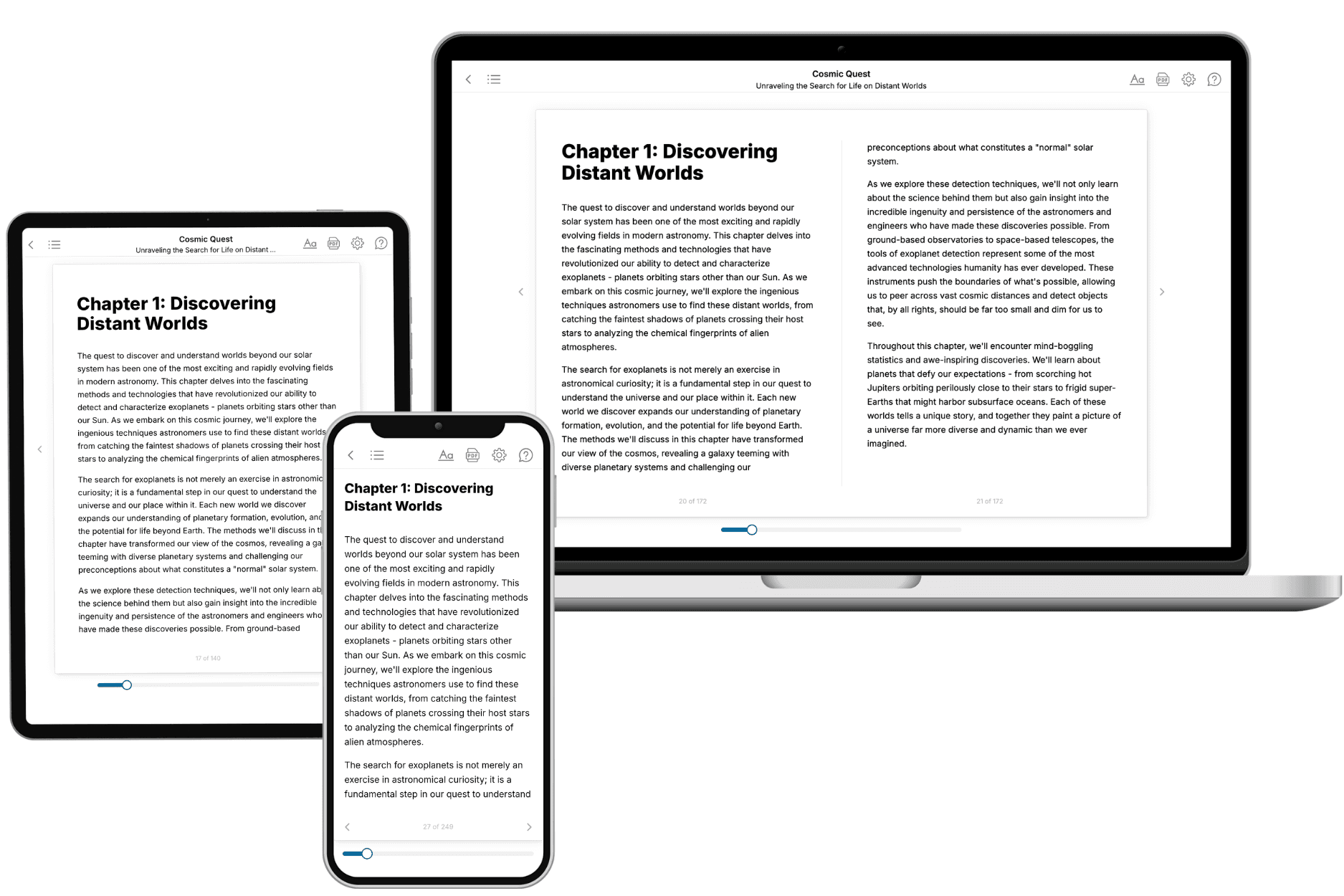
TailoredRead creates complete, full-length nonfiction ebooks, written specifically for you. Tell us what you want to learn and why, and TailoredRead writes you a complete ebook on it, with charts, tables, and diagrams throughout. Read it online, on Kindle, or on any e-reader, or download it as a PDF or EPUB. Every book is written fresh the day you order it.
- How is the book tailored to me?
Before anything is written, you answer a few short questions about your goals, your background, and the topics you care about. Your book is then planned around your answers: written at your level, focused on your goals, and covering the topics you chose, instead of the one-size-fits-all book a store sells everyone.
- Will it read like generic AI content?
No. Your book isn't a chat transcript: it's planned chapter by chapter before a single word is written, told in a clear book voice, and explains ideas visually with charts, tables, and diagrams. After writing, every book goes through an editorial pass that polishes chapters so the book reads consistent from start to finish. Judge for yourself: browse thousands of sample books on our Explore Books page.
- How accurate is the content?
Our AI first checks whether your subject needs live research. Niche and fast-moving subjects are researched before writing, and the book plan and chapters are grounded in what it finds. After writing, every book goes through a quality pass that checks its facts and consistency, and researched books list their sources in a Notes section at the back.
- How long is the book?
You choose the length: Comprehensive (250-300 pages), Detailed (150-200 pages), Essential (70-100 pages), or Short (30-50 pages).
- Does the book include visuals?
Yes. Every book includes visual elements such as timelines, checklists, step-by-step guides, decision trees, comparison tables, and matrices, and many include bar charts. A typical book includes dozens of these visual elements.
- Can I read it on Kindle? What formats can I download?
Yes. Every book can be read in our online reader or downloaded as a PDF or EPUB. The EPUB can be opened with Kindle, Apple Books, Kobo, and any e-reader. The Commercial and Author licenses also include an editable Word (DOCX) and Markdown download.
- How much does it cost?
About the price of a regular ebook. The exact price depends on your book's length and complexity, from $2 for the shortest books to $35 for the most comprehensive, and it's shown when you review your book, before you commit to anything. Each book is a one-time purchase, yours to keep, no subscription. Licenses that let you share, teach, or publish your book range from $35.99 to $49.99.
- Can I preview the book before purchasing?
Before you pay, you'll see what your book will cover: the title, a detailed description, the estimated length, and the complete chapter-by-chapter table of contents, so you know what you're getting before you decide. The full text itself is written after you purchase.
- How long does it take to create a book?
About 10 minutes. You can start reading the opening chapters while the rest is still being written.