Beyond the Binary
Understanding and Embracing Non-Binary Transgender Identity
This book takes you through the multifaceted world of non-binary and transgender identity, moving beyond stereotypes to reveal the real stories, challenges, and triumphs of people living authentically.
222 pages10 chaptersJun 24, 2026LGBT Studies
About this book
You'll explore what non-binary identity actually means, how it differs from and intersects with other transgender experiences, and the practical realities of navigating a society built on binary assumptions. Through personal narratives, expert insights, and accessible explanations, you'll gain a deeper understanding of the legal, medical, social, and emotional dimensions of non-binary life. Whether you're questioning your own identity, supporting someone you care about, or simply seeking to expand your understanding of human diversity, this book provides the knowledge and perspective needed to engage meaningfully with non-binary experiences and become a more informed ally.
Table of contents
- IntroductionWhy This Book Matters Now, How to Use This Book, A Note on Language and Terminology, What You'll DiscoverRead below
- Chapter 1: Understanding Non-Binary IdentityWhat Does Non-Binary Actually Mean?, Identity as a Spectrum, Not a Destination, How Non-Binary Differs from Binary Transgender Experiences
- Chapter 2: The Language of IdentityPronouns: More Than Grammar, Names and Chosen Identity, Essential Terminology and What It Means
- Chapter 3: The Journey of Self-DiscoveryRecognizing Your Authentic Self, The Questioning Process: Taking Your Time, Deciding When and How to Come Out
- Chapter 4: Legal and Administrative RealitiesNavigating Legal Name and Gender Changes, The Challenge of Identification Documents, Understanding Your Legal Rights and Protections
- Chapter 5: Healthcare and Medical TransitionUnderstanding Medical Transition Options, Finding Affirming Healthcare Providers, Mental Health and Emotional Wellbeing
- Chapter 6: Social Transition and Daily LifeNavigating Work and Professional Spaces, Family Dynamics and Relationship Changes, Finding Safety and Belonging in Social Spaces
- Chapter 7: Intersectionality and Multiple IdentitiesNon-Binary Identity and Race and Ethnicity, Disability, Neurodiversity, and Non-Binary Experience, Class, Socioeconomic Status, and Access
- Chapter 8: Building Community and ConnectionCreating and Nurturing Chosen Family, Finding LGBTQ+ Community and Support Networks, Digital Spaces and Online Connection
- Chapter 9: Resilience, Challenges, and ThrivingFacing Discrimination and Staying Safe, Mental Health Challenges and Coping Strategies, Building Resilience and Finding Joy
- Chapter 10: Being an Ally and Supporting OthersWhat True Allyship Looks Like, Listening, Learning, and Staying Humble, Practical Ways to Show Up for Non-Binary People
- ConclusionMoving Forward with Understanding and Compassion
- Glossary of Terms
- Resources and Further Reading
Introduction
Something is shifting in the way people understand gender. Across schools, workplaces, healthcare settings, and family dinner tables, conversations are happening that simply weren't possible a generation ago. People are introducing themselves with pronouns. Forms are adding a third option. Young people especially are describing their gender in ways that don't fit neatly into the categories most of us grew up with. For some, this feels like a welcome expansion of human possibility. For others, it feels confusing, even unsettling. Wherever you're starting from, this book is for you.
Non-binary identity is not a trend, a phase, or a product of social media. It is a deeply human experience with roots stretching back through history and across cultures. What is new is the language, the visibility, and the growing recognition that the two-box system of gender has never actually contained the full range of human experience. People who exist outside or between the categories of "man" and "woman" have always been here. What's changed is that more of them now have words for who they are, and more of the world is beginning to listen.
This book is built on a simple but powerful premise: understanding leads to empathy, and empathy leads to better outcomes for everyone. Whether you are non-binary yourself, questioning your own identity, supporting a child or partner or friend, or simply trying to be a more informed and compassionate person, the pages ahead offer something concrete. Not just theory, but real insight into what it actually feels like to navigate a world that wasn't designed with you in mind. Not just definitions, but the human stories and practical realities behind them.
Throughout this book, you'll find a mix of accessible explanation, real-world context, and practical guidance. The goal is never to lecture or overwhelm, but to open doors. Gender is one of the most fundamental aspects of human experience, and expanding your understanding of it is one of the most meaningful things you can do, both for the people in your life and for yourself.
Why This Book Matters Now
The visibility of non-binary and transgender people has grown dramatically over the past decade. According to a 2022 Gallup poll, approximately 5.6% of American adults identify as LGBTQ+, with younger generations showing significantly higher rates of identification.[1] Among Generation Z adults specifically, around 1 in 5 identifies as LGBTQ+. These numbers reflect not a sudden change in human nature, but a shift in how safe and possible it feels to be honest about who you are. More people are coming out, and more people need accurate, respectful information to understand what that means.
At the same time, non-binary people face real and serious challenges. Discrimination in employment, housing, and healthcare remains widespread. Legal systems in most countries still struggle to accommodate identities that don't fit a binary framework. Mental health outcomes for non-binary individuals are significantly worse than for the general population, largely due to minority stress, social rejection, and lack of affirming support.[2] These are not abstract statistics. They represent real people navigating real hardship, often without adequate support.
This is why a book like this matters now. Visibility without understanding can actually increase harm. When people encounter non-binary identities without context, they sometimes respond with dismissal, mockery, or hostility, not always out of malice, but out of confusion and unfamiliarity. Education is one of the most effective tools for changing that. Research consistently shows that personal connection and accurate information are the two biggest factors in shifting attitudes toward LGBTQ+ people.[3] This book aims to provide both.
There is also a political dimension that cannot be ignored. Non-binary and transgender people are increasingly the subject of legislative debate, media controversy, and public discourse. In many places, laws are being proposed or passed that directly affect transgender people's access to healthcare, education, and public life. Navigating this landscape requires more than good intentions. It requires knowledge. Understanding what non-binary identity actually is, rather than what it is caricatured to be, is a prerequisite for engaging meaningfully with these conversations.
Beyond politics, there is something more personal at stake. Many people reading this book know someone who is non-binary or transgender. A child, a sibling, a coworker, a student, a friend. The quality of that relationship, and the wellbeing of the non-binary person in it, is directly affected by how much the people around them understand and accept who they are. Family acceptance, in particular, has been shown to be one of the strongest protective factors for LGBTQ+ youth mental health.[4] What you learn here could genuinely make a difference in someone's life.
Finally, this book matters because non-binary people deserve to see their experiences reflected accurately and respectfully in the world. Too much of what gets written about gender diversity is either sensationalized, oversimplified, or filtered through perspectives that don't include non-binary voices. This book tries to do better, centering the actual experiences, challenges, and strengths of non-binary people rather than treating them as a curiosity or a controversy.
How to Use This Book
This book is designed to be read in order, but it doesn't have to be. Each chapter is structured to stand on its own, so if you're drawn to a particular topic, such as healthcare, legal issues, or allyship, you can jump directly there without losing the thread. That said, the early chapters on identity, language, and self-discovery lay important groundwork that makes the later chapters richer and more meaningful. If you're new to this topic, starting from the beginning is the most rewarding path.
The book is organized into ten chapters, each covering a distinct dimension of non-binary experience. Here's a quick map of what you'll find:
- Chapters 1 and 2 cover the foundations: what non-binary identity means, how it relates to other transgender experiences, and why language matters so much.
- Chapter 3 explores the personal journey of self-discovery and coming out, with attention to the emotional complexity of that process.
- Chapters 4 and 5 address the practical realities of legal documentation and healthcare, including what options exist and what barriers non-binary people commonly face.
- Chapter 6 looks at social transition: navigating work, family, and everyday social spaces.
- Chapter 7 examines intersectionality, exploring how race, disability, class, and other identities shape non-binary experience in distinct ways.
- Chapter 8 focuses on community and connection, including chosen family and online spaces.
- Chapter 9 addresses resilience, mental health challenges, and the real work of building a life that feels authentic.
- Chapter 10 is a practical guide to allyship, with concrete steps for showing up meaningfully for non-binary people.
Throughout the book, you'll encounter real-world examples, composite scenarios drawn from common experiences, and practical frameworks you can apply immediately. These are not hypothetical exercises. They reflect the kinds of situations non-binary people and their allies actually encounter. Pay attention to the examples, even if they don't seem directly relevant to your situation. They often illuminate principles that apply more broadly than they first appear.
You'll also find a glossary at the back of the book. Gender and identity terminology can feel like a moving target, and that's partly because language in this space genuinely does evolve as communities develop new ways of describing their experiences. The glossary is a reference tool, not a test. If you encounter a term you don't recognize while reading, flip to the back. There's no shame in needing a definition. In fact, looking things up rather than guessing is one of the hallmarks of genuine engagement with this material.
If you are non-binary or questioning your own identity, this book is written with you in mind too, not just as a subject but as a reader. Some chapters may feel validating. Others may bring up difficult emotions. Take breaks when you need them. You don't have to read everything at once, and you don't have to have everything figured out by the time you finish. This book is a companion, not a checklist.
For those reading as allies, parents, partners, or professionals, the most important thing to bring to this book is genuine curiosity and a willingness to sit with discomfort. Some of what you read may challenge assumptions you didn't even know you had. That's not a problem. That's the point. Growth rarely happens in the absence of challenge, and the discomfort of learning is far smaller than the discomfort of being misunderstood or unseen.
A Note on Language and Terminology
Language is one of the most important and most contested aspects of conversations about gender identity. The words used to describe non-binary and transgender experiences have changed significantly over time, and they continue to evolve. What was considered respectful terminology a decade ago may now be outdated or even considered offensive by some communities. This is not a reason to avoid the conversation. It's a reason to approach it with humility and a commitment to keeping up.
Throughout this book, certain terms are used consistently and intentionally. Non-binary is used as an umbrella term for people whose gender identity doesn't fit exclusively within the categories of "man" or "woman." Transgender is used as a broader umbrella that includes non-binary people, as well as binary trans men and trans women. Not everyone who is non-binary identifies as transgender, and that's valid. But the two communities overlap significantly, and many of the legal, medical, and social challenges they face are shared.
The singular they/them pronoun is used throughout this book when referring to non-binary individuals in general, or when a specific person's pronouns are not known. This is grammatically correct and has been used in English for centuries, despite what some grammar guides have historically claimed.[5] When specific individuals are referenced with known pronouns, those pronouns are used. Respecting pronouns is not a matter of political opinion. It is a basic act of courtesy, and this book models that practice throughout.
Some terms in this space carry different meanings in different communities. For example, genderqueer is used by some people as a synonym for non-binary, while others see it as a distinct identity with its own history and connotations. Agender, genderfluid, bigender, and demi-gender are all terms that fall under the non-binary umbrella but describe meaningfully different experiences. The glossary at the back of this book provides definitions for these and many other terms. When in doubt, the best approach is always to ask the individual what terms they use and prefer.
One important note: some language that was once used within LGBTQ+ communities has been reclaimed by those communities but remains hurtful when used by outsiders. This book does not use slurs, even in historical or educational contexts, without clear framing and purpose. The goal is always to illuminate, not to harm. If you encounter terminology in other contexts that you're unsure about, the safest approach is to follow the lead of the people whose identities are being described.
Language mistakes happen. Even people who are deeply committed to respecting non-binary identities sometimes use the wrong pronoun, the wrong name, or an outdated term. What matters is not perfection but intention and response. When a mistake happens, the right move is to correct it briefly, without excessive apology or self-flagellation, and move on. Making a big deal of the mistake often centers the feelings of the person who made it rather than the person who was affected. This book will return to this point in the chapters on language and allyship, but it's worth naming here at the outset.
Finally, it's worth acknowledging that the language in this book reflects a primarily English-language, Western context. Gender identity terminology varies significantly across languages and cultures. Some languages have grammatical gender built into their structure in ways that make non-binary expression particularly complex. Some cultures have long-standing traditions of recognizing more than two genders, using terms and frameworks that predate Western LGBTQ+ vocabulary entirely. Chapter 7, on intersectionality, touches on some of these cultural dimensions. The goal is not to impose one framework on all experiences, but to offer a starting point for understanding that can be expanded and adapted.
What You'll Discover
By the time you finish this book, you'll have a significantly richer understanding of what non-binary identity actually means, not as an abstract concept, but as a lived reality. You'll understand the difference between gender identity, gender expression, and biological sex, and why those distinctions matter. You'll be familiar with the range of identities that fall under the non-binary umbrella and the diversity of experiences within that range. You'll also have a clearer sense of what non-binary people share with other transgender people and where their experiences diverge.
You'll gain practical knowledge that you can use immediately. This includes:
- How to use someone's correct pronouns and what to do when you make a mistake
- What the legal process of changing name and gender markers looks like in the United States, and what barriers non-binary people face
- What medical transition options exist and how to find affirming healthcare providers
- How to navigate workplace situations involving non-binary colleagues or employees
- What concrete allyship looks like in everyday interactions
You'll also encounter the emotional and psychological dimensions of non-binary experience. The journey of recognizing and accepting a non-binary identity is rarely simple or linear. It often involves years of confusion, self-questioning, and gradual discovery. Coming out, when it happens, can bring relief and joy, but also fear, loss, and complicated family dynamics. This book doesn't shy away from those realities. Understanding the emotional landscape of non-binary experience is just as important as understanding the practical one.
One of the most important things you'll discover is the remarkable resilience and creativity that many non-binary people bring to the challenge of living authentically. When the world doesn't offer you a ready-made template for who you are, you have to build one. Non-binary communities have developed rich traditions of mutual support, creative self-expression, and collective advocacy. These are not just survival strategies. They are genuine contributions to human culture and to our collective understanding of what it means to be a person.
You'll also come away with a clearer sense of what you don't know, and that's valuable too. One of the risks of reading a single book on any complex topic is the illusion of complete understanding. Non-binary experience is enormously diverse. No book can capture all of it. What this book can do is give you a solid foundation and point you toward further learning. The resources section at the back includes books, organizations, and online communities where you can continue to expand your understanding.
Perhaps most importantly, you'll finish this book with a deeper appreciation for the humanity at the center of all of this. Behind every pronoun discussion, every legal form, every medical appointment, and every coming-out conversation is a person trying to live honestly and be seen for who they actually are. That is not a political agenda. It is one of the most fundamental human needs there is. Understanding that need, and learning how to honor it, is what this book is ultimately about.
Gender diversity is not a new phenomenon. What is new is the growing recognition that the full range of human experience has always been broader than the categories we were given. This book is an invitation to see that range more clearly, and to respond to it with the curiosity and compassion it deserves.
Whatever brought you to this book, whether curiosity, concern, personal experience, or professional need, you're in the right place. The conversation about gender is one of the defining conversations of our time, and engaging with it thoughtfully is one of the most meaningful things you can do. Turn the page, and let's begin.
Notes
Introduction
- 1. Gallup, "LGBT Identification in U.S. Ticks Up to 7.1%," Gallup News, 2022
- 2. Trevor Project, 2022 National Survey on LGBTQ Youth Mental Health, The Trevor Project, 2022
- 3. D. Broockman and J. Kalla, "Durably reducing transphobia," Science, 2016
- 4. C. Ryan and others, "Family acceptance in adolescence and the health of LGBT young adults," Journal of Child and Adolescent Psychiatric Nursing, 2010
- 5. Merriam-Webster, Singular 'they', Merriam-Webster Word of the Year 2019, 2019
This is the end of the free sample. The full book has 10 chapters.
Want this book written for you?
Tell us your goals and background, and get your own version of this book, tailored by AI to you.


Benefits of AI-tailored books
- Read one book, not ten:
- all the LGBT Studies knowledge you need, gathered into a single book.
- Save days of learning:
- tell us your goals, choose your topics, and the whole book is built around them.
- Learn effortlessly:
- LGBT Studies book written for your specific background and expertise.
- Understand at a glance:
- includes charts, tables, timelines, checklists, decision trees, and more.
- Stay current:
- written the day you order it, not years ago.
- Trust what you read:
- every book is checked for accuracy, with real research when your subject needs it.
Create your unique book in 3 steps
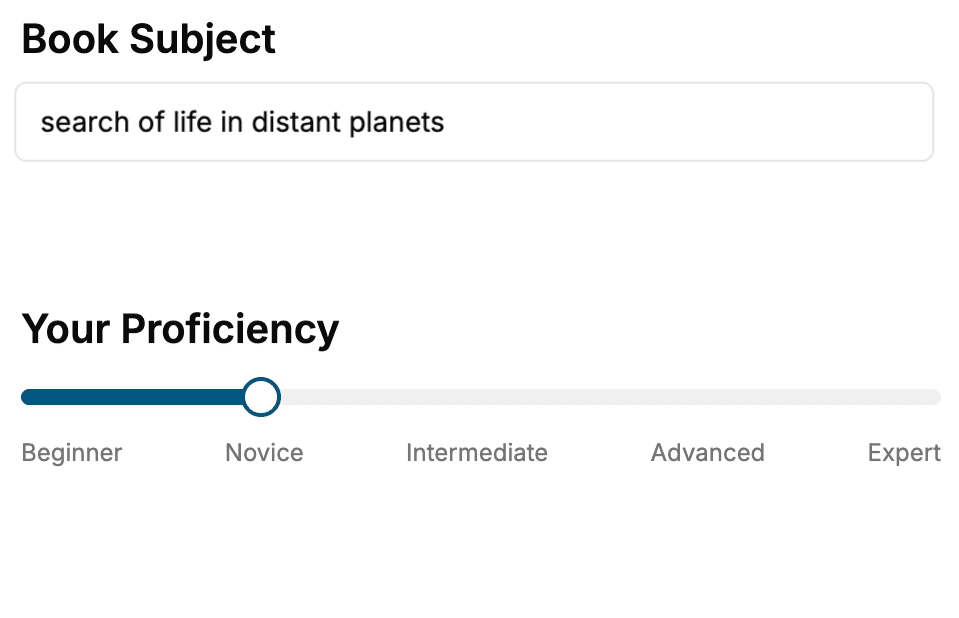
- 1. Select your focus
Select the focus of your LGBT Studies book and share your background
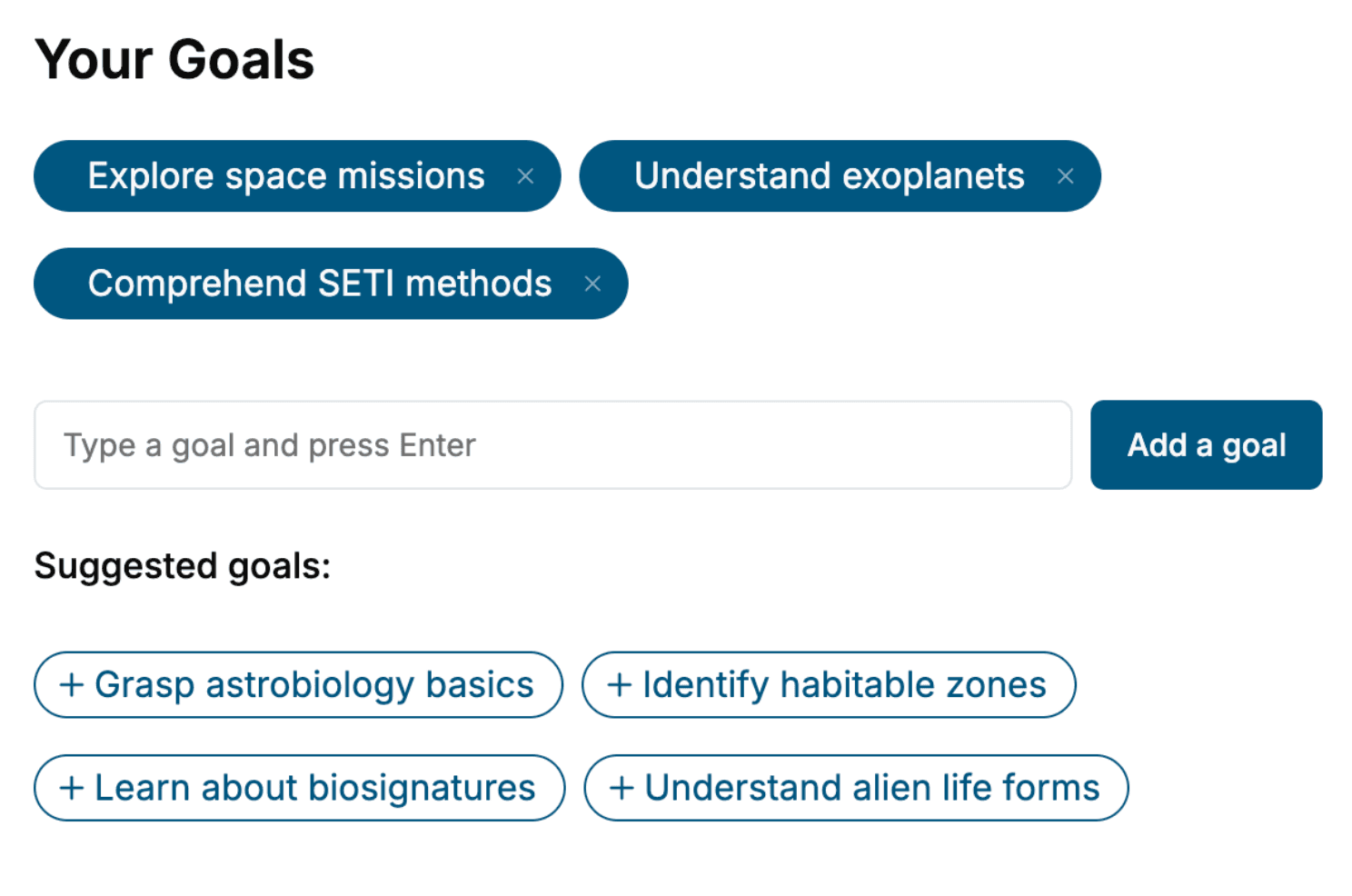
- 2. Personalize your book
Specify your goals and choose sub-topics to include
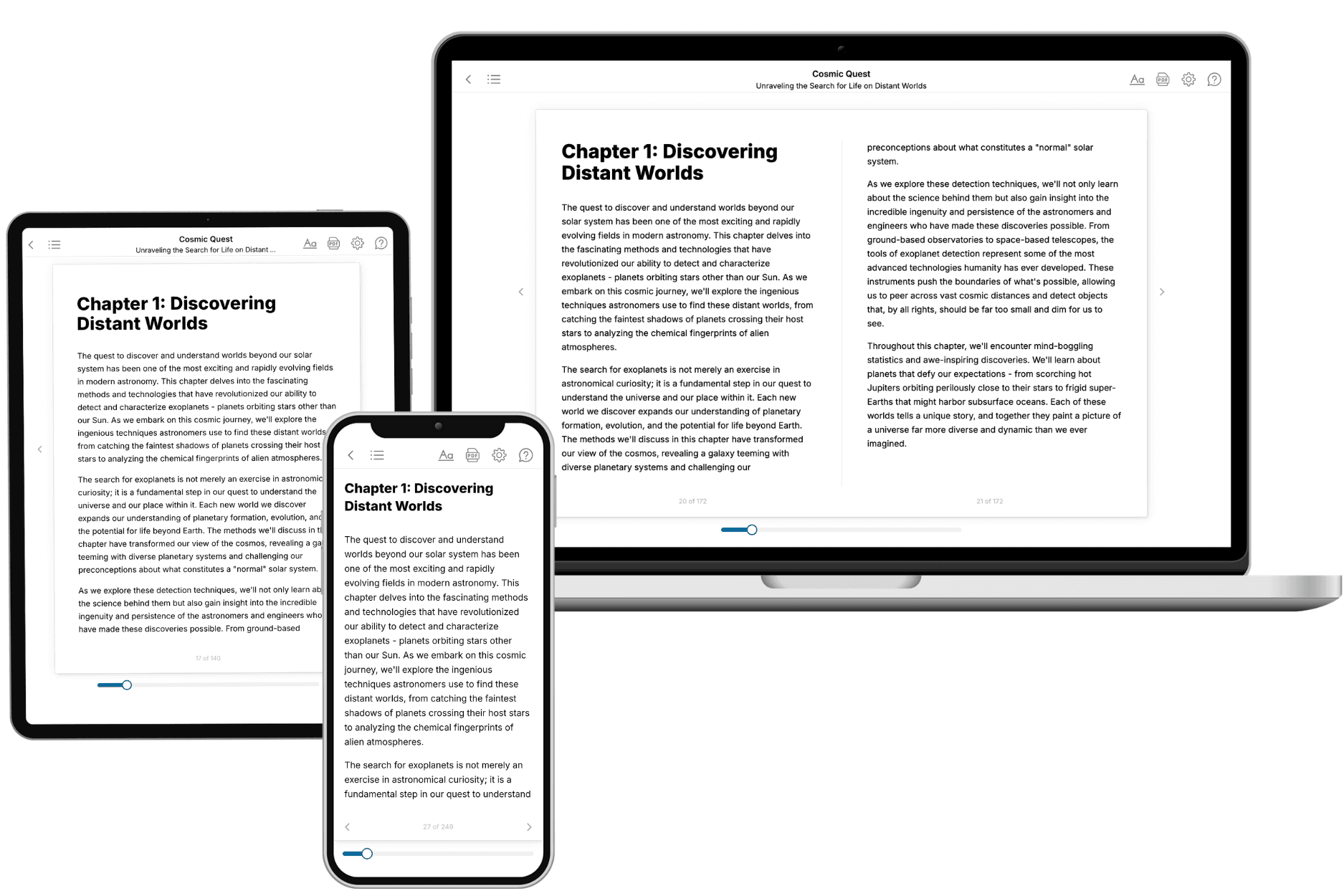
- 3. Get your tailored book
Your book is ready in 10 minutes. Read it online, download as EPUB or PDF, or send to Kindle.
Frequently asked questions
- What is TailoredRead?
TailoredRead creates complete, full-length nonfiction ebooks, written specifically for you. Tell us what you want to learn and why, and TailoredRead writes you a complete ebook on it, with charts, tables, and diagrams throughout. Read it online, on Kindle, or on any e-reader, or download it as a PDF or EPUB. Every book is written fresh the day you order it.
- How is the book tailored to me?
Before anything is written, you answer a few short questions about your goals, your background, and the topics you care about. Your book is then planned around your answers: written at your level, focused on your goals, and covering the topics you chose, instead of the one-size-fits-all book a store sells everyone.
- Will it read like generic AI content?
No. Your book isn't a chat transcript: it's planned chapter by chapter before a single word is written, told in a clear book voice, and explains ideas visually with charts, tables, and diagrams. After writing, every book goes through an editorial pass that polishes chapters so the book reads consistent from start to finish. Judge for yourself: browse thousands of sample books on our Explore Books page.
- How accurate is the content?
Our AI first checks whether your subject needs live research. Niche and fast-moving subjects are researched before writing, and the book plan and chapters are grounded in what it finds. After writing, every book goes through a quality pass that checks its facts and consistency, and researched books list their sources in a Notes section at the back.
- How long is the book?
You choose the length: Comprehensive (250-300 pages), Detailed (150-200 pages), Essential (70-100 pages), or Short (30-50 pages).
- Does the book include visuals?
Yes. Every book includes charts, tables, and diagrams: timelines, checklists, step-by-step guides, decision trees, comparison tables, matrices, and bar charts. A typical book includes dozens of these visual elements.
- Can I read it on Kindle? What formats can I download?
Yes. Every book can be read in our online reader or downloaded as a PDF or EPUB. The EPUB can be opened with Kindle, Apple Books, Kobo, and any e-reader. The Commercial and Author licenses also include an editable Word (DOCX) and Markdown download.
- How much does it cost?
About the price of a regular ebook. The exact price depends on your book's length and complexity, from $2 for the shortest books to $35 for the most comprehensive, and it's shown when you review your book, before you commit to anything. Each book is a one-time purchase, yours to keep, no subscription. Licenses that let you share, teach, or publish your book range from $35.99 to $49.99.
- Can I preview the book before purchasing?
Before you pay, you'll see what your book will cover: the title, a detailed description, the estimated length, and the complete chapter-by-chapter table of contents, so you know what you're getting before you decide. The full text itself is written after you purchase.
- How long does it take to create a book?
About 10 minutes. You can start reading the opening chapters while the rest is still being written.