Beyond Fear
Understanding and Overcoming Phobias Through Science and Practical Strategies
Fear can feel paralyzing, especially when it prevents you from doing things you want or need to do.
222 pages10 chaptersNov 25, 2025Psychology
About this book
Whether you're struggling with a specific phobia or generalized anxiety, the uncertainty about why you feel this way and whether it can change is often as distressing as the fear itself. This book demystifies phobias by explaining how your brain creates and maintains them, then guides you through proven strategies to reclaim your freedom. You'll learn why avoidance makes fears stronger, how exposure therapy actually rewires your nervous system, and practical techniques you can start using immediately. Drawing on cognitive-behavioral psychology, neuroscience, and real-world applications, this guide bridges the gap between understanding your fear and taking action against it. Whether you're working with a therapist or managing fears independently, you'll discover that phobias are treatable conditions—and that change is possible.
Table of contents
- IntroductionWhy Fear Matters and When It Becomes a Problem, What You'll Learn in This Book, How to Use This Book for Maximum BenefitRead below
- Chapter 1: The Science of Fear: How Your Brain Creates PhobiasFear vs. Phobia: Understanding the Difference, The Amygdala and Your Threat-Detection System, Classical Conditioning: How Fears Are Learned, Neural Pathways and Memory: Why Phobias Stick Around
- Chapter 2: Types of Phobias and Their PatternsSpecific Phobias: Animals, Objects, and Situations, Social Phobias and Performance Anxiety, Agoraphobia and Panic-Related Fears, Recognizing Your Own Fear Patterns
- Chapter 3: Why Avoidance Makes Fears StrongerThe Avoidance Cycle: How It Reinforces Phobias, Safety Behaviors and Their Hidden Costs, Breaking the Avoidance Pattern
- Chapter 4: Exposure Therapy: The Gold Standard TreatmentHow Exposure Therapy Works: Extinction and Habituation, Types of Exposure: Imaginal, In Vivo, and Virtual, Creating Your Fear Hierarchy and Exposure Plan, Managing Anxiety During Exposure
- Chapter 5: Cognitive Restructuring: Changing Your Thoughts About FearIdentifying Catastrophic Thinking Patterns, Common Cognitive Distortions in Phobias, Challenging and Reframing Fearful Thoughts, Building Evidence-Based Thinking Habits
- Chapter 6: Physiological Techniques: Calming Your Nervous SystemUnderstanding Fight, Flight, and Freeze Responses, Breathing Techniques and Diaphragmatic Breathing, Progressive Muscle Relaxation and Body Awareness, Grounding Techniques for Immediate Anxiety Relief
- Chapter 7: Mindfulness and Acceptance: A Different Approach to FearAcceptance and Commitment Therapy (ACT) Principles, Mindfulness Meditation for Fear and Anxiety, Observing Thoughts Without Judgment, Living According to Your Values Despite Fear
- Chapter 8: Lifestyle Factors That Influence Fear and AnxietySleep, Stress, and Their Impact on Phobias, Exercise, Nutrition, and Physical Health, Caffeine, Alcohol, and Other Substances, Social Support and Connection
- Chapter 9: When to Seek Professional HelpTypes of Therapy: CBT, Exposure Therapy, and Beyond, Finding and Choosing the Right Therapist, Medication Options and When They Help, Getting the Most Out of Professional Treatment
- Chapter 10: Creating Your Personal Recovery PlanAssessing Your Phobia and Setting Goals, Building Your Personalized Treatment Plan, Tracking Progress and Adjusting Your Approach, Maintaining Gains and Preventing Relapse
- Conclusion: Your Path ForwardRecap of Key Principles, Hope and the Reality of Recovery
- Glossary of Terms
- Further Reading and Resources
Introduction
Fear is one of the most fundamental human emotions, wired into your brain through millions of years of evolution. It has kept your ancestors alive by alerting them to danger, triggering rapid responses to threats, and teaching them what to avoid. Yet for many people, this protective mechanism becomes overactive, creating intense reactions to situations that pose little or no actual danger. When fear grows disproportionate to the threat and begins limiting your choices, activities, or quality of life, it crosses the line from helpful instinct to debilitating phobia. This transformation doesn't happen because you're weak or flawed—it occurs through specific, identifiable processes in your brain and nervous system that can be understood and, importantly, changed.
If you've picked up this book, you likely know what it feels like when fear takes control. Perhaps you avoid certain places, situations, or activities that others navigate easily. Maybe you've canceled plans, turned down opportunities, or felt your heart race at the mere thought of encountering something you fear. You might have wondered why your reaction feels so overwhelming when you logically know the danger is minimal. These experiences are more common than you might think—specific phobias affect approximately 12.5% of adults at some point in their lives, while social anxiety disorder impacts around 7% of the population annually[1]. Beyond these clinical diagnoses, countless others experience subclinical fears that still interfere with their daily functioning and well-being.
The good news is that phobias are among the most treatable mental health conditions. Decades of research have identified specific mechanisms that create and maintain fears, and evidence-based treatments have been developed that directly target these mechanisms. Unlike some psychological conditions that require long-term management, many phobias can be significantly reduced or even eliminated through focused intervention. This book brings together insights from neuroscience, cognitive-behavioral psychology, and clinical practice to give you both understanding and practical tools. You'll learn not just what phobias are, but how they work in your brain, why certain strategies succeed while others fail, and how to apply proven techniques to your own situation. Whether you're working independently or alongside a mental health professional, this knowledge will empower you to take concrete steps toward freedom from fear.
Why Fear Matters and When It Becomes a Problem
Fear serves a crucial evolutionary purpose. When your ancestors encountered a predator or dangerous situation, their fear response triggered immediate physiological changes: increased heart rate, rapid breathing, heightened alertness, and a surge of energy to either fight or flee. This acute stress response happened automatically, without conscious thought, because survival often depended on split-second reactions. Your brain's threat-detection system, centered in a small almond-shaped structure called the amygdala, constantly scans your environment for potential dangers. When it identifies a threat, it activates your body's alarm system before your conscious mind even registers what's happening. This rapid response has saved countless lives throughout human history and continues to protect you from genuine dangers today.
Normal fear is proportionate, temporary, and adaptive. If you're hiking and encounter a venomous snake, fear prompts you to back away carefully—an appropriate response to a real threat. Once you're at a safe distance, your fear subsides, and your body returns to its baseline state. This type of fear enhances your safety without limiting your life. It teaches you useful caution: you might watch where you step more carefully on future hikes, but you don't stop hiking altogether. The fear response activates when needed and deactivates when the threat passes. Your brain learns from the experience, updating its threat assessment without creating permanent avoidance patterns. This is fear functioning as designed—a helpful warning system that keeps you safe while allowing you to engage fully with life.
A phobia, by contrast, involves fear that is disproportionate to the actual danger, persistent over time, and leads to avoidance that interferes with your life. Consider someone with a spider phobia who refuses to enter their basement for months because they once saw a spider there, or who experiences panic attacks at the sight of even a tiny, harmless spider in a photograph. The fear response is identical to what they'd experience facing a genuine life-threatening situation, but the trigger poses minimal actual danger. This person might avoid outdoor activities, refuse to visit certain friends' homes, or spend excessive time checking for spiders before entering rooms. The phobia doesn't just cause momentary discomfort—it actively restricts their choices and activities. Unlike normal fear, which fades when the threat is gone, phobic fear persists and often intensifies over time, especially when avoidance behaviors are used to manage it.
The distinction between normal fear and clinical phobia involves several key factors that mental health professionals assess when making diagnoses:
- Intensity: The fear response is significantly stronger than the situation warrants, often reaching panic-level intensity
- Duration: The fear persists for six months or longer, rather than naturally diminishing over time
- Avoidance: You go out of your way to avoid the feared object or situation, sometimes making significant life adjustments
- Distress: The fear itself, or the avoidance it causes, creates significant emotional distress or embarrassment
- Impairment: The fear interferes with your work, relationships, daily activities, or overall quality of life
- Recognition: You typically recognize that your fear is excessive or unreasonable, yet feel unable to control it
Understanding when fear becomes problematic helps you recognize whether you need intervention. Some people live with phobias for years, assuming their fear is just part of who they are or that nothing can be done about it. Others feel ashamed of their fear, believing it reflects personal weakness or irrationality. Neither assumption is accurate. Phobias develop through specific learning processes that can happen to anyone, regardless of intelligence, strength, or character. A successful executive might have a debilitating fear of flying, while a physically courageous firefighter might panic at the sight of a dog. These fears don't reflect the person's overall capabilities—they reflect how their brain has learned to respond to specific triggers through conditioning, traumatic experiences, or other mechanisms you'll explore in detail throughout this book.
The impact of phobias extends beyond the immediate fear response. Chronic avoidance can lead to secondary problems: missed career opportunities, strained relationships, reduced independence, and decreased self-confidence. Someone with social phobia might turn down promotions that require public speaking, gradually limiting their career trajectory. A person with driving phobia might become dependent on others for transportation, affecting their sense of autonomy and sometimes burdening relationships. The constant vigilance required to avoid feared situations creates ongoing stress, which can contribute to other mental health issues like depression or generalized anxiety. Additionally, the shame and frustration of living with a phobia can erode self-esteem, creating a cycle where you feel increasingly powerless and hopeless about change.
Recognizing that your fear has crossed into phobia territory is actually the first step toward change. It means acknowledging that your current coping strategies—primarily avoidance—aren't working and that a different approach is needed. This recognition isn't about labeling yourself as disordered or broken; it's about accurately identifying a treatable condition so you can access effective interventions. Many people experience relief when they learn their struggles have a name and that evidence-based treatments exist. The fear that has felt mysterious, overwhelming, and permanent suddenly becomes something concrete that can be understood and addressed. This shift from confusion to clarity, from helplessness to agency, marks the beginning of recovery for many people who successfully overcome their phobias.
It's also important to understand that phobias exist on a spectrum. Not everyone with a fear meets full diagnostic criteria for a phobia, yet their fear still causes meaningful distress or limitation. You don't need to wait until your fear is completely debilitating before seeking help or applying treatment strategies. Early intervention often prevents fears from becoming more entrenched and spreading to related situations. If you find yourself avoiding situations more frequently, if your fear is increasing rather than decreasing over time, or if you're making life decisions based on your fear, these are signs that intervention could be beneficial. The strategies in this book are designed to help whether you have a diagnosed phobia or a subclinical fear that you'd like to address before it grows more limiting.
What You'll Learn in This Book
This book is structured to give you both understanding and practical tools. The first section focuses on the science behind fear and phobias, explaining how your brain creates and maintains these responses. You'll learn about the neural pathways involved in fear conditioning, why certain fears are more common than others, and how your threat-detection system can become overly sensitive. This scientific foundation isn't just academic—understanding the mechanisms behind your fear helps you recognize that your reactions are biological processes, not character flaws. It also helps you understand why certain treatment approaches work while others don't, allowing you to make informed decisions about your recovery strategy. When you know that avoidance strengthens neural pathways associated with fear, you'll understand why exposure therapy is so effective at weakening those same pathways.
Chapter 1 explores the neuroscience of fear, introducing you to the brain structures and processes that create phobic responses. You'll learn how the amygdala acts as your brain's alarm system, how the hippocampus stores fear memories, and how the prefrontal cortex can regulate emotional responses when properly engaged. Understanding classical conditioning—the process through which neutral stimuli become fear triggers—will help you trace how your specific phobia likely developed. You'll also learn about the concept of fear extinction, the neurological process that underlies successful phobia treatment. This chapter establishes the scientific framework that makes sense of your experiences and explains why evidence-based treatments work at a biological level. Rather than viewing your fear as a mysterious force beyond your control, you'll see it as a learned response that can be unlearned through specific interventions.
Chapter 2 examines different types of phobias and their characteristic patterns. Specific phobias—fears of animals, natural environments, blood-injection-injury, or situational triggers—each have distinct features and often require slightly different treatment approaches. Social phobias involve fear of judgment or embarrassment in social situations, while agoraphobia centers on fear of being in situations where escape might be difficult or help unavailable. By understanding these categories and their patterns, you'll better recognize your own fear profile. This chapter includes self-assessment tools to help you identify which type of phobia you're experiencing, how severe it is, and what maintaining factors might be keeping it active. Recognizing your specific patterns is essential for developing an effective treatment plan tailored to your situation rather than applying generic strategies that might not address your particular needs.
The middle chapters focus on core treatment approaches, starting with why avoidance makes fears stronger (Chapter 3) and then introducing exposure therapy, the gold-standard treatment for phobias (Chapter 4). You'll learn the specific mechanisms through which avoidance reinforces fear and how safety behaviors—subtle forms of avoidance—can undermine your progress even when you think you're confronting your fears. The exposure therapy chapter provides detailed, practical guidance on creating fear hierarchies, planning exposure exercises, and managing anxiety during exposures. You'll learn about different types of exposure—imaginal, in vivo, and virtual reality—and when each is most appropriate. This isn't just theory; you'll get step-by-step instructions for implementing exposure therapy, whether you're working with a therapist or applying these principles independently.
Chapter 5 introduces cognitive restructuring, teaching you to identify and challenge the catastrophic thinking patterns that fuel phobias. You'll learn to recognize common cognitive distortions like probability overestimation, catastrophizing, and emotional reasoning. The chapter provides specific techniques for examining the evidence for and against your fearful thoughts, generating alternative interpretations, and building more balanced, realistic thinking patterns. These cognitive skills complement exposure therapy by helping you approach feared situations with a different mindset, reducing anticipatory anxiety and making exposures more effective. You'll learn practical exercises like thought records, behavioral experiments, and Socratic questioning that you can apply immediately to your own fearful thoughts.
Chapters 6 and 7 expand your toolkit with physiological and mindfulness-based approaches. Chapter 6 teaches you techniques for calming your nervous system, including diaphragmatic breathing, progressive muscle relaxation, and grounding exercises. These skills help you manage the physical symptoms of anxiety during exposure exercises and in daily life. You'll understand the fight-flight-freeze response in detail and learn why certain physical sensations occur during fear responses. Chapter 7 introduces mindfulness and acceptance-based strategies drawn from Acceptance and Commitment Therapy (ACT). Rather than trying to eliminate fear, these approaches teach you to change your relationship with it—observing fearful thoughts without getting caught up in them and taking action based on your values even when fear is present. This perspective shift can be particularly helpful when you've struggled with traditional approaches or when complete fear elimination isn't realistic.
The later chapters address practical considerations for long-term success. Chapter 8 examines lifestyle factors that influence anxiety and fear, including sleep, exercise, nutrition, substance use, and social support. These factors don't cause phobias, but they significantly affect your nervous system's baseline reactivity and your capacity to engage in treatment. Chapter 9 helps you determine when professional help is needed and how to find effective treatment. You'll learn about different therapy modalities, what to look for in a therapist, and when medication might be a helpful adjunct to therapy. Chapter 10 guides you through creating a personalized recovery plan, setting realistic goals, tracking progress, and maintaining gains over time. This chapter includes templates and worksheets to help you organize your approach and stay accountable to your recovery process.
Throughout the book, you'll find concrete examples, case studies, and practical exercises. These aren't generic scenarios—they're based on common patterns seen in clinical practice and research. You'll see examples of what effective exposure exercises look like, how to troubleshoot common problems, and what successful cognitive restructuring sounds like in practice. Each major concept includes actionable steps you can implement immediately, not just theoretical explanations. The goal is to give you a comprehensive understanding of phobias while also providing a practical manual you can return to repeatedly as you work through your recovery. Some sections will be more relevant to your specific situation than others, and that's expected—use what applies to you and skip what doesn't, or save it for future reference if your needs change.
How to Use This Book for Maximum Benefit
This book is designed to be both read sequentially and used as a reference guide. If you're new to understanding phobias, reading straight through from beginning to end will give you a comprehensive foundation. The chapters build on each other, with earlier sections providing context that makes later techniques more understandable and effective. However, if you're already familiar with the basics of anxiety and phobias, you might choose to skim the early chapters and focus more attention on the treatment chapters that address your specific needs. There's no single correct way to use this book—the best approach is the one that matches your current knowledge level, learning style, and immediate needs. Some people benefit from thoroughly understanding the science before attempting any interventions, while others prefer to start applying techniques quickly and return to the theoretical chapters later for deeper understanding.
As you read, keep a notebook or journal dedicated to your phobia work. Use it to complete the self-assessment exercises, record your thoughts and reactions to different concepts, and track your progress as you implement strategies. Writing helps consolidate learning and creates a record you can review to see how far you've come. When you encounter a technique or concept that resonates with you, mark the page or take detailed notes so you can easily return to it. You might also use your journal to identify patterns in your own fear responses, noting what triggers your anxiety, what thoughts accompany it, and what you typically do in response. This self-monitoring builds awareness and helps you recognize the specific maintaining factors that keep your phobia active. Over time, your journal becomes a personalized supplement to this book, filled with insights specific to your situation.
The practical exercises and techniques in this book are most effective when you actually practice them, not just read about them. Understanding how exposure therapy works intellectually is different from experiencing habituation firsthand. Reading about cognitive restructuring won't change your thought patterns unless you actively practice identifying and challenging your fearful thoughts. Set aside time to complete the exercises, even if they feel uncomfortable at first. Start with the easier techniques and build gradually toward more challenging ones. You might dedicate 15-30 minutes several times per week to practicing specific skills, gradually increasing as you build confidence. Consistency matters more than intensity—regular, modest practice produces better results than occasional intensive efforts followed by long gaps.
Consider your current readiness for change when deciding how to use this book. If you're not yet ready to directly confront your fears through exposure therapy, focus first on the chapters about understanding phobias, cognitive restructuring, and physiological calming techniques. These approaches can reduce your overall anxiety and build skills that will make exposure work easier when you're ready. If you're highly motivated and your phobia is significantly limiting your life, you might move more quickly to the exposure therapy chapter and begin creating your fear hierarchy. There's no shame in moving slowly or taking breaks when needed—recovery isn't linear, and respecting your own pace often leads to more sustainable progress than pushing yourself too hard too fast. The goal is forward movement, not perfection.
If you're working with a therapist, this book can complement your treatment. Share relevant sections with your therapist and discuss how the concepts apply to your specific situation. Your therapist can help you adapt the techniques to your needs, provide accountability and support during exposure exercises, and troubleshoot problems that arise. If you're not currently in therapy but find that self-directed work isn't producing the progress you'd hoped for, Chapter 9 will help you determine whether professional support would be beneficial and how to find it. Many people successfully reduce their phobias through self-directed work using books like this one, while others benefit from the structure, expertise, and support that therapy provides. Neither approach is inherently better—the right choice depends on your specific situation, the severity of your phobia, your resources, and your personal preferences.
Be prepared for the fact that working on your phobia will sometimes feel uncomfortable. Anxiety is an inherent part of the recovery process, particularly during exposure exercises. The goal isn't to eliminate all discomfort but to learn that you can tolerate it and that feared outcomes don't actually occur. This distinction is crucial: you're not trying to feel completely calm before approaching feared situations, but rather learning to take action despite feeling anxious. Many people wait to "feel ready" before starting exposure work, not realizing that readiness comes through action, not before it. Expect some anxiety, plan for it, and recognize it as a sign that you're doing the work that will ultimately reduce your fear. The discomfort is temporary and purposeful, not a sign that something is wrong or that you should stop.
Track your progress using concrete, measurable indicators rather than relying solely on how you feel. Create a baseline assessment before you start implementing strategies, noting:
- What situations you currently avoid and how often
- Your anxiety level (0-10 scale) when thinking about or encountering feared situations
- How much your phobia interferes with your daily life, work, or relationships
- What safety behaviors you use and how frequently
- How much time you spend worrying about or planning around your fear
Finally, approach this work with self-compassion. Phobias are not character flaws, and struggling with fear doesn't make you weak or broken. You're dealing with a learned response that your brain created to protect you, even if that protection has become excessive and limiting. Recovery takes time, effort, and patience. You'll have setbacks, difficult days, and moments when you question whether change is possible. These experiences are normal parts of the process, not signs of failure. Treat yourself with the same kindness and encouragement you'd offer a friend facing a similar challenge. Celebrate small victories—each time you approach rather than avoid a feared situation, each time you challenge a catastrophic thought, each time you practice a calming technique, you're rewiring your brain and building new patterns. These small steps accumulate into significant change over time, leading you toward the freedom from fear that brought you to this book.
Notes
Introduction
- 1. National Institute of Mental Health, Specific Phobia, Retrieved from NIMH statistics on anxiety disorders, 2017
This is the end of the free sample. The full book has 10 chapters.
Want this book written for you?
Tell us your goals and background, and get your own version of this book, tailored by AI to you.


Benefits of AI-tailored books
- Read one book, not ten:
- all the Psychology knowledge you need, gathered into a single book.
- Save days of learning:
- tell us your goals, choose your topics, and the whole book is built around them.
- Learn effortlessly:
- Psychology book written for your specific background and expertise.
- Understand at a glance:
- includes charts, tables, timelines, checklists, decision trees, and more.
- Stay current:
- written the day you order it, not years ago.
- Trust what you read:
- every book is checked for accuracy, with real research when your subject needs it.
Create your unique book in 3 steps
- 1. Select your focus
Select the focus of your Psychology book and share your background
- 2. Personalize your book
Specify your goals and choose sub-topics to include
- 3. Get your tailored book
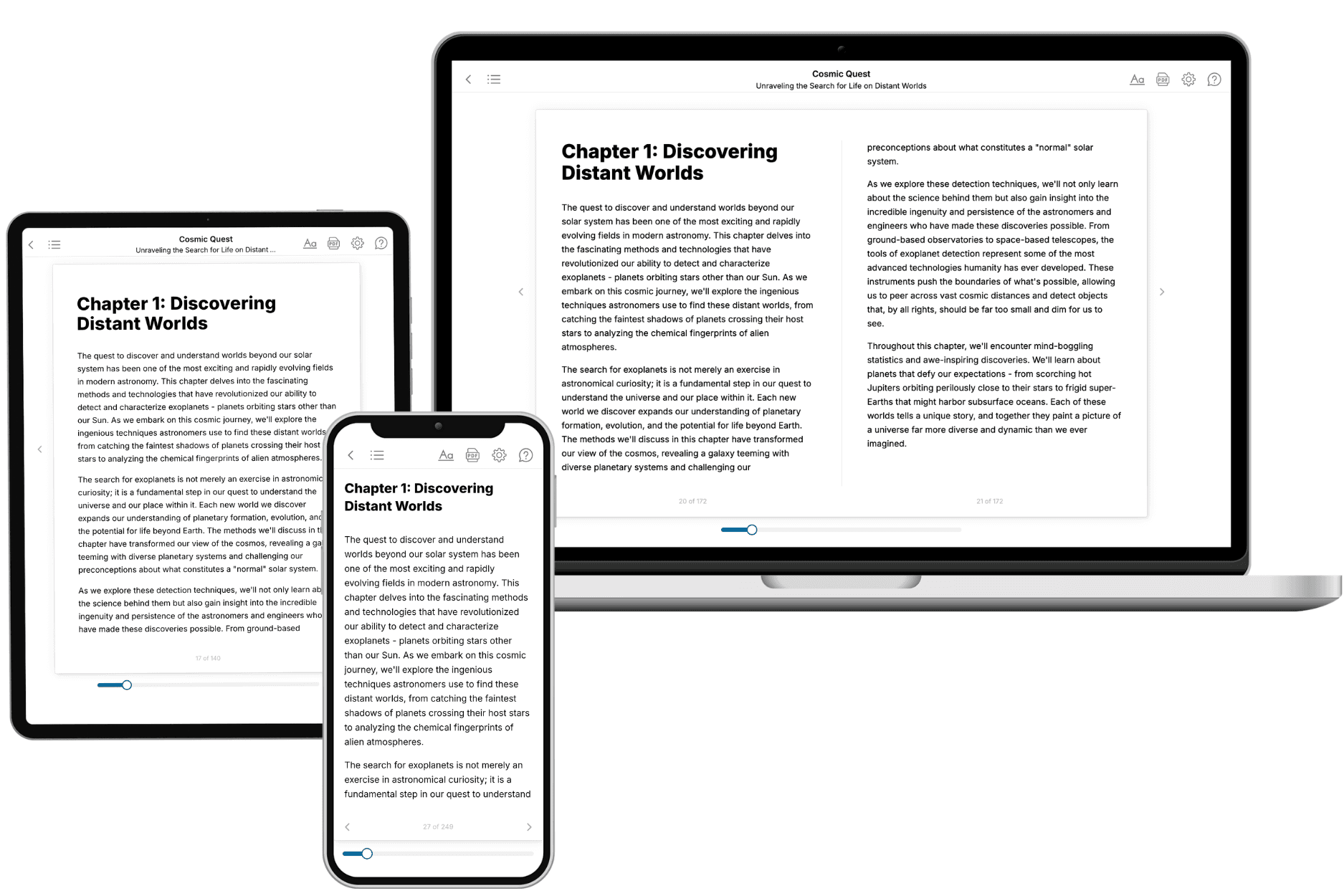
Your book is ready in 10 minutes. Read it online, download as EPUB or PDF, or send to Kindle.
Frequently asked questions
- What is TailoredRead?
TailoredRead creates complete, full-length nonfiction ebooks, written specifically for you. Tell us what you want to learn and why, and TailoredRead writes you a complete ebook on it, with charts, tables, and diagrams throughout. Read it online, on Kindle, or on any e-reader, or download it as a PDF or EPUB. Every book is written fresh the day you order it.
- How is the book tailored to me?
Before anything is written, you answer a few short questions about your goals, your background, and the topics you care about. Your book is then planned around your answers: written at your level, focused on your goals, and covering the topics you chose, instead of the one-size-fits-all book a store sells everyone.
- Will it read like generic AI content?
No. Your book isn't a chat transcript: it's planned chapter by chapter before a single word is written, told in a clear book voice, and explains ideas visually with charts, tables, and diagrams. After writing, every book goes through an editorial pass that polishes chapters so the book reads consistent from start to finish. Judge for yourself: browse thousands of sample books on our Explore Books page.
- How accurate is the content?
Our AI first checks whether your subject needs live research. Niche and fast-moving subjects are researched before writing, and the book plan and chapters are grounded in what it finds. After writing, every book goes through a quality pass that checks its facts and consistency, and researched books list their sources in a Notes section at the back.
- How long is the book?
You choose the length: Comprehensive (250-300 pages), Detailed (150-200 pages), Essential (70-100 pages), or Short (30-50 pages).
- Does the book include visuals?
Yes. Every book includes visual elements such as timelines, checklists, step-by-step guides, decision trees, comparison tables, and matrices, and many include bar charts. A typical book includes dozens of these visual elements.
- Can I read it on Kindle? What formats can I download?
Yes. Every book can be read in our online reader or downloaded as a PDF or EPUB. The EPUB can be opened with Kindle, Apple Books, Kobo, and any e-reader. The Commercial and Author licenses also include an editable Word (DOCX) and Markdown download.
- How much does it cost?
About the price of a regular ebook. The exact price depends on your book's length and complexity, from $2 for the shortest books to $35 for the most comprehensive, and it's shown when you review your book, before you commit to anything. Each book is a one-time purchase, yours to keep, no subscription. Licenses that let you share, teach, or publish your book range from $35.99 to $49.99.
- Can I preview the book before purchasing?
Before you pay, you'll see what your book will cover: the title, a detailed description, the estimated length, and the complete chapter-by-chapter table of contents, so you know what you're getting before you decide. The full text itself is written after you purchase.
- How long does it take to create a book?
About 10 minutes. You can start reading the opening chapters while the rest is still being written.