Beyond Visible Light
Master Infrared Photography to Reveal Hidden Worlds
Discover how to see beyond the visible spectrum and create stunning images that reveal hidden dimensions of the world around you.
238 pages11 chaptersJul 5, 2026Photography
About this book
This comprehensive guide takes you from infrared fundamentals through advanced creative applications, equipping you with both the technical knowledge and artistic vision needed to master this specialized photography discipline. You'll learn how infrared light behaves differently than visible light, explore camera conversion options and filter technologies, and develop the skills to compose compelling infrared images. The book covers essential techniques for exposure metering, white balance, and post-processing workflows specifically designed for infrared work. Through practical examples and detailed explanations, you'll understand how different materials respond to infrared radiation, enabling you to predict and control your results. Whether you're interested in ethereal landscape photography, striking architectural images, or exploring nature in new ways, this guide provides the knowledge and confidence to transform your creative practice and produce images that captivate and inspire.
Table of contents
- IntroductionWhy Infrared Photography Matters, What You'll Learn in This Book, How to Use This GuideRead below
- Chapter 1: The Science of Infrared LightUnderstanding the Electromagnetic Spectrum, Infrared Wavelengths and Photography, How Digital Cameras Detect Infrared, Key Differences from Visible Light Photography
- Chapter 2: Camera Conversion and Equipment OptionsFull-Spectrum and Infrared Conversion Services, Infrared Filters: Types and Characteristics, Choosing the Right Equipment for Your Goals, Budget-Friendly Approaches and Alternatives
- Chapter 3: Exposure and Metering in InfraredWhy Standard Metering Fails in Infrared, Effective Exposure Techniques and Strategies, Bracketing and Safety Margins, ISO Sensitivity in Infrared Photography
- Chapter 4: White Balance and Color ChannelsWhite Balance Fundamentals in Infrared, Setting Custom White Balance, Channel Swapping and Color Interpretation, Converting to Black and White
- Chapter 5: Composition and Subject SelectionDeveloping Infrared Vision, Choosing Subjects That Shine in Infrared, Composition Principles for Infrared Images, Understanding Tonal Relationships in Infrared
- Chapter 6: Material Response and PredictabilityHow Vegetation Responds to Infrared, Water, Sky, and Atmospheric Effects, Man-Made Materials and Surfaces, Predicting Results Before You Shoot
- Chapter 7: Post-Processing Infrared ImagesProcessing RAW Files from Infrared Cameras, Contrast and Tone Curve Adjustments, Color Grading and Creative Interpretation, Advanced Blending and Composite Techniques
- Chapter 8: Infrared Landscape PhotographyLandscape-Specific Techniques and Approaches, Creating Drama with Sky and Foliage Contrast, Seasonal Variations and Planning, Location Scouting for Infrared Landscapes
- Chapter 9: Infrared Architecture and Urban PhotographySeeing Architecture Through Infrared, Revealing Material Textures and Details, Urban Exploration and Street Photography, Interior and Controlled Lighting Scenarios
- Chapter 10: Nature and Wildlife in InfraredNature Photography Approaches, Wildlife Photography Challenges and Solutions, Macro and Close-Up Infrared Work, Seasonal Wildlife and Behavioral Patterns
- Chapter 11: Building Your Infrared PracticeOptimizing Your Workflow for Efficiency, Continuous Learning and Skill Development, Building a Strong Infrared Portfolio, Connecting with the Infrared Photography Community
- ConclusionYour Infrared Photography Journey Ahead, Next Steps and Continued Growth
- Glossary
- Further Reading and Resources
Introduction
There is a version of the world that your eyes will never see. It exists in the same places you walk every day, in the same parks, streets, and open fields you have photographed dozens of times before. But it operates on a different wavelength, one that sits just beyond the edge of human vision. Infrared photography is the practice of capturing that hidden world, and once you see it for the first time, it is genuinely difficult to look at ordinary photographs the same way again. The glowing white foliage, the ink-dark skies, the dreamlike quality that seems to belong to another dimension entirely — these are not digital tricks. They are the real world, revealed.
Infrared photography has a long and fascinating history. Film photographers discovered its possibilities in the early twentieth century, using specially sensitized emulsions to capture landscapes that looked almost otherworldly. Ansel Adams experimented with infrared film to deepen the drama of his skies. Photographers working in scientific, military, and aerial contexts used it to cut through haze and reveal details invisible to standard film. When digital cameras arrived, the technology shifted, but the fundamental appeal never changed. Today, with dedicated camera conversions and high-quality filters, infrared photography is more accessible than it has ever been, and the results are more controllable and consistent than anything possible in the film era.
This book is written for photographers who already understand the basics. You know how to expose an image, you are comfortable working in manual mode, and you have some experience with post-processing software. What you are looking for is a new direction, a way to push your creative practice into territory that feels genuinely fresh. Infrared photography offers exactly that. It is not a filter preset or a post-processing style. It is a fundamentally different way of seeing, one that requires new technical knowledge, new compositional instincts, and a willingness to rethink assumptions you have built up over years of shooting in visible light.
The chapters ahead cover everything from the physics of infrared light to the specifics of post-processing workflows, from equipment decisions to genre-specific techniques for landscapes, architecture, and nature. Each section builds on the last, so by the time you reach the more advanced material, you will have the foundation to understand and apply it confidently. Whether you are considering your first infrared filter purchase or you have already made a camera conversion and want to get more from it, this guide is designed to meet you where you are and take you further than you expected to go.
Why Infrared Photography Matters
Photography, at its core, is about seeing. Every technical skill you develop as a photographer ultimately serves one purpose: helping you translate what you see, or what you imagine, into an image that communicates something meaningful. Infrared photography expands what you are capable of seeing in a very literal sense. It opens up a portion of the electromagnetic spectrum that human eyes cannot access, and it turns that invisible energy into photographs that are visually striking, emotionally resonant, and unlike anything produced by conventional cameras.
The visual language of infrared is distinctive and immediately recognizable. Healthy green vegetation reflects infrared radiation intensely, which means that grass, leaves, and trees appear almost luminously white or pale silver in infrared images. Clear blue skies, on the other hand, absorb infrared and render as deep, dramatic tones ranging from dark gray to near-black. Water behaves differently depending on its depth and clarity. Skin takes on a smooth, almost porcelain quality. These tonal reversals and transformations are not arbitrary. They follow predictable physical rules, and once you understand those rules, you can use them deliberately to shape the mood and impact of every image you make.
Beyond the technical novelty, infrared photography matters because it produces images that carry a particular emotional weight. There is something about the infrared aesthetic that feels timeless, slightly surreal, and deeply atmospheric. Landscapes that might look pleasant but unremarkable in a standard photograph can become genuinely haunting in infrared. A row of trees along a country road becomes a cathedral of white light. A stormy sky over a field of grass becomes a study in contrast that feels almost theatrical. These qualities are not accidental, and they are not easy to replicate with post-processing tricks applied to visible-light images. They come from the physics of how infrared light interacts with the real world.
Infrared photography also matters from a practical standpoint because it gives you a creative tool that relatively few photographers use well. In a world where billions of photographs are taken every day, standing out requires more than technical competence. It requires a distinctive vision. Infrared photography, done thoughtfully, produces images that are immediately recognizable as the work of someone who has invested in a specialized skill. That distinctiveness has real value, whether you are building a portfolio, exhibiting work, or simply trying to make photographs that feel genuinely your own.
It is also worth noting that infrared photography has practical applications beyond pure aesthetics. Landscape photographers use it to cut through atmospheric haze and reveal distant details with unusual clarity. Architectural photographers use it to emphasize texture and material contrast in ways that standard photography cannot match. Nature photographers use it to document plant health and environmental conditions in ways that carry scientific as well as artistic value. The technique is versatile, and its applications extend well beyond any single genre or style.
Infrared photography does not just change how your images look. It changes how you look at the world. Once you start thinking in infrared, you begin to see potential in scenes that would have seemed ordinary before. That shift in perception is one of the most valuable things this discipline can offer.
Finally, infrared photography matters because it is genuinely challenging in ways that make you a better photographer overall. The exposure challenges, the need to understand how different materials respond to infrared radiation, the compositional adjustments required when tonal relationships are completely different from what you expect — all of these demands push you to think more carefully and deliberately about every image you make. Photographers who work seriously in infrared consistently report that it sharpens their technical thinking and deepens their understanding of light in ways that carry over into all of their other work.
What You'll Learn in This Book
This book is organized to take you through infrared photography in a logical sequence, starting with the foundational science and working through to advanced creative applications. Each chapter addresses a specific area of knowledge or skill, and together they form a complete picture of what it takes to work confidently and creatively in infrared. Here is a clear overview of what each part of the book covers and why it matters to your practice.
The science of infrared light is where everything begins. Chapter 1 explains how infrared radiation fits into the electromagnetic spectrum, what wavelengths are relevant to photography, and how digital camera sensors detect infrared light. Understanding this foundation is not just academic. It directly informs every practical decision you will make, from choosing a filter to predicting how a particular scene will render. You do not need a physics degree to follow this material, but you do need a working understanding of the principles involved.
Camera conversion and equipment is covered in Chapter 2, and it is one of the most consequential sections in the book. The equipment decisions you make at the start of your infrared journey will shape everything that follows. The chapter covers:
- The difference between full-spectrum conversions and dedicated infrared conversions
- How to evaluate conversion services and what to look for in a converted camera
- The range of infrared filters available, from the 590nm warm-tone filters to the 830nm deep infrared options
- How to match your equipment choices to your creative goals and budget
Exposure and metering in infrared is genuinely different from standard photography, and Chapter 3 explains why. Standard camera metering systems are calibrated for visible light, which means they can produce significantly incorrect exposures when used with infrared filters or converted cameras. The chapter provides practical strategies for getting accurate exposures consistently, including bracketing techniques and the specific adjustments needed for different filter types and lighting conditions.
White balance and color channels are covered in Chapter 4, and this is where infrared photography gets particularly interesting for photographers who want to work in color rather than pure black and white. Infrared images captured in RAW format contain color information that can be manipulated in post-processing to produce a wide range of looks, from the classic false-color effect with blue skies and golden foliage to more subtle interpretations. The chapter explains how to set custom white balance in the field and how to work with color channels in post-processing to achieve your intended result.
Composition and subject selection in Chapter 5 addresses one of the most important and often overlooked aspects of infrared photography. Because tonal relationships are so different in infrared, compositional instincts developed through years of visible-light photography do not always transfer directly. A scene that has strong visual contrast in visible light may look flat in infrared, while a scene that seems unremarkable to the naked eye may have extraordinary infrared potential. This chapter helps you develop what experienced infrared photographers call infrared vision, the ability to look at a scene and predict how it will render before you press the shutter.
Material response and predictability is the subject of Chapter 6, and it is one of the most practically useful sections in the book. Different materials reflect and absorb infrared radiation in very different ways, and understanding these differences is essential for predicting your results. The chapter covers vegetation, water, sky, skin, stone, metal, glass, and a range of man-made materials, giving you a reliable mental model for how each will behave in your images.
Post-processing is covered in depth in Chapter 7. Infrared RAW files require a different processing approach than standard digital files, and the chapter walks through the complete workflow from initial RAW conversion through tone curve adjustments, color grading, and advanced blending techniques. Specific guidance is provided for both Lightroom and Photoshop, with attention to the particular challenges that infrared files present.
The final chapters cover genre-specific applications in landscape, architecture, and nature photography, followed by a chapter on building a sustainable infrared practice. These sections bring together everything covered earlier and apply it to specific creative contexts, with practical examples and detailed guidance for each genre. By the time you finish the book, you will have both the technical knowledge and the creative framework to work confidently across a wide range of infrared subjects and situations.
How to Use This Guide
This book is designed to be read from beginning to end on your first pass. The chapters build on each other in a deliberate sequence, and concepts introduced early in the book are referenced and expanded in later chapters. If you skip ahead to the post-processing chapter without reading the sections on exposure and white balance, for example, some of the guidance will make less sense than it should. The investment in reading the foundational material pays off in the later chapters, where the practical applications become much clearer because you understand the underlying principles.
That said, once you have read through the book once, it is designed to work equally well as a reference. Each chapter is self-contained enough that you can return to specific sections when you need a refresher on a particular topic. If you are heading out for a landscape shoot and want to review the guidance on exposure bracketing or location scouting, you can go directly to those sections without needing to re-read the surrounding material. The structure is meant to support both linear reading and targeted reference use.
Throughout the book, you will find several recurring elements designed to make the content more practical and immediately applicable:
- Concrete examples drawn from real shooting scenarios, with specific settings, conditions, and outcomes described in enough detail to be genuinely useful
- Common mistakes and how to avoid them, based on the challenges that photographers most frequently encounter when starting out in infrared
- Step-by-step processes for technical tasks like setting custom white balance, processing RAW files, and performing channel swaps in post-processing
- Predictive frameworks that help you anticipate how a scene will render before you shoot, reducing wasted time and missed opportunities
One of the most important things you can do while working through this book is to shoot alongside your reading. Infrared photography is a practical skill, and reading about it is only part of the learning process. Each chapter introduces concepts that become much clearer once you have tried to apply them in the field. If you have access to an infrared filter or a converted camera, try to get out and shoot after each chapter, even if only for a short session. The combination of reading and doing will accelerate your learning significantly compared to either approach on its own.
If you are just starting out and have not yet made any equipment decisions, the early chapters will help you understand your options before you spend any money. Chapter 2 in particular is worth reading carefully before purchasing a filter or committing to a camera conversion, because the choices you make at that stage will have long-term implications for your creative possibilities. There is no single right answer for every photographer, and the chapter is designed to help you identify the approach that best fits your goals, shooting style, and budget.
For photographers who already have some infrared experience, the book offers depth and specificity that goes beyond introductory material. The chapters on material response, post-processing, and genre-specific techniques contain detailed guidance that is useful even for photographers who have been working in infrared for some time. If you find that certain early sections cover ground you already know well, feel free to move through them more quickly and spend more time with the chapters that address areas where you want to develop further.
It is also worth approaching this book with a spirit of experimentation. Infrared photography rewards curiosity and a willingness to try things that might not work. Some of the most interesting infrared images come from unexpected combinations of subject, light, and technique. The technical knowledge in this book gives you a reliable foundation, but the creative possibilities extend well beyond any set of rules or guidelines. Use the frameworks provided here as a starting point, and then push past them. The goal is not to produce images that look like everyone else's infrared work. The goal is to develop a personal vision that is distinctly your own, expressed through a medium that has the power to reveal things that ordinary photography simply cannot show.
Finally, be patient with yourself as you work through the learning curve. Infrared photography has a steeper initial learning curve than most photographic specializations, largely because so many of the intuitions you have developed through visible-light photography need to be recalibrated. Exposures that look right on the histogram may not match your expectations. Scenes that seem promising may not deliver the drama you anticipated. Scenes that seem unremarkable may surprise you completely. This unpredictability is part of what makes infrared photography so engaging, and it diminishes significantly as your understanding of the medium deepens. Every session in the field teaches you something, and the knowledge accumulates faster than you might expect. By the time you have worked through this book and applied its guidance across a range of shooting situations, you will have developed a reliable intuition for infrared that makes the process feel natural rather than effortful.
The world beyond visible light is waiting. The chapters ahead will show you how to find it, capture it, and share it in images that carry the unmistakable quality of something genuinely seen rather than merely processed. That is what infrared photography, at its best, makes possible. And that is exactly what this book is designed to help you achieve.
This is the end of the free sample. The full book has 11 chapters.
Want this book written for you?
Tell us your goals and background, and get your own version of this book, tailored by AI to you.


Benefits of AI-tailored books
- Read one book, not ten:
- all the Photography knowledge you need, gathered into a single book.
- Save days of learning:
- tell us your goals, choose your topics, and the whole book is built around them.
- Learn effortlessly:
- Photography book written for your specific background and expertise.
- Understand at a glance:
- includes charts, tables, timelines, checklists, decision trees, and more.
- Stay current:
- written the day you order it, not years ago.
- Trust what you read:
- every book is checked for accuracy, with real research when your subject needs it.
Create your unique book in 3 steps
- 1. Select your focus
Select the focus of your Photography book and share your background
- 2. Personalize your book
Specify your goals and choose sub-topics to include
- 3. Get your tailored book
Your book is ready in 10 minutes. Read it online, download as EPUB or PDF, or send to Kindle.

Frequently asked questions
- What is TailoredRead?
TailoredRead creates complete, full-length nonfiction ebooks, written specifically for you. Tell us what you want to learn and why, and TailoredRead writes you a complete ebook on it, with charts, tables, and diagrams throughout. Read it online, on Kindle, or on any e-reader, or download it as a PDF or EPUB. Every book is written fresh the day you order it.
- How is the book tailored to me?
Before anything is written, you answer a few short questions about your goals, your background, and the topics you care about. Your book is then planned around your answers: written at your level, focused on your goals, and covering the topics you chose, instead of the one-size-fits-all book a store sells everyone.
- Will it read like generic AI content?
No. Your book isn't a chat transcript: it's planned chapter by chapter before a single word is written, told in a clear book voice, and explains ideas visually with charts, tables, and diagrams. After writing, every book goes through an editorial pass that polishes chapters so the book reads consistent from start to finish. Judge for yourself: browse thousands of sample books on our Explore Books page.
- How accurate is the content?
Our AI first checks whether your subject needs live research. Niche and fast-moving subjects are researched before writing, and the book plan and chapters are grounded in what it finds. After writing, every book goes through a quality pass that checks its facts and consistency, and researched books list their sources in a Notes section at the back.
- How long is the book?
You choose the length: Comprehensive (250-300 pages), Detailed (150-200 pages), Essential (70-100 pages), or Short (30-50 pages).
- Does the book include visuals?
Yes. Every book includes charts, tables, and diagrams: timelines, checklists, step-by-step guides, decision trees, comparison tables, matrices, and bar charts. A typical book includes dozens of these visual elements.
- Can I read it on Kindle? What formats can I download?
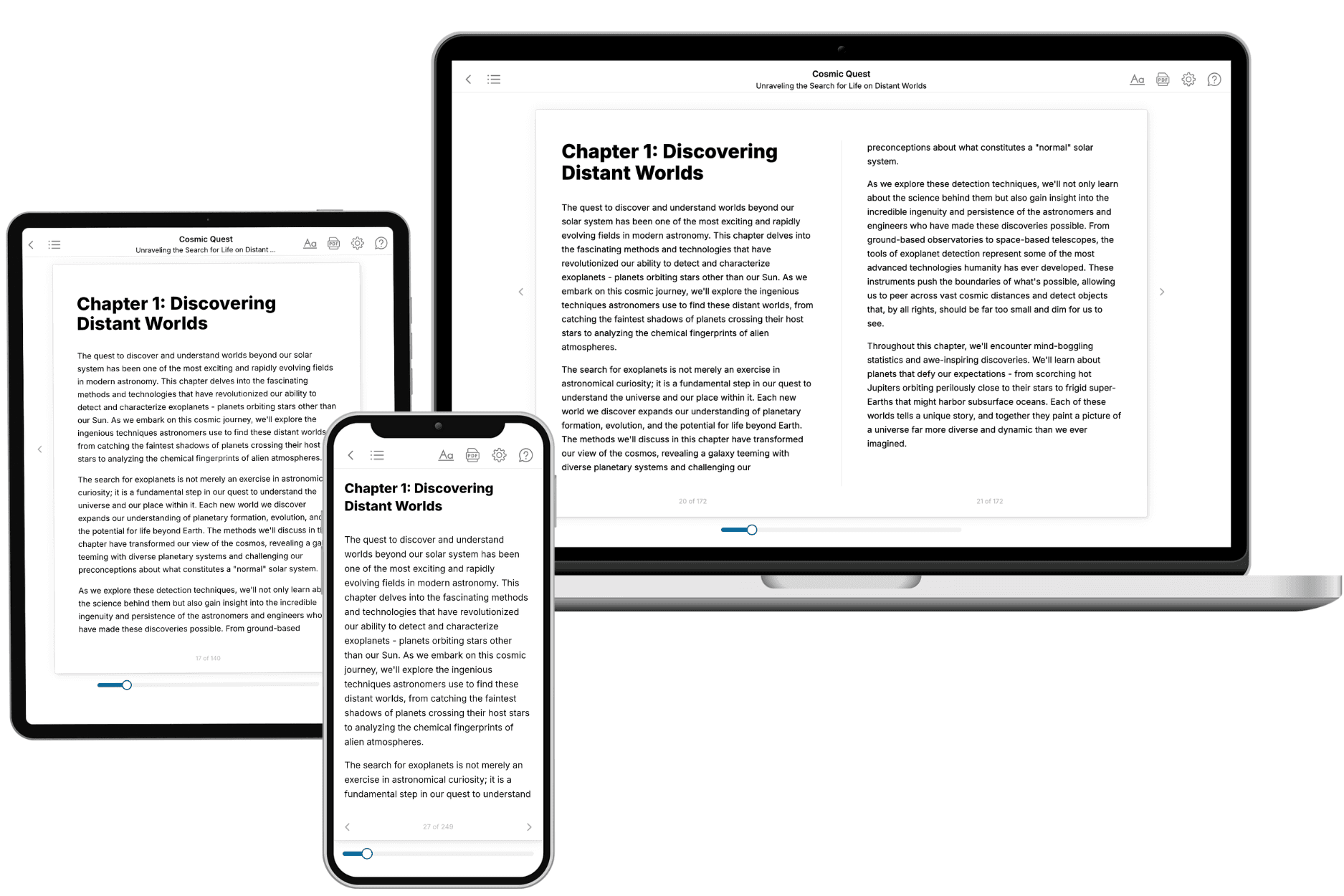
Yes. Every book can be read in our online reader or downloaded as a PDF or EPUB. The EPUB can be opened with Kindle, Apple Books, Kobo, and any e-reader. The Commercial and Author licenses also include an editable Word (DOCX) and Markdown download.
- How much does it cost?
About the price of a regular ebook. The exact price depends on your book's length and complexity, from $2 for the shortest books to $35 for the most comprehensive, and it's shown when you review your book, before you commit to anything. Each book is a one-time purchase, yours to keep, no subscription. Licenses that let you share, teach, or publish your book range from $35.99 to $49.99.
- Can I preview the book before purchasing?
Before you pay, you'll see what your book will cover: the title, a detailed description, the estimated length, and the complete chapter-by-chapter table of contents, so you know what you're getting before you decide. The full text itself is written after you purchase.
- How long does it take to create a book?
About 10 minutes. You can start reading the opening chapters while the rest is still being written.