Bolo de Milho
Mastering the Art of Portuguese Cornbread
Embark on a culinary journey through the heart of Portuguese cuisine with "Bolo de Milho: Mastering the Art of Portuguese Cornbread." This comprehensive guide will take you on a flavorful adventure, exploring the rich history, cultural significance, and mouthwatering variations of this beloved Portuguese staple.
269 pages13 chaptersNov 23, 2024Baking
About this book
From the sun-drenched fields of corn to your very own kitchen, you'll discover the secrets behind creating the perfect Bolo de Milho. Learn about the traditional ingredients, time-honored techniques, and modern twists that make this dish a true culinary treasure. Whether you're a seasoned cook or just starting your culinary journey, this book will equip you with the knowledge and skills to craft golden, aromatic cornbread that will transport you straight to the charming villages of Portugal. Dive deep into the world of Portuguese cooking as you master not only the classic Bolo de Milho recipe but also explore its many regional variations and creative adaptations. With step-by-step instructions, helpful tips, and stunning photography, you'll gain the confidence to experiment with flavors and textures, making each loaf uniquely your own. Get ready to fill your home with the irresistible aroma of freshly baked cornbread and impress your family and friends with your newfound expertise in Portuguese cuisine.
Table of contents
- IntroductionWhat is Bolo de Milho?, Your Culinary Journey Ahead, Essential Equipment for Baking Bolo de Milho, Measuring Techniques for Consistent ResultsRead below
- Chapter 1: The Rich History and Culture of Bolo de MilhoOrigins of Bolo de Milho in Portuguese Cuisine, Cultural Significance and Traditions, Regional Importance Across Portugal, Evolution of Bolo de Milho Through the Ages
- Chapter 2: Essential Ingredients for Bolo de MilhoTypes of Cornmeal and Their Characteristics, Selecting the Right Flour for Your Bolo, Fats and Oils: Butter, Olive Oil, and Alternatives, Dairy Products in Bolo de Milho, Sweeteners: Sugar, Honey, and Natural Alternatives
- Chapter 3: The Classic Bolo de Milho RecipeIngredient List and Proportions, Mixing Techniques for Perfect Texture, The Baking Process: Temperature and Timing, Cooling and Storing Your Bolo de Milho
- Chapter 4: Regional Variations of Bolo de MilhoNorthern Portugal's Hearty Versions, Central Portugal's Traditional Recipes, Southern Portugal's Sun-Kissed Variations, Island Variations: Azores and Madeira
- Chapter 5: Enhancing Flavors in Bolo de MilhoHerbs and Spices to Complement Cornbread, Cheese Variations for Savory Bolo de Milho, Fruit Additions for Sweet Variations, Vegetable Inclusions for Added Nutrition
- Chapter 6: Mastering Texture in Bolo de MilhoControlling Moisture for the Perfect Crumb, Developing a Golden, Crispy Crust, Leavening Agents and Their Effects, Kneading Techniques for Different Textures
- Chapter 7: Various Baking Methods for Bolo de MilhoTraditional Oven Baking Techniques, Skillet Method for Crispy Edges, Steam Baking for Extra Moisture, Outdoor Baking Methods: Grills and Wood-Fired Ovens
- Chapter 8: Serving and Pairing Bolo de MilhoTraditional Portuguese Accompaniments, Modern Pairing Suggestions, Beverage Pairings: From Coffee to Wine, Presentation Techniques for Various Occasions
- Chapter 9: Health and Nutrition of Bolo de MilhoNutritional Profile of Bolo de Milho, Health Benefits of Key Ingredients, Adapting Recipes for Dietary Restrictions, Portion Control and Moderation
- Chapter 10: Troubleshooting Common Bolo de Milho IssuesAddressing Texture Problems, Correcting Flavor Imbalances, Solving Baking and Browning Issues, Dealing with Storage and Freshness Problems
- Chapter 11: Creative Uses for Bolo de MilhoDelicious Ideas for Leftover Bolo de Milho, Fusion Recipes Incorporating Bolo de Milho, Transforming Bolo de Milho into Desserts, Holiday and Special Occasion Variations
- Chapter 12: Sustainability in Bolo de Milho ProductionSourcing Local and Sustainable Ingredients, Reducing Waste in Bolo de Milho Preparation, Eco-Friendly Packaging and Storage Solutions, Seasonal Adaptations for Sustainability
- Chapter 13: Bolo de Milho Around the WorldGlobal Cornbread Variations, Bolo de Milho in Portuguese Diaspora Communities, International Influences on Bolo de Milho, Fusion Creations Inspired by Bolo de Milho
- ConclusionReflecting on Your Bolo de Milho Mastery Journey, Future Explorations in Portuguese Cuisine
- Glossary of Terms
- Further Resources
Introduction
Welcome to the delightful world of Bolo de Milho, a cornerstone of Portuguese cuisine that has captivated taste buds for generations. As you embark on this culinary journey, you'll discover the rich tapestry of flavors, textures, and traditions that make this humble cornbread a beloved staple in kitchens across Portugal and beyond. This introduction will lay the foundation for your exploration, providing you with a comprehensive overview of Bolo de Milho, the exciting path that lies ahead in mastering this dish, the essential equipment you'll need, and the crucial measuring techniques that will ensure your success.
Throughout this book, you'll delve deep into the heart of Portuguese cooking, uncovering the secrets that have been passed down through generations of skilled bakers and home cooks. Whether you're a seasoned chef looking to expand your repertoire or an enthusiastic home cook eager to explore new culinary territories, this guide will equip you with the knowledge, skills, and inspiration to create authentic, mouthwatering Bolo de Milho that will transport you to the sun-drenched hills of Portugal with every bite.
As we journey together through the pages of this book, you'll not only learn how to perfect the classic Bolo de Milho recipe but also discover its many regional variations, explore creative flavor combinations, and master the techniques that will elevate your cornbread from good to exceptional. By the time you reach the final chapter, you'll have gained a deep appreciation for the cultural significance of this dish and the confidence to experiment with your own unique twists on this timeless classic.
So, preheat your oven, gather your ingredients, and prepare to immerse yourself in the warm, comforting embrace of Portuguese culinary tradition. Your adventure in mastering the art of Bolo de Milho begins now, and the rewards that await you are as rich and satisfying as the golden loaves you'll soon be pulling from your oven.
What is Bolo de Milho?
Bolo de Milho, which translates to "corn cake" in English, is a traditional Portuguese cornbread that holds a special place in the country's culinary heritage. Far more than just a simple bread, Bolo de Milho is a versatile and beloved dish that reflects the agricultural abundance and culinary ingenuity of Portugal. At its core, this golden delight is made primarily from cornmeal, giving it a distinctive texture and flavor that sets it apart from other bread varieties.
The origins of Bolo de Milho can be traced back centuries, intertwining with the history of corn cultivation in Portugal. Corn, or maize, was introduced to the Iberian Peninsula in the 16th century following the discovery of the Americas. It quickly became a staple crop, particularly in the northern regions of Portugal, where the climate and soil conditions were ideal for its cultivation. As corn became more prevalent, innovative Portuguese cooks began incorporating it into their cuisine, leading to the development of various cornmeal-based dishes, including Bolo de Milho.
What makes Bolo de Milho truly special is its remarkable versatility. Depending on the region and the cook's preferences, it can range from a dense, hearty bread to a lighter, cake-like consistency. Some versions are savory, while others lean towards the sweet side. This adaptability is one of the reasons why Bolo de Milho has remained a beloved staple in Portuguese households for generations.
The basic ingredients of Bolo de Milho typically include cornmeal, wheat flour, eggs, milk or water, and some form of fat, such as butter or olive oil. However, the beauty of this dish lies in its ability to accommodate a wide range of additional ingredients and flavors. From herbs and spices to cheese, vegetables, or even fruits, the possibilities for customization are nearly endless, allowing each baker to put their unique stamp on this traditional recipe.
In terms of texture, a well-made Bolo de Milho should have a golden, slightly crispy exterior that gives way to a moist, tender crumb when sliced. The cornmeal provides a pleasant grittiness that distinguishes it from wheat-based breads, while also imparting a subtle sweetness and a rich, corn flavor that is both comforting and satisfying.
Bolo de Milho plays various roles in Portuguese cuisine. It can be enjoyed as a standalone snack, often served warm with a pat of butter melting into its golden surface. It's also a common accompaniment to meals, particularly soups and stews, where its sturdy texture makes it perfect for soaking up flavorful broths. In some regions, it's even incorporated into desserts or served as a sweet treat, drizzled with honey or sprinkled with sugar.
Beyond its culinary applications, Bolo de Milho holds significant cultural importance in Portugal. It's often featured in traditional festivals and celebrations, symbolizing abundance and community. In rural areas, the preparation of Bolo de Milho can be a communal activity, bringing families and neighbors together to share in the process of mixing, kneading, and baking.
As you delve deeper into the world of Bolo de Milho, you'll discover that it's more than just a recipe – it's a window into Portuguese culture, history, and way of life. Each loaf tells a story of tradition, innovation, and the deep connection between people and their land. By mastering the art of Bolo de Milho, you're not just learning to bake bread; you're becoming part of a rich culinary legacy that has been cherished for centuries.
In the chapters that follow, we'll explore every aspect of Bolo de Milho in detail, from its historical roots to modern variations. You'll learn about the science behind the perfect crumb, the art of balancing flavors, and the techniques that will help you achieve consistent, delicious results every time. Whether you're looking to recreate a taste of Portugal in your own kitchen or simply expand your baking repertoire, Bolo de Milho offers a world of culinary possibilities waiting to be explored.
Your Culinary Journey Ahead
As you embark on this exciting culinary adventure into the world of Bolo de Milho, it's important to understand the journey that lies ahead. This book is designed to be your comprehensive guide, taking you from the basics of Portuguese cornbread to advanced techniques and creative variations. Each chapter builds upon the last, providing you with a structured path to mastery that will deepen your understanding and appreciation of this beloved dish.
Your journey begins with an exploration of the rich history and cultural significance of Bolo de Milho. You'll discover how this humble bread has evolved over centuries, adapting to regional tastes and ingredients while maintaining its core identity. This historical context will not only enrich your appreciation for the dish but also inspire you to connect with the traditions behind each loaf you bake.
From there, we'll dive into the heart of Bolo de Milho: its ingredients. You'll learn about the different types of cornmeal and their unique properties, as well as the roles of other key ingredients like flour, fats, and leavening agents. Understanding these components is crucial for achieving the perfect texture and flavor in your Bolo de Milho. We'll explore how to select the best quality ingredients and how to make substitutions when necessary, empowering you to create delicious cornbread even when traditional Portuguese ingredients might not be readily available.
With a solid foundation in ingredients, we'll move on to mastering the classic Bolo de Milho recipe. This section will break down each step of the process in detail, from measuring and mixing to kneading and baking. You'll learn the secrets to achieving that perfect golden crust and moist, tender crumb that characterizes an exceptional Bolo de Milho. We'll also cover troubleshooting tips to help you overcome common challenges and consistently produce outstanding results.
As you gain confidence with the basic recipe, we'll expand your horizons by exploring regional variations of Bolo de Milho from across Portugal. Each region has its own unique twist on this classic dish, reflecting local ingredients, traditions, and tastes. By learning these variations, you'll not only broaden your repertoire but also gain insights into the diverse culinary landscape of Portugal.
The journey continues with an exploration of flavor enhancements and texture techniques. You'll discover how to incorporate herbs, spices, cheeses, and other ingredients to create exciting new flavor profiles while still honoring the essence of Bolo de Milho. We'll also delve into advanced techniques for controlling moisture, developing crust, and achieving different textures, allowing you to customize your cornbread to suit any occasion or preference.
As your skills grow, we'll introduce you to various baking methods beyond the traditional oven approach. You'll learn how to use skillets, steam baking, and even outdoor cooking techniques to create unique variations of Bolo de Milho. These alternative methods will not only expand your culinary toolkit but also allow you to adapt to different cooking environments and equipment.
No culinary journey is complete without considering the broader context of the dish, so we'll explore how to serve and pair Bolo de Milho with other foods and beverages. You'll learn about traditional Portuguese accompaniments as well as modern pairing suggestions that can elevate your dining experience. We'll also discuss presentation techniques to help you showcase your Bolo de Milho in the most appealing way, whether for a casual family meal or a special occasion.
As we near the end of our journey, we'll take a closer look at the health and nutritional aspects of Bolo de Milho. You'll gain insights into the nutritional profile of this dish and learn how to adapt recipes to accommodate various dietary needs without sacrificing flavor or texture. This knowledge will allow you to enjoy Bolo de Milho as part of a balanced diet and share it with friends and family who may have specific dietary requirements.
Throughout the book, you'll find practical tips, expert advice, and inspirational ideas to fuel your creativity. We'll cover everything from troubleshooting common issues to exploring creative uses for leftover Bolo de Milho. You'll also discover how to incorporate sustainable practices into your baking, reflecting the growing global awareness of environmental issues in food production and consumption.
By the time you reach the conclusion of this book, you'll have gained a comprehensive understanding of Bolo de Milho that goes far beyond simply following a recipe. You'll have the knowledge and skills to create authentic Portuguese cornbread, the confidence to experiment with your own variations, and a deep appreciation for the cultural significance of this beloved dish.
Remember, mastering Bolo de Milho is not just about perfecting a single recipe – it's about embracing a culinary tradition and making it your own. Each loaf you bake is an opportunity to connect with Portuguese culture, express your creativity, and share something truly special with those around you. So, as we set out on this journey together, prepare to engage all your senses, challenge your culinary skills, and most importantly, enjoy the delicious rewards of your efforts. Your adventure in the world of Bolo de Milho starts now – let's begin!
Essential Equipment for Baking Bolo de Milho
Before embarking on your Bolo de Milho baking adventure, it's crucial to ensure you have the right tools at your disposal. While Portuguese home cooks have been making this delicious cornbread for centuries with minimal equipment, having the proper utensils and bakeware can significantly enhance your experience and help you achieve consistent, professional-quality results. This section will guide you through the essential equipment needed for baking Bolo de Milho, explaining the purpose of each item and offering suggestions for alternatives where possible.
First and foremost, you'll need a reliable oven. Traditional Bolo de Milho is typically baked in a conventional oven, but don't worry if you have a convection oven – we'll discuss how to adjust temperatures and baking times accordingly. If you're fortunate enough to have access to a wood-fired oven, you'll be able to recreate the authentic flavors of rural Portuguese kitchens. However, a standard home oven is more than sufficient for producing excellent Bolo de Milho.
A good mixing bowl is essential for combining your ingredients. Opt for a large, sturdy bowl that gives you plenty of room to mix and knead the dough without making a mess. Stainless steel bowls are popular among professional bakers for their durability and ease of cleaning, but glass or ceramic bowls work well too. If you plan to let your dough rise in the bowl, consider having a second bowl on hand or a clean kitchen towel to cover it.
When it comes to measuring ingredients, accuracy is key to achieving consistent results. A set of measuring cups and spoons is indispensable. Look for sets that include both dry and liquid measures. While many Portuguese recipes traditionally use weight measurements, we'll provide both weight and volume measurements throughout this book. If you want to take your baking to the next level, consider investing in a kitchen scale for precise measurements, especially when working with cornmeal and flour.
For mixing your Bolo de Milho batter, you have several options. A wooden spoon or sturdy silicone spatula works well for hand mixing, allowing you to feel the texture of the batter as it comes together. If you prefer a more hands-off approach or are making larger batches, a stand mixer with a paddle attachment can be a great time-saver. However, be cautious not to overmix the batter, as this can lead to a tough texture in the final product.
When it comes to baking vessels, traditional Bolo de Milho is often made in a round cake pan or a rectangular baking dish. A 9-inch round cake pan or a 9x13-inch baking dish are good standard sizes to start with. Look for pans with straight sides to give your cornbread a classic shape. Non-stick pans can be convenient, but if you're using a regular pan, make sure to grease it well or line it with parchment paper to prevent sticking.
For those interested in exploring different textures and presentations, a cast-iron skillet can be an excellent investment. Cast iron retains heat well and can create a beautifully crisp crust on your Bolo de Milho. It's also versatile enough to use for other cooking methods we'll explore later in the book.
A wire cooling rack is another useful tool to have on hand. After baking, it's important to allow your Bolo de Milho to cool properly to prevent it from becoming soggy. A wire rack allows air to circulate around the bread, cooling it evenly and maintaining that desirable texture contrast between the crust and the interior.
For more advanced techniques and variations, you might consider having a few additional items in your kitchen arsenal. A pastry brush is useful for applying egg washes or glazes to your cornbread. A sharp serrated knife will help you achieve clean slices without compressing the bread. If you plan to experiment with adding fresh herbs or other mix-ins, a good chef's knife and cutting board will come in handy.
While not strictly necessary, a kitchen thermometer can be a valuable tool for ensuring your Bolo de Milho is cooked to perfection. By checking the internal temperature of your bread, you can avoid the disappointment of an undercooked center or an overly dry loaf.
Lastly, don't forget about storage containers. Properly storing your Bolo de Milho is crucial for maintaining its freshness and texture. Airtight containers or resealable plastic bags are good options for short-term storage, while freezer-safe containers or wraps are essential if you plan to freeze your cornbread for later enjoyment.
Remember, while having the right equipment can certainly make your baking experience more enjoyable and potentially yield better results, the most important tools are your hands and your passion for baking. Many of the items mentioned can be substituted with alternatives you may already have in your kitchen. The key is to work with what you have and focus on understanding the techniques and principles behind making great Bolo de Milho. As you progress in your journey, you can gradually acquire more specialized equipment to expand your capabilities.
With these essential tools at your disposal, you'll be well-equipped to tackle the recipes and techniques we'll explore throughout this book. Each piece of equipment plays a role in helping you create delicious, authentic Bolo de Milho that would make any Portuguese baker proud. So, gather your tools, roll up your sleeves, and get ready to immerse yourself in the wonderful world of Portuguese cornbread baking!
Measuring Techniques for Consistent Results
Accurate measurement is the cornerstone of successful baking, and Bolo de Milho is no exception. The right balance of ingredients is crucial for achieving the perfect texture, flavor, and appearance in your cornbread. In this section, we'll explore various measuring techniques that will help you consistently produce outstanding Bolo de Milho, ensuring that each loaf is as delicious as the last.
First and foremost, it's important to understand the difference between volume and weight measurements. In many traditional Portuguese recipes, ingredients are often measured by volume (cups, tablespoons, etc.). However, professional bakers often prefer weight measurements (grams, ounces) for their precision. Throughout this book, we'll provide both volume and weight measurements to accommodate different preferences and equipment availability.
When measuring dry ingredients like cornmeal, flour, or sugar by volume, the "scoop and level" method is key. Start by fluffing the ingredient in its container to aerate it and prevent compaction. Then, use a spoon to gently scoop the ingredient into your measuring cup until it's overflowing. Finally, use the straight edge of a knife or spatula to level off the excess, creating a smooth surface even with the rim of the cup. This method ensures you're not packing the ingredient too tightly, which can lead to using more than the recipe calls for.
For smaller amounts of dry ingredients, such as baking powder, salt, or spices, use measuring spoons. The same "scoop and level" principle applies here. When measuring sticky ingredients like honey or molasses, lightly coat your measuring spoon or cup with oil first. This will help the ingredient slide out easily, ensuring you get the full amount into your mixture.
Liquid ingredients require a different approach. Use a clear, graduated measuring cup placed on a flat surface. Pour the liquid in until it reaches the desired level, then bend down to check at eye level. The bottom of the liquid's meniscus (the curved surface at the top of the liquid) should align with the measurement line for accuracy.
When it comes to fats, the method depends on the form. For solid fats like butter, look for measurement markings on the wrapper, or use the water displacement method: fill a measuring cup with cold water to a specific level, then add pieces of butter until the water rises to the desired measurement. For liquid fats like oil, use a liquid measuring cup as described above.
If you're using a kitchen scale for weight measurements, always zero or "tare" the scale with your empty bowl or container on it before adding ingredients. This ensures you're measuring only the weight of the ingredients, not the container. When adding multiple ingredients to the same bowl, remember to zero the scale between each addition for accurate individual measurements.
Temperature can affect the volume of ingredients, particularly liquids. For consistent results, try to measure ingredients at room temperature unless the recipe specifies otherwise. This is especially important for butter, eggs, and milk, which can behave differently in recipes depending on their temperature.
When measuring cornmeal, which is a key ingredient in Bolo de Milho, be particularly mindful of compaction. Cornmeal can settle and compact during storage, so always fluff it up before measuring. If your recipe calls for sifted cornmeal, sift it after measuring unless the recipe specifically states "X cups of sifted cornmeal," in which case you should sift before measuring.
For recipes that call for fresh herbs or grated cheese, pay attention to whether the measurement should be taken before or after chopping or grating. "1 cup chopped parsley" and "1 cup parsley, chopped" can yield significantly different amounts.
As you become more experienced with baking Bolo de Milho, you may find yourself able to eyeball measurements or adjust quantities based on feel. While this intuitive approach can work well for experienced bakers, it's always best to start with precise measurements, especially when trying a new recipe or variation.
Remember that humidity and altitude can affect your ingredients and how they behave in recipes. If you live in a particularly humid or high-altitude area, you may need to make slight adjustments to your measurements or techniques. We'll discuss these considerations in more detail in later chapters.
Lastly, consistency in your measuring techniques is key. Try to develop a standard approach and stick to it across all your baking projects. This will help you achieve reliable results and make it easier to troubleshoot if something doesn't turn out as expected.
By mastering these measuring techniques, you're laying a solid foundation for your Bolo de Milho baking journey. Accurate measurements will give you the confidence to experiment with different variations and help you consistently produce delicious cornbread that captures the authentic flavors of Portugal. As you practice and refine your skills, you'll find that precise measuring becomes second nature, allowing you to focus on the creative aspects of baking and the joy of sharing your delicious creations with others.
This is the end of the free sample. The full book has 13 chapters.
Want this book written for you?
Tell us your goals and background, and get your own version of this book, tailored by AI to you.


Benefits of AI-tailored books
- Read one book, not ten:
- all the Baking knowledge you need, gathered into a single book.
- Save days of learning:
- tell us your goals, choose your topics, and the whole book is built around them.
- Learn effortlessly:
- Baking book written for your specific background and expertise.
- Understand at a glance:
- includes charts, tables, timelines, checklists, decision trees, and more.
- Stay current:
- written the day you order it, not years ago.
- Trust what you read:
- every book is checked for accuracy, with real research when your subject needs it.
Create your unique book in 3 steps
- 1. Select your focus
Select the focus of your Baking book and share your background
- 2. Personalize your book
Specify your goals and choose sub-topics to include
- 3. Get your tailored book
Your book is ready in 10 minutes. Read it online, download as EPUB or PDF, or send to Kindle.


Frequently asked questions
- What is TailoredRead?
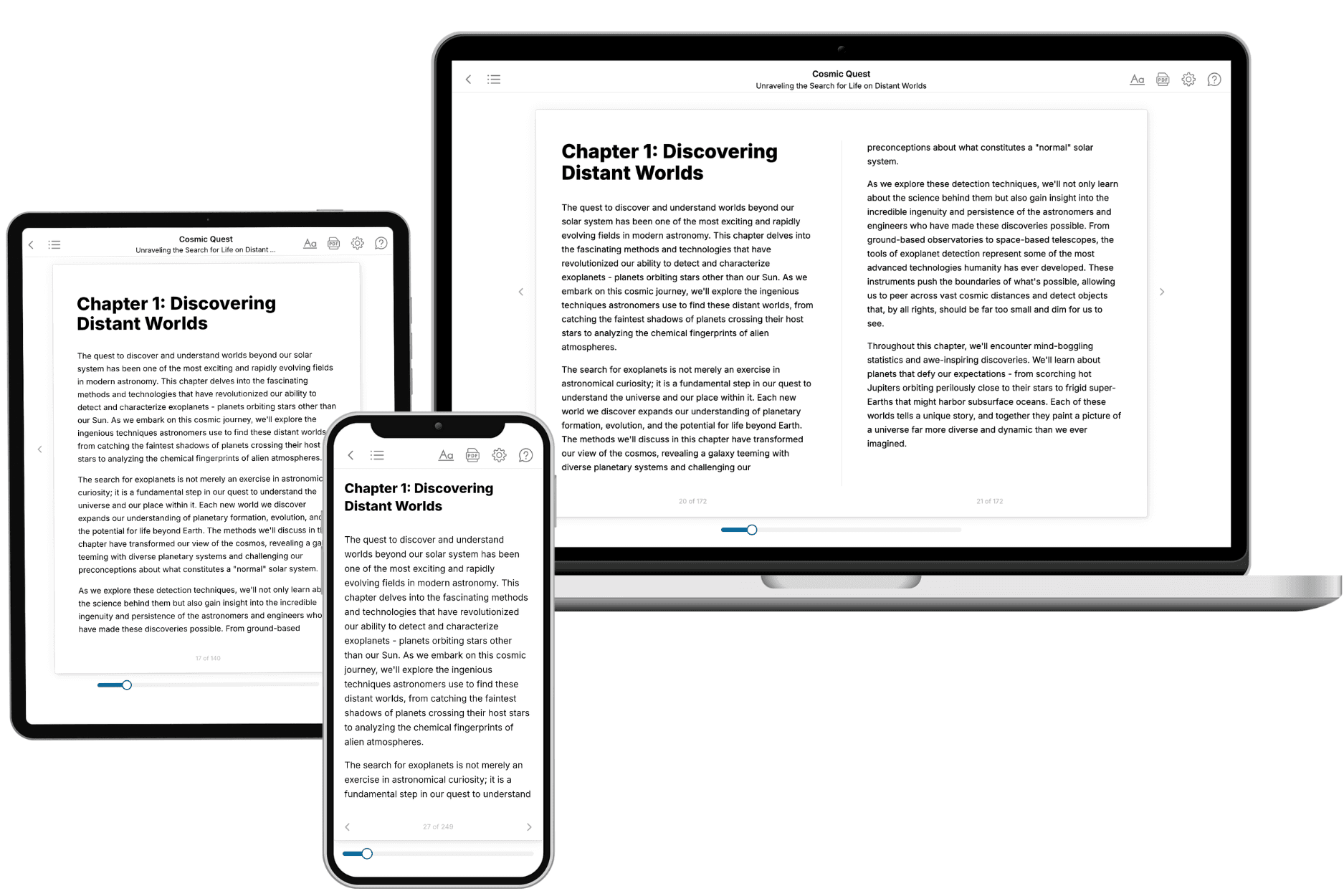
TailoredRead creates complete, full-length nonfiction ebooks, written specifically for you. Tell us what you want to learn and why, and TailoredRead writes you a complete ebook on it, with charts, tables, and diagrams throughout. Read it online, on Kindle, or on any e-reader, or download it as a PDF or EPUB. Every book is written fresh the day you order it.
- How is the book tailored to me?
Before anything is written, you answer a few short questions about your goals, your background, and the topics you care about. Your book is then planned around your answers: written at your level, focused on your goals, and covering the topics you chose, instead of the one-size-fits-all book a store sells everyone.
- Will it read like generic AI content?
No. Your book isn't a chat transcript: it's planned chapter by chapter before a single word is written, told in a clear book voice, and explains ideas visually with charts, tables, and diagrams. After writing, every book goes through an editorial pass that polishes chapters so the book reads consistent from start to finish. Judge for yourself: browse thousands of sample books on our Explore Books page.
- How accurate is the content?
Our AI first checks whether your subject needs live research. Niche and fast-moving subjects are researched before writing, and the book plan and chapters are grounded in what it finds. After writing, every book goes through a quality pass that checks its facts and consistency, and researched books list their sources in a Notes section at the back.
- How long is the book?
You choose the length: Comprehensive (250-300 pages), Detailed (150-200 pages), Essential (70-100 pages), or Short (30-50 pages).
- Does the book include visuals?
Yes. Every book includes charts, tables, and diagrams: timelines, checklists, step-by-step guides, decision trees, comparison tables, matrices, and bar charts. A typical book includes dozens of these visual elements.
- Can I read it on Kindle? What formats can I download?
Yes. Every book can be read in our online reader or downloaded as a PDF or EPUB. The EPUB can be opened with Kindle, Apple Books, Kobo, and any e-reader. The Commercial and Author licenses also include an editable Word (DOCX) and Markdown download.
- How much does it cost?
About the price of a regular ebook. The exact price depends on your book's length and complexity, from $2 for the shortest books to $35 for the most comprehensive, and it's shown when you review your book, before you commit to anything. Each book is a one-time purchase, yours to keep, no subscription. Licenses that let you share, teach, or publish your book range from $35.99 to $49.99.
- Can I preview the book before purchasing?
Before you pay, you'll see what your book will cover: the title, a detailed description, the estimated length, and the complete chapter-by-chapter table of contents, so you know what you're getting before you decide. The full text itself is written after you purchase.
- How long does it take to create a book?
About 10 minutes. You can start reading the opening chapters while the rest is still being written.