Bootstrap to Profitability
Build a Sustainable, Community-Driven Business Without External Funding
You'll master the complete playbook for building a profitable, community-driven business from day one without relying on external funding.
191 pages9 chaptersDec 8, 2025BootstrappingCreated by Rudiger
About this book
This guide cuts through startup mythology to show you exactly how to charge customers early, validate product-market fit through direct engagement, and design lean operational systems that scale. You'll learn profitability-first pricing strategies, ruthless cost reduction techniques, and sustainable growth metrics that actually matter for bootstrapped companies. Discover how to build community loyalty that becomes your competitive moat, manage founder energy to prevent burnout, and retain full equity while scaling revenue. Whether you're launching with minimal resources or optimizing an existing operation, you'll gain actionable frameworks for designing resilient business models, calculating customer lifetime value, and achieving sustainable scaling without external capital. This is the practical, no-nonsense guide for entrepreneurs ready to build businesses that last.
Table of contents
- IntroductionWhy Bootstrapping Beats the Venture Capital Trap, Sustainable Growth vs. Unsustainable Scaling, How to Use This BookRead below
- Chapter 1: The Bootstrapped Founder MindsetWhy Full Ownership Matters More Than You Think, Constraints as Your Competitive Advantage, Managing Founder Energy for the Long Game
- Chapter 2: Profitability-First Pricing StrategyPricing Psychology and Customer Perception, Building Unit Economics That Work, Charging Customers from Day One
- Chapter 3: Lean Customer Acquisition and Community BuildingBuilding Community as Your Competitive Moat, Organic Growth Channels That Scale, Reducing Customer Acquisition Costs Through Community
- Chapter 4: Product-Market Fit Testing Without Burning CashThe Lean Validation Framework, Direct Customer Engagement and Feedback Loops, Knowing When to Pivot and When to Double Down
- Chapter 5: Operational Cost Reduction and Lean SystemsConducting a Ruthless Cost Audit, Automation and Leverage Without Hiring, Building Remote-First Operations
- Chapter 6: Customer Retention Economics and Lifetime ValueMeasuring and Optimizing Retention Metrics, Calculating and Maximizing Customer Lifetime Value, Churn Reduction Strategies That Compound
- Chapter 7: Sustainable Scaling Metrics and BenchmarksVanity Metrics vs. Real Growth Indicators, Cash Flow as Your North Star Metric, Profitable Growth Benchmarks for Bootstrapped Companies
- Chapter 8: Founder Financial Planning and Equity RetentionSeparating Personal and Business Finances, Protecting Your Founder Equity, Building Long-Term Wealth as a Bootstrapped Founder
- Chapter 9: Building Resilient Business SystemsDocumenting Processes for Scalability, Risk Mitigation and Business Continuity, Creating a Sustainable Company Culture
- ConclusionYour Path Forward
- Further Resources and Tools
Introduction
The startup world has sold you a myth. You've been told that building a successful business requires venture capital, rapid scaling, and sacrificing profitability for growth at all costs. This narrative dominates business schools, accelerator programs, and entrepreneurial media. Yet the reality is starkly different: most venture-backed startups fail, burning through millions while founders lose control of their companies. Meanwhile, thousands of bootstrapped businesses quietly build sustainable, profitable operations that generate wealth for their founders without external funding or the pressure to exit.
This book exists because there's a better path forward. Bootstrapping isn't about scraping by with limited resources or settling for a lifestyle business that never scales. It's about building a profitability-first operation that generates customer revenue from day one, maintains lean systems that scale efficiently, and creates sustainable competitive advantages through community engagement. You'll discover that constraints aren't limitations—they're strategic advantages that force clarity, discipline, and customer focus. The businesses that survive economic downturns, market shifts, and competitive pressures are those built on solid unit economics and genuine customer value, not those propped up by investor capital.
Throughout this guide, you'll gain actionable frameworks for every stage of building a bootstrapped company. You'll learn how to price for profitability immediately, validate product-market fit without burning cash, reduce operational costs ruthlessly, and scale sustainably using metrics that actually matter. You'll understand how to build community loyalty that becomes your competitive moat, manage your energy to prevent founder burnout, and retain full equity while growing revenue. Whether you're launching a new venture with minimal resources or optimizing an existing operation to eliminate external funding dependency, this book provides the practical playbook for building businesses that last. The strategies here aren't theoretical—they're battle-tested approaches used by successful bootstrapped founders who've built profitable, sustainable companies while maintaining complete ownership and control.
The entrepreneurial landscape is shifting. Economic uncertainty, changing investor appetites, and the maturation of remote-first operations have created unprecedented opportunities for bootstrapped businesses. You no longer need expensive office space, large teams, or massive marketing budgets to compete effectively. Technology has democratized business building, enabling lean operations that can serve global markets with minimal overhead. The question isn't whether bootstrapping is viable—it's whether you're ready to embrace the discipline, customer focus, and operational excellence required to build a truly sustainable business. This introduction will establish why bootstrapping beats the venture capital trap, clarify the difference between sustainable growth and unsustainable scaling, and show you exactly how to use this book to build your profitable, community-driven business.
Why Bootstrapping Beats the Venture Capital Trap
Venture capital fundamentally misaligns incentives between founders and investors. When you accept external funding, you're no longer building a business optimized for profitability and sustainability—you're building an asset designed for a specific exit timeline and return multiple. Venture capitalists need portfolio companies to return ten times their investment or more to compensate for the majority that fail completely. This creates immense pressure to scale rapidly, often before product-market fit is truly validated, and to prioritize growth metrics over unit economics. The result is predictable: approximately 75% of venture-backed startups fail to return investor capital[1], leaving founders with diluted equity in failed companies and years of their lives invested in someone else's financial strategy.
The venture capital model works brilliantly for a specific type of business: those with network effects, winner-take-all market dynamics, and the potential for billion-dollar valuations. If you're building the next social media platform or marketplace that benefits from massive scale, venture funding might make strategic sense. However, most businesses don't fit this profile. The vast majority of successful companies are built serving specific customer segments with profitable unit economics from the start. These businesses don't need to capture entire markets—they need to serve customers exceptionally well and generate more revenue than they spend. Venture capital actively works against this model by encouraging cash burn, rapid hiring, and market share acquisition regardless of profitability. You end up optimizing for the wrong metrics entirely.
Bootstrapping preserves your strategic flexibility and decision-making authority. When you're not answerable to a board of investors with specific return expectations and exit timelines, you can make decisions based on what's best for customers, employees, and long-term business health. Consider these fundamental differences:
- Timeline flexibility: Bootstrapped founders can build over decades if needed, while venture-backed founders face 5-7 year exit pressures
- Profitability focus: Bootstrapped businesses must generate positive cash flow to survive, creating discipline and sustainable economics
- Customer alignment: Revenue comes from customers, not investors, forcing genuine product-market fit and value creation
- Equity retention: Founders maintain ownership and capture the full value they create rather than diluting across multiple funding rounds
- Strategic autonomy: Business decisions are made based on customer needs and market realities, not investor preferences or exit strategies
The financial mathematics of bootstrapping are compelling when you examine them closely. Imagine you build a business that generates $2 million in annual profit. As a bootstrapped founder with full ownership, you capture that entire profit stream—either as distributions, reinvestment, or enterprise value if you eventually sell. Now consider the venture-backed alternative: after multiple funding rounds, you might own 20-30% of your company. To generate the same $2 million in personal value, your company needs to produce $7-10 million in profit or achieve a significantly higher valuation multiple at exit. The dilution cost is enormous, and that's before considering the opportunity cost of years spent scaling unprofitably while burning investor capital. Bootstrapped founders often build more personal wealth with smaller, profitable businesses than venture-backed founders do with larger, unprofitable ones.
Venture capital also creates perverse incentives around risk-taking and business model validation. When you're spending other people's money, the psychological relationship to cash burn changes fundamentally. It becomes easier to justify expensive experiments, premature hiring, and marketing spend without clear ROI because the capital feels abundant. Bootstrapped founders, spending their own money or early customer revenue, develop a completely different relationship with every dollar spent. This constraint forces creativity, resourcefulness, and genuine validation before scaling. You can't afford to guess at product-market fit—you must prove it with paying customers. You can't hire your way out of operational problems—you must build efficient systems first. These constraints aren't limitations; they're the foundation of sustainable business building.
The venture capital trap extends beyond financial misalignment to affect founder wellbeing and company culture. The pressure to achieve hypergrowth creates unsustainable work environments, encourages premature scaling, and often leads to founder burnout. When your investors expect 10x returns within a specific timeframe, every quarter becomes a high-stakes performance where missing growth targets feels like existential failure. Bootstrapped founders certainly face stress and challenges, but they're building businesses on their own terms and timelines. The psychological freedom of knowing you're not on someone else's clock, that you can adjust strategy based on market feedback rather than investor expectations, and that you're building something genuinely sustainable creates a fundamentally different entrepreneurial experience. This isn't just about money—it's about building a business and life you actually want.
Consider the example of Basecamp (formerly 37signals), which has operated profitably as a bootstrapped company for over two decades. The founders, Jason Fried and David Heinemeier Hansson, have repeatedly turned down acquisition offers and venture capital, choosing instead to build a sustainable business serving customers directly. Their company generates tens of millions in annual revenue with a small team, maintains healthy profit margins, and allows the founders complete strategic control. Compare this to countless venture-backed project management tools that raised hundreds of millions, scaled rapidly, and either failed completely or sold for less than the capital invested. Basecamp's success isn't despite bootstrapping—it's because of it. The constraint of self-funding forced product excellence, customer focus, and operational efficiency that became lasting competitive advantages.
The venture capital industry has created a narrative that equates funding announcements with success and company valuation with achievement. This narrative serves investors who need to attract limited partners and justify their fees, but it doesn't serve founders building sustainable businesses. When you see headlines about massive funding rounds, remember that you're reading about companies taking on debt (equity is debt with different terms) and committing to specific exit timelines and return expectations. You're not reading about profitability, customer satisfaction, or sustainable business models. The bootstrapped path receives less media attention precisely because it's less dramatic—there are no funding announcements to publicize, no valuation milestones to celebrate. But quiet, profitable businesses building genuine customer value represent the vast majority of successful entrepreneurship. This book will show you how to join them.
Sustainable Growth vs. Unsustainable Scaling
The distinction between sustainable growth and unsustainable scaling is fundamental to bootstrapped success, yet it's consistently misunderstood in startup culture. Sustainable growth means expanding revenue, customers, and operations at a pace supported by unit economics, operational capacity, and cash flow generation. Each new customer adds more value than they cost to acquire and serve, systems scale efficiently without proportional cost increases, and the business becomes stronger with size. Unsustainable scaling, by contrast, means growing top-line metrics regardless of underlying economics—adding customers at negative unit economics, expanding into new markets before achieving product-market fit in existing ones, and hiring ahead of revenue to create the appearance of momentum. This approach works temporarily when funded by external capital, but it creates fragile businesses that collapse when funding dries up or market conditions change.
The mathematics of sustainable growth are straightforward but often ignored. For growth to be sustainable, your customer lifetime value (LTV) must exceed your customer acquisition cost (CAC) by a meaningful margin—typically at least 3:1 for healthy businesses. Additionally, you must recover acquisition costs quickly enough to maintain positive cash flow—ideally within 12 months or less. When these conditions are met, growth becomes self-funding: revenue from existing customers finances the acquisition of new customers, creating a virtuous cycle. Unsustainable scaling violates these principles by acquiring customers at negative unit economics or with payback periods so long that the business runs out of cash before achieving profitability. The growth looks impressive on charts, but the underlying business is fundamentally unprofitable and dependent on continuous external funding.
Consider how these two approaches differ across key business dimensions:
- Customer acquisition: Sustainable growth focuses on channels with proven positive ROI and reasonable payback periods; unsustainable scaling burns cash on unproven channels to hit growth targets
- Product development: Sustainable growth validates features with paying customers before building; unsustainable scaling builds speculatively based on assumed future needs
- Team building: Sustainable growth hires when revenue supports additional capacity; unsustainable scaling hires ahead of revenue to create infrastructure for anticipated growth
- Market expansion: Sustainable growth masters one market before expanding; unsustainable scaling enters multiple markets simultaneously to maximize addressable market size
- Operational systems: Sustainable growth builds scalable processes before they're needed; unsustainable scaling accepts operational chaos as the cost of rapid growth
The psychological difference between these approaches is equally important. Sustainable growth creates confidence and momentum because each milestone is built on solid foundations. When you add customers profitably, you know the business model works and more growth means more profit. This creates a positive feedback loop where success breeds more success and the business becomes progressively stronger. Unsustainable scaling creates anxiety and fragility because growth doesn't translate to business health. You're constantly worried about the next funding round, whether unit economics will eventually work out, and what happens if growth slows before profitability is achieved. The stress of unsustainable scaling contributes significantly to founder burnout and poor decision-making under pressure.
Mailchimp provides an excellent example of sustainable growth executed over nearly two decades. The email marketing platform grew slowly and profitably from its founding in 2001, focusing relentlessly on product quality and customer satisfaction rather than rapid scaling. While venture-backed competitors raised hundreds of millions and scaled aggressively, Mailchimp remained bootstrapped and grew at a pace supported by cash flow. By 2021, when the company finally sold to Intuit for $12 billion, the founders had built a genuinely sustainable business serving millions of customers profitably[2]. The sustainable growth approach allowed them to maintain full ownership until exit, capture the entire value they created, and build a business that didn't depend on continuous external funding. Many of their venture-backed competitors no longer exist.
Unsustainable scaling often disguises itself as ambition and vision. Founders are told that thinking big requires aggressive growth, that market leadership demands rapid scaling, and that conservative approaches mean settling for mediocrity. This narrative is dangerous because it conflates speed with success and size with sustainability. The reality is that most markets reward sustainable business models over time. Customers prefer vendors who will still exist in five years. Employees prefer companies with stable operations and clear paths to profitability. Partners prefer businesses with predictable economics and reliable execution. The short-term advantages of rapid scaling—market visibility, competitive positioning, talent attraction—often prove hollow when the underlying business model doesn't work. Sustainable growth might look slower initially, but it compounds over time and creates businesses that last.
The transition from unsustainable scaling to sustainable growth is possible but painful. Many venture-backed companies eventually realize their unit economics don't work and must dramatically restructure operations, cut costs, and refocus on profitability. This process typically involves layoffs, product simplification, market contraction, and a fundamental reset of growth expectations. Founders who bootstrap from the start avoid this painful transition by building sustainable economics from day one. You never have to explain to employees why the company is suddenly prioritizing profitability after years of growth-at-all-costs. You never have to cut teams you prematurely hired or shut down markets you prematurely entered. The discipline of sustainable growth prevents these mistakes before they happen.
Understanding this distinction will inform every decision you make as a bootstrapped founder. When evaluating a new marketing channel, you'll ask whether it generates positive ROI at current scale, not whether it might work if you spend enough. When considering a new product feature, you'll validate demand with paying customers first rather than building speculatively. When thinking about hiring, you'll ensure revenue supports the additional capacity rather than hiring ahead of need. These decisions might feel conservative compared to venture-backed competitors, but they're building a business that compounds value over time rather than one that depends on continuous external funding. Sustainable growth is how bootstrapped businesses win in the long run.
How to Use This Book
This book is structured as a practical playbook, not a theoretical treatise. Each chapter addresses a specific dimension of building a profitable, bootstrapped business with actionable frameworks you can implement immediately. You don't need to read sequentially—if you're currently struggling with customer acquisition costs, jump directly to Chapter 3. If you're trying to validate product-market fit without burning cash, start with Chapter 4. However, the chapters do build on each other conceptually, so reading in order will give you the most comprehensive understanding of how these strategies interconnect. The goal is to provide you with a complete system for bootstrapped business building that you can reference repeatedly as your company evolves.
The book is organized around the critical challenges bootstrapped founders face at different stages:
- Chapters 1-2: Establish the foundational mindset and pricing strategy required for bootstrapped success, covering ownership psychology, constraint advantages, and profitability-first pricing
- Chapters 3-4: Address customer acquisition and product-market fit validation using lean, capital-efficient approaches that prioritize community building and direct customer engagement
- Chapters 5-6: Focus on operational efficiency and customer economics, showing you how to reduce costs ruthlessly while maximizing customer lifetime value and retention
- Chapters 7-8: Cover measurement and financial planning, teaching you which metrics actually matter for bootstrapped businesses and how to protect founder equity while building long-term wealth
- Chapter 9: Addresses business resilience and systems building, ensuring your company can scale sustainably without founder burnout or operational chaos
Each chapter follows a consistent structure designed for practical application. You'll find specific frameworks and methodologies explained step-by-step, real-world examples from successful bootstrapped companies, and common pitfalls to avoid. The content assumes you have business fundamentals from your MBA education but may lack specific experience with bootstrapped operations and capital-efficient growth strategies. You won't find basic explanations of business concepts like revenue or profit margins—instead, you'll get advanced strategies for optimizing these metrics in resource-constrained environments. The tone is direct and pragmatic because your time is valuable and you need actionable guidance, not motivational platitudes or generic business advice.
As you read, keep a notebook or digital document for capturing insights specific to your business. The frameworks presented here are deliberately general so they apply across industries and business models, but their power comes from adaptation to your specific context. When you encounter a pricing strategy or customer acquisition approach, immediately consider how it applies to your market, customers, and competitive environment. The goal isn't to copy these strategies exactly—it's to understand the underlying principles and adapt them to your unique situation. Bootstrapped success requires creativity and resourcefulness, and these frameworks provide the foundation for your specific innovations.
Throughout the book, you'll notice an emphasis on measurement and metrics. This isn't accidental—bootstrapped founders must be ruthlessly data-driven because you can't afford expensive mistakes or prolonged experiments that don't work. Every chapter includes specific metrics to track and benchmarks to target. Set up systems to measure these metrics for your business as you read. If Chapter 2 discusses unit economics, calculate your actual unit economics immediately. If Chapter 6 covers customer lifetime value, determine your current LTV and identify opportunities for improvement. The book becomes exponentially more valuable when you're applying concepts to real data from your business rather than consuming them abstractly.
Pay particular attention to the examples and case studies throughout each chapter. These aren't included for inspiration—they're included to show you exactly how successful bootstrapped founders have applied these strategies in practice. When you read about Basecamp's approach to product development or Mailchimp's customer acquisition strategy, you're seeing proven implementations of the frameworks being discussed. Study these examples carefully, noting not just what these companies did but why they made specific choices and how those choices aligned with bootstrapped principles. The patterns you identify across multiple examples will help you recognize opportunities and avoid pitfalls in your own business.
This book also serves as a reference guide you'll return to repeatedly as your business evolves. The challenges of a pre-revenue startup differ from those of a company doing $100,000 in monthly recurring revenue, which differ from those of a business approaching $1 million in annual profit. Bookmark chapters that address your current stage, but also read ahead to understand what's coming. Knowing that customer retention economics become critical at scale will influence how you structure your product and pricing from the beginning. Understanding that operational systems need documentation before they become bottlenecks will encourage you to build those systems early. The most successful bootstrapped founders think several stages ahead while executing relentlessly on current priorities.
Finally, approach this book with appropriate skepticism and critical thinking. The strategies presented here are based on patterns from successful bootstrapped companies and fundamental business principles, but your specific market, customers, and competitive environment may require adaptations or even contradictions of general advice. If a framework doesn't seem to fit your situation, think carefully about why—sometimes the mismatch reveals important insights about your business model or market dynamics. The goal is to develop your own bootstrapped business philosophy informed by these principles but adapted to your unique context. Successful bootstrapping requires both discipline in following proven principles and creativity in applying them to your specific situation. This book provides the principles; you provide the creative adaptation that makes them work for your business.
This is the end of the free sample. The full book has 9 chapters.
Want this book written for you?
Tell us your goals and background, and get your own version of this book, tailored by AI to you.


Benefits of AI-tailored books
- Read one book, not ten:
- all the Bootstrapping knowledge you need, gathered into a single book.
- Save days of learning:
- tell us your goals, choose your topics, and the whole book is built around them.
- Learn effortlessly:
- Bootstrapping book written for your specific background and expertise.
- Understand at a glance:
- includes charts, tables, timelines, checklists, decision trees, and more.
- Stay current:
- written the day you order it, not years ago.
- Trust what you read:
- every book is checked for accuracy, with real research when your subject needs it.
Create your unique book in 3 steps
- 1. Select your focus
Select the focus of your Bootstrapping book and share your background
- 2. Personalize your book
Specify your goals and choose sub-topics to include
- 3. Get your tailored book
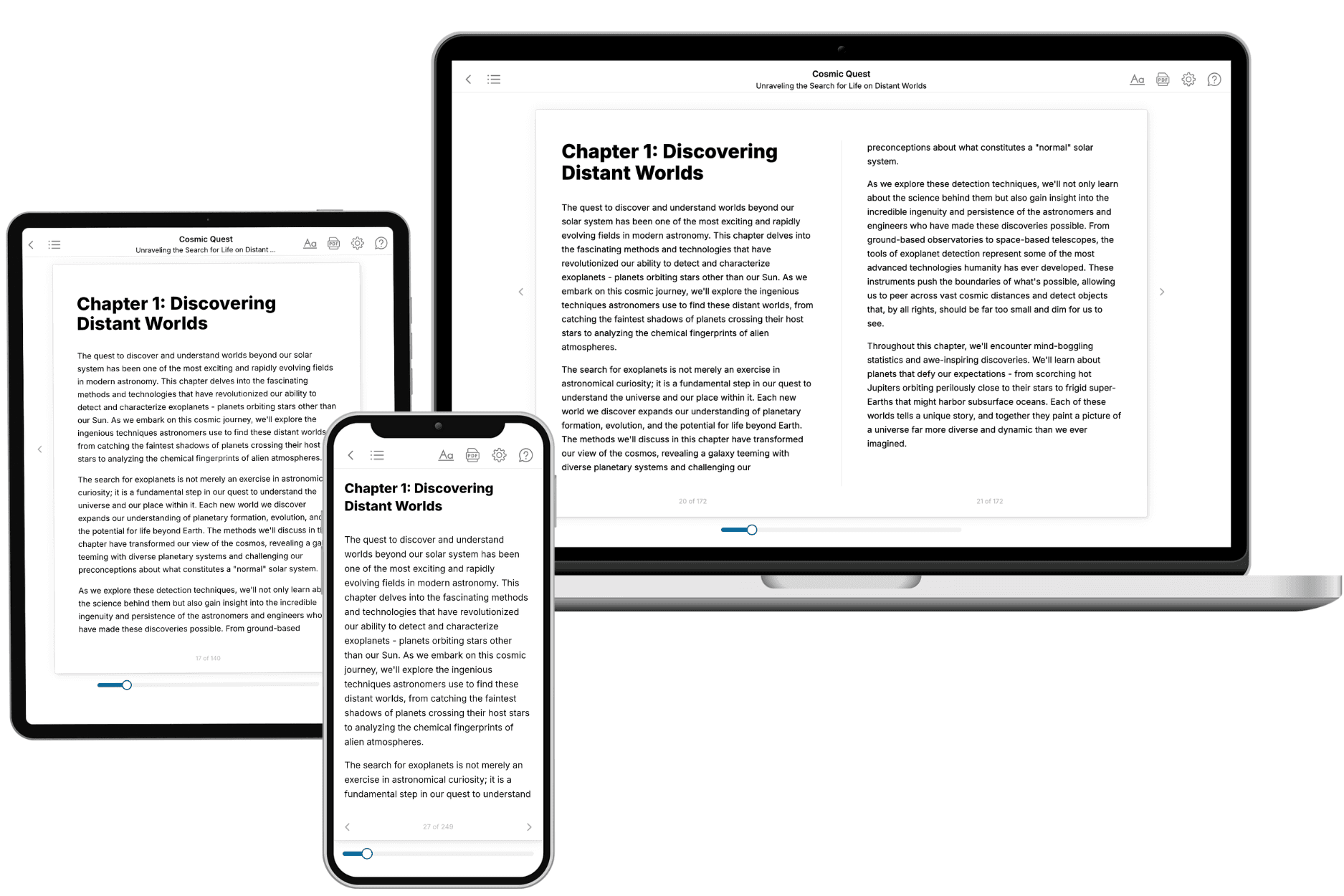
Your book is ready in 10 minutes. Read it online, download as EPUB or PDF, or send to Kindle.
Frequently asked questions
- What is TailoredRead?
TailoredRead creates complete, full-length nonfiction ebooks, written specifically for you. Tell us what you want to learn and why, and TailoredRead writes you a complete ebook on it, with charts, tables, and diagrams throughout. Read it online, on Kindle, or on any e-reader, or download it as a PDF or EPUB. Every book is written fresh the day you order it.
- How is the book tailored to me?
Before anything is written, you answer a few short questions about your goals, your background, and the topics you care about. Your book is then planned around your answers: written at your level, focused on your goals, and covering the topics you chose, instead of the one-size-fits-all book a store sells everyone.
- Will it read like generic AI content?
No. Your book isn't a chat transcript: it's planned chapter by chapter before a single word is written, told in a clear book voice, and explains ideas visually with charts, tables, and diagrams. After writing, every book goes through an editorial pass that polishes chapters so the book reads consistent from start to finish. Judge for yourself: browse thousands of sample books on our Explore Books page.
- How accurate is the content?
Our AI first checks whether your subject needs live research. Niche and fast-moving subjects are researched before writing, and the book plan and chapters are grounded in what it finds. After writing, every book goes through a quality pass that checks its facts and consistency, and researched books list their sources in a Notes section at the back.
- How long is the book?
You choose the length: Comprehensive (250-300 pages), Detailed (150-200 pages), Essential (70-100 pages), or Short (30-50 pages).
- Does the book include visuals?
Yes. Every book includes charts, tables, and diagrams: timelines, checklists, step-by-step guides, decision trees, comparison tables, matrices, and bar charts. A typical book includes dozens of these visual elements.
- Can I read it on Kindle? What formats can I download?
Yes. Every book can be read in our online reader or downloaded as a PDF or EPUB. The EPUB can be opened with Kindle, Apple Books, Kobo, and any e-reader. The Commercial and Author licenses also include an editable Word (DOCX) and Markdown download.
- How much does it cost?
About the price of a regular ebook. The exact price depends on your book's length and complexity, from $2 for the shortest books to $35 for the most comprehensive, and it's shown when you review your book, before you commit to anything. Each book is a one-time purchase, yours to keep, no subscription. Licenses that let you share, teach, or publish your book range from $35.99 to $49.99.
- Can I preview the book before purchasing?
Before you pay, you'll see what your book will cover: the title, a detailed description, the estimated length, and the complete chapter-by-chapter table of contents, so you know what you're getting before you decide. The full text itself is written after you purchase.
- How long does it take to create a book?
About 10 minutes. You can start reading the opening chapters while the rest is still being written.