Breaking Barriers
The Stories, Science, and Struggle of Transgender Athletes
This book takes you through the multifaceted world of transgender athletes—their personal stories, the scientific realities, and the ongoing debates shaping their participation in sports.
176 pages8 chaptersApr 20, 2026Sports
About this book
You'll discover how transgender individuals navigate the intersection of identity and athletic passion, often facing unprecedented challenges while pursuing their dreams. Through real accounts and evidence-based analysis, you'll explore the biological complexities of hormone therapy and athletic performance, the evolving landscape of sports policies across different organizations, and the profound impact of inclusion on both athletes and communities. You'll examine how different countries and sports bodies approach eligibility, learn from athletes who've broken barriers, and understand the broader implications of these conversations for fairness, dignity, and belonging in athletics. This comprehensive exploration moves beyond headlines to reveal the human stories and scientific nuances that define this important conversation.
Table of contents
- IntroductionWhy This Conversation Matters Now, What You'll Discover in This Book, Our Approach: Evidence, Stories, and NuanceRead below
- Chapter 1: Understanding Transgender Identity and AthleticsGender Identity: Beyond the Binary, Coming Out and Transitioning as an Athlete, Why Transgender People Pursue Athletic Dreams
- Chapter 2: The Science of Transition and Athletic PerformanceHormone Therapy: How It Works, Physical Changes and Athletic Implications, What Current Research Tells Us, Why Individual Variation Matters
- Chapter 3: Global Policies and Eligibility StandardsInternational Olympic Committee Guidelines, How Different Countries Approach Eligibility, College and University Policies, How Policies Have Changed Over Time
- Chapter 4: Voices from the Field: Athlete StoriesPioneering Athletes Who Opened Doors, Diverse Experiences Across Sports and Levels, Challenges Overcome and Lessons Learned
- Chapter 5: The Fairness Debate: Examining the ArgumentsUnderstanding Competitive Advantage Claims, What Does Fairness in Sports Really Mean?, Analyzing the Evidence on Both Sides, Moving Beyond Binary Thinking
- Chapter 6: Inclusion, Community, and BelongingThe Mental Health Impact of Athletic Participation, How Sports Create Community and Connection, Discrimination and Barriers to Participation
- Chapter 7: Media, Representation, and Public PerceptionHow Media Covers Transgender Athletes, The Power of Visibility and Representation, Addressing Myths and Misinformation, Building More Inclusive Sports Narratives
- Chapter 8: Creating Inclusive Sports EnvironmentsWhat Organizations Can Do, Training and Education for Coaches and Staff, Building Peer Support and Team Culture
- Conclusion: Moving Forward TogetherKey Takeaways and Reflections, The Future of Transgender Athletes in Sports
- Further Reading and Resources
Introduction
Sports have always been about more than winning. They are about belonging, identity, discipline, and the deeply human desire to push past limits. For transgender athletes, those themes carry an extra weight. Every time a transgender person steps onto a field, a track, or a court, they are not just competing. They are navigating a world that is still figuring out how to include them, often in real time, often under intense public scrutiny. This book is about understanding that experience fully, honestly, and with the care it deserves.
The conversation around transgender athletes has grown louder in recent years. Legislative battles, policy debates, and high-profile media stories have pushed the topic into living rooms and locker rooms alike. But much of that conversation has been shaped more by political heat than by evidence or empathy. The loudest voices often speak in absolutes, either dismissing concerns about competitive fairness entirely or treating every transgender athlete as a threat to sport itself. Neither extreme reflects reality. The truth, as it usually is, lives in the details.
This book is built on a simple belief: that good decisions require good information. Whether you are a coach, a parent, an athlete, a policymaker, or simply someone trying to understand a complex issue, you deserve access to the science, the stories, and the full range of perspectives that shape this debate. That is exactly what these pages offer. You will find no easy answers here, because easy answers do not exist. What you will find is a thorough, honest, and human exploration of one of the most important conversations happening in sports today.
Before diving in, it is worth acknowledging something directly. Transgender people, including transgender athletes, face significant rates of discrimination, mental health challenges, and social exclusion.[1] That context matters. It does not mean every policy question has a predetermined answer, but it does mean that how we talk about these issues has real consequences for real people. This book takes that responsibility seriously throughout every chapter.
Why This Conversation Matters Now
In the past decade, the number of bills targeting transgender athletes in the United States alone has surged dramatically. According to the American Civil Liberties Union, more than 20 states had enacted laws restricting transgender youth participation in school sports as of 2024.[2] Internationally, governing bodies from World Athletics to World Aquatics have revised their eligibility frameworks multiple times in just a few years. The pace of change is striking, and the stakes are high for everyone involved.
What makes this moment particularly significant is the collision of several forces happening at once. Medical science is advancing our understanding of how hormone therapy affects the body. Legal frameworks around gender recognition are shifting in many countries. Social attitudes toward gender identity are evolving, especially among younger generations. And sports organizations are being asked to make binding decisions in the middle of all that change, often without clear consensus from researchers or medical professionals.
The athletes themselves are caught in the middle of these forces. Consider the experience of a transgender woman who has competed in her sport for years, undergone hormone therapy, and simply wants to continue doing something she loves. Or a transgender man navigating whether and how to disclose his identity to teammates and coaches. These are not abstract policy questions for them. They are daily realities that affect their mental health, their relationships, and their sense of self.
Youth sports add another layer of urgency. Research consistently shows that participation in organized sports provides significant benefits for young people, including improved mental health, stronger social connections, and better academic outcomes.[3] When transgender youth are excluded from those opportunities, the consequences extend well beyond the playing field. Understanding what is actually at stake helps frame why getting these policies right matters so much.
There is also a broader cultural dimension to consider. How sports institutions handle transgender inclusion sends a signal about who belongs in public life. Sports have historically been a site where social progress is both contested and eventually achieved. The integration of racial minorities, the growth of women's sports, and the gradual acceptance of openly gay athletes all followed similar patterns of resistance, debate, and eventual change. The current moment with transgender athletes fits into that longer arc, even if the specific questions are different.
Finally, this conversation matters because misinformation is genuinely harmful. When public debate is driven by myths, exaggerations, or incomplete data, the people most affected pay the price. Transgender athletes deserve to have their experiences discussed accurately. Sports communities deserve policies grounded in evidence. And everyone involved in this debate deserves access to the full picture, not just the parts that confirm what they already believe.
The question is not whether transgender athletes belong in sports. They already are in sports, at every level, in every country. The real question is how to build systems that treat them fairly while honoring the values that make athletic competition meaningful.
What You'll Discover in This Book
This book is organized to take you from foundational understanding through to practical action. Each chapter builds on the last, but they are also designed to stand on their own if you want to focus on a specific area. Whether you are most interested in the science, the policy debates, the personal stories, or the path forward, there is a clear entry point for you.
The journey begins with identity. Chapter 1 explores what it means to be transgender, how gender identity works beyond simple binaries, and what the experience of transitioning looks like specifically within an athletic context. This chapter grounds everything that follows in human experience rather than abstraction. You will hear about the motivations that drive transgender people to compete and the unique challenges they face when their identity intersects with their athletic life.
From there, the book moves into science. Chapter 2 examines what hormone therapy actually does to the body, how those changes affect athletic performance, and what current research says about competitive outcomes. This is one of the most misunderstood areas of the entire debate, and the chapter takes care to present findings accurately, including where the evidence is strong, where it is limited, and where researchers still disagree.
Chapter 3 maps the policy landscape, from the International Olympic Committee's evolving frameworks to national governing bodies, collegiate sports organizations, and high school athletics. Policies vary enormously across sports and jurisdictions, and understanding that variation is essential for anyone trying to make sense of the debate. The chapter also traces how policies have changed over time and what has driven those changes.
Chapter 4 brings the human dimension back to the center. Through the stories of pioneering and contemporary transgender athletes, you will see how the issues discussed in earlier chapters play out in real lives. These accounts span different sports, different levels of competition, and different parts of the world. They include moments of triumph, but also moments of exclusion, doubt, and resilience.
The fairness debate gets its own dedicated space in Chapter 5, which examines the arguments on all sides with care and rigor. What does competitive advantage actually mean? How do we define fairness in a sport where natural variation is enormous? What does the evidence actually show about transgender athletes' performance outcomes? This chapter does not pretend there are no legitimate concerns, but it also does not accept unsupported claims at face value.
Chapters 6, 7, and 8 shift toward community, culture, and change. You will explore the mental health benefits of athletic participation for transgender people, the role of media in shaping public perception, and the concrete steps that organizations, coaches, and teammates can take to build more inclusive sports environments. The book closes with a look at where this conversation is heading and what a more equitable future for transgender athletes might look like.
Throughout all of this, the goal is not to tell you what to think. It is to give you the tools to think clearly about a genuinely complex issue. That means presenting evidence honestly, including its limitations. It means sharing stories without turning people into symbols. And it means holding space for the reality that reasonable people can disagree about specific policies while still agreeing that every athlete deserves dignity and respect.
Our Approach: Evidence, Stories, and Nuance
Writing about transgender athletes requires navigating several tensions at once. There is the tension between scientific uncertainty and the need for clear policy. There is the tension between individual rights and collective fairness. There is the tension between moving quickly enough to protect people from harm and moving carefully enough to get things right. This book does not resolve those tensions, because they cannot be fully resolved. But it does try to hold them honestly.
The approach here rests on three pillars. The first is evidence. Every scientific claim in this book is grounded in peer-reviewed research or credible institutional sources. Where the evidence is strong, that is stated clearly. Where it is preliminary, contested, or limited by small sample sizes, that is stated just as clearly. The science of transgender athletic performance is genuinely evolving, and presenting it as more settled than it is would be a disservice to everyone.
The second pillar is stories. Data and policy frameworks can only take understanding so far. The lived experiences of transgender athletes add dimensions that numbers cannot capture: the fear of being outed before you are ready, the joy of competing as your authentic self for the first time, the exhaustion of being treated as a political issue rather than a person. These stories are not used as emotional manipulation. They are used because they are true, and because truth requires them.
The third pillar is nuance. This means resisting the pull toward simple narratives. It means acknowledging that a policy can be well-intentioned and still cause harm. It means recognizing that concerns about competitive fairness can be raised in good faith without being transphobic, and that advocating for inclusion does not require ignoring legitimate scientific questions. Nuance is not weakness or indecision. It is the only honest response to a genuinely complicated situation.
A few specific commitments shape how this material is presented throughout the book. First, transgender athletes are treated as full human beings, not as case studies or policy problems. Their athletic achievements, their struggles, and their contributions to their sports are all part of the story. Second, the language used throughout is respectful and current, following guidance from organizations like GLAAD and the National Center for Transgender Equality on terminology.[4] Third, where experts disagree, those disagreements are presented fairly rather than resolved artificially.
It is also worth being transparent about what this book is not. It is not a legal guide, and nothing here should be taken as legal advice. It is not a medical manual, and anyone with specific health questions should consult qualified medical professionals. It is not a political manifesto arguing for a particular policy outcome. It is an attempt to inform, to illuminate, and to contribute to a conversation that deserves more light and less heat.
One practical note on structure: each chapter includes specific examples, research findings, and where relevant, frameworks or questions that can guide thinking and action. These are designed to make the content as useful as possible, whether you are reading for personal understanding, professional development, or to inform decisions in your own sports community. The goal throughout is to be genuinely helpful, not just comprehensive.
Consider, for example, how different the experience of a transgender collegiate swimmer in the United States is from that of a transgender recreational runner in New Zealand, or a transgender youth soccer player in the United Kingdom. The policies they face are different. The cultural contexts are different. The levels of support available to them are different. Keeping that diversity of experience in view is essential to avoiding the trap of treating "transgender athletes" as a single, uniform category when they are, in fact, an enormously varied group of individuals.
What unites them is not a single experience but a shared reality: they love their sport, they want to compete, and they are doing so in a world that is still working out how to include them fully. That is the story this book tells. It is a story worth telling carefully, and worth reading with an open mind.
The athletes at the center of this conversation are not symbols of a culture war. They are people who wake up early for practice, push through injuries, celebrate wins, and learn from losses, just like every other athlete. Keeping that humanity in focus is the starting point for everything that follows.
As you move through these chapters, you may find that some of your existing views are confirmed, some are challenged, and some are simply made more complex. That is a sign that the material is doing its job. The goal is not to leave you with a tidy set of conclusions but with a richer, more grounded understanding of a conversation that will continue to evolve for years to come. The best contribution this book can make is to help you engage with that conversation more thoughtfully, more accurately, and with greater compassion for everyone involved.
Notes
Introduction
- 1. S. E. James and others, The Report of the 2015 U.S. Transgender Survey, National Center for Transgender Equality, 2016
- 2. American Civil Liberties Union, Legislation Affecting LGBTQ Rights Across the Country, ACLU.org, 2024
- 3. R. M. Eime and others, "A systematic review of the psychological and social benefits of participation in sport for children and adolescents," International Journal of Behavioral Nutrition and Physical Activity, 2013
- 4. GLAAD, GLAAD Media Reference Guide, 11th Edition, GLAAD.org, 2023
This is the end of the free sample. The full book has 8 chapters.
Want this book written for you?
Tell us your goals and background, and get your own version of this book, tailored by AI to you.


Benefits of AI-tailored books
- Read one book, not ten:
- all the Sports knowledge you need, gathered into a single book.
- Save days of learning:
- tell us your goals, choose your topics, and the whole book is built around them.
- Learn effortlessly:
- Sports book written for your specific background and expertise.
- Understand at a glance:
- includes charts, tables, timelines, checklists, decision trees, and more.
- Stay current:
- written the day you order it, not years ago.
- Trust what you read:
- every book is checked for accuracy, with real research when your subject needs it.
Create your unique book in 3 steps
- 1. Select your focus
Select the focus of your Sports book and share your background
- 2. Personalize your book
Specify your goals and choose sub-topics to include
- 3. Get your tailored book
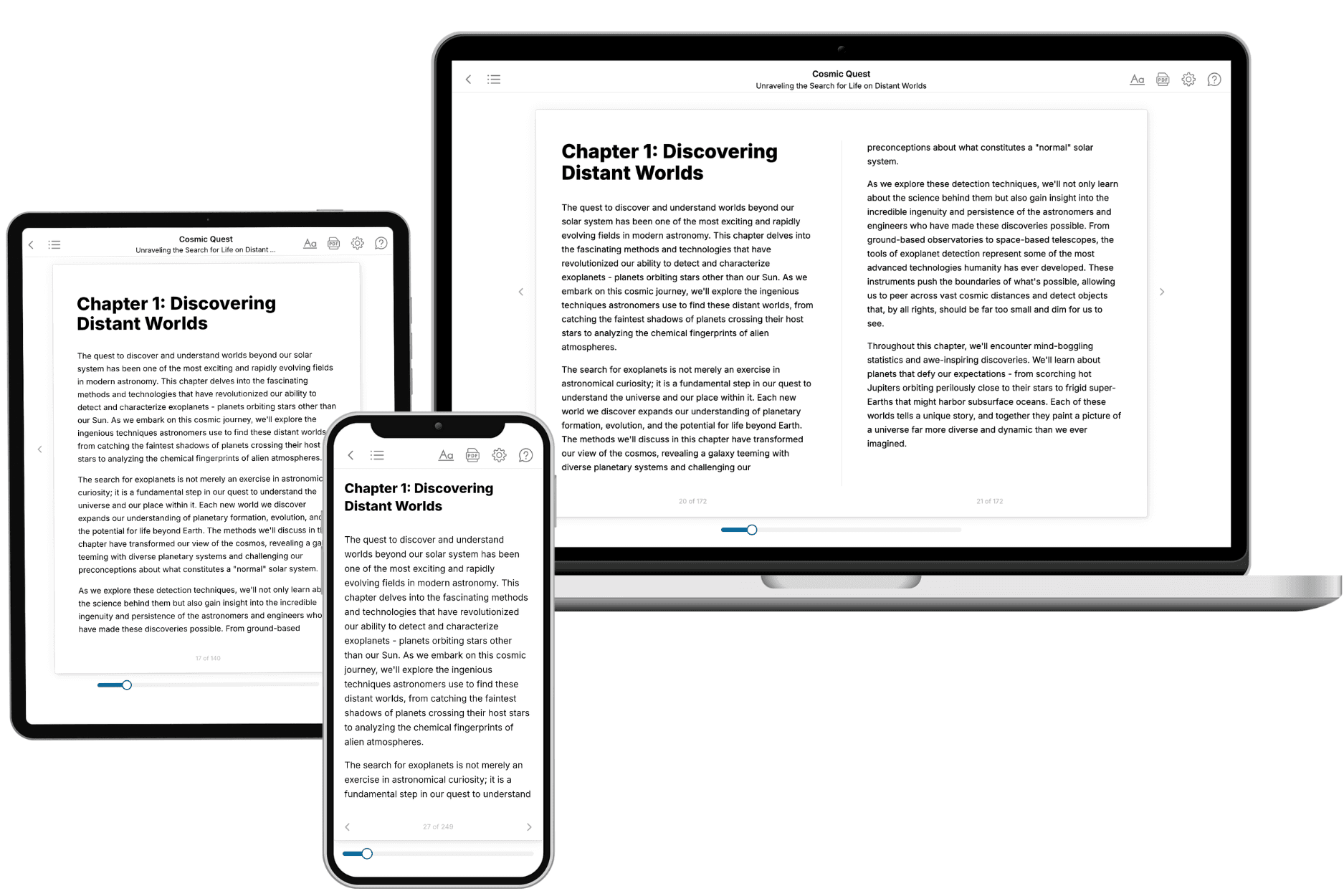
Your book is ready in 10 minutes. Read it online, download as EPUB or PDF, or send to Kindle.

Frequently asked questions
- What is TailoredRead?
TailoredRead creates complete, full-length nonfiction ebooks, written specifically for you. Tell us what you want to learn and why, and TailoredRead writes you a complete ebook on it, with charts, tables, and diagrams throughout. Read it online, on Kindle, or on any e-reader, or download it as a PDF or EPUB. Every book is written fresh the day you order it.
- How is the book tailored to me?
Before anything is written, you answer a few short questions about your goals, your background, and the topics you care about. Your book is then planned around your answers: written at your level, focused on your goals, and covering the topics you chose, instead of the one-size-fits-all book a store sells everyone.
- Will it read like generic AI content?
No. Your book isn't a chat transcript: it's planned chapter by chapter before a single word is written, told in a clear book voice, and explains ideas visually with charts, tables, and diagrams. After writing, every book goes through an editorial pass that polishes chapters so the book reads consistent from start to finish. Judge for yourself: browse thousands of sample books on our Explore Books page.
- How accurate is the content?
Our AI first checks whether your subject needs live research. Niche and fast-moving subjects are researched before writing, and the book plan and chapters are grounded in what it finds. After writing, every book goes through a quality pass that checks its facts and consistency, and researched books list their sources in a Notes section at the back.
- How long is the book?
You choose the length: Comprehensive (250-300 pages), Detailed (150-200 pages), Essential (70-100 pages), or Short (30-50 pages).
- Does the book include visuals?
Yes. Every book includes charts, tables, and diagrams: timelines, checklists, step-by-step guides, decision trees, comparison tables, matrices, and bar charts. A typical book includes dozens of these visual elements.
- Can I read it on Kindle? What formats can I download?
Yes. Every book can be read in our online reader or downloaded as a PDF or EPUB. The EPUB can be opened with Kindle, Apple Books, Kobo, and any e-reader. The Commercial and Author licenses also include an editable Word (DOCX) and Markdown download.
- How much does it cost?
About the price of a regular ebook. The exact price depends on your book's length and complexity, from $2 for the shortest books to $35 for the most comprehensive, and it's shown when you review your book, before you commit to anything. Each book is a one-time purchase, yours to keep, no subscription. Licenses that let you share, teach, or publish your book range from $35.99 to $49.99.
- Can I preview the book before purchasing?
Before you pay, you'll see what your book will cover: the title, a detailed description, the estimated length, and the complete chapter-by-chapter table of contents, so you know what you're getting before you decide. The full text itself is written after you purchase.
- How long does it take to create a book?
About 10 minutes. You can start reading the opening chapters while the rest is still being written.