Breaking Silos
How Cross-Functional Teams Drive Organizational Agility and Business Results
Build cross-functional teams that actually work and drive your organization forward.
191 pages10 chaptersMay 28, 2026Organizational Agility
About this book
This practical guide shows you how to assemble diverse talent across departments, establish clear collaboration frameworks, and navigate the inevitable conflicts that arise when breaking down silos. You'll learn proven strategies for creating psychological safety, managing competing priorities, and aligning incentives so team members prioritize collective goals over departmental interests. Discover how to measure what matters—not just individual contributions but real organizational impact. Whether you're launching your first cross-functional initiative or scaling teams across your enterprise, this book provides actionable frameworks, real-world examples, and step-by-step guidance for building teams that accelerate decision-making, reduce redundancy, and deliver results faster than traditional hierarchies ever could.
Table of contents
- IntroductionWhy Organizational Silos Fail Modern Business, The Cross-Functional Solution, What You'll Learn in This Book, How to Use This BookRead below
- Chapter 1: Understanding Cross-Functional TeamsDefining Cross-Functional Teams, Types of Cross-Functional Structures, The Connection to Organizational Agility
- Chapter 2: The Business Case for Breaking SilosThe Hidden Costs of Organizational Silos, Quantifiable Benefits of Cross-Functional Collaboration, Building Sustainable Competitive Advantage
- Chapter 3: Designing Your Cross-Functional TeamSelecting the Right Team Members, Defining Roles and Responsibilities, Creating a Powerful Team Charter, Establishing Governance and Decision Rights
- Chapter 4: Building Trust and Psychological SafetyWhy Trust Is Non-Negotiable, Creating Psychological Safety Across Departments, Practical Trust-Building Practices
- Chapter 5: Managing Conflict and Competing PrioritiesUnderstanding Conflict in Cross-Functional Teams, Decision-Making Frameworks That Resolve Conflict, Aligning Competing Departmental Priorities, When and How to Escalate Issues
- Chapter 6: Communication and Collaboration PracticesDesigning Effective Communication Structures, Running Meetings That Drive Decisions, Breaking Down Information Silos
- Chapter 7: Leadership in Cross-Functional EnvironmentsLeading Without Direct Authority, Developing Systems Thinking Skills, Managing Stakeholders Across Functions, Adaptive Leadership in Uncertain Environments
- Chapter 8: Aligning Incentives and AccountabilityHow Incentives Drive Departmental Loyalty, Redesigning Incentives for Collaboration, Creating Shared Accountability
- Chapter 9: Measuring Performance and ImpactBuilding a Balanced Metrics Framework, Measuring Team Performance, Tracking Organizational Impact
- Chapter 10: Scaling Cross-Functional TeamsChallenges When Scaling Teams, Strategies for Sustainable Growth, Coordinating Multiple Cross-Functional Teams
- ConclusionKey Takeaways, Your Next Steps
Introduction
Picture a product launch that should have taken three months but stretched into nine. The engineering team built features the sales team never asked for. The marketing team created messaging that didn't match what the product actually did. Legal held up approvals for six weeks because nobody looped them in early enough. Meanwhile, a competitor shipped a similar product and captured the market. Sound familiar? This scenario plays out in organizations of every size, across every industry, every single day. The culprit is almost always the same: silos.
Organizational silos are not just an inconvenience. They are a structural problem that quietly drains resources, slows decisions, and erodes competitive advantage. When departments operate as separate kingdoms with their own goals, their own metrics, and their own loyalties, the organization as a whole pays the price. Information gets hoarded. Decisions get delayed. Customers get frustrated. And talented people spend more energy navigating internal politics than doing the work that actually matters.
The good news is that this problem is solvable. Organizations that have learned to break down silos through well-designed cross-functional teams consistently outperform those that haven't. They move faster, innovate more effectively, and respond to market changes with far greater agility. But building cross-functional teams that actually work requires more than just putting people from different departments in the same room. It requires deliberate design, clear structure, strong leadership, and a genuine commitment to changing how work gets done.
This book is a practical guide for making that change happen. Whether you are a mid-level manager trying to get your first cross-functional initiative off the ground, a team lead navigating the messy reality of competing departmental priorities, or an organizational development professional designing systems for enterprise-wide collaboration, you will find concrete frameworks, real-world examples, and step-by-step guidance here. The goal is not to give you theory to admire. The goal is to give you tools you can use starting this week.
Why Organizational Silos Fail Modern Business
Silos were not always a problem. In the industrial era, specialization was a competitive advantage. You hired experts, grouped them by function, gave each group a clear mandate, and measured their output. The system worked because the environment was relatively stable, products changed slowly, and customers had fewer choices. A functional hierarchy was efficient precisely because it minimized the need for cross-department coordination. Each team could optimize its own piece of the machine without worrying too much about the others.
That world no longer exists. Today's business environment is defined by speed, complexity, and constant disruption. Customer expectations shift in months, not years. Technology cycles compress product lifespans. Competitors emerge from unexpected directions. In this environment, the slow, sequential handoffs that functional silos produce are not just inefficient. They are genuinely dangerous. By the time information travels from engineering to product to marketing to sales and back again, the opportunity may already be gone.
Research consistently confirms this. A McKinsey study found that companies with strong cross-functional collaboration are 1.5 times more likely to report above-average revenue growth than those with weak collaboration.[1] The reason is straightforward: when the people who understand the customer, the technology, the operations, and the finances are all working together in real time, decisions are faster and better informed. When they are working in separate departments and communicating through formal channels, critical information gets lost or delayed at every handoff.
The failure modes of siloed organizations tend to cluster around a few recurring patterns:
- Duplicated effort: Two departments solve the same problem independently because neither knew the other was working on it.
- Misaligned priorities: Each department optimizes for its own metrics, even when doing so hurts the broader organization.
- Slow decision-making: Decisions that require input from multiple functions get stuck in approval chains and escalation loops.
- Innovation gaps: New ideas that require cross-functional execution never get off the ground because no single department owns them.
- Customer experience failures: Customers encounter inconsistent experiences because the teams serving them are not coordinated.
Consider what happened at a major U.S. retailer during the early years of e-commerce. The company's digital team and its store operations team operated as completely separate units with separate leadership, separate budgets, and separate goals. When customers started expecting seamless online-to-offline experiences, like buying online and returning in-store, neither team had the authority or the relationships to build that capability together. Competitors who had invested in cross-functional coordination captured the market while this retailer spent years in internal negotiations. The cost was measured in billions of dollars of lost market share.
The deeper problem with silos is cultural, not just structural. When people spend years working within a single department, they naturally develop loyalty to that department's goals, language, and way of thinking. They start to see other departments as obstacles rather than partners. This is not a character flaw. It is a predictable human response to the incentive systems and organizational structures that most companies have built. Changing it requires more than a reorganization chart. It requires a deliberate effort to build new habits, new relationships, and new ways of measuring success.
The urgency of this challenge has only grown with the rise of remote and hybrid work. When teams are distributed across locations and time zones, the informal coordination that used to happen in hallways and cafeterias disappears. Silos that were already a problem become even more entrenched. Organizations that have not invested in cross-functional collaboration infrastructure find themselves increasingly unable to move at the speed the market demands.
The Cross-Functional Solution
A cross-functional team brings together people with different areas of expertise to work toward a shared goal. Instead of passing work sequentially from one department to the next, team members collaborate in parallel, making decisions together and moving faster as a result. The concept is not new. What has changed is how central it has become to organizational effectiveness, and how much more sophisticated our understanding of what makes these teams succeed or fail has grown.
The most compelling evidence for cross-functional teams comes from the software industry, where agile development practices have demonstrated the model at scale. Spotify's famous "squad" model, for example, organized small cross-functional teams around specific product areas, each containing engineers, designers, product managers, and data analysts.[2] Each squad had the autonomy and the capability to take a feature from concept to production without waiting for approvals from separate functional departments. The result was dramatically faster delivery and higher team engagement. The model has since been adapted by organizations far outside the tech sector, from healthcare systems to financial services firms to consumer goods companies.
What makes cross-functional teams so effective when they work well? Several factors stand out:
- Faster decision-making: When all the relevant expertise is in the room, decisions that used to take weeks of back-and-forth can happen in a single meeting.
- Better solutions: Diverse perspectives surface problems and opportunities that any single function would miss.
- Reduced handoff waste: Work that used to sit in queues waiting for the next department gets done continuously.
- Stronger ownership: Team members who are involved from start to finish develop a deeper sense of accountability for outcomes.
- Accelerated learning: People who work alongside colleagues from other disciplines develop broader organizational knowledge and more empathy for other functions.
It is important to be honest about the challenges, too. Cross-functional teams are not a magic solution. They introduce their own complexities. Team members often have competing loyalties between their functional department and their cross-functional team. Decision-making authority can be unclear. Conflict is more frequent because people with different professional backgrounds and priorities are working in close proximity. Without the right structures and leadership, cross-functional teams can become slower and more chaotic than the functional silos they were meant to replace.
The difference between cross-functional teams that thrive and those that struggle almost always comes down to design and leadership. Teams that succeed have clear charters, explicit decision rights, and leaders who know how to build trust and manage conflict across functional boundaries. Teams that fail tend to be assembled quickly without enough thought given to how they will actually operate. They get the structure without the substance.
A global consumer goods company launched a cross-functional innovation team with representatives from R&D, marketing, supply chain, and finance. In the first six months, the team cut new product development time by 40% compared to the company's traditional process. The key was not just the team composition. It was the explicit decision-making framework the team used, which defined who had authority to approve what, and the weekly rhythm of structured collaboration that kept everyone aligned. Without those elements, the same group of people would likely have produced the same delays and miscommunications as the old process.
The cross-functional model also requires organizational support to sustain. If the incentive systems still reward departmental performance over team outcomes, people will eventually revert to protecting their department's interests. If senior leaders do not actively champion cross-functional collaboration, middle managers will quietly undermine it to protect their turf. Building effective cross-functional teams is as much an organizational change challenge as it is a team design challenge. This book addresses both dimensions.
One more thing worth noting: cross-functional collaboration does not mean the end of functional expertise. The goal is not to create generalists who know a little about everything. The goal is to create teams where deep specialists can work together effectively, contributing their expertise to shared outcomes while learning enough about adjacent disciplines to collaborate without constant friction. The best cross-functional teams combine deep expertise with broad perspective. That combination is what drives both innovation and execution.
What You'll Learn in This Book
This book is organized to take you from understanding to action. Each chapter builds on the previous one, moving from foundational concepts through practical implementation and into the more advanced challenges of scaling and sustaining cross-functional collaboration. You do not need to read it cover to cover in sequence, though that approach will give you the most complete picture. If you have a specific challenge you are facing right now, the structure of the book makes it easy to jump to the relevant section.
Chapters 1 and 2 lay the foundation. Chapter 1 defines what cross-functional teams actually are, distinguishes between different types of cross-functional structures, and explains the connection to organizational agility. Chapter 2 makes the business case, quantifying the costs of silos and the measurable benefits of cross-functional collaboration. These chapters give you the language and the evidence you need to build internal support for cross-functional initiatives.
Chapters 3 through 5 cover the design and launch phase. Chapter 3 walks through how to select team members, define roles, create a team charter, and establish governance structures. Chapter 4 addresses the human foundation of effective collaboration: trust and psychological safety. Chapter 5 tackles conflict and competing priorities, providing frameworks for making decisions and resolving disagreements without losing momentum.
Chapters 6 and 7 focus on the ongoing work of running a cross-functional team. Chapter 6 covers communication and collaboration practices, including how to design meeting rhythms, share knowledge across functions, and prevent information silos from re-forming. Chapter 7 addresses leadership, with specific attention to the skills that cross-functional leaders need and that traditional management training rarely develops: influence without authority, systems thinking, stakeholder management, and adaptive leadership.
Chapters 8 through 10 address the organizational context that determines whether cross-functional teams succeed or fail in the long run. Chapter 8 examines incentive systems and accountability structures, explaining how to align them with cross-functional objectives. Chapter 9 provides a framework for measuring performance and organizational impact. Chapter 10 covers the challenges and strategies involved in scaling cross-functional teams across an enterprise.
Throughout the book, you will find:
- Real-world case studies drawn from organizations that have successfully built cross-functional teams, as well as honest accounts of what went wrong when teams failed.
- Practical frameworks you can adapt and apply immediately, including team charter templates, decision-making models, and conflict resolution protocols.
- Diagnostic questions to help you assess where your current teams or organization stand and identify the highest-leverage areas for improvement.
- Action steps at the end of each major section, so you always know what to do next.
The book draws on research from organizational psychology, management science, and agile practice, as well as practical experience from organizations across industries. Where research is cited, sources are provided. Where frameworks are offered, the reasoning behind them is explained so you can adapt them intelligently rather than applying them mechanically. The goal throughout is to give you not just answers but the understanding to find your own answers when the situation calls for it.
How to Use This Book
Before diving in, it helps to be clear about where you are starting from. The challenges facing someone who is launching their first cross-functional team are different from those facing someone who is trying to scale cross-functional collaboration across a 5,000-person organization. Both will find relevant material here, but the most useful chapters will differ. Take a moment to identify your primary context before you start reading.
If you are new to cross-functional teams and building your first one, start with Chapters 1 through 4. These chapters will give you the conceptual foundation and the practical tools to design and launch a team with a strong chance of success. Pay particular attention to Chapter 3 on team design and Chapter 4 on trust and psychological safety. These are the areas where new cross-functional teams most commonly stumble, and getting them right from the start saves enormous time and energy later.
If you are leading an existing cross-functional team that is struggling, Chapters 5 through 7 are likely your most urgent reading. Chapter 5 on conflict and competing priorities addresses the most common source of dysfunction in cross-functional teams. Chapter 6 on communication practices often reveals quick wins that can improve team effectiveness within weeks. Chapter 7 on leadership will help you assess whether the team's challenges are structural or behavioral, and what to do about either.
If you are an organizational development professional or senior leader trying to build cross-functional capability at scale, Chapters 8 through 10 are where you will find the most relevant material. Chapter 8 on incentive alignment is particularly critical because it addresses the organizational-level factors that determine whether cross-functional teams can sustain themselves over time. Chapter 10 on scaling provides frameworks for coordinating multiple teams without recreating the bureaucracy that silos produce.
Regardless of where you start, a few practices will help you get the most out of this book. First, read actively. Each chapter includes diagnostic questions and action steps. Engage with them rather than skipping past them. The questions are designed to surface insights specific to your situation that generic advice cannot provide. Second, share what you learn. Cross-functional collaboration is, by definition, a collective endeavor. The frameworks in this book are more powerful when multiple people on your team understand and use them. Consider reading key chapters together with your team and discussing how the concepts apply to your specific context.
Third, be patient with the process. Building effective cross-functional teams is not a one-time project. It is an ongoing practice that requires continuous attention and adjustment. Organizations that do it well have typically been working at it for years, iterating and improving as they go. The goal of this book is not to give you a perfect blueprint to execute once. It is to give you a way of thinking and a set of tools that you can apply repeatedly as your teams and your organization evolve.
Finally, remember that context matters enormously. The frameworks and examples in this book come from a wide range of organizations and industries, but no two organizations are identical. What works at a 50-person startup will need adaptation for a 50,000-person corporation. What works in a technology company may need significant modification for a manufacturing firm or a healthcare system. Use the frameworks as starting points, not as rigid prescriptions. The best cross-functional teams are built by leaders who understand the principles deeply enough to adapt them intelligently to their specific situation.
The organizations that will thrive in the coming decade are those that figure out how to harness the collective intelligence of their people across functional boundaries. That is not a prediction. It is already happening. The companies pulling ahead in almost every industry are those that have cracked the code on cross-functional collaboration. This book is your guide to joining them. The work is challenging, but the payoff, in speed, innovation, and organizational resilience, is substantial. Let's get started.
This is the end of the free sample. The full book has 10 chapters.
Want this book written for you?
Tell us your goals and background, and get your own version of this book, tailored by AI to you.


Benefits of AI-tailored books
- Read one book, not ten:
- all the Organizational Agility knowledge you need, gathered into a single book.
- Save days of learning:
- tell us your goals, choose your topics, and the whole book is built around them.
- Learn effortlessly:
- Organizational Agility book written for your specific background and expertise.
- Understand at a glance:
- includes charts, tables, timelines, checklists, decision trees, and more.
- Stay current:
- written the day you order it, not years ago.
- Trust what you read:
- every book is checked for accuracy, with real research when your subject needs it.
Create your unique book in 3 steps
- 1. Select your focus
Select the focus of your Organizational Agility book and share your background
- 2. Personalize your book
Specify your goals and choose sub-topics to include
- 3. Get your tailored book
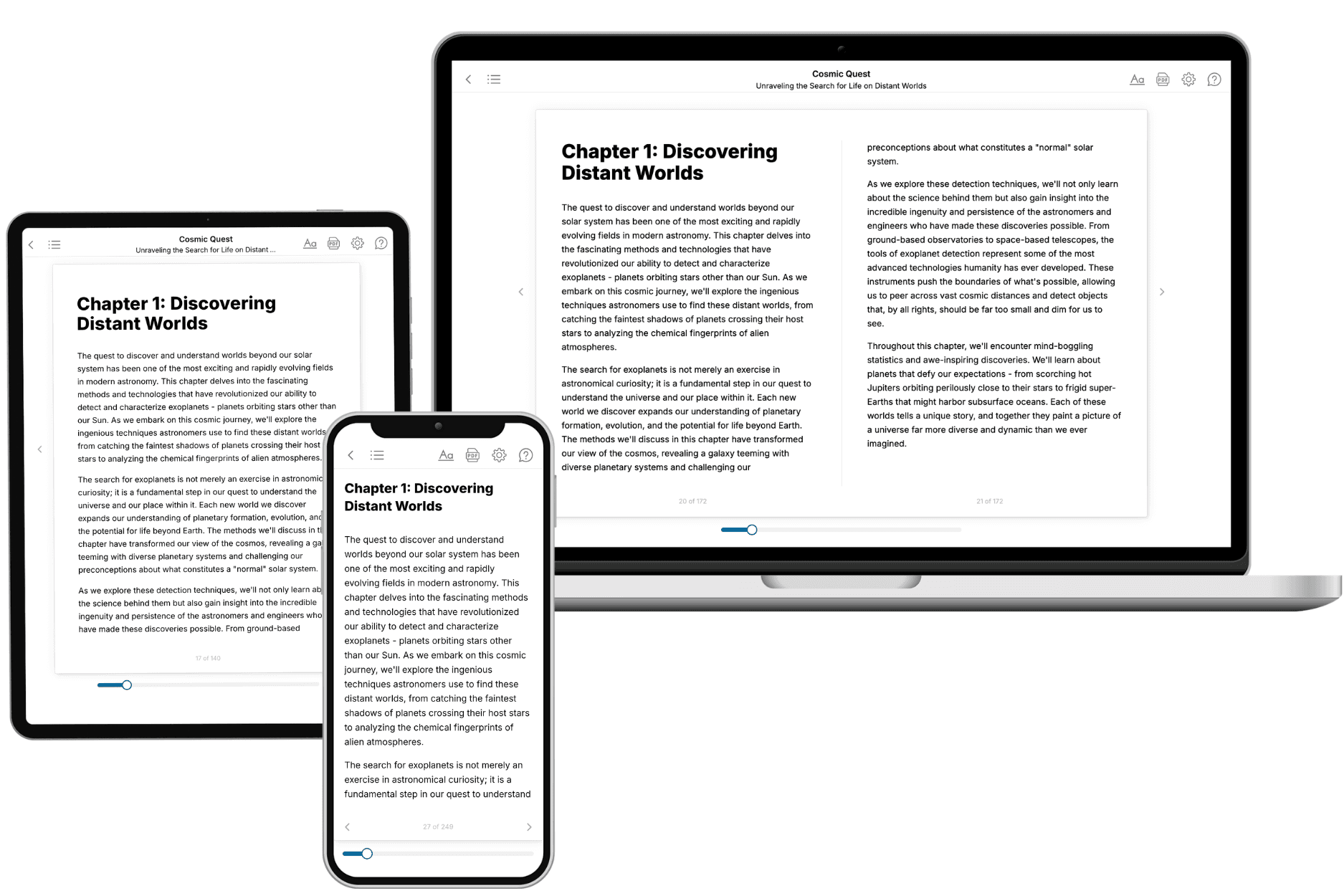
Your book is ready in 10 minutes. Read it online, download as EPUB or PDF, or send to Kindle.

Frequently asked questions
- What is TailoredRead?
TailoredRead creates complete, full-length nonfiction ebooks, written specifically for you. Tell us what you want to learn and why, and TailoredRead writes you a complete ebook on it, with charts, tables, and diagrams throughout. Read it online, on Kindle, or on any e-reader, or download it as a PDF or EPUB. Every book is written fresh the day you order it.
- How is the book tailored to me?
Before anything is written, you answer a few short questions about your goals, your background, and the topics you care about. Your book is then planned around your answers: written at your level, focused on your goals, and covering the topics you chose, instead of the one-size-fits-all book a store sells everyone.
- Will it read like generic AI content?
No. Your book isn't a chat transcript: it's planned chapter by chapter before a single word is written, told in a clear book voice, and explains ideas visually with charts, tables, and diagrams. After writing, every book goes through an editorial pass that polishes chapters so the book reads consistent from start to finish. Judge for yourself: browse thousands of sample books on our Explore Books page.
- How accurate is the content?
Our AI first checks whether your subject needs live research. Niche and fast-moving subjects are researched before writing, and the book plan and chapters are grounded in what it finds. After writing, every book goes through a quality pass that checks its facts and consistency, and researched books list their sources in a Notes section at the back.
- How long is the book?
You choose the length: Comprehensive (250-300 pages), Detailed (150-200 pages), Essential (70-100 pages), or Short (30-50 pages).
- Does the book include visuals?
Yes. Every book includes charts, tables, and diagrams: timelines, checklists, step-by-step guides, decision trees, comparison tables, matrices, and bar charts. A typical book includes dozens of these visual elements.
- Can I read it on Kindle? What formats can I download?
Yes. Every book can be read in our online reader or downloaded as a PDF or EPUB. The EPUB can be opened with Kindle, Apple Books, Kobo, and any e-reader. The Commercial and Author licenses also include an editable Word (DOCX) and Markdown download.
- How much does it cost?
About the price of a regular ebook. The exact price depends on your book's length and complexity, from $2 for the shortest books to $35 for the most comprehensive, and it's shown when you review your book, before you commit to anything. Each book is a one-time purchase, yours to keep, no subscription. Licenses that let you share, teach, or publish your book range from $35.99 to $49.99.
- Can I preview the book before purchasing?
Before you pay, you'll see what your book will cover: the title, a detailed description, the estimated length, and the complete chapter-by-chapter table of contents, so you know what you're getting before you decide. The full text itself is written after you purchase.
- How long does it take to create a book?
About 10 minutes. You can start reading the opening chapters while the rest is still being written.