Bridging the Divide
Understanding Turkey-Armenia Relations in the Shadow of Nagorno-Karabakh
Imagine a world where the complexities of Turkey-Armenia relations are no longer shrouded in mystery.
269 pages13 chaptersMar 5, 2025International Relations
About this book
A future where you possess a nuanced understanding of the historical, cultural, and geopolitical factors that have shaped this intricate relationship. In "Bridging the Divide: Understanding Turkey-Armenia Relations in the Shadow of Nagorno-Karabakh," you'll gain unprecedented insight into one of the most challenging diplomatic puzzles of our time. This book takes you on a compelling exploration of the multifaceted relationship between Turkey and Armenia, with a special focus on the impact of the Nagorno-Karabakh conflict. You'll delve into the historical roots of their strained ties, examine the current state of affairs, and explore potential pathways to reconciliation and cooperation. Through expert analysis and engaging storytelling, you'll uncover the intricate web of cultural, economic, and political factors that continue to influence Turkey-Armenia relations. From the legacy of historical events to the role of international actors, this book leaves no stone unturned in its quest to provide you with a comprehensive understanding of this complex issue. Whether you're a student of international relations, a policy maker, or simply a curious mind seeking to broaden your global perspective, "Bridging the Divide" offers invaluable insights that will enhance your understanding of this critical geopolitical relationship. Prepare to challenge your preconceptions and gain a deeper appreciation for the nuances of diplomacy in one of the world's most volatile regions.
Table of contents
- IntroductionThe Importance of Understanding Turkey-Armenia Relations, Overview of the Book's Structure, Current State of Turkey-Armenia Relations, The Nagorno-Karabakh Conflict: A Brief IntroductionRead below
- Chapter 1: Historical BackgroundThe Ottoman Era and Its Legacy, World War I and Its Aftermath, The Soviet Period and Its Impact, Armenian Independence and Initial Relations with Turkey
- Chapter 2: The Nagorno-Karabakh ConflictOrigins of the Conflict, The First Nagorno-Karabakh War (1988-1994), The Ceasefire and Frozen Conflict Period, The 2020 Nagorno-Karabakh War
- Chapter 3: Turkey's Role in the Nagorno-Karabakh ConflictTurkey's Historical Stance on the Conflict, Support for Azerbaijan: Motivations and Actions, Turkey's Diplomatic Efforts in the Region, Impact on Turkey-Armenia Relations
- Chapter 4: Armenia's PerspectiveSecurity Concerns and Strategic Alliances, The Influence of the Armenian Diaspora, Economic Challenges and Regional Isolation, Public Opinion and Political Discourse in Armenia
- Chapter 5: The Geopolitical ContextRussia's Role in the Caucasus, Iran's Interests and Influence, Western Powers: The EU and US Perspectives, Regional Dynamics: Georgia and Azerbaijan
- Chapter 6: Economic Factors in Turkey-Armenia RelationsThe Impact of Closed Borders, Potential for Trade and Economic Cooperation, Energy Politics in the Region, Regional Economic Initiatives and Their Implications
- Chapter 7: Cultural and Social TiesShared Cultural Heritage, People-to-People Exchanges and Initiatives, Media Portrayals and Public Perceptions, The Role of Diaspora Communities
- Chapter 8: Diplomatic Efforts and NegotiationsThe Zurich Protocols and Their Aftermath, International Mediation Attempts, Track Two Diplomacy Initiatives, Recent Diplomatic Developments
- Chapter 9: Obstacles to NormalizationConflicting Historical Narratives, Territorial Disputes and Border Issues, Domestic Political Considerations, Third-Party Influences and Pressures
- Chapter 10: Pathways to ReconciliationConfidence-Building Measures, Promoting Economic Cooperation, Enhancing Cultural and Educational Exchanges, The Role of Civil Society in Reconciliation
- Chapter 11: Future Scenarios and ProspectsMaintaining the Status Quo, Gradual Normalization of Relations, Increased Regional Cooperation, Potential for Conflict Escalation
- Chapter 12: The Role of the International CommunityUN Initiatives and Resolutions, The OSCE Minsk Group and Its Efforts, EU Engagement and the Eastern Partnership, The Influence of Global Powers
- Chapter 13: Lessons Learned and Way ForwardLessons for Conflict Resolution, Implications for Regional Stability, Policy Recommendations, Areas for Future Research and Analysis
- ConclusionKey Takeaways, Future Outlook for Turkey-Armenia Relations
- Glossary
- Further Reading
Introduction
In the complex tapestry of international relations, few threads are as intricately woven and fraught with tension as the relationship between Turkey and Armenia. This introduction sets the stage for a comprehensive exploration of the multifaceted dynamics that have shaped and continue to influence the interactions between these two nations. As you embark on this journey through the pages of "Bridging the Divide: Understanding Turkey-Armenia Relations in the Shadow of Nagorno-Karabakh," you will gain invaluable insights into one of the most challenging diplomatic puzzles of our time. The historical, cultural, and geopolitical factors that have molded this relationship over centuries will be unraveled, providing you with a nuanced understanding of the current state of affairs and potential pathways to reconciliation.
The importance of comprehending Turkey-Armenia relations extends far beyond the borders of these two countries. It is a microcosm of broader regional dynamics, reflecting the intricate balance of power in the Caucasus and the wider Middle East. As you delve deeper into this topic, you will discover how the legacy of historical events, the influence of global powers, and the aspirations of local populations all converge to create a diplomatic landscape that is as challenging as it is fascinating. This book aims to equip you with the knowledge and analytical tools necessary to navigate this complex terrain, offering a balanced and comprehensive perspective on a relationship that has significant implications for regional stability and international diplomacy.
Throughout this exploration, the Nagorno-Karabakh conflict will serve as a crucial lens through which to examine Turkey-Armenia relations. This long-standing dispute has not only been a source of direct tension between Armenia and Azerbaijan but has also profoundly impacted Turkey's stance and involvement in the region. By understanding the intricacies of this conflict and its ripple effects, you will gain a more holistic view of the challenges and opportunities that lie at the heart of Turkey-Armenia dynamics. The book will guide you through the historical roots of the conflict, its evolution over time, and its current status, all while analyzing how it has shaped and been shaped by the broader context of Turkey-Armenia relations.
As you progress through the chapters, you will encounter a wealth of information drawn from academic research, diplomatic archives, and contemporary analyses. This book synthesizes diverse perspectives to provide a comprehensive and balanced account of the subject matter. You will find that the narrative is supported by rigorous scholarship, with references to key studies and data that underpin the arguments presented. For instance, a study by the International Crisis Group has highlighted that the normalization of Turkey-Armenia relations could potentially increase bilateral trade from its current negligible levels to as much as $300 million annually, demonstrating the significant economic implications of diplomatic progress[1].
Moreover, this book goes beyond mere description to offer actionable insights and analysis. You will find discussions on potential pathways for reconciliation, the role of international mediation, and the impact of changing global dynamics on the prospects for improved relations. By examining case studies of successful conflict resolution in other regions and applying those lessons to the Turkey-Armenia context, the book provides a framework for understanding how progress might be achieved. For example, the reconciliation process between France and Germany after World War II offers valuable lessons on how former adversaries can overcome historical grievances to build strong partnerships, a model that could inform approaches to Turkey-Armenia reconciliation[2].
The Importance of Understanding Turkey-Armenia Relations
The significance of comprehending the intricacies of Turkey-Armenia relations cannot be overstated in today's interconnected global landscape. These relations serve as a critical nexus point for understanding broader regional dynamics, historical reconciliation processes, and the complex interplay between national interests and international diplomacy. As you delve into this topic, you will discover that the Turkey-Armenia relationship is not merely a bilateral issue but a multifaceted challenge that reverberates throughout the Caucasus, Europe, and the Middle East. Understanding these dynamics is crucial for policymakers, diplomats, scholars, and anyone interested in the stability and prosperity of this strategically important region.
One of the primary reasons for the importance of this relationship lies in its potential impact on regional stability. The Caucasus, situated at the crossroads of Europe and Asia, has long been a arena of competing interests and conflicts. The normalization of relations between Turkey and Armenia could significantly alter the geopolitical landscape, potentially leading to increased economic cooperation, improved security, and a reduction in regional tensions. For instance, a study by the Carnegie Endowment for International Peace has suggested that open borders and normalized relations could lead to a 30-50% increase in Armenia's GDP over five years, highlighting the substantial economic benefits of reconciliation[3]. This economic potential underscores the tangible benefits that could arise from improved relations, extending beyond political considerations to impact the lives of citizens in both countries.
Furthermore, the Turkey-Armenia relationship serves as a case study for addressing historical grievances and building reconciliation between nations with a troubled past. The legacy of the events of 1915, which Armenians refer to as genocide and Turkey disputes, continues to cast a long shadow over bilateral relations. How these two nations navigate this sensitive historical issue has implications not only for their own relationship but also for other countries grappling with historical reconciliation processes. By examining the challenges and potential pathways for addressing this historical divide, you gain insights into broader questions of historical memory, national identity, and the possibilities for overcoming seemingly intractable conflicts.
The strategic importance of Turkey and Armenia in their respective regions adds another layer of significance to their relationship. Turkey, as a NATO member and a bridge between Europe and the Middle East, plays a crucial role in regional and global affairs. Its policies towards Armenia and the broader Caucasus region have implications for its relationships with Western allies, Russia, and other regional powers. Armenia, while smaller, occupies a strategic position in the South Caucasus and has cultivated close ties with Russia while also seeking to balance its relationships with Western countries and Iran. Understanding the Turkey-Armenia dynamic provides a window into the complex web of alliances and rivalries that characterize this geopolitically significant region.
Moreover, the Turkey-Armenia relationship intersects with numerous other regional issues, including energy politics, transportation routes, and economic integration initiatives. The potential opening of the Turkish-Armenian border, for example, could create new trade routes and energy corridors, altering the economic landscape of the entire region. A World Bank study has estimated that opening the border could increase Armenia's exports by 30-50% in the short term, demonstrating the significant economic implications of political decisions in this relationship[4]. These economic considerations highlight how understanding Turkey-Armenia relations is crucial for grasping the full picture of regional development and integration prospects.
The role of diaspora communities adds another dimension to the importance of this relationship. Both Turkey and Armenia have significant diaspora populations around the world, particularly in Europe and North America. These communities often play an influential role in shaping public opinion and policy in their host countries regarding Turkey-Armenia relations. Understanding the dynamics of these diaspora communities and their impact on bilateral relations provides insights into the global reach of this seemingly localized issue. It also illustrates how domestic politics in countries far removed from the Caucasus can influence the prospects for reconciliation and cooperation between Turkey and Armenia.
Lastly, the Turkey-Armenia relationship serves as a litmus test for the effectiveness of international mediation and conflict resolution mechanisms. Various international actors, including the United States, Russia, and the European Union, have attempted to facilitate dialogue and reconciliation between the two countries. The successes and failures of these efforts offer valuable lessons for conflict resolution in other parts of the world. By studying these diplomatic initiatives, you gain a deeper understanding of the challenges and opportunities in international mediation, the role of third-party facilitators, and the conditions necessary for successful conflict transformation.
In conclusion, understanding Turkey-Armenia relations is crucial not only for comprehending the specific dynamics between these two countries but also for gaining insights into broader issues of regional stability, historical reconciliation, economic development, and international diplomacy. As you proceed through this book, you will discover how this relationship encapsulates many of the key challenges and opportunities facing the international community in the 21st century. The lessons drawn from this complex relationship have the potential to inform approaches to conflict resolution and regional cooperation far beyond the borders of Turkey and Armenia.
Overview of the Book's Structure
"Bridging the Divide: Understanding Turkey-Armenia Relations in the Shadow of Nagorno-Karabakh" is structured to provide you with a comprehensive and nuanced understanding of this complex topic. The book is organized into thirteen chapters, each focusing on a specific aspect of Turkey-Armenia relations, complemented by an introduction and conclusion. This structure is designed to guide you through the historical background, current challenges, and potential future developments in a logical and engaging manner. By following this carefully crafted progression, you will gain a holistic view of the subject matter, enabling you to draw informed conclusions and develop a sophisticated understanding of the dynamics at play.
The book begins with this introduction, which sets the stage for your exploration by highlighting the importance of understanding Turkey-Armenia relations and providing an overview of the key themes that will be addressed. Following this, Chapter 1 delves into the historical background, tracing the roots of the current relationship from the Ottoman era through World War I, the Soviet period, and up to Armenian independence. This historical context is crucial for understanding the deep-seated issues that continue to influence contemporary relations. For instance, the chapter examines how the events of 1915, which Armenians refer to as genocide, have shaped national narratives and continue to be a point of contention. It also explores the impact of the Cold War era on the development of separate national identities and geopolitical alignments.
Chapters 2 and 3 focus on the Nagorno-Karabakh conflict, a critical factor in Turkey-Armenia relations. Chapter 2 provides a detailed examination of the conflict's origins, the first Nagorno-Karabakh War (1988-1994), the subsequent ceasefire period, and the 2020 war. Chapter 3 specifically analyzes Turkey's role in this conflict, exploring its historical stance, support for Azerbaijan, diplomatic efforts, and the impact on relations with Armenia. These chapters draw on extensive research and data to illustrate the complexity of the conflict. For example, they include analysis of military expenditures, casualty figures, and displacement statistics to provide a comprehensive picture of the conflict's impact[5].
Chapter 4 shifts the focus to Armenia's perspective, examining its security concerns, the influence of the Armenian diaspora, economic challenges, and public opinion. This chapter provides balance to the narrative by ensuring that Armenian viewpoints and interests are thoroughly explored. It includes data on Armenia's economic situation, such as trade statistics and GDP figures, to illustrate the impact of closed borders and regional isolation. The chapter also delves into public opinion surveys to provide insights into Armenian attitudes towards Turkey and the prospects for reconciliation.
The geopolitical context is addressed in Chapter 5, which examines the roles of Russia, Iran, Western powers, and regional actors like Georgia and Azerbaijan. This chapter helps you understand how Turkey-Armenia relations are influenced by and, in turn, influence broader regional dynamics. It includes analysis of strategic partnerships, military alliances, and economic ties to illustrate the complex web of relationships in the region. For instance, it examines Russia's military presence in Armenia and its economic ties with both countries to demonstrate the multifaceted nature of its influence.
Chapters 6 and 7 explore economic factors and cultural ties, respectively. These chapters highlight both the challenges and opportunities in Turkey-Armenia relations beyond the political sphere. Chapter 6 includes economic modeling to demonstrate the potential benefits of open borders and increased trade, while Chapter 7 examines shared cultural heritage and people-to-people initiatives that persist despite governmental tensions. These chapters provide a nuanced view of the relationship, showing how economic and cultural factors can both hinder and potentially facilitate improved relations.
The book then turns to diplomatic efforts in Chapter 8, examining initiatives like the Zurich Protocols, international mediation attempts, and recent developments. This chapter provides insights into the challenges of diplomacy in practice, analyzing why previous efforts have failed and what lessons can be drawn for future initiatives. It includes case studies of specific diplomatic initiatives, examining their strengths, weaknesses, and outcomes to provide a comprehensive understanding of the diplomatic landscape.
Chapters 9 and 10 focus on obstacles to normalization and pathways to reconciliation, respectively. These chapters provide a balanced view of the challenges facing Turkey-Armenia relations while also exploring potential solutions. They draw on examples from other post-conflict reconciliation processes around the world to provide context and potential models for progress. For instance, they examine how Germany and Poland overcame historical animosities to build strong bilateral relations, offering lessons that could be applied to the Turkey-Armenia context.
Chapter 11 looks to the future, presenting various scenarios for how Turkey-Armenia relations might evolve. This chapter employs scenario planning methodologies to explore potential outcomes, from maintaining the status quo to full normalization of relations. It provides a framework for understanding the factors that could influence future developments and the potential consequences of different policy choices.
The role of the international community is examined in Chapter 12, which looks at UN initiatives, the OSCE Minsk Group, EU engagement, and the influence of global powers. This chapter helps you understand how external actors have shaped and continue to influence Turkey-Armenia relations. It includes analysis of diplomatic statements, aid programs, and policy initiatives to illustrate the multifaceted nature of international involvement.
Finally, Chapter 13 synthesizes the lessons learned throughout the book and offers a way forward. This chapter provides concrete policy recommendations based on the analysis presented in previous chapters. It also identifies areas for future research, acknowledging that our understanding of this complex relationship continues to evolve.
The book concludes with a summary of key takeaways and a final reflection on the future outlook for Turkey-Armenia relations. Additionally, a glossary of key terms and a list of suggested further readings are provided to support your continued exploration of this topic.
By following this structured approach, you will gain a comprehensive understanding of Turkey-Armenia relations, from their historical roots to potential future developments. The book's organization allows for a logical progression of ideas while also enabling you to focus on specific aspects of interest. Whether you are a student, policy maker, or simply an interested reader, this structure will guide you through the complexities of this important geopolitical relationship.
Current State of Turkey-Armenia Relations
The current state of Turkey-Armenia relations is characterized by a complex interplay of historical grievances, geopolitical considerations, and tentative steps towards normalization. As of 2023, the two countries do not have formal diplomatic relations, and their shared border remains closed, a situation that has persisted since 1993. This lack of official ties stands in stark contrast to the geographical proximity of the two nations and their shared cultural and historical connections. Understanding the current state of affairs requires a nuanced examination of recent developments, ongoing challenges, and the various factors that continue to shape the relationship.
One of the most significant recent developments in Turkey-Armenia relations was the aftermath of the 2020 Nagorno-Karabakh war. This conflict, which resulted in significant territorial changes in favor of Azerbaijan, Turkey's close ally, has had profound implications for the regional balance of power and, consequently, for Turkey-Armenia dynamics. In the wake of the war, there have been cautious signals from both sides about the possibility of normalizing relations. For instance, in December 2021, Turkey and Armenia appointed special envoys to discuss the normalization process, marking a potential turning point in their relationship[6]. This initiative has been accompanied by statements from officials on both sides expressing willingness to engage in dialogue, suggesting a possible thaw in the long-frozen relations.
However, these positive signals are tempered by significant ongoing challenges. The historical issue of the 1915 events, which Armenians refer to as genocide and Turkey strongly contests, remains a major point of contention. This historical dispute continues to influence public opinion and political discourse in both countries, making it a sensitive and potentially volatile aspect of any normalization process. Recent studies have shown that public opinion in both countries remains deeply divided on this issue, with a 2021 survey indicating that 94% of Armenians believe Turkey should recognize the events as genocide, while the majority of Turks reject this characterization[7]. This divergence in historical narratives presents a significant obstacle to full normalization of relations.
The geopolitical context also plays a crucial role in shaping the current state of Turkey-Armenia relations. Turkey's strong alliance with Azerbaijan, particularly in the context of the Nagorno-Karabakh conflict, continues to be a major factor influencing its approach to Armenia. The trilateral cooperation between Turkey, Azerbaijan, and Georgia in areas such as energy and transportation further complicates the regional dynamics. For Armenia, its strategic alliance with Russia, manifested through membership in the Collective Security Treaty Organization (CSTO) and the presence of Russian military bases on Armenian soil, adds another layer of complexity to its relations with Turkey. These geopolitical alignments create a web of interests and obligations that both constrain and shape the possibilities for bilateral engagement between Turkey and Armenia.
Economic factors also play a significant role in the current state of relations. The closed border between the two countries has had substantial economic implications, particularly for Armenia. A World Bank study estimated that opening the border could increase Armenia's GDP by 30% in the long term, highlighting the significant economic potential of normalized relations[8]. For Turkey, while the economic impact is less pronounced due to its larger and more diversified economy, the potential for increased trade and investment in the Caucasus region presents attractive opportunities. These economic considerations are increasingly recognized by policymakers on both sides as potential catalysts for improved relations.
The role of civil society and people-to-people contacts in the current state of Turkey-Armenia relations should not be underestimated. Despite the lack of formal diplomatic ties, there have been ongoing efforts by non-governmental organizations, academic institutions, and cultural groups to foster dialogue and understanding between the two societies. For example, the Turkey-Armenia Fellowship Scheme, supported by the European Union, has facilitated exchanges between professionals from both countries, contributing to increased mutual understanding at the societal level[9]. These grassroots initiatives provide a foundation for potential future rapprochement and demonstrate that connections between the two societies persist despite governmental tensions.
The international context also significantly influences the current state of Turkey-Armenia relations. The United States, European Union, and Russia have all expressed support for normalization efforts between the two countries. The EU, in particular, has been actively encouraging dialogue through its Eastern Partnership program and has offered economic incentives for regional cooperation. However, the effectiveness of international mediation efforts has been limited, as demonstrated by the failure of previous initiatives such as the 2009 Zurich Protocols. The current geopolitical tensions between Russia and the West add another layer of complexity to international involvement in Turkey-Armenia relations.
In terms of recent diplomatic developments, the appointment of special envoys by both countries in late 2021 has led to several rounds of talks aimed at normalizing relations. These discussions have covered a range of issues, including the potential opening of the border and the establishment of diplomatic relations. While progress has been slow and incremental, the very fact that these talks are taking place represents a significant shift from the previous status quo. Both sides have expressed cautious optimism about the process, though they also acknowledge the many challenges that lie ahead.
The current state of Turkey-Armenia relations is also influenced by domestic political considerations in both countries. In Turkey, the government's approach to Armenia is shaped by its broader foreign policy objectives, its relationship with Azerbaijan, and domestic political dynamics. In Armenia, the aftermath of the 2020 Nagorno-Karabakh war and subsequent political changes have created a new context for considering relations with Turkey. Public opinion and the influence of diaspora communities in both countries continue to play important roles in shaping the political discourse around bilateral relations.
In conclusion, the current state of Turkey-Armenia relations is characterized by a mix of persistent challenges and cautious steps towards engagement. While historical issues and geopolitical considerations continue to pose significant obstacles, there are also signs of a potential thaw in relations. Economic incentives, civil society initiatives, and international encouragement provide impetus for improved ties. However, the path to full normalization remains long and fraught with difficulties. As you proceed through this book, you will gain a deeper understanding of these complex dynamics and the various factors that will shape the future of Turkey-Armenia relations.
The Nagorno-Karabakh Conflict: A Brief Introduction
The Nagorno-Karabakh conflict stands as one of the most complex and enduring disputes in the post-Soviet space, playing a pivotal role in shaping the dynamics of Turkey-Armenia relations. This territorial and ethnic conflict between Armenia and Azerbaijan over the Nagorno-Karabakh region has its roots in the early 20th century but escalated dramatically with the dissolution of the Soviet Union. Understanding this conflict is crucial for comprehending the broader context of Turkey-Armenia relations, as it has significantly influenced Turkey's stance towards Armenia and has been a major obstacle to normalization efforts between the two countries.
Nagorno-Karabakh, known as Artsakh in Armenian, is a mountainous region located in the South Caucasus. Historically, it has been home to both Armenians and Azerbaijanis, with its status and governance changing hands multiple times over the centuries. The modern conflict began in 1988, during the final years of the Soviet Union, when the Armenian majority in Nagorno-Karabakh, then an autonomous oblast within the Azerbaijan Soviet Socialist Republic, voted to unify with Armenia. This move was rejected by Azerbaijan and led to increasing tensions between the Armenian and Azerbaijani communities in the region.
With the collapse of the Soviet Union in 1991, the conflict escalated into a full-scale war between newly independent Armenia and Azerbaijan. The war, which lasted from 1992 to 1994, resulted in significant casualties and displacement on both sides. By the time a ceasefire was brokered in 1994, ethnic Armenian forces, with support from Armenia, had taken control of Nagorno-Karabakh and several surrounding Azerbaijani districts. This created a de facto independent state, the "Republic of Artsakh," which was not recognized by any UN member state, including Armenia. The conflict resulted in approximately 30,000 deaths and displaced hundreds of thousands of people, primarily Azerbaijanis from Nagorno-Karabakh and the surrounding regions[10].
Following the 1994 ceasefire, the conflict entered a "frozen" phase, characterized by periodic skirmishes along the line of contact but no large-scale military operations. During this period, international mediation efforts, primarily through the OSCE Minsk Group co-chaired by Russia, France, and the United States, attempted to negotiate a peaceful resolution to the conflict. However, these efforts failed to produce a lasting solution, with both sides maintaining maximalist positions and unwilling to make significant concessions.
The situation changed dramatically in September 2020 when Azerbaijan, with strong support from Turkey, launched a large-scale military offensive to regain control of Nagorno-Karabakh and the surrounding territories. This 44-day war, known as the Second Nagorno-Karabakh War, resulted in significant Azerbaijani territorial gains. The conflict ended with a Russian-brokered ceasefire on November 10, 2020, which saw Azerbaijan regain control over much of the previously occupied territories, including parts of Nagorno-Karabakh itself. The agreement also provided for the deployment of Russian peacekeeping forces to the region.
The outcome of the 2020 war has significantly altered the regional dynamics and has had profound implications for Turkey-Armenia relations. Turkey's strong support for Azerbaijan during the conflict, including military assistance and diplomatic backing, further strained its already tense relationship with Armenia. The war demonstrated Turkey's increased influence in the South Caucasus and its willingness to play a more assertive role in regional affairs. This has added a new dimension to the challenges facing Turkey-Armenia normalization efforts.
The Nagorno-Karabakh conflict intersects with Turkey-Armenia relations in several key ways. Firstly, Turkey's close alliance with Azerbaijan, often described as "one nation, two states," has been a major factor in its approach to Armenia. Turkey closed its border with Armenia in 1993 in solidarity with Azerbaijan during the first Nagorno-Karabakh war, and this closure has remained a significant obstacle to normalization. Secondly, the conflict has reinforced Turkey's strategic interests in the Caucasus region, including its desire to establish a direct land connection with Azerbaijan through Armenian territory (the so-called "Zangezur corridor"), which has become a point of contention in recent discussions.
Furthermore, the Nagorno-Karabakh conflict has influenced public opinion and political discourse in both Turkey and Armenia. In Turkey, support for Azerbaijan's position has been a consistent feature of foreign policy and public sentiment. In Armenia, the conflict has been central to national identity and security concerns, with the loss of territory in 2020 leading to significant political upheaval. These domestic factors continue to shape the possibilities for engagement between Turkey and Armenia.
The international dimension of the Nagorno-Karabakh conflict also impacts Turkey-Armenia relations. Russia's role as the primary security guarantor in the region, particularly following the 2020 war, adds complexity to any potential normalization process between Turkey and Armenia. Similarly, the involvement of Western powers, including the United States and European Union members, in mediation efforts creates a multilayered diplomatic environment in which Turkey-Armenia relations must be navigated.
As you proceed through this book, you will encounter more detailed analyses of how the Nagorno-Karabakh conflict has shaped and continues to influence Turkey-Armenia relations. Understanding this conflict is essential for grasping the full complexity of the challenges and opportunities in the relationship between these two countries. The Nagorno-Karabakh issue serves as a lens through which many aspects of Turkey-Armenia dynamics can be examined, from historical grievances and security concerns to economic interests and regional power dynamics.
In conclusion, the Nagorno-Karabakh conflict remains a critical factor in Turkey-Armenia relations. Its resolution, or lack thereof, will likely continue to play a significant role in determining the future course of bilateral ties. As you delve deeper into the chapters that follow, keep in mind the centrality of this conflict to the broader narrative of Turkey-Armenia relations and its implications for regional stability and cooperation in the South Caucasus.
Notes
Introduction
- 1. International Crisis Group, "Turkey and Armenia: Opening Minds, Opening Borders," Europe Report N°199, 2009
- 2. L. G. Feldman, Germany's Foreign Policy of Reconciliation, Rowman & Littlefield Publishers, 2012
- 3. R. Giragosian, Changing Armenia-Turkish Relations, Friedrich-Ebert-Stiftung, 2009
- 4. World Bank, Armenia: Implications of Opening the Turkish-Armenian Border, 2015
- 5. T. de Waal, Black Garden, NYU Press, 2013
- 6. D. Isachenko, Turkey-Armenia Normalization: Mitigating Risks, Maximizing Potential, SWP Comment, 2022
- 7. Caucasus Research Resource Center, Caucasus Barometer, 2021
- 8. World Bank, Armenia: Implications of Opening the Turkish-Armenian Border, 2015
- 9. Civilnet, Turkey-Armenia Fellowship Scheme: Building Bridges Through Professional Exchanges, 2022
- 10. T. de Waal, Black Garden, NYU Press, 2013
This is the end of the free sample. The full book has 13 chapters.
Want this book written for you?
Tell us your goals and background, and get your own version of this book, tailored by AI to you.


Benefits of AI-tailored books
- Read one book, not ten:
- all the International Relations knowledge you need, gathered into a single book.
- Save days of learning:
- tell us your goals, choose your topics, and the whole book is built around them.
- Learn effortlessly:
- International Relations book written for your specific background and expertise.
- Understand at a glance:
- includes charts, tables, timelines, checklists, decision trees, and more.
- Stay current:
- written the day you order it, not years ago.
- Trust what you read:
- every book is checked for accuracy, with real research when your subject needs it.
Create your unique book in 3 steps
- 1. Select your focus
Select the focus of your International Relations book and share your background
- 2. Personalize your book
Specify your goals and choose sub-topics to include
- 3. Get your tailored book
Your book is ready in 10 minutes. Read it online, download as EPUB or PDF, or send to Kindle.


Frequently asked questions
- What is TailoredRead?
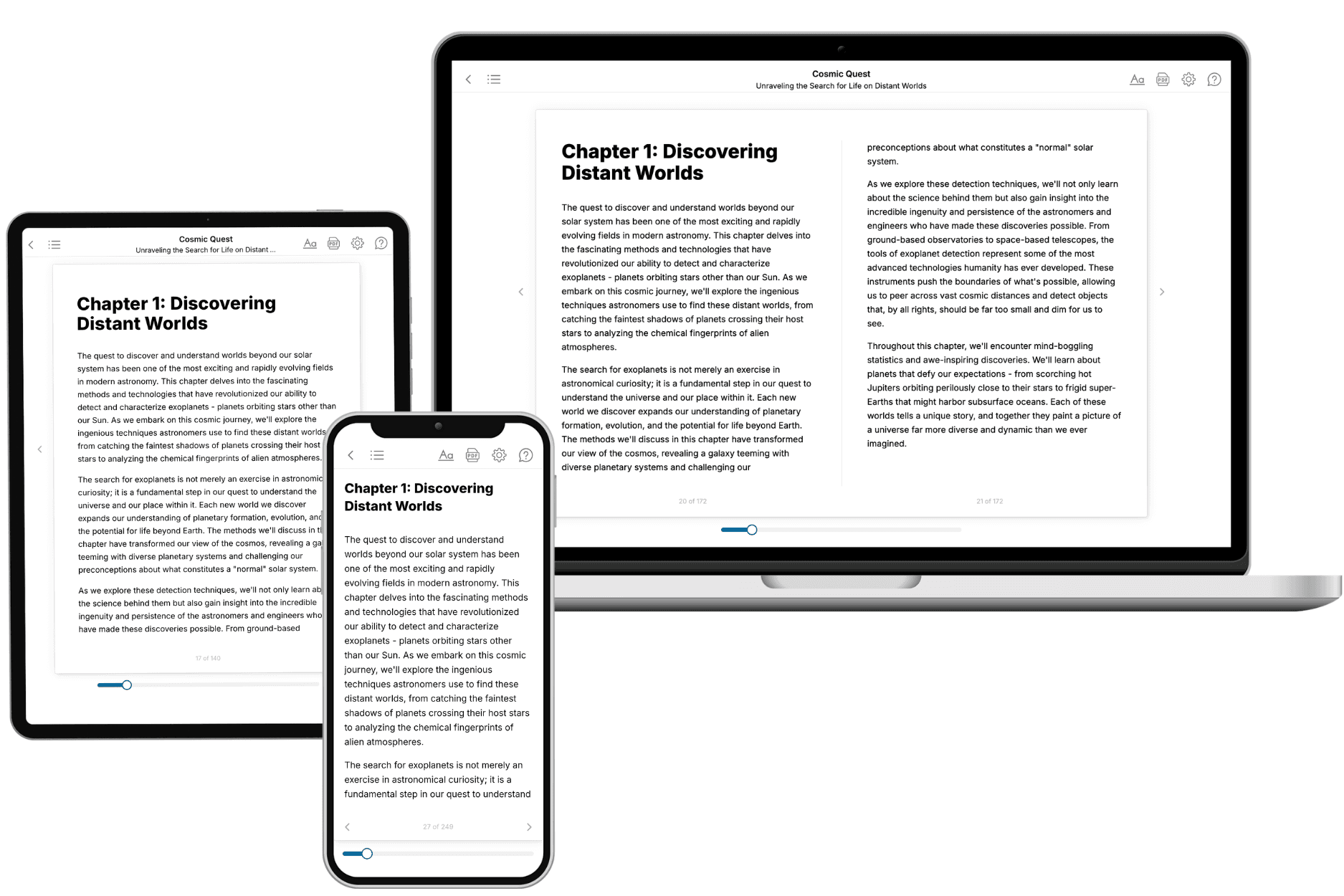
TailoredRead creates complete, full-length nonfiction ebooks, written specifically for you. Tell us what you want to learn and why, and TailoredRead writes you a complete ebook on it, with charts, tables, and diagrams throughout. Read it online, on Kindle, or on any e-reader, or download it as a PDF or EPUB. Every book is written fresh the day you order it.
- How is the book tailored to me?
Before anything is written, you answer a few short questions about your goals, your background, and the topics you care about. Your book is then planned around your answers: written at your level, focused on your goals, and covering the topics you chose, instead of the one-size-fits-all book a store sells everyone.
- Will it read like generic AI content?
No. Your book isn't a chat transcript: it's planned chapter by chapter before a single word is written, told in a clear book voice, and explains ideas visually with charts, tables, and diagrams. After writing, every book goes through an editorial pass that polishes chapters so the book reads consistent from start to finish. Judge for yourself: browse thousands of sample books on our Explore Books page.
- How accurate is the content?
Our AI first checks whether your subject needs live research. Niche and fast-moving subjects are researched before writing, and the book plan and chapters are grounded in what it finds. After writing, every book goes through a quality pass that checks its facts and consistency, and researched books list their sources in a Notes section at the back.
- How long is the book?
You choose the length: Comprehensive (250-300 pages), Detailed (150-200 pages), Essential (70-100 pages), or Short (30-50 pages).
- Does the book include visuals?
Yes. Every book includes visual elements such as timelines, checklists, step-by-step guides, decision trees, comparison tables, and matrices, and many include bar charts. A typical book includes dozens of these visual elements.
- Can I read it on Kindle? What formats can I download?
Yes. Every book can be read in our online reader or downloaded as a PDF or EPUB. The EPUB can be opened with Kindle, Apple Books, Kobo, and any e-reader. The Commercial and Author licenses also include an editable Word (DOCX) and Markdown download.
- How much does it cost?
About the price of a regular ebook. The exact price depends on your book's length and complexity, from $2 for the shortest books to $35 for the most comprehensive, and it's shown when you review your book, before you commit to anything. Each book is a one-time purchase, yours to keep, no subscription. Licenses that let you share, teach, or publish your book range from $35.99 to $49.99.
- Can I preview the book before purchasing?
Before you pay, you'll see what your book will cover: the title, a detailed description, the estimated length, and the complete chapter-by-chapter table of contents, so you know what you're getting before you decide. The full text itself is written after you purchase.
- How long does it take to create a book?
About 10 minutes. You can start reading the opening chapters while the rest is still being written.