Brown Adipocytes
Engineering Metabolic Tissue for Health and Innovation
Imagine a future where metabolic diseases like obesity and diabetes are treated not with pharmaceuticals alone, but with living, functional tissue engineered in the laboratory.
191 pages10 chaptersJul 26, 2026Tissue Engineering
About this book
Brown adipocytes—specialized fat cells that burn calories to generate heat—hold remarkable promise for this vision. This book provides a clear, practical guide to understanding brown adipocytes and their engineering for therapeutic and research applications. You'll explore the fundamental biology that makes these cells unique, discover how they develop and function, and learn cutting-edge tissue engineering strategies to cultivate them in controlled environments. Whether you're a researcher designing bioreactor systems, a clinician exploring new treatment options, or a biotech professional developing next-generation therapies, this book equips you with the knowledge to navigate this rapidly advancing field. Grounded in current science yet accessible to intermediate learners, it bridges the gap between basic biology and real-world application, offering both theoretical foundations and practical insights for innovation in metabolic tissue engineering.
Table of contents
- IntroductionWhy Brown Adipocytes Matter in Modern Medicine, What You'll Learn in This Book, How to Use This GuideRead below
- Chapter 1: Fundamentals of Adipose Tissue BiologyOverview of Adipose Tissue Types, Distinguishing White from Brown Adipocytes, Metabolic Roles and Functions
- Chapter 2: Brown Adipocyte Biology and ThermogenesisUncoupling Protein 1 and Heat Generation, Thermogenic Signaling Pathways, Mitochondrial Adaptations in Brown Adipocytes, Metabolic Regulation and Energy Expenditure
- Chapter 3: Development and Differentiation of Brown AdipocytesLineage Origins and Developmental Pathways, Key Transcription Factors in Differentiation, Molecular Signals and Growth Factors
- Chapter 4: Cell Sources for Brown Adipocyte EngineeringBone Marrow-Derived Mesenchymal Stem Cells, Induced Pluripotent Stem Cells and Reprogramming, Alternative Cell Sources and Direct Conversion
- Chapter 5: Culture Systems and Differentiation ProtocolsTwo-Dimensional Culture Approaches, Three-Dimensional Culture and Scaffold Systems, Optimizing Differentiation Conditions, Media Formulations and Supplementation
- Chapter 6: Bioreactor Design and Scale-UpTypes of Bioreactors for Adipocyte Culture, Critical Process Parameters and Control, Scaling from Bench to Clinical Production
- Chapter 7: Characterization and Quality AssessmentMorphological and Histological Analysis, Gene Expression and Molecular Markers, Functional Assays and Metabolic Testing, Quality Control Standards and Specifications
- Chapter 8: Therapeutic Applications and Clinical PotentialObesity and Metabolic Disorder Management, Type 2 Diabetes and Glucose Homeostasis, Regenerative Medicine and Tissue Implants
- Chapter 9: Research Applications and Drug DevelopmentDisease Modeling and Personalized Medicine, Drug Screening and Toxicity Testing, Mechanistic Studies and Basic Research
- Chapter 10: Challenges, Limitations, and Future DirectionsCurrent Technical and Biological Challenges, Regulatory and Manufacturing Considerations, Emerging Technologies and Future Innovations
- ConclusionKey Takeaways and Synthesis, Your Next Steps in Brown Adipocyte Research and Development
Introduction
For decades, fat tissue was treated as a passive reservoir, a place where excess calories accumulated and waited. That view began to shift in the 1990s when researchers confirmed that adult humans retain depots of metabolically active Brown Adipose Tissue, capable of burning fuel to generate heat rather than storing it.[1] The discovery reframed an entire field. Suddenly, fat was not just a problem to be reduced; it was a potential therapeutic target, a tissue that could be engineered, activated, and deployed to address some of the most pressing metabolic diseases of our time.
The numbers behind metabolic disease make the urgency clear. Obesity affects more than one billion people globally, and type 2 diabetes follows closely as one of the fastest-growing chronic conditions worldwide.[2] Existing pharmaceutical and surgical interventions manage symptoms but rarely address the underlying dysfunction in energy balance. Brown Adipose Tissue offers a different angle: rather than suppressing appetite or blocking nutrient absorption, it increases the body's capacity to expend energy. Engineering that capacity in a controlled, reproducible way is the central challenge this book addresses.
What makes this moment particularly compelling is the convergence of several fields. Stem cell biology, biomaterials science, bioreactor engineering, and genomic tools like CRISPR Gene Editing have all matured to a point where building functional metabolic tissue in the laboratory is no longer speculative. Researchers can now derive brown adipocytes from Induced Pluripotent Stem Cells, culture them in three-dimensional Scaffold systems that mimic native tissue architecture, and verify their thermogenic function using quantitative assays like the Seahorse Metabolic Assay. The science is moving fast, and the gap between bench discovery and clinical application is narrowing.
This book is written for professionals and researchers who already have a working foundation in biology or tissue engineering and want to go deeper into this specific field. The goal is not to survey every paper published on Brown Adipose Tissue, but to give you a coherent, practical understanding of how these cells work, how they are made, how they are tested, and where they are headed. Each chapter builds on the last, moving from fundamental biology through engineering practice and into clinical and commercial application.
Why Brown Adipocytes Matter in Modern Medicine
Brown adipocytes are structurally and functionally unlike any other fat cell. Where White Adipose Tissue stores triglycerides in a single large lipid droplet, brown adipocytes pack their cytoplasm with multiple smaller droplets and an unusually dense population of mitochondria. That mitochondrial density is not incidental. It reflects the cell's primary job: generating heat through a process called Non-Shivering Thermogenesis, driven by a protein called Uncoupling Protein 1 embedded in the inner mitochondrial membrane. When activated, Uncoupling Protein 1 short-circuits the normal energy-capture process, releasing the proton gradient across the mitochondrial membrane as heat rather than ATP.
This thermogenic capacity has direct metabolic consequences. Active Brown Adipose Tissue increases whole-body energy expenditure, draws glucose and fatty acids from circulation, and improves markers of metabolic health including Insulin Sensitivity.[3] In lean, metabolically healthy individuals, Brown Adipose Tissue depots are more active and more abundant. In people with obesity or type 2 diabetes, those depots tend to be smaller and less responsive. The correlation is not coincidental, and it points toward a therapeutic hypothesis: restoring or augmenting Brown Adipose Tissue activity could help correct the energy imbalance that underlies metabolic disease.
Beyond energy expenditure, brown adipocytes communicate with other organs. They secrete signaling molecules, sometimes called batokines, that influence liver metabolism, muscle function, and even brain activity.[4] This endocrine dimension means that engineering functional Brown Adipose Tissue is not just about adding a heat-generating depot; it is about restoring a signaling network that participates in whole-body metabolic regulation. That broader role makes the therapeutic case considerably stronger.
The clinical interest in Brown Adipose Tissue has also been accelerated by the identification of Beige Adipocytes, a related cell type that can emerge within White Adipose Tissue depots under certain stimuli, including cold exposure and Beta-Adrenergic Signaling. Beige Adipocytes share many functional properties with classical brown adipocytes, including Uncoupling Protein 1 expression, and they represent an additional target for therapeutic activation. Understanding the relationship between brown and beige cells is essential for anyone designing interventions aimed at increasing thermogenic capacity.
From a tissue engineering perspective, brown adipocytes present both opportunities and challenges. Their high metabolic rate means they are sensitive to oxygen and nutrient supply, which complicates culture at scale. Their differentiation requires precise coordination of transcription factors including PRDM16, PGC-1α, and PPARγ, and the signals that drive that differentiation must be carefully controlled to produce cells that are genuinely thermogenic rather than merely lipid-laden. Getting that right is the technical core of this field, and it is where the most active research is currently concentrated.
The medical stakes are high enough that regulatory agencies and major research funders have taken notice. Clinical trials exploring Brown Adipocyte Transplantation and pharmacological activation of Brown Adipose Tissue are underway or in planning stages in multiple countries. The path from laboratory to clinic is long and demanding, but the biological rationale is solid, and the engineering tools are increasingly capable. That combination is what makes this an unusually productive moment to engage with the field.
Brown adipocytes are not simply an alternative type of fat cell. They are a metabolic engine with therapeutic potential that extends from energy balance to glucose regulation to organ-level signaling, and engineering them reliably is one of the more consequential challenges in modern metabolic medicine.
What You'll Learn in This Book
The book is organized to move from foundational biology through engineering practice and into application. Each layer builds on the previous one, so the concepts introduced early become the vocabulary for more technical discussions later. Here is a map of what each section covers and why it is sequenced the way it is.
The opening chapters establish the biological foundation. The chapter on adipose tissue fundamentals draws the structural and metabolic contrast between White Adipose Tissue and Brown Adipose Tissue, and introduces Beige Adipocytes as a third category with its own significance. Without that taxonomy, the engineering chapters that follow would lack context. The subsequent chapter on thermogenesis goes deeper into the mechanism, explaining how Uncoupling Protein 1 works at the molecular level, how Beta-Adrenergic Signaling activates it, and how Mitochondrial Uncoupling translates into measurable heat output and metabolic benefit.
The development chapter then traces how brown adipocytes arise during embryogenesis, focusing on the role of Myf5-Positive Progenitors and the transcription factor cascade that specifies brown adipocyte identity. This is not purely academic. Understanding lineage origins directly informs which cell sources are most appropriate for engineering purposes and which reprogramming strategies are most likely to produce genuinely functional cells. The transcription factors PRDM16, PGC-1α, and PPARγ appear repeatedly throughout the book because they are the molecular levers that engineers use to drive differentiation.
The cell sources chapter surveys the practical options available for generating brown adipocytes in the laboratory:
- Mesenchymal Stem Cells derived from bone marrow or adipose tissue, which are accessible and relatively straightforward to differentiate
- Induced Pluripotent Stem Cells, which offer scalability and patient-specificity but require more complex differentiation protocols
- Direct Conversion strategies, which reprogram somatic cells without passing through a pluripotent intermediate, offering speed at the cost of yield
The culture systems and bioreactor chapters address the engineering side in detail. Two-dimensional culture methods are well established and useful for early-stage work, but they do not replicate the three-dimensional architecture of native tissue. Three-dimensional platforms using Hydrogel and Scaffold systems better approximate the mechanical and biochemical environment that brown adipocytes experience in vivo, and they tend to produce cells with stronger thermogenic function. The bioreactor chapter then addresses the scale-up problem: how to move from a flask on a bench to a manufacturing process that produces clinically relevant quantities of cells under Good Manufacturing Practice conditions, using Process Analytical Technology to monitor and control critical parameters in real time.
Characterization and quality control occupy their own chapter because they are often underemphasized in the research literature but are absolutely central to any serious engineering effort. The chapter covers:
- Morphological assessment using Oil Red O Staining and microscopy
- Molecular verification through gene expression profiling of thermogenic markers
- Functional testing using the Seahorse Metabolic Assay to measure Oxygen Consumption Rate
- Release Criteria frameworks that define what a batch of engineered cells must demonstrate before it can be used in a downstream application
The final three chapters shift from production to application. The therapeutic applications chapter examines the clinical rationale for Brown Adipocyte Transplantation in obesity and type 2 diabetes, reviews the evidence for metabolic benefit, and discusses the regulatory and safety considerations that shape the path to clinical use. The research applications chapter covers Disease Modeling, High-Throughput Drug Screening, and the use of Organ-on-Chip platforms that incorporate brown adipocytes as functional components. The final chapter synthesizes the field's unresolved challenges, from vascularization and long-term cell survival to regulatory harmonization, and maps the emerging technologies, including Single-Cell Omics and advanced CRISPR Gene Editing strategies, that are most likely to define the next decade of progress.
Throughout, the emphasis is on practical understanding. Concepts are illustrated with specific examples, protocols are described with enough detail to be actionable, and the connections between biological mechanism and engineering decision are made explicit. The goal is not just to inform but to equip you to make better decisions in your own work, whether that work is in a research laboratory, a clinical development program, or a biotech company building the next generation of metabolic therapies.
How to Use This Guide
The book is designed to be read sequentially, but it is also structured so that individual chapters can stand alone as reference material. If you are already comfortable with adipose tissue biology and want to go directly to engineering practice, the chapters on culture systems, bioreactor design, and characterization can be read independently. If you are approaching from a clinical background and want to understand the therapeutic rationale before diving into the biology, the therapeutic applications chapter provides a self-contained overview that will point you back to the relevant foundational sections when you need them.
For researchers who are new to this specific field but experienced in adjacent areas, the recommended path is to read the first three chapters in order. They establish the vocabulary and conceptual framework that the rest of the book assumes. Pay particular attention to the canonical terms used throughout: Brown Adipose Tissue, White Adipose Tissue, Beige Adipocytes, Uncoupling Protein 1, Non-Shivering Thermogenesis, and the key transcription factors PRDM16, PGC-1α, and PPARγ. These terms appear consistently across all chapters, and understanding their precise meaning early will prevent confusion later.
For biotech professionals and product developers, the most immediately relevant sections are likely the cell sources chapter, the bioreactor and scale-up chapter, and the quality control chapter. Together, these three sections describe the manufacturing pipeline from cell selection through production to release testing. The regulatory considerations discussed in the final chapter are also directly relevant to anyone thinking about a development pathway toward clinical or commercial use.
For clinicians and translational researchers, the therapeutic applications chapter is the natural entry point, but the characterization chapter deserves close attention as well. Understanding what Release Criteria mean, and why they matter, is essential for evaluating the quality of any cell-based product being considered for clinical use. The disease modeling and drug screening chapter is also relevant for clinicians involved in research programs that use patient-derived cells to study metabolic disease mechanisms.
A few practical notes on how the content is presented throughout the book:
- Examples and case studies are drawn from published research and are described with enough specificity to be useful, but the focus is always on the principle being illustrated rather than the specific study
- Protocols and frameworks are presented as starting points, not fixed recipes. The field is moving quickly, and the best current practice in any given area may have evolved since the relevant research was published
- Canonical terminology is used consistently throughout. When a term is introduced for the first time, it is defined in context. After that, it is used without repeated definition, so the glossary at the back of the book is a useful reference if you encounter a term whose meaning has become unclear
- Cross-references between chapters are made by concept rather than by chapter number, so you can follow a thread of interest without needing to track the book's structure explicitly
The field of brown adipocyte engineering sits at the intersection of cell biology, materials science, bioprocess engineering, and clinical medicine. No single reader will be equally expert in all of these areas, and the book does not assume that you are. Where a concept requires background that may not be universal, it is explained from first principles before being applied. Where a concept is likely to be familiar to most readers, it is introduced briefly and then used without extensive elaboration. The goal is to respect your existing knowledge while filling in the specific gaps that this field requires.
One final orientation point: the book does not treat Brown Adipose Tissue as a solved problem or a guaranteed therapeutic success. The biology is compelling, the engineering is advancing rapidly, and the clinical rationale is strong. But significant challenges remain, from achieving durable thermogenic function in engineered constructs to navigating the regulatory requirements for cell-based therapies. Those challenges are addressed honestly throughout, and the final chapter is devoted entirely to mapping what remains unknown and what the most promising paths forward look like. Engaging seriously with the difficulties is part of what makes this field worth working in.
The convergence of metabolic disease urgency, maturing stem cell technology, and increasingly sophisticated biomaterials has created a genuine opening for brown adipocyte engineering to move from laboratory curiosity to clinical reality. The chapters that follow are a guide to understanding that opening and, for those positioned to act on it, to moving through it with confidence and rigor.
Notes
Introduction
- 1. Jan Nedergaard and others, "Unexpected evidence for active brown adipose tissue in adult humans," American Journal of Physiology, 2007
- 2. World Health Organization, "Obesity and Overweight Fact Sheet," World Health Organization, 2024
- 3. Wouter van Marken Lichtenbelt and others, "Cold-activated brown adipose tissue in healthy men," New England Journal of Medicine, 2009
- 4. Kristin Stanford and others, "Brown adipose tissue regulates glucose homeostasis and insulin sensitivity," Journal of Clinical Investigation, 2013
This is the end of the free sample. The full book has 10 chapters.
Want this book written for you?
Tell us your goals and background, and get your own version of this book, tailored by AI to you.


Benefits of AI-tailored books
- Read one book, not ten:
- all the Tissue Engineering knowledge you need, gathered into a single book.
- Save days of learning:
- tell us your goals, choose your topics, and the whole book is built around them.
- Learn effortlessly:
- Tissue Engineering book written for your specific background and expertise.
- Understand at a glance:
- includes charts, tables, timelines, checklists, decision trees, and more.
- Stay current:
- written the day you order it, not years ago.
- Trust what you read:
- every book is checked for accuracy, with real research when your subject needs it.
Create your unique book in 3 steps
- 1. Select your focus
Select the focus of your Tissue Engineering book and share your background
- 2. Personalize your book
Specify your goals and choose sub-topics to include
- 3. Get your tailored book
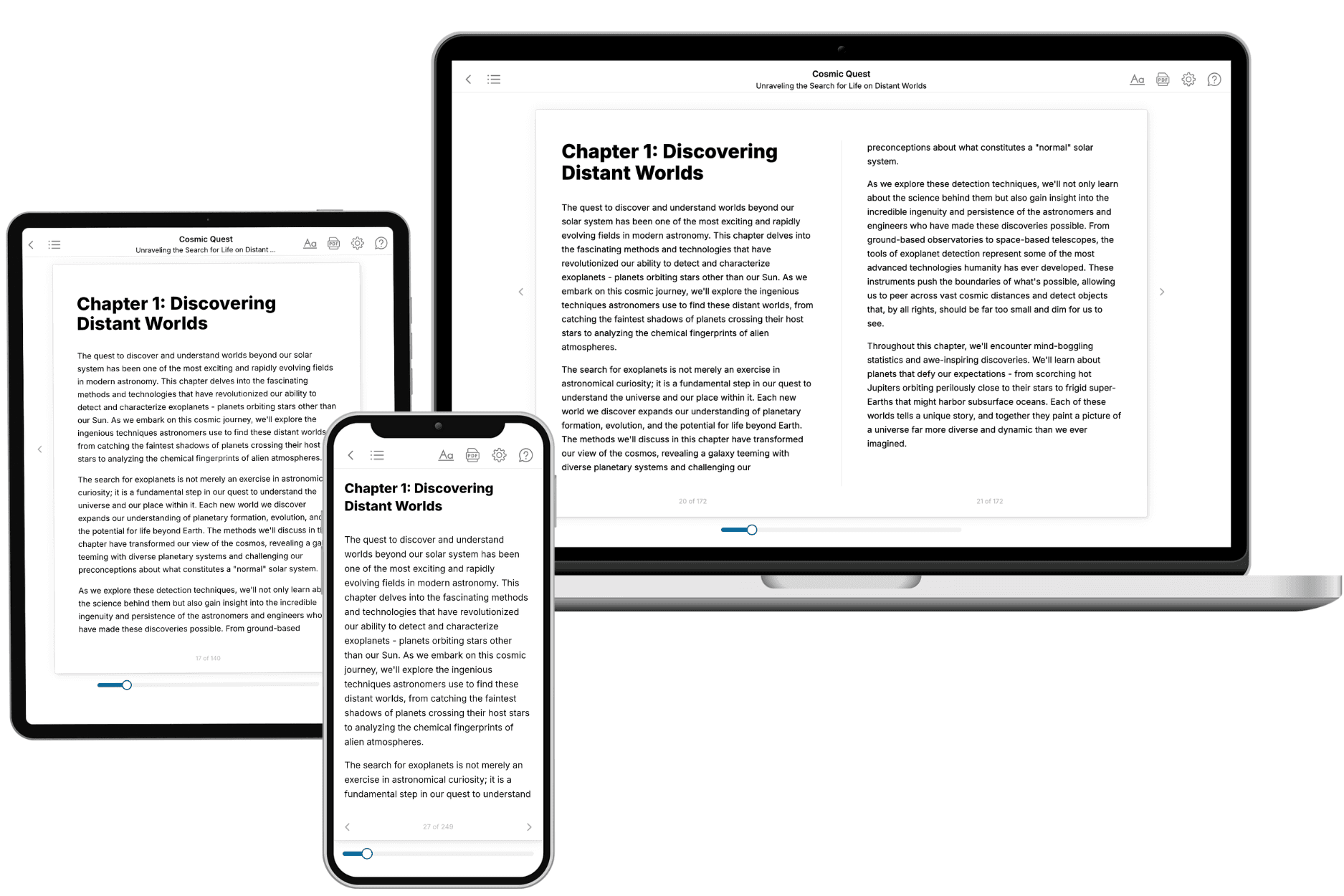
Your book is ready in 10 minutes. Read it online, download as EPUB or PDF, or send to Kindle.

Frequently asked questions
- What is TailoredRead?
TailoredRead creates complete, full-length nonfiction ebooks, written specifically for you. Tell us what you want to learn and why, and TailoredRead writes you a complete ebook on it, with charts, tables, and diagrams throughout. Read it online, on Kindle, or on any e-reader, or download it as a PDF or EPUB. Every book is written fresh the day you order it.
- How is the book tailored to me?
Before anything is written, you answer a few short questions about your goals, your background, and the topics you care about. Your book is then planned around your answers: written at your level, focused on your goals, and covering the topics you chose, instead of the one-size-fits-all book a store sells everyone.
- Will it read like generic AI content?
No. Your book isn't a chat transcript: it's planned chapter by chapter before a single word is written, told in a clear book voice, and explains ideas visually with charts, tables, and diagrams. After writing, every book goes through an editorial pass that polishes chapters so the book reads consistent from start to finish. Judge for yourself: browse thousands of sample books on our Explore Books page.
- How accurate is the content?
Our AI first checks whether your subject needs live research. Niche and fast-moving subjects are researched before writing, and the book plan and chapters are grounded in what it finds. After writing, every book goes through a quality pass that checks its facts and consistency, and researched books list their sources in a Notes section at the back.
- How long is the book?
You choose the length: Comprehensive (250-300 pages), Detailed (150-200 pages), Essential (70-100 pages), or Short (30-50 pages).
- Does the book include visuals?
Yes. Every book includes charts, tables, and diagrams: timelines, checklists, step-by-step guides, decision trees, comparison tables, matrices, and bar charts. A typical book includes dozens of these visual elements.
- Can I read it on Kindle? What formats can I download?
Yes. Every book can be read in our online reader or downloaded as a PDF or EPUB. The EPUB can be opened with Kindle, Apple Books, Kobo, and any e-reader. The Commercial and Author licenses also include an editable Word (DOCX) and Markdown download.
- How much does it cost?
About the price of a regular ebook. The exact price depends on your book's length and complexity, from $2 for the shortest books to $35 for the most comprehensive, and it's shown when you review your book, before you commit to anything. Each book is a one-time purchase, yours to keep, no subscription. Licenses that let you share, teach, or publish your book range from $35.99 to $49.99.
- Can I preview the book before purchasing?
Before you pay, you'll see what your book will cover: the title, a detailed description, the estimated length, and the complete chapter-by-chapter table of contents, so you know what you're getting before you decide. The full text itself is written after you purchase.
- How long does it take to create a book?
About 10 minutes. You can start reading the opening chapters while the rest is still being written.