Building Global Applications with Next.js
Master Internationalization and Localization for Worldwide Audiences
Most developers treat internationalization as an afterthought—a translation layer bolted onto an existing application.
207 pages10 chaptersAug 4, 2026Internationalization
About this book
This approach leads to fragmented user experiences, SEO problems, and maintenance nightmares. Building Global Applications with Next.js shows you how to architect internationalization from the start, making it a core part of your application design rather than a feature you add later. You'll learn practical strategies for routing, content management, and language detection that work seamlessly with Next.js's rendering capabilities. Whether you're supporting two languages or twenty, this guide covers everything from choosing the right routing strategy to implementing automated translation workflows, handling right-to-left languages, and optimizing performance for international users. With real-world examples and proven patterns, you'll discover how to build applications that feel native to users worldwide while keeping your codebase maintainable and scalable.
Table of contents
- IntroductionWhy Internationalization Matters in Modern Web Development, Understanding i18n and l10n: More Than Just Translation, Why Next.js is Ideal for Building Global Applications, How to Use This BookRead below
- Chapter 1: Foundations of InternationalizationCore Concepts and Terminology, Common Pitfalls and How to Avoid Them, Planning Your Internationalization Strategy
- Chapter 2: Routing Strategies for International ApplicationsSub-path Routing: /en/about and /fr/about, Domain-Based Routing: example.com vs example.fr, Header-Based Routing and Accept-Language Detection, Comparing Routing Strategies: Trade-offs and Selection
- Chapter 3: Implementing i18n with Next.js App RouterSetting Up i18n with the App Router, Using Middleware for Language Detection and Routing, Working with Dynamic Segments and Locale Parameters
- Chapter 4: Translation Management and Content OrganizationOrganizing Translation Files and Namespacing, Popular i18n Libraries: next-intl, next-i18next, and Alternatives, Loading and Managing Translations Dynamically, Implementing Translation Workflows and Automation
- Chapter 5: Server-Side Rendering and Static Generation for i18nServer-Side Rendering with Internationalization, Static Generation for Multiple Languages, Incremental Static Regeneration for i18n Content
- Chapter 6: Client-Side Language Switching and User PreferencesBuilding Language Switcher Components, Persisting User Language Preferences, Client-Side Language Detection and Fallbacks, Implementing Seamless Language Switching Without Page Reload
- Chapter 7: Handling Complex Localization ScenariosDate, Time, and Number Formatting Across Locales, Supporting Right-to-Left Languages and Bidirectional Text, Managing Currency, Units, and Regional Variations
- Chapter 8: SEO Optimization for International ApplicationsImplementing hreflang Tags and Canonical URLs, Creating Sitemaps for Multiple Languages, SEO Best Practices for International Content, Structured Data and Schema Markup for Multiple Languages
- Chapter 9: Performance Optimization for i18n ApplicationsOptimizing Bundle Size and Code Splitting, Caching Strategies for Translated Content, Lazy Loading Translations and Language-Specific Resources
- Chapter 10: Testing and Quality Assurance for International ApplicationsTesting Across Multiple Locales and Languages, Testing Right-to-Left Language Support, Validating Translation Completeness and Consistency, Automating i18n Testing in Your CI/CD Pipeline
- ConclusionKey Takeaways and Next Steps, Future Considerations and Emerging Patterns
- Appendix: Quick Reference and ResourcesCommon Code Snippets and Configuration Examples, Recommended Tools, Libraries, and Services, Further Reading and Community Resources
Introduction
The web serves roughly 5.4 billion people, and fewer than 26% of them are native English speakers.[1] Yet the majority of web applications are built English-first, with other languages treated as optional extras. The result is predictable: users who encounter an interface in a language they don't understand simply leave. They don't file bug reports or send feedback. They close the tab and find a competitor who speaks their language. Internationalization is not a feature for large enterprises with dedicated localization teams. It is a baseline expectation for any application that wants to reach the full breadth of the internet's audience.
The gap between knowing that internationalization matters and actually implementing it well is surprisingly wide. Many developers have shipped a "translated" application only to discover that dates display in the wrong format for German users, that Arabic text breaks the layout entirely, or that Google indexes only the English version of their pages. These are not edge cases. They are predictable consequences of treating internationalization as a translation problem rather than an architectural one. The decisions you make about routing, rendering, and content structure in the first weeks of a project will either make global support natural or make it painful.
Next.js occupies a unique position for solving these problems. Its App Router, middleware system, and hybrid rendering model give you the building blocks to handle locale detection, per-locale static generation, and server-side content negotiation without reaching for a separate framework. The ecosystem around it, including libraries like next-intl and next-i18next, has matured to the point where patterns that once required significant custom engineering are now well-documented and repeatable. This book maps those patterns in detail, from the first routing decision to the final CI/CD check that confirms every translation key is accounted for.
What follows is not a survey of internationalization theory. It is a practical guide built around the specific constraints and capabilities of Next.js. Each chapter addresses a concrete layer of the problem: routing architecture, translation management, rendering strategy, client-side UX, complex locale formatting, SEO signals, performance, and testing. The goal is to give you a complete mental model and a working toolkit, so that supporting ten languages feels like a natural extension of your application rather than a second project running in parallel.
Why Internationalization Matters in Modern Web Development
Consider a concrete scenario. A SaaS product launches in English and grows steadily in the US and UK. The team adds a French translation after several enterprise customers in France request it. Six months later, a German-speaking user reports that currency amounts display with a period as the thousands separator instead of a period as the decimal separator, which is the German convention. The fix requires touching dozens of components that each format numbers independently. This is the classic cost of retrofitting internationalization: the problem is not the translation itself, but all the assumptions baked into the original code.
The business case for getting this right early is straightforward. Research from Common Sense Advisory found that a significant majority of consumers prefer to buy products in their native language, and a large portion will not purchase from English-only websites even if they can read English.[2] For B2C applications, this translates directly to conversion rates. For B2B applications, it affects enterprise sales cycles, where procurement teams in non-English-speaking markets often require localized documentation and interfaces as a contractual condition.
Beyond revenue, there are regulatory dimensions. The European Union's accessibility and digital services regulations increasingly expect that applications serving EU residents provide content in the user's language. Several national governments have similar requirements for public-facing digital services. Internationalization is not just a growth strategy; in some markets, it is a compliance requirement.
The technical debt argument is equally compelling. Applications that start with a solid internationalization architecture are dramatically easier to extend. Adding a new locale to a well-structured Next.js application can be as simple as adding a new translation file and a new entry in the locale configuration. Adding a new locale to an application where strings are hardcoded throughout the component tree requires a full audit of every user-facing string, which in a large codebase can take weeks.
There is also a performance angle that is easy to overlook. Users in emerging markets, which represent some of the fastest-growing internet populations, often connect on slower networks and lower-powered devices. An internationalized application that uses proper code splitting and locale-specific static generation can serve a user in Brazil or Indonesia a fast, pre-rendered page in their language. An application that loads all translations upfront and renders everything client-side will feel slow to those same users, regardless of how good the translation quality is.
The practical takeaway is this: internationalization is most valuable when it is treated as a first-class architectural concern, not a translation layer. The chapters ahead show you exactly how to make that shift in the context of Next.js, with concrete patterns you can apply from the start of a project or use to refactor an existing one.
Understanding i18n and l10n: More Than Just Translation
Internationalization (abbreviated i18n, because there are 18 letters between the "i" and the "n") is the process of designing and building your application so that it can support multiple languages and regions without requiring engineering changes for each new locale. Localization (abbreviated l10n) is the process of actually adapting the application for a specific locale: translating strings, adjusting formats, and accounting for cultural conventions. The two are related but distinct, and confusing them leads to poor decisions.
A useful analogy: internationalization is building a house with plumbing rough-ins in every room, so that adding a bathroom later requires only fixtures, not tearing open walls. Localization is choosing the fixtures. If the rough-ins are not there, every new bathroom is a renovation project. If they are, it is an afternoon of work. The same logic applies to software: i18n is the infrastructure, l10n is the content that flows through it.
In practice, internationalization covers a broader set of concerns than most developers initially expect. Here is a breakdown of the main categories:
- Text and translation: Externalizing all user-facing strings into translation files, using translation keys instead of hardcoded text, and supporting pluralization rules that vary by language.
- Date and time formatting: Different locales use different date formats (MM/DD/YYYY in the US, DD/MM/YYYY in the UK, YYYY-MM-DD in ISO contexts), different calendar systems, and different conventions for displaying time zones.
- Number and currency formatting: The number 1,234.56 in English notation is written 1.234,56 in German and 1 234,56 in French. Currency symbols, their position relative to the number, and the number of decimal places all vary by locale.
- Text direction: Arabic, Hebrew, Persian, and Urdu are written right-to-left. An application that supports these languages must handle bidirectional text and mirror its layout accordingly.
- Locale-specific content: Some content is not just translated but fundamentally different by region. Legal disclaimers, privacy notices, and even imagery may need to change based on the user's location.
- Sorting and collation: Alphabetical sorting rules differ by language. Swedish treats "ä" as a letter that comes after "z", not as a variant of "a".
The Intl API, built into modern JavaScript runtimes, handles many of the formatting concerns natively. Intl.DateTimeFormat, Intl.NumberFormat, and Intl.PluralRules are your primary tools for locale-aware formatting without pulling in heavy third-party libraries. The chapter on handling complex localization scenarios covers these in depth, with specific examples for currency formatting, date display, and plural forms across different language families.
A locale identifier is the standard way to specify a language and region combination. The format follows the BCP 47 standard: a language code, optionally followed by a region code. For example, en-US is English as used in the United States, en-GB is English as used in the United Kingdom, fr-FR is French as used in France, and fr-CA is French as used in Canada. The distinction matters because en-US and en-GB share a language but differ in spelling conventions, date formats, and currency. Your routing and translation systems need to handle both the language and the region.
The concept of a fallback locale is equally important. When a translation is missing for a specific locale, the application needs a defined fallback chain. A common pattern is to fall back from a regional variant to the base language, then to a default language. For example, if a translation key is missing for fr-CA, the application might try fr-FR next, then en-US as the final fallback. Without a deliberate fallback strategy, missing translations either crash the application or silently display translation keys to users, both of which are bad outcomes.
Globalization is the umbrella term that encompasses both i18n and l10n, along with the business and operational processes that support them. In a software context, globalization includes the translation management workflows, the tooling that validates translation completeness, and the CI/CD automation that prevents untranslated strings from reaching production. The final chapters of this book address these operational concerns directly, because the best technical architecture fails if the human processes around it are broken.
Why Next.js is Ideal for Building Global Applications
Next.js brings together several capabilities that, in combination, make it unusually well-suited for internationalized applications. No single feature is unique to Next.js, but the way these features compose together is what makes the difference. Understanding why Next.js fits this problem well also helps you understand the constraints you are working within and the trade-offs you will need to make.
The App Router, introduced in Next.js 13 and stabilized in version 14, is built around a file-system routing model that maps naturally to locale-prefixed URL structures. A folder named [locale] at the top of the app directory creates a dynamic segment that captures the locale identifier from the URL. Every page and layout nested inside that folder automatically has access to the locale parameter. This is not just a convenience; it means that locale awareness is structural rather than something you thread through props or context manually.
The Next.js middleware system runs at the edge, before any page is rendered. This is the right place to handle locale detection from the Accept-Language header, to redirect users to their preferred locale, and to enforce consistent URL structures. Because middleware runs close to the user geographically (on edge infrastructure like Vercel's Edge Network or Cloudflare Workers), locale detection and redirection add minimal latency. The chapter on middleware and language detection walks through exactly how to wire this up.
Next.js's hybrid rendering model is another significant advantage. Consider what this means for a global application:
- Static generation for multiple locales: Using
getStaticPaths with locales, you can pre-render every page in every supported language at build time. A marketing site with 50 pages and 10 languages generates 500 pre-rendered HTML files, each served instantly from a CDN with no server computation at request time. - Server-side rendering for dynamic content: User dashboards, personalized feeds, and content that changes frequently can be rendered server-side with the correct locale applied, ensuring that the first byte of HTML already contains localized content rather than requiring a client-side hydration step to swap in translations.
- Incremental Static Regeneration: For content that changes occasionally, such as a product catalog or a blog, Incremental Static Regeneration lets you serve pre-rendered pages while revalidating them in the background. This works per-locale, so a French product page can be revalidated independently of its English counterpart.
The SEO implications of this rendering flexibility are substantial. Search engines index pre-rendered HTML more reliably than client-rendered content. When your French pages are statically generated with French text in the HTML, with correct hreflang tags pointing to their language variants, and with locale-specific canonical URLs, you give search engines everything they need to rank your content correctly in French-language searches. The chapter on SEO optimization covers the full set of signals required to make this work.
The Next.js ecosystem has also produced mature, well-maintained i18n libraries that integrate tightly with the framework's rendering model. next-intl is designed specifically for the App Router and supports server components natively, which means translations can be loaded and applied on the server without any client-side JavaScript overhead. next-i18next has a longer history and broader adoption, particularly in Pages Router applications. Both libraries support the ICU message format, which handles pluralization, gender agreement, and variable interpolation in a standardized way across languages.
One practical example illustrates the composability of these features. Suppose you are building an e-commerce application that needs to support English, French, German, and Japanese. With Next.js, you can configure sub-path routing so that /en, /fr, /de, and /ja each serve locale-specific content. Middleware detects the user's preferred language from the Accept-Language header and redirects them to the appropriate prefix on first visit. Product pages are statically generated for all four locales at build time. The language switcher component persists the user's choice to a cookie, so returning visitors land directly on their preferred locale. The entire setup uses the same codebase, the same components, and the same data layer, with locale as a parameter that flows through the system cleanly.
None of this is magic, and none of it is effortless. There are real trade-offs to navigate: build times grow with the number of locales and pages, middleware logic can become complex, and translation management requires ongoing operational discipline. But Next.js gives you the right primitives to handle these trade-offs deliberately, rather than working around framework limitations.
How to Use This Book
This book is organized as a progression from foundations to advanced topics, but it is also designed so that individual chapters can be read independently if you are solving a specific problem. If you are starting a new project, reading from the beginning will give you the clearest mental model. If you are working on an existing application with a specific pain point, such as broken RTL layout or missing hreflang tags, you can jump directly to the relevant chapter without losing context.
The progression follows the natural order of decisions you face when building an internationalized Next.js application:
- Foundations: The first chapter establishes the shared vocabulary and mental model for i18n and l10n. It covers core concepts, common pitfalls, and how to plan your internationalization strategy before writing any code. If you are new to i18n or want to align your team on terminology, start here.
- Routing architecture: The second chapter compares the three URL and domain routing strategies available for international Next.js applications: sub-path routing, domain-based routing, and header-based routing. Each has distinct trade-offs for SEO, user experience, and implementation complexity. The chapter gives you a framework for choosing the right strategy for your specific situation.
- App Router implementation: The third chapter gets into the mechanics of wiring the App Router, middleware, dynamic locale segments, and locale parameters together. This is where the routing strategy you chose in the previous chapter becomes working code.
- Translation management: The fourth chapter covers how to structure, load, and automate translation files, and how to choose and configure the libraries that manage them. It addresses both the technical and operational sides of keeping translations in sync.
- Rendering strategies: The fifth chapter focuses on choosing and configuring server-side rendering, static generation, and Incremental Static Regeneration specifically for multi-locale content delivery.
- Client-side UX: The sixth chapter covers the user-facing layer: building language switcher components, persisting user language preferences, and implementing seamless language switching without full page reloads.
- Complex localization: The seventh chapter addresses the hard edge cases that trip up most implementations: date and number formatting, right-to-left layout support, bidirectional text, currency formatting, and regional variants.
- SEO: The eighth chapter covers the full set of SEO signals required for international applications, including hreflang tags, international sitemaps, canonical URLs for locales, and structured data for multiple languages.
- Performance: The ninth chapter addresses i18n bundle splitting, translation caching strategies, CDN caching for i18n content, and lazy loading translations to avoid serving unnecessary language data.
- Testing and QA: The tenth chapter covers locale-specific testing, RTL layout testing, translation completeness validation, pseudo-localization, and building an i18n CI/CD pipeline that catches problems before they reach production.
Each chapter is self-contained enough to serve as a reference, but the concepts build on each other. The routing chapter assumes you understand locale identifiers and fallback chains from the foundations chapter. The rendering chapter assumes you understand the routing architecture. Reading in order the first time through will make the later chapters easier to follow.
The code examples throughout the book use TypeScript and the Next.js App Router. If you are working with the Pages Router, most concepts still apply, but the specific APIs differ. Where the distinction matters, the text calls it out explicitly. The examples use next-intl as the primary translation library because it is designed for the App Router and supports server components, but the patterns are transferable to other libraries. The chapter on translation management covers the trade-offs between the major options in detail.
A few conventions to be aware of as you read. Code examples are complete enough to run but trimmed to focus on the relevant concept. File paths are shown relative to the project root. Configuration examples assume a standard Next.js project structure. When a concept has a canonical term defined in the field, that term is used consistently throughout the book, so that the vocabulary you build here maps directly to documentation, library APIs, and community discussions you will encounter in practice.
The appendix at the end of the book collects common code snippets, configuration examples, recommended tools and services, and pointers to further reading. It is designed as a quick reference once you have worked through the main content. The conclusion looks at emerging patterns in the i18n space, including machine translation integration, AI-assisted localization workflows, and the direction the Next.js framework itself is moving with respect to internationalization support.
One final note on scope. This book focuses on the technical implementation of internationalization in Next.js applications. It does not cover the linguistics of translation, the business process of managing a translation agency, or the cultural research required to localize content effectively for specific markets. Those are real and important topics, but they are outside the scope of what a Next.js book can usefully address. What this book does cover is everything on the engineering side: the architecture, the code, the tooling, and the testing that makes a global application work correctly and perform well. The translation content itself is your team's responsibility; this book makes sure the system that delivers it is solid.
Notes
Introduction
- 1. Internet World Stats, "Internet World Users by Language," internetworldstats.com, 2023
- 2. Common Sense Advisory, "Can't Read, Won't Buy," Common Sense Advisory, 2014
This is the end of the free sample. The full book has 10 chapters.
Want this book written for you?
Tell us your goals and background, and get your own version of this book, tailored by AI to you.


Benefits of AI-tailored books
- Read one book, not ten:
- all the Internationalization knowledge you need, gathered into a single book.
- Save days of learning:
- tell us your goals, choose your topics, and the whole book is built around them.
- Learn effortlessly:
- Internationalization book written for your specific background and expertise.
- Understand at a glance:
- includes charts, tables, timelines, checklists, decision trees, and more.
- Stay current:
- written the day you order it, not years ago.
- Trust what you read:
- every book is checked for accuracy, with real research when your subject needs it.
Create your unique book in 3 steps
- 1. Select your focus
Select the focus of your Internationalization book and share your background
- 2. Personalize your book
Specify your goals and choose sub-topics to include
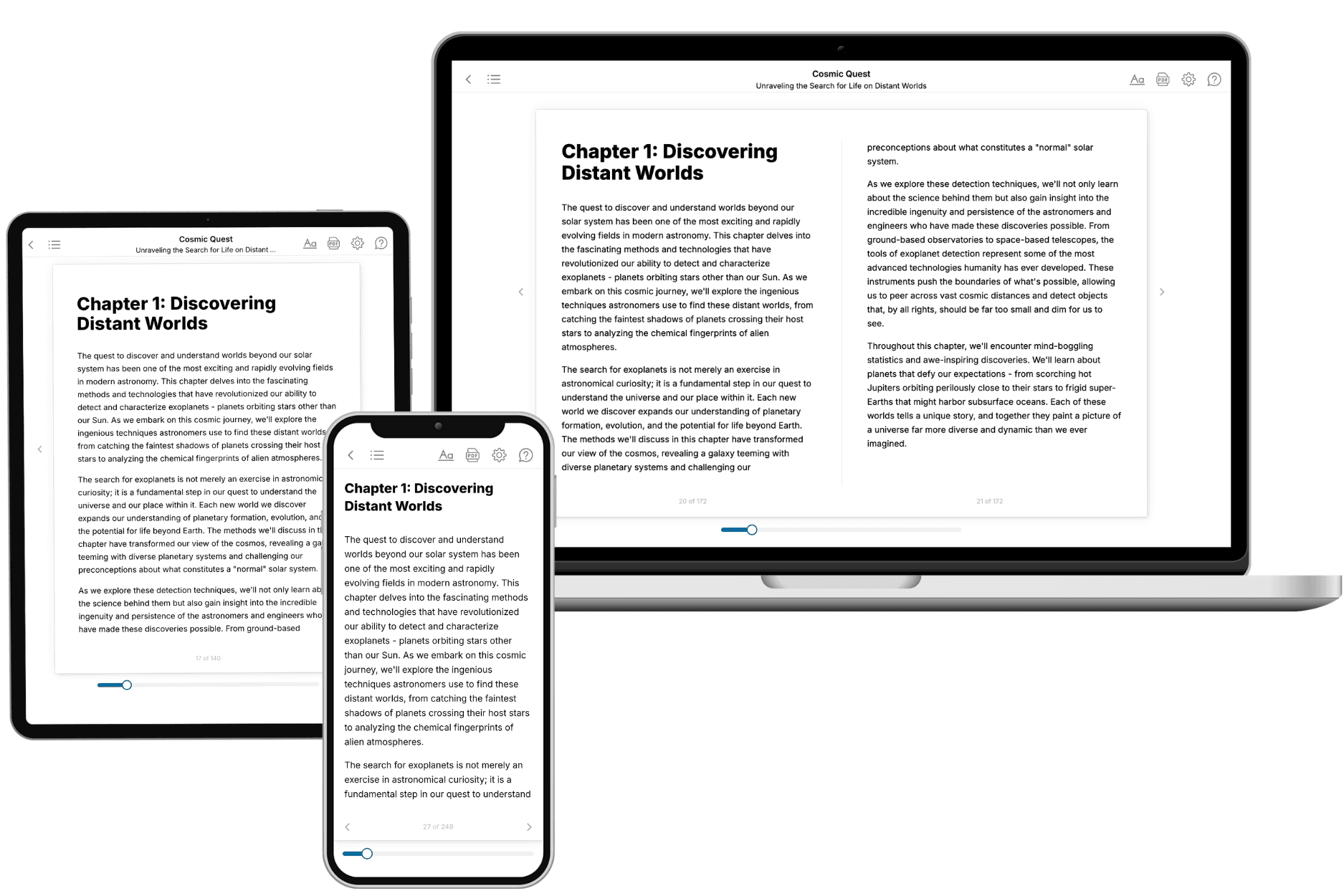
- 3. Get your tailored book
Your book is ready in 10 minutes. Read it online, download as EPUB or PDF, or send to Kindle.
Frequently asked questions
- What is TailoredRead?
TailoredRead creates complete, full-length nonfiction ebooks, written specifically for you. Tell us what you want to learn and why, and TailoredRead writes you a complete ebook on it, with charts, tables, and diagrams throughout. Read it online, on Kindle, or on any e-reader, or download it as a PDF or EPUB. Every book is written fresh the day you order it.
- How is the book tailored to me?
Before anything is written, you answer a few short questions about your goals, your background, and the topics you care about. Your book is then planned around your answers: written at your level, focused on your goals, and covering the topics you chose, instead of the one-size-fits-all book a store sells everyone.
- Will it read like generic AI content?
No. Your book isn't a chat transcript: it's planned chapter by chapter before a single word is written, told in a clear book voice, and explains ideas visually with charts, tables, and diagrams. After writing, every book goes through an editorial pass that polishes chapters so the book reads consistent from start to finish. Judge for yourself: browse thousands of sample books on our Explore Books page.
- How accurate is the content?
Our AI first checks whether your subject needs live research. Niche and fast-moving subjects are researched before writing, and the book plan and chapters are grounded in what it finds. After writing, every book goes through a quality pass that checks its facts and consistency, and researched books list their sources in a Notes section at the back.
- How long is the book?
You choose the length: Comprehensive (250-300 pages), Detailed (150-200 pages), Essential (70-100 pages), or Short (30-50 pages).
- Does the book include visuals?
Yes. Every book includes visual elements such as timelines, checklists, step-by-step guides, decision trees, comparison tables, and matrices, and many include bar charts. A typical book includes dozens of these visual elements.
- Can I read it on Kindle? What formats can I download?
Yes. Every book can be read in our online reader or downloaded as a PDF or EPUB. The EPUB can be opened with Kindle, Apple Books, Kobo, and any e-reader. The Commercial and Author licenses also include an editable Word (DOCX) and Markdown download.
- How much does it cost?
About the price of a regular ebook. The exact price depends on your book's length and complexity, from $2 for the shortest books to $35 for the most comprehensive, and it's shown when you review your book, before you commit to anything. Each book is a one-time purchase, yours to keep, no subscription. Licenses that let you share, teach, or publish your book range from $35.99 to $49.99.
- Can I preview the book before purchasing?
Before you pay, you'll see what your book will cover: the title, a detailed description, the estimated length, and the complete chapter-by-chapter table of contents, so you know what you're getting before you decide. The full text itself is written after you purchase.
- How long does it take to create a book?
About 10 minutes. You can start reading the opening chapters while the rest is still being written.