Building Rural Ventures
Creating Sustainable Businesses in Agricultural Communities
What makes a business succeed in a place where the nearest supplier is 50 miles away and your customer base numbers in the hundreds rather than thousands?
207 pages10 chaptersAug 16, 2026Entrepreneurship
About this book
Rural entrepreneurship operates by different rules than urban business, yet most guides ignore these realities entirely. This book cuts through generic advice to show you how to build a thriving venture in an agricultural community by working with—not against—the unique characteristics of rural life. You'll discover how to identify genuine market opportunities within your region, leverage the social networks and local knowledge that outsiders can't replicate, navigate the real constraints of rural capital and infrastructure, and create a business model that strengthens rather than exploits your community. Whether you're a farmer diversifying income, a community leader seeking economic development, or someone returning to rural roots, this guide provides concrete strategies grounded in rural sociology and tested by entrepreneurs who've succeeded where others failed.
Table of contents
- IntroductionWhy Rural Entrepreneurship Matters Now, How Rural Business Differs from Urban Models, How to Use This BookRead below
- Chapter 1: Understanding Your Rural ContextThe Sociology of Rural Communities, Identifying Your Community's Unique Assets, Recognizing Constraints and Hidden Opportunities
- Chapter 2: Building Social Capital and TrustMapping and Leveraging Local Networks, Establishing Trust in Your Community, Managing Your Reputation as an Entrepreneur
- Chapter 3: Identifying Market OpportunitiesConducting Effective Local Market Research, Finding Your Niche in Rural Markets, Value-Added Products and Services
- Chapter 4: Securing Capital and ResourcesRural-Specific Funding Sources and Programs, Bootstrapping and Resource Efficiency, Managing Cash Flow in Seasonal Economies
- Chapter 5: Navigating Rural Infrastructure and LogisticsBuilding Resilient Supply Chains, Technology Adoption in Rural Settings, Creating Effective Distribution Networks
- Chapter 6: Developing Your Business ModelCreating a Rural-Focused Business Plan, Pricing Strategies for Rural Markets, Diversification and Risk Management
- Chapter 7: Marketing and Customer AcquisitionLeveraging Word-of-Mouth and Community Channels, Digital Marketing for Rural Businesses, Building Direct Customer Relationships
- Chapter 8: Managing Growth and ScalingPlanning for Sustainable Growth, Hiring and Developing Local Talent, Scaling Operations Without Losing Community Connection
- Chapter 9: Community Impact and ResponsibilityCreating Genuine Community Benefit, Environmental Stewardship and Sustainability, Balancing Profit with Purpose
- Chapter 10: Learning from Peers and Building NetworksFinding Mentors and Advisors, Peer Learning Communities and Associations, Sharing Knowledge and Supporting Other Entrepreneurs
- ConclusionYour Rural Advantage, Taking Your First Steps
- Resources and Further Reading
Introduction
A feed store owner in a town of eleven hundred people decides to add a small café counter next to the register. Within six months, the counter is generating more profit per square foot than the entire hardware aisle. That small pivot did not happen because of a clever marketing campaign or a viral social post. It happened because the owner understood who walked through that door every morning, what they needed that no one else nearby offered, and how far they were willing to drive for coffee versus buying a tractor part. That kind of knowledge, built from years of watching a community rather than studying a spreadsheet, is the raw material this book works with.
Most business guidance assumes a customer base that numbers in the tens of thousands, a supply chain that runs through a regional distribution hub, and a labor pool with dozens of qualified applicants for every open position. None of those assumptions hold in a county where the largest town has three stoplights. Rural entrepreneurs are told to scale fast
or disrupt the market
using playbooks written for Austin or Seattle, then wonder why the advice falls flat when their entire trade area has fewer residents than a single city apartment block. This mismatch is not a failure of rural entrepreneurs. It is a failure of the advice.
This book starts from a different premise: rural markets are not smaller, weaker versions of urban markets. They operate on a distinct set of mechanics, with their own logic around trust, distance, seasonality, and relationships. Someone who understands those mechanics and builds a venture around them, rather than around a template designed for a different environment, has a genuine structural advantage. That advantage is available to farmers looking to diversify income, to community leaders trying to anchor local jobs, and to people moving back to a hometown after years away.
The three sections ahead lay the groundwork for everything that follows. The first makes the case for why rural entrepreneurship carries particular weight right now, not as a nostalgic ideal but as an economic necessity shaped by real demographic and market shifts. The second draws out the specific ways rural business mechanics diverge from urban assumptions, so the differences stop feeling like obstacles and start reading as design parameters. The third gives a practical map for moving through the rest of the book, chapter by chapter, so the material can be applied rather than just read.
Why Rural Entrepreneurship Matters Now
Roughly one in five Americans lives in a rural area, according to the U.S. Census Bureau, yet those areas cover the overwhelming majority of the country's land.[1] That gap between population share and geographic footprint is not a footnote. It shapes everything from where hospitals get built to where a small manufacturer can find a workforce. When a region holds a small share of the population but a large share of the land, farmland, and natural resources, the businesses that emerge there carry outsized responsibility for keeping local economies functional.
The demographic pressure behind this urgency is concrete. The average age of a principal farm operator in the United States has climbed past 57, according to the USDA Census of Agriculture, and fewer young people are stepping into that role.[2] Many rural counties have watched decades of steady out-migration among residents in their twenties and thirties, drawn away by university towns and metro job markets. Without new economic activity to replace retiring farmers and departed graduates, entire towns risk losing the tax base that funds schools, roads, and clinics.
Rural entrepreneurship is one of the few forces that can interrupt that decline from the inside. A new venture, whether it is a value-added food processor, a niche equipment repair shop, or a regional logistics service, does more than generate a paycheck for its founder. It creates local jobs that do not require relocation, it keeps dollars circulating inside the community instead of leaking out to distant retailers, and it gives young residents a reason to imagine a future where they already live. This is Community Impact operating as an economic mechanism, not just a slogan.
Consumer behavior has also shifted in ways that favor rural producers who position themselves well. Demand for traceable food, regional craftsmanship, and products with a known origin story has grown steadily over the past two decades, and rural areas hold a natural advantage in supplying it. A regional creamery that can name the farm its milk comes from, or a woodworker who can point to the exact forest a plank was cut from, offers something a national brand cannot easily replicate. That authenticity, once treated as a limitation of scale, now functions as a genuine market edge.
Consider two versions of the same opportunity. A grain farmer in a Midwest county sells raw wheat at commodity prices set by a distant exchange, absorbing whatever margin the market allows that season. A neighboring farmer mills a portion of that same wheat into flour, packages it under a local label, and sells it through a regional grocery co-op and a farm stand. The second farmer has not changed the crop. They have changed their position in the value chain, and that repositioning is the seed of a genuine Rural Context-driven business rather than a passive commodity role.
Public policy has started to catch up with this reality, though unevenly. Broadband expansion programs, rural development grants, and renewed interest in local food systems have created pockets of support that did not exist fifteen years ago. These programs are covered in depth later in the book, but the broader point matters here: the infrastructure for rural entrepreneurship to succeed is improving, even as the demographic pressure that makes it necessary keeps intensifying. Acting now means catching a narrow but real window where support and need are both rising together.
None of this suggests rural entrepreneurship is easy or guaranteed to succeed. Startup failure rates in rural areas can be just as steep as anywhere else, and the margin for error is often thinner given smaller customer bases. What it does suggest is that the stakes attached to getting it right are unusually high, and the potential reward, both personal and communal, is unusually meaningful. A rural venture that survives its first five years does not just generate income. It often becomes a fixture the community organizes around, from sponsoring the county fair to anchoring the main street.
The chapters that follow will return repeatedly to this dual mandate: building something profitable while strengthening the place it operates in. That is not an added obligation bolted onto rural business. It is the actual mechanism by which rural ventures earn the trust, labor, and customer loyalty they depend on to survive. Understanding that connection now, before diving into tactics, sets up every later chapter to make more sense.
How Rural Business Differs from Urban Models
An urban coffee shop in a city of half a million people can survive on capturing a tiny fraction of the local market. A rural coffee shop in a town of two thousand has no such luxury. It must capture a meaningful share of a small, fixed pool of potential customers, which means the cost of losing even a handful of regulars is proportionally much higher. This single fact, the ratio of fixed costs to a small addressable market, drives a large share of the strategic differences covered throughout this book.
Distance changes the math in ways that urban business models rarely have to account for. A supplier delay that costs an urban retailer a same-day rush fee might cost a rural retailer two weeks, because the nearest replacement stock sits three counties away. This is why Rural Supply Chain planning cannot simply copy urban just-in-time inventory models. Rural operators often need to hold more buffer stock, build relationships with multiple backup suppliers, and plan purchases around delivery schedules that run weekly or biweekly rather than daily.
Customer relationships operate on a fundamentally different scale and depth. In a city, a business can survive largely on anonymous transactions, repeat visits driven by convenience rather than personal familiarity. In a rural town, the person buying eggs at the farm stand is often someone the seller sees at church, at the school board meeting, and at the volunteer fire department fundraiser. This overlapping web of relationships is Social Capital in its most literal form, and it means reputation damage from a single bad transaction can spread through a community far faster than any online review ever could.
Pricing strategy has to bend around local income realities and cash-flow patterns that urban businesses rarely face in the same way. A landscaping business in a farming county cannot price its services as if customers have steady monthly paychecks, because many customers earn the bulk of their annual income in two or three harvest-driven windows. Ignoring this reality by insisting on standard monthly billing can quietly drive away otherwise loyal customers. A workable Rural Pricing Strategy often means offering seasonal payment plans or bundling services around harvest and planting cycles instead of the calendar month.
Marketing channels diverge sharply as well. An urban business can build an entire customer base through targeted digital ads and never meet most of its customers in person. A rural business often finds that word-of-mouth referrals from a handful of trusted local figures, a well-placed sign at the grain elevator, or a mention at the county fair outperform any digital ad campaign. This does not mean rural businesses should ignore digital tools entirely. It means digital marketing has to be layered on top of, not substituted for, the relationship-driven channels that already carry weight in the community.
Workforce dynamics also look different. An urban employer choosing between fifty applicants for one position can afford to be selective about specific credentials. A rural employer might have three applicants total, none with the exact experience listed in a job posting, which means hiring and training have to be treated as connected activities rather than separate steps. This reality reshapes how rural ventures think about Rural Talent Development, favoring on-the-job mentorship and cross-training over rigid credential requirements that the local labor pool simply cannot supply.
Access to capital diverges just as sharply from the urban startup narrative of venture funding and angel investors. Most rural ventures are financed through a patchwork of personal savings, family loans, community bank relationships, and targeted federal programs rather than a pitch deck aimed at a venture capital firm. A local bank loan officer who has known a family for two generations can sometimes extend credit that a distant lender never would, based on relationship history rather than a credit score alone. That dynamic reshapes how rural entrepreneurs need to approach fundraising conversations from the very first meeting.
None of these differences make rural business inherently harder or easier than urban business. They make it a distinct discipline with its own internal logic, closer to a specialized craft than a smaller copy of a big-city playbook. A rural entrepreneur who tries to force an urban model onto a rural market, ignoring distance, relationship density, and income seasonality, is set up to struggle regardless of how good the underlying product is. One who works with these mechanics, treating them as design constraints rather than deficiencies, builds something far more durable.
How to Use This Book
This book is organized to mirror the actual sequence most rural ventures move through, from understanding a community to eventually contributing back to it. It does not assume the reader is starting from zero. Someone already running a farm stand, a repair shop, or a small consulting practice can jump directly to the chapters most relevant to a current challenge, whether that is cash flow, marketing, or hiring. Someone still in the idea stage will benefit from working through the chapters roughly in order, since later strategies build on groundwork laid in earlier ones.
The opening chapters focus on foundations that everything else depends on. Before any market research or business planning makes sense, it helps to understand the specific sociology, assets, and constraints of a given community, which is the work covered under Rural Context and Community Asset Mapping. Skipping straight to tactics without this grounding is a common mistake among people transplanting urban business instincts into a rural setting, and it tends to produce ventures that misjudge local demand or offend unspoken community norms without realizing it.
From there, the book moves into the mechanics of trust, market discovery, and capital, treating each as a distinct skill rather than a single combined step. Trust-Building and Local Network Mapping get dedicated attention because they function as prerequisites for almost every other activity in a small community, including securing a bank loan or landing a first wholesale contract. Rural Market Research and Niche Identification follow, showing how to find genuine, underserved demand rather than guessing at what a community might want.
The middle chapters address the operational realities that most generic business books skip entirely. Rural Funding Sources, including USDA Programs and Bootstrapping techniques, get a full treatment because capital access looks so different outside metro areas. Rural Supply Chain and Distribution Networks address the physical logistics of getting goods in and products out when the nearest wholesale supplier or shipping hub sits an hour or more away. Technology Adoption covers how to use digital tools without assuming broadband speeds or device access that many rural areas still lack.
Later chapters shift toward growth and legacy, covering how to scale a venture, build a marketing approach suited to rural channels, and hire local talent without outgrowing the relationships that made the business viable in the first place. The closing chapters address something many business guides treat as optional: the responsibility a venture carries toward the community and environment it operates within, alongside the peer networks and mentorship relationships that help rural entrepreneurs avoid isolation. These are not soft add-ons. They are treated throughout this book as strategic assets that directly affect a venture's long-term survival.
Each chapter includes concrete frameworks, worked examples, and specific steps rather than abstract principles alone. Where a concept connects to material developed elsewhere in the book, that connection is flagged so the ideas can be traced across chapters instead of treated as isolated units. A reader working through the chapter on Rural Pricing Strategy, for instance, will find it references groundwork laid in the market research material, since pricing decisions only make sense once genuine demand and willingness to pay have been established.
A practical suggestion for getting the most from this material: keep a working notebook, physical or digital, dedicated specifically to observations about a particular community or venture idea while reading. Many of the exercises embedded in later chapters ask for specific local information, such as naming the three most trusted figures in a local network or listing every existing business within a certain radius. Building this notebook alongside the chapters, rather than reading passively and returning to the exercises later, tends to produce sharper, more usable results.
The guidance ahead draws on rural sociology research, documented case examples, and patterns observed across agricultural communities, but it does not pretend every rural place is identical. A cattle ranching community in the high plains faces different dynamics than a fishing village on the coast or a fruit-growing valley in a temperate river basin. The frameworks in this book are built to be adapted, not applied mechanically, and the strongest results will come from treating each chapter as a lens to apply to a specific place rather than a fixed formula to follow line by line.
This is the end of the free sample. The full book has 10 chapters.
Want this book written for you?
Tell us your goals and background, and get your own version of this book, tailored by AI to you.


Benefits of AI-tailored books
- Read one book, not ten:
- all the Entrepreneurship knowledge you need, gathered into a single book.
- Save days of learning:
- tell us your goals, choose your topics, and the whole book is built around them.
- Learn effortlessly:
- Entrepreneurship book written for your specific background and expertise.
- Understand at a glance:
- includes charts, tables, timelines, checklists, decision trees, and more.
- Stay current:
- written the day you order it, not years ago.
- Trust what you read:
- every book is checked for accuracy, with real research when your subject needs it.
Create your unique book in 3 steps
- 1. Select your focus
Select the focus of your Entrepreneurship book and share your background
- 2. Personalize your book
Specify your goals and choose sub-topics to include
- 3. Get your tailored book
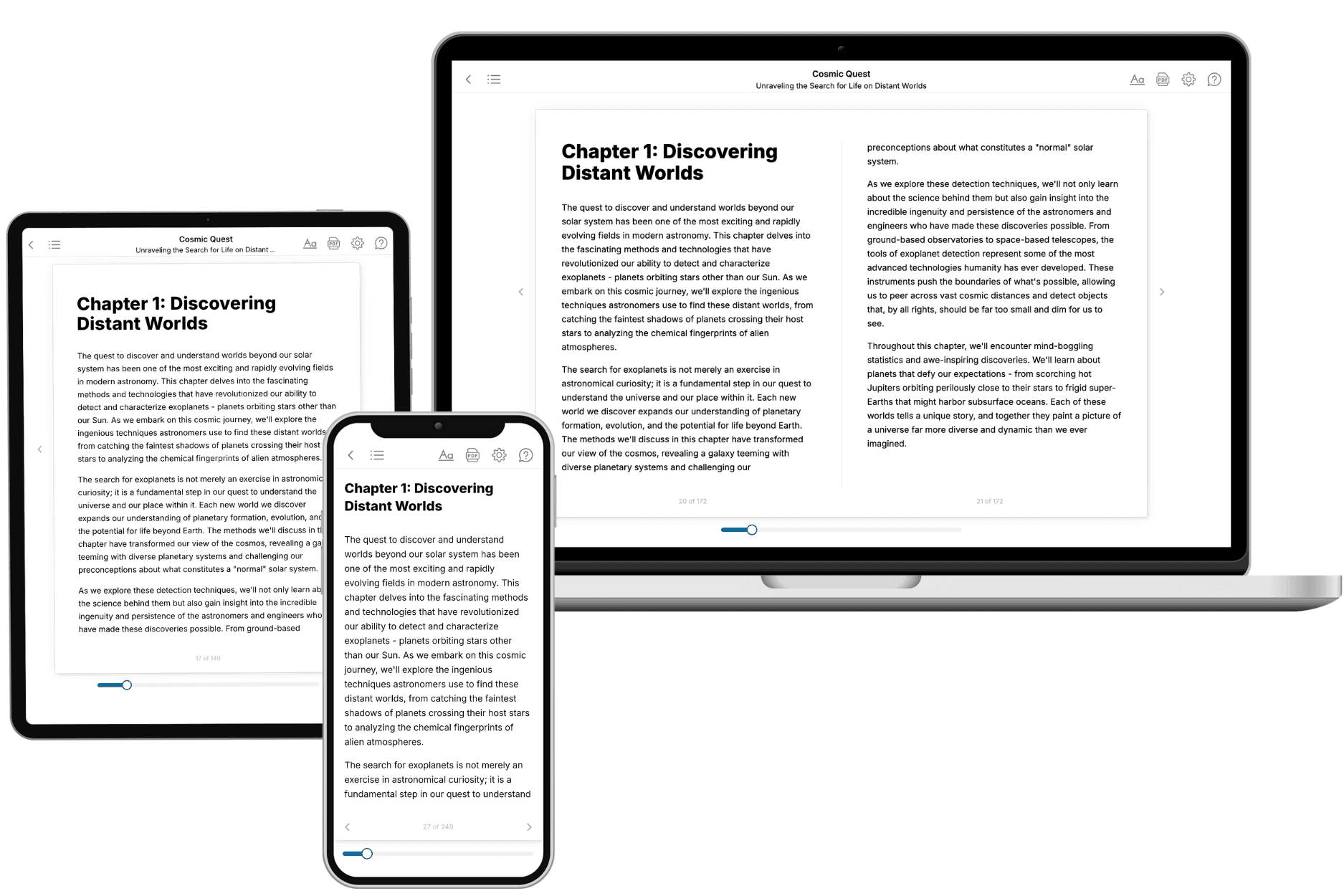
Your book is ready in 10 minutes. Read it online, download as EPUB or PDF, or send to Kindle.

Frequently asked questions
- What is TailoredRead?
TailoredRead creates complete, full-length nonfiction ebooks, written specifically for you. Tell us what you want to learn and why, and TailoredRead writes you a complete ebook on it, with charts, tables, and diagrams throughout. Read it online, on Kindle, or on any e-reader, or download it as a PDF or EPUB. Every book is written fresh the day you order it.
- How is the book tailored to me?
Before anything is written, you answer a few short questions about your goals, your background, and the topics you care about. Your book is then planned around your answers: written at your level, focused on your goals, and covering the topics you chose, instead of the one-size-fits-all book a store sells everyone.
- Will it read like generic AI content?
No. Your book isn't a chat transcript: it's planned chapter by chapter before a single word is written, told in a clear book voice, and explains ideas visually with charts, tables, and diagrams. After writing, every book goes through an editorial pass that polishes chapters so the book reads consistent from start to finish. Judge for yourself: browse thousands of sample books on our Explore Books page.
- How accurate is the content?
Our AI first checks whether your subject needs live research. Niche and fast-moving subjects are researched before writing, and the book plan and chapters are grounded in what it finds. After writing, every book goes through a quality pass that checks its facts and consistency, and researched books list their sources in a Notes section at the back.
- How long is the book?
You choose the length: Comprehensive (250-300 pages), Detailed (150-200 pages), Essential (70-100 pages), or Short (30-50 pages).
- Does the book include visuals?
Yes. Every book includes charts, tables, and diagrams: timelines, checklists, step-by-step guides, decision trees, comparison tables, matrices, and bar charts. A typical book includes dozens of these visual elements.
- Can I read it on Kindle? What formats can I download?
Yes. Every book can be read in our online reader or downloaded as a PDF or EPUB. The EPUB can be opened with Kindle, Apple Books, Kobo, and any e-reader. The Commercial and Author licenses also include an editable Word (DOCX) and Markdown download.
- How much does it cost?
About the price of a regular ebook. The exact price depends on your book's length and complexity, from $2 for the shortest books to $35 for the most comprehensive, and it's shown when you review your book, before you commit to anything. Each book is a one-time purchase, yours to keep, no subscription. Licenses that let you share, teach, or publish your book range from $35.99 to $49.99.
- Can I preview the book before purchasing?
Before you pay, you'll see what your book will cover: the title, a detailed description, the estimated length, and the complete chapter-by-chapter table of contents, so you know what you're getting before you decide. The full text itself is written after you purchase.
- How long does it take to create a book?
About 10 minutes. You can start reading the opening chapters while the rest is still being written.