Bukit Timah Nature Reserve
Your Complete Guide to Singapore's Iconic Forest Sanctuary
Many visitors to Singapore overlook Bukit Timah Nature Reserve, assuming it's just another urban park.
191 pages8 chaptersMar 14, 2026Travel Guide
About this book
In reality, this 163-hectare sanctuary preserves one of Southeast Asia's oldest rainforests, teeming with wildlife and ecological wonders that rival destinations across the region. This guide reveals what makes Bukit Timah extraordinary and how to experience it fully. You'll discover the best trails for your fitness level, learn to identify the reserve's remarkable biodiversity, understand the conservation challenges it faces, and master the practical skills needed for a memorable visit. Whether you're a casual walker seeking peaceful nature or an avid naturalist eager to spot rare species, this guide equips you with insider knowledge about timing your visit, navigating trails safely, observing wildlife responsibly, and appreciating the ecological significance of this irreplaceable forest. By the end, you'll understand why protecting Bukit Timah matters and how your visit can support its preservation.
Table of contents
- IntroductionWhy Bukit Timah Matters, What You'll Discover in This Guide, How to Use This BookRead below
- Chapter 1: The Reserve's Rich History and SignificanceColonial Origins and Forest Preservation, Ecological Importance in Modern Singapore, Conservation Timeline and Milestones
- Chapter 2: Understanding the EcosystemRainforest Structure and Layers, Flora: Trees, Plants, and Vegetation, Fauna: Mammals, Birds, and Insects, Endemic and Rare Species
- Chapter 3: Planning Your VisitBest Times to Visit: Seasons and Weather, Entry Information and Visitor Facilities, Essential Gear and What to Pack, Physical Preparation and Fitness Considerations
- Chapter 4: Trail Navigation and Hiking RoutesMain Summit Trail: The Classic Route, Alternative Routes and Loop Options, Trail Difficulty Assessment and Fitness Matching, Navigation Safety and Trail Markers
- Chapter 5: Wildlife Observation and PhotographySpotting Techniques and Best Locations, Wildlife Identification Guide, Ethical Wildlife Observation Practices, Photography Tips for Nature Enthusiasts
- Chapter 6: Safety and Responsible VisitingHealth and Safety Hazards, Environmental Responsibility and Leave No Trace, Emergency Procedures and Getting Help
- Chapter 7: Conservation Challenges and Restoration EffortsCurrent Threats to the Reserve, Active Restoration and Management Projects, How Visitors Impact Conservation, Ways to Support Conservation Efforts
- Chapter 8: Nearby Attractions and Extended ExplorationAdjacent Nature Areas and Parks, Cultural and Historical Sites Nearby, Multi-Day Itineraries and Combinations
- ConclusionThe Lasting Impact of Your Visit, The Future of Bukit Timah
- Glossary
- Further Reading and Resources
Introduction
Singapore is famous for many things: its gleaming skyline, its world-class food scene, its reputation as one of the most efficiently run cities on the planet. But tucked into the island's central region, surrounded by highways and housing estates, sits something that surprises almost every visitor who stumbles upon it. Bukit Timah Nature Reserve is a 163-hectare pocket of ancient rainforest that has survived centuries of colonial rule, rapid urbanization, and the relentless pressure of one of the world's most densely populated cities. It is, by almost any measure, a remarkable place.
Most travelers arrive in Singapore with a packed itinerary: the Marina Bay Sands, Gardens by the Bay, Sentosa Island, the hawker centers of Chinatown. Bukit Timah rarely makes the shortlist. That's a genuine shame, because what this reserve offers is something none of those attractions can replicate. It offers a direct encounter with a living, breathing tropical rainforest that is older than Singapore itself. The trees here were growing long before Stamford Raffles arrived in 1819. Some of the wildlife species found within these boundaries exist nowhere else on the island. The forest floor, the canopy, the streams, and the ridgelines all tell a story that stretches back millions of years.
This guide exists because Bukit Timah deserves better than a passing mention in a travel blog. It deserves the kind of attention that helps you arrive prepared, explore confidently, observe thoughtfully, and leave with a genuine understanding of what you've experienced. Whether you're planning a single morning hike or building an entire nature-focused itinerary around the reserve, the chapters ahead will give you the practical knowledge and ecological context to make the most of every minute you spend inside this forest.
The reserve is accessible, but it rewards preparation. The trails range from gentle paved paths to steep, root-covered climbs. The wildlife is present, but it requires patience and the right techniques to observe. The conservation story is urgent and ongoing, and understanding it changes how you walk through the forest. This guide covers all of it, from the history of the reserve's establishment to the specific gear you should pack, from the best spots to watch for flying lemurs to the ethical guidelines that protect the animals you're hoping to see.
Why Bukit Timah Matters
To understand why Bukit Timah matters, you need to understand what it represents in the context of Southeast Asia's environmental history. The region was once blanketed in vast tracts of lowland dipterocarp rainforest, one of the most biodiverse forest types on Earth. Over the past two centuries, the overwhelming majority of that forest has been cleared for agriculture, timber, and urban development. What remains is fragmented, degraded, and under constant pressure. Bukit Timah is one of the last intact fragments of that original lowland forest in the entire region.[1]
The numbers are striking. Singapore has lost more than 95% of its original forest cover since the colonial era. What remains in Bukit Timah represents a tiny but ecologically vital remnant. Despite its small size, the reserve contains an extraordinary concentration of biodiversity. More than 840 flowering plant species have been recorded here, along with over 500 animal species.[2] That density of life in such a compact area is genuinely unusual, even by tropical standards.
Bukit Timah also holds the distinction of being home to Singapore's highest natural point, the 163.63-meter Bukit Timah Hill. While that elevation might seem modest compared to mountain ranges elsewhere, it plays a meaningful ecological role. The hill creates microclimatic variation across the reserve, supporting different plant communities at different elevations and providing habitat diversity that sustains a wider range of species than a flat forest of the same size would.
The reserve's significance extends beyond its borders. Bukit Timah is connected to the Central Catchment Nature Reserve through a series of ecological corridors, creating a larger network of protected green space in the heart of Singapore. This connectivity is critical for wildlife movement, genetic diversity, and the long-term resilience of the ecosystem. Without these connections, the reserve would function as an isolated island of habitat, vulnerable to the gradual loss of species that ecologists call island biogeography effects.[3]
For Singapore itself, the reserve carries deep cultural and historical weight. It was one of the first areas in the region to receive formal forest protection, gazetted as a forest reserve in 1883. It survived the Japanese occupation of World War II, during which fierce fighting took place on its slopes. It has been studied by naturalists, botanists, and ecologists for over a century, generating a scientific record that makes it one of the best-documented tropical forest fragments in the world. That history gives every visit a layer of meaning that goes well beyond a pleasant walk in the woods.
On a more personal level, Bukit Timah matters because it offers something increasingly rare in modern urban life: genuine contact with a wild, complex, living system. The sounds are different here. The air feels different. The pace of attention shifts when you're watching a long-tailed macaque move through the canopy or listening for the call of a greater racket-tailed drongo. That shift in attention, that slowing down and tuning in, is something this guide will help you cultivate and sustain throughout your visit.
A note on scale: Bukit Timah Nature Reserve covers 163 hectares. For comparison, New York's Central Park covers about 341 hectares. The fact that a forest less than half the size of Central Park contains more plant species than the entire British Isles is a testament to the extraordinary productivity of tropical ecosystems.[4]
Understanding why Bukit Timah matters is the foundation for everything else in this guide. When you know what you're walking into, and what it took to preserve it, the experience becomes richer, more intentional, and more memorable. The forest rewards curiosity. This guide is designed to give you the tools to be curious in the right directions.
What You'll Discover in This Guide
This guide is organized to take you from background knowledge through practical preparation and into the experience itself, then out the other side into a broader understanding of conservation and context. Each chapter builds on the previous one, but the structure is also designed so you can jump directly to the sections most relevant to your needs. Here's a clear picture of what each part of the book covers and what you'll be able to do with that information.
Chapter 1: The Reserve's Rich History and Significance traces the story of Bukit Timah from its colonial-era origins as a protected forest reserve through to its current status as a nationally significant natural heritage site. You'll learn about the key figures and decisions that shaped the reserve's survival, the role it played during World War II, and how Singapore's relationship with its natural environment has evolved over nearly two centuries. This historical grounding helps explain why the reserve looks and functions the way it does today.
Chapter 2: Understanding the Ecosystem gives you the ecological literacy to appreciate what you're seeing on the trail. You'll learn how the rainforest is structured in vertical layers, from the forest floor to the emergent canopy, and why each layer supports different communities of life. The chapter covers the reserve's most significant plant and animal species, with practical identification tips and notes on where and when to look for them. Special attention is given to endemic and rare species, including the Raffles' banded langur and the Sunda colugo.
Chapter 3: Planning Your Visit is the practical preparation chapter. It covers the best times of year to visit based on weather patterns and wildlife activity, what the entry process looks like, what facilities are available at the visitor center, and exactly what to pack for a comfortable and safe experience. This chapter also addresses fitness considerations, helping you honestly assess which trails are appropriate for your current level of physical preparation.
Chapter 4: Trail Navigation and Hiking Routes provides detailed guidance on every major trail in the reserve. You'll find descriptions of the main summit trail, the alternative loop routes, and the connecting paths that allow you to customize your experience. Each route is assessed for difficulty, estimated time, and key points of interest. The chapter also covers navigation safety, trail markers, and what to do if you become disoriented.
The remaining chapters address wildlife observation and photography techniques, safety and responsible visiting practices, the conservation challenges the reserve currently faces, and the broader network of natural and cultural attractions in the surrounding area. The guide closes with a look at the future of Bukit Timah and how your visit, done thoughtfully, contributes to that future.
Throughout the guide, you'll find practical tools to use on the ground:
- Species identification checklists for birds, mammals, and plants
- Trail difficulty ratings matched to fitness levels
- Photography settings and techniques for rainforest conditions
- Ethical observation guidelines for specific wildlife encounters
- Emergency contact information and safety protocols
- Recommended itineraries for visits ranging from two hours to a full day
The goal throughout is to be specific and practical rather than vague and inspirational. There are plenty of travel pieces that describe Bukit Timah as "magical" or "unmissable" without telling you where to stand to watch for flying squirrels at dusk, or which trail section is most likely to be slippery after rain, or why you should never feed the macaques no matter how insistently they approach. This guide aims to give you that level of detail, grounded in ecological understanding and practical experience.
One thing this guide does not do is make promises about specific wildlife sightings. The forest is wild, and wildlife encounters are never guaranteed. What the guide does promise is that if you arrive prepared, move quietly, pay attention, and know what to look for, your chances of meaningful encounters increase dramatically. The difference between a visitor who sees nothing but trees and a visitor who spots a Raffles' banded langur family moving through the canopy is almost always preparation and awareness, not luck.
How to Use This Book
Different visitors come to Bukit Timah with different goals, different fitness levels, different amounts of time, and different levels of prior knowledge about tropical ecosystems. This guide is designed to serve all of those visitors, but it works best when you use it in a way that matches your specific situation. Here's how to get the most out of it depending on who you are and what you're looking for.
If you're visiting Singapore for a short trip and want to include Bukit Timah as a half-day excursion, start with Chapter 3 (Planning Your Visit) and Chapter 4 (Trail Navigation). These two chapters will give you everything you need to arrive prepared, choose the right trail, and navigate safely. Read the introduction to Chapter 2 for a quick overview of what you might see, and bookmark the wildlife identification section to reference on the trail. The multi-day itineraries in Chapter 8 can help you combine the reserve with other nearby attractions efficiently.
If you're a nature enthusiast or amateur naturalist with a specific interest in tropical biodiversity, Chapter 2 is your starting point. Read it thoroughly before your visit, and use the species notes to build a personal observation checklist. Chapter 5 (Wildlife Observation and Photography) will sharpen your field techniques, and Chapter 7 (Conservation Challenges) will give you the broader ecological context that makes individual observations more meaningful. Consider reading Chapter 1 as well, since the historical record of species presence and absence in the reserve is directly relevant to understanding what you're likely to encounter today.
If you're visiting with children or less experienced hikers, Chapter 3's fitness considerations section and Chapter 4's trail difficulty assessments are essential reading. Chapter 6 (Safety and Responsible Visiting) covers the health and safety information that's particularly important when hiking with younger visitors. The wildlife identification sections in Chapter 2 and Chapter 5 can be turned into an engaging activity for children, giving them specific things to look and listen for on the trail.
If you're a photographer with a serious interest in nature photography, Chapter 5's photography tips section is written specifically for you. It covers equipment recommendations, camera settings for the challenging light conditions inside a tropical rainforest, and the ethical boundaries that apply to wildlife photography in a protected reserve. Chapter 2's species accounts will help you understand animal behavior well enough to anticipate shots rather than just react to them.
Regardless of your visitor profile, there are a few sections that everyone should read before their first visit:
- Chapter 3: Entry Information and Visitor Facilities (so you know the practical logistics before you arrive)
- Chapter 6: Environmental Responsibility and Leave No Trace (so your visit doesn't inadvertently harm the ecosystem you've come to enjoy)
- Chapter 6: Health and Safety Hazards (so you're aware of the specific risks present in a tropical rainforest environment)
The guide is also designed to be useful during your visit, not just before it. The trail descriptions in Chapter 4 are written to be referenced on the ground, with landmarks and decision points described in the order you'll encounter them. The species identification notes in Chapter 2 and Chapter 5 are organized by habitat zone, so you can quickly reference what to look for in the section of the forest you're currently walking through. If you're reading a digital version of this guide, consider bookmarking the trail maps section and the emergency contacts page for quick access.
A word about the glossary at the back of the book: ecological and botanical terminology appears throughout the guide, and while the text always explains technical terms when they're first introduced, the glossary provides a quick reference if you encounter an unfamiliar word mid-chapter. Terms like dipterocarp, epiphyte, canopy layer, and endemic species are used frequently enough that a quick review of the glossary before you start reading will make the rest of the guide easier to follow.
Finally, the Further Reading and Resources section at the end of the book points you toward scientific papers, field guides, and online resources for those who want to go deeper into any of the topics covered here. The National Parks Board of Singapore (NParks) maintains excellent online resources about the reserve, including updated trail conditions and event listings. The references cited throughout this guide are listed there as well, for those who want to explore the primary sources behind the ecological and historical claims made in the text.
Bukit Timah is a place that reveals itself gradually. First-time visitors often leave feeling they've only scratched the surface, and they're right. The forest has layers, literally and figuratively, and each visit tends to open up new details that weren't visible before. This guide is a starting point, not a complete account of everything the reserve contains. The best way to use it is as a foundation for your own growing familiarity with this extraordinary place. The more you know before you arrive, the more you'll see when you're there, and the more you'll want to come back.
Practical tip: Download an offline map of the reserve trails before your visit. Mobile data coverage inside the forest can be unreliable, and having a cached map ensures you can navigate even in areas with poor signal. NParks provides downloadable trail maps through the OneMap Singapore platform and the NParks website.
The chapters ahead are written for someone who takes this place seriously, who wants to understand it, not just photograph it and move on. If that's you, you're in the right place. Bukit Timah has been waiting a very long time, and it has a great deal to show you.
Notes
Introduction
- 1. R. T. Corlett, "The ecological transformation of Singapore, 1819-1990," Journal of Biogeography, 1992
- 2. National Parks Board Singapore (NParks). Bukit Timah Nature Reserve. Official species records and biodiversity data.
- 3. R. H. MacArthur and E. O. Wilson, The Theory of Island Biogeography, Princeton University Press, 1967
- 4. T. C. Whitmore, Tropical Rain Forests of the Far East, Oxford University Press, 1984
This is the end of the free sample. The full book has 8 chapters.
Want this book written for you?
Tell us your goals and background, and get your own version of this book, tailored by AI to you.


Benefits of AI-tailored books
- Read one book, not ten:
- all the Travel Guide knowledge you need, gathered into a single book.
- Save days of learning:
- tell us your goals, choose your topics, and the whole book is built around them.
- Learn effortlessly:
- Travel Guide book written for your specific background and expertise.
- Understand at a glance:
- includes charts, tables, timelines, checklists, decision trees, and more.
- Stay current:
- written the day you order it, not years ago.
- Trust what you read:
- every book is checked for accuracy, with real research when your subject needs it.
Create your unique book in 3 steps
- 1. Select your focus
Select the focus of your Travel Guide book and share your background
- 2. Personalize your book
Specify your goals and choose sub-topics to include
- 3. Get your tailored book
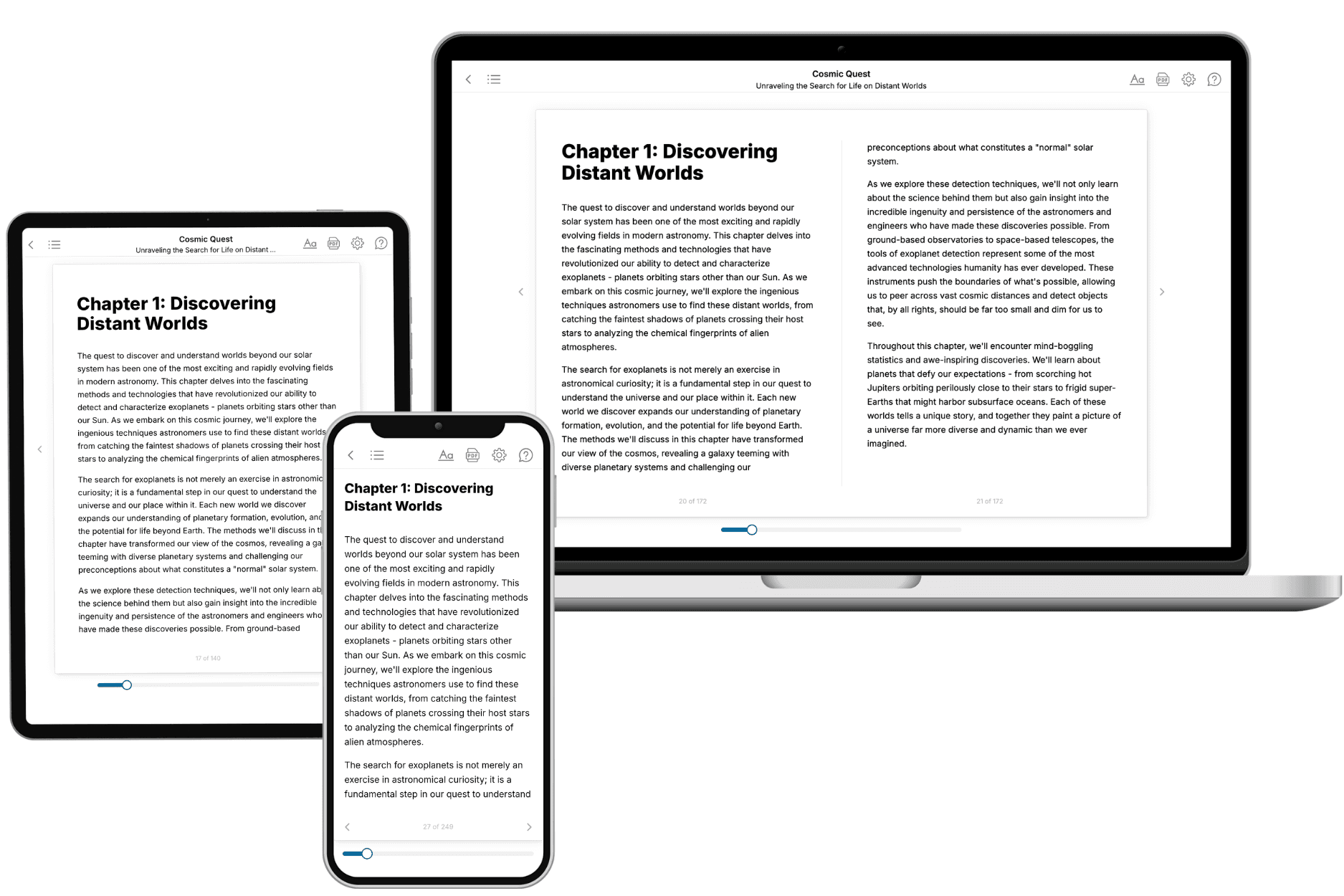
Your book is ready in 10 minutes. Read it online, download as EPUB or PDF, or send to Kindle.
Frequently asked questions
- What is TailoredRead?
TailoredRead creates complete, full-length nonfiction ebooks, written specifically for you. Tell us what you want to learn and why, and TailoredRead writes you a complete ebook on it, with charts, tables, and diagrams throughout. Read it online, on Kindle, or on any e-reader, or download it as a PDF or EPUB. Every book is written fresh the day you order it.
- How is the book tailored to me?
Before anything is written, you answer a few short questions about your goals, your background, and the topics you care about. Your book is then planned around your answers: written at your level, focused on your goals, and covering the topics you chose, instead of the one-size-fits-all book a store sells everyone.
- Will it read like generic AI content?
No. Your book isn't a chat transcript: it's planned chapter by chapter before a single word is written, told in a clear book voice, and explains ideas visually with charts, tables, and diagrams. After writing, every book goes through an editorial pass that polishes chapters so the book reads consistent from start to finish. Judge for yourself: browse thousands of sample books on our Explore Books page.
- How accurate is the content?
Our AI first checks whether your subject needs live research. Niche and fast-moving subjects are researched before writing, and the book plan and chapters are grounded in what it finds. After writing, every book goes through a quality pass that checks its facts and consistency, and researched books list their sources in a Notes section at the back.
- How long is the book?
You choose the length: Comprehensive (250-300 pages), Detailed (150-200 pages), Essential (70-100 pages), or Short (30-50 pages).
- Does the book include visuals?
Yes. Every book includes visual elements such as timelines, checklists, step-by-step guides, decision trees, comparison tables, and matrices, and many include bar charts. A typical book includes dozens of these visual elements.
- Can I read it on Kindle? What formats can I download?
Yes. Every book can be read in our online reader or downloaded as a PDF or EPUB. The EPUB can be opened with Kindle, Apple Books, Kobo, and any e-reader. The Commercial and Author licenses also include an editable Word (DOCX) and Markdown download.
- How much does it cost?
About the price of a regular ebook. The exact price depends on your book's length and complexity, from $2 for the shortest books to $35 for the most comprehensive, and it's shown when you review your book, before you commit to anything. Each book is a one-time purchase, yours to keep, no subscription. Licenses that let you share, teach, or publish your book range from $35.99 to $49.99.
- Can I preview the book before purchasing?
Before you pay, you'll see what your book will cover: the title, a detailed description, the estimated length, and the complete chapter-by-chapter table of contents, so you know what you're getting before you decide. The full text itself is written after you purchase.
- How long does it take to create a book?
About 10 minutes. You can start reading the opening chapters while the rest is still being written.