The Camp David Accords
How a Secret Summit Reshaped the Middle East and the Cold War
What if two nations locked in conflict for three decades could find peace through thirteen days of intensive negotiation?
238 pages11 chaptersNov 22, 2025Middle East History
About this book
The Camp David Accords stand as one of the most remarkable diplomatic achievements of the twentieth century, yet their full story remains surprisingly untold. This book explores how President Jimmy Carter brought together Israeli Prime Minister Menachem Begin and Egyptian President Anwar Sadat to negotiate the first Arab-Israeli peace treaty, fundamentally reshaping Middle Eastern politics and Cold War strategy. You'll discover the personal dynamics that made breakthrough possible, the intricate negotiations that nearly collapsed multiple times, and the geopolitical consequences that rippled across the globe. From the initial conditions that made peace conceivable to the framework's lasting legacy, this account examines how diplomacy, leadership, and strategic vision can overcome decades of hostility. Whether you're studying Cold War history, international relations, or the roots of modern Middle Eastern politics, this book provides essential context for understanding one of history's most consequential diplomatic moments.
Table of contents
- IntroductionWhy Camp David Matters Today, What This Book Covers, The State of the Middle East in 1978Read below
- Chapter 1: The Road to Deadlock: Arab-Israeli Conflict Before 1978Israel's Founding and the Palestinian Displacement, Wars, Occupation, and Escalating Tensions, Why Previous Peace Efforts Failed
- Chapter 2: The Cold War Dimension: Superpowers and Regional ConflictSoviet Interests and Strategy in the Middle East, American Cold War Objectives in the Region, How Superpower Competition Fueled Regional Wars
- Chapter 3: The Three Leaders: Carter, Begin, and SadatJimmy Carter's Idealism and Foreign Policy Vision, Menachem Begin: From Resistance Fighter to Prime Minister, Anwar Sadat's Bold Shift Toward Peace, How Personal Relationships Would Shape Negotiations
- Chapter 4: The Path to Camp David: Preliminary Negotiations and BreakthroughsSadat's Historic Visit to Israel, Carter's Decision to Host Direct Negotiations, Preparing the Ground: Pre-Summit Diplomacy
- Chapter 5: Thirteen Days at Camp David: The Negotiations UnfoldOpening Positions and Initial Impasses, Breakthrough Moments and Creative Solutions, When Negotiations Nearly Fell Apart, The Final Push to Agreement
- Chapter 6: The Framework Explained: What the Accords Actually AchievedTwo Separate Frameworks: Israel-Egypt and Palestinian Issues, The Sinai Peninsula: Israeli Withdrawal and Demilitarization, Palestinian Autonomy: Ambitions and Limitations, Security Arrangements and International Monitoring
- Chapter 7: Regional Reactions: Winners, Losers, and ComplicationsThe Arab World's Rejection and Egypt's Isolation, Palestinian Perspectives and Unmet Expectations, Soviet Concerns and Cold War Implications, Domestic Opposition in Israel and Egypt
- Chapter 8: Implementation and the Peace Treaty: From Framework to RealityThe 1979 Egypt-Israel Peace Treaty, Returning the Sinai: Phased Withdrawal and Verification, Normalizing Relations: Trade, Diplomacy, and Cultural Exchange
- Chapter 9: The Palestinian Question: Why the Framework StalledAttempts to Implement Palestinian Autonomy, Israeli Settlements and the Erosion of Palestinian Trust, Why the Palestinian Framework Never Materialized
- Chapter 10: Cold War Consequences: Reshaping US Strategy in the Middle EastExpanding American Influence and Strategic Partnerships, Soviet Setbacks and Declining Regional Influence, Long-Term Implications for Cold War Competition
- Chapter 11: Legacy and Lessons: What Camp David Teaches UsCamp David as a Model for Future Negotiations, Understanding Partial Success in Diplomacy, How the Accords Continue to Shape Middle Eastern Politics, Lessons for Leaders and Policymakers
- ConclusionThe Enduring Significance of Camp David, Unfinished Business and Ongoing Challenges
- Glossary of Key Terms
- Further Reading and Resources
Introduction
In September 1978, three men gathered at a secluded presidential retreat in the Maryland mountains with the weight of history on their shoulders. President Jimmy Carter, Israeli Prime Minister Menachem Begin, and Egyptian President Anwar Sadat arrived at Camp David with decades of hostility between their nations and little reason to believe they could succeed where countless diplomats had failed. Thirteen days later, they emerged with an agreement that would fundamentally reshape the Middle East, alter the trajectory of the Cold War, and demonstrate that even the most intractable conflicts could yield to determined diplomacy. The Camp David Accords stand as one of the twentieth century's most remarkable diplomatic achievements, yet their full significance extends far beyond the immediate peace treaty they produced.
Understanding the Camp David Accords requires more than simply recounting the negotiations themselves. These agreements emerged from a complex web of regional conflicts, superpower competition, personal relationships, and strategic calculations that had been building for decades. The accords represented a dramatic departure from previous approaches to Middle Eastern diplomacy, replacing incremental steps and international conferences with intensive, leader-to-leader negotiations facilitated by an American president willing to stake his political capital on success. The framework established at Camp David would influence peace negotiations for generations, while the agreements themselves would create new realities on the ground that continue to shape regional politics today.
The story of Camp David reveals how diplomacy actually works at the highest levels. It demonstrates the crucial role of personal relationships between leaders, the importance of understanding cultural and historical contexts, and the ways domestic politics constrain international agreements. The negotiations also highlight the limitations of even successful diplomacy, as the accords resolved some conflicts while leaving others unaddressed. By examining this pivotal moment in detail, you'll gain insight into the possibilities and constraints of international peacemaking, the interplay between regional conflicts and global power struggles, and the lasting consequences of diplomatic decisions made under intense pressure.
Why Camp David Matters Today
The Camp David Accords remain directly relevant to contemporary Middle Eastern politics and international relations more broadly. The Egypt-Israel peace treaty that emerged from these negotiations has endured for over four decades, making it the longest-lasting peace agreement in the modern Middle East. This durability stands in stark contrast to the region's ongoing conflicts and demonstrates that negotiated settlements between former enemies can survive changes in leadership, regional upheaval, and domestic opposition. The accords proved that Arab-Israeli peace was possible, not merely theoretical, and established a precedent that would influence subsequent negotiations between Israel and Jordan, as well as multiple attempts to resolve the Israeli-Palestinian conflict.
The diplomatic approach pioneered at Camp David continues to influence how international mediators approach seemingly intractable conflicts. Carter's decision to bring leaders together for intensive, secluded negotiations created a model that has been attempted in numerous subsequent peace processes, from the Balkans to Northern Ireland to Colombia. The Camp David framework demonstrated several key principles that remain relevant today:
- Direct engagement between adversaries can break through diplomatic stalemates that indirect negotiations cannot resolve
- Personal relationships between leaders can overcome institutional resistance and historical animosity
- Creative ambiguity in agreements can allow parties with different interpretations to move forward together
- Sustained pressure from a committed mediator can prevent negotiations from collapsing during difficult moments
- Phased implementation can build confidence while addressing security concerns incrementally
Understanding Camp David also illuminates the complex relationship between the United States and the Middle East that continues to shape global politics. The accords marked a fundamental shift in American strategy, transforming the US from a Cold War power focused primarily on containing Soviet influence into an active peace broker with substantial leverage over regional actors. This role brought significant benefits, including enhanced American influence and strategic partnerships, but also created lasting commitments and complications. The substantial military and economic aid packages that accompanied the accords established patterns of American involvement that continue today, with Egypt and Israel remaining among the largest recipients of US foreign assistance.
The unresolved aspects of Camp David matter as much as its successes. The framework for Palestinian autonomy that was supposed to follow the Egypt-Israel treaty never materialized, leaving the Palestinian question unresolved and contributing to decades of subsequent conflict. This failure demonstrates how partial diplomatic success can create new problems even as it solves old ones. Egypt's separate peace removed the most powerful Arab military from the conflict with Israel, fundamentally altering the regional balance of power but also leaving Palestinians without their most significant potential ally. Understanding why the Palestinian framework failed provides crucial lessons about the limitations of top-down diplomacy and the importance of including all affected parties in peace processes.
The accords also offer important insights into how domestic politics shape international agreements. Begin faced significant opposition from Israeli settlers and right-wing parties who opposed returning the Sinai Peninsula. Sadat risked isolation from the Arab world and ultimately paid with his life when he was assassinated by Egyptian extremists in 1981. Carter invested enormous political capital in the negotiations, contributing to his broader foreign policy legacy but also exposing him to criticism when other Middle Eastern challenges emerged. These domestic political dimensions remind us that international agreements must be sustainable within each party's political system, not just acceptable to the leaders who negotiate them.
Finally, Camp David demonstrates the complex interplay between regional conflicts and global power competition. The accords had significant Cold War implications, strengthening American influence in the Middle East while complicating Soviet strategic interests. This dynamic illustrates how regional disputes become entangled with broader geopolitical struggles, and how resolving local conflicts can shift the balance of power at the global level. In today's multipolar world, where regional conflicts in the Middle East, Eastern Europe, and East Asia intersect with great power competition, the Camp David experience offers valuable lessons about managing these interconnected challenges.
For students of history and international relations, Camp David provides a rich case study in diplomatic strategy, negotiation tactics, and the role of leadership in international affairs. The detailed records of the negotiations, including memoirs from all three leaders and their advisors, offer rare insight into how high-stakes diplomacy actually unfolds. The accords demonstrate that historical change often results from contingent decisions made by individuals under pressure, not just from impersonal forces or inevitable trends. By studying this pivotal moment, you can better understand how diplomacy works, why it sometimes succeeds against long odds, and what factors determine whether agreements endure or collapse.
What This Book Covers
This book provides a comprehensive examination of the Camp David Accords from their historical origins through their lasting impact on Middle Eastern politics and Cold War dynamics. Rather than focusing solely on the thirteen days of negotiations in September 1978, this account situates Camp David within the broader context of Arab-Israeli conflict, superpower competition, and the evolution of American foreign policy. You'll gain understanding of not just what happened at Camp David, but why it happened when it did, how the agreements were implemented, and what consequences they produced for the region and the world.
The early chapters establish the essential background for understanding why the Camp David negotiations represented such a dramatic breakthrough. You'll explore the origins and evolution of the Arab-Israeli conflict from Israel's founding through the wars of 1967 and 1973, examining why previous peace efforts had failed and what conditions made a new approach possible by 1978. The Cold War dimension receives particular attention, as superpower competition fundamentally shaped regional dynamics and influenced the strategic calculations of all parties. Understanding how the Soviet Union and the United States viewed the Middle East as a crucial arena for global competition helps explain why the Camp David Accords had implications far beyond the immediate Egypt-Israel relationship.
A substantial portion of the book examines the three leaders who made Camp David possible. Jimmy Carter brought an unusual combination of idealism and determination to Middle Eastern diplomacy, viewing peace in the region as both a moral imperative and a strategic necessity. Menachem Begin's background as a resistance fighter and his deep commitment to Israeli security shaped his negotiating positions and his ultimate willingness to make territorial concessions. Anwar Sadat's bold decision to break with decades of Arab policy and pursue a separate peace with Israel reflected both strategic calculation and personal vision. The personal dynamics between these three men—their mutual respect, their conflicts, and their ability to work through disagreements—proved essential to achieving agreement.
The book provides a detailed account of the negotiations themselves, drawing on memoirs, diplomatic records, and historical research to reconstruct how the agreements emerged. You'll follow the progression from initial positions through multiple impasses to eventual breakthrough, understanding the specific issues that nearly derailed the talks and the creative solutions that allowed progress. The narrative captures the intensity of the thirteen days at Camp David, including the moments when participants believed the negotiations would fail and the personal interventions by Carter that kept the process moving forward. This detailed examination reveals the actual mechanics of high-level diplomacy, not just the sanitized version presented in official statements.
Subsequent chapters analyze what the accords actually achieved and what they left unresolved. The book carefully explains the two separate frameworks that emerged from Camp David:
- The Framework for Peace in the Middle East, which outlined principles for resolving the Palestinian question and achieving comprehensive regional peace
- The Framework for the Conclusion of a Peace Treaty between Egypt and Israel, which established specific terms for normalizing relations and returning the Sinai Peninsula
The book examines regional reactions to the accords in detail, exploring how different actors responded to this dramatic shift in Middle Eastern politics. The Arab world's largely negative reaction and Egypt's resulting isolation demonstrated the political costs of Sadat's peace initiative. Palestinian perspectives receive careful attention, as the accords' failure to adequately address Palestinian national aspirations would have lasting consequences. Soviet concerns about declining influence and American strategic gains illustrate the Cold War dimensions of the agreements. Domestic opposition within both Israel and Egypt reveals the political challenges of implementing controversial international agreements.
The implementation phase receives thorough coverage, as the transition from framework agreements to actual peace treaty involved substantial additional negotiations and practical challenges. The phased Israeli withdrawal from the Sinai, the establishment of international monitoring mechanisms, and the difficult process of normalizing relations between former enemies all required sustained diplomatic effort. The book also examines why the Palestinian autonomy framework never materialized, analyzing the combination of Israeli settlement expansion, Palestinian rejection, and American diplomatic priorities that prevented implementation of this crucial component of the accords.
The final chapters assess Camp David's lasting legacy and the lessons it offers for contemporary diplomacy. You'll explore how the accords reshaped American strategy in the Middle East, established patterns of US involvement that continue today, and influenced subsequent peace negotiations. The book examines both the successes—a durable peace treaty that has survived multiple regional crises—and the failures—an unresolved Palestinian question that continues to generate conflict. By understanding both dimensions, you'll gain a nuanced appreciation of what diplomacy can and cannot achieve, even under favorable circumstances with committed leaders.
Throughout the book, you'll find specific examples, detailed analysis, and connections to broader themes in international relations and diplomatic history. The goal is not simply to recount events but to help you understand the complex factors that shape international negotiations, the role of leadership in overcoming historical animosity, and the ways that diplomatic agreements create new realities while leaving other problems unresolved. Whether you're studying Cold War history, Middle Eastern politics, or the practice of international diplomacy, this comprehensive examination of Camp David will provide essential context and insight.
The State of the Middle East in 1978
The Middle East that Jimmy Carter inherited when he became president in January 1977 was a region defined by conflict, instability, and superpower competition. Three decades after Israel's founding, the Arab-Israeli conflict remained the central fault line in regional politics, having generated four major wars and numerous smaller confrontations. The 1973 Yom Kippur War had ended just three years earlier, demonstrating that despite Israel's military superiority, Arab states retained the capacity to launch devastating attacks and that the conflict could escalate into a superpower confrontation. The war had also triggered an oil embargo that sent shockwaves through the global economy, illustrating how Middle Eastern conflicts could directly impact Western interests.
Egypt occupied a unique position in the Arab world and in the broader Cold War struggle. As the most populous Arab nation and historically the leader of Arab nationalism, Egypt's stance toward Israel significantly influenced regional dynamics. Under President Gamal Abdel Nasser, Egypt had been the Soviet Union's primary Middle Eastern ally and the driving force behind Arab opposition to Israel. However, Nasser's successor, Anwar Sadat, had begun reorienting Egyptian foreign policy, expelling Soviet advisors in 1972 and gradually moving toward the United States. By 1978, Egypt faced severe economic challenges, with a growing population, limited resources, and an economy strained by decades of military spending. Sadat recognized that continued confrontation with Israel offered little prospect of recovering the Sinai Peninsula, lost in the 1967 Six-Day War, while peace might bring economic benefits and American support.
Israel in 1978 was a nation shaped by three decades of conflict and the trauma of the Holocaust that had driven its founding. The country had achieved remarkable military success, defeating Arab armies in 1948, 1956, 1967, and 1973, but this success had not brought security or acceptance in the region. Israel controlled substantial territories captured in 1967, including the Sinai Peninsula, the West Bank, the Gaza Strip, and the Golan Heights. The question of what to do with these territories divided Israeli society. The 1977 election of Menachem Begin and his right-wing Likud party marked a significant shift from the Labor governments that had led Israel since independence. Begin's background in the Irgun resistance movement and his ideological commitment to Greater Israel suggested he would be unlikely to make territorial concessions, yet he also understood that Israel's long-term security required some form of regional acceptance.
The Palestinian question remained unresolved and increasingly urgent. The 1967 war had brought over one million Palestinians in the West Bank and Gaza under Israeli military occupation, adding to the hundreds of thousands displaced in 1948. The Palestine Liberation Organization (PLO), led by Yasser Arafat, had emerged as the primary representative of Palestinian national aspirations, though its use of terrorism and its rejection of Israel's right to exist made it unacceptable as a negotiating partner to Israel and the United States. Palestinian refugees in Lebanon, Jordan, and other Arab states represented a destabilizing force in regional politics. Any comprehensive peace would need to address Palestinian concerns, yet no clear path existed for doing so given the fundamental disagreements between Palestinians and Israelis about borders, refugees, and sovereignty.
The Cold War context fundamentally shaped Middle Eastern dynamics in 1978. The Soviet Union maintained significant influence in the region through its relationships with Syria, Iraq, and various Palestinian factions, as well as its continued military and economic support to these clients. The United States had strong relationships with Israel, Iran (still under the Shah), and Saudi Arabia, but lacked diplomatic relations with several key Arab states. Both superpowers viewed the Middle East as a crucial arena for competition, with access to oil, strategic position, and ideological influence all at stake. The risk that regional conflicts could escalate into superpower confrontation had been demonstrated during the 1973 war, when the United States and Soviet Union both placed their forces on alert. This Cold War dimension meant that regional peace efforts had implications far beyond the immediate parties to any conflict.
Previous attempts at Arab-Israeli peace had achieved limited success. United Nations Security Council Resolution 242, passed after the 1967 war, had established the principle of land for peace
—Israeli withdrawal from occupied territories in exchange for Arab recognition and peace—but implementation had proven impossible. The 1973 war had been followed by shuttle diplomacy led by US Secretary of State Henry Kissinger, which produced disengagement agreements between Israel and Egypt and between Israel and Syria, but these were limited military arrangements rather than comprehensive peace. The Geneva Conference of 1973, co-chaired by the United States and Soviet Union, had brought parties together but achieved no substantive progress. By 1978, the diplomatic landscape was littered with failed initiatives and dashed hopes.
Several factors in 1978 created new possibilities for diplomatic breakthrough despite this history of failure:
- War exhaustion: The 1973 war had demonstrated the enormous costs of continued conflict without offering prospects for decisive victory
- Economic pressures: Egypt desperately needed to redirect resources from military spending to economic development
- Leadership changes: New leaders in the United States, Israel, and Egypt brought fresh perspectives and different priorities
- Strategic realignment: Egypt's shift away from the Soviet Union created opportunities for American-mediated diplomacy
- Territorial clarity: Unlike the ambiguous armistice lines of 1949, the 1967 borders provided a clear basis for territorial negotiations
The broader regional context included other significant developments that would influence the peace process. Iran, still under Shah Mohammad Reza Pahlavi, was America's primary regional ally and a major military power, though revolutionary forces were gathering that would topple the Shah within a year. Lebanon was descending into civil war, with Syrian intervention and Palestinian involvement creating a complex humanitarian and political crisis. Saudi Arabia, enriched by oil revenues, wielded significant influence in the Arab world and had the financial resources to support or oppose peace initiatives. Jordan's King Hussein, who had lost the West Bank in 1967, had his own interests in any peace process but remained cautious about breaking with Arab consensus.
Understanding this complex regional situation in 1978 is essential for appreciating why the Camp David Accords represented such a dramatic breakthrough and why they took the specific form they did. The negotiations would need to address not just the bilateral relationship between Egypt and Israel, but also the broader questions of Palestinian rights, regional security, superpower interests, and the political sustainability of any agreement within each country's domestic context. The fact that Carter, Begin, and Sadat managed to navigate these challenges and produce a lasting peace treaty between Egypt and Israel stands as a remarkable achievement, even as the failure to resolve the Palestinian question would create lasting problems. The following chapters will examine how these leaders approached these challenges and what their efforts ultimately achieved.
This is the end of the free sample. The full book has 11 chapters.
Want this book written for you?
Tell us your goals and background, and get your own version of this book, tailored by AI to you.


Benefits of AI-tailored books
- Read one book, not ten:
- all the Middle East History knowledge you need, gathered into a single book.
- Save days of learning:
- tell us your goals, choose your topics, and the whole book is built around them.
- Learn effortlessly:
- Middle East History book written for your specific background and expertise.
- Understand at a glance:
- includes charts, tables, timelines, checklists, decision trees, and more.
- Stay current:
- written the day you order it, not years ago.
- Trust what you read:
- every book is checked for accuracy, with real research when your subject needs it.
Create your unique book in 3 steps
- 1. Select your focus
Select the focus of your Middle East History book and share your background
- 2. Personalize your book
Specify your goals and choose sub-topics to include
- 3. Get your tailored book
Your book is ready in 10 minutes. Read it online, download as EPUB or PDF, or send to Kindle.


Frequently asked questions
- What is TailoredRead?
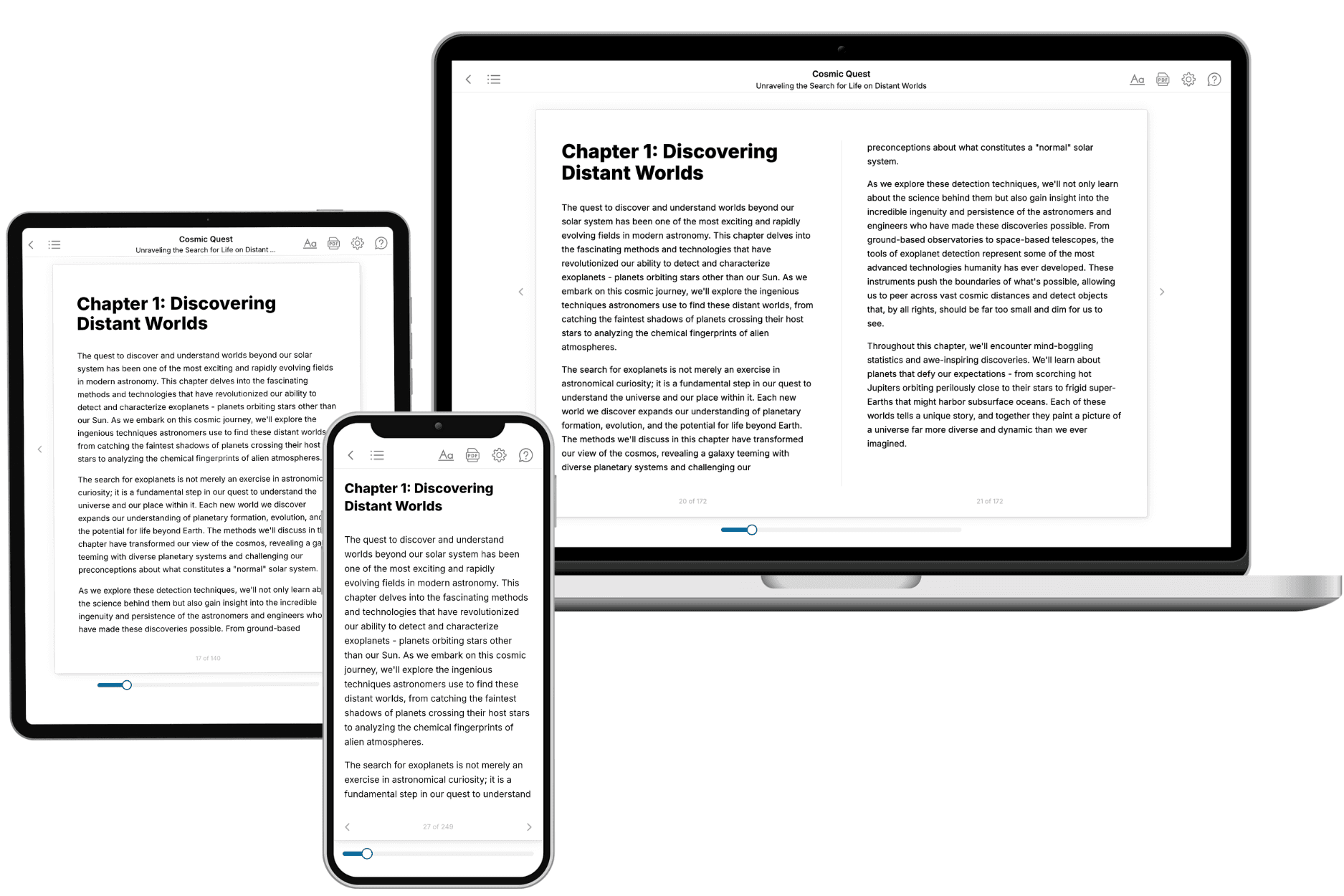
TailoredRead creates complete, full-length nonfiction ebooks, written specifically for you. Tell us what you want to learn and why, and TailoredRead writes you a complete ebook on it, with charts, tables, and diagrams throughout. Read it online, on Kindle, or on any e-reader, or download it as a PDF or EPUB. Every book is written fresh the day you order it.
- How is the book tailored to me?
Before anything is written, you answer a few short questions about your goals, your background, and the topics you care about. Your book is then planned around your answers: written at your level, focused on your goals, and covering the topics you chose, instead of the one-size-fits-all book a store sells everyone.
- Will it read like generic AI content?
No. Your book isn't a chat transcript: it's planned chapter by chapter before a single word is written, told in a clear book voice, and explains ideas visually with charts, tables, and diagrams. After writing, every book goes through an editorial pass that polishes chapters so the book reads consistent from start to finish. Judge for yourself: browse thousands of sample books on our Explore Books page.
- How accurate is the content?
Our AI first checks whether your subject needs live research. Niche and fast-moving subjects are researched before writing, and the book plan and chapters are grounded in what it finds. After writing, every book goes through a quality pass that checks its facts and consistency, and researched books list their sources in a Notes section at the back.
- How long is the book?
You choose the length: Comprehensive (250-300 pages), Detailed (150-200 pages), Essential (70-100 pages), or Short (30-50 pages).
- Does the book include visuals?
Yes. Every book includes charts, tables, and diagrams: timelines, checklists, step-by-step guides, decision trees, comparison tables, matrices, and bar charts. A typical book includes dozens of these visual elements.
- Can I read it on Kindle? What formats can I download?
Yes. Every book can be read in our online reader or downloaded as a PDF or EPUB. The EPUB can be opened with Kindle, Apple Books, Kobo, and any e-reader. The Commercial and Author licenses also include an editable Word (DOCX) and Markdown download.
- How much does it cost?
About the price of a regular ebook. The exact price depends on your book's length and complexity, from $2 for the shortest books to $35 for the most comprehensive, and it's shown when you review your book, before you commit to anything. Each book is a one-time purchase, yours to keep, no subscription. Licenses that let you share, teach, or publish your book range from $35.99 to $49.99.
- Can I preview the book before purchasing?
Before you pay, you'll see what your book will cover: the title, a detailed description, the estimated length, and the complete chapter-by-chapter table of contents, so you know what you're getting before you decide. The full text itself is written after you purchase.
- How long does it take to create a book?
About 10 minutes. You can start reading the opening chapters while the rest is still being written.