Causal Inference in AI
Understanding Why AI Makes Decisions and How to Build More Reliable Systems
Move beyond prediction to true understanding of why your AI systems make the decisions they do.
207 pages9 chaptersNov 24, 2025Artificial Intelligence
About this book
This book bridges the gap between traditional machine learning and causal inference, showing you how to build AI models that don't just predict accurately—they explain their reasoning and generalize reliably to new situations. You'll learn practical frameworks for identifying causal relationships in data, designing experiments that establish true causality rather than mere correlation, and integrating causal techniques into your machine learning workflows. Whether you're working with Midjourney, building recommendation systems, or developing predictive models, understanding causality transforms your ability to debug failures, improve robustness, and create AI systems that stakeholders can trust. This book combines rigorous causal theory with hands-on examples, showing you how to apply these concepts immediately to real-world challenges in AI development and deployment.
Table of contents
- IntroductionWhy Causality Matters in AI, The Correlation-Causation Gap, What You'll Learn in This Book, How to Use This BookRead below
- Chapter 1: Foundations of Causal ThinkingDefining Causality and Causal Effects, Causal Inference vs. Statistical Inference, Understanding Counterfactuals, The Potential Outcomes Framework
- Chapter 2: Representing Causality with GraphsIntroduction to Directed Acyclic Graphs, Building Causal Models from Domain Knowledge, Identifying Confounders and Colliders, D-Separation and Conditional Independence
- Chapter 3: Causal Inference from Observational DataChallenges in Observational Studies, Propensity Score Methods, Matching and Stratification Techniques, Regression Adjustment and Covariate Control
- Chapter 4: Experimental Design and Causal DiscoveryRandomized Controlled Trials and Their Power, Quasi-Experimental Designs, Instrumental Variables for Causal Estimation, Causal Discovery Algorithms
- Chapter 5: Integrating Causality into Machine LearningOverview of Causal Machine Learning, Causal Forests and Heterogeneous Treatment Effects, Double Machine Learning for Debiased Estimation, Causal Feature Engineering
- Chapter 6: Causality in Generative AI and MidjourneyHow Generative Models Relate to Causality, Causal Relationships in Midjourney Prompts, Using Causal Understanding to Control AI Outputs, Improving Interpretability in Generative Systems
- Chapter 7: Common Biases and How to Avoid ThemConfounding Bias and Its Impact, Selection Bias in Data Collection, Measurement Error and Misclassification, Reverse Causality and Feedback Loops
- Chapter 8: Practical Applications and Case StudiesCausal Inference in Recommendation Systems, Healthcare and Treatment Effect Estimation, Marketing Attribution and Campaign Analysis, Policy Evaluation and Impact Assessment
- Chapter 9: Tools, Libraries, and ImplementationPopular Causal Inference Libraries and Frameworks, Implementing Causal Methods in Python, Visualizing Causal Models and Results, Best Practices for Implementation
- ConclusionKey Takeaways, The Future of Causal AI
- Glossary
- Further Reading and Resources
Introduction
Artificial intelligence has transformed from a research curiosity into the backbone of modern technology. Machine learning models now recommend what you watch, diagnose diseases, approve loans, and generate stunning images from text prompts. Yet despite their impressive capabilities, most AI systems operate as sophisticated pattern-matching engines. They excel at finding correlations in data and making predictions based on those patterns. When a recommendation system suggests a product you might like, it's identifying statistical associations between your behavior and that of similar users. When a generative AI creates an image, it's leveraging patterns learned from millions of training examples. These correlations drive remarkable performance, but they reveal nothing about the underlying mechanisms that produce the outcomes we observe.
The distinction between correlation and causation represents more than an academic curiosity or a statistical technicality. It determines whether your AI system will generalize reliably to new situations, whether it can explain its reasoning to stakeholders, and whether it will fail catastrophically when the world changes in unexpected ways. A model trained to predict hospital readmissions might learn that patients who receive follow-up calls are more likely to return to the hospital. The correlation is real, but the causation runs backward: sicker patients receive more follow-up calls. Deploy this model to optimize care, and you might inadvertently reduce follow-up calls to the patients who need them most. Understanding causality transforms how you approach every stage of AI development, from data collection and feature engineering to model evaluation and deployment.
This book bridges the gap between traditional machine learning and causal inference. You'll learn practical frameworks for identifying causal relationships, designing studies that establish true causality, and integrating causal techniques into your existing workflows. Whether you're building recommendation systems, working with generative AI like Midjourney, or developing predictive models for business decisions, causal thinking will fundamentally change how you approach problems. You'll move beyond asking "what will happen?" to answering "why does this happen?" and "what would happen if we intervened?" These questions unlock new capabilities: models that remain robust when data distributions shift, systems that can explain their reasoning in terms humans understand, and AI that supports genuine decision-making rather than merely automating existing biases.
The journey from correlation to causation requires new tools, new ways of thinking, and a willingness to question assumptions that pervade standard machine learning practice. You'll discover that some of your most reliable predictive features might be useless or even harmful for causal inference. You'll learn that adding more data doesn't always help and can sometimes make things worse. You'll find that domain knowledge and careful reasoning about causal mechanisms often matter more than sophisticated algorithms. These insights don't diminish the value of machine learning; they enhance it by providing a principled foundation for building AI systems that truly understand the world they operate in.
Why Causality Matters in AI
Modern AI systems face a fundamental challenge that pure prediction cannot solve: the world changes. A model trained on historical data captures patterns that existed during the training period, but those patterns may not persist. Consider a fraud detection system trained during economic prosperity. It learns to flag unusual spending patterns based on correlations observed in stable times. When a recession hits and consumer behavior shifts dramatically, the model's performance degrades because the correlations it relies on have changed. A causally-informed system, by contrast, would focus on the mechanisms that generate fraudulent behavior rather than surface-level patterns. It would remain robust because causal relationships tend to be more stable than statistical associations.
The stability of causal relationships stems from their connection to underlying mechanisms rather than contingent circumstances. When you understand that a medication reduces blood pressure by blocking specific receptors, that causal knowledge transfers across different patient populations, healthcare systems, and time periods. The correlation between taking the medication and improved outcomes might vary depending on factors like diet, exercise, or concurrent medications, but the causal mechanism remains constant. This distinction becomes critical when deploying AI systems in new contexts. A model that learns causal relationships can adapt to new environments more reliably than one that merely memorizes correlations from training data.
Explainability and trust represent another crucial dimension where causality matters. Stakeholders increasingly demand that AI systems explain their decisions, particularly in high-stakes domains like healthcare, criminal justice, and financial services. Correlation-based explanations often feel unsatisfying or misleading. Telling a loan applicant that their application was denied because people with similar characteristics tend to default doesn't provide actionable insight or justify the decision. A causal explanation—identifying specific factors that genuinely influence creditworthiness and explaining how changing those factors would affect the outcome—offers both transparency and a path forward. This shift from "what patterns did the model find?" to "why did the model make this decision?" transforms AI from an inscrutable black box into a tool that augments human judgment.
Causal understanding also enables AI systems to reason about interventions and counterfactuals. Prediction answers the question "what will happen?" but decision-making requires answering "what would happen if we did something different?" A recommendation system might predict that users who watch science fiction movies also watch action movies, but this correlation doesn't tell you whether recommending action movies will increase engagement. Perhaps both preferences stem from a common cause—a taste for escapist entertainment—and recommending action movies to science fiction fans will have no effect. Causal inference provides tools to estimate the effect of interventions, allowing you to optimize decisions rather than merely predict outcomes.
The limitations of correlation become particularly apparent in generative AI systems. When you prompt Midjourney or another image generation model, you're attempting to control the output through your input. Understanding the causal relationship between prompt elements and generated features allows you to craft more effective prompts and achieve more consistent results. If you observe that prompts containing "cinematic lighting" tend to produce dramatic images, you need to know whether the lighting term causes the dramatic effect or whether both are associated with some other prompt characteristic. Causal thinking transforms prompt engineering from trial-and-error experimentation into a systematic practice grounded in understanding how different elements influence the generation process.
Fairness and bias mitigation represent another domain where causal reasoning proves essential. Many AI systems exhibit biased behavior, producing different outcomes for different demographic groups. Addressing these biases requires understanding their causal origins. Is the bias present in the training data, introduced by the model architecture, or arising from how the system is deployed? Does a feature that correlates with protected characteristics actually cause the outcome, or is it merely a proxy for some legitimate causal factor? Without causal analysis, bias mitigation efforts often fail or introduce new problems. You might remove a biased feature only to find that the model learns to reconstruct it from other variables, or you might inadvertently remove information that legitimately predicts outcomes, reducing accuracy without improving fairness.
The business value of causal AI extends beyond technical improvements to strategic decision-making. Organizations increasingly use AI not just to automate existing processes but to inform strategic choices: which products to develop, which markets to enter, which interventions to implement. These decisions require causal understanding. A retailer might observe that customers who receive email promotions spend more, but this correlation doesn't justify increasing email volume. Perhaps customers who opt in to emails are already more engaged, and sending more emails would have no effect or might even annoy recipients. Causal inference techniques can estimate the true effect of interventions, enabling data-driven decisions that actually work when implemented. This capability transforms AI from a tool for optimization within existing constraints into a platform for discovering new opportunities and strategies.
The Correlation-Causation Gap
The distinction between correlation and causation appears simple in principle but proves surprisingly subtle in practice. Correlation means that two variables tend to move together: when one increases, the other tends to increase (positive correlation) or decrease (negative correlation). Causation means that changing one variable directly produces a change in the other. The classic example—ice cream sales correlate with drowning deaths—illustrates the gap clearly. Both increase during summer, but neither causes the other. Temperature represents a common cause that drives both variables. This example seems obvious, but real-world cases often involve more complex causal structures that obscure the true relationships.
Machine learning algorithms are fundamentally correlation-finding engines. They identify patterns in training data that predict outcomes, without distinguishing between causal relationships and spurious associations. A model predicting hospital readmissions might discover that patients who receive physical therapy are more likely to return to the hospital. This correlation exists in the data, and the model will use it for predictions. But the causal relationship runs through disease severity: sicker patients receive more physical therapy and are also more likely to be readmitted. If you intervened to reduce physical therapy based on this model, you would harm patients rather than help them. The model's predictions are accurate for the training distribution, but its implied causal story is completely wrong.
The gap between correlation and causation widens when you move from prediction to decision-making. Consider a content recommendation system that observes users who click on political articles also tend to engage with sports content. The correlation suggests recommending sports articles to politics readers. But perhaps both preferences stem from a common cause—users who check the site frequently see both types of content. Recommending sports to politics readers might have no effect because the correlation doesn't reflect a causal relationship. Alternatively, the correlation might arise because the current recommendation algorithm already shows sports to politics readers, creating a feedback loop. Understanding the causal structure determines whether the intervention will succeed.
Several common scenarios produce correlations without causation, and recognizing these patterns helps you avoid causal errors:
- Common causes (confounding): Two variables correlate because they share a common cause, like ice cream and drowning both increasing with temperature
- Reverse causation: The correlation exists, but the causal arrow points in the opposite direction from what you assume
- Selection bias: The correlation appears in your data because of how you selected observations, not because of any real relationship in the population
- Measurement error: Variables correlate because of how they're measured rather than any genuine relationship between the underlying concepts
- Mediating variables: One variable causes another through an intermediate variable, and the correlation reflects this indirect path
The challenge intensifies in high-dimensional settings typical of modern machine learning. When you have thousands or millions of features, spurious correlations become inevitable. Some features will correlate with the outcome purely by chance, and machine learning algorithms will happily exploit these correlations for prediction. A model might discover that the number of letters in a customer's last name predicts purchase behavior in the training data. This correlation might be real but meaningless—a statistical accident that won't replicate in new data. Or it might proxy for ethnicity or socioeconomic status, raising both accuracy and fairness concerns. Without causal reasoning, you cannot distinguish meaningful relationships from statistical noise or problematic proxies.
The correlation-causation gap also manifests in temporal relationships. Just because one event precedes another doesn't mean it causes it. A model might observe that users who view a product page on Monday are more likely to purchase on Friday than users who view on Wednesday. This temporal correlation might reflect causal influence—Monday viewers have more time to consider the purchase. Or it might reflect selection—users who shop on Mondays differ systematically from Wednesday shoppers in ways that affect purchase likelihood. Time series data creates additional complications because past values of a variable often predict future values, but this autocorrelation doesn't necessarily indicate causal influence. Distinguishing genuine causal dynamics from spurious temporal patterns requires careful analysis.
Understanding the correlation-causation gap transforms how you approach feature selection, model evaluation, and deployment. Features that provide strong predictive power might be useless or harmful for causal inference. A variable that perfectly predicts the outcome but sits downstream of your intervention point won't help you estimate intervention effects. Conversely, features with weak predictive power might be crucial for causal identification if they help you control for confounding. This inversion of standard machine learning intuitions requires a different mindset. You must think carefully about causal structure rather than simply maximizing predictive accuracy. The tools and frameworks in this book will help you navigate this transition, building AI systems that understand causation rather than merely detecting correlation.
What You'll Learn in This Book
This book provides a comprehensive journey from foundational concepts to practical implementation of causal inference in AI systems. You'll begin by building a solid understanding of what causality means and how it differs from statistical association. The early chapters introduce the potential outcomes framework and directed acyclic graphs (DAGs), two complementary approaches to representing and reasoning about causal relationships. These frameworks provide the conceptual foundation for everything that follows. You'll learn to draw causal diagrams that represent your domain knowledge, identify confounding variables that bias estimates, and understand when you can and cannot estimate causal effects from available data.
The middle chapters focus on practical techniques for causal inference from different types of data. You'll explore methods for extracting causal insights from observational data, where you cannot control which units receive which treatments. Techniques like propensity score matching, instrumental variables, and regression discontinuity designs allow you to approximate experimental conditions using carefully analyzed observational data. You'll also learn about experimental design, understanding when randomized controlled trials are feasible and how to design quasi-experiments when randomization isn't possible. These chapters emphasize the assumptions underlying each method, helping you understand when techniques are appropriate and what can go wrong when assumptions are violated.
A major focus of the book involves integrating causal inference with modern machine learning. You'll discover how to combine the flexibility and scalability of machine learning algorithms with the rigor of causal inference. Techniques like causal forests, double machine learning, and targeted learning allow you to estimate heterogeneous treatment effects—understanding not just whether an intervention works on average, but for whom it works best. This capability proves crucial for personalization and optimization. You'll learn how to use machine learning for nuisance parameter estimation while maintaining valid causal inference, and how to engineer features that capture causal relationships rather than spurious correlations.
The book dedicates substantial attention to generative AI and systems like Midjourney, exploring how causal thinking applies to these increasingly important technologies. You'll understand how causal relationships manifest in prompt engineering, how to achieve more consistent and controllable outputs by understanding causal mechanisms, and how to improve interpretability in generative systems. These chapters bridge the gap between traditional causal inference focused on tabular data and the emerging challenges of causal reasoning in high-dimensional, unstructured domains. The insights apply broadly to any AI system where you need to understand and control the relationship between inputs and outputs.
Throughout the book, you'll encounter detailed discussions of common pitfalls and biases that undermine causal inference. Understanding what can go wrong proves as important as knowing what to do. You'll learn to recognize confounding bias, selection bias, measurement error, and reverse causality in your data and models. Each bias receives concrete examples showing how it manifests in practice and practical strategies for detection and mitigation. These chapters will sharpen your critical thinking about causal claims, helping you evaluate both your own work and causal assertions you encounter in research papers, business presentations, and AI system documentation.
The practical applications chapters ground abstract concepts in real-world scenarios across multiple domains:
- Recommendation systems: Estimating the causal effect of recommendations on user engagement and distinguishing genuine influence from selection effects
- Healthcare: Evaluating treatment effects, understanding heterogeneous responses, and making personalized treatment decisions
- Marketing: Attribution analysis, campaign evaluation, and optimizing marketing spend based on causal impact rather than correlation
- Policy evaluation: Assessing the impact of interventions, programs, and policy changes using observational data
The final chapters provide practical implementation guidance, introducing you to the tools and libraries that make causal inference accessible. You'll learn to use Python libraries like DoWhy, CausalML, and EconML to implement the methods discussed throughout the book. Code examples demonstrate how to estimate causal effects, visualize causal models, conduct sensitivity analyses, and integrate causal inference into machine learning pipelines. These chapters emphasize best practices for implementation, helping you avoid common coding errors and interpret results correctly. You'll also learn how to communicate causal findings to stakeholders who may not have technical backgrounds, translating statistical results into actionable insights.
By the end of this book, you'll possess a comprehensive toolkit for causal inference in AI. You'll understand when causal thinking matters and when prediction suffices. You'll be able to design studies that identify causal effects, analyze data using appropriate methods, and integrate causal inference into your machine learning workflows. Most importantly, you'll develop a causal mindset—a way of thinking about problems that considers mechanisms, interventions, and counterfactuals rather than merely patterns and predictions. This shift in perspective will transform how you approach AI development, enabling you to build systems that are more robust, more interpretable, and more aligned with the genuine goals of decision-making and intervention.
How to Use This Book
This book is designed for intermediate AI practitioners and professionals who already have foundational knowledge of machine learning and statistics. You should be comfortable with basic concepts like regression, classification, training and test sets, and model evaluation. Familiarity with Python and common machine learning libraries like scikit-learn or pandas will help you engage with the code examples, though the conceptual content remains accessible even without coding along. If you're new to machine learning, consider building foundational skills before diving into causal inference. If you're an experienced practitioner, you'll find that causal thinking complements and enhances your existing expertise rather than replacing it.
The book follows a logical progression from foundations to applications, and reading chapters in order will provide the most coherent learning experience. Early chapters introduce concepts that later chapters build upon. However, the book is also designed to support selective reading based on your interests and needs. If you're primarily interested in practical applications, you might skim the theoretical foundations in early chapters and focus on the case studies and implementation chapters. If you're working specifically with generative AI, you might prioritize the chapter on causality in Midjourney and generative systems. Each chapter includes references to related concepts in other chapters, allowing you to navigate to prerequisite material as needed.
The book balances theory and practice throughout. Theoretical sections explain the conceptual foundations and mathematical frameworks underlying causal inference, while practical sections demonstrate how to apply these concepts to real problems. You don't need advanced mathematics to benefit from this book, but some sections include mathematical notation to precisely define concepts. When mathematical formulations appear, they're accompanied by intuitive explanations and concrete examples. If you find a mathematical section challenging, focus on understanding the intuition and practical implications rather than every technical detail. The goal is to develop working knowledge that you can apply, not to master every theoretical nuance.
Code examples throughout the book use Python and popular libraries for causal inference and machine learning. These examples are designed to be practical and adaptable to your own projects. You can download the code from the book's companion repository and experiment with modifications. The examples use realistic datasets and scenarios, though simplified for pedagogical clarity. When working through code examples, try modifying parameters, applying techniques to your own data, and exploring how results change under different assumptions. This hands-on experimentation will deepen your understanding more effectively than passive reading. The implementation chapter provides detailed guidance on setting up your environment and working with causal inference libraries.
Each chapter includes concrete examples and case studies that illustrate concepts in context. These examples span multiple domains—healthcare, marketing, recommendation systems, generative AI—to demonstrate the broad applicability of causal inference. When you encounter an example from an unfamiliar domain, focus on the causal reasoning and methodological approach rather than domain-specific details. The patterns you learn in one context transfer to others. For instance, techniques for handling confounding in healthcare applications apply equally to marketing attribution or recommendation systems. The diversity of examples helps you develop flexible thinking that adapts to your specific challenges.
As you read, actively engage with the material by relating concepts to your own work:
- When you learn about confounding, think about potential confounders in your datasets
- When you encounter a causal inference technique, consider how you might apply it to a current project
- When you read about a bias or pitfall, reflect on whether it might affect your existing models
- When you see a causal diagram, try drawing diagrams for problems you're working on
The book includes numerous references to academic papers, research studies, and additional resources. These references serve multiple purposes: they provide evidence for claims, point you toward deeper technical treatments, and suggest directions for further learning. You don't need to read every referenced paper to benefit from the book, but following up on references in areas of particular interest will deepen your expertise. The "Further Reading and Resources" section at the end of the book provides curated recommendations for continuing your causal inference education, including textbooks, online courses, research papers, and software documentation.
Finally, remember that causal inference involves judgment and domain knowledge as much as technical skill. The methods in this book provide tools for rigorous analysis, but they cannot replace careful thinking about causal mechanisms, plausible assumptions, and alternative explanations. As you apply these techniques, maintain healthy skepticism about your results. Conduct sensitivity analyses to understand how conclusions change under different assumptions. Seek feedback from domain experts who can evaluate whether your causal claims make sense. Communicate uncertainty honestly rather than overstating the strength of causal evidence. The goal is not to achieve perfect causal knowledge—an impossible standard—but to make better-informed decisions by systematically reasoning about causality rather than relying solely on correlation. This book provides the frameworks and tools to support that reasoning, but your judgment and critical thinking remain essential.
This is the end of the free sample. The full book has 9 chapters.
Want this book written for you?
Tell us your goals and background, and get your own version of this book, tailored by AI to you.


Benefits of AI-tailored books
- Read one book, not ten:
- all the Artificial Intelligence knowledge you need, gathered into a single book.
- Save days of learning:
- tell us your goals, choose your topics, and the whole book is built around them.
- Learn effortlessly:
- Artificial Intelligence book written for your specific background and expertise.
- Understand at a glance:
- includes charts, tables, timelines, checklists, decision trees, and more.
- Stay current:
- written the day you order it, not years ago.
- Trust what you read:
- every book is checked for accuracy, with real research when your subject needs it.
Create your unique book in 3 steps
- 1. Select your focus
Select the focus of your Artificial Intelligence book and share your background
- 2. Personalize your book
Specify your goals and choose sub-topics to include
- 3. Get your tailored book
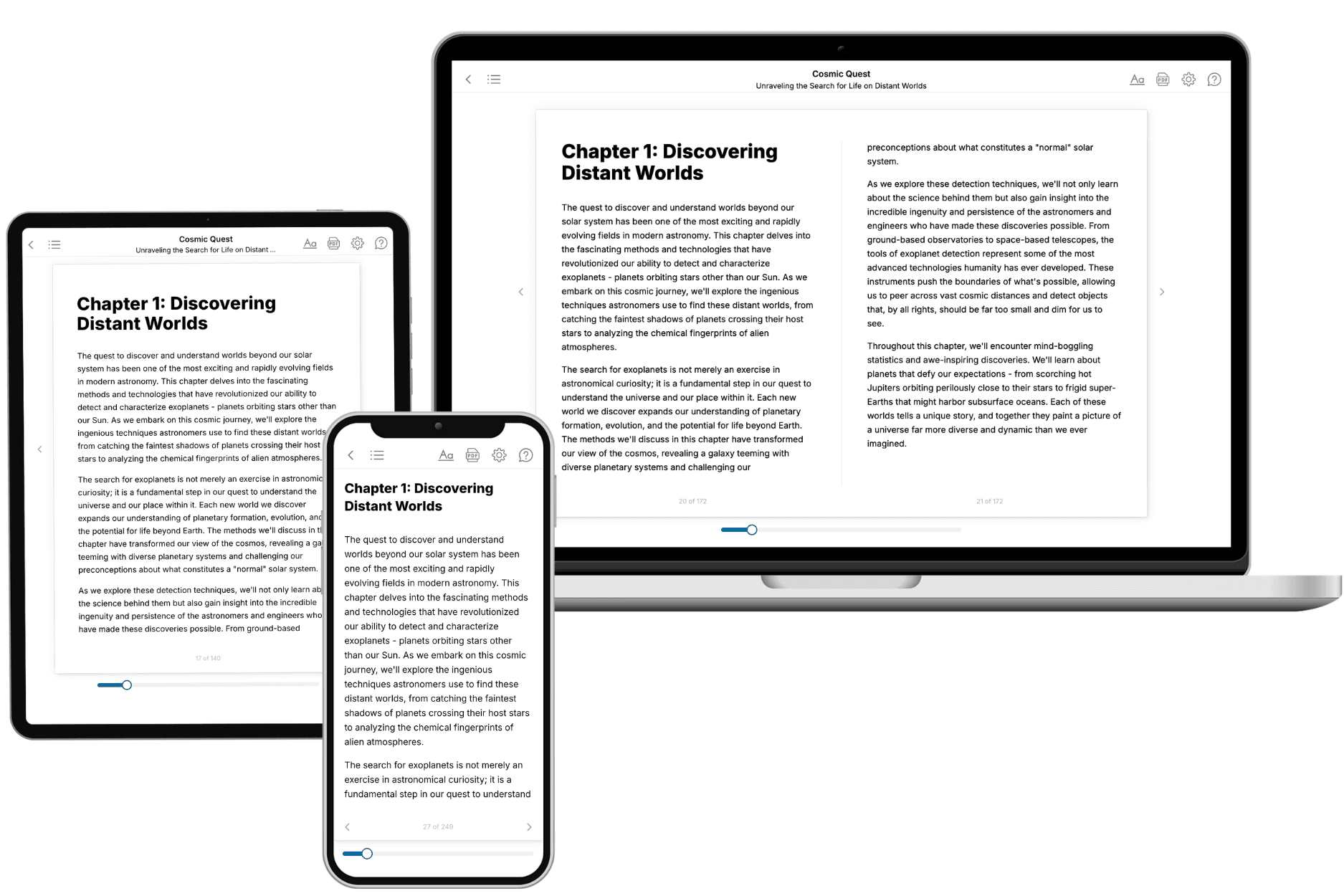
Your book is ready in 10 minutes. Read it online, download as EPUB or PDF, or send to Kindle.
Frequently asked questions
- What is TailoredRead?
TailoredRead creates complete, full-length nonfiction ebooks, written specifically for you. Tell us what you want to learn and why, and TailoredRead writes you a complete ebook on it, with charts, tables, and diagrams throughout. Read it online, on Kindle, or on any e-reader, or download it as a PDF or EPUB. Every book is written fresh the day you order it.
- How is the book tailored to me?
Before anything is written, you answer a few short questions about your goals, your background, and the topics you care about. Your book is then planned around your answers: written at your level, focused on your goals, and covering the topics you chose, instead of the one-size-fits-all book a store sells everyone.
- Will it read like generic AI content?
No. Your book isn't a chat transcript: it's planned chapter by chapter before a single word is written, told in a clear book voice, and explains ideas visually with charts, tables, and diagrams. After writing, every book goes through an editorial pass that polishes chapters so the book reads consistent from start to finish. Judge for yourself: browse thousands of sample books on our Explore Books page.
- How accurate is the content?
Our AI first checks whether your subject needs live research. Niche and fast-moving subjects are researched before writing, and the book plan and chapters are grounded in what it finds. After writing, every book goes through a quality pass that checks its facts and consistency, and researched books list their sources in a Notes section at the back.
- How long is the book?
You choose the length: Comprehensive (250-300 pages), Detailed (150-200 pages), Essential (70-100 pages), or Short (30-50 pages).
- Does the book include visuals?
Yes. Every book includes charts, tables, and diagrams: timelines, checklists, step-by-step guides, decision trees, comparison tables, matrices, and bar charts. A typical book includes dozens of these visual elements.
- Can I read it on Kindle? What formats can I download?
Yes. Every book can be read in our online reader or downloaded as a PDF or EPUB. The EPUB can be opened with Kindle, Apple Books, Kobo, and any e-reader. The Commercial and Author licenses also include an editable Word (DOCX) and Markdown download.
- How much does it cost?
About the price of a regular ebook. The exact price depends on your book's length and complexity, from $2 for the shortest books to $35 for the most comprehensive, and it's shown when you review your book, before you commit to anything. Each book is a one-time purchase, yours to keep, no subscription. Licenses that let you share, teach, or publish your book range from $35.99 to $49.99.
- Can I preview the book before purchasing?
Before you pay, you'll see what your book will cover: the title, a detailed description, the estimated length, and the complete chapter-by-chapter table of contents, so you know what you're getting before you decide. The full text itself is written after you purchase.
- How long does it take to create a book?
About 10 minutes. You can start reading the opening chapters while the rest is still being written.