Charging the Future
How Tesla Built the World's Most Powerful EV Network and Changed Transportation Forever
Discover how Tesla built an infrastructure empire that fundamentally reshaped the automotive industry.
191 pages9 chaptersFeb 1, 2026Business Strategy
About this book
This book traces the Supercharger network from its ambitious origins as a solution to range anxiety, through its explosive global expansion, to its current role as a critical competitive advantage and revenue generator. You'll explore the strategic decisions that made the network possible—from Elon Musk's early conviction that charging infrastructure was essential, to the engineering innovations that made fast charging practical, to the business model evolution that opened the network to competitors. Through detailed analysis of real-world challenges, technological breakthroughs, and market dynamics, you'll understand how Tesla created something far more valuable than a charging network: a blueprint for how technology companies can build infrastructure that becomes indispensable. Whether you're interested in business strategy, automotive innovation, or the future of transportation, this book reveals the decisions, challenges, and insights behind one of the most consequential infrastructure projects of the 21st century.
Table of contents
- IntroductionThe Problem That Started It All: Range Anxiety, Tesla's Audacious Vision for a Global Network, Why the Supercharger Network Matters TodayRead below
- Chapter 1: The Genesis: Why Tesla Needed Its Own Charging NetworkThe Roadster Era and Early Charging Challenges, The Fragmented Charging Landscape of 2010, Elon Musk's Conviction: Infrastructure as Competitive Advantage
- Chapter 2: Engineering the Impossible: Supercharger TechnologyThe Physics and Engineering of Fast Charging, Battery Management Systems and Thermal Control, The Proprietary Connector: A Strategic Choice, Continuous Innovation: V1 to V3 and Beyond
- Chapter 3: The First Superchargers: Building the Network from ScratchSelecting the First Locations: Strategic Site Selection, Real Estate Acquisition and Permitting Challenges, Grid Integration and Power Infrastructure
- Chapter 4: Global Expansion: From North America to the WorldRapid Expansion Across the United States, International Expansion: Europe, Asia, and Beyond, Adapting to Regional Regulations and Infrastructure, Growth Metrics and Network Density
- Chapter 5: The Business Model: How Supercharging Became ProfitablePricing Strategy and Revenue Models, Operational Efficiency and Cost Management, Path to Profitability and Financial Impact
- Chapter 6: Competitive Advantage: Why Others Can't Catch UpNetwork Effects and the Chicken-and-Egg Problem, Vertical Integration: Hardware, Software, and Data, Brand Loyalty and Customer Lock-In, How Competitors Are Responding
- Chapter 7: Opening the Network: The Strategic PivotIndustry Pressure and Standardization Movements, The Decision to Open the Network to Other Manufacturers, Implementation Challenges and Adapter Solutions, Revenue Implications and New Business Opportunities
- Chapter 8: Data, Analytics, and Customer InsightsWhat Tesla Learns from Charging Data, Predictive Analytics and Network Optimization, Understanding Customer Behavior and Preferences
- Chapter 9: The Broader Impact: Accelerating the EV RevolutionHow Superchargers Transformed Industry Expectations, Impact on EV Adoption Rates and Market Growth, Influence on Government Policy and Infrastructure Investment
- ConclusionKey Lessons for Technology and Infrastructure Strategy, The Future of Tesla's Supercharger Network
- Further Reading and Resources
Introduction
On a September evening in 2012, six gleaming white charging stations appeared in a parking lot in Hawthorne, California. They looked almost sculptural—sleek pillars with glowing Tesla logos, each connected to a Model S sedan. This was the world's first glimpse of the Supercharger network, and it represented something far more ambitious than a convenient place to charge electric vehicles. It was the physical manifestation of a radical bet: that the future of transportation depended not just on building better cars, but on building the infrastructure that would make those cars practical for millions of people. While competitors focused exclusively on vehicle development, Tesla was simultaneously constructing an entirely new category of infrastructure that would become one of its most valuable competitive advantages.
The Supercharger network solved a problem that had plagued electric vehicles since their inception—the anxiety that comes from limited range and uncertain charging availability. Traditional automakers assumed that charging infrastructure would emerge organically, developed by third parties, utilities, or governments. Tesla took the opposite approach, recognizing that waiting for others to build infrastructure would doom electric vehicles to remain niche products for early adopters willing to tolerate inconvenience. By taking control of the charging experience, Tesla could ensure reliability, speed, and seamless integration with its vehicles. This decision to vertically integrate charging infrastructure alongside vehicle production was unconventional, capital-intensive, and risky. It was also transformative.
Today, the Supercharger network spans more than 50,000 individual charging stalls across thousands of locations on six continents. It has enabled millions of long-distance trips that would have been impossible or impractical with earlier electric vehicles. The network has evolved from a customer amenity into a significant business operation, generating revenue while simultaneously serving as a powerful marketing tool and competitive moat. More importantly, it fundamentally changed the conversation around electric vehicle adoption. Before Superchargers, the question was whether EVs could ever be practical for anything beyond local commuting. After Superchargers, the question became when—not if—electric vehicles would replace combustion engines entirely. This book examines how Tesla built this infrastructure empire, the strategic decisions that shaped its development, and the lessons it offers for anyone interested in technology strategy, infrastructure development, or the future of transportation.
The Problem That Started It All: Range Anxiety
Range anxiety is the fear that an electric vehicle will run out of power before reaching a charging station, leaving the driver stranded. This psychological barrier has proven more powerful than the actual limitations of EV technology. Even when electric vehicles offered sufficient range for the vast majority of daily driving needs, the possibility of being stranded created a perception problem that prevented mainstream adoption. Surveys conducted in the early 2010s consistently showed that range anxiety ranked as the primary concern preventing consumers from considering electric vehicles, even among environmentally conscious buyers who were otherwise enthusiastic about the technology[1]. This wasn't entirely irrational—early electric vehicles like the Nissan Leaf offered only 73 miles of range, and public charging infrastructure was sparse, unreliable, and incompatible across different networks.
The problem extended beyond simple mathematics of range and distance. Unlike gasoline vehicles, where refueling takes five minutes at ubiquitous gas stations, early EV charging required hours and depended on finding compatible charging equipment. Public charging stations were often broken, occupied, or required multiple apps and payment systems to access. A driver planning a long trip in an electric vehicle faced a complex optimization problem: calculating range based on terrain, weather, and driving speed, then identifying charging stations along the route, verifying their operational status, and building in substantial time buffers for charging stops. This cognitive burden transformed what should have been a simple road trip into an exercise in logistics and risk management. The result was that electric vehicles remained confined to a narrow use case—short-range urban commuting by owners with home charging capability.
Traditional automakers approached this problem by assuming infrastructure would develop independently. They built electric vehicles with standard charging ports and expected that third-party networks, utilities, or government initiatives would gradually fill the infrastructure gap. This created a classic chicken-and-egg problem: consumers wouldn't buy electric vehicles without charging infrastructure, but companies wouldn't invest in charging infrastructure without a substantial population of electric vehicles to serve. The few charging networks that did emerge were fragmented, operated by different companies with incompatible payment systems and varying reliability standards. A driver might need accounts with ChargePoint, Blink, EVgo, and several other networks to access charging stations across a single state. This fragmentation reinforced the perception that electric vehicles were impractical for anyone who couldn't charge exclusively at home.
Tesla recognized that solving range anxiety required more than incremental improvements to battery technology. The company needed to address the psychological dimension of the problem—the fear and uncertainty that prevented people from even considering an electric vehicle. This meant creating an experience where long-distance travel felt not just possible but effortless. The solution required three elements working in concert:
- Sufficient vehicle range to make charging stops infrequent enough to feel comparable to gasoline refueling patterns
- Fast charging capability to minimize the time spent at charging stations, reducing the trip time penalty
- Reliable, convenient charging infrastructure positioned along major travel corridors with guaranteed availability and seamless payment
The Model S, launched in 2012, addressed the first requirement with up to 265 miles of range—substantially more than any previous electric vehicle. But range alone wasn't sufficient. Tesla needed to ensure that drivers could recharge quickly and reliably anywhere they wanted to travel. This realization led to the Supercharger concept: a proprietary fast-charging network that would be as reliable as Tesla's vehicles themselves, positioned strategically to enable long-distance travel, and integrated seamlessly into the vehicle's navigation and payment systems. Rather than hoping someone else would solve the infrastructure problem, Tesla would build the solution itself, treating charging infrastructure as an essential component of the product rather than an external dependency.
The decision to build proprietary infrastructure was controversial even within Tesla. It required enormous capital investment at a time when the company was struggling to ramp Model S production and burning cash rapidly. Critics argued that Tesla should focus its limited resources on vehicle development and let the market solve the charging problem. But Elon Musk understood something fundamental: the Supercharger network wasn't just about solving a technical problem. It was about changing the narrative around electric vehicles. Every Supercharger station served as physical proof that long-distance EV travel was practical. Every successful road trip shared by a Tesla owner on social media demonstrated that range anxiety was a solvable problem. The network became both infrastructure and marketing, both utility and competitive advantage.
Range anxiety also had a temporal dimension that Tesla exploited strategically. While the fear of running out of charge was immediate and visceral, the actual frequency of long-distance travel for most drivers was relatively low. Studies showed that the average American driver travels less than 40 miles per day, well within the range of even early electric vehicles[2]. The challenge was that people made vehicle purchase decisions based on their occasional needs—the annual road trip, the unexpected emergency, the possibility of a long drive—rather than their typical daily patterns. By building the Supercharger network, Tesla addressed these edge cases, allowing customers to purchase based on their actual daily needs while maintaining confidence that the vehicle could handle exceptional situations. This psychological shift was crucial in moving electric vehicles from niche products to mainstream consideration.
Tesla's Audacious Vision for a Global Network
When Tesla unveiled the first Supercharger stations in September 2012, the company simultaneously announced an audacious goal: to enable free long-distance travel across the United States and eventually the world. This wasn't a modest pilot program or a limited regional initiative. Tesla committed to building a comprehensive network that would make electric vehicle travel as convenient as gasoline vehicle travel, and to do so within just a few years. The initial announcement included plans for stations covering major highways connecting San Francisco to Los Angeles and New York to Washington, D.C., with expansion to cover most of the United States by 2015. This timeline seemed impossibly aggressive given the complexity of site acquisition, permitting, utility connections, and construction required for each location.
The vision extended far beyond simply placing charging stations along highways. Tesla designed the Supercharger experience to be fundamentally different from traditional refueling. Stations would be located near amenities—restaurants, shopping centers, rest areas—where drivers could productively use their charging time. The charging process would be completely automated: drivers would simply plug in, and the vehicle would handle authentication, payment, and charging management without any additional interaction. Navigation systems would automatically route drivers through Supercharger stations on long trips, calculating optimal charging stops based on real-time data about station availability, vehicle battery level, and route conditions. This level of integration required controlling the entire stack—vehicle hardware, charging hardware, software, and network operations—which is why Tesla's vertical integration strategy was essential to the vision.
The global ambition was present from the beginning, even when Tesla had only a handful of stations in California. Elon Musk described a future where Tesla owners could drive from London to Moscow, from Beijing to Shanghai, from Los Angeles to New York, all using the Supercharger network. This vision required not just building thousands of charging stations but navigating vastly different regulatory environments, electrical standards, real estate markets, and business practices across dozens of countries. Each market presented unique challenges:
- Europe required adapting to different electrical standards, multiple languages, and complex cross-border regulations while competing with established charging networks
- China demanded partnerships with local entities, compliance with government mandates for charging standards, and rapid expansion to match the world's largest EV market
- Australia presented challenges of vast distances between population centers and limited electrical infrastructure in remote areas
- Developing markets required creative solutions for unreliable electrical grids and limited real estate options
Tesla's network vision also included a commitment to renewable energy that aligned with the company's broader mission. Early Supercharger stations incorporated solar canopies and battery storage systems, demonstrating that the network could eventually operate independently of fossil fuel-based electrical grids. While the economics of solar-powered charging proved challenging—the energy density required for fast charging exceeded what rooftop solar could practically provide—the symbolic value was significant. It reinforced Tesla's positioning as an environmental company rather than simply an automotive company, and it provided a proof of concept for future integration of renewable energy and energy storage with transportation infrastructure.
The financial model underlying this vision was equally bold. Initially, Tesla offered free Supercharging for life to early Model S buyers, treating the network as a customer acquisition cost rather than a profit center. This decision was strategically brilliant but financially risky. It removed any friction from the charging experience—no payment systems, no price anxiety, no comparison shopping—making Supercharging feel like a natural extension of vehicle ownership. However, it also meant that Tesla was committing to provide free electricity indefinitely to a growing fleet of vehicles, with costs that would scale with both network usage and electricity prices. The company was betting that the competitive advantage and customer loyalty generated by free Supercharging would outweigh the ongoing operational costs.
Critics questioned whether Tesla could possibly execute on such an ambitious vision while simultaneously scaling vehicle production, developing new models, and managing the countless other challenges facing a young automotive company. The capital requirements alone seemed prohibitive—each Supercharger station cost hundreds of thousands of dollars to build, and the vision required thousands of stations. Traditional automotive wisdom suggested that infrastructure should be someone else's problem, that Tesla should focus on its core competency of building vehicles. But Tesla's leadership understood that the Supercharger network wasn't a distraction from the core business—it was an essential enabler of the core business. Without the network, Tesla vehicles would remain niche products. With the network, they could compete directly with gasoline vehicles on practicality.
The vision also included a temporal dimension that demonstrated sophisticated strategic thinking. Tesla didn't need the complete global network to exist immediately; it needed to demonstrate credible progress toward that vision. Each new Supercharger station served as proof that the vision was real, that Tesla was committed to solving the infrastructure problem, and that the company had the execution capability to deliver on ambitious promises. This created a virtuous cycle: network expansion made Tesla vehicles more attractive, increasing sales and generating capital for further network expansion. The vision itself became a competitive advantage, differentiating Tesla from competitors who offered only vague promises about future charging infrastructure that would supposedly be built by others.
By 2024, much of Tesla's original vision has been realized. The Supercharger network covers all major travel corridors in North America, Europe, and China, with expanding coverage in other markets. Drivers can travel coast-to-coast across the United States, traverse Europe from Scandinavia to the Mediterranean, or drive across China's vast distances, all using Superchargers. The network has grown from six stations in 2012 to over 5,000 stations with more than 50,000 individual charging stalls globally[3]. What seemed impossibly ambitious in 2012 has become operational reality, fundamentally changing the practical viability of electric vehicles and forcing every automotive manufacturer to reconsider their infrastructure strategies.
Why the Supercharger Network Matters Today
The Supercharger network's significance extends far beyond its immediate function of charging Tesla vehicles. It represents a case study in how technology companies can create competitive advantages through infrastructure investment, how vertical integration enables superior customer experiences, and how solving fundamental barriers to adoption can accelerate entire industry transitions. For business strategists, the Supercharger story offers lessons about the value of controlling critical dependencies, the power of network effects, and the strategic timing of opening proprietary systems. For technology professionals, it demonstrates how hardware, software, and data integration can create experiences that competitors struggle to replicate. For anyone interested in the future of transportation, it shows how infrastructure decisions shape market outcomes and influence the pace of technological change.
The network's competitive impact has become increasingly apparent as the EV market has matured. Tesla's early investment in charging infrastructure created a moat that competitors are still struggling to cross. When traditional automakers finally committed to electric vehicles in the late 2010s, they discovered that building competitive vehicles was only half the challenge—they also needed to address the charging experience. This led to a flurry of infrastructure initiatives: Volkswagen's Electrify America network (funded by diesel emissions settlement money), partnerships between automakers to build shared charging networks, and massive investments by charging companies like EVgo and ChargePoint. Yet none of these efforts have matched the Supercharger network's combination of coverage, reliability, and user experience. The result is that Tesla maintains a significant advantage in customer satisfaction and brand loyalty, even as competitors have closed the gap in vehicle technology.
The network's evolution into a profit center represents another dimension of strategic importance. What began as a customer amenity and competitive differentiator has become a significant business operation in its own right. Tesla has progressively refined its pricing strategy, moving from free lifetime Supercharging to pay-per-use models with dynamic pricing based on demand and electricity costs. The company has also begun opening the network to non-Tesla vehicles, creating an entirely new revenue stream while simultaneously positioning itself as a neutral infrastructure provider. This evolution demonstrates how infrastructure investments can generate multiple forms of value over time:
- Customer acquisition value by removing barriers to EV adoption and differentiating Tesla from competitors
- Customer retention value by creating switching costs and ecosystem lock-in
- Direct revenue from charging fees paid by Tesla and non-Tesla customers
- Data value from insights into driving patterns, charging behavior, and vehicle performance
- Strategic optionality by creating leverage in negotiations with other automakers, utilities, and governments
The Supercharger network also matters because it influenced policy and accelerated the broader EV transition. Governments worldwide have committed hundreds of billions of dollars to charging infrastructure development, partly inspired by Tesla's demonstration that comprehensive networks are both technically feasible and strategically valuable. The European Union's requirement that all new vehicles sold after 2035 be zero-emission would be impractical without the charging infrastructure that Tesla helped prove was possible. Similarly, the U.S. Infrastructure Investment and Jobs Act allocated $7.5 billion for EV charging infrastructure, explicitly aiming to create a national network comparable to what Tesla built privately. The Supercharger network didn't just serve Tesla's business interests—it changed policymakers' understanding of what was possible and necessary for the EV transition.
From a technology perspective, the Supercharger network showcases the power of vertical integration and systems thinking. Tesla didn't just build charging stations; it created an integrated system where vehicles, chargers, software, and network operations work together seamlessly. The vehicle knows the location, availability, and current usage of every Supercharger station. It can precondition the battery for optimal charging speed as it approaches a station. It can automatically route drivers to less congested stations when multiple options exist. It can push software updates to both vehicles and chargers to improve performance and add features. This level of integration is only possible when a single company controls all the components, and it creates an experience that third-party charging networks cannot easily replicate even with superior hardware.
The network's data collection capabilities represent another dimension of strategic value that is often underappreciated. Every charging session generates data about vehicle performance, battery degradation, charging patterns, and customer behavior. Aggregated across millions of charging sessions, this data provides Tesla with unprecedented insights into how electric vehicles are actually used in the real world. This information feeds back into vehicle design, battery development, software optimization, and network expansion planning. It also provides Tesla with valuable information about travel patterns and demand that could be monetized in various ways—from optimizing station placement to informing autonomous vehicle routing algorithms to partnering with retail and hospitality businesses seeking to attract EV drivers.
The Supercharger story also matters because it challenges conventional wisdom about business strategy and competitive advantage. Traditional strategic thinking suggests that companies should focus on their core competencies and outsource or partner for everything else. Tesla did the opposite, taking on the enormous complexity and capital requirements of building global infrastructure because leadership recognized that charging was too critical to leave to others. This decision was controversial and risky, but it created a competitive advantage that has proven durable and valuable. The lesson is that sometimes the most important strategic decisions involve taking on challenges that conventional wisdom says you should avoid, particularly when those challenges represent fundamental barriers to customer adoption.
Finally, the Supercharger network matters because it demonstrates how infrastructure can accelerate technology adoption curves. The history of technology is filled with examples where infrastructure availability determined the pace of adoption—railroads, electricity grids, telephone networks, internet connectivity. In each case, the technology's potential couldn't be realized until the supporting infrastructure reached critical mass. Tesla recognized this pattern and refused to wait for others to build the infrastructure that electric vehicles required. By taking infrastructure development into its own hands, Tesla compressed the timeline for EV adoption by years or possibly decades. This has implications far beyond automotive—it suggests that companies introducing transformative technologies should carefully consider whether infrastructure development should be part of their strategy rather than an external dependency.
This book examines the Supercharger network from multiple perspectives: the strategic decisions that shaped its development, the technical innovations that made it possible, the operational challenges of building and maintaining global infrastructure, the competitive dynamics it created, and the broader impact on the EV industry and transportation future. Each chapter explores a different dimension of the network's story, providing insights that are relevant whether your interest is business strategy, technology development, infrastructure planning, or the future of mobility. The Supercharger network is more than a collection of charging stations—it's a blueprint for how companies can build infrastructure that becomes indispensable, and a case study in how bold strategic bets can reshape entire industries.
Notes
Introduction
- 1. T. Franke and J. F. Krems, Understanding charging behaviour of electric vehicle users, Transportation Research Part F: Traffic Psychology and Behaviour, 2013
- 2. U.S. Department of Transportation and Federal Highway Administration, 2017 National Household Travel Survey, 2017
- 3. Inc Tesla, Supercharger Network Statistics, Retrieved from Tesla.com, 2024
This is the end of the free sample. The full book has 9 chapters.
Want this book written for you?
Tell us your goals and background, and get your own version of this book, tailored by AI to you.


Benefits of AI-tailored books
- Read one book, not ten:
- all the Business Strategy knowledge you need, gathered into a single book.
- Save days of learning:
- tell us your goals, choose your topics, and the whole book is built around them.
- Learn effortlessly:
- Business Strategy book written for your specific background and expertise.
- Understand at a glance:
- includes charts, tables, timelines, checklists, decision trees, and more.
- Stay current:
- written the day you order it, not years ago.
- Trust what you read:
- every book is checked for accuracy, with real research when your subject needs it.
Create your unique book in 3 steps
- 1. Select your focus
Select the focus of your Business Strategy book and share your background
- 2. Personalize your book
Specify your goals and choose sub-topics to include
- 3. Get your tailored book
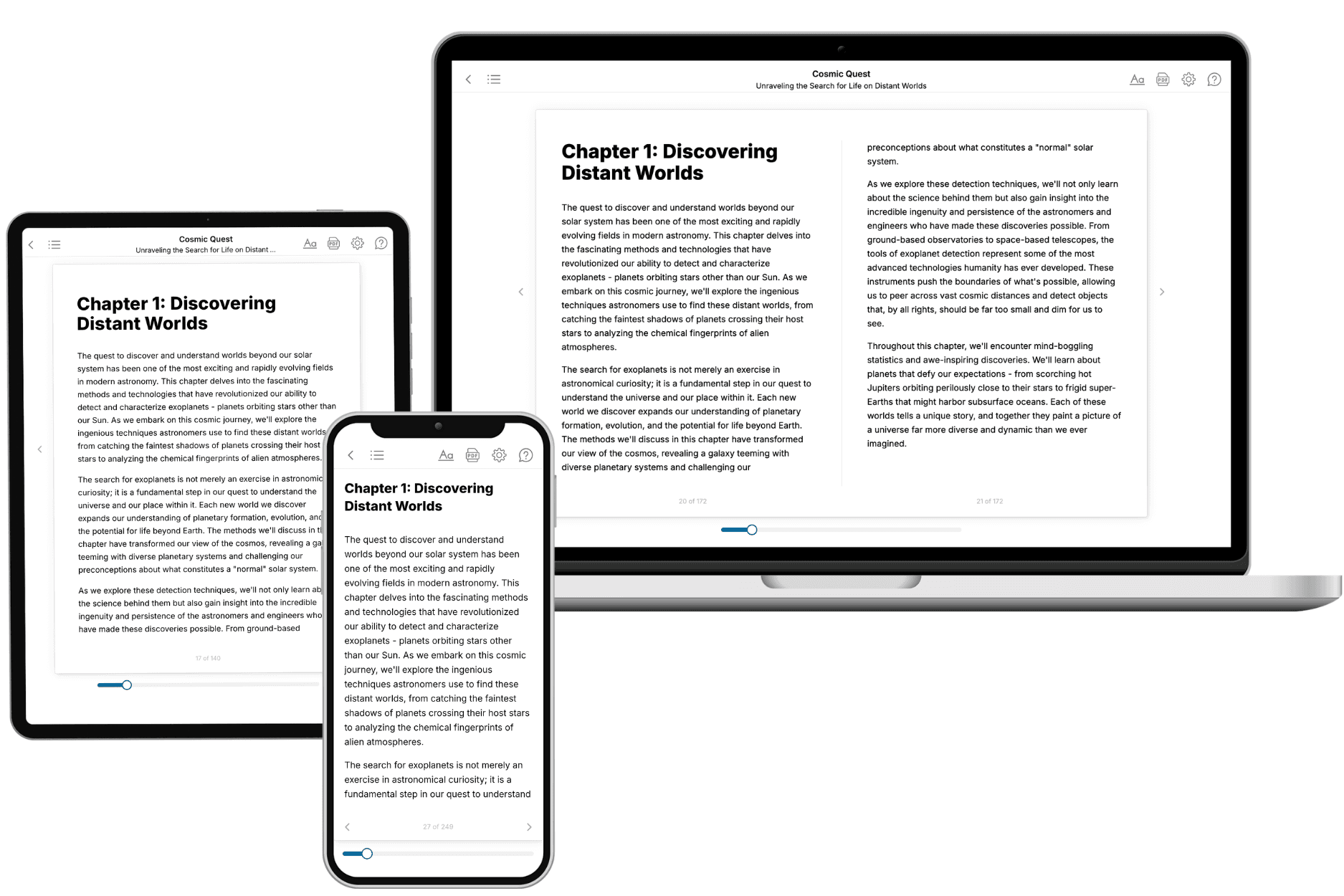
Your book is ready in 10 minutes. Read it online, download as EPUB or PDF, or send to Kindle.

Frequently asked questions
- What is TailoredRead?
TailoredRead creates complete, full-length nonfiction ebooks, written specifically for you. Tell us what you want to learn and why, and TailoredRead writes you a complete ebook on it, with charts, tables, and diagrams throughout. Read it online, on Kindle, or on any e-reader, or download it as a PDF or EPUB. Every book is written fresh the day you order it.
- How is the book tailored to me?
Before anything is written, you answer a few short questions about your goals, your background, and the topics you care about. Your book is then planned around your answers: written at your level, focused on your goals, and covering the topics you chose, instead of the one-size-fits-all book a store sells everyone.
- Will it read like generic AI content?
No. Your book isn't a chat transcript: it's planned chapter by chapter before a single word is written, told in a clear book voice, and explains ideas visually with charts, tables, and diagrams. After writing, every book goes through an editorial pass that polishes chapters so the book reads consistent from start to finish. Judge for yourself: browse thousands of sample books on our Explore Books page.
- How accurate is the content?
Our AI first checks whether your subject needs live research. Niche and fast-moving subjects are researched before writing, and the book plan and chapters are grounded in what it finds. After writing, every book goes through a quality pass that checks its facts and consistency, and researched books list their sources in a Notes section at the back.
- How long is the book?
You choose the length: Comprehensive (250-300 pages), Detailed (150-200 pages), Essential (70-100 pages), or Short (30-50 pages).
- Does the book include visuals?
Yes. Every book includes charts, tables, and diagrams: timelines, checklists, step-by-step guides, decision trees, comparison tables, matrices, and bar charts. A typical book includes dozens of these visual elements.
- Can I read it on Kindle? What formats can I download?
Yes. Every book can be read in our online reader or downloaded as a PDF or EPUB. The EPUB can be opened with Kindle, Apple Books, Kobo, and any e-reader. The Commercial and Author licenses also include an editable Word (DOCX) and Markdown download.
- How much does it cost?
About the price of a regular ebook. The exact price depends on your book's length and complexity, from $2 for the shortest books to $35 for the most comprehensive, and it's shown when you review your book, before you commit to anything. Each book is a one-time purchase, yours to keep, no subscription. Licenses that let you share, teach, or publish your book range from $35.99 to $49.99.
- Can I preview the book before purchasing?
Before you pay, you'll see what your book will cover: the title, a detailed description, the estimated length, and the complete chapter-by-chapter table of contents, so you know what you're getting before you decide. The full text itself is written after you purchase.
- How long does it take to create a book?
About 10 minutes. You can start reading the opening chapters while the rest is still being written.