The Cipher's Evolution
From Enigma's Rotors to Modern Symmetric Key Algorithms
Picture yourself confidently designing secure communication systems, understanding not just what makes encryption work, but why certain approaches succeed while others fail spectacularly.
331 pages17 chaptersOct 3, 2025Cryptography Algorithms
About this book
You'll trace the fascinating evolution from the mechanical ingenuity of the Enigma machine to the mathematical elegance of today's Advanced Encryption Standard, gaining insights that textbooks rarely provide. This comprehensive exploration takes you inside the world of symmetric key cryptography, where the same key that locks your message also unlocks it. You'll discover how the Enigma's rotating wheels and plugboard connections laid the groundwork for concepts still used in modern algorithms, and why understanding these historical foundations is crucial for anyone working with contemporary cryptographic systems. Through detailed analysis of both classical and cutting-edge algorithms, you'll master the mathematical principles that govern symmetric encryption, learn to identify vulnerabilities that have toppled seemingly unbreakable codes, and understand the delicate balance between computational efficiency and cryptographic strength. Each chapter builds upon the last, creating a complete picture of how symmetric key algorithms protect everything from your online banking to military communications. Whether you're developing secure applications, studying cybersecurity, or simply fascinated by the intersection of mathematics and history, this book provides the deep understanding you need to navigate the complex world of modern cryptography with confidence and expertise.
Table of contents
- IntroductionThe Foundations of Cryptographic Thinking, Symmetric vs Asymmetric: Understanding the Divide, From Ancient Ciphers to Digital Age, Your Journey Through Symmetric CryptographyRead below
- Chapter 1: The Enigma Machine: Mechanical Cryptography PerfectedBirth of a Cryptographic Legend, Rotors, Reflectors, and Plugboards, How Enigma Transformed Messages, Daily Keys and Operational Security
- Chapter 2: Mathematical Principles Behind EnigmaPolyalphabetic Substitution Mechanics, Group Theory and Rotor Mathematics, Calculating Enigma's Theoretical Strength, Rotor Stepping and Cipher Periods
- Chapter 3: Cryptanalysis: How Enigma Was BrokenEarly Polish Cryptanalytic Methods, Bletchley Park's Systematic Approach, The Bombe: Mechanizing Cryptanalysis, Human Error and Protocol Weaknesses
- Chapter 4: Fundamentals of Symmetric Key CryptographyEssential Properties of Symmetric Systems, Shannon's Principles of Confusion and Diffusion, One-Time Pads and Perfect Secrecy, Real-World Limitations and Trade-offs
- Chapter 5: Stream Ciphers: Digital Descendants of EnigmaHow Stream Ciphers Work, Linear Feedback Shift Registers, RC4: Strengths and Vulnerabilities, ChaCha20 and Contemporary Stream Ciphers
- Chapter 6: Introduction to Block CiphersBlock Cipher Fundamentals, Feistel Networks and Their Properties, Substitution-Permutation Networks, Key Schedule Algorithms
- Chapter 7: Data Encryption Standard (DES)Development and Standardization of DES, DES Algorithm Structure and Operations, S-Box Design and Cryptographic Properties, Differential and Linear Cryptanalysis of DES
- Chapter 8: Triple DES and Transitional AlgorithmsEDE and EEE Configurations, Two-Key and Three-Key Triple DES, Meet-in-the-Middle Attacks, Bridging DES to Modern Standards
- Chapter 9: Advanced Encryption Standard (AES) DevelopmentThe AES Selection Process, Rijndael's Innovative Approach, Serpent, Twofish, and Other Finalists, Security, Performance, and Implementation Factors
- Chapter 10: AES Algorithm Deep DiveRound Function and State Array, SubBytes and the Rijndael S-Box, MixColumns and Galois Field Arithmetic, AES Key Expansion Algorithm
- Chapter 11: Modes of OperationElectronic Codebook and Cipher Block Chaining, Cipher Feedback and Output Feedback, Counter Mode and Its Advantages, GCM, CCM, and Authenticated Encryption
- Chapter 12: Key Management and DistributionCryptographically Secure Random Number Generation, Key Derivation Functions and Password-Based Keys, Symmetric Key Exchange Protocols, Key Storage, Rotation, and Destruction
- Chapter 13: Modern Cryptanalytic TechniquesDifferential Cryptanalysis Principles, Linear Cryptanalysis and Approximations, Algebraic and Integral Cryptanalysis, Side-Channel Attacks and Countermeasures
- Chapter 14: Implementation Security and PerformanceConstant-Time Implementation Techniques, AES-NI and Hardware Acceleration, Software Optimization Strategies, Balancing Security and Performance
- Chapter 15: Lightweight CryptographyResource Constraints in IoT Devices, PRESENT, CLEFIA, and Lightweight Block Ciphers, Design Principles for Constrained Environments, NIST Lightweight Cryptography Standardization
- Chapter 16: Post-Quantum Symmetric CryptographyQuantum Computing Threats to Cryptography, Symmetric Algorithms' Quantum Resistance, Key Length Requirements in Quantum Era, Hybrid Classical-Quantum Resistant Systems
- Chapter 17: Future Directions and Emerging TrendsHomomorphic Encryption and Privacy-Preserving Computation, White-Box Cryptography Applications, Machine Learning in Cryptanalysis, Next-Generation Symmetric Algorithm Design
- Conclusion
- Glossary
- Further Reading
Introduction
The story of symmetric key cryptography begins with a simple yet profound challenge: how do you keep a secret when you must share it? This fundamental paradox has driven centuries of innovation, from the mechanical ingenuity of rotor-based cipher machines to the mathematical elegance of modern digital algorithms. Every time you make an online purchase, send a secure message, or access your bank account, you're relying on cryptographic principles that trace their lineage back through decades of evolution, refinement, and hard-learned lessons from both spectacular successes and catastrophic failures.
The Enigma machine stands as perhaps the most famous example of symmetric key cryptography in action, representing both the pinnacle of mechanical cipher design and a cautionary tale about the importance of proper implementation and operational security. Its rotating wheels, electrical pathways, and daily key changes embodied sophisticated cryptographic concepts that remain relevant today. Yet Enigma's eventual defeat at Bletchley Park revealed vulnerabilities that continue to inform modern algorithm design, demonstrating that mathematical strength alone cannot guarantee security without careful attention to implementation details and human factors.
Modern symmetric algorithms like the Advanced Encryption Standard (AES) represent the culmination of this evolutionary process, incorporating lessons learned from historical failures while leveraging advanced mathematical structures that would have been impossible to implement in mechanical systems. These algorithms protect trillions of dollars in digital transactions, secure military communications across the globe, and safeguard the personal data of billions of users. Understanding their development, implementation, and ongoing evolution provides essential insights for anyone working with contemporary cryptographic systems.
This exploration takes you on a journey through time and mathematics, connecting the dots between mechanical rotors and digital transformations, between wartime codebreaking and modern cybersecurity challenges. You'll discover how the fundamental principles of confusion and diffusion, first articulated by Claude Shannon, manifest in both Enigma's rotor stepping and AES's round functions. You'll see how the key management challenges that plagued World War II communications continue to shape modern protocol design, and how the cryptanalytic techniques that broke historical ciphers inform today's security assessments.
The Foundations of Cryptographic Thinking
Cryptographic thinking begins with understanding that security is not just about mathematical complexity, but about the entire ecosystem in which an algorithm operates. The most mathematically sound cipher can be rendered useless by poor key management, predictable implementation patterns, or operational security failures. This holistic perspective emerged from hard-won experience, particularly during World War II when the theoretical strength of systems like Enigma proved insufficient against determined adversaries who understood that breaking codes often meant exploiting human weaknesses rather than mathematical ones.
The concept of computational security forms the bedrock of modern cryptographic design, representing a fundamental shift from the perfect security of systems like one-time pads to practical security that balances mathematical strength with real-world usability. This approach recognizes that absolute security often comes at the cost of practicality, and that effective cryptographic systems must find the optimal balance between these competing demands. Consider how AES-128 provides security equivalent to searching through 2^128 possible keys—a task that would require more energy than exists in the observable universe to complete using conventional computing methods.
The principle of Kerckhoffs's maxim fundamentally shapes how we approach cryptographic design today, stating that the security of a cryptographic system should depend only on the secrecy of the key, not on the secrecy of the algorithm itself. This principle, formulated in the 19th century, proved prophetic during World War II when the Allies' ability to capture Enigma machines and understand their mechanical operation did not immediately break German communications. The security resided in the daily key settings, not in the machine's design. Modern algorithms like AES embrace this principle completely, with their specifications published openly and subjected to years of public scrutiny before adoption.
Understanding threat models represents another crucial foundation of cryptographic thinking, requiring designers and implementers to clearly define what they're protecting against and what assumptions they're making about their adversaries. The Enigma machine was designed to resist casual interception and basic cryptanalytic attacks, but its designers likely never anticipated the industrial-scale codebreaking operation that emerged at Bletchley Park. Modern symmetric algorithms must consider threats ranging from passive eavesdropping to active manipulation, from classical computers to potential quantum adversaries, and from mathematical attacks to side-channel analysis of physical implementations.
The concept of defense in depth emerges naturally from studying historical cryptographic failures, demonstrating that robust security requires multiple layers of protection rather than reliance on a single strong algorithm. Even if Enigma's basic cipher had been unbreakable, operational security failures like repeated message keys, predictable message formats, and captured codebooks provided alternative attack vectors. Modern cryptographic systems incorporate this lesson through techniques like authenticated encryption, which combines confidentiality and integrity protection, and through careful protocol design that considers how algorithms interact with their operational environment.
The evolution from mechanical to digital cryptography also highlights the importance of implementation security, where the gap between theoretical algorithm strength and practical security can be enormous. Enigma's mechanical implementation provided certain natural protections against some types of analysis while creating vulnerabilities in others. Digital implementations face different challenges, including side-channel attacks that exploit power consumption patterns, timing variations, or electromagnetic emissions. Understanding these implementation considerations is crucial for anyone working with modern symmetric algorithms, as even perfectly designed algorithms can be compromised by careless implementation.
Finally, cryptographic thinking requires appreciation for the economic and practical constraints that shape real-world security decisions. The most secure algorithm is useless if it's too slow, too expensive, or too complex for its intended application. Enigma represented a practical compromise for its era, providing reasonable security with acceptable operational complexity for field use. Modern lightweight cryptography continues this tradition, developing algorithms specifically designed for resource-constrained environments like IoT devices, where traditional algorithms like AES might be too demanding in terms of power consumption, memory requirements, or computational overhead.
Symmetric vs Asymmetric: Understanding the Divide
The fundamental distinction between symmetric and asymmetric cryptography lies in their approach to the key distribution problem—the challenge of securely sharing cryptographic keys between communicating parties. Symmetric systems like Enigma and AES use the same key for both encryption and decryption, creating an elegant mathematical symmetry but requiring secure key distribution mechanisms. Asymmetric systems use different keys for encryption and decryption, solving the key distribution problem but introducing computational complexity that makes them impractical for bulk data encryption. Understanding this trade-off is essential for appreciating why symmetric algorithms remain the workhorses of modern cryptography despite the theoretical elegance of public-key systems.
The performance characteristics of symmetric algorithms make them indispensable for high-throughput applications where speed and efficiency are paramount. Modern symmetric algorithms like AES can encrypt data at rates exceeding several gigabytes per second on contemporary hardware, while asymmetric algorithms typically operate at speeds measured in kilobytes per second for equivalent security levels. This performance difference stems from the mathematical operations involved: symmetric algorithms rely on relatively simple operations like substitutions, permutations, and XOR operations that can be efficiently implemented in both software and hardware, while asymmetric algorithms require complex mathematical operations involving large integers or elliptic curve points.
The key management paradigm in symmetric cryptography creates both challenges and opportunities that shape how these systems are deployed in practice. Every pair of communicating parties must share a unique secret key, leading to a quadratic growth in the number of keys required as the network size increases. For n parties, a fully connected network requires n(n-1)/2 unique keys. However, this apparent limitation becomes a strength in many applications where centralized key management is feasible, such as in corporate networks or cloud services where a central authority can securely distribute keys to all participants.
The concept of perfect forward secrecy illustrates how symmetric and asymmetric cryptography complement each other in modern protocols. While symmetric algorithms excel at bulk encryption, they traditionally struggle with forward secrecy—the property that compromise of long-term keys doesn't compromise past communications. Asymmetric algorithms naturally provide forward secrecy through ephemeral key exchange, but their computational overhead makes them unsuitable for encrypting large amounts of data. Modern protocols like TLS elegantly combine both approaches, using asymmetric cryptography to establish temporary symmetric keys that provide both efficiency and forward secrecy.
The mathematical foundations of symmetric cryptography differ fundamentally from those of asymmetric systems, leading to different security assumptions and attack vectors. Symmetric algorithms typically base their security on the difficulty of distinguishing their output from random data, or on the computational infeasibility of recovering keys through exhaustive search or sophisticated cryptanalytic techniques. Asymmetric algorithms rely on specific mathematical problems like integer factorization or discrete logarithms that are believed to be computationally hard. This difference means that advances in mathematics or computing technology can affect the two types of systems differently.
The implementation complexity of symmetric algorithms generally favors their adoption in resource-constrained environments and safety-critical applications where simplicity reduces the attack surface and improves reliability. Symmetric algorithms like AES can be implemented in a few hundred lines of code and verified through extensive testing and formal analysis. Asymmetric implementations require careful handling of large numbers, protection against timing attacks, and sophisticated mathematical libraries that increase both the complexity and the potential for implementation errors. This simplicity advantage becomes crucial in applications like embedded systems, IoT devices, and high-assurance environments.
The quantum computing threat affects symmetric and asymmetric cryptography differently, highlighting another important distinction between these approaches. Grover's quantum algorithm can effectively halve the security level of symmetric algorithms, meaning that AES-128 provides only 64 bits of security against quantum adversaries. However, this threat can be addressed by simply doubling key lengths—AES-256 remains secure against known quantum attacks. Asymmetric algorithms face more severe threats from quantum computers, with Shor's algorithm potentially breaking all widely-used public-key systems based on integer factorization or discrete logarithms. This differential impact means that symmetric cryptography will likely remain relevant even in a post-quantum world, while asymmetric cryptography requires fundamental redesign.
Understanding the hybrid approach that dominates modern cryptographic protocols reveals how symmetric and asymmetric systems work together to overcome their individual limitations. Internet protocols like TLS, IPsec, and Signal use asymmetric cryptography for initial authentication and key establishment, then switch to symmetric algorithms for the actual data encryption. This approach leverages the key management advantages of asymmetric cryptography while maintaining the performance benefits of symmetric algorithms. The result is a system that provides both security and efficiency, demonstrating that the symmetric-asymmetric distinction is not about choosing one over the other, but about understanding how to use each approach where it provides the greatest advantage.
From Ancient Ciphers to Digital Age
The journey from ancient cryptographic techniques to modern digital algorithms reveals a continuous thread of innovation driven by the eternal arms race between codemakers and codebreakers. Early ciphers like the Caesar cipher and Vigenère cipher established fundamental concepts that persist in modern symmetric cryptography: the idea of systematic transformation of plaintext using a secret key, the importance of key length and complexity, and the vulnerability of systems that rely on simple patterns or limited key spaces. These ancient techniques, while easily broken by modern standards, introduced the mathematical thinking that would eventually evolve into sophisticated algorithms like AES.
The mechanical era of cryptography, exemplified by devices like the Enigma machine, Jefferson's wheel cipher, and the Hebern rotor machine, represented a crucial evolutionary step that bridged manual cipher techniques and electronic computation. These machines automated the complex substitution and transposition operations that were tedious and error-prone when performed by hand, while introducing concepts like rotor stepping, electrical pathways, and mechanical key generation that would influence digital algorithm design decades later. The Enigma machine's use of multiple rotors to create long cipher periods directly parallels modern block ciphers' use of multiple rounds to achieve security through iteration.
The World War II cryptographic revolution accelerated development in ways that continue to shape modern cryptography, demonstrating both the strategic importance of secure communications and the devastating consequences of cryptographic failure. The breaking of Enigma, Purple, and other Axis cipher systems provided unprecedented insights into the practical aspects of cryptanalysis, revealing that theoretical security means little without proper operational procedures, secure key distribution, and protection against traffic analysis. These lessons directly informed the development of modern cryptographic standards, which emphasize not just algorithmic strength but also implementation security and protocol design.
The transition to electronic and digital cryptography in the post-war era brought both opportunities and challenges that reshaped the field fundamentally. Early electronic systems like SIGSALY (the first digital voice encryption system) and the NSA's KL-7 demonstrated the potential for high-speed, high-security encryption, but also revealed new vulnerabilities related to electronic implementation, key synchronization, and the need for standardized algorithms that could be widely deployed. The development of the Data Encryption Standard (DES) in the 1970s marked the first time a cryptographic algorithm was subjected to open public scrutiny, establishing the principle that security should not depend on algorithm secrecy.
The personal computer revolution of the 1980s and 1990s democratized cryptography in unprecedented ways, making sophisticated encryption available to ordinary users while creating new challenges for key management and user interface design. Software implementations of algorithms like DES and later AES had to balance security with performance on increasingly diverse hardware platforms, leading to innovations in algorithm design that considered both mathematical security and implementation efficiency. This period also saw the emergence of cryptographic libraries and standards that made it easier for developers to incorporate strong encryption into applications without becoming cryptographic experts themselves.
The internet age brought cryptography into everyday life through protocols like SSL/TLS, which protect web browsing, email, and online commerce. This widespread deployment revealed the importance of cryptographic agility—the ability to upgrade algorithms and key lengths as threats evolve—and highlighted the challenges of securing communications across untrusted networks with diverse endpoints. The development of AES through an open competition process reflected lessons learned from decades of cryptographic evolution, emphasizing transparency, international collaboration, and rigorous security analysis as essential elements of algorithm development.
The emergence of mobile computing and IoT devices has created new constraints and requirements that echo historical challenges while introducing novel considerations. Just as Enigma had to balance security with the practical limitations of mechanical implementation and field deployment, modern lightweight cryptography must provide strong security within the power, memory, and computational constraints of battery-powered devices. The development of algorithms like PRESENT and the ongoing NIST lightweight cryptography standardization process demonstrate how historical lessons about balancing security and practicality remain relevant in contemporary contexts.
Looking toward the quantum computing era, we see another historical parallel in how disruptive technologies force cryptographic evolution. Just as the development of electronic computers in the 1940s and 1950s rendered many mechanical cipher systems obsolete, quantum computers threaten to break many current cryptographic systems while potentially enabling new forms of quantum-resistant encryption. The current development of post-quantum cryptographic standards reflects the same pattern of proactive adaptation that has characterized cryptographic evolution throughout history, demonstrating that the field's strength lies not in any particular algorithm but in its ability to evolve in response to changing threats and technologies.
Your Journey Through Symmetric Cryptography
This exploration of symmetric key cryptography follows a carefully structured path that builds understanding progressively, starting with the mechanical foundations of the Enigma machine and culminating in cutting-edge developments in post-quantum and lightweight cryptography. The journey begins with hands-on analysis of Enigma's mechanical design and mathematical principles, providing concrete examples of how symmetric encryption works in practice while establishing fundamental concepts that apply to all symmetric systems. You'll trace the evolution from mechanical rotors to digital transformations, understanding not just what changed but why these changes were necessary and how they improved security.
The historical foundation section (Chapters 1-3) immerses you in the world of mechanical cryptography, examining the Enigma machine's design, mathematical principles, and eventual cryptanalysis in detail. These chapters provide more than historical context—they establish fundamental concepts like polyalphabetic substitution, key scheduling, period length, and operational security that remain central to modern symmetric cryptography. By understanding how Enigma worked and why it was broken, you'll develop intuition for recognizing similar patterns and vulnerabilities in contemporary systems. The detailed analysis of Bletchley Park's cryptanalytic methods introduces techniques that evolved into modern differential and linear cryptanalysis.
The theoretical foundations section (Chapters 4-6) bridges historical and modern cryptography by exploring the mathematical principles that govern all symmetric systems. You'll master Shannon's concepts of confusion and diffusion, understand the trade-offs between perfect and computational security, and explore how these principles manifest in both stream ciphers (digital descendants of Enigma) and block ciphers (the foundation of modern standards). These chapters provide the mathematical toolkit you'll need to understand and evaluate symmetric algorithms, including linear feedback shift registers, Feistel networks, and substitution-permutation networks.
The classical algorithms section (Chapters 7-8) examines the Data Encryption Standard (DES) and Triple DES in depth, providing case studies in how theoretical principles translate into practical algorithms. You'll understand not just how these algorithms work, but why they were designed the way they were, what vulnerabilities were discovered over time, and how these discoveries influenced subsequent algorithm development. The analysis of DES's S-boxes introduces concepts of nonlinearity and resistance to differential cryptanalysis that remain crucial in modern design, while the study of Triple DES illustrates both the benefits and limitations of extending algorithm lifetimes through composition.
The modern standards section (Chapters 9-11) focuses on the Advanced Encryption Standard (AES) and its operational deployment through various modes of operation. You'll follow the AES selection process to understand how modern cryptographic standards are developed, then dive deep into Rijndael's mathematical structure, including its use of Galois field arithmetic and its elegant approach to key scheduling. The exploration of modes of operation demonstrates how block ciphers are adapted for different applications, from simple data encryption to authenticated encryption that provides both confidentiality and integrity protection.
The practical implementation section (Chapters 12-14) addresses the crucial gap between algorithm specification and secure deployment, covering key management, cryptanalytic techniques, and implementation security. These chapters emphasize that algorithm strength is only one component of overall system security, and that practical considerations like key generation, distribution, and storage often determine real-world security levels. You'll learn about side-channel attacks, constant-time implementation techniques, and hardware acceleration methods that are essential for deploying symmetric cryptography securely and efficiently.
The specialized applications section (Chapters 15-16) explores how symmetric cryptography adapts to emerging challenges and constraints, including lightweight cryptography for IoT devices and post-quantum considerations for the era of quantum computing. These chapters demonstrate that cryptographic evolution continues, with new algorithms and techniques being developed to address changing technological landscapes and threat models. You'll understand how resource constraints drive algorithm design choices and how the quantum computing threat is reshaping cryptographic planning and standardization efforts.
The future directions section (Chapter 17) examines emerging trends and research areas that will shape the next generation of symmetric cryptography, including homomorphic encryption, white-box cryptography, and the application of machine learning to both cryptographic design and cryptanalysis. This forward-looking perspective prepares you to continue learning and adapting as the field evolves, understanding that mastery of symmetric cryptography requires not just knowledge of current algorithms but appreciation for the principles and processes that drive ongoing innovation.
Throughout this journey, you'll encounter practical examples, implementation details, and real-world case studies that illustrate how theoretical concepts apply in practice. Each chapter builds on previous material while introducing new concepts, creating a comprehensive understanding that spans from historical mechanical systems to cutting-edge digital algorithms. By the end, you'll have not just knowledge of specific algorithms, but the analytical skills and conceptual framework needed to evaluate new systems, identify potential vulnerabilities, and make informed decisions about cryptographic implementation and deployment in your own work.
This is the end of the free sample. The full book has 17 chapters.
Want this book written for you?
Tell us your goals and background, and get your own version of this book, tailored by AI to you.


Benefits of AI-tailored books
- Read one book, not ten:
- all the Cryptography Algorithms knowledge you need, gathered into a single book.
- Save days of learning:
- tell us your goals, choose your topics, and the whole book is built around them.
- Learn effortlessly:
- Cryptography Algorithms book written for your specific background and expertise.
- Understand at a glance:
- includes charts, tables, timelines, checklists, decision trees, and more.
- Stay current:
- written the day you order it, not years ago.
- Trust what you read:
- every book is checked for accuracy, with real research when your subject needs it.
Create your unique book in 3 steps
- 1. Select your focus
Select the focus of your Cryptography Algorithms book and share your background
- 2. Personalize your book
Specify your goals and choose sub-topics to include
- 3. Get your tailored book
Your book is ready in 10 minutes. Read it online, download as EPUB or PDF, or send to Kindle.


Frequently asked questions
- What is TailoredRead?
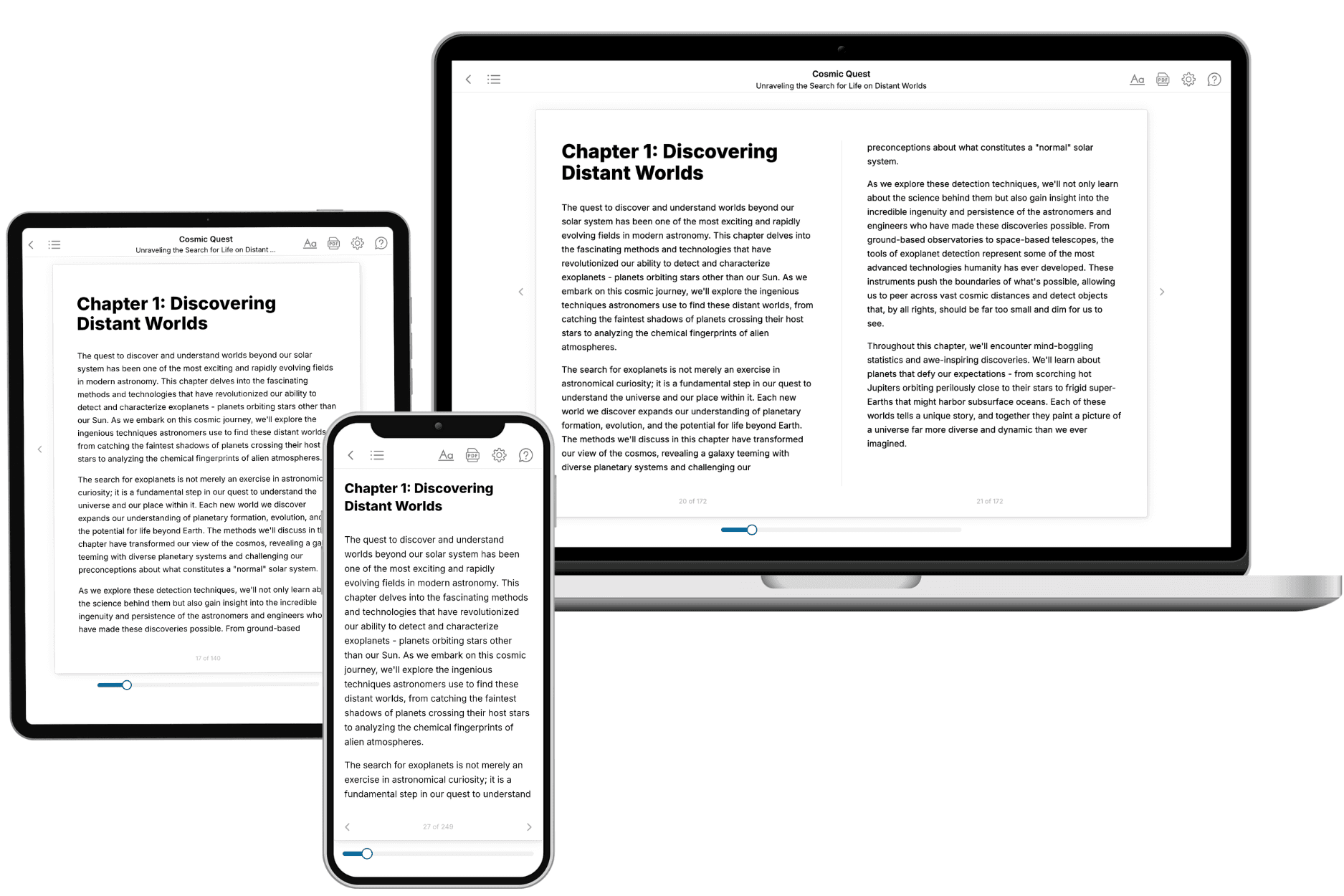
TailoredRead creates complete, full-length nonfiction ebooks, written specifically for you. Tell us what you want to learn and why, and TailoredRead writes you a complete ebook on it, with charts, tables, and diagrams throughout. Read it online, on Kindle, or on any e-reader, or download it as a PDF or EPUB. Every book is written fresh the day you order it.
- How is the book tailored to me?
Before anything is written, you answer a few short questions about your goals, your background, and the topics you care about. Your book is then planned around your answers: written at your level, focused on your goals, and covering the topics you chose, instead of the one-size-fits-all book a store sells everyone.
- Will it read like generic AI content?
No. Your book isn't a chat transcript: it's planned chapter by chapter before a single word is written, told in a clear book voice, and explains ideas visually with charts, tables, and diagrams. After writing, every book goes through an editorial pass that polishes chapters so the book reads consistent from start to finish. Judge for yourself: browse thousands of sample books on our Explore Books page.
- How accurate is the content?
Our AI first checks whether your subject needs live research. Niche and fast-moving subjects are researched before writing, and the book plan and chapters are grounded in what it finds. After writing, every book goes through a quality pass that checks its facts and consistency, and researched books list their sources in a Notes section at the back.
- How long is the book?
You choose the length: Comprehensive (250-300 pages), Detailed (150-200 pages), Essential (70-100 pages), or Short (30-50 pages).
- Does the book include visuals?
Yes. Every book includes charts, tables, and diagrams: timelines, checklists, step-by-step guides, decision trees, comparison tables, matrices, and bar charts. A typical book includes dozens of these visual elements.
- Can I read it on Kindle? What formats can I download?
Yes. Every book can be read in our online reader or downloaded as a PDF or EPUB. The EPUB can be opened with Kindle, Apple Books, Kobo, and any e-reader. The Commercial and Author licenses also include an editable Word (DOCX) and Markdown download.
- How much does it cost?
About the price of a regular ebook. The exact price depends on your book's length and complexity, from $2 for the shortest books to $35 for the most comprehensive, and it's shown when you review your book, before you commit to anything. Each book is a one-time purchase, yours to keep, no subscription. Licenses that let you share, teach, or publish your book range from $35.99 to $49.99.
- Can I preview the book before purchasing?
Before you pay, you'll see what your book will cover: the title, a detailed description, the estimated length, and the complete chapter-by-chapter table of contents, so you know what you're getting before you decide. The full text itself is written after you purchase.
- How long does it take to create a book?
About 10 minutes. You can start reading the opening chapters while the rest is still being written.