Clash of Nations
The Mexican-American War and Its Lasting Legacy in North America
Embark on a captivating journey through one of the most pivotal conflicts in North American history with "Clash of Nations: The Mexican-American War and Its Lasting Legacy in North America." This meticulously researched and engagingly written book offers a comprehensive exploration of the war that reshaped the continent and set the stage for the modern United States and Mexico.
269 pages13 chaptersDec 5, 2024Mexican History
About this book
From the tensions that sparked the conflict to the dramatic battles that decided its outcome, you'll gain a deep understanding of the political, social, and cultural forces at play during this tumultuous period. Discover the motivations of key figures on both sides, the strategies that determined victory and defeat, and the profound consequences that continue to echo through both nations today. "Clash of Nations" goes beyond the battlefield to examine the war's impact on ordinary citizens, indigenous peoples, and the evolving national identities of both countries. You'll explore how this conflict influenced art, literature, and popular culture, leaving an indelible mark on the collective memory of two proud nations. Whether you're a history buff or simply curious about the events that shaped North America, this book offers fresh insights and a nuanced perspective on a war that continues to fascinate and provoke debate to this day.
Table of contents
- IntroductionThe Importance of the Mexican-American War, Overview of the Conflict, Structure of the BookRead below
- Chapter 1: Historical ContextMexican Independence and Early Republic, U.S. Westward Expansion, The Texas Revolution and Republic, Manifest Destiny and American Expansionism
- Chapter 2: The Road to WarDiplomatic Tensions, The Annexation of Texas, Border Disputes and Negotiations, The Slidell Mission
- Chapter 3: The Outbreak of WarJames K. Polk's Presidency, Mexican Political Instability, The Thornton Affair, Declarations of War
- Chapter 4: Early CampaignsBattle of Palo Alto, Battle of Resaca de la Palma, Siege of Monterrey, Battle of Buena Vista
- Chapter 5: Naval OperationsThe Pacific Squadron, The Gulf Squadron, The California Campaign, Naval Blockade of Mexico
- Chapter 6: Scott's CampaignLanding at Vera Cruz, Battle of Cerro Gordo, Battles of Contreras and Churubusco, Storming of Chapultepec
- Chapter 7: The Northern CampaignKearny's Expedition, The New Mexico Campaign, Doniphan's Expedition, The Taos Revolt
- Chapter 8: Key Figures of the WarAmerican Military and Political Leaders, Mexican Military and Political Leaders, Diplomats and Negotiators, Notable Soldiers and Officers
- Chapter 9: The Home FrontsU.S. Public Opinion and Debate, Mexican Society During the War, Economic Impacts of the Conflict, Propaganda and Media Coverage
- Chapter 10: Peace NegotiationsEarly Armistice Attempts, The Trist Mission, Drafting the Treaty of Guadalupe Hidalgo, Ratification and Implementation
- Chapter 11: Immediate AftermathTerritorial Changes and Borders, Population Shifts and Citizenship Issues, Political Consequences in Both Nations, Veterans and Their Reintegration
- Chapter 12: Long-Term ImpactsU.S. Territorial Expansion and the Civil War, Mexican Reform and Modernization, Impact on Indigenous Peoples, The Evolution of Border Culture
- Chapter 13: The War's LegacyShaping of National Identities, U.S.-Mexico Relations, Historical Memory and Commemoration, Relevance in Modern North American Politics
- Conclusion
- Glossary
- Further Reading
Introduction
The Mexican-American War of 1846-1848 stands as a pivotal moment in North American history, reshaping the continent's political landscape and leaving an indelible mark on the national identities of both the United States and Mexico. This conflict, often overshadowed by the American Civil War that followed, played a crucial role in defining the territorial boundaries and geopolitical dynamics of North America as we know them today. The war's causes, conduct, and consequences continue to resonate in contemporary discussions of border politics, cultural identity, and international relations between these neighboring nations.
As you embark on this exploration of the Mexican-American War, you'll discover a complex tapestry of political ambitions, cultural clashes, and military strategies that culminated in a conflict with far-reaching implications. This introduction aims to set the stage for a comprehensive examination of the war, providing context for the detailed analysis that follows in subsequent chapters. By understanding the significance of this conflict, you'll gain valuable insights into the forces that shaped modern North America and the ongoing dialogue between the United States and Mexico.
The Mexican-American War emerged from a confluence of factors, including territorial disputes, divergent political ideologies, and the expansionist doctrine of Manifest Destiny. It was a war that saw the still-young United States flex its growing military and economic might against a Mexico struggling with internal political instability and the challenges of maintaining its vast northern territories. The outcome would dramatically alter the map of North America, with Mexico ceding nearly half of its territory to the United States, including the present-day states of California, Nevada, Utah, and parts of Arizona, New Mexico, and Colorado.
Beyond the immediate territorial changes, the war had profound and lasting impacts on both nations. For the United States, victory fueled a sense of national destiny and accelerated its rise as a continental power. However, it also intensified debates over slavery and states' rights, contributing to the tensions that would ultimately lead to the Civil War. For Mexico, the loss of territory and the humiliation of defeat sparked a period of national introspection and reform, shaping its political and cultural development in the decades that followed.
As we delve into the intricacies of this conflict, it's essential to approach the subject with an open mind, recognizing the complexities and multiple perspectives involved. The Mexican-American War was not simply a matter of right and wrong, victor and vanquished. It was a clash of nations with different histories, cultures, and visions for the future of North America. By examining this war in detail, you'll gain a nuanced understanding of a critical juncture in the continent's history and its enduring legacy.
The Importance of the Mexican-American War
The Mexican-American War holds a unique place in the annals of North American history, serving as a catalyst for significant geopolitical, social, and cultural changes that continue to shape the continent today. Its importance extends far beyond the immediate military conflict, touching on fundamental aspects of national identity, territorial expansion, and international relations. To fully appreciate the war's significance, it's crucial to examine its multifaceted impacts and the ways in which it altered the trajectory of both nations involved.
First and foremost, the war resulted in a massive transfer of territory from Mexico to the United States, dramatically altering the map of North America. The Treaty of Guadalupe Hidalgo, which ended the conflict in 1848, saw Mexico cede approximately 55% of its pre-war territory to the United States[1]. This vast acquisition, known as the Mexican Cession, included the present-day states of California, Nevada, Utah, and parts of Arizona, New Mexico, and Colorado. The significance of this territorial gain cannot be overstated, as it fulfilled the expansionist vision of Manifest Destiny and secured the United States' position as a continental power stretching from the Atlantic to the Pacific.
The acquisition of these territories had profound implications for the United States' economic and political development. The discovery of gold in California just days before the treaty was signed sparked the California Gold Rush, attracting hundreds of thousands of settlers and accelerating the region's integration into the Union. The new territories also intensified the ongoing debate over the expansion of slavery, contributing to the sectional tensions that would ultimately lead to the American Civil War. The war thus served as a critical turning point in the nation's history, setting the stage for the conflicts and transformations that would define the latter half of the 19th century.
For Mexico, the war's importance was equally profound, albeit in starkly different ways. The loss of nearly half its territory was a national trauma that would shape Mexican politics and culture for generations. The defeat exposed the weaknesses of Mexico's political and military institutions, leading to a period of introspection and reform known as La Reforma. This era saw significant attempts to modernize the country, secularize its institutions, and forge a stronger sense of national identity in the face of external threats. The war also solidified anti-American sentiment in Mexico, influencing its foreign policy and cultural attitudes towards its northern neighbor for decades to come.
The conflict's importance extends to its impact on indigenous peoples and existing Hispanic populations in the ceded territories. The Treaty of Guadalupe Hidalgo guaranteed the rights of Mexican citizens in these areas, but the reality often fell short of these promises. The war and its aftermath set in motion complex processes of cultural negotiation and conflict as Anglo-American settlers moved into regions with established Hispanic and indigenous communities. These interactions would shape the unique cultural landscape of the American Southwest, contributing to the rich multicultural heritage that characterizes the region today.
From a military perspective, the Mexican-American War served as a training ground for many officers who would later play crucial roles in the American Civil War. Future generals like Ulysses S. Grant, Robert E. Lee, and Jefferson Davis all gained valuable combat experience during the conflict. The war also saw innovations in military technology and tactics, including the use of flying artillery and the implementation of amphibious landing operations, which would influence military doctrine in subsequent conflicts.
The war's diplomatic repercussions were far-reaching, altering the balance of power in North America and setting precedents for U.S. foreign policy. The conflict marked the first time the United States fought a war on foreign soil, foreshadowing its future role as a global military power. It also established patterns of intervention in Latin America that would characterize U.S. policy in the region for much of the 19th and 20th centuries. For Mexico, the war underscored the need for alliances and international support to counterbalance U.S. power, influencing its diplomatic strategies in subsequent years.
In the realm of national identity, the Mexican-American War played a crucial role in shaping how both nations viewed themselves and each other. For the United States, victory reinforced a sense of exceptionalism and divine providence that had long been part of the national narrative. It bolstered the idea of America as a chosen nation destined for greatness, a concept that would influence U.S. foreign policy and self-perception well into the 20th century. For Mexico, the war became a defining moment in the nation's history, a source of both trauma and resilience that contributed to the forging of a distinct national identity in opposition to its northern neighbor.
The war's importance is also evident in its lasting impact on U.S.-Mexico relations. The conflict created a legacy of mistrust and resentment that has colored bilateral relations for generations. At the same time, it established an inextricable link between the two nations, setting the stage for the complex, interdependent relationship that exists today. Understanding the war and its consequences is crucial for comprehending the nuances of contemporary U.S.-Mexico relations, from border issues and immigration debates to economic partnerships and cultural exchanges.
Finally, the Mexican-American War holds significant importance for its role in shaping historical memory and national narratives in both countries. In the United States, the war has often been overlooked or simplified in popular history, overshadowed by the Civil War that followed. However, its study offers crucial insights into the complexities of American expansionism and the roots of modern debates over multiculturalism and national identity. In Mexico, the war remains a potent symbol of resistance against foreign intervention and a key element of national historical consciousness.
As you delve deeper into the study of the Mexican-American War, keep in mind its multifaceted importance. This conflict was not merely a series of battles and treaties, but a transformative event that reshaped the North American continent, altered the destinies of two nations, and set in motion forces that continue to influence the region today. By understanding the war's significance, you'll gain valuable insights into the historical processes that have shaped the modern world and the ongoing dialogue between the United States and Mexico.
Overview of the Conflict
The Mexican-American War, spanning from 1846 to 1848, was a complex and multifaceted conflict that arose from long-standing tensions between the United States and Mexico. To fully grasp the nature of this war, it's essential to examine its origins, key events, and the broader context in which it unfolded. This overview will provide you with a comprehensive understanding of the conflict's timeline, major battles, and the key players involved, setting the stage for the more detailed analysis that follows in subsequent chapters.
The roots of the war can be traced back to the 1836 Texas Revolution, which saw the region break away from Mexico and establish itself as an independent republic. The United States' annexation of Texas in 1845 was a major catalyst for the conflict, as Mexico had never recognized Texan independence and considered the annexation an act of aggression. Furthermore, disputes over the exact boundary between Texas and Mexico added to the tensions. While Texas claimed the Rio Grande as its southern border, Mexico insisted that the boundary was the Nueces River, further north. This disagreement over territory would prove to be the immediate spark for war[2].
The conflict officially began on April 25, 1846, when Mexican cavalry attacked a U.S. patrol led by Captain Seth Thornton in the disputed territory north of the Rio Grande. This skirmish, known as the Thornton Affair, provided the pretext for U.S. President James K. Polk to declare that Mexico had "shed American blood upon American soil." Congress declared war on Mexico on May 13, 1846, with Mexico following suit on July 7. It's worth noting that the war was controversial even at the time, with opponents in the United States arguing that it was an unjust war of aggression aimed at territorial expansion.
The war unfolded across multiple fronts, with major campaigns in northern Mexico, California, and central Mexico. In the north, U.S. General Zachary Taylor led a force that quickly secured victories at the Battles of Palo Alto and Resaca de la Palma in May 1846. These early successes were followed by the capture of Monterrey in September and the hard-fought victory at the Battle of Buena Vista in February 1847, where Taylor's forces repelled a larger Mexican army led by General Antonio López de Santa Anna.
Simultaneously, U.S. forces under Stephen W. Kearny conducted a campaign in the New Mexico Territory, capturing Santa Fe without resistance in August 1846. Kearny then led a portion of his force to California, where he joined U.S. naval forces and local American settlers who had already begun the conquest of that territory. The California Campaign, which included the controversial Bear Flag Revolt, saw relatively little fighting but resulted in the U.S. acquisition of this vast and resource-rich region.
The decisive campaign of the war came in 1847 when General Winfield Scott led an amphibious landing at Veracruz on Mexico's east coast. After capturing the city in March, Scott's army began a grueling march inland towards Mexico City. This campaign saw some of the war's fiercest fighting, including the Battles of Cerro Gordo, Contreras, and Churubusco. The advance culminated in the capture of Mexico City in September 1847, following the dramatic storming of Chapultepec Castle, which would later be immortalized in U.S. Marine Corps lore as the "Halls of Montezuma."
Throughout the conflict, the U.S. Navy played a crucial role by blockading Mexican ports and supporting land operations. The naval campaigns in the Gulf of Mexico and the Pacific significantly hampered Mexico's ability to defend its territory and contributed to the overall U.S. victory. The war also saw the first significant use of Marine Corps landing parties, foreshadowing the amphibious warfare tactics that would become a hallmark of U.S. military operations in future conflicts.
The war concluded with the signing of the Treaty of Guadalupe Hidalgo on February 2, 1848. Under the terms of the treaty, Mexico ceded vast territories to the United States, including all or parts of present-day California, Nevada, Utah, Arizona, New Mexico, Colorado, Wyoming, and Texas. In return, the U.S. agreed to pay Mexico $15 million and assume $3.25 million in claims by U.S. citizens against Mexico. The treaty also addressed issues of citizenship for Mexican residents in the ceded territories and established the Rio Grande as the southern border of Texas.
Several key figures emerged from the conflict who would go on to play significant roles in American history. Zachary Taylor's military success propelled him to the presidency in 1848. Other future Civil War generals, including Ulysses S. Grant, Robert E. Lee, and Jefferson Davis, gained valuable combat experience during the war. On the Mexican side, the war saw the return to power of Antonio López de Santa Anna, whose leadership during the conflict was marked by both strategic failures and personal courage.
The war had profound consequences for both nations. For the United States, it fulfilled the vision of Manifest Destiny, securing the nation's continental ambitions. However, it also intensified debates over slavery and sectional tensions that would eventually lead to the Civil War. For Mexico, the war resulted in the loss of nearly half its territory and sparked a period of national soul-searching and reform. The conflict left a lasting legacy of distrust between the two nations, influencing their relationship well into the 20th century.
As you delve deeper into the study of the Mexican-American War, it's important to consider the conflict from multiple perspectives. While U.S. sources often emphasize military victories and territorial gains, Mexican and international perspectives offer different interpretations of the war's causes, conduct, and consequences. By examining a range of viewpoints, you'll gain a more nuanced understanding of this complex and consequential conflict.
This overview provides a foundation for understanding the Mexican-American War, but it's just the beginning. Each aspect of the conflict – from the political maneuvering that led to war to the experiences of soldiers and civilians on both sides – deserves closer examination. As you proceed through the subsequent chapters, you'll explore these topics in greater depth, gaining a comprehensive understanding of a war that reshaped North America and continues to influence U.S.-Mexico relations to this day.
Structure of the Book
"Clash of Nations: The Mexican-American War and Its Lasting Legacy in North America" is structured to provide you with a comprehensive and engaging exploration of this pivotal conflict. The book is organized thematically and chronologically, allowing for a deep dive into various aspects of the war while maintaining a clear narrative thread. This structure is designed to give you a thorough understanding of the war's causes, conduct, and consequences, as well as its broader historical context and lasting impacts.
The book begins with a detailed examination of the historical context that set the stage for the conflict. Chapter 1, "Historical Context," delves into the complex web of events and ideologies that led to the war. You'll explore the aftermath of Mexican independence, the expansion of the United States westward, the Texas Revolution, and the concept of Manifest Destiny. This chapter provides essential background information, helping you understand the long-term factors that contributed to the outbreak of hostilities.
Chapter 2, "The Road to War," focuses on the immediate causes of the conflict. Here, you'll examine the diplomatic tensions between the United States and Mexico, the controversial annexation of Texas, and the border disputes that served as the immediate trigger for war. This chapter also introduces key political figures such as James K. Polk and provides insight into the decision-making processes that led both nations into conflict.
The next several chapters provide a detailed account of the war itself. Chapter 3, "The Outbreak of War," covers the initial skirmishes and declarations of war, setting the stage for the conflict to come. Chapters 4 through 7 then delve into the various campaigns of the war, including the early battles in northern Mexico, naval operations, Winfield Scott's march to Mexico City, and the often-overlooked northern campaign. These chapters offer a balanced mix of strategic overview and vivid battle descriptions, bringing the conflict to life while explaining its broader military and political significance.
Chapter 8, "Key Figures of the War," provides in-depth profiles of the major players on both sides of the conflict. This chapter goes beyond simple biographies, examining how these individuals shaped the course of the war and were, in turn, shaped by it. You'll gain insights into the motivations, strategies, and legacies of figures ranging from military commanders to political leaders and diplomats.
The book then shifts focus to examine the war's impact beyond the battlefield. Chapter 9, "The Home Fronts," explores how the conflict affected civilian populations in both the United States and Mexico. This chapter covers topics such as public opinion, economic impacts, and the role of media and propaganda in shaping perceptions of the war.
Chapters 10 and 11 deal with the conclusion of the war and its immediate aftermath. "Peace Negotiations" provides a detailed look at the diplomatic efforts that ended the conflict, including the controversial Treaty of Guadalupe Hidalgo. "Immediate Aftermath" then examines the short-term consequences of the war, including territorial changes, population shifts, and political repercussions in both nations.
The final chapters of the book are dedicated to analyzing the war's long-term impacts and legacy. Chapter 12, "Long-Term Impacts," explores how the conflict influenced the development of both the United States and Mexico in the decades following the war. This includes an examination of how the war affected U.S. territorial expansion, Mexican political reform, indigenous peoples, and the evolution of border culture.
Chapter 13, "The War's Legacy," brings the narrative up to the present day, examining how the Mexican-American War continues to shape national identities, bilateral relations, and political discourse in both countries. This chapter encourages you to consider the war's relevance to contemporary issues and debates.
The book concludes with a synthesis of the key themes and arguments presented throughout, offering final reflections on the significance of the Mexican-American War in the broader context of North American history. Following the conclusion, you'll find a comprehensive glossary of key terms and concepts, as well as suggestions for further reading for those interested in exploring specific aspects of the war in greater depth.
Throughout the book, you'll encounter a variety of features designed to enhance your understanding and engagement with the material. These include:
- Maps and illustrations to help visualize key battles, campaigns, and territorial changes
- Primary source excerpts, offering firsthand accounts from participants and observers of the war
- Sidebars exploring interesting facts, anecdotes, or historiographical debates related to the main narrative
- Timelines to help you keep track of the sequence of events
- Discussion questions at the end of each chapter to encourage critical thinking and reflection
This structure is designed to provide a comprehensive, engaging, and accessible exploration of the Mexican-American War. Whether you're a history enthusiast, a student, or simply curious about this pivotal moment in North American history, "Clash of Nations" offers a thorough and nuanced examination of the conflict and its enduring legacy.
As you progress through the book, you're encouraged to draw connections between different chapters and themes. The Mexican-American War was a complex event with far-reaching consequences, and understanding it requires considering multiple perspectives and long-term impacts. By the time you reach the conclusion, you'll have gained not just a wealth of historical knowledge, but also a deeper appreciation for the ways in which this 19th-century conflict continues to shape the North American continent and its peoples.
Remember that history is not just a collection of facts, but a ongoing process of interpretation and reinterpretation. As you read, consider how different historians have viewed the war and its significance. Don't hesitate to question assumptions, compare conflicting accounts, and form your own opinions based on the evidence presented. By engaging critically with the material, you'll gain a richer and more nuanced understanding of this crucial chapter in North American history.
This is the end of the free sample. The full book has 13 chapters.
Want this book written for you?
Tell us your goals and background, and get your own version of this book, tailored by AI to you.


Benefits of AI-tailored books
- Read one book, not ten:
- all the Mexican History knowledge you need, gathered into a single book.
- Save days of learning:
- tell us your goals, choose your topics, and the whole book is built around them.
- Learn effortlessly:
- Mexican History book written for your specific background and expertise.
- Understand at a glance:
- includes charts, tables, timelines, checklists, decision trees, and more.
- Stay current:
- written the day you order it, not years ago.
- Trust what you read:
- every book is checked for accuracy, with real research when your subject needs it.
Create your unique book in 3 steps
- 1. Select your focus
Select the focus of your Mexican History book and share your background
- 2. Personalize your book
Specify your goals and choose sub-topics to include
- 3. Get your tailored book
Your book is ready in 10 minutes. Read it online, download as EPUB or PDF, or send to Kindle.


Frequently asked questions
- What is TailoredRead?
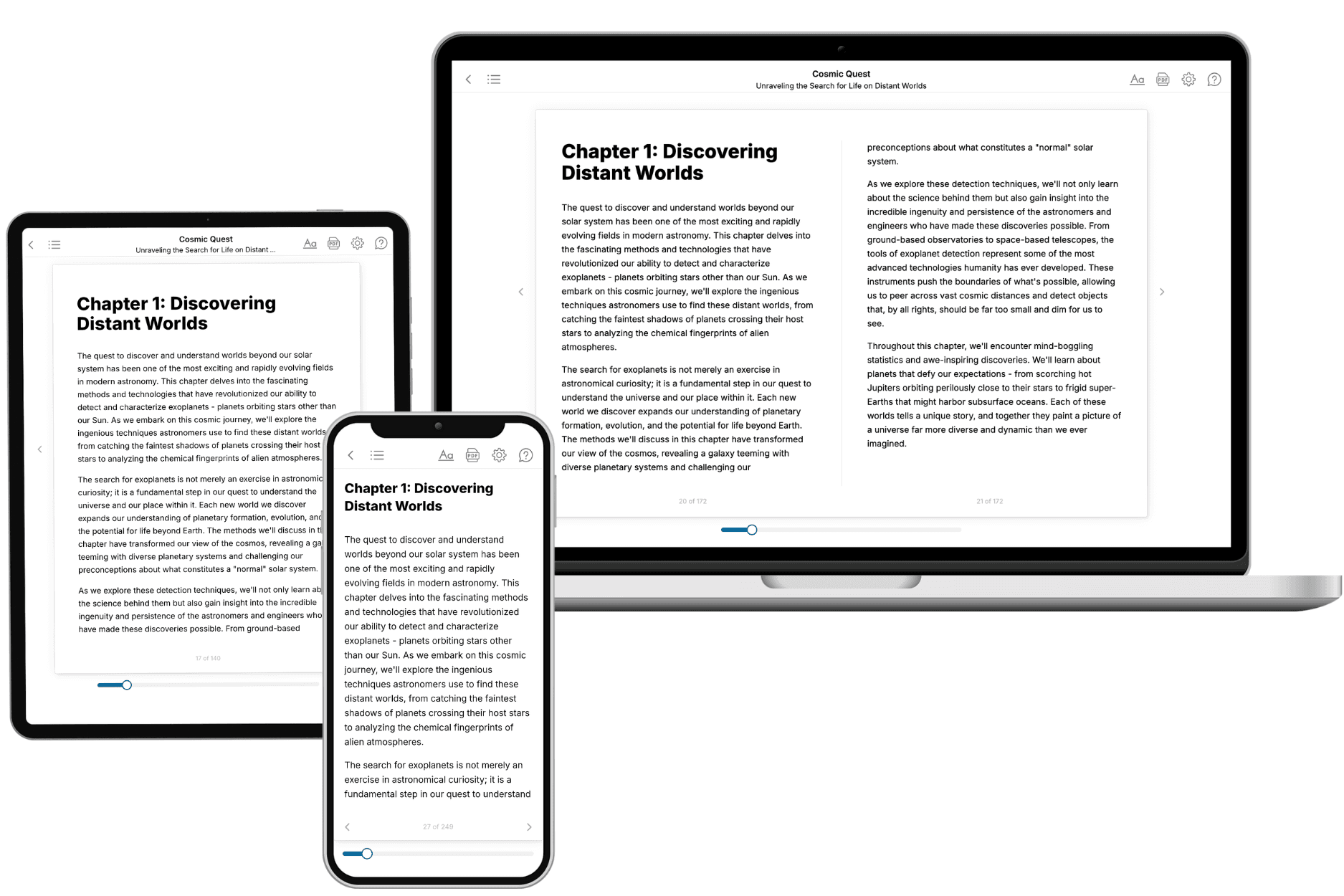
TailoredRead creates complete, full-length nonfiction ebooks, written specifically for you. Tell us what you want to learn and why, and TailoredRead writes you a complete ebook on it, with charts, tables, and diagrams throughout. Read it online, on Kindle, or on any e-reader, or download it as a PDF or EPUB. Every book is written fresh the day you order it.
- How is the book tailored to me?
Before anything is written, you answer a few short questions about your goals, your background, and the topics you care about. Your book is then planned around your answers: written at your level, focused on your goals, and covering the topics you chose, instead of the one-size-fits-all book a store sells everyone.
- Will it read like generic AI content?
No. Your book isn't a chat transcript: it's planned chapter by chapter before a single word is written, told in a clear book voice, and explains ideas visually with charts, tables, and diagrams. After writing, every book goes through an editorial pass that polishes chapters so the book reads consistent from start to finish. Judge for yourself: browse thousands of sample books on our Explore Books page.
- How accurate is the content?
Our AI first checks whether your subject needs live research. Niche and fast-moving subjects are researched before writing, and the book plan and chapters are grounded in what it finds. After writing, every book goes through a quality pass that checks its facts and consistency, and researched books list their sources in a Notes section at the back.
- How long is the book?
You choose the length: Comprehensive (250-300 pages), Detailed (150-200 pages), Essential (70-100 pages), or Short (30-50 pages).
- Does the book include visuals?
Yes. Every book includes visual elements such as timelines, checklists, step-by-step guides, decision trees, comparison tables, and matrices, and many include bar charts. A typical book includes dozens of these visual elements.
- Can I read it on Kindle? What formats can I download?
Yes. Every book can be read in our online reader or downloaded as a PDF or EPUB. The EPUB can be opened with Kindle, Apple Books, Kobo, and any e-reader. The Commercial and Author licenses also include an editable Word (DOCX) and Markdown download.
- How much does it cost?
About the price of a regular ebook. The exact price depends on your book's length and complexity, from $2 for the shortest books to $35 for the most comprehensive, and it's shown when you review your book, before you commit to anything. Each book is a one-time purchase, yours to keep, no subscription. Licenses that let you share, teach, or publish your book range from $35.99 to $49.99.
- Can I preview the book before purchasing?
Before you pay, you'll see what your book will cover: the title, a detailed description, the estimated length, and the complete chapter-by-chapter table of contents, so you know what you're getting before you decide. The full text itself is written after you purchase.
- How long does it take to create a book?
About 10 minutes. You can start reading the opening chapters while the rest is still being written.