Clash of Nations
The Mexican-American War and Its Lasting Legacy
Embark on a captivating journey through one of the most pivotal conflicts in North American history with "Clash of Nations: The Mexican-American War and Its Lasting Legacy." This meticulously researched and engagingly written book offers a comprehensive exploration of the war that reshaped the continent and set the stage for future relations between the United States and Mexico.
269 pages13 chaptersDec 1, 2024US 19th Century History
About this book
From the complex political landscape that led to the outbreak of hostilities to the dramatic battles that decided the fate of vast territories, you'll gain a nuanced understanding of the war's causes, progression, and far-reaching consequences. Delve into the strategies of key military leaders, the experiences of soldiers on both sides, and the diplomatic maneuverings that ultimately brought the conflict to its conclusion. "Clash of Nations" goes beyond the battlefield to examine the war's profound impact on both countries' national identities, territorial boundaries, and future trajectories. You'll explore how this conflict influenced the development of the American West, shaped Mexican politics and society, and left an indelible mark on the shared history of these neighboring nations. With its balanced perspective and attention to often-overlooked aspects of the war, this book offers fresh insights that will deepen your appreciation of this crucial chapter in North American history.
Table of contents
- IntroductionThe Importance of Understanding the Mexican-American War, Overview of the Conflict, Structure of the BookRead below
- Chapter 1: Historical ContextMexican Independence and Early Republic, U.S. Westward Expansion, The Texas Revolution and Its Aftermath, Growing Diplomatic Tensions
- Chapter 2: The Road to WarManifest Destiny and American Expansionism, The Annexation of Texas, Boundary Disputes and Failed Negotiations, The Slidell Mission
- Chapter 3: The Outbreak of WarThe Polk Presidency and War Preparations, The Thornton Affair, Declaration of War, Public Reaction in Both Countries
- Chapter 4: Early CampaignsTaylor's Campaign in Northern Mexico, Kearny's Expedition to New Mexico, Naval Operations in the Pacific, The Bear Flag Revolt in California
- Chapter 5: Major Battles and CampaignsThe Battle of Monterrey, The Battle of Buena Vista, The Siege of Veracruz, The Battle of Cerro Gordo
- Chapter 6: The Mexico City CampaignScott's Strategy and Advance, The Battles of Contreras and Churubusco, Molino del Rey and Chapultepec, The Fall of Mexico City
- Chapter 7: Guerrilla Warfare and OccupationMexican Guerrilla Tactics, U.S. Countermeasures and Challenges, Challenges of Occupying Mexican Territory, Cultural Interactions During Occupation
- Chapter 8: The Home FrontsU.S. Political Debates and Opposition, Political Instability in Mexico, Economic Impacts of the War, Propaganda and Media Coverage
- Chapter 9: The Treaty of Guadalupe HidalgoPeace Negotiations, Terms of the Treaty, Territorial Changes and Their Significance, Ratification Challenges in Both Countries
- Chapter 10: Immediate AftermathU.S. Territorial Organization and Governance, Mexican Efforts at National Reconstruction, Experiences of Veterans, Early Border Issues and Tensions
- Chapter 11: Long-Term ImpactsU.S. Territorial Expansion and the American West, Reshaping of Mexican National Identity, Impact on the U.S. Slavery Debate, Military Innovations and Future Warfare
- Chapter 12: Cultural LegacyThe Birth of Borderlands Culture, The Emergence of Mexican-American Identity, Representations in Art and Literature, Historical Memory and Commemoration
- Chapter 13: Modern RelevanceContemporary U.S.-Mexico Relations, Modern Border Issues and Debates, Ongoing Cultural Exchanges and Influences, Historical Lessons for Today's World
- Conclusion
- Glossary
- Further Reading
Introduction
The Mexican-American War stands as a pivotal moment in North American history, shaping the destinies of two nations and leaving an indelible mark on the continent's political, cultural, and geographical landscape. This conflict, which raged from 1846 to 1848, was more than a mere territorial dispute; it was a clash of ideologies, ambitions, and national identities that would have far-reaching consequences for generations to come. As you embark on this exploration of this crucial period, you'll discover the complex web of factors that led to the outbreak of hostilities, the dramatic campaigns that decided the war's outcome, and the lasting legacy that continues to influence U.S.-Mexico relations to this day.
Understanding the Mexican-American War is essential for anyone seeking to comprehend the modern dynamics between the United States and Mexico, as well as the broader historical context of North American development. This conflict not only redrew the map of the continent but also played a significant role in shaping the national narratives of both countries. For the United States, it was a period of rapid expansion and the realization of "Manifest Destiny," while for Mexico, it represented a traumatic loss of territory and a challenge to its sovereignty that would have long-lasting repercussions.
As you delve deeper into the pages of this book, you'll gain insights into the political, military, and social aspects of the war, as well as its impact on individuals and communities on both sides of the conflict. From the halls of power in Washington D.C. and Mexico City to the dusty battlefields of the Southwest and the streets of occupied towns, the story of the Mexican-American War is one of ambition, sacrifice, innovation, and transformation. By examining this critical period in detail, you'll be better equipped to understand the complexities of U.S.-Mexico relations and the historical forces that have shaped the modern American Southwest.
The Importance of Understanding the Mexican-American War
The Mexican-American War holds a unique place in the annals of North American history, serving as a crucial turning point that reshaped the continent and set the stage for the modern relationship between the United States and Mexico. Its significance extends far beyond the immediate territorial gains and losses, touching upon fundamental questions of national identity, expansionism, and the balance of power in the Western Hemisphere. By delving into the complexities of this conflict, you gain invaluable insights into the forces that have shaped the political, cultural, and social landscape of North America for over a century and a half.
One of the primary reasons for studying the Mexican-American War is its role in the territorial expansion of the United States. The conflict resulted in the acquisition of vast swathes of land, including present-day California, Nevada, Utah, and parts of Arizona, New Mexico, and Colorado. This massive land transfer not only fulfilled the vision of "Manifest Destiny" but also set the stage for the rapid development of the American West. Understanding the war provides crucial context for the subsequent gold rush, the transcontinental railroad, and the complex issues surrounding Native American displacement and the extension of slavery into new territories.
For Mexico, the war represented a watershed moment in its national history. The loss of nearly half its territory was a traumatic event that profoundly impacted Mexican politics, society, and national identity. Studying the conflict from the Mexican perspective offers insights into the challenges faced by a young nation struggling to maintain its sovereignty in the face of a powerful neighbor's expansionist ambitions. It also sheds light on the roots of many contemporary issues in U.S.-Mexico relations, including border disputes, immigration, and cultural tensions.
The Mexican-American War also serves as a fascinating case study in military history and strategy. It was a conflict that saw the implementation of new technologies and tactics, as well as the rise of military leaders who would go on to play crucial roles in the American Civil War. The war featured a diverse range of military operations, from conventional battles to guerrilla warfare and urban combat, providing a rich tapestry of strategic and tactical lessons for military historians and strategists.
Furthermore, the war had significant implications for domestic politics in both countries. In the United States, it intensified debates over slavery, sectionalism, and the nature of the Union, contributing to the political tensions that would ultimately lead to the Civil War. In Mexico, the conflict exacerbated political instability and set the stage for future interventions and reforms. By examining these political dimensions, you gain a deeper understanding of the internal dynamics that shaped both nations during this critical period.
The cultural impact of the Mexican-American War is another crucial aspect that merits close attention. The conflict brought two distinct societies into close contact, leading to cultural exchanges, misunderstandings, and the birth of new hybrid identities. The war played a significant role in shaping perceptions and stereotypes that would persist for generations, influencing literature, art, and popular culture. By studying these cultural interactions and their long-term effects, you can better appreciate the complex tapestry of identities and experiences that characterize the U.S.-Mexico borderlands today.
Understanding the Mexican-American War is also essential for grasping the development of international law and diplomacy in the 19th century. The conflict and its resolution through the Treaty of Guadalupe Hidalgo raised important questions about the rights of conquered populations, the nature of international boundaries, and the principles governing territorial acquisitions. These issues continue to resonate in modern international relations, making the study of the war relevant to contemporary debates on sovereignty, self-determination, and the rules of warfare.
Moreover, the war serves as a powerful reminder of the human cost of conflict and territorial expansion. By examining the experiences of soldiers, civilians, and indigenous populations caught up in the war, you gain a more nuanced and empathetic understanding of the personal tragedies and triumphs that lie behind the grand narratives of national histories. This human dimension is crucial for developing a well-rounded perspective on historical events and their lasting impacts.
Finally, studying the Mexican-American War provides valuable context for understanding contemporary issues in U.S.-Mexico relations. Many of the challenges and opportunities facing both nations today – from border security and immigration to economic integration and cultural exchange – have their roots in the events and outcomes of this 19th-century conflict. By grasping the historical background, you are better equipped to analyze current events, policy debates, and bilateral relations between these two neighboring countries.
In conclusion, the importance of understanding the Mexican-American War cannot be overstated. It is a conflict that shaped the geographical, political, and cultural contours of North America, leaving a legacy that continues to influence the lives of millions on both sides of the border. By studying this pivotal moment in history, you gain not only knowledge of past events but also valuable insights into the forces that continue to shape the present and future of U.S.-Mexico relations and the broader dynamics of the North American continent.
Overview of the Conflict
The Mexican-American War, which lasted from 1846 to 1848, was a complex and multifaceted conflict that arose from a combination of long-standing tensions, territorial disputes, and the expansionist ambitions of the United States. To fully appreciate the scope and significance of this war, it's essential to understand its key phases, major players, and the broader context in which it unfolded. This overview will provide you with a comprehensive framework for understanding the conflict, setting the stage for a more detailed exploration in subsequent chapters.
The roots of the war can be traced back to the early 19th century, with the independence of Mexico from Spain in 1821 and the subsequent instability of the young Mexican republic. Meanwhile, the United States was experiencing a period of rapid westward expansion, driven by the ideology of "Manifest Destiny" – the belief that American settlers were destined to spread across the North American continent. These divergent trajectories set the stage for increasing tensions between the two nations, particularly over the status of Texas, which had gained independence from Mexico in 1836 and was annexed by the United States in 1845.
The immediate trigger for the war came in 1846, when U.S. President James K. Polk ordered General Zachary Taylor to lead troops into the disputed territory between the Nueces River and the Rio Grande. This action was seen by Mexico as a provocation and an invasion of its sovereign territory. The conflict officially began on April 25, 1846, with the Thornton Affair, in which Mexican cavalry attacked a U.S. patrol in the contested zone. Polk used this incident to declare that Mexico had "shed American blood upon American soil," and on May 13, 1846, the United States Congress declared war on Mexico.
The war itself can be divided into several major campaigns and theaters of operation. In the north, General Zachary Taylor led U.S. forces to victories at Palo Alto and Resaca de la Palma before capturing the city of Monterrey in September 1846. Meanwhile, U.S. forces under Stephen W. Kearny occupied New Mexico and California with relatively little resistance, aided by the Bear Flag Revolt of American settlers in California. The U.S. Navy also played a crucial role, blockading Mexican ports and supporting land operations along the coast.
As the war progressed, the focus shifted to central Mexico. In March 1847, General Winfield Scott launched an ambitious amphibious landing at Veracruz, capturing the city and beginning a march inland towards Mexico City. This campaign saw some of the war's most intense fighting, including the battles of Cerro Gordo, Contreras, and Churubusco. The fall of Mexico City in September 1847 effectively ended major combat operations, although guerrilla warfare and occupation duties continued for several months.
Throughout the conflict, both sides faced significant challenges. For the United States, the war represented its first major foreign conflict fought primarily on enemy soil. This presented logistical and strategic challenges, as well as the need to occupy and administer conquered territories. The U.S. military also had to contend with disease, unfamiliar terrain, and the challenges of fighting a war far from home. For Mexico, the war came at a time of political instability and financial weakness, hampering its ability to mount an effective defense. Despite these challenges, Mexican forces fought bravely and at times effectively, particularly in guerrilla operations that posed significant problems for U.S. occupation forces.
The war had profound political implications for both nations. In the United States, it exacerbated tensions over the issue of slavery, as debates raged over whether newly acquired territories would be slave or free states. The conflict also launched the careers of many military officers who would later play crucial roles in the American Civil War. In Mexico, the war led to political turmoil, with several changes of government during the conflict and a lasting sense of national trauma that would influence Mexican politics and culture for generations.
The conflict officially ended with the signing of the Treaty of Guadalupe Hidalgo on February 2, 1848. Under the terms of the treaty, Mexico ceded nearly half of its territory to the United States, including the present-day states of California, Nevada, Utah, and parts of Arizona, New Mexico, and Colorado. In return, the United States agreed to pay Mexico $15 million and assume $3.25 million in claims by U.S. citizens against the Mexican government. The treaty also addressed issues such as the rights of Mexican citizens in the ceded territories and the establishment of the Rio Grande as the southern border of Texas.
The aftermath of the war had far-reaching consequences for both nations. For the United States, the vast territorial gains fulfilled the vision of Manifest Destiny and set the stage for rapid westward expansion. However, it also intensified debates over slavery and sectionalism that would ultimately lead to the Civil War. For Mexico, the loss of territory was a devastating blow that would shape its national identity and foreign policy for decades to come. The war also had significant impacts on Native American populations in the ceded territories, many of whom found themselves under U.S. jurisdiction and faced new challenges to their lands and ways of life.
In the broader context of international relations, the Mexican-American War marked a significant shift in the balance of power in North America. The United States emerged as the dominant power in the region, while Mexico was left weakened and facing the challenge of rebuilding its national institutions and identity. The conflict also set important precedents in international law and diplomacy, particularly regarding the rights of conquered populations and the principles governing territorial acquisitions.
As you delve deeper into the specific aspects of the war in the following chapters, it's important to keep this overview in mind. The Mexican-American War was not simply a series of battles and campaigns, but a complex interplay of political, social, and cultural forces that would shape the future of North America. By understanding the conflict in its entirety – from its origins to its long-term consequences – you'll be better equipped to appreciate its significance in the broader sweep of history and its relevance to contemporary issues in U.S.-Mexico relations.
Structure of the Book
This book is designed to provide you with a comprehensive and engaging exploration of the Mexican-American War, its causes, events, and lasting impacts. The structure of the book has been carefully crafted to guide you through the complex narrative of this pivotal conflict, offering a logical progression from the historical context that led to the war, through its major events and campaigns, to its immediate aftermath and long-term consequences. By following this structure, you'll gain a thorough understanding of the war's significance and its enduring relevance to modern U.S.-Mexico relations.
The book begins with an examination of the historical context that set the stage for the conflict. Chapter 1, "Historical Context," delves into the events and developments that preceded the war, including Mexican independence, U.S. westward expansion, the Texas Revolution, and the growing diplomatic tensions between the two nations. This chapter provides essential background information that will help you understand the complex factors that contributed to the outbreak of hostilities.
Chapter 2, "The Road to War," focuses on the immediate causes of the conflict, exploring concepts such as Manifest Destiny, the annexation of Texas, boundary disputes, and failed diplomatic efforts to prevent war. This chapter sets the stage for the conflict by examining the political, ideological, and territorial issues that ultimately led to the declaration of war. You'll gain insights into the decision-making processes and motivations of key figures on both sides of the conflict.
The next section of the book, comprising Chapters 3 through 7, provides a detailed account of the war itself. Chapter 3, "The Outbreak of War," covers the initial stages of the conflict, including the Polk presidency, the Thornton Affair, and the formal declarations of war by both nations. Chapters 4 and 5 delve into the early campaigns and major battles of the war, offering vivid descriptions of key engagements and the strategies employed by both sides. Chapter 6 focuses on the crucial Mexico City campaign, which effectively decided the outcome of the war. Chapter 7 examines the often-overlooked aspects of guerrilla warfare and occupation, providing insights into the challenges faced by both Mexican resistance fighters and U.S. occupation forces.
To provide a comprehensive view of the conflict, Chapter 8, "The Home Fronts," shifts the focus away from the battlefields to examine the political, economic, and social impacts of the war on both countries. This chapter explores topics such as political debates, economic consequences, and the role of media and propaganda in shaping public opinion about the war. By examining these aspects, you'll gain a more nuanced understanding of how the conflict affected society as a whole, beyond just military engagements.
Chapter 9 is dedicated to the Treaty of Guadalupe Hidalgo, which formally ended the war. This chapter provides a detailed analysis of the peace negotiations, the terms of the treaty, and the significant territorial changes that resulted from it. You'll learn about the challenges faced in ratifying the treaty in both countries and the immediate implications of its provisions.
The book then moves on to examine the aftermath and long-term impacts of the war. Chapter 10, "Immediate Aftermath," looks at the challenges faced by both nations in the years immediately following the conflict, including U.S. territorial organization, Mexican efforts at national reconstruction, and the experiences of veterans. Chapter 11, "Long-Term Impacts," takes a broader view, exploring how the war influenced U.S. territorial expansion, reshaped Mexican national identity, impacted the U.S. slavery debate, and contributed to military innovations that would influence future conflicts.
The final chapters of the book examine the cultural legacy and modern relevance of the Mexican-American War. Chapter 12, "Cultural Legacy," explores the war's impact on borderlands culture, the emergence of Mexican-American identity, and representations of the conflict in art and literature. Chapter 13, "Modern Relevance," brings the narrative up to the present day, examining how the war continues to influence contemporary U.S.-Mexico relations, border issues, and cultural exchanges. This chapter also reflects on the historical lessons that can be drawn from the conflict and applied to today's world.
Throughout the book, you'll find that each chapter is designed to build upon the knowledge gained in previous sections, creating a comprehensive and interconnected narrative of the Mexican-American War. The chapters are further divided into subsections that focus on specific aspects or events, allowing for a detailed exploration of key topics while maintaining a clear overall structure.
To enhance your understanding and engagement with the material, the book includes various features such as maps, illustrations, and primary source excerpts. These elements provide visual context, bring historical figures and events to life, and offer direct insights into the perspectives of those who experienced the war firsthand. Additionally, each chapter concludes with a brief summary and a set of discussion questions, encouraging you to reflect on the material and consider its broader implications.
By following this carefully structured approach, you'll be able to navigate the complex history of the Mexican-American War with clarity and depth. From the broad historical context to the specific details of military campaigns, and from the immediate aftermath to the long-term cultural impacts, this book provides a comprehensive framework for understanding one of the most significant conflicts in North American history. As you progress through the chapters, you'll develop a nuanced appreciation for the war's multifaceted nature and its enduring relevance to the modern world.
This is the end of the free sample. The full book has 13 chapters.
Want this book written for you?
Tell us your goals and background, and get your own version of this book, tailored by AI to you.


Benefits of AI-tailored books
- Read one book, not ten:
- all the US 19th Century History knowledge you need, gathered into a single book.
- Save days of learning:
- tell us your goals, choose your topics, and the whole book is built around them.
- Learn effortlessly:
- US 19th Century History book written for your specific background and expertise.
- Understand at a glance:
- includes charts, tables, timelines, checklists, decision trees, and more.
- Stay current:
- written the day you order it, not years ago.
- Trust what you read:
- every book is checked for accuracy, with real research when your subject needs it.
Create your unique book in 3 steps
- 1. Select your focus
Select the focus of your US 19th Century History book and share your background
- 2. Personalize your book
Specify your goals and choose sub-topics to include
- 3. Get your tailored book
Your book is ready in 10 minutes. Read it online, download as EPUB or PDF, or send to Kindle.


Frequently asked questions
- What is TailoredRead?
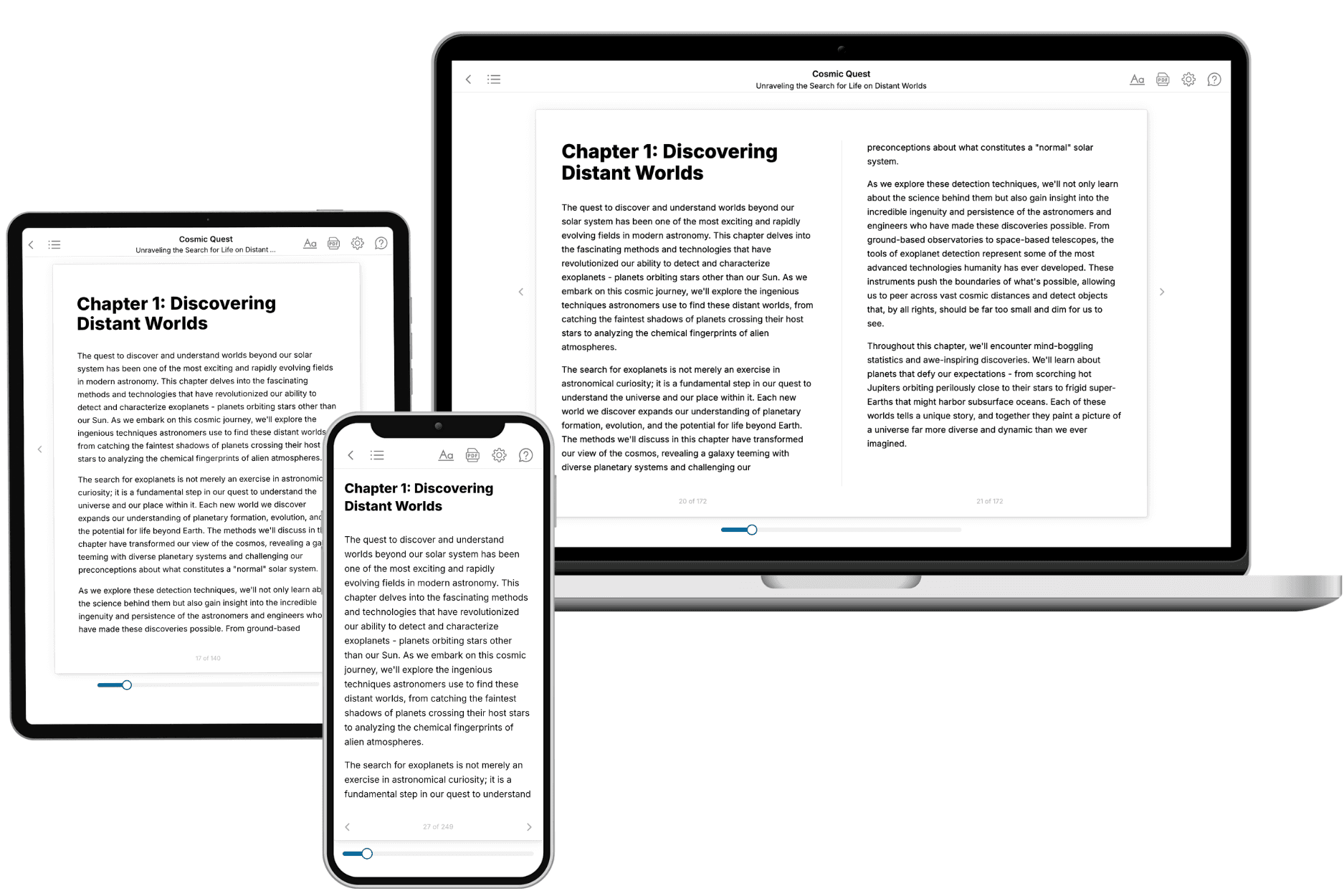
TailoredRead creates complete, full-length nonfiction ebooks, written specifically for you. Tell us what you want to learn and why, and TailoredRead writes you a complete ebook on it, with charts, tables, and diagrams throughout. Read it online, on Kindle, or on any e-reader, or download it as a PDF or EPUB. Every book is written fresh the day you order it.
- How is the book tailored to me?
Before anything is written, you answer a few short questions about your goals, your background, and the topics you care about. Your book is then planned around your answers: written at your level, focused on your goals, and covering the topics you chose, instead of the one-size-fits-all book a store sells everyone.
- Will it read like generic AI content?
No. Your book isn't a chat transcript: it's planned chapter by chapter before a single word is written, told in a clear book voice, and explains ideas visually with charts, tables, and diagrams. After writing, every book goes through an editorial pass that polishes chapters so the book reads consistent from start to finish. Judge for yourself: browse thousands of sample books on our Explore Books page.
- How accurate is the content?
Our AI first checks whether your subject needs live research. Niche and fast-moving subjects are researched before writing, and the book plan and chapters are grounded in what it finds. After writing, every book goes through a quality pass that checks its facts and consistency, and researched books list their sources in a Notes section at the back.
- How long is the book?
You choose the length: Comprehensive (250-300 pages), Detailed (150-200 pages), Essential (70-100 pages), or Short (30-50 pages).
- Does the book include visuals?
Yes. Every book includes charts, tables, and diagrams: timelines, checklists, step-by-step guides, decision trees, comparison tables, matrices, and bar charts. A typical book includes dozens of these visual elements.
- Can I read it on Kindle? What formats can I download?
Yes. Every book can be read in our online reader or downloaded as a PDF or EPUB. The EPUB can be opened with Kindle, Apple Books, Kobo, and any e-reader. The Commercial and Author licenses also include an editable Word (DOCX) and Markdown download.
- How much does it cost?
About the price of a regular ebook. The exact price depends on your book's length and complexity, from $2 for the shortest books to $35 for the most comprehensive, and it's shown when you review your book, before you commit to anything. Each book is a one-time purchase, yours to keep, no subscription. Licenses that let you share, teach, or publish your book range from $35.99 to $49.99.
- Can I preview the book before purchasing?
Before you pay, you'll see what your book will cover: the title, a detailed description, the estimated length, and the complete chapter-by-chapter table of contents, so you know what you're getting before you decide. The full text itself is written after you purchase.
- How long does it take to create a book?
About 10 minutes. You can start reading the opening chapters while the rest is still being written.