Coal Gasification Essentials
Understanding the Technology, Applications, and Future of Converting Coal to Syngas
What if the coal industry's future depends not on burning coal, but on transforming it?
191 pages8 chaptersJul 15, 2026Coal Energy
About this book
Coal gasification represents a fundamental shift in how we can utilize coal resources—converting solid fuel into a versatile synthesis gas that powers industries, generates electricity, and produces chemicals. This book demystifies the technology behind coal gasification, explaining how it works, why it matters, and what it means for energy systems worldwide. You'll discover the different gasification technologies reshaping industrial processes, explore the economic realities of competing with natural gas and renewables, and understand the environmental trade-offs that determine viability. Whether you're an energy professional, policy maker, or simply curious about fossil fuel innovation, this guide provides the knowledge to navigate coal gasification's complex landscape. Learn how syngas becomes electricity, chemicals, and synthetic fuels—and why this technology remains central to energy security discussions globally.
Table of contents
- IntroductionWhy Coal Still Matters in Modern Energy, Beyond Combustion: The Gasification Alternative, What You'll Learn in This BookRead below
- Chapter 1: Fundamentals of Coal GasificationWhat Is Coal Gasification?, The Chemistry Behind the Process, Understanding Synthesis Gas Composition
- Chapter 2: Gasification Technologies and ProcessesFixed-Bed Gasification Systems, Fluidized-Bed Gasification Technology, Entrained-Flow Gasification Systems, Comparing Gasification Technologies
- Chapter 3: Industrial Applications and End-UsesPower Generation from Syngas, Chemicals and Fertilizers from Syngas, Producing Synthetic Fuels and Hydrogen, Industrial Heat and Steam Applications
- Chapter 4: Economics of Coal GasificationCapital Investment and Operating Costs, Competing with Natural Gas and Renewables, Assessing Economic Viability
- Chapter 5: Environmental Considerations and EmissionsEmissions Profile of Gasification, Water Consumption and Management, Carbon Capture and Storage Integration, Lifecycle Environmental Assessment
- Chapter 6: Advanced Technologies and InnovationsIntegrated Gasification Combined Cycle (IGCC), Advanced Hydrogen Production Methods, Emerging Gasification Technologies
- Chapter 7: Global Coal Gasification LandscapeRegional Gasification Deployment and Capacity, Policy Frameworks and Government Incentives, Current Market Trends and Growth Projections
- Chapter 8: Strategic Importance and Energy SecurityCoal Gasification and Energy Independence, Industrial Competitiveness and Supply Chains, Geopolitical Implications of Coal Utilization
- ConclusionKey Takeaways and Critical Insights, The Future of Coal Gasification
- Glossary of Key Terms
- Further Reading and Resources
Introduction
Coal has a reputation problem. In most public conversations about energy, it appears as the villain: the dirtiest fuel, the one that needs to be phased out as quickly as possible. That narrative is not entirely wrong, but it is incomplete. Coal remains one of the most abundant and widely distributed energy resources on the planet, and for many countries, it is not going away anytime soon. The real question is not whether coal will be used, but how it will be used. That distinction matters enormously, both for industrial performance and for the environment.
This is where coal gasification enters the picture. Rather than burning coal directly to release heat, gasification converts it into a gas mixture called synthesis gas, or syngas. That gas can then be cleaned, processed, and used in ways that direct combustion simply cannot match. It can generate electricity more efficiently, serve as a raw material for chemicals and fertilizers, produce synthetic fuels, and even yield hydrogen. The transformation from solid fuel to versatile gas opens up a completely different set of possibilities for coal utilization.
Understanding coal gasification requires more than a passing familiarity with chemistry or engineering. It demands a clear picture of how the technology works at a process level, what economic forces shape its deployment, and what environmental trade-offs come with it. This book is designed to give you exactly that. Whether you work in energy production, industrial manufacturing, policy, or project finance, the knowledge here will help you evaluate gasification as a technology and understand its place in the broader energy landscape. The chapters ahead move from foundational science through to global strategy, building a complete and practical picture of this important technology.
Before diving into the technical details, it helps to understand the context that makes coal gasification relevant today. Energy systems worldwide are under pressure from multiple directions at once: climate commitments, energy security concerns, volatile fuel prices, and the rapid growth of renewable power. Coal gasification sits at the intersection of all these pressures. It offers a path to cleaner coal use, but it also competes with cheaper alternatives. Navigating that complexity is what this book is about.
Why Coal Still Matters in Modern Energy
Coal is the world's most abundant fossil fuel by proven reserves. Global coal reserves are estimated at over 1.07 trillion tonnes, enough to last well over a century at current consumption rates.[1] Unlike oil and natural gas, which are concentrated in a relatively small number of countries, coal deposits are spread across dozens of nations, including the United States, China, India, Australia, Russia, and South Africa. This geographic distribution gives coal a unique role in energy security discussions that no other fossil fuel can replicate.
Global coal consumption tells a story that surprises many people. Despite years of decline in Western Europe and North America, total world coal use has remained stubbornly high. In 2022, global coal consumption reached a record high of approximately 8 billion tonnes, driven primarily by demand in Asia.[2] China alone accounts for more than half of global coal consumption, and India's coal demand continues to grow as its economy expands. These are not small, marginal markets. They represent billions of people and trillions of dollars in economic activity.
Coal's role in electricity generation remains substantial. Globally, coal-fired power plants generate roughly 36% of the world's electricity, making it the single largest source of power generation worldwide.[3] In countries like India, Poland, and South Africa, that share is far higher. Replacing this capacity overnight with renewables is not technically or economically feasible in most cases. Grid stability, financing constraints, and the sheer scale of existing coal infrastructure mean that coal will remain part of the energy mix for decades in many regions.
Beyond electricity, coal plays a critical role in industrial processes that have no easy substitutes. Metallurgical coal, also called coking coal, is essential for steel production. The global steel industry consumes around 1.1 billion tonnes of coking coal annually, and no commercially viable large-scale alternative currently exists for blast furnace steelmaking.[4] This industrial dependency means that even in a world with abundant renewable electricity, coal retains a structural role in manufacturing.
The economic weight of coal is also significant for many national governments. Coal mining and related industries support millions of jobs in countries like China, India, Indonesia, and the United States. In regions where coal is the primary employer, energy transition policies face serious political and social resistance. Understanding coal's continued relevance is not about defending its environmental record. It is about recognizing the real-world constraints that shape energy policy and industrial planning.
None of this means that coal's future is secure or that its current role is desirable from a climate perspective. It means that the challenge of managing coal's decline, or transforming its use, is one of the most consequential problems in global energy policy. Technologies like gasification matter precisely because they offer a way to extract more value from coal while reducing its worst environmental impacts. That potential is what makes this technology worth understanding in depth.
Consider a concrete example. South Africa generates approximately 85% of its electricity from coal and has limited natural gas resources.[5] For a country in that position, the choice is not simply between coal and renewables. It involves managing grid reliability, fuel costs, existing infrastructure, and industrial competitiveness simultaneously. Coal gasification, particularly when combined with power generation technology, represents one of the tools available for navigating that transition more cleanly than conventional combustion allows.
Coal is not going away because the world wants it to stay. It is staying because the systems built around it are deeply embedded in economies, infrastructure, and industrial supply chains. The question for energy professionals is how to manage that reality responsibly.
Beyond Combustion: The Gasification Alternative
When most people think about using coal for energy, they picture a furnace or a boiler: coal burns, heat is released, steam drives a turbine, electricity is generated. This is the conventional combustion pathway, and it has been the dominant method of coal utilization for over two centuries. It is also a relatively inefficient and polluting process. Conventional coal power plants typically convert only 33 to 40% of coal's energy content into electricity, with the rest lost as waste heat.[6] The combustion process also produces a complex mixture of pollutants that are difficult and expensive to control.
Gasification takes a fundamentally different approach. Instead of burning coal in the presence of excess oxygen, gasification reacts coal with a carefully controlled, limited supply of oxygen and steam at high temperatures. This process does not combust the coal. Instead, it breaks down the coal's molecular structure and converts it into a mixture of gases, primarily carbon monoxide (CO) and hydrogen (H₂), along with smaller amounts of carbon dioxide, methane, and other compounds. This gas mixture is what engineers call syngas.
The advantages of working with syngas rather than burning coal directly are substantial. Syngas is a gas, which means it can be cleaned and purified far more effectively than the exhaust from combustion. Sulfur compounds, particulates, mercury, and other contaminants can be removed from syngas before it is used, rather than trying to scrub them from a massive volume of flue gas after combustion. This upstream cleaning approach is both more effective and, in many cases, more economical at scale.
Syngas is also a versatile feedstock. Once produced and cleaned, it can be directed toward multiple end uses depending on what the market needs. Consider the range of products that syngas can become:
- Electricity, through combustion in gas turbines or fuel cells
- Hydrogen, by reacting syngas with steam in a water-gas shift reaction
- Ammonia and fertilizers, using hydrogen from syngas as a feedstock
- Methanol and synthetic fuels, through catalytic conversion processes
- Synthetic natural gas, through methanation reactions
- Industrial chemicals, including acetic acid, formaldehyde, and others
This flexibility is one of gasification's most important attributes. A gasification plant can be designed to optimize for one product or configured to switch between products as market conditions change.
The history of coal gasification is longer than many people realize. Town gas, produced by gasifying coal, was used to light streets and homes in Europe and North America throughout the 19th and early 20th centuries, before natural gas pipelines made it obsolete in most markets. During World War II, Germany operated large-scale coal-to-liquid fuel programs based on gasification technology, producing synthetic fuels when petroleum supplies were cut off. South Africa's Sasol company, founded in 1950, built its entire business model around coal gasification and has operated the world's largest coal-to-liquids complex for decades.[7]
Modern gasification technology has advanced considerably beyond these historical examples. Today's entrained-flow gasifiers operate at temperatures above 1,400°C and pressures of 20 to 80 bar, achieving carbon conversion efficiencies above 98%.[8] Advanced gas cleaning systems can remove sulfur compounds to parts-per-million levels. Digital control systems optimize reactor conditions in real time. The technology has matured from an industrial curiosity into a proven, large-scale industrial process.
The environmental case for gasification over combustion is real but conditional. Gasification itself does not eliminate carbon dioxide emissions. Coal still contains carbon, and that carbon ends up as CO₂ at some point in the process. However, gasification makes it significantly easier to capture that CO₂ before it reaches the atmosphere. In a gasification system, CO₂ is present in a concentrated, high-pressure stream that is far cheaper to capture than the dilute, low-pressure CO₂ in conventional power plant flue gas. When combined with carbon capture and storage (CCS), gasification-based power generation can achieve very low net carbon emissions. That combination is what gives gasification its long-term environmental credibility.
It is important to be honest about the limitations as well. Gasification plants are complex and capital-intensive. They require significant upfront investment and skilled operational teams. Several high-profile IGCC projects in the United States ran into serious cost overruns and technical difficulties during the 2000s and 2010s, which damaged the technology's commercial reputation.[9] Understanding both the genuine potential and the real challenges of gasification is essential for anyone working in this field.
What You'll Learn in This Book
This book is structured to take you from foundational principles through to strategic and global perspectives, building knowledge progressively so that each chapter reinforces and extends what came before. The goal is not to make you a gasification engineer, though engineers will find the technical content useful. The goal is to give you a thorough, practical understanding of the technology, its economics, its environmental implications, and its role in the energy system. Here is what each part of the book covers and why it matters.
Chapter 1: Fundamentals of Coal Gasification establishes the scientific foundation. You will learn exactly what gasification is at a chemical level, which reactions drive the process, and what determines the composition of the syngas produced. This chapter uses clear explanations and avoids unnecessary jargon, but it does not shy away from the chemistry that makes gasification work. Understanding the fundamentals is essential for evaluating technology claims and making sense of performance data you will encounter in later chapters.
Chapter 2: Gasification Technologies and Processes covers the three main families of gasification reactors: fixed-bed, fluidized-bed, and entrained-flow systems. Each technology has distinct characteristics, advantages, and limitations. You will learn how to distinguish between them, understand which applications each is best suited for, and see how real-world gasification plants are configured. A comparison framework at the end of the chapter helps you evaluate technology choices systematically.
Chapter 3: Industrial Applications and End-Uses explores what happens after syngas is produced. This is where the economic value of gasification becomes concrete. The chapter covers power generation, chemicals and fertilizer production, synthetic fuels, hydrogen, and industrial heat applications. Each section includes specific examples of operating facilities and the scale of production involved. By the end of this chapter, you will understand why gasification is described as a platform technology rather than a single-purpose process.
Chapter 4: Economics of Coal Gasification addresses the financial realities that determine whether gasification projects get built. Capital costs, operating costs, feedstock prices, and product revenues all interact in complex ways. This chapter provides frameworks for thinking about economic viability and explains why gasification competes differently against natural gas in different market conditions. It also covers the role of policy incentives and carbon pricing in shifting the economics.
Chapter 5: Environmental Considerations and Emissions gives an honest assessment of gasification's environmental profile. The chapter covers air emissions, water consumption, solid waste management, and the critical question of carbon capture integration. A lifecycle assessment perspective helps you understand the full environmental footprint of gasification compared to alternatives. This chapter does not oversell gasification's green credentials, but it does explain clearly where and how it can outperform conventional coal combustion.
Chapter 6: Advanced Technologies and Innovations looks at the cutting edge of gasification development. Integrated Gasification Combined Cycle (IGCC) systems represent the most advanced approach to coal-based power generation. Advanced hydrogen production methods are gaining importance as hydrogen economies develop. Emerging technologies, including underground coal gasification and plasma gasification, offer intriguing possibilities for the future. This chapter helps you understand where the technology is heading and what developments to watch.
Chapter 7: Global Coal Gasification Landscape maps the current state of gasification deployment around the world. China dominates global gasification capacity, but significant projects exist in the United States, Europe, South Africa, India, and elsewhere. Regional differences in coal resources, energy policy, and industrial structure shape how gasification is deployed in each market. This chapter also covers policy frameworks and market trends that are driving or constraining growth.
Chapter 8: Strategic Importance and Energy Security zooms out to the geopolitical and strategic level. For countries with large coal reserves and limited alternatives, gasification represents a path to energy independence. For industrial economies, it offers supply chain resilience for chemicals and fuels. This chapter examines how gasification fits into national energy strategies and what its broader geopolitical implications are.
Throughout the book, you will find specific examples, real facility data, and practical frameworks that make the content immediately applicable. The goal is not abstract knowledge but working understanding. By the time you finish, you should be able to:
- Explain how coal gasification works and why it differs from combustion
- Distinguish between the major gasification technologies and their appropriate applications
- Evaluate the economic viability of a gasification project in a given market context
- Assess the environmental trade-offs of gasification compared to alternatives
- Understand the strategic role of gasification in energy security and industrial policy
- Identify the key trends and innovations shaping the future of the technology
A note on terminology: this book uses technical terms where they are necessary and explains them clearly when they first appear. A glossary at the back of the book provides quick reference definitions for all key terms. If you encounter an unfamiliar term in the text, the glossary is a reliable first stop. The further reading section at the end points you toward primary sources, technical standards, and deeper academic literature for topics where you want to go beyond what this book covers.
Coal gasification is not a simple topic, and this book does not pretend otherwise. But it is also not as impenetrable as it might seem from the outside. The chemistry is logical, the engineering principles are systematic, and the economic and strategic considerations follow patterns that experienced energy professionals will recognize. What this book provides is the connective tissue that links all these dimensions into a coherent picture. That picture is what you need to engage seriously with coal gasification as a technology, a business, or a policy question.
The energy transition is one of the defining challenges of this century. Coal gasification will not solve that challenge on its own, and it is not without serious drawbacks. But for the billions of people in countries where coal remains central to energy supply and industrial production, it represents a meaningful option for cleaner, more efficient coal utilization. Understanding it clearly is the first step toward using it wisely. That is what this book is for.
Notes
Introduction
- 1. BP Statistical Review of World Energy 2023, British Petroleum, London.
- 2. International Energy Agency (IEA), Coal 2022: Analysis and Forecast to 2025, IEA Publications, Paris.
- 3. International Energy Agency (IEA), Electricity Market Report 2023, IEA Publications, Paris.
- 4. World Steel Association, Steel Statistical Yearbook 2022, Brussels.
- 5. Eskom Holdings SOC Ltd, Integrated Report 2022, Johannesburg.
- 6. U.S. Energy Information Administration (EIA), How much coal, natural gas, or petroleum is used to generate a kilowatthour of electricity?, EIA, Washington D.C., 2023.
- 7. Sasol Limited and Our History, "Sasol Corporate Website," Johannesburg, 2023
- 8. Higman, "C. and van der Burgt, M., Gasification, 2nd ed., Gulf Professional Publishing, Burlington," MA, 2008
- 9. U.S. Government Accountability Office (GAO), "Clean Coal," Washington D.C, 2014
This is the end of the free sample. The full book has 8 chapters.
Want this book written for you?
Tell us your goals and background, and get your own version of this book, tailored by AI to you.


Benefits of AI-tailored books
- Read one book, not ten:
- all the Coal Energy knowledge you need, gathered into a single book.
- Save days of learning:
- tell us your goals, choose your topics, and the whole book is built around them.
- Learn effortlessly:
- Coal Energy book written for your specific background and expertise.
- Understand at a glance:
- includes charts, tables, timelines, checklists, decision trees, and more.
- Stay current:
- written the day you order it, not years ago.
- Trust what you read:
- every book is checked for accuracy, with real research when your subject needs it.
Create your unique book in 3 steps
- 1. Select your focus
Select the focus of your Coal Energy book and share your background
- 2. Personalize your book
Specify your goals and choose sub-topics to include
- 3. Get your tailored book
Your book is ready in 10 minutes. Read it online, download as EPUB or PDF, or send to Kindle.


Frequently asked questions
- What is TailoredRead?
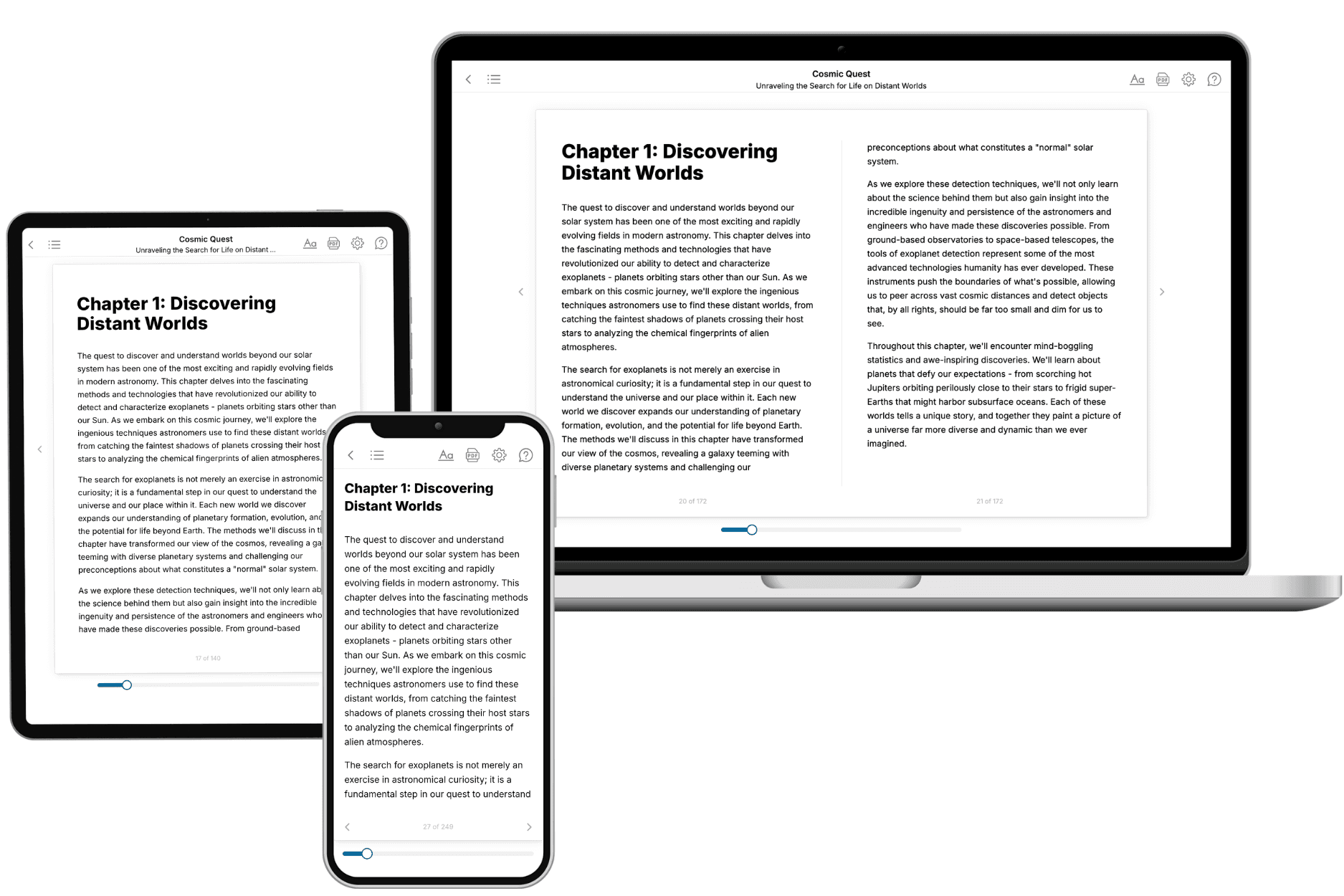
TailoredRead creates complete, full-length nonfiction ebooks, written specifically for you. Tell us what you want to learn and why, and TailoredRead writes you a complete ebook on it, with charts, tables, and diagrams throughout. Read it online, on Kindle, or on any e-reader, or download it as a PDF or EPUB. Every book is written fresh the day you order it.
- How is the book tailored to me?
Before anything is written, you answer a few short questions about your goals, your background, and the topics you care about. Your book is then planned around your answers: written at your level, focused on your goals, and covering the topics you chose, instead of the one-size-fits-all book a store sells everyone.
- Will it read like generic AI content?
No. Your book isn't a chat transcript: it's planned chapter by chapter before a single word is written, told in a clear book voice, and explains ideas visually with charts, tables, and diagrams. After writing, every book goes through an editorial pass that polishes chapters so the book reads consistent from start to finish. Judge for yourself: browse thousands of sample books on our Explore Books page.
- How accurate is the content?
Our AI first checks whether your subject needs live research. Niche and fast-moving subjects are researched before writing, and the book plan and chapters are grounded in what it finds. After writing, every book goes through a quality pass that checks its facts and consistency, and researched books list their sources in a Notes section at the back.
- How long is the book?
You choose the length: Comprehensive (250-300 pages), Detailed (150-200 pages), Essential (70-100 pages), or Short (30-50 pages).
- Does the book include visuals?
Yes. Every book includes visual elements such as timelines, checklists, step-by-step guides, decision trees, comparison tables, and matrices, and many include bar charts. A typical book includes dozens of these visual elements.
- Can I read it on Kindle? What formats can I download?
Yes. Every book can be read in our online reader or downloaded as a PDF or EPUB. The EPUB can be opened with Kindle, Apple Books, Kobo, and any e-reader. The Commercial and Author licenses also include an editable Word (DOCX) and Markdown download.
- How much does it cost?
About the price of a regular ebook. The exact price depends on your book's length and complexity, from $2 for the shortest books to $35 for the most comprehensive, and it's shown when you review your book, before you commit to anything. Each book is a one-time purchase, yours to keep, no subscription. Licenses that let you share, teach, or publish your book range from $35.99 to $49.99.
- Can I preview the book before purchasing?
Before you pay, you'll see what your book will cover: the title, a detailed description, the estimated length, and the complete chapter-by-chapter table of contents, so you know what you're getting before you decide. The full text itself is written after you purchase.
- How long does it take to create a book?
About 10 minutes. You can start reading the opening chapters while the rest is still being written.