The Communist and Socialist Movements
Understanding Ideology, History, and Political Impact
You encounter conflicting narratives about communism and socialism everywhere—in politics, media, and casual conversation—yet struggle to separate ideology from history, theory from practice.
222 pages10 chaptersJun 23, 2026Communism and Socialism
About this book
This book cuts through the polarization to provide a clear, evidence-based examination of these influential political movements. Rather than advocating for or against these ideologies, it explores how they emerged from specific historical conditions, how they've been interpreted and implemented across different nations, and why they continue to shape global politics today. You'll discover the intellectual foundations laid by Marx and Engels, trace the divergent paths taken by communist and socialist movements from Russia to China to Cuba, and understand how these ideologies influenced everything from labor movements to welfare systems. By examining both the theoretical aspirations and real-world outcomes, you'll develop the nuanced understanding necessary to engage thoughtfully with contemporary political debates and recognize the genuine human concerns these movements addressed, even when their solutions proved inadequate or harmful.
Table of contents
- IntroductionWhy Understanding These Ideologies Matters Today, Defining Communism, Socialism, and Radicalism, How This Book Approaches These Complex TopicsRead below
- Chapter 1: The Intellectual FoundationsEarly Socialist Thought Before Marx, Marx and Engels: Building the Framework, Historical Materialism and Class Analysis, The Critique of Capitalism and Surplus Value
- Chapter 2: Communism vs. Socialism: Key DistinctionsTheoretical Differences in Goals and Methods, The Timeline: From Socialism to Communism, How These Distinctions Play Out in Practice
- Chapter 3: The Russian Revolution and Soviet ModelHistorical Conditions Leading to Revolution, Lenin, the Bolsheviks, and Revolutionary Strategy, Building the Soviet System: Structure and Ideology, Stalin's Transformation and the Totalitarian State
- Chapter 4: Communist Movements Beyond the Soviet UnionChinese Communism: Mao and Adaptation to Rural Societies, The Cuban Revolution and Caribbean Communism, Communist Movements in Vietnam, North Korea, and Eastern Europe
- Chapter 5: Socialist Movements and Democratic SocialismDemocratic Socialism and Electoral Politics, European Socialist Parties and Welfare States, Labor Movements and Trade Unionism, Contemporary Socialist Movements and Figures
- Chapter 6: Radicalism, Revolution, and Political ChangeRevolutionary vs. Reformist Strategies, Radical Movements Across Continents and Centuries, Radicalism in Contemporary Politics
- Chapter 7: Economic Systems and ImplementationPlanned Economies: Theory and Practice, Collective vs. Private Property: Models and Outcomes, Economic Performance and Challenges, Market Socialism and Hybrid Models
- Chapter 8: The Human Cost: Successes and FailuresDocumented Achievements in Education, Healthcare, and Literacy, Authoritarian Outcomes and Political Repression, Economic Stagnation and Inefficiency, The Gap Between Theory and Practice
- Chapter 9: Global Influence and Cold War DynamicsThe Cold War: Ideological Conflict and Geopolitics, Proxy Wars and Communist Expansion, Western Responses and Anti-Communist Movements
- Chapter 10: Communism and Socialism in the 21st CenturyAfter the Cold War: Decline and Adaptation, Resurgence of Socialist Ideas in Developed Nations, Contemporary Debates on Inequality and Economic Systems, Relevance in an Age of Automation and Climate Change
- ConclusionSynthesizing History, Theory, and Practice, Developing Critical Thinking About Political Ideologies
- Glossary of Key Terms
- Further Reading and Resources
Introduction
Few political words carry as much weight, confusion, and emotional charge as communism and socialism. Depending on where you grew up, who raised you, and what media you consume, these terms might conjure images of liberation or oppression, of workers finally gaining dignity or of authoritarian regimes crushing dissent. They get thrown around in political debates as insults, as aspirations, and as explanations for everything from healthcare policy to foreign policy. Yet for all the noise surrounding them, genuine understanding of what these ideologies actually are, where they came from, and what they have produced in practice remains surprisingly rare.
This book exists because that gap between noise and understanding matters. When people argue about socialism without knowing what it means, or condemn communism without understanding its historical context, the conversation goes nowhere useful. Political polarization deepens, nuance disappears, and real questions about economic fairness, social organization, and political power get buried under slogans. The goal here is not to tell you what to think about these ideologies. It is to give you the tools to think about them clearly, accurately, and with the kind of historical grounding that makes genuine analysis possible.
What you will find in these pages is a structured, evidence-based journey through the intellectual origins, historical development, and contemporary relevance of communist and socialist movements. The approach is analytical rather than advocacy-driven. Both the genuine achievements and the serious failures of these movements receive honest attention. The theoretical ideals that inspired millions of people deserve to be understood on their own terms, and the real-world outcomes, including the painful ones, deserve equally honest examination. Neither cheerleading nor dismissal serves the goal of understanding. Only careful, grounded analysis does.
The chapters that follow move from intellectual foundations to historical case studies, from economic theory to human consequences, and from Cold War dynamics to 21st-century debates. Along the way, you will encounter the ideas of Karl Marx and Friedrich Engels, the revolutionary strategies of Lenin and Mao, the welfare-state experiments of European social democrats, and the contemporary resurgence of socialist ideas in countries that once seemed firmly committed to free-market capitalism. Each of these threads connects to a larger story about how human societies have struggled, and continue to struggle, with questions of inequality, power, and collective organization.
Why Understanding These Ideologies Matters Today
The relevance of communism and socialism to contemporary life is not a matter of historical nostalgia. These ideologies are actively shaping political conversations right now, in ways that affect elections, economic policy, and social movements across the globe. In the United States, the word "socialist" became a central flashpoint in multiple presidential election cycles during the 2010s and 2020s. In Latin America, left-wing governments have risen and fallen on platforms explicitly drawing from socialist traditions. In Europe, debates about the future of welfare states and public ownership are ongoing and consequential. Understanding the intellectual DNA of these movements helps make sense of all of it.
Consider what happens when these terms are misunderstood or deliberately distorted. During the 2020 U.S. presidential campaign, the label "socialist" was applied to candidates and policies ranging from modest expansions of healthcare coverage to full government ownership of industry, as if these were equivalent positions.[1] That kind of conflation makes it impossible to have a productive conversation about what any given policy actually involves or what its likely effects might be. Precision matters, and precision requires knowledge of what these terms actually mean and where they come from.
Beyond electoral politics, these ideologies have shaped the world's institutional landscape in ways that most people take for granted. The eight-hour workday, the weekend, minimum wage laws, public education systems, and social safety nets all emerged partly from the pressure that socialist and labor movements applied to governments and employers over more than a century. Understanding this history does not require endorsing any particular ideology. It simply requires acknowledging that the world you live in was shaped by these struggles, and that understanding them illuminates how social change actually happens.
There is also a forward-looking reason to engage seriously with these ideas. The 21st century is generating economic pressures that echo the conditions that gave rise to socialist and communist movements in the first place. Automation is displacing workers across industries. Wealth inequality in many countries has reached levels not seen since the early 20th century.[2] Climate change is raising fundamental questions about whether market-driven economies can address collective problems at the necessary scale and speed. These are not abstract concerns. They are the kinds of conditions that historically have driven people toward radical political alternatives, and understanding those alternatives clearly is essential for navigating what comes next.
Finally, understanding these ideologies matters for basic civic literacy. Democratic societies depend on citizens who can evaluate political claims, recognize propaganda, and engage with complex ideas. When communism and socialism are treated as either utopian dreams or pure evil, depending on who is speaking, the capacity for that kind of civic engagement breaks down. A grounded, historically informed understanding of these movements is not a luxury for academics. It is a practical tool for anyone trying to make sense of the political world they inhabit.
The stakes of getting this wrong are real. Misunderstanding these ideologies has led to both the uncritical adoption of systems that produced enormous human suffering and the reflexive rejection of policies that might have addressed genuine social problems. Neither error serves people well. The goal of this book is to help you avoid both mistakes by building a clear, honest, and nuanced picture of what these movements actually are and what they have actually done.
Defining Communism, Socialism, and Radicalism
Before going any further, it is worth establishing what these terms actually mean, because the confusion surrounding them is itself a significant obstacle to understanding. Socialism, in its broadest sense, refers to a family of political and economic theories that advocate for collective or governmental ownership and regulation of the means of production, distribution, and exchange. The core idea is that the economy should serve the common good rather than the private interests of a small ownership class. Beyond that basic principle, socialist thought branches into dozens of distinct traditions with very different ideas about how to achieve that goal.
Communism, in the Marxist tradition, is best understood as a specific endpoint or stage of social development rather than simply a more extreme version of socialism. In Marx's framework, socialism is a transitional phase in which the working class controls the state and manages the economy collectively, while communism is the final stage in which the state itself has withered away, class distinctions have disappeared, and resources are distributed according to the principle from each according to his ability, to each according to his needs.
[3] In practice, the governments that called themselves communist never claimed to have reached this final stage. They described themselves as socialist states in the process of building toward communism.
This distinction matters enormously, and it is one that popular discourse almost entirely ignores. When people refer to the Soviet Union or Cuba as "communist," they are using the term loosely to describe states governed by communist parties that claimed to be working toward communism. The theoretical endpoint that Marx described, a stateless, classless society, was never achieved anywhere. Keeping this distinction in mind prevents a great deal of confusion when comparing theory to historical reality.
Radicalism is a broader term that refers to political positions or movements that seek fundamental, root-level change to existing social, political, or economic systems. The word comes from the Latin radix, meaning root. A radical position is one that does not seek to reform the existing system at the margins but to transform it at its foundations. Both communist and socialist movements have included radical strands, but radicalism is not synonymous with either. There are radical libertarians, radical nationalists, and radical environmentalists, none of whom are socialists or communists. The term describes a relationship to the existing order, not a specific ideological content.
It is also worth distinguishing between democratic socialism and social democracy, two terms that are frequently confused even by people who use them regularly. Democratic socialism refers to a commitment to achieving socialist economic goals through democratic political processes, maintaining collective ownership of key industries while preserving democratic governance. Social democracy, by contrast, accepts the basic framework of a capitalist market economy but advocates for strong government regulation, robust welfare programs, and redistribution of wealth through taxation. The Scandinavian countries are often cited as examples of social democracy, not democratic socialism, a distinction that matters when evaluating what these systems actually involve.
A useful way to think about the relationship between these terms: imagine a spectrum of positions on economic organization. At one end sits pure laissez-faire capitalism with minimal government intervention. Moving along the spectrum, you encounter social democracy, then democratic socialism, then Marxist socialism, and finally the theoretical endpoint of communism. These are not simply points on a line from "moderate" to "extreme." They represent genuinely different theories about human nature, economic organization, and political power.
The following table of key distinctions is worth keeping in mind as you read through the chapters ahead:
- Socialism: Collective ownership of the means of production; can be achieved through democratic or revolutionary means; the state continues to exist and manage economic life.
- Communism (theoretical): Stateless, classless society; resources distributed by need; no private ownership of productive property; achieved after a transitional socialist phase.
- Communist states (historical): Single-party states governed by communist parties; state ownership of industry; claimed to be building toward communism; never reached the theoretical endpoint.
- Democratic socialism: Socialist economic goals pursued through democratic elections and institutions; maintains political pluralism and civil liberties.
- Social democracy: Capitalist market economy with strong welfare state, labor protections, and redistributive taxation; does not seek to abolish private ownership of industry.
- Radicalism: Commitment to fundamental, root-level transformation of existing systems; can apply across the ideological spectrum.
These definitions are starting points, not final answers. Each of these terms has been contested, redefined, and argued over by theorists, activists, and politicians for more than two centuries. Part of what makes this subject genuinely interesting is that the definitions themselves are sites of political struggle. Who gets to define what socialism means, or what counts as "real" communism, is not a neutral academic question. It has real consequences for how movements organize, how governments justify their actions, and how ordinary people understand their political choices.
Throughout this book, terms will be used as precisely as the context allows, and when a term is being used in a specific or contested way, that will be noted explicitly. The goal is clarity, not false precision. These are complex ideas that resist simple definitions, and acknowledging that complexity is part of taking them seriously.
How This Book Approaches These Complex Topics
The approach taken here is grounded in a few core commitments that are worth stating clearly at the outset. The first is analytical neutrality. This book does not advocate for communism, socialism, capitalism, or any other economic or political system. It examines these ideologies as historical and intellectual phenomena, asking how they emerged, what they claimed to offer, how they were implemented, and what they actually produced. That kind of analysis requires taking ideas seriously on their own terms before evaluating them, which means engaging with the genuine appeal of these movements rather than dismissing them, while also examining their failures honestly rather than explaining them away.
The second commitment is to historical context. Political ideologies do not emerge in a vacuum. Communism and socialism arose in specific historical conditions, responding to specific forms of economic exploitation, political exclusion, and social suffering. Understanding why millions of people found these ideas compelling requires understanding the world they were living in. A factory worker in 19th-century Manchester, a peasant in early 20th-century Russia, or a sugar cane worker in mid-20th-century Cuba experienced economic realities that made radical alternatives to the existing order feel not just appealing but necessary. Acknowledging this does not mean endorsing the solutions these movements proposed. It means taking seriously the problems they were responding to.
The third commitment is to distinguishing theory from practice. One of the most persistent sources of confusion in discussions of communism and socialism is the failure to distinguish between what these ideologies claim to be and what they have actually produced when implemented. Marxist theory describes a path to human liberation. The Soviet Union under Stalin produced mass terror and famine. Both of these facts are true, and the relationship between them is complex and contested. This book examines both the theoretical frameworks and the historical outcomes, and it takes seriously the question of why the gap between them was so often so large.
The fourth commitment is to intellectual honesty about evidence. Where historical facts are well-established, they are presented as such. Where they are contested among historians, that contestation is acknowledged. Where statistics are cited, their sources and limitations are noted. This is not a book that cherry-picks evidence to support a predetermined conclusion. It is a book that tries to follow the evidence where it leads, even when that produces uncomfortable or complicated conclusions.
Here is a practical guide to how the book is structured and how to get the most from it:
- Chapters 1 and 2 cover intellectual foundations and key theoretical distinctions. If you are new to these ideas, these chapters provide the conceptual vocabulary you will need for everything that follows.
- Chapters 3 and 4 examine the major historical communist movements, from the Russian Revolution through China, Cuba, Vietnam, and beyond. These chapters focus on how ideology interacted with specific national contexts and leadership decisions.
- Chapter 5 turns to socialist movements that pursued change through democratic rather than revolutionary means, including European welfare states and contemporary figures like Bernie Sanders and Jeremy Corbyn.
- Chapters 6 and 7 examine radicalism as a political strategy and the economic systems that communist and socialist governments actually built, including their performance and their failures.
- Chapter 8 takes an honest look at the human costs and genuine achievements of these systems, refusing to reduce the history to either propaganda or apology.
- Chapters 9 and 10 situate these movements in the Cold War context and examine their contemporary relevance, including the resurgence of socialist ideas in the 21st century.
A word about what this book is not. It is not a comprehensive academic history of every communist or socialist movement that has ever existed. That would require multiple volumes and a different kind of scholarly apparatus. It is also not a political manifesto, either for or against these ideologies. What it is, is a clear, honest, and accessible guide to understanding movements that have shaped the modern world and continue to shape contemporary politics. The aim is to leave you better equipped to think about these ideas, not to tell you what conclusions to reach.
One practical note on sources and evidence: throughout the book, specific claims are supported with references to historians, economists, and political scientists who have studied these movements in depth. Where scholars disagree, those disagreements are noted rather than papered over. The goal is to model the kind of careful, evidence-based thinking that these complex topics require. Political ideologies are not sports teams to be cheered or booed. They are serious attempts to answer serious questions about how human societies should be organized, and they deserve to be engaged with seriously.
The questions these movements grappled with, about inequality, exploitation, collective action, and the proper role of the state, are not historical relics. They are live questions that every generation has to answer for itself. Understanding how previous generations answered them, what worked, what failed, and why, is one of the most valuable things history can offer. That is what this book is for.
With that foundation in place, it is time to begin at the beginning: the intellectual world that gave rise to socialist and communist thought, and the specific historical conditions that made these ideas feel not just interesting but urgent to the people who first embraced them.
Notes
Introduction
This is the end of the free sample. The full book has 10 chapters.
Want this book written for you?
Tell us your goals and background, and get your own version of this book, tailored by AI to you.


Benefits of AI-tailored books
- Read one book, not ten:
- all the Communism and Socialism knowledge you need, gathered into a single book.
- Save days of learning:
- tell us your goals, choose your topics, and the whole book is built around them.
- Learn effortlessly:
- Communism and Socialism book written for your specific background and expertise.
- Understand at a glance:
- includes charts, tables, timelines, checklists, decision trees, and more.
- Stay current:
- written the day you order it, not years ago.
- Trust what you read:
- every book is checked for accuracy, with real research when your subject needs it.
Create your unique book in 3 steps
- 1. Select your focus
Select the focus of your Communism and Socialism book and share your background
- 2. Personalize your book
Specify your goals and choose sub-topics to include
- 3. Get your tailored book
Your book is ready in 10 minutes. Read it online, download as EPUB or PDF, or send to Kindle.


Frequently asked questions
- What is TailoredRead?
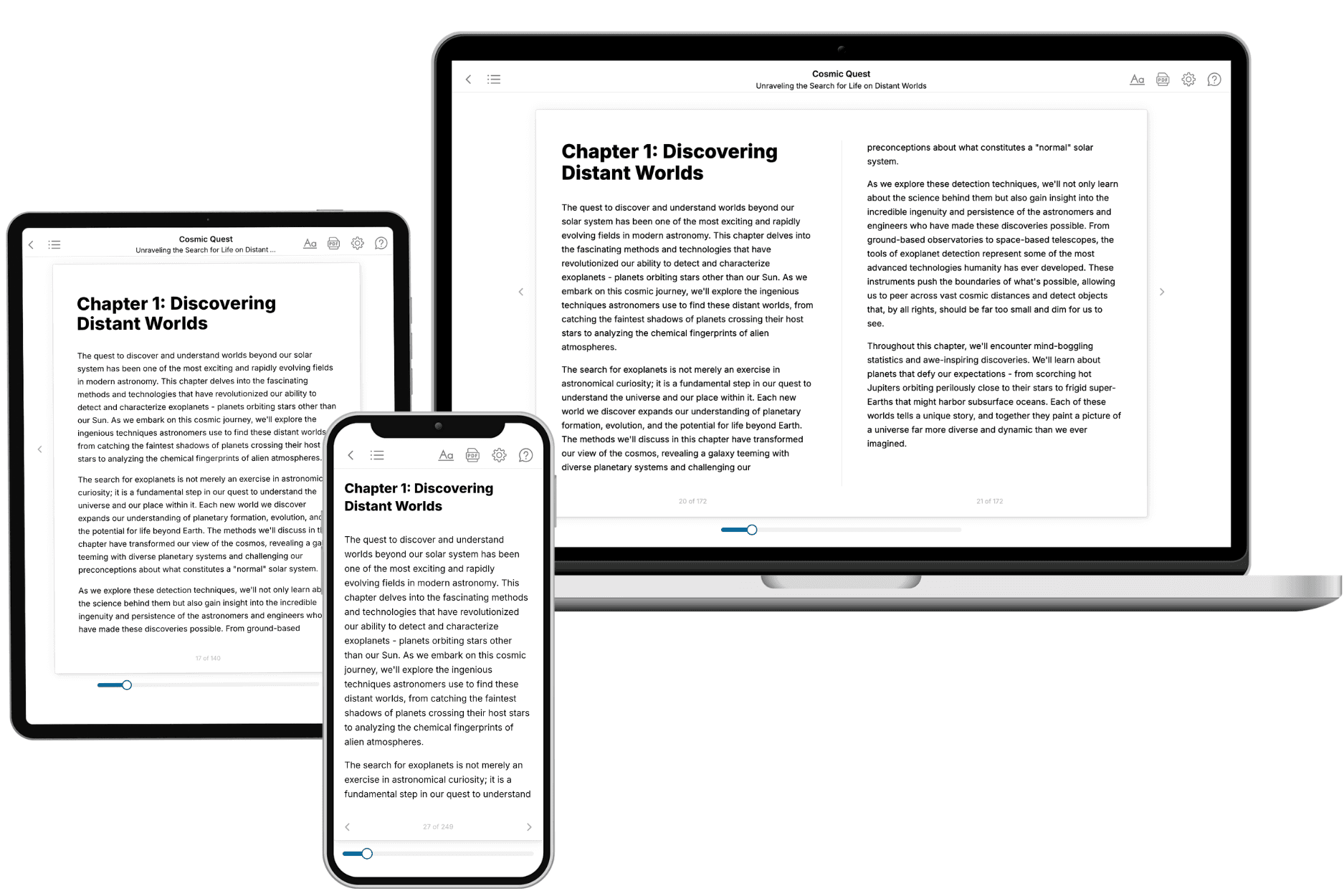
TailoredRead creates complete, full-length nonfiction ebooks, written specifically for you. Tell us what you want to learn and why, and TailoredRead writes you a complete ebook on it, with charts, tables, and diagrams throughout. Read it online, on Kindle, or on any e-reader, or download it as a PDF or EPUB. Every book is written fresh the day you order it.
- How is the book tailored to me?
Before anything is written, you answer a few short questions about your goals, your background, and the topics you care about. Your book is then planned around your answers: written at your level, focused on your goals, and covering the topics you chose, instead of the one-size-fits-all book a store sells everyone.
- Will it read like generic AI content?
No. Your book isn't a chat transcript: it's planned chapter by chapter before a single word is written, told in a clear book voice, and explains ideas visually with charts, tables, and diagrams. After writing, every book goes through an editorial pass that polishes chapters so the book reads consistent from start to finish. Judge for yourself: browse thousands of sample books on our Explore Books page.
- How accurate is the content?
Our AI first checks whether your subject needs live research. Niche and fast-moving subjects are researched before writing, and the book plan and chapters are grounded in what it finds. After writing, every book goes through a quality pass that checks its facts and consistency, and researched books list their sources in a Notes section at the back.
- How long is the book?
You choose the length: Comprehensive (250-300 pages), Detailed (150-200 pages), Essential (70-100 pages), or Short (30-50 pages).
- Does the book include visuals?
Yes. Every book includes charts, tables, and diagrams: timelines, checklists, step-by-step guides, decision trees, comparison tables, matrices, and bar charts. A typical book includes dozens of these visual elements.
- Can I read it on Kindle? What formats can I download?
Yes. Every book can be read in our online reader or downloaded as a PDF or EPUB. The EPUB can be opened with Kindle, Apple Books, Kobo, and any e-reader. The Commercial and Author licenses also include an editable Word (DOCX) and Markdown download.
- How much does it cost?
About the price of a regular ebook. The exact price depends on your book's length and complexity, from $2 for the shortest books to $35 for the most comprehensive, and it's shown when you review your book, before you commit to anything. Each book is a one-time purchase, yours to keep, no subscription. Licenses that let you share, teach, or publish your book range from $35.99 to $49.99.
- Can I preview the book before purchasing?
Before you pay, you'll see what your book will cover: the title, a detailed description, the estimated length, and the complete chapter-by-chapter table of contents, so you know what you're getting before you decide. The full text itself is written after you purchase.
- How long does it take to create a book?
About 10 minutes. You can start reading the opening chapters while the rest is still being written.