The Complete Aquarium Cycling Guide
Master the Nitrogen Cycle and Create a Thriving Home for Your Fish
Imagine opening your aquarium cabinet to find crystal-clear water, thriving fish with vibrant colors, and a tank that practically maintains itself.
207 pages9 chaptersAug 19, 2026Fish Aquarium
About this book
This is the reality when your aquarium is properly cycled. Too many aquarists struggle with cloudy water, sick fish, and constant water changes because they skip or misunderstand the cycling process. This guide cuts through the confusion and gives you a clear, step-by-step roadmap to establish a stable nitrogen cycle in your tank. You'll learn exactly how beneficial bacteria work, which cycling method fits your situation, how to interpret water test results, and how to troubleshoot problems before they become disasters. Whether you're setting up your first tank or optimizing an existing one, this book provides the practical knowledge and confidence you need to create a self-sustaining aquatic ecosystem where your fish don't just survive—they flourish.
Table of contents
- IntroductionWhy Aquarium Cycling Matters, What You'll Learn in This Guide, How to Use This BookRead below
- Chapter 1: Understanding the Nitrogen CycleWhat Is the Nitrogen Cycle?, Where Ammonia Comes From, The Role of Beneficial Bacteria, How the Cycle Completes
- Chapter 2: Water Chemistry and Key ParametersAmmonia: The Starting Point, Nitrite: The Toxic Middle Stage, Nitrate: The End Product, pH and Alkalinity Effects
- Chapter 3: Testing Equipment and InterpretationTypes of Test Kits Available, How to Read and Interpret Results, Establishing a Testing Schedule
- Chapter 4: Cycling Methods and ApproachesFishless Cycling: The Humane Approach, Fish-In Cycling: Managing the Challenges, Seeding: Accelerating the Process, Comparing Methods: Which Is Right for You?
- Chapter 5: The Complete Fishless Cycling ProcessPreparation and Tank Setup, Dosing Ammonia Correctly, Monitoring Bacterial Progression, Recognizing Cycle Completion
- Chapter 6: Fish-In Cycling: Minimizing HarmStrategic Stocking Decisions, Water Change Protocols, Monitoring Fish Health During Cycling
- Chapter 7: Cycling Different Tank TypesFreshwater Aquariums, Saltwater and Reef Tanks, Planted Tank Considerations, Specialized Systems and Setups
- Chapter 8: Troubleshooting Cycling ProblemsWhen the Cycle Stalls, Unexpected Ammonia Spikes, Bacterial Die-Off and Recovery, Persistent Problems and Solutions
- Chapter 9: Maintaining Cycle Stability Long-TermRoutine Maintenance Practices, Managing Bioload Over Time, Filter Maintenance and Bacterial Preservation, Adapting to Seasonal Changes
- ConclusionYour Path Forward, Final Thoughts on Aquarium Success
- Glossary of Terms
- Further Reading and Resources
Introduction
A ten-gallon tank filled with tap water, a handful of gravel, and three goldfish looks harmless enough on day one. By day four, the water turns cloudy, the fish gasp at the surface, and by day seven one of them is floating. This scene repeats itself in millions of homes every year, not because the fish were weak or the equipment was faulty, but because an invisible biological process had no time to establish itself before the tank was asked to support life. That process is aquarium cycling, and understanding it separates hobbyists who lose fish repeatedly from those who build tanks that run for a decade with barely a hiccup.
This book exists because so much of the information available to new and intermediate aquarists is fragmented, contradictory, or written for people who already know the vocabulary. Forum threads argue about which method is best
without acknowledging that best depends entirely on the situation. Product packaging promises instant results that biology simply cannot deliver. The goal here is to replace that noise with a single, coherent explanation of how cycling works, why it works that way, and how to apply that knowledge to the specific tank sitting in front of you right now.
The reader this book has in mind already has some experience with aquariums. Maybe a tank has been running for months or years, or maybe an earlier attempt ended badly and left some scars. Either way, the assumption here is not that cycling is a completely foreign concept, but that the mechanics behind it, the decision points, and the troubleshooting skills need sharpening. Basic terms will be defined, but the pace assumes someone who already knows a fish tank needs a filter and a heater, and who is ready to go deeper.
Cycling is not a single event with a start and finish line marked in bold. It is an ongoing biological relationship between waste-producing animals and waste-processing bacteria, one that needs to be established, monitored, and protected for as long as the tank exists. Treating it as a one-time chore to complete before adding fish, rather than a system to maintain permanently, is one of the most common reasons tanks that cycled successfully still run into trouble months later. This introduction sets up the reasoning behind everything that follows, so the later chapters on chemistry, testing, and methods make sense as parts of one connected story rather than isolated tips.
Why Aquarium Cycling Matters
Fish produce ammonia constantly, through their gills as a direct byproduct of protein metabolism and through waste that breaks down in the water. In an open lake or river, ammonia disperses into a vast volume of water and gets diluted to negligible levels almost immediately. In a sealed glass box holding twenty or fifty gallons, there is nowhere for it to go. Without something actively converting that ammonia into less toxic compounds, its concentration climbs hour by hour until it reaches levels that damage gill tissue and shut down a fish's ability to absorb oxygen from the water.
The damage from ammonia exposure is not always immediate or dramatic, which is part of why so many new hobbyists miss the connection. Fish exposed to elevated ammonia often show clamped fins, lethargy, and loss of appetite before anything more visible happens. By the time visible red streaking appears on the fins or gills, or fish start gasping at the surface, the exposure has usually been building for days. This delayed and gradual presentation is exactly why relying on how the fish look
is a poor substitute for testing the water directly, a point this book returns to repeatedly.
An uncycled tank does not just risk one bad week. It sets up a pattern that many hobbyists know as new tank syndrome,
where fish sicken, some die, replacements get added, and the ammonia spike resets and repeats. Each cycle of loss is often blamed on bad luck, a faulty heater, or low-quality fish, when the real cause is a tank that was never given the chance to build a stable population of bacteria capable of processing the waste being produced. Recognizing this pattern for what it is, a chemistry problem rather than a fish quality problem, is the single biggest shift in thinking this book aims to produce.
Consider two aquarists setting up an identical twenty-gallon tank on the same day. The first fills the tank, waits twenty-four hours for the chlorine to clear, and adds six tetras immediately. The second spends four to six weeks running the same tank fishless, feeding it ammonia and tracking the water chemistry until it can process a full dose within hours. The first aquarist will likely lose two or three fish in the following month and spend that time doing emergency water changes. The second adds fish to a tank already capable of supporting them and spends that same month simply enjoying the tank.
Money is also part of this equation, something often overlooked in discussions that focus purely on fish welfare. Replacing dead fish, treating illnesses caused by poor water quality, and running excessive water changes all cost more over time than the modest investment in test kits and patience that proper cycling requires. A liquid test kit costs somewhere in the range of twenty to thirty dollars and lasts for hundreds of tests across the life of a tank, a fraction of the cost of repeatedly restocking a tank that keeps losing fish to preventable chemistry problems.
Beyond the practical and financial arguments, there is a welfare dimension that deserves direct acknowledgment. Fish are living animals capable of experiencing stress and suffering, and exposing them to toxic ammonia and nitrite as a matter of course, simply because cycling takes effort, is a choice that has consequences for another creature's wellbeing. This does not mean fish-in cycling is never appropriate, later chapters cover how to do it responsibly when it is the only option, but it does mean cycling should be understood as an animal welfare issue as much as a technical one.
The broader ecological logic at play here mirrors what happens in natural water systems on a much larger scale, something explored fully in the chapter on the nitrogen cycle itself. What matters at this stage is recognizing that the tank is not a static container of water and decorations. It is meant to become a small, functioning ecosystem, and every decision about stocking, feeding, and maintenance either supports that ecosystem or undermines it. Cycling is the process of building that ecosystem from nothing into something stable enough to support life.
One further reason cycling matters is that it changes the entire relationship a hobbyist has with the tank going forward. A properly cycled and maintained aquarium requires far less crisis intervention. Water changes happen on a predictable schedule rather than as emergency responses to sick fish. Testing becomes a quick weekly check rather than a stressed reaction to visible symptoms. The tank becomes a source of enjoyment rather than a source of anxiety, and that shift alone justifies the weeks of patience the process demands upfront.
What You'll Learn in This Guide
This guide moves through the subject in a deliberate order, building from foundational science toward increasingly specific and practical applications. The early chapters establish exactly what happens biologically and chemically inside a cycling tank, covering the nitrogen cycle itself and the specific parameters, ammonia, nitrite, nitrate, pH, and alkalinity, that describe a tank's chemical state at any given moment. Without this foundation, later advice about dosing schedules or troubleshooting symptoms would be difficult to apply with real understanding rather than blind rule-following.
From there, attention turns to the tools used to measure what is actually happening in the water. A dedicated chapter walks through the differences between liquid test kits and test strips, how to read color-based results accurately, and how to build a testing schedule that catches problems early without becoming an obsessive daily chore. This section matters because even a perfectly executed cycling method is useless if the hobbyist cannot accurately read what the water is telling them at each stage.
The middle of the book covers the major approaches to cycling in detail: fishless cycling, fish-in cycling, and seeding methods that use established bacteria from another source to speed things along. Rather than declaring one method universally superior, the comparison chapter lays out the tradeoffs of each, timeline, cost, risk to fish, and required effort, so the choice can be matched to individual circumstances rather than dogma. Full step-by-step chapters then follow for both fishless cycling and the harm-reduction techniques needed when fish-in cycling is unavoidable.
Because no two tanks are identical, a dedicated chapter addresses how cycling differs across freshwater tanks, saltwater and reef systems, planted tanks, and specialized setups. Saltwater cycling, for instance, often relies on live rock as a bacterial source and behaves differently from a standard freshwater tank running on filter media alone. Planted tanks introduce another variable, since live plants absorb some ammonia and nitrate directly, which changes what normal
readings look like during the process.
Troubleshooting gets its own extended treatment, because even carefully planned cycles run into trouble. A stalled cycle where ammonia and nitrite refuse to drop, an unexpected spike weeks after things seemed stable, or a sudden bacterial die-off following a power outage or medication treatment, all have identifiable causes and specific fixes. Rather than leaving the reader to guess, this section works through each failure mode with the reasoning needed to diagnose it correctly and the concrete steps needed to recover.
The final substantive chapter shifts focus from establishing a cycle to preserving one indefinitely. A tank that cycled successfully six months ago can still crash if bioload increases faster than the bacterial colony, if filter media gets rinsed in tap water and kills off bacteria, or if seasonal temperature swings shift bacterial activity. This section covers the ongoing habits, routine maintenance, bioload management, and filter care, that keep a mature cycle intact for years rather than months.
Throughout every chapter, the emphasis stays on practical application rather than abstract theory for its own sake. Concepts get explained with enough depth to make sense, but always with an eye toward the decision a hobbyist actually needs to make: what to test, when to test it, how much ammonia to dose, when it is safe to add fish, and what to do when a reading looks wrong. By the final page, the goal is a reader who no longer needs to search forums for reassurance, because the underlying logic of cycling has become second nature.
It is also worth setting expectations honestly from the start. Cycling a tank properly, especially using the fishless method most experts recommend, typically takes somewhere between four and eight weeks depending on temperature, ammonia source, and whether seeding material is available. There is no reliable shortcut that compresses this into a few days without risking an unstable or incomplete bacterial colony. This book will not promise a faster timeline than biology allows, but it will make sure every week of that timeline is spent productively rather than wasted on guesswork.
How to Use This Book
This book is structured to work both as a straight read-through and as a reference to return to during an active cycling project. For someone starting a brand new tank, reading the early chapters in order before beginning the process makes the most sense, since the chapters on the nitrogen cycle and water chemistry provide the vocabulary and reasoning that the later how-to chapters depend on. Skipping ahead to a step-by-step guide without that foundation often leads to following instructions mechanically without understanding why a reading matters or what to do when something deviates from the expected pattern.
For someone already mid-cycle, perhaps a few weeks into a fishless cycle or dealing with fish showing early signs of stress, jumping directly to the relevant troubleshooting or method chapter is a reasonable approach. The chapter on diagnosing stalled cycles, ammonia spikes, and bacterial die-off is written to stand on its own for exactly this kind of urgent, in-the-moment reference. Keeping the book, or notes from it, near the tank during the first month of any new setup makes it easier to cross-check a confusing test result against the explanations here rather than searching scattered online sources of uneven quality.
A few specific habits will make the material easier to apply in practice. Keeping a simple log of test results, dates, and any actions taken (a dose of ammonia, a water change, a new fish added) turns abstract chemistry into a visible pattern over time. A basic notebook or spreadsheet works fine for this purpose.
- Record the date and time of each test
- Note the ammonia, nitrite, and nitrate readings
- Log any water changes, feedings, or additions made that day
- Mark temperature, since bacterial activity slows in cooler water
This kind of log makes patterns visible that would otherwise be easy to miss, such as a nitrite reading that has been stuck at the same level for a week, signaling a stalled cycle worth investigating rather than simply waiting out.
Terminology gets used consistently throughout the book to avoid the confusion that comes from different sources using different words for the same idea. Terms like beneficial bacteria, seeding, and cycle completion always mean the same specific thing wherever they appear, and the glossary at the back provides a quick reference if a term needs revisiting mid-chapter. Building familiarity with this shared vocabulary early makes the more technical chapters, particularly the ones on water chemistry parameters, considerably easier to follow.
Some readers will be setting up a single freshwater community tank, while others may be managing a reef system or a heavily planted aquascape. Rather than writing three separate books, this guide covers the shared biological foundation once and then addresses tank-specific differences in a dedicated chapter, allowing anyone to skip directly to the section relevant to their setup after absorbing the core material. Cross-referencing between chapters is used deliberately so that a concept explained once, such as un-ionized ammonia's dependence on pH, does not need to be re-explained every time it becomes relevant again.
It helps to think of this book less as a novel to finish once and more as a working manual to consult repeatedly across the life of an aquarium. The chapter on long-term maintenance, in particular, is meant to be revisited months or years after the initial cycle, when questions shift from how do I start this cycle
to how do I keep this cycle from breaking down as my tank changes.
Aquariums evolve: fish grow, new species get added, plants fill in, and seasons change water temperature. Coming back to relevant sections as the tank itself changes will get more value out of this book than treating it as a one-time read.
Finally, patience deserves one more direct mention before moving into the technical chapters ahead. Nothing in this book will make bacterial colonies grow faster than their biology allows, and no product on a store shelf changes that fundamental reality regardless of what its label claims. What this book offers instead is the clearest possible map of that process, so that the weeks spent waiting are weeks spent understanding exactly what is happening in the water, rather than weeks spent anxious and guessing.
This is the end of the free sample. The full book has 9 chapters.
Want this book written for you?
Tell us your goals and background, and get your own version of this book, tailored by AI to you.


Benefits of AI-tailored books
- Read one book, not ten:
- all the Fish Aquarium knowledge you need, gathered into a single book.
- Save days of learning:
- tell us your goals, choose your topics, and the whole book is built around them.
- Learn effortlessly:
- Fish Aquarium book written for your specific background and expertise.
- Understand at a glance:
- includes charts, tables, timelines, checklists, decision trees, and more.
- Stay current:
- written the day you order it, not years ago.
- Trust what you read:
- every book is checked for accuracy, with real research when your subject needs it.
Create your unique book in 3 steps
- 1. Select your focus
Select the focus of your Fish Aquarium book and share your background
- 2. Personalize your book
Specify your goals and choose sub-topics to include
- 3. Get your tailored book
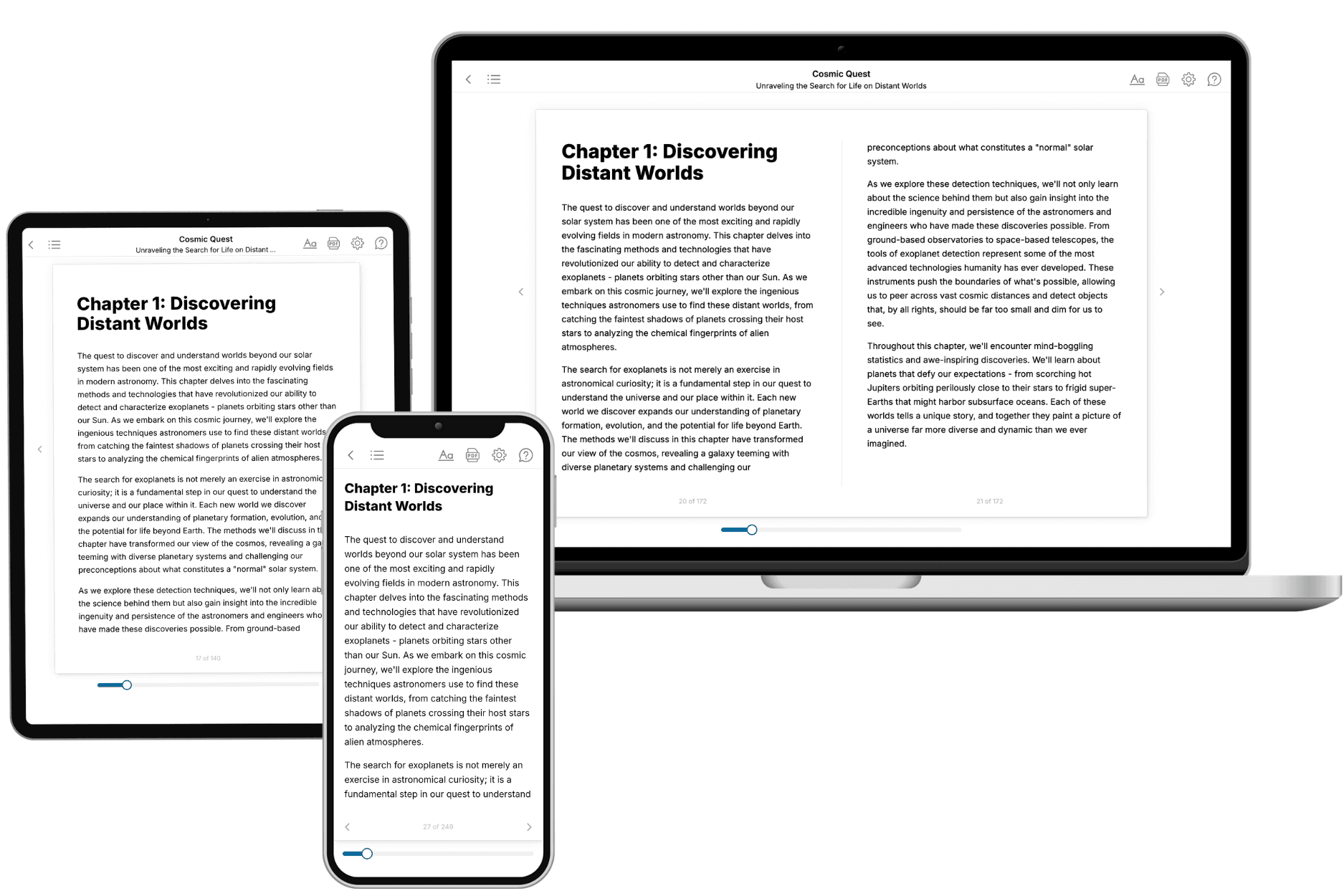
Your book is ready in 10 minutes. Read it online, download as EPUB or PDF, or send to Kindle.
Frequently asked questions
- What is TailoredRead?
TailoredRead creates complete, full-length nonfiction ebooks, written specifically for you. Tell us what you want to learn and why, and TailoredRead writes you a complete ebook on it, with charts, tables, and diagrams throughout. Read it online, on Kindle, or on any e-reader, or download it as a PDF or EPUB. Every book is written fresh the day you order it.
- How is the book tailored to me?
Before anything is written, you answer a few short questions about your goals, your background, and the topics you care about. Your book is then planned around your answers: written at your level, focused on your goals, and covering the topics you chose, instead of the one-size-fits-all book a store sells everyone.
- Will it read like generic AI content?
No. Your book isn't a chat transcript: it's planned chapter by chapter before a single word is written, told in a clear book voice, and explains ideas visually with charts, tables, and diagrams. After writing, every book goes through an editorial pass that polishes chapters so the book reads consistent from start to finish. Judge for yourself: browse thousands of sample books on our Explore Books page.
- How accurate is the content?
Our AI first checks whether your subject needs live research. Niche and fast-moving subjects are researched before writing, and the book plan and chapters are grounded in what it finds. After writing, every book goes through a quality pass that checks its facts and consistency, and researched books list their sources in a Notes section at the back.
- How long is the book?
You choose the length: Comprehensive (250-300 pages), Detailed (150-200 pages), Essential (70-100 pages), or Short (30-50 pages).
- Does the book include visuals?
Yes. Every book includes charts, tables, and diagrams: timelines, checklists, step-by-step guides, decision trees, comparison tables, matrices, and bar charts. A typical book includes dozens of these visual elements.
- Can I read it on Kindle? What formats can I download?
Yes. Every book can be read in our online reader or downloaded as a PDF or EPUB. The EPUB can be opened with Kindle, Apple Books, Kobo, and any e-reader. The Commercial and Author licenses also include an editable Word (DOCX) and Markdown download.
- How much does it cost?
About the price of a regular ebook. The exact price depends on your book's length and complexity, from $2 for the shortest books to $35 for the most comprehensive, and it's shown when you review your book, before you commit to anything. Each book is a one-time purchase, yours to keep, no subscription. Licenses that let you share, teach, or publish your book range from $35.99 to $49.99.
- Can I preview the book before purchasing?
Before you pay, you'll see what your book will cover: the title, a detailed description, the estimated length, and the complete chapter-by-chapter table of contents, so you know what you're getting before you decide. The full text itself is written after you purchase.
- How long does it take to create a book?
About 10 minutes. You can start reading the opening chapters while the rest is still being written.